

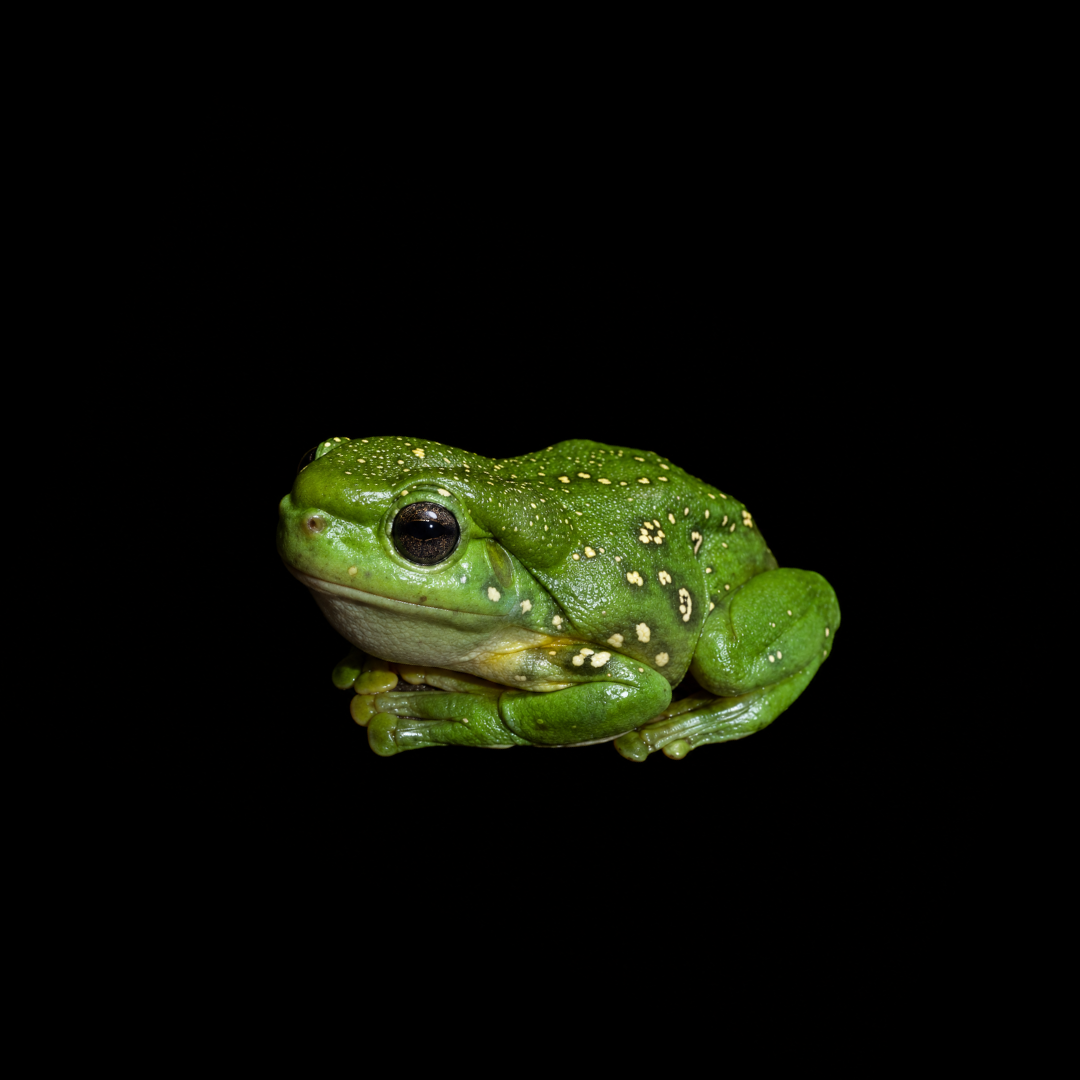
解説Description
マグニフィセントツリーフロッグは、オーストラリア北西部のキンバリー地域を中心に暮らす大型のカエルです。鮮やかな緑色からオリーブ色の体に白色や黄色の斑点が散り、成熟個体では頭部背面に大きなパラトイド腺(耳腺)が発達します。典型的な「木の上のアマガエル」という印象とは少し異なり、野生では砂岩の崖、洞窟、岩の割れ目、岩だまり周辺などを利用します。昼は湿り気のある隙間などで休み、夜になると発達した指先の吸盤を使って岩壁や樹木を登り、昆虫などを探して活動します。 The Magnificent Tree Frog is a large Australian frog native mainly to the Kimberley region of north-western Australia. Its green to olive body is scattered with white or yellow spots, and mature individuals develop conspicuous parotoid glands across the dorsal surface of the head. Despite the “tree frog” name, it is strongly associated with sandstone cliffs, caves, crevices, rock pools, and other rocky shelters. It rests in humid retreats by day and becomes active at night, climbing rock faces and vegetation with enlarged adhesive toe pads while hunting invertebrate prey.
このカエルの魅力は外見だけではありません。皮膚分泌物にはさまざまな生理活性ペプチドが含まれ、その一部は抗菌・抗ウイルス作用の研究対象になってきました。また、雄の皮膚分泌物から見つかった「スプレンディフェリン」は、水中で雌を誘引するペプチド性フェロモンとして知られ、カエル類の化学コミュニケーションを示す重要な研究例です。大型で見た目にも生態にも独自性がある一方、飼育では広い空間、清潔な水、十分な換気、安定した温度管理が欠かせません。 Its appeal extends far beyond appearance. The skin secretion contains a range of bioactive peptides, several of which have been investigated for antimicrobial and antiviral activity. Splendipherin, identified from male skin secretions, is a peptide pheromone that attracts females in water and has become an important example in research on chemical communication in frogs. The species is large and distinctive in both form and ecology, but successful captive care depends on generous space, clean water, strong ventilation, and stable temperature management.
基本情報Basic Information
| 学名Scientific Name | Pelodryas splendida (Tyler, Davies & Martin, 1977) / Litoria splendida(従来名・流通上も広く使用) |
|---|---|
| 通称Common Name | マグニフィセントツリーフロッグ、スプレンディッドツリーフロッグ。日本の流通では英名をカタカナ表記した「マグニフィセントツリーフロッグ」が一般的です。Magnificent Tree Frog, Splendid Treefrog. |
| 分類Classification | 両生綱・無尾目・ペロドリアス科(Pelodryadidae)・ペロドリアス属(Pelodryas)。近年の分子系統学的再検討により属名の扱いが変化しており、旧来の体系や未更新の資料ではアマガエル科や Litoria 属、Ranoidea 属として掲載されることがあります。Class Amphibia, Order Anura, Family Pelodryadidae, Genus Pelodryas. Recent molecular revisions have changed generic boundaries, so older or not-yet-updated references may still place the species in Hylidae, Litoria, or Ranoidea. |
| 英名English Name | Magnificent Tree Frog / Splendid Treefrog |
| 分布Distribution | オーストラリア固有。西オーストラリア州北部のキンバリー地域を中心に、隣接するノーザンテリトリー北西部まで分布します。砂岩地帯の峡谷、洞窟、岩の割れ目、水場周辺でよく見られ、人家周辺のシャワー室や貯水設備などを利用することもあります。Endemic to Australia. It occurs mainly in the Kimberley region of northern Western Australia and extends into adjacent north-western Northern Territory. It is associated with sandstone gorges, caves, rock crevices, and water sources, and may also use human structures such as shower blocks and water installations. |
| 成体サイズAdult Size | 頭胴長でおよそ10~11cm。資料によっては約12cmに達する個体も報告されています。雌は雄よりやや大型になる傾向があり、体高と頭部の耳腺が発達するため、数値以上に重厚な印象を与えます。Approximately 10–11 cm in snout–vent length, with some sources reporting individuals around 12 cm. Females tend to be slightly larger than males, and the robust body together with the enlarged head glands makes adults appear especially substantial. |
| 寿命Lifespan | 寿命に関する種特異的な公表データは限られています。動物園などの一般公開資料では8年程度を示す例がありますが、飼育下での上限を一律に示せるだけの情報は十分ではありません。大型のカエルとして、導入時から長期飼育を前提に環境を整えることが大切です。Species-specific longevity data are limited. Some publicly available zoo sources give a lifespan of around eight years, but there is not enough consistent evidence to state a universal maximum for captive animals. As a large frog, it should nevertheless be acquired with long-term husbandry in mind. |
飼育環境Enclosure Environment
| 飼育容器・サイズEnclosure and Size | 成体1匹なら、幅60cm×奥行45cm×高さ60cm程度を実用的な目安とし、可能であればさらに広いテラリウムを用意します。大型で夜間によく移動するため、高さだけでなく横方向にも余裕がある容器が適しています。複数飼育では個体数に応じて床面積と隠れ家を増やし、餌場が偏らないようにします。蓋は頑丈なメッシュなどで確実に固定し、換気と脱走防止を両立させます。For one adult, an enclosure around 60 × 45 × 60 cm is a practical starting point, with larger terraria preferred whenever possible. Because this is a heavy-bodied frog that moves actively at night, both vertical and horizontal space are useful. Group housing requires proportionally more floor area, perches, and retreats, with feeding areas arranged to reduce competition. Use a secure, well-ventilated mesh lid to prevent escapes. |
|---|---|
| 温度Temperature | 日中は24~28℃前後、夜間は20~24℃程度を基本にし、長時間30℃を超える高温が続かないようにします。ケージ内には多少の温度勾配を作り、カエル自身が場所を選べるようにするのが理想です。日本の冬は室温低下に注意し、必要に応じてサーモスタット管理の保温器具を使用します。熱源には直接触れられない構造とし、局所的な過熱や低温やけどを防ぎます。Maintain daytime temperatures around 24–28°C and night temperatures around 20–24°C, avoiding prolonged exposure above 30°C. A gentle thermal gradient is preferable so the frog can choose its own microclimate. In winter, thermostatically controlled heating may be required, but all heat sources must be guarded to prevent direct contact, overheating, or burns. |
| 環境管理Environmental Management | 湿度はおおむね60~80%を目安としつつ、常に蒸れた状態にせず、霧吹き後に表面が適度に乾く時間を作ります。日本の梅雨や夏は高湿度と高温が重なりやすいため、十分な換気が特に重要です。全身が無理なく入れる浅めの水容器を置き、カルキを除いた清潔な水へこまめに交換します。糞や食べ残しは早めに除去し、床材の悪臭、ぬめり、カビが見られたら部分交換またはリセットを行います。Aim for roughly 60–80% relative humidity while avoiding permanently stagnant, saturated conditions. After misting, allow surfaces to dry somewhat between humid periods. Ventilation is especially important during Japan’s hot and humid rainy season and summer. Provide a shallow soaking dish large enough for the frog to enter comfortably, using clean dechlorinated water and changing it frequently. Remove feces and leftover food promptly, and replace substrate if odor, slime, or mold develops. |
| レイアウトLayout | 野生の岩場環境を意識し、太いコルクバーク、安定した流木、幅のある止まり木、洞窟状の隠れ家などを立体的に配置します。岩を使う場合は大型個体が乗っても崩れないよう完全に固定し、鋭い縁や擦れやすい素材は避けます。床材にはヤシガラ土、両生類向けソイル、落ち葉など保湿性と排水性を両立できる素材が使えます。丈夫な観葉植物を加えると視線を遮る休息場所が増えますが、夜間の移動経路を塞ぎすぎないようにします。Reflect its rocky natural habitat with thick cork bark, stable driftwood, broad perches, and cave-like retreats arranged in three dimensions. Any real stone must be securely fixed so that a heavy adult cannot shift or collapse it, and sharp or abrasive surfaces should be avoided. Coconut fiber, amphibian-safe soil mixes, and leaf litter can provide moisture retention with drainage. Robust live plants can add cover, but should not obstruct the frog’s nocturnal movement routes. |
| 注意点Precautions | 本種には皮膚分泌物があるため、必要以上のハンドリングは避け、眼・鼻・口などの粘膜へ触れないようにします。移動が必要な場合は、清潔な水で湿らせたパウダーフリー手袋を使うと、カエルの皮膚と飼育者の双方を守りやすくなります。触れた後は手を洗い、顔や眼をこすらないようにします。また、芳香剤、殺虫剤、消毒剤の残留、ハンドクリームなどは両生類の皮膚から吸収されるおそれがあるため、飼育空間の近くでは慎重に扱います。新規個体は既存個体とすぐに同居させず、隔離観察を行うのが安全です。Because this species produces skin secretions, unnecessary handling should be avoided and contact with the eyes, nose, and mouth should be prevented. When handling is required, clean powder-free gloves moistened with safe water help protect both the frog’s skin and the keeper. Wash hands afterward and avoid touching the face or eyes. Air fresheners, pesticides, disinfectant residues, hand creams, and similar chemicals can be absorbed through amphibian skin and should be kept away from the enclosure. Newly acquired frogs are safest when quarantined before joining established animals. |
餌と給餌Feeding
| 餌の種類Diet | 主食はコオロギ類、デュビアなどのローチ類、シルクワーム、ブラックソルジャーフライ幼虫、適切な大きさのミミズなど、多様な無脊椎動物を組み合わせます。単一の餌だけに偏らせず、給餌前に餌昆虫へ十分な栄養を与えるガットローディングも有効です。農薬や寄生虫のリスクが読めない野外採集昆虫は常食にしないほうが安全です。Use a varied invertebrate diet such as crickets, roaches including dubia, silkworms, black soldier fly larvae, and appropriately sized earthworms. Avoid relying on a single feeder species, and gut-load feeder insects before use. Wild-caught insects are best avoided as routine food because pesticide exposure and parasite risks are difficult to assess. |
|---|---|
| 給餌のポイントFeeding Tips | 成体は週2~3回程度を目安に、体型と活動量を見ながら1回量を調整します。幼体は代謝が高いため、より少量を高頻度で与えます。大型で食欲旺盛なため肥満させやすく、腹部が常に大きく張るほどの給餌は避けます。カルシウムと総合ビタミンは、餌の種類やガットローディングの内容、製品の指示に合わせて過不足なくダスティングします。餌昆虫を放置するとカエルをかじることがあるため、食べ残しは回収します。Adults are commonly fed about two to three times per week, with portion size adjusted to body condition and activity. Juveniles have higher metabolic demands and are usually offered smaller meals more frequently. This is an enthusiastic feeder and can become obese, so avoid keeping the abdomen constantly distended. Calcium and multivitamin supplements should be used in amounts appropriate to the feeder diet, gut-loading routine, and manufacturer instructions. Remove uneaten insects, as some feeders may bite or stress resting frogs. |
行動と同居Behavior and Cohabitation
| 行動・性質Behavior | 夜行性で、日中は岩の隙間やコルクの陰など、暗く湿度の保たれた場所でじっと休むことが多いカエルです。消灯後は想像以上に活発で、壁面や枝を登りながら餌を探します。成熟雄は繁殖期に低く響く大きな声で鳴くため、集合住宅では鳴き声への配慮も必要です。人に対して比較的落ち着いて見える個体でも、触られること自体を楽しむ動物ではないため、観察中心の付き合い方が適しています。Primarily nocturnal, it usually rests by day in dark, humid retreats such as rock-like crevices or behind cork bark. After lights-out it can become surprisingly active, climbing walls and branches while searching for prey. Mature males may produce loud, deep calls during the breeding season, which is worth considering in apartments. Even calm-looking individuals do not benefit from routine handling, so this species is best enjoyed mainly through observation. |
|---|---|
| 同居の相性Compatibility | 同種同士は、十分な広さと複数の隠れ家、複数の給餌ポイントを確保できれば飼育例がありますが、体格差が大きい個体の組み合わせは避けます。大型のカエルは口に入る小動物を捕食する可能性があるため、幼体と成体の混在や、小型のカエルとの同居は不向きです。異種同居は、病原体の持ち込み、環境要求の違い、給餌競争を生みやすいため推奨されません。健康管理のしやすさでは単独飼育が最も確実です。Conspecifics can sometimes be maintained together when the enclosure is spacious and provides multiple retreats and feeding stations, but animals with large size differences should not be mixed. A large frog may attempt to swallow smaller animals, making juvenile–adult mixing and cohabitation with smaller frog species unsuitable. Mixed-species housing is not recommended because of pathogen transfer, differing environmental needs, and feeding competition. Solitary housing remains the easiest arrangement for close health monitoring. |
病気と対策Diseases and Prevention
| かかりやすい病気・不調Common Diseases and Health Problems | 注意したいのは、細菌性皮膚炎や敗血症に伴って腹部・脚の皮膚が赤く見える「レッドレッグ」と呼ばれる状態、真菌性皮膚疾患、脱水、脱皮不全、肥満、カルシウム・ビタミンD不足などが関与する代謝性骨疾患です。「レッドレッグ」は一つの病原体だけを指す病名ではなく、環境悪化やストレスを背景に複数の細菌が関与し得る症候群として考える必要があります。床材の誤飲による消化管トラブルや、硬いレイアウトによる擦過傷にも注意します。Important problems include bacterial dermatitis and septicemia that may cause the abdomen or legs to appear red (“red-leg” syndrome), fungal skin disease, dehydration, retained shed, obesity, and metabolic bone disease associated with calcium or vitamin D imbalance. “Red-leg” is not a single-pathogen diagnosis; it is better understood as a clinical syndrome that can involve several bacteria, often against a background of stress or poor environmental conditions. Substrate ingestion and abrasions from hard décor can also cause problems. |
|---|---|
| 対策と予防Prevention and Care | 予防の中心は、清潔な水、十分な換気、安定した温度、濡れっぱなしにしない床面、適切な栄養とカルシウム管理です。食欲低下、持続する皮膚の発赤、潰瘍、むくみ、極端な無気力、体重減少、異常な脱皮などが見られた場合は、個体を清潔な隔離容器へ移し、両生類を診療できる獣医師へ早めに相談します。両生類は皮膚から薬物を吸収しやすいため、塩水浴、ヨウ素系薬剤、抗菌薬などを自己判断で使用すると状態を悪化させることがあります。治療薬の種類・濃度・投与法は専門的な診断のもとで決めます。Prevention centers on clean water, strong ventilation, stable temperatures, a substrate that is not continuously waterlogged, and appropriate nutrition and calcium management. If the frog develops persistent loss of appetite, redness, ulcers, swelling, severe lethargy, weight loss, or abnormal shedding, move it to a clean isolation enclosure and seek an amphibian-experienced veterinarian promptly. Because amphibians readily absorb substances through the skin, unsupervised salt baths, iodine solutions, antibiotics, or other medications can worsen the condition. Drug choice, concentration, and administration should be based on professional diagnosis. |
増やし方(繁殖)Breeding
| 雌雄の判別Sexing | 成熟雄は繁殖期に鳴くことが最も分かりやすい手がかりです。雌は平均的にやや大型で、成熟すると腹部に厚みが出やすい傾向があります。繁殖期の雄では前肢の婚姻瘤が目立つことがありますが、若い個体や季節外では外見だけでの判別が難しい場合があります。確実性を求める場合は、鳴き声、成熟時の体格、繁殖期の二次性徴を総合して判断します。Calling during the breeding season is the clearest practical sign of a mature male. Females tend to be slightly larger on average and may become broader through the abdomen when mature. Breeding males can show more obvious nuptial pads on the forelimbs, but juveniles and out-of-season animals may be difficult to sex from appearance alone. Reliable sexing usually combines calling behavior, mature body size, and seasonal secondary sexual characteristics. |
|---|---|
| 繁殖形態Reproduction | 野生では雨季の強い降雨が繁殖の大きなきっかけとなり、雄は岩だまりや一時的な水場の周辺で鳴いて雌を呼びます。抱接後、雌は水中へ多数の卵を産みます。産卵数は多く、古い観察記録では数千卵規模、最大約6,400卵の例も報告されています。孵化した幼生は水中で成長します。幼生期間は飼育条件によって変わりますが、研究では1か月を超える発生期間が確認され、別の飼育下研究では産卵から約84日で変態が始まった例があります。In the wild, heavy wet-season rainfall is a major breeding cue. Males call around rock pools and temporary water bodies to attract females, and amplexus is followed by deposition of large numbers of eggs in water. Clutch sizes can be substantial, with older observations reporting several thousand eggs and records of around 6,400. Tadpoles develop aquatically. The larval period varies with conditions; published work confirms development lasting more than a month, and one captive study recorded the onset of metamorphosis at about 84 days after egg deposition. |
| 繁殖のポイントBreeding Tips | 飼育下繁殖では、親個体を十分にコンディショニングしたうえで、乾季から雨季への変化を穏やかに再現し、レインチャンバーなどで降雨刺激を与える方法が用いられます。急激な低温化ではなく、安全な範囲で環境の季節変化を作り、その後に温度・湿度・降雨量を上げて繁殖行動を誘発します。産卵数が非常に多くなる可能性があるため、繁殖を試みる前に、幼生用の水量、ろ過・換水体制、変態後の多数の幼体を収容するスペースまで準備しておくことが重要です。幼生は水質悪化に弱いため、過密を避け、急激な水温・水質変化を起こさない管理を優先します。Captive breeding usually involves well-conditioned adults and a gradual simulation of the transition from a drier season to the wet season, often using a rain chamber. Rather than exposing frogs to abrupt chilling, keep seasonal changes within a safe range, then increase warmth, humidity, and rainfall to encourage reproductive behavior. Because clutches can be extremely large, breeders should prepare adequate water volume, filtration and water-change capacity, and sufficient space for many post-metamorphic froglets before attempting reproduction. Tadpoles are vulnerable to deteriorating water quality, so avoid overcrowding and sudden changes in temperature or water chemistry. |
雑学と豆知識Trivia and Fun Facts
| 1. 学名が揺れ動くカエル1. A Frog with a Changing Scientific Name | 本種は1977年に Litoria splendida として新種記載され、長い間その名前で親しまれてきました。その後、オーストラロ・パプア地域の樹上性カエルの系統関係が分子データで詳しく調べられるようになり、Ranoidea splendida や Pelodryas splendida とする体系が提案されました。2025年の大規模な系統解析を受け、現在は Pelodryas splendida を採用する主要データベースも増えています。一方、オーストラリアの一部データベースや飼育・流通の世界では Litoria splendida が今も広く使われています。名前の違いは別種を意味するのではなく、分類体系の更新過程を映したものです。The species was described in 1977 as Litoria splendida, a name that remained familiar for decades. As molecular studies clarified relationships among Australo-Papuan tree frogs, alternative combinations such as Ranoidea splendida and Pelodryas splendida were proposed. Following a major phylogenomic revision published in 2025, several leading databases now use Pelodryas splendida. However, Litoria splendida remains common in parts of Australian biodiversity databases and in the pet trade. These different names reflect taxonomic revision rather than different species. |
|---|---|
| 2. 頭全体を覆う巨大なパラトイド腺2. Enormous Parotoid Glands Across the Head | 成長した個体の頭部には、近縁のイエアメガエルより目立つ巨大なパラトイド腺が発達します。ここから出る分泌物は捕食者にとって不快な防御物質として働くとされ、本種を見分けるうえでも重要な特徴です。一方、本種が日中に岩の割れ目や洞窟を利用することもよく知られています。巨大な頭部の腺と岩場で暮らす習性はいずれも本種を強く印象づける特徴ですが、腺そのものが岩の隙間を塞ぐための適応であるとまでは確認されていません。Mature frogs develop huge parotoid glands that are much more conspicuous than those of the closely related White’s Tree Frog. Their secretions are regarded as a defensive deterrent to predators, and the enlarged glands are also an important identification feature. The species is also well known for sheltering in rock crevices and caves. Both traits are characteristic of the frog, but a direct functional role for the glands in plugging rocky retreats has not been established. |
| 3. 雌を呼ぶ水中フェロモン「スプレンディフェリン」3. Splendipherin: a Female-Attracting Aquatic Pheromone | マグニフィセントツリーフロッグの雄から発見されたスプレンディフェリンは、25個のアミノ酸からなるペプチドです。繁殖期の雄の皮膚分泌物に増え、水中で極めて低い濃度でも雌を誘引することが実験で示されました。カエルの求愛といえば鳴き声が有名ですが、本種は音だけでなく化学物質も使って相手へ情報を送っています。この発見は、無尾類のコミュニケーションが想像以上に多様であることを示した代表例になりました。Splendipherin, discovered in male Magnificent Tree Frogs, is a 25-amino-acid peptide. It increases in male skin secretions during the breeding season and has been shown experimentally to attract females in water at extremely low concentrations. Frog courtship is famous for acoustic calls, yet this species also sends reproductive information chemically. The discovery became a classic example of how diverse communication can be in anurans. |
| 4. 皮膚ペプチド「カエリン」と医療研究4. Caerin Skin Peptides and Biomedical Research | 皮膚分泌物からは「カエリン(Caerin)」と呼ばれる抗菌ペプチド群が見つかっています。カエリン1.1などは微生物の膜と相互作用する性質を持ち、薬剤耐性菌やHIVを含むウイルスに対する活性が、試験管内研究や一部の動物実験で調べられてきました。つまり、本種の皮膚成分には微生物の働きを抑える可能性があり、その仕組みが新薬開発の手掛かりとして研究されているということです。ただし、研究対象として有望であることと、人の治療薬として確立していることは別です。The skin secretion contains antimicrobial peptides known as caerins. Caerin 1.1 and related peptides interact with microbial membranes, and activity against drug-resistant bacteria and viruses including HIV has been investigated in laboratory studies and some animal models. In practical terms, these compounds may interfere with microbes in ways that make them useful leads for drug research. Promising experimental activity does not mean that they are established medicines for people. |
| 5. 2024年に見つかった鮮やかな青い個体5. The Brilliant Blue Frog Found in 2024 | 2024年、西オーストラリア州のチャーンリー・リバー=アーテジアン・レンジ野生動物保護区で、全身が鮮やかな青色に見える個体が発見されました。これは黄色系色素が十分に現れない「アキサンティズム」と呼ばれる非常に珍しい色彩変異と考えられています。通常の緑色は皮膚内の複数の色素細胞と光の反射が重なって生まれますが、黄色成分が弱くなると青色成分が目立ちます。野生下でこれほど鮮やかな青色の個体が見つかったこと自体が、生物の色彩の仕組みと自然変異の面白さを強く印象づけました。In 2024, an unusually bright blue individual was found at Charnley River–Artesian Range Wildlife Sanctuary in Western Australia. The coloration is thought to result from axanthism, a rare condition in which yellow pigmentation is reduced or inhibited. Normal green frog coloration is produced by the interaction of several pigment-cell layers and reflected light; when the yellow component is missing, underlying blue tones become much more visible. The discovery of such a striking blue individual in the wild highlighted both the biology of amphibian color and the rarity of naturally occurring pigment mutations. |
| 6. 「樹上性」なのに岩と洞窟が大好き6. A “Tree Frog” that Loves Rocks and Caves | 大きな吸盤を備えているため樹木にもよく登りますが、本種を理解するうえで重要なのは「岩場のカエル」という側面です。乾季のキンバリーでは、日中の岩の割れ目や洞窟が高温と乾燥から身を守る避難場所になります。人の生活圏では、シャワー室やトイレ、貯水設備など、湿度が保たれる人工構造物を使うこともあります。そのため、飼育でもコルクや洞窟状シェルターなど、体を隠せる場所を十分に用意することが自然な環境づくりにつながります。Its large toe pads make it an excellent climber, yet the key to understanding this species is its strong association with rock. During the dry Kimberley season, deep crevices and caves provide refuge from heat and water loss. Around human settlements, frogs may also use humid artificial structures such as shower blocks, toilets, and water facilities. Providing cork tubes and cave-like retreats in captivity therefore reflects an important part of its natural history rather than serving only as decoration. |
| 7. オオヒキガエルと幼生の競争7. Tadpole Competition with Cane Toads | キンバリーへ侵入したオオヒキガエルは在来生態系へ大きな影響を与えています。本種のオタマジャクシとオオヒキガエルの幼生を同じ環境で比較した研究では、資源競争によってオオヒキガエル側の成長や生存が低下する条件が示されています。これは在来両生類が健全に残る水域そのものが外来種の増殖を抑える要素になり得ることを示す興味深い結果です。ただし、野外への人為的な放流を安易に正当化するものではなく、生態系管理では地域全体の条件を考える必要があります。The invasive Cane Toad has had major ecological effects as it spreads through the Kimberley. Experiments comparing native frog tadpoles with Cane Toad larvae have shown conditions in which competition for resources reduces Cane Toad growth or survival. This suggests that healthy native amphibian communities can influence how an invader performs within temporary pools. It should not, however, be interpreted as justification for casual translocation or release of frogs; ecosystem management must consider the full ecological context. |
| 8. 保全状態と流通で意識したいこと8. Conservation and Responsible Trade | 国際的には低懸念(Least Concern)と評価されている一方、分布域はオーストラリア北西部に限られています。降雨パターンの変化、大規模火災、外来種、感染症などは局地的な個体群へ影響を与える可能性があります。また、オーストラリアでは在来両生類の商業目的の生体輸出が認められていません。そのため、正規の海外流通では、オーストラリアから新たに商業輸出された野生個体ではなく、国外で維持・繁殖されてきた系統であることが前提になります。購入時にはCBという表示だけで判断せず、繁殖者や販売者から来歴を確認できる個体を選ぶことが、責任ある飼育と流通につながります。The species is internationally assessed as Least Concern, but its natural range is restricted to north-western Australia. Changes in rainfall, large fires, invasive species, and infectious disease can still affect local populations. Australia does not permit the commercial live export of native amphibians. In legitimate overseas trade, animals should therefore belong to lineages maintained and bred outside Australia rather than newly exported wild stock. When purchasing, do not rely on a “captive-bred” label alone; clear provenance from the breeder or seller is important for responsible husbandry and trade. |
まとめConclusion
マグニフィセントツリーフロッグは、巨大なパラトイド腺、緑の体に散る明るい斑点、そして岩壁を登る力強い姿をあわせ持つ、ひと目で忘れにくいカエルです。キンバリーの岩の割れ目や洞窟を利用し、夜に活動する生態を知ると、一般的な「樹上性カエル」だけでは捉えきれない本種らしさが見えてきます。さらに、スプレンディフェリンやカエリンの研究からは、鳴き声や体色だけでなく、皮膚分泌物を介した化学的なコミュニケーションと防御も、このカエルを理解する大切な側面だと分かります。 The Magnificent Tree Frog is unforgettable: massive parotoid glands, bright spotting on a green body, and a powerful build capable of climbing rock faces. Its use of caves and crevices in the Kimberley, together with its nocturnal activity, shows that the species cannot be understood simply as a typical “tree frog.” Research on splendipherin and caerins adds another dimension, revealing the importance of chemical communication and skin-based defence alongside its calls and striking appearance.
飼育では、その大きさを受け止められる広い空間を用意し、湿度だけを上げるのではなく、清潔な水と風通し、安定した温度、十分な隠れ家を組み合わせることが大切です。必要以上に触れず、夜の行動や季節ごとの変化を静かに観察していくと、岩陰で休む昼の姿と、消灯後に堂々と動き回る夜の姿という二つの表情を長く楽しませてくれるでしょう。 In captivity, its large size deserves a spacious home built around clean water, strong airflow, stable temperatures, and secure retreats rather than humidity alone. With minimal handling and patient observation, the frog reveals two very different sides of itself: a quiet daytime animal tucked into a sheltered crevice, and a confident nocturnal climber that comes alive after dark. Given consistent care, that rhythm can become one of the most rewarding parts of keeping this remarkable species.

気になる道具や飼い方を見つけてみませんか?
 アイのアクアグッズ案内コケを食べるコイの仲間に合わせる飼育用品|フライングフォックス・アルジイーター・ガラ道具の特徴や使い方、選ぶときのポイントをアイが紹介します。記事はコチラ →
 アイのアクアグッズ案内水草の肥料の選び方|底床用・液肥・メネデールの使い分け道具の特徴や使い方、選ぶときのポイントをアイが紹介します。記事はコチラ →
 アイのアクアグッズ案内プレコ飼育に必要なもの|餌・流木・ろ過・隠れ家・掃除用品道具の特徴や使い方、選ぶときのポイントをアイが紹介します。記事はコチラ →
 アイのアクアグッズ案内水槽ライトの選び方|魚の見え方・水草・海水で選ぶおすすめ照明道具の特徴や使い方、選ぶときのポイントをアイが紹介します。記事はコチラ →
さまざまな飼育テーマをご紹介。リンク先の記事には広告・商品紹介が含まれます。
案内・紹介記事一覧へ →分布マップ
マグニフィセントツリーフロッグ(Pelodryas splendida)はオーストラリア固有種で、西オーストラリア州北部のキンバリー地域を中心に、隣接するノーザンテリトリー北西部まで分布します。砂岩地帯の峡谷や洞窟、岩の割れ目、水場の周辺などを主な生息環境としています。
※この地図は分布地域を把握するための概略表示です。表示範囲はキンバリー地域からノーザンテリトリー北西部を含むよう設定しており、マーカーは分布域を示すための代表地点で、実際の採集地点や特定個体の生息地点を示すものではありません。
参考文献
- Frost, D. R. Amphibian Species of the World: an Online Reference. American Museum of Natural History. “Pelodryas splendida (Tyler, Davies, and Martin, 1977)”. 原資料 分類、学名・異名、分布。
- Donnellan, S. C., Mahony, M. J., Esquerré, D., Brennan, I. G., Price, L. C., Lemmon, A. R., Lemmon, E. M., Günther, R., Monis, P., Bertozzi, T., Keogh, J. S., Shea, G. M. & Richards, S. J. (2025). “Phylogenomics informs a generic revision of the Australo-Papuan treefrogs (Anura: Pelodryadidae).” Zoological Journal of the Linnean Society, 204(2), zlaf015. DOI ペロドリアス科の属レベル再検討と Pelodryas splendida の分類。
- Western Australian Museum. “Splendid Tree Frog — Litoria splendida Tyler, Davies & Martin 1977.” 原資料 分布、成体サイズ、生息環境、岩場・洞窟の利用、降雨後の繁殖、産卵数。
- Watson, G. F. & Gerhardt, H. C. (1997). “The breeding biology and advertisement call of Litoria splendida Tyler, Davies and Martin.” Transactions of the Royal Society of South Australia, 121, 119–124. Biodiversity Heritage Library 繁殖生態、繁殖期の行動、雄の広告音。
- Wabnitz, P. A., Walters, H., Tyler, M. J., Wallace, J. C. & Bowie, J. H. (1998). “First record of host defence peptides in tadpoles. The magnificent tree frog Litoria splendida.” The Journal of Peptide Research, 52(6), 477–481. PubMed 幼生の発生過程と、飼育下で産卵後約84日に変態開始が確認された記録。
- Western Australian Society of Amateur Herpetologists (WASAH). “Tree Frogs — Keeping Advice Sheet.” Western Australia Department of Biodiversity, Conservation and Attractions Library. PDF マグニフィセントツリーフロッグを含む大型樹上性カエルの飼育容器、換気、水、温度、照明、給餌、ハンドリング、繁殖管理。
- Poole, V. A. & Grow, S. (eds.) (2012). Amphibian Husbandry Resource Guide, Edition 2.0. Association of Zoos and Aquariums, Amphibian Taxon Advisory Group. PDF 両生類の飼育環境、水質、給餌、衛生管理、隔離・検疫、繁殖管理の基礎。
- Whitaker, B. R. & Yaw, T. J. Merck Veterinary Manual. “Environment and Husbandry for Amphibians.” 原資料 温度勾配、水質、換気、照明、清掃など、両生類の環境管理。
- Whitaker, B. R. & Yaw, T. J. Merck Veterinary Manual. “Infectious Diseases of Amphibians” / “Noninfectious Disorders of Amphibians.” 感染症 非感染性疾患 レッドレッグ症候群、真菌性疾患、栄養性疾患、代謝性骨疾患、肥満などの病気と予防・診断の考え方。




コメント