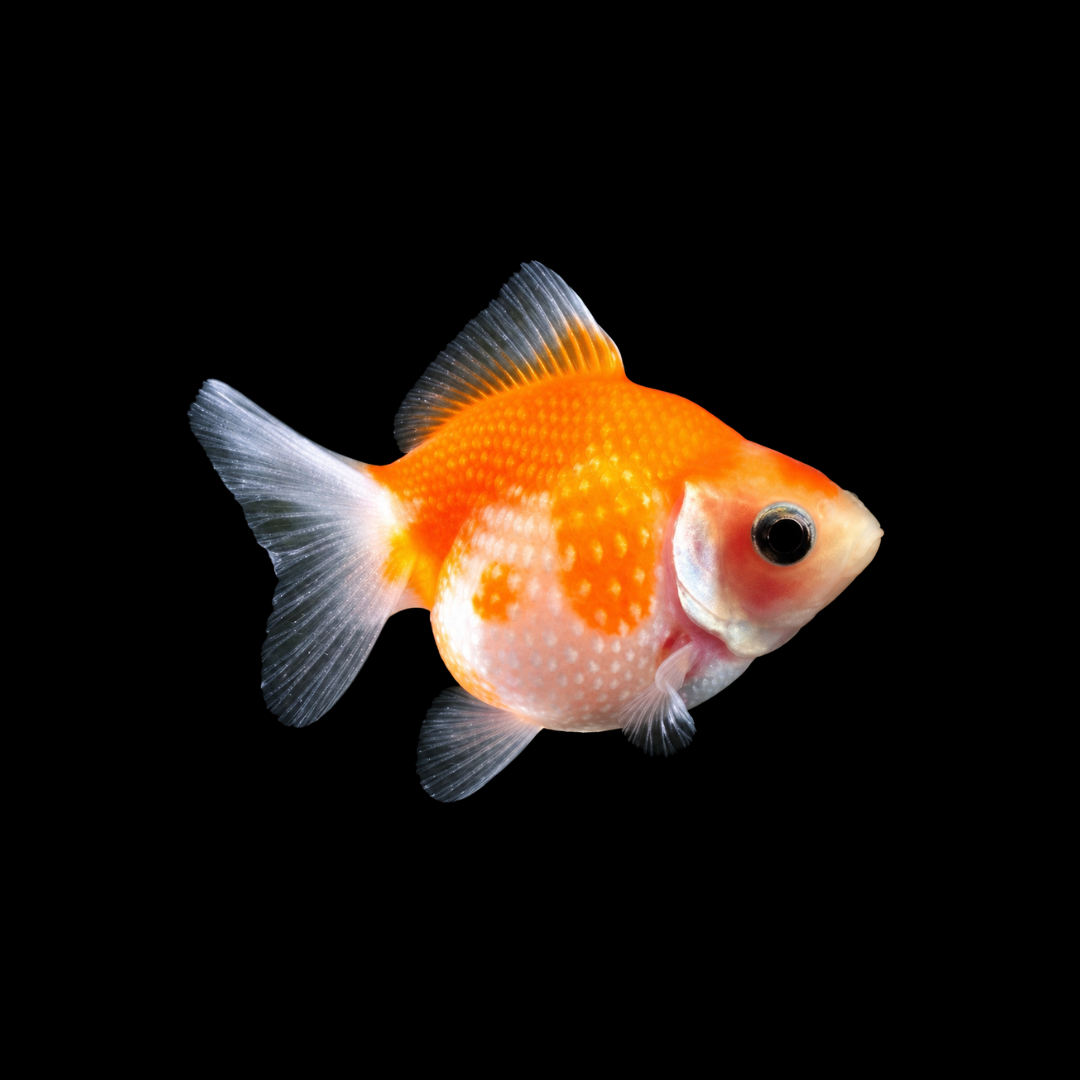
ピンポンパールは、金魚のPearlscale/珍珠鱗系のうち、体幹が短く、体高と体幅が大きい、強く球形化した型に対して日本の流通で使われる呼称です。最大の特徴は、体表の鱗一枚一枚の中央部が半球状に盛り上がる「パール鱗」にあります。単に腹部が丸い琉金やオランダ獅子頭とは異なり、短く球形の体と隆起した鱗の組み合わせが、この魚の特徴を形づくっています。背鰭は通常あり、流通名には尾型の違いを含む例もあるため、尾の長さだけで判別することはできません。素赤、更紗、白・ミルク、キャリコ、黒系など色彩の幅も広く、同じピンポンパールでも印象は大きく変わります。Ping Pong Pearlscale is a Japanese trade name used for a strongly short-bodied and globular form within the Pearlscale goldfish group. Its defining feature is the pearl scale, in which the central part of each scale is distinctly domed. Unlike Ryukin or Oranda that may simply have a rounded abdomen, this form is characterized by the combination of a short globular body and raised scales. A dorsal fin is normally present, and retail naming can include different tail forms, so tail length alone is not a reliable identifier. Colors include solid red, red-and-white, white or milky forms, calico, and dark or blackish forms.
基本情報 / Basic Information
学名 / Scientific Name
Carassius auratus (Linnaeus, 1758)
通称 / Common Name
ピンポンパール。関連する広い系統名として、パールスケール/Pearlscale、珍珠鱗(チンシュリン)が使われます。国内流通ではこれらの呼び分けが必ずしも統一されていません。Ping Pong Pearlscale. The broader group is generally referred to as Pearlscale Goldfish, and Japanese retail usage does not always separate these names consistently.
分類 / Family
コイ目・コイ科・フナ属。ピンポンパール固有の種名や亜種名はなく、金魚の人為選抜された観賞用品種・市場型として扱われます。Order Cypriniformes, family Cyprinidae, genus Carassius. Ping Pong Pearlscale has no separate species or subspecies name and is a selectively bred ornamental form of goldfish.
野生分布を持つ独立種ではありません。金魚の家畜化は中国で始まり、Pearlscale/珍珠鱗も中国で成立した系統とされています。ただし、Pearlscaleがいつ、どのような交配で作出されたかという詳細な系譜は確定していません。現在は日本を含む各地で繁殖・流通しています。This is not a wild species with its own natural distribution. Goldfish domestication began in China, and Pearlscale is generally regarded as a Chinese-developed ornamental line. However, the exact date and breeding pedigree by which Pearlscale arose have not been established. Today it is bred and traded in Japan and elsewhere.
最大体長 / Max Size
ピンポンパール短身体型の生物学的な最大体長を定める査読データは十分ではありません。国内の販売情報では15cm程度までと案内する例がありますが、これは品種の絶対的な上限を示す値ではありません。成長サイズは系統や飼育条件によって差が出ます。There is no well-established peer-reviewed biological maximum size specifically for the short-bodied Ping Pong Pearlscale form. Some Japanese retail care information gives around 15 cm as a possible adult size, but this should not be treated as an absolute limit. Final size varies with lineage and husbandry.
寿命 / Lifespan
ピンポンパール短身体型だけを対象に、寿命を定量的に示した信頼できる査読データは十分に確認されていません。体型だけから寿命を短い、または長いと断定せず、水質、過密、疾病、摂餌、遊泳状態を継続的に管理することが重要です。Reliable peer-reviewed lifespan data specifically for the Japanese short-bodied Ping Pong Pearlscale form are insufficient. Lifespan should not be assumed from body shape alone; long-term management of water quality, stocking density, disease, feeding and swimming condition is more meaningful.
飼育環境 / Aquarium Environment
水槽サイズ / Tank Size
成魚では実水量30~50L/尾程度を安全側の出発点とし、1~2尾なら60cm級の規格水槽、3~4尾なら90cm級の規格水槽を優先すると管理しやすくなります。これはピンポンパールで実験的に証明された「最適密度」ではなく、過密を避けるための実務的な目安です。最終的にはアンモニア・亜硝酸、溶存酸素、成長、摂餌、呼吸、遊泳状態に応じて調整してください。For adults, an effective water volume of roughly 30–50 L per fish is a cautious starting point. A 60 cm-class standard aquarium is practical for one to two adults, while a 90 cm-class aquarium is preferable for three to four. These figures are management guidelines to reduce crowding, not experimentally proven optimum densities for Ping Pong Pearlscale. Final stocking should be adjusted according to ammonia and nitrite control, dissolved oxygen, growth, feeding, respiration and swimming condition.
水温 / Temperature
ピンポンパールの成魚だけを対象に、適温を比較した研究は十分ではありません。家庭では20~24℃前後を一つの管理目安とし、特に急激な温度変化と極端な高水温を避けます。なお、一般的な金魚の研究で孵化に最適と推定された約23.9℃は胚発生に関する値であり、成魚の最適飼育温度を示すものではありません。Adult temperature requirements have not been experimentally compared specifically in Ping Pong Pearlscale. In home aquaria, around 20–24°C can be used as a practical management reference, with greater emphasis on avoiding rapid changes and extreme heat. The approximately 23.9°C optimum reported in a general goldfish study refers to egg hatching during embryonic development and should not be interpreted as the optimum temperature for adult fish.
水質 / Water Quality
中性付近を目安に、数値そのものより急変させないことを優先します。日本の水道水は地域差があり、塩素消毒を前提としているため、換水時は適切に塩素を中和してください。十分な生物ろ過と酸素供給を確保し、アンモニアや亜硝酸が蓄積しない管理を行います。Aim for water around neutral pH, but prioritize stability over chasing a single number. Japanese tap water varies by region and is chlorinated, so incoming water should be properly dechlorinated. Provide adequate biological filtration and oxygenation, and manage the aquarium so that ammonia and nitrite do not accumulate.
レイアウト / Layout
隆起した鱗を傷つけないよう、鋭い岩、表面の粗い装飾、狭い隙間を減らしたシンプルなレイアウトが向きます。ピンポンパールの遊泳能力を直接評価した研究は乏しいため、強い水流で流され続ける個体がいる場合は、流量や吐出口の向きを調整します。広い遊泳空間と観察しやすさを優先してください。A simple layout is suitable, with sharp rocks, rough decorations and narrow gaps minimized to protect the raised scales. Direct studies of swimming performance in Ping Pong Pearlscale are limited, so reduce or redirect flow if a fish is continuously pushed around by the current. Prioritize open swimming space and easy observation.
注意点 / Precautions
過密、急な水温・水質変化、酸欠、残餌の蓄積を避けます。新しく迎えた魚は既存魚とすぐに同居させず、別容器で健康状態を観察するのが安全です。新魚は一定期間、食欲、呼吸、体表、排泄、遊泳状態を確認してから合流させます。隔離期間にピンポンパール固有の最適値が確立されているわけではありません。また、飼育魚を河川や池へ放流しないでください。Avoid overcrowding, abrupt changes in temperature or water chemistry, low oxygen and accumulated uneaten food. Newly acquired fish should be observed separately rather than immediately mixed with established stock. Observe new fish separately for appetite, respiration, external condition, waste and swimming before introduction. No Ping Pong Pearlscale-specific optimum quarantine duration has been established. Never release aquarium fish into rivers, ponds or other natural waters.
餌と給餌 / Feeding
餌の種類 / Diet
成魚は金魚用の良質な配合飼料を基本にします。仔魚では、遊泳を始めて卵黄を吸収した後、アルテミア幼生など口に合う大きさの生餌と微細な配合飼料を段階的に組み合わせます。一般的な金魚の仔魚では、人工飼料だけよりも生餌、または生餌を含む混合給餌の方が成長や生残に良好な結果を示した研究があります。For adults, a good-quality formulated goldfish diet can be used as the staple. After yolk absorption and the onset of free swimming, fry can be offered suitably sized live food such as Artemia nauplii together with fine formulated diets. Studies in general goldfish larvae have found better growth or survival with live food, or diets containing live food, than with dry feed alone.
給餌のポイント / Feeding Tips
一度に大量に与えるより、少量を複数回に分ける方が管理しやすくなります。一般的な金魚では1日4回給餌で良好な成長と飼料利用を示した研究がありますが、これはピンポンパール固有の最適回数ではありません。家庭では体格や水温、食欲を見ながら1日2~4回程度を目安にし、数分以内に食べ切れる量に抑えます。食べ残しは回収し、個体ごとに食べ負けや食後の姿勢変化がないかも確認してください。Small divided feedings are generally easier to manage than a single large meal. Studies in general goldfish have found good growth and feed utilization with four meals per day under experimental conditions, but this is not a Ping Pong Pearlscale-specific optimum. At home, roughly two to four small feedings can be used as a practical guide according to body condition, temperature and appetite, with each portion limited to what is eaten within a few minutes. Remove leftovers and check individual fish for food competition or marked post-meal changes in posture.
性格と混泳 / Temperament and Tank Mates
性格 / Temperament
ピンポンパール短身体型だけを対象に、性格や行動傾向を定量化した研究は十分ではありません。そのため「必ずおとなしい」「活発ではない」といった一律の決めつけは避け、個体差を見ます。繁殖期には雄が雌を追尾することがありますが、これは繁殖行動として現れるものです。日常の飼育では、落ち着いて摂餌・遊泳できているかを個体ごとに確認してください。There is insufficient research that quantitatively defines the temperament or behavioral tendency of the short-bodied Ping Pong Pearlscale. Avoid assuming that every individual is necessarily calm or inactive. During the breeding season males may chase females as part of spawning behavior. In routine care, judge each fish by whether it can feed and swim without persistent disturbance.
混泳の相性 / Compatibility
ピンポンパールの混泳相性を比較した研究は十分ではありません。実際の組み合わせでは、餌の奪い合い、追尾、衝突、水流の好みの違いによって、ピンポンパールの摂餌や安定した遊泳が妨げられないことを優先します。泳力や体格が大きく異なる相手との同居は慎重に行い、食べ負け、継続的な追尾、呼吸の乱れが見られた場合は分離してください。混泳時も過密を避けることが基本です。Breed-specific comparative studies of tank-mate compatibility are limited. In practice, prioritize combinations that do not interfere with feeding or postural control through food competition, chasing, collisions or very different flow requirements. Be cautious with tank mates that differ greatly in swimming ability or size, and separate fish if persistent chasing, food deprivation or respiratory stress appears. Avoid crowding even in community setups.
病気と対策 / Diseases and Prevention
かかりやすい病気 / Common Diseases
白点病、吸虫などの外部寄生虫、細菌性の皮膚・鰓障害、腹水に伴う松かさ様症状、浮力・姿勢異常、隆起鱗の擦過傷などは、飼育中に注意したい問題です。ただし、「ピンポンパールは必ず転覆する」「松かさになりやすい」といった品種固有の発症率を裏づける疫学データは十分ではありません。特に、正常なパール鱗と松かさ症状を混同しないことが重要です。正常なパール鱗では鱗の中央部が盛り上がっていますが、腹水などに伴う松かさ症状では鱗全体が外向きに開き、腹部膨満、眼球突出、食欲低下などを伴うことがあります。Problems worth monitoring include white spot disease, external parasites such as flukes, bacterial skin or gill disorders, pineconing associated with dropsy, buoyancy or postural abnormalities, and physical damage to the raised scales. However, epidemiological data are insufficient to claim that Ping Pong Pearlscale inevitably develops buoyancy problems or is uniquely prone to dropsy. Normal pearl scales should not be confused with pineconing: in a normal Pearlscale the center of each scale is domed, whereas dropsy can cause the whole scale to project outward together with abdominal swelling, exophthalmia and reduced appetite.
対策と予防 / Prevention
最初に水質、水温、酸素、過密、摂餌状態を確認し、異常魚は必要に応じて隔離します。新魚の隔離観察は重要な防疫手段です。白点や外部寄生虫が疑われる場合は、可能なら皮膚・鰓の検査などで原因を絞り込み、観賞魚用薬を使用する場合は国内製品の表示どおりに扱います。抗菌薬を原因不明のまま反復使用することは避け、重症例や診断が難しい場合は魚類診療に対応できる専門家への相談を検討してください。隆起鱗の損傷予防には、鋭い装飾物を置かないことも有効です。First check water quality, temperature, oxygen, stocking density and feeding, and isolate affected fish when appropriate. Quarantine and observation of new arrivals are key preventive measures. If white spot disease or other external parasites are suspected, diagnostic examination of skin or gills is ideal where available, and aquarium medications should be used strictly according to Japanese product labels. Avoid repeated, indiscriminate antibiotic use without identifying the cause, and seek professional fish-health advice for severe or difficult cases. Removing sharp decorations also helps prevent damage to the raised scales.
増やし方(繁殖) / Breeding
雌雄の判別 / Sexing
成熟期の雄では、鰓蓋や胸鰭の前方に追星(繁殖突起)が現れることがあります。成熟した雌では総排泄孔が目立ちやすくなり、産卵前には腹部がふっくらすることがあります。ただし、これらの特徴は季節や成熟状態、個体差によって不明瞭な場合があるため、複数の所見を合わせて判断します。ピンポンパールではもともと体が丸いため、腹部の丸さだけを雌雄判別の決め手にしないでください。In mature males, breeding tubercles may appear on the operculum and the anterior part of the pectoral fins. In mature females, the cloacal opening may become more prominent and the abdomen may become fuller before spawning. These signs can be indistinct depending on season, maturity and the individual, so sexing is best based on several observations together. Because Ping Pong Pearlscale is naturally globular, abdominal roundness alone should not be used as a sexing criterion.
繁殖形態 / Reproduction
金魚は粘着性の卵を基質に産みつける体外受精魚です。自然繁殖では産卵モップや人工水草などを産卵床として利用できます。研究目的では成熟雌から採卵し、雄から採精して体外で混合する乾式授精も用いられますが、家庭でホルモン誘起などの研究手技を安易に転用するべきではありません。Goldfish are external fertilizers that deposit adhesive eggs on a substrate. Spawning mops or artificial plants can be used as spawning media in natural breeding setups. In research, eggs and milt may also be collected and mixed externally using a dry fertilization method, but laboratory hormone-induction protocols should not be casually transferred to home aquaria.
繁殖のポイント / Breeding Tips
成熟した親魚の状態を整え、産卵床を用意し、産卵後は親魚と卵を分けるのが基本です。一般的な金魚の研究では産卵基質が産卵や孵化成績に影響しましたが、その受精率や孵化率をピンポンパールの期待値として扱うことはできません。また、一般金魚の胚では約23.9℃が孵化に適した温度として推定されていますが、これもピンポンパール固有の最適値ではありません。仔魚は卵黄吸収と遊泳開始を確認してから、アルテミア幼生などの生餌と微細配合飼料を段階的に与えます。選別では丸さだけでなく、鱗の均一性、体軸、左右対称性、尾、継続的な摂餌、正常姿勢、遊泳能力も同時に見ることが大切です。Condition mature broodfish, provide a spawning substrate, and separate adults from the eggs after spawning. Studies in general goldfish show that spawning substrate can affect spawning and hatching performance, but their reported fertilization and hatching rates should not be treated as expected values for Ping Pong Pearlscale. In one general goldfish embryo study, about 23.9°C was estimated as an optimum for hatching, but this is not a Ping Pong Pearlscale-specific optimum. After yolk absorption and the onset of free swimming, fry can be offered live food such as Artemia nauplii together with fine formulated diets. When selecting juveniles, evaluate not only roundness but also scale uniformity, body axis, symmetry, tail structure, sustained feeding, normal posture and swimming ability.
雑学と豆知識 / Trivia and Fun Facts
1. 「ピンポンパール」と「珍珠鱗」は完全な同義語ではない / 1. “Ping Pong Pearlscale” and “Pearlscale” are not perfectly identical terms
日本の店頭では両者が近い意味で使われることがありますが、流通上の呼び分けは必ずしも統一されていません。Pearlscale/珍珠鱗は隆起した鱗を持つ広い系統群を指し、その中でも特に体幹が短く、体高・体幅が大きい球形の型が「ピンポンパール」と呼ばれる傾向があります。尾型を含む販売名には例外もあるため、名称だけで厳密に線引きするより、パール鱗と球形短身という形態の組み合わせを見る方が実態に合っています。In Japanese retail, these names are sometimes used almost interchangeably, and the boundary is not standardized. Pearlscale refers to the broader group characterized by raised scales, while “Ping Pong Pearlscale” tends to be used for especially short, deep and globular forms. Because retail names can also vary with tail form, the most useful distinction is the morphology itself: pearl scales combined with a strongly globular short body.
2. 宝石のような鱗、その遺伝子はまだ確定していない / 2. The jewel-like scales still lack a confirmed causal gene
パール鱗は見た瞬間に分かるほど強い特徴なので、「原因遺伝子も当然分かっている」と思いたくなります。ところが、研究の現状はそこまで単純ではありません。Pearlscaleでは、一枚一枚の鱗をドーム状に変える形質が固定されていることは整理されていますが、その原因遺伝子や遺伝形式は確定していません。比較対象として、コイの鏡鱗ではFGFR1の変異が知られており、金魚でもFGFR1や関連遺伝子を調べる意義が指摘されています。しかし、これはPearlscaleのパール鱗がFGFR1変異で生じることを示したものではありません。見た目には明瞭な形質でも、その遺伝的な仕組みはまだ解明途中なのです。Pearl scales are so visually striking that it is tempting to assume their causal gene must already be known. The research picture is less simple. Pearlscale is recognized as carrying a trait that changes individual scales into a domed form, but its causal gene and inheritance pattern have not been established. In common carp, an FGFR1 mutation is known to cause a mirror-scale phenotype, and the goldfish review notes that FGFR1 and related genes are worth investigating comparatively. That does not show that Pearlscale itself is caused by an FGFR1 mutation. It is a useful example of a visually obvious trait whose genetic basis remains unresolved.
3. 丸さは「骨が短い」だけでは説明できない / 3. The round body is not explained simply by “shorter bones”
2026年にPearlscaleを直接含めて比較した組織学研究では、Pearlscaleの球形体型に、側方体壁の肥厚、脂肪組織の増加、筋線維密度の低下が伴うことが示されました。つまり、あの独特の丸みは骨格だけの問題ではなく、体壁や脂肪、筋組織まで含む複数の変化から成り立っていると考えられます。一方で、その研究は疼痛や寿命、慢性ストレス、遊泳能力を直接測ったものではありません。丸い外見だけから福祉状態を断定せず、正常姿勢、摂餌、呼吸、遊泳を実際に観察することが、飼育者にとって大切です。A 2026 histological study directly comparing Pearlscale with other goldfish forms found that its globular shape is associated with a thicker lateral body wall, increased adipose tissue and lower muscle-fiber density. In other words, the characteristic roundness appears to involve more than skeletal shortening; body wall, fat and muscle all contribute. The study did not, however, directly measure pain, lifespan, chronic stress or swimming performance. Welfare therefore should not be inferred from appearance alone; actual posture, feeding, respiration and swimming should be observed.
4. 中国の金魚文化から、日本の「ピンポン」へ / 4. From Chinese goldfish culture to Japan’s “Ping Pong” form
金魚の家畜化は中国で始まり、長い人為選抜の積み重ねが、現在見られる多様な体形や色彩を生みました。Pearlscale/珍珠鱗も中国で成立した系統とされていますが、「いつ、誰が、どの交配で作ったか」という具体的な系譜は学術的には確定していません。日本で「ピンポンパール」と呼ばれる強い球形短身型がどの地域でどのように固定されていったかについても、流通上の説明はあるものの、系譜解析で確定した歴史ではありません。はっきり分かっている歴史と、業界で伝えられてきた説明を分けて考えることが大切です。Goldfish domestication began in China, and a long history of artificial selection produced the remarkable diversity of body forms and colors seen today. Pearlscale is also generally regarded as a Chinese-developed line, but the exact origin—who created it, when, and from which crosses—has not been established academically. The regional history by which the extremely short and globular form sold in Japan as Ping Pong Pearlscale became established is likewise not resolved by pedigree or genomic analysis. It is therefore important to distinguish well-supported history from accounts preserved mainly in the ornamental-fish trade.
5. 日本で生まれた「パールブリストル」という交雑例 / 5. “Pearl Bristol,” a Japanese cross using Ping Pong Pearlscale traits
ピンポンパールの特徴が別系統へ受け継がれた具体例もあります。アクアマリンふくしまでは2017年からブリストル朱文金とピンポンパールを交配し、2019年春に両者の特徴を備える魚を得て、2021年に「パールブリストル」として紹介しました。これは、パール鱗や体形の特徴を新しい観賞形質へ組み合わせようとした、日本の公的水族館による明確な育種例です。完成された品種を眺めるだけでなく、その特徴が次世代へどう伝わるのかを考えると、金魚育種の奥行きが見えてきます。There is also a concrete Japanese example in which Ping Pong Pearlscale traits were introduced into another line. Aquamarine Fukushima began crossing Bristol Shubunkin with Ping Pong Pearlscale in 2017, obtained fish showing features of both parents in spring 2019, and introduced them in 2021 as “Pearl Bristol.” This is a clear breeding example from a public aquarium, combining pearl-scale and body-form traits with another ornamental lineage. It illustrates that goldfish breeding is not only about preserving existing forms, but also about observing how distinctive traits can be inherited and recombined.
6. 「丸いほど良い」だけでは測れない価値 / 6. Value cannot be measured by “the rounder, the better” alone
ピンポンパールの魅力は、確かに強い丸みにあります。しかし繁殖や購入で外見だけを追うと、左右対称性、正常な姿勢、継続的な摂餌、呼吸、遊泳といった機能を見落とすおそれがあります。2026年の組織学研究はPearlscaleの体内組織が他の金魚型と異なることを示しましたが、それだけで健康状態の良し悪しは判断できません。美しいパール鱗と丸い体形を楽しみながら、その魚自身が無理なく泳ぎ、食べ、休めているかを同時に見ることが、これからのピンポンパールとの付き合い方として重要です。The charm of Ping Pong Pearlscale undeniably lies in its remarkable roundness. Yet if breeding or purchasing decisions focus only on appearance, important functional traits—symmetry, stable posture, sustained feeding, normal respiration and swimming—can be overlooked. A 2026 histological study shows that Pearlscale internal tissues differ from those of other goldfish forms, but those differences alone do not determine health. Enjoying the beautiful raised scales and globular body while also asking whether the individual fish can swim, feed and rest comfortably is an important way to approach this variety.
まとめ / Conclusion
ピンポンパールは、短く球形の体と、鱗一枚一枚の中央が真珠の粒のように盛り上がるパール鱗を併せ持つ、金魚の中でも個性的な存在です。その姿は長い金魚の選抜史の延長にありますが、パール鱗の原因遺伝子や球形体型の生理、品種固有の寿命や疾病リスクなど、まだ十分に分かっていないことも残されています。Ping Pong Pearlscale is a distinctive goldfish form that combines a short globular body with individually domed pearl scales. It belongs to the long history of selective breeding in goldfish, while important questions remain unresolved, including the causal genetics of pearl scales, the physiology of the globular body, and breed-specific data on lifespan and disease risk.
飼育では「特別に弱い魚」と決めつけるより、過密を避け、安定した水温と水質、十分なろ過と酸素、少量分割給餌、新魚の隔離観察を丁寧に積み重ねることが大切です。丸さだけでなく、まっすぐ泳げること、しっかり食べられること、落ち着いて呼吸できることまで含めて一尾ずつ見守れば、ピンポンパールの独特の存在感をより長く、健やかに楽しむことにつながります。Rather than treating it simply as an unusually fragile fish, good husbandry comes from avoiding crowding, keeping temperature and water quality stable, providing adequate filtration and oxygen, feeding small divided meals, and observing new arrivals in quarantine. Watching each fish not only for roundness but also for stable swimming, reliable feeding and calm respiration helps preserve the distinctive presence of Ping Pong Pearlscale in a healthier, more sustainable way.
Froese, R. & Pauly, D. (eds.).
FishBase: Carassius auratus (Linnaeus, 1758).
対応項目:学名・分類、金魚の自然分布、生息環境、生態の基礎情報。
Chen, D. et al. (2020).
The evolutionary origin and domestication history of goldfish (Carassius auratus). Proceedings of the National Academy of Sciences of the United States of America, 117(47), 29775–29785. doi: 10.1073/pnas.2005545117.
対応項目:金魚の中国における家畜化、系統・ゲノム背景、観賞用品種の成立史。
Pearlscaleの形態・遺伝的背景
Ota, K. G. & Abe, G. (2016).
Goldfish morphology as a model for evolutionary developmental biology. WIREs Developmental Biology, 5(3), 272–295. doi: 10.1002/wdev.224.
対応項目:Pearlscaleの隆起鱗、金魚の形態変異、パール鱗の原因遺伝子が未確定であること。
Ota, K. G., Abe, G., Wang, C.-Y., Li, I.-J. & Sanchez, P. G. L. (2026).
Histological divergence underlying globular body shapes in ornamental goldfish. Zoological Studies, 65, 29. doi: 10.6620/ZS.2026.65-29.
対応項目:Pearlscaleの球形体型、側方体壁・脂肪組織・筋線維密度に関する組織学的知見。
飼育条件・給餌
Priestley, S. M., Stevenson, A. E. & Alexander, L. G. (2006).
The influence of feeding frequency on growth and body condition of the common goldfish (Carassius auratus). The Journal of Nutrition, 136(7 Suppl), 1979S–1981S. doi: 10.1093/jn/136.7.1979S.
対応項目:少量分割給餌、給餌頻度と成長・飼料利用の関係。
Abi-Ayad, S.-M. E.-A. & Kestemont, P. (1994).
Comparison of the nutritional status of goldfish (Carassius auratus) larvae fed with live, mixed or dry diet. Aquaculture, 128(1–2), 163–176. doi: 10.1016/0044-8486(94)90111-2.
対応項目:仔魚期の生餌・混合飼料・乾燥飼料による成長と生残の比較。
Livengood, E. J. & Chapman, F. A. (2007).
The Ornamental Fish Trade: An Introduction with Perspectives for Responsible Aquarium Fish Ownership. UF/IFAS Extension, EDIS FA124. doi: 10.32473/edis-fa124-2007.
対応項目:生物ろ過、水質維持、適切な給餌、新規導入魚の隔離など観賞魚飼育の基本管理。
Tsai, H.-Y., Chang, M., Liu, S.-C., Abe, G. & Ota, K. G. (2013).
Embryonic development of goldfish (Carassius auratus): A model for the study of evolutionary change in developmental mechanisms by artificial selection. Developmental Dynamics, 242(11), 1262–1283. doi: 10.1002/dvdy.24022.
対応項目:金魚の体外受精、乾式授精、胚発生の基礎。
Motta, J. H. S., Glória, L. S., Radael, M. C., Mattos, D. C., Cardoso, L. D. & Vidal-Júnior, M. V. (2023).
Effect of temperature on embryonic development and first exogenous feeding of goldfish Carassius auratus (Linnaeus, 1758). Brazilian Journal of Biology, 83, e270943. doi: 10.1590/1519-6984.270943.
対応項目:胚発生・孵化に対する水温の影響、高水温による発生異常。
Jaman, A., Rahman, U. O., Lucky, N. S. & Islam, M. S. (2024).
Enhancing goldfish reproduction: Role of substrates in optimizing fertilization and hatching rates under controlled conditions. Ege Journal of Fisheries and Aquatic Sciences, 41(4), 280–285. doi: 10.12714/egejfas.41.4.04.
対応項目:産卵基質、自然産卵、受精率・孵化率に関する一般金魚の実験データ。
病気・防疫・飼育上の注意
Larcombe, E., Alexander, M. E., Snellgrove, D., Henriquez, F. L. & Sloman, K. A. (2025).
Current disease treatments for the ornamental pet fish trade and their associated problems. Reviews in Aquaculture, 17(1), e12948. doi: 10.1111/raq.12948.
対応項目:過密・輸送・不良水質などのストレス、観賞魚の疾病感受性、薬剤・抗菌薬の不適切使用に関する注意。
Bu, X. et al. (2025).
Effect of ectoparasite Ichthyophthirius multifiliis on the histopathology and gill and gut microbiota of goldfish (Carassius auratus). Frontiers in Veterinary Science, 12, 1539446. doi: 10.3389/fvets.2025.1539446.
対応項目:金魚における白点病原虫の感染、鰓などへの組織障害。






コメント