

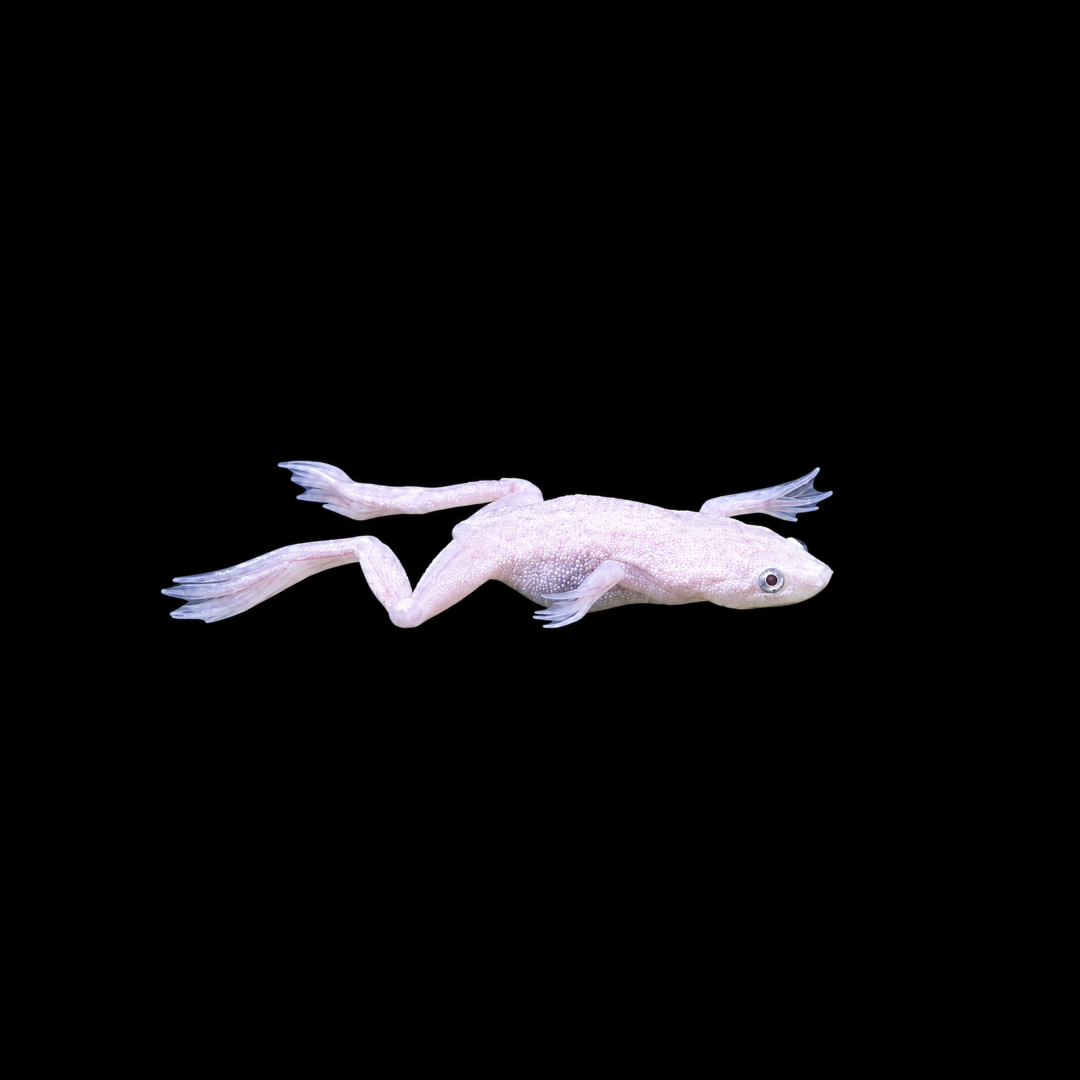
解説Description
ホワイトヒメツメガエルは、観賞用に流通するヒメツメガエル属 Hymenochirus の白色系統です。小さな体、細い四肢、前肢と後肢の両方に発達した水かき、そして水底からふわりと水面へ浮上して呼吸する独特の動きが大きな魅力です。魚のように生涯を水中で過ごしますが、成体は肺で呼吸するため、水面へ無理なく上がれる環境が欠かせません。国内では H. boettgeri 名義で扱われることが多いものの、近年の研究では、長く飼育下で維持されてきた流通系統が野生の H. boettgeri と一致しない可能性が示されており、種レベルの同定には注意が必要です。 The White African Dwarf Frog is a pale aquarium form of the dwarf clawed frog genus Hymenochirus. Its tiny body, slender limbs, webbing on both the front and hind feet, and gentle trips from the bottom to the surface for air give it a distinctive charm. It spends its entire life in water, but adults breathe with lungs and must be able to reach the surface easily. Although captive frogs are commonly traded as H. boettgeri, recent research indicates that long-established aquarium stocks may not be conspecific with wild H. boettgeri, so species-level identification should be treated cautiously.
「ホワイト」は主に流通上の呼び名で、体色を生み出す遺伝的背景まで示す名称ではありません。流通名や眼の色など、外見だけを根拠にアルビノや白変と断定するのは避けたほうがよいでしょう。白い体色は水槽内でよく映えますが、見た目の違いにかかわらず、水草や隠れ家を用意して落ち着ける場所を確保することが大切です。 “White” is primarily a trade description and does not by itself identify the genetic basis of the coloration. It is therefore best not to diagnose albinism, leucism, or another pigment condition from the trade name, eye color, or appearance alone. Regardless of color, plants and secure retreats help these frogs settle and behave naturally.
基本情報Basic Information
| 学名Scientific Name | Hymenochirus sp. (流通上は H. boettgeri とされることが多い) (commonly traded as H. boettgeri) |
|---|---|
| 通称Common Name | ホワイトヒメツメガエル、ヒメツメガエルの白色系統White African Dwarf Frog, pale color morph of the African Dwarf Frog |
| 分類Classification | 両生綱・無尾目・ピパ科・ヒメツメガエル属Class Amphibia, Order Anura, Family Pipidae, Genus Hymenochirus |
| 英名English Name | African Dwarf Frog / Dwarf Clawed Frog (white morph) |
| 分布Distribution | 観賞用に維持されてきた流通系統の正確な野生起源は、種レベルでは確定していません。野生の H. boettgeri は、ナイジェリア南部とカメルーンから赤道ギニア、ガボン、コンゴ盆地にかけて分布し、流れの緩い河川や湿地などの静かな水域に生息します。ホワイト個体は飼育下繁殖系統として流通しています。The exact wild origin of long-established aquarium stocks remains unresolved at the species level. Wild H. boettgeri occurs from southern Nigeria and Cameroon through Equatorial Guinea, Gabon, and the Congo Basin, where it inhabits quiet or slow-moving waters. White aquarium frogs are distributed as captive-bred stock. |
| 成体サイズAdult Size | 頭胴長はおおむね2.5〜3.5cmほど。メスのほうが大きく、成熟すると腹部に丸みが出ます。Usually about 2.5–3.5 cm in snout–vent length. Females are generally larger and become more rounded through the abdomen when mature. |
| 寿命Lifespan | 飼育情報では5〜8年程度がひとつの目安として挙げられることが多いですが、系統や飼育条件によって幅があります。安定した水質、適切な給餌、事故防止を続けることが長期飼育につながります。Captive care references commonly give roughly 5–8 years as a practical estimate, although longevity varies with stock and husbandry. Stable water quality, appropriate feeding, and accident prevention are central to long-term care. |
飼育環境Enclosure Environment
| 飼育容器・サイズEnclosure and Size | フタのできる横長の水槽が向きます。複数飼育を前提とするなら40L前後以上を目安にすると、水質が安定しやすく、泳ぐ場所と休む場所を分けやすくなります。水深の数値そのものより、どの位置からでも水面へ上がりやすく、水面近くで休める水草や足場があることを優先します。一般的な横長水槽では20〜30cm程度の水深が扱いやすいでしょう。成体に陸地は必要ありません。A horizontally oriented aquarium with a secure lid is ideal. For a small group, roughly 40 L or more provides greater water stability and makes it easier to create swimming and resting areas. Rather than treating one depth as a strict limit, make sure every frog can reach the surface easily and has plants or supports near the surface for resting. In a typical low aquarium, a depth of about 20–30 cm is practical to manage. Adult frogs do not require a land area. |
|---|---|
| 温度Temperature | 22〜27℃程度の安定した水温を目安にします。冬は必要に応じてヒーターを使い、夏は高温が長く続かないよう室温や水温を確認します。急な温度変化は避け、導入時の水合わせもゆっくり行います。Aim for a stable water temperature of about 22–27°C. Use a heater when necessary in winter, and monitor for prolonged overheating in summer. Avoid sudden temperature shifts and acclimate new frogs gradually. |
| 環境管理Environmental Management | カルキを抜いた水を使い、ろ過が安定した環境を用意します。アンモニアと亜硝酸は検出されない状態を保ち、硝酸塩の蓄積も定期的な換水で抑えます。pHはおおむね6.5〜8.0の範囲に適応します。強い水流は疲労につながるため、スポンジフィルターなどを使って穏やかな流れにします。肺呼吸のため水面へ上がりやすいこと、フタと水面の間に呼吸できる空間があることも重要です。Use dechlorinated water and a fully cycled filtration system. Keep ammonia and nitrite at undetectable levels and control nitrate through regular water changes. These frogs tolerate roughly pH 6.5–8.0. Strong current can exhaust these small frogs, so gentle filtration such as a sponge filter is preferable. Because they breathe air, they need unobstructed access to the surface and an air space beneath the lid. |
| レイアウトLayout | 流木や丸みのある石、水草、シェルターなどを使い、休める場所を複数作ります。底床は誤飲しにくい粒の大きな砂利、非常に細かな砂、または清掃性を優先したベアタンクが安全です。鋭い石や狭すぎる穴は皮膚を傷つけたり挟まり事故を起こしたりするため避けます。照明を強くしすぎず、浮草や水草の陰など落ち着ける場所を作ると観察もしやすくなります。Provide several resting places with smooth wood, rounded stones, aquatic plants, and shelters. To reduce accidental ingestion, use gravel too large to swallow, very fine sand, or a bare-bottom setup for easy cleaning. Avoid sharp rocks and tight openings that could injure or trap the frog. Avoid excessively intense lighting and provide shaded areas among floating or submerged plants. |
| 注意点Precautions | 最重要なのは飛び出し防止です。わずかな隙間から脱出すると、完全水棲のため、短時間で乾燥して危険な状態になります。配線やホース周りも含めてフタの隙間を確認してください。また、吸水口への吸い込み事故を防ぐためスポンジカバーを付けます。皮膚から物質を吸収しやすいため、洗剤、殺虫剤、香料、金属類、自己判断の薬剤を水槽へ持ち込まないことも大切です。Escape prevention is critical. A fully aquatic frog that leaves the aquarium can dehydrate rapidly, so check every gap around lids, cables, and hoses. Cover filter intakes with sponge to prevent entrapment. Amphibian skin readily absorbs dissolved substances, so keep detergents, pesticides, fragrances, metals, and unprescribed medications away from the enclosure. |
餌と給餌Feeding
| 餌の種類Diet | 小型の水生無脊椎動物を中心とする肉食性です。飼育下では、冷凍アカムシ、イトミミズ類、ブラインシュリンプ、小型のミミズ類、両生類や底棲肉食魚向けの沈下性人工飼料などを組み合わせます。単一の餌に偏らず、栄養の幅を持たせることが大切です。This is a carnivorous frog that naturally feeds on small aquatic invertebrates. In captivity, offer a varied rotation of frozen bloodworms, tubifex-type worms, brine shrimp, small earthworms, and suitable sinking diets formulated for amphibians or small carnivorous bottom feeders. Avoid relying on a single food. |
|---|---|
| 給餌のポイントFeeding Tips | 餌を探す際は視覚だけでなく、嗅覚や水中の振動も利用します。動きの速い魚と一緒にすると食べ負けやすいため、ピンセットやスポイトで目の前へ落とす個別給餌が有効です。成体は1日おき、または週3〜4回程度を目安に、体型を見ながら食べ過ぎない量を与えます。食べ残しは水質悪化の原因になるので早めに取り除きます。These frogs use not only vision but also smell and water movement to locate food. When kept with fast fish, they can easily be outcompeted, so target feeding with tweezers or a pipette is useful. As a practical starting point, adults can be fed every other day or about three to four times per week, with portions adjusted to body condition. Remove uneaten food promptly. |
行動と同居Behavior and Cohabitation
| 行動・性質Behavior | 穏やかで、底や水草の間で休みながら、時おり水面へ素早く浮上して呼吸します。驚くと勢いよく泳ぎますが、普段は底を歩くように移動し、餌に近づくと口を素早く開いて水とともに吸い込むように捕食します。脱皮した皮を自分で食べることもあります。繁殖期のオスは水中で低いハム音のような声を出します。These frogs are generally peaceful. They often rest on the bottom or among plants, making quick trips to the surface to breathe. When calm, they may appear to “walk” along the substrate; when they approach prey, they rapidly open the mouth and capture it with suction. They may also eat their shed skin. Breeding males produce a low humming call underwater. |
|---|---|
| 同居の相性Compatibility | 最も管理しやすいのはヒメツメガエルだけの飼育です。複数飼育する場合は、十分なスペースと給餌場所を確保します。魚との混泳は不可能ではありませんが、餌を素早く奪う魚、攻撃的な魚、ヒレや四肢をつつく魚、大型の捕食魚は避けます。混泳させる場合でも、各個体が確実に食べているかを毎回確認してください。A frog-only aquarium is the easiest option to manage. Several dwarf clawed frogs can be kept together when there is adequate space and access to food. Community setups with fish are possible but risky; avoid fast feeders, aggressive fish, fin- or limb-nippers, and any fish large enough to prey on the frogs. If housed with fish, confirm at every feeding that each frog actually eats. |
病気と対策Diseases and Prevention
| かかりやすい病気・不調Common Diseases and Health Problems | 注意したい症状には、腹部や全身が異常に膨らむ腹水・浮腫、腹面や四肢の赤み、皮膚のただれや白い付着物、食欲不振、著しい痩せ、浮力の異常、底床の誤飲による消化管閉塞などがあります。両生類ではカエルツボカビなどの感染症も問題になるため、新しく迎えた個体の状態確認と隔離期間は重要です。Important warning signs include abnormal swelling or edema, redness of the belly or limbs, skin lesions or pale growths, loss of appetite, marked weight loss, abnormal buoyancy, and intestinal blockage after swallowing substrate. Amphibians can also be affected by infectious diseases such as chytridiomycosis, so careful observation and quarantine of new animals are important. |
|---|---|
| 対策と予防Prevention and Care | 予防の基本は、水質の安定、適温、過密の回避、食べ残しの除去、適切な栄養、導入個体の隔離です。体が膨れる、赤みが強い、皮膚が崩れる、呼吸や浮力がおかしい、数日続けて餌を食べないなどの変化があれば、まず隔離して水質と温度を確認し、両生類を診療できる獣医師へ相談します。両生類は皮膚から薬剤を吸収するため、食塩浴や抗菌薬などを自己判断で濃度設定して使うのは避けてください。Prevention depends on stable water quality, appropriate temperature, avoiding overcrowding, removing uneaten food, balanced nutrition, and quarantining new frogs. If a frog becomes swollen, develops severe redness or skin damage, shows abnormal breathing or buoyancy, or refuses food for several days, isolate it, check the environment, and consult a veterinarian experienced with amphibians. Because amphibians absorb chemicals through the skin, avoid improvised salt baths or antibiotic treatments without professional guidance. |
増やし方(繁殖)Breeding
| 雌雄の判別Sexing | 成熟するとメスはオスより大きく、腹部に丸みが出やすくなります。オスでは前肢の付け根付近に小さな皮下腺があり、白っぽい点やふくらみとして見えることがあります。繁殖期に鳴くのも主にオスです。若い個体では判別が難しいことがあります。Mature females are usually larger and have a fuller abdomen. Males have small post-axillary glands near the base of the forelimbs that may appear as pale spots or swellings. Calling during the breeding season is mainly a male behavior. Juveniles can be difficult to sex reliably. |
|---|---|
| 繁殖形態Reproduction | オスは水中で鳴き、メスを後方から抱く抱接を行います。ペアは水面付近へ上がりながら少数ずつ卵を放ち、体外受精します。卵は水面付近や水草に散らばり、親が食べることがあるため、採卵するか親を別容器へ移します。孵化までの時間は水温などに左右されますが、飼育研究では産卵からおよそ2日で孵化した例があります。The male calls underwater and clasps the female in amplexus. The pair repeatedly rises toward the surface, releasing small numbers of eggs that are externally fertilized. Eggs may remain near the surface or become scattered among plants, and adults may eat them, so eggs or parents should be separated. Hatching time varies with conditions, but captive research has documented hatching at about two days after laying. |
| 繁殖のポイントBreeding Tips | 幼生は非常に小さく、水質悪化と餌切れの両方に弱いため、口に入る微細な餌を少量ずつ頻回に与え、食べ残しや死卵をこまめに除去します。ヒメツメガエル属のオタマジャクシは、小さな獲物を吸い込む捕食性の摂食形態を持ちます。成長に応じて、微細な餌からブラインシュリンプ幼生などへ切り替えます。変態が近づいたら水面へ上がりやすい環境にし、水面近くで休める水草や足場を増やします。変態後も完全水棲なので、陸地へ上げる必要はありません。The larvae are tiny and vulnerable to both poor water quality and lack of food. Offer small, suitably sized foods frequently and remove uneaten food, dead eggs, and debris carefully. Hymenochirus tadpoles use a predatory suction-feeding mode to capture small prey. As they grow, feeding can progress from very fine foods to newly hatched brine shrimp. Near metamorphosis, make the surface easy to reach and provide plants or supports near it for resting. The froglets remain fully aquatic and do not need to be moved onto land. |
雑学と豆知識Trivia and Fun Facts
| 1. 流通個体の学名は再検討が進んでいる1. The scientific identity of aquarium stocks is being reassessed | Hymenochirus boettgeri は1896年にグスタフ・トルニエによって記載され、同年にジョージ・アルバート・ブーレンジャーがヒメツメガエル属 Hymenochirus を設立しました。現在この属には4種が認められています。一方、2024年に公表された染色体・分子データの研究では、長年飼育下で維持されてきたヒメツメガエルの流通系統は、野生の H. boettgeri と同種とはみなしにくく、現時点では Hymenochirus sp. とするのが妥当と提案されました。観賞魚市場で定着した学名と、現在の分類学的な理解が必ずしも一致していない例です。Hymenochirus boettgeri was described by Gustav Tornier in 1896, and George Albert Boulenger established the genus Hymenochirus in the same year. Four species are currently recognized in the genus. However, a cytogenetic and molecular study published in 2024 concluded that long-established captive dwarf-clawed-frog stocks are unlikely to be conspecific with wild H. boettgeri and are presently better referred to as Hymenochirus sp. It is a useful example of how a familiar aquarium name can persist even while taxonomic understanding changes. |
|---|---|
| 2. 「ホワイト」は流通上の表現2. “White” is a trade description | 「ホワイト」「アルビノ」「白変」などの呼び方は、販売現場では必ずしも遺伝学的な定義に沿って使われているとは限りません。少なくとも流通名と外見だけでは、白い体色を生む遺伝的な仕組みまで確定できません。そのため、特定の遺伝型と断定するよりも、白色系統という表現で扱うほうが正確です。Terms such as “white,” “albino,” and “leucistic” are not always used in the aquarium trade according to strict genetic definitions. A trade label and outward appearance alone do not establish the genetic mechanism behind the pale coloration. Describing these frogs simply as a pale or white aquarium form is therefore the more cautious approach. |
| 3. 空気を押し出さず、水中で鳴く3. An underwater call produced without ordinary airflow | 多くのカエルは肺から喉へ空気を送り、その流れを使って鳴きます。ヒメツメガエルを含むピパ科の多くでは、通常のような空気の移動に頼らず、特殊化した喉頭の構造によって水中で音を作ります。オスの低いハム音は繁殖行動の一部で、静かな水槽では人の耳にも小さな「ジー」「ブー」という音として聞こえることがあります。Most frogs call by moving air from the lungs through the throat. In many pipid frogs, including Hymenochirus, sound is produced underwater by a specialized laryngeal mechanism that does not depend on the usual movement of an air column. The male’s low humming call is part of reproductive behavior and may be audible outside a quiet aquarium as a faint buzz. |
| 4. 水中生活でも、呼吸は肺4. Fully aquatic, yet dependent on lungs | 成体はエラを持たず、定期的に水面へ浮上して空気を吸います。一方で、体側には水流や振動を感じ取る側線系が発達しており、嗅覚と合わせて暗い水中で餌や周囲の動きを探ります。「魚のように暮らすカエル」でありながら、呼吸と感覚の組み合わせは両生類らしい独自性に満ちています。Adults lack gills and must surface regularly to breathe air. At the same time, they possess a lateral-line sensory system that detects water movement and vibration, working together with smell to locate food and activity in murky water. They live much like tiny fish, yet their breathing and sensory biology remain distinctly amphibian. |
| 5. オタマジャクシも小さな捕食者5. Even the tadpoles are tiny predators | ヒメツメガエル属の幼生は、よく知られた草食・雑食性のオタマジャクシ像とは大きく異なります。微小な動物性プランクトンなどを狙い、口を急速に開いて水ごと獲物を吸い込む「吸引摂食」を行います。成体の小さな姿からは想像しにくい、非常に洗練された水中捕食の仕組みです。The tadpoles differ greatly from the familiar image of grazing or omnivorous tadpoles. They target tiny zooplankton and use rapid suction feeding, opening the mouth to draw prey in with the surrounding water. It is a remarkably refined predatory system for such a small aquatic animal. |
| 6. 皮膚分泌物から見つかった「ヒメノキリン」6. Hymenochirins discovered in the skin | ヒメツメガエルの皮膚分泌物からは、ヒメノキリン(hymenochirin)と呼ばれる宿主防御ペプチド群が報告されています。中でも hymenochirin-1B は、細菌に対する抗菌活性や複数の腫瘍細胞株に対する細胞毒性が実験レベルで調べられてきました。さらに、分解されにくさや作用の選択性を高めるため、分子構造を改変した合成アナログも研究されています。これは医薬品として確立したという意味ではなく、両生類の皮膚が持つ生理活性物質を新薬研究の手がかりとして調べている段階です。Host-defense peptides known as hymenochirins have been reported from dwarf clawed frog skin secretions. Hymenochirin-1B has been studied experimentally for antimicrobial activity and cytotoxic effects against several tumor cell lines, and synthetic analogues have been investigated to improve stability and selectivity. This does not mean that hymenochirins are established medicines; rather, they are examples of amphibian skin compounds being studied as leads for future biomedical research. |
まとめConclusion
ホワイトヒメツメガエルは、白く小さな体の中に、肺呼吸、側線感覚、水中発声、捕食性の幼生といった、水中生活へ特化した特徴をいくつも持つカエルです。長く健やかに飼うためには、穏やかな水流と安定した水質、水面へ上がりやすい環境、確実に餌を食べられる給餌方法、そして飛び出しを防ぐフタが欠かせません。熱帯魚と同じ水槽で飼える場合があっても、管理の基準はあくまで完全水棲の両生類として考えることが大切です。 The White African Dwarf Frog combines several remarkable adaptations to aquatic life in a tiny pale body, including lung breathing, lateral-line sensation, underwater calling, and predatory larvae. Long-term care depends on gentle water movement, stable water quality, easy access to the surface, reliable feeding, and a secure lid. Even when these frogs share an aquarium with fish, their needs are best understood from the perspective of a fully aquatic amphibian.
穏やかな水流の中で水草に身を預け、やがて思い出したように水面へ浮かんで一息つく姿は、ヒメツメガエルならではの愛らしさです。急がせず、驚かせず、確実に食べられる環境を整えて観察すると、白い体色だけではないヒメツメガエル本来の行動と奥深さが少しずつ見えてきます。 Its quiet habit of resting among plants, then suddenly drifting upward for a breath, is part of the particular charm of dwarf clawed frogs. With gentle conditions, secure feeding, and patient observation, the appeal of the White African Dwarf Frog becomes much more than its pale coloration; its subtle behavior and specialized aquatic life gradually reveal themselves.
気になる道具や飼い方を見つけてみませんか?
 アイのアクアグッズ案内アカヒレの仲間に合わせる飼育用品|無加温・混泳・繁殖の水槽とろ過道具の特徴や使い方、選ぶときのポイントをアイが紹介します。記事はコチラ →
 アイのアクアグッズ案内ダニオの仲間に合わせる飼育用品|ゼブラダニオから超小型種まで水槽・ろ過・餌を選ぶ道具の特徴や使い方、選ぶときのポイントをアイが紹介します。記事はコチラ →
 アイのアクアグッズ案内コケを食べるコイの仲間に合わせる飼育用品|フライングフォックス・アルジイーター・ガラ道具の特徴や使い方、選ぶときのポイントをアイが紹介します。記事はコチラ →
 アイのアクアグッズ案内水草の肥料の選び方|底床用・液肥・メネデールの使い分け道具の特徴や使い方、選ぶときのポイントをアイが紹介します。記事はコチラ →
さまざまな飼育テーマをご紹介。リンク先の記事には広告・商品紹介が含まれます。
案内・紹介記事一覧へ →分布マップ
観賞用に流通するホワイトヒメツメガエルは、種が特定されていないため、学名を Hymenochirus sp. と表記しています。流通系統の正確な野生起源は確定していないため、この地図では参考として、野生の Hymenochirus boettgeri が知られるナイジェリア南部・カメルーンから赤道ギニア、ガボン、コンゴ盆地にかけての地域を概略表示しています。
※この地図は分布地域を把握するための概略表示です。マーカーは分布域を見やすくするために設定した代表地点であり、実際の採集地点や産地を示すものではありません。また、観賞用に流通しているホワイト個体の野生起源を示すものでもありません。
参考文献
- Gvoždík, V., Knytl, M., Zassi-Boulou, A.-G., Fornaini, N. R. & Bergelová, B. (2024). Tetraploidy in the Boettger’s dwarf clawed frog (Pipidae: Hymenochirus boettgeri) from the Congo indicates non-conspecificity with the captive population. Zoological Journal of the Linnean Society, 200(4), 1034–1047. https://doi.org/10.1093/zoolinnean/zlad119
- Frost, D. R. Amphibian Species of the World 6.2, an Online Reference. American Museum of Natural History. Hymenochirus 属 / Hymenochirus boettgeri (2026年9月20日閲覧)
- IUCN SSC Amphibian Specialist Group (2014). Hymenochirus boettgeri. The IUCN Red List of Threatened Species 2014: e.T58154A18396612. https://doi.org/10.2305/IUCN.UK.2014-3.RLTS.T58154A18396612.en
- Carvalho, T., Si, C., Clemons, R. A., Faust, E. & James, T. Y. (2023). Amphibian Hymenochirus boettgeri as an experimental model for infection studies with the chytrid fungus Batrachochytrium dendrobatidis. Virulence, 14(1), 2270252. https://doi.org/10.1080/21505594.2023.2270252
- Whitaker, B. R. & Yaw, T. J. Infectious Diseases of Amphibians. MSD Veterinary Manual. Full Review: October 2021; updated February 2026. MSD Veterinary Manual (2026年9月20日閲覧)




コメント