

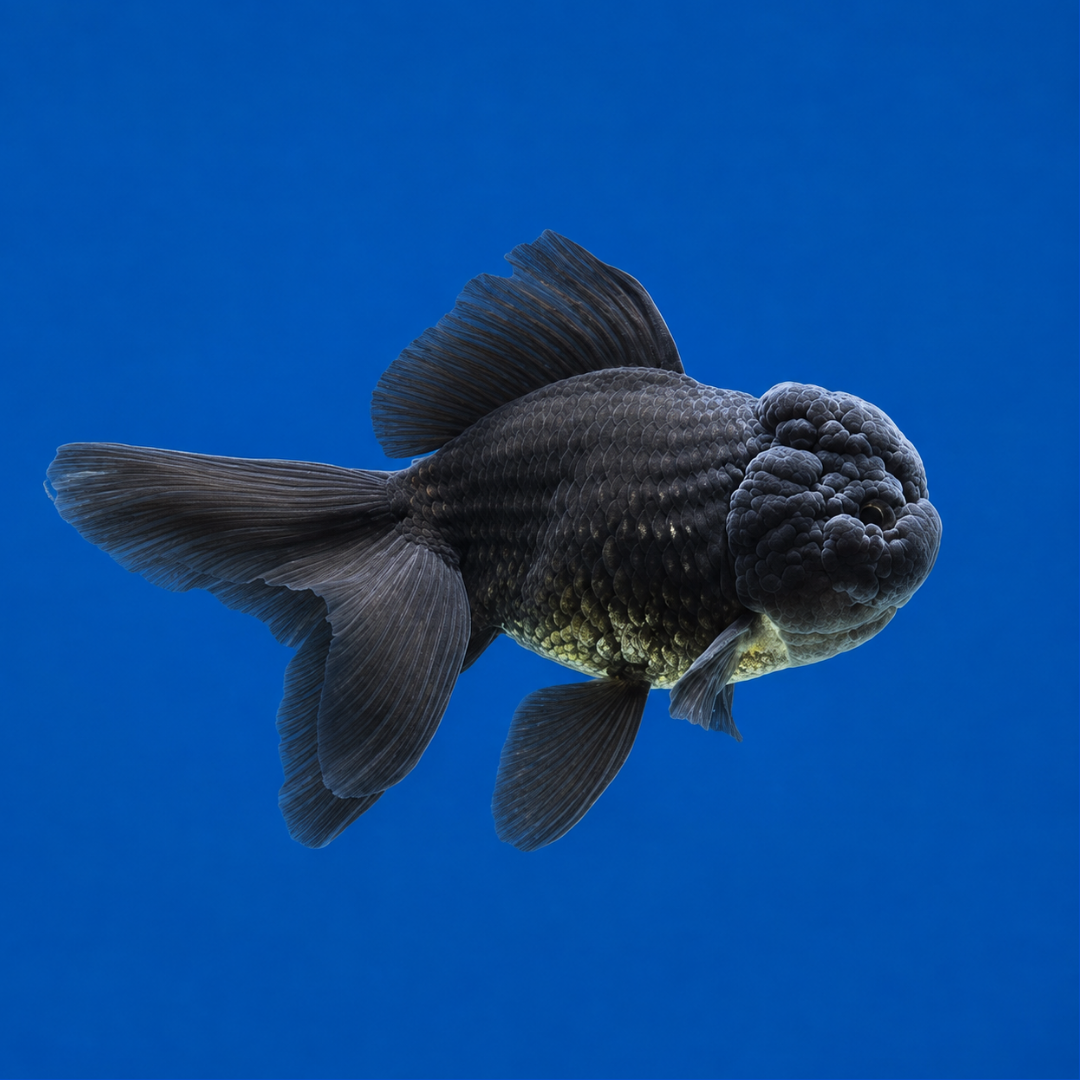
解説 / Description
黒オランダ獅子頭は、オランダ獅子頭の特徴である豊かな肉瘤、背ビレ、複尾を備え、黒色の体色を特徴とする改良金魚です。丸みのある体と頭部の肉瘤がつくる重厚なシルエットに黒色が重なり、赤や更紗のオランダとは異なる落ち着いた存在感を見せます。黒色の濃さや残り方には個体差があり、成長に伴って腹部や体側が褐色、金色、橙色へ変化する個体もいます。こうした体色の変化も含めて、一尾ごとの違いを見守ることが黒オランダを飼う面白さのひとつです。泳ぎは和金のような細長い金魚ほど速くないため、強すぎない水流を避け、十分な水量と安定した水質を保つことが大切です。 The Black Oranda is a fancy goldfish with the characteristic head growth, upright dorsal fin and double tail of the Oranda, together with a predominantly black body color. Its rounded body and head growth create a substantial silhouette, while the dark coloration gives it a distinct appearance compared with red or calico Orandas. The depth and persistence of black vary among individuals, and some fish develop brown, gold or orange areas as they mature. These changes are part of the individual variation seen in the variety. Because the Black Oranda is a slower swimmer than streamlined goldfish, it benefits from generous water volume, stable water quality and a gentle current.
基本情報 / Basic Information
| 学名 / Scientific Name | Carassius auratus |
|---|---|
| 通称 / Common Name | 黒オランダ、黒オランダ獅子頭、ブラックオランダBlack Oranda, Black Oranda Goldfish |
| 分類 / Family | コイ目・コイ科・フナ属に属する金魚の改良品種Order Cypriniformes, family Cyprinidae, genus Carassius; a domesticated goldfish variety |
| 英名 / English Name | Black Oranda Goldfish |
| 分布 / Distribution | 自然分布を持つ野生型ではなく、金魚として人為的に維持される改良品種です。金魚の家畜化は中国に起源を持ち、黒オランダも現在は国内外の養魚場で繁殖・流通しています。This is a domesticated ornamental variety rather than a naturally occurring wild population. Goldfish domestication originated in China, and Black Orandas are now bred and traded by ornamental-fish farms in many regions. |
| 最大体長 / Max Size | 飼育下では15~25cmほどがひとつの目安です。個体差が大きく、血統や飼育期間、飼育環境によってはさらに大型になることもあります。A typical captive length is around 15–25 cm, although size varies considerably among individuals and some may grow larger depending on genetics, age and husbandry. |
| 寿命 / Lifespan | 適切な飼育下では10~15年ほどがひとつの目安で、良好な環境ではそれ以上に長生きする例もあります。About 10–15 years is a useful husbandry guideline under appropriate care, and some individuals live longer in favorable conditions. |
飼育環境 / Aquarium Environment
| 水槽サイズ / Tank Size | 幼魚1匹なら60cm規格水槽(容量約60L前後)がひとつの出発点ですが、成魚まで長く飼う場合は90cm規格水槽(容量約180L)など、より水量に余裕のある水槽を検討すると管理しやすくなります。複数飼育では、匹数や成魚時の体格、ろ過能力に応じてさらに余裕を持たせます。黒オランダは排泄量が多いため、体長だけでなく水量とろ過能力を合わせて考えることが重要です。For a single juvenile, a standard 60 cm aquarium of roughly 60 L can be used as a starting point, but long-term adult care is easier in a standard 90 cm aquarium of about 180 L or another setup with similarly generous water volume. For multiple fish, allow additional space according to adult body size, stocking level and filtration capacity. Orandas produce substantial waste, so water volume and filtration should be considered together rather than judging the setup by fish length alone. |
|---|---|
| 水温 / Temperature | 家庭の水槽ではおおむね18~25℃前後をひとつの目安とし、急激な水温変化を避けて安定させます。水温が下がると活動や消化も低下するため、無加温で冬越しさせる場合は水温に合わせて給餌量を減らし、低水温時に無理に食べさせないことが大切です。 Roughly 18–25°C is a practical household-aquarium guideline, with stability more important than chasing a single exact temperature. Activity and digestion slow as the water cools, so if fish are overwintered without heating, reduce feeding with falling temperature and do not force food at low temperatures. |
| 水質 / Water Quality | 中性付近から弱アルカリ性の範囲を目安に、急変のない安定した水質を保ちます。アンモニアと亜硝酸は検出されない状態を目標とし、硝酸塩と有機物の蓄積も定期的な換水で抑えます。金魚は丈夫と思われがちですが、黒オランダの肉瘤やヒレを良い状態に保つには、十分な酸素供給、水量に見合ったろ過能力、強すぎない水流、定期的な換水が重要です。Maintain stable water around neutral to mildly alkaline conditions. Ammonia and nitrite should remain undetectable, while nitrate and dissolved organic waste should be controlled through regular water changes. Goldfish are often considered hardy, but clean, well-oxygenated water is essential for keeping the head growth, fins and skin of a Black Oranda in good condition. |
| レイアウト / Layout | 泳ぐ空間を広く取り、尖った石や枝、狭い隙間など肉瘤やヒレを傷つけやすい素材は避けます。底床は掃除を優先したベアタンク、または大磯砂などを薄く敷く方法が管理しやすいでしょう。吸水口にはスポンジを付け、強い水流が魚体へ直撃しないように調整します。一般の金魚では、背景色によって体色や色彩調節に関わる内分泌反応が変化することが研究で示されています。ただし、暗い背景が黒オランダの黒色を一生維持する方法として確立されているわけではありません。Provide broad open swimming space and avoid sharp rocks, rough wood or narrow gaps that could damage the head growth or fins. A bare-bottom setup is easiest to clean, although a thin layer of smooth gravel such as Japanese Oiso gravel can also work. Protect filter intakes with sponge and diffuse strong flow. Studies in goldfish have shown that background color can affect body coloration and the endocrine systems involved in color regulation. However, a dark background has not been established as a way to preserve the black coloration of Black Orandas for life. |
| 注意点 / Precautions | 丸い体型と発達した肉瘤のため俊敏ではなく、強い水流や餌の奪い合いが負担になりやすい品種です。肉瘤が過度に発達すると視界を狭めることがあり、擦り傷などの皮膚障害は二次感染のきっかけになることがあります。また、黒色は成長とともに変化することがあり、明るい色へ変わっただけで病気とは判断できません。急な体色変化に食欲低下、充血、粘液の増加、泳ぎ方の異常などが伴う場合は、水質や健康状態を確認します。Its rounded body and pronounced head growth make this variety less agile than streamlined goldfish, so strong current and intense competition for food can be stressful. Excessive head growth may restrict vision, and abrasions or other skin damage can become starting points for secondary infection. Black coloration may also change naturally with age, so fading alone does not establish disease. If rapid color change occurs together with poor appetite, reddening, excess mucus or abnormal swimming, check water quality and the fish’s overall health. |
餌と給餌 / Feeding
| 餌の種類 / Diet | 主食には消化性の良い金魚用の沈下性ペレットやゲルフードを用い、冷凍赤虫などの動物質は補助的に与えます。柔らかくした葉野菜や植物質を含む餌も組み合わせると、単一の高タンパク餌に偏りにくくなります。肉瘤の成長を意識する場合でも、栄養価の高い餌を大量に与えるより、総合栄養食を中心に体型と糞の状態を見ながら調整することが安全です。Use a digestible sinking goldfish pellet or gel food as the staple diet. Frozen bloodworms and similar animal-based foods can be offered as supplements, while softened leafy vegetables or foods containing plant material help prevent an overly protein-heavy diet. Even when promoting head growth, it is safer to rely on a balanced staple and adjust quantity according to body condition and fecal quality rather than simply feeding large amounts of high-protein food. |
|---|---|
| 給餌のポイント / Feeding Tips | 活発に動いている時期は、1日1~3回を目安に、短時間で食べ切れる量を少量ずつ与えます。水温が下がって消化が鈍る時期は回数と量を減らします。水面で餌と一緒に空気を吸い込みやすい個体では、沈下性の餌が扱いやすいことがあります。食後に浮く、傾く、腹部が張るといった症状が出る場合は、給餌量、水温、水質、消化状態などを確認し、症状だけで原因を「浮袋の病気」と決めつけないことが大切です。When the fish are active, feed small portions one to three times daily, giving only what can be consumed promptly. Reduce both frequency and quantity as the water becomes colder and digestion slows. Sinking foods can be useful for individuals that take in excessive air while feeding at the surface. If a fish floats, tilts or becomes distended after meals, first reassess feeding quantity, temperature, water quality and digestive condition rather than diagnosing a swim-bladder disorder from the symptom alone. |
性格と混泳 / Temperament and Tank Mates
| 性格 / Temperament | 基本的には温和で、人にも慣れやすい金魚です。水槽の前に人が来ると餌を期待して寄ってくる個体も多く、ゆったりした泳ぎと表情の変化を楽しめます。繁殖期にはオスがメスを追尾するため、一時的に激しく追い回しているように見えることがあります。Black Orandas are generally peaceful and often become accustomed to their keeper, frequently approaching the front of the aquarium when people appear. Their slow swimming and expressive appearance make them engaging display fish. During the breeding season, males may vigorously chase females, which can temporarily look more aggressive than their usual behavior. |
|---|---|
| 混泳の相性 / Compatibility | もっとも相性が良いのは、オランダ獅子頭、琉金、東錦など、泳ぐ速さと体型が近い丸手の金魚です。和金、コメットなど俊敏な品種とは餌の競争で不利になることがあります。ヒレをつつく魚、口に入る小型魚や小型エビとの混泳は避けた方が安全です。熱帯魚との混泳は水温、餌、泳力、疾病管理の条件が合いにくいため、金魚同士でまとめる飼い方が基本です。The best companions are similarly slow, deep-bodied fancy goldfish such as other Orandas, Ryukins and Azumanishiki-type fish. Fast varieties such as Common Goldfish or Comets can outcompete them at feeding time. Avoid fin-nipping fish and very small fish or shrimp that may be swallowed. Mixing with tropical species is generally not ideal because temperature, diet, swimming ability and disease-management requirements often differ. |
病気と対策 / Diseases and Prevention
| かかりやすい病気 / Common Diseases | 丸い体型の金魚では浮力異常や転覆症状がみられることがあり、消化状態、水温、体型、内部疾患、感染など複数の要因が関与します。外部寄生虫では白点病の原因となる白点虫や、エラ・体表に寄生する吸虫類に注意が必要です。細菌性疾患では、エロモナス属やフラボバクテリウム属が関与する病変などがみられます。黒オランダでは肉瘤の擦り傷などの皮膚障害から二次感染が起こることもあります。購入直後や輸送直後は、ストレスを受けた魚の体調変化を特に注意して観察します。Deep-bodied fancy goldfish can develop buoyancy disorders or loss of balance, and these signs may involve digestion, temperature, body conformation, internal disease or infection rather than a single cause. External parasites such as the ciliate that causes ich and gill or skin flukes are important concerns. Bacterial lesions involving Aeromonas or Flavobacterium species may also occur. In Black Orandas, abrasions or other skin damage around the head growth can become sites of secondary infection. Newly purchased or recently transported fish should be watched closely for changes in condition after transport stress. |
|---|---|
| 対策と予防 / Prevention | 予防の中心は、過密を避け、アンモニアと亜硝酸が検出されないろ過環境を保ち、定期換水と十分な酸素供給を続けることです。新しい魚は可能であれば30日以上を目安に別容器で観察し、食欲、糞、呼吸、体表、ヒレ、肉瘤の状態を確認してから合流させます。病気が疑われる場合は隔離して水質を確認し、原因に合った魚病薬を製品の用法・用量に従って使用します。細菌用薬、色素剤、殺虫剤などを根拠なく重ねて使用すると魚体やろ過への負担が増えるため、複数薬の自己判断での混用は避け、重症例では魚類診療に対応する獣医師や経験豊富な専門店へ相談するのが安全です。Prevention is based on avoiding overcrowding, maintaining filtration that keeps ammonia and nitrite undetectable, performing regular water changes and providing good oxygenation. When possible, observe new fish in a separate quarantine system for at least 30 days before introduction, checking appetite, feces, respiration, skin, fins and head growth. If disease is suspected, isolate the fish, verify water quality and use an appropriate fish medication according to the product label and the likely diagnosis. Unnecessary combinations of antibacterial drugs, dyes and antiparasitic chemicals can increase stress and damage the biofilter, so avoid indiscriminate drug mixing and seek aquatic veterinary or experienced professional advice for severe cases. |
増やし方(繁殖) / Breeding
| 雌雄の判別 / Sexing | 成熟期のオスは胸ビレの前縁やエラぶたに白い粒状の追星が現れやすく、繁殖期にはメスを追尾します。メスは産卵期に腹部がふっくらし、上から見ると左右へ張り出して見えることがあります。ただし若魚や繁殖期以外では外見だけの判別が難しく、追星や腹部の形だけで100%確実に判断できるわけではありません。Mature males commonly develop small white breeding tubercles on the leading rays of the pectoral fins and on the gill covers, and they actively chase females during the spawning season. Females often become fuller through the abdomen as eggs develop. Outside the breeding season, however, sexing can be difficult, and no single external sign is completely reliable in every individual. |
|---|---|
| 繁殖形態 / Reproduction | 卵生で、繁殖期にオスがメスを追い、メスが水草や産卵床へ粘着性の卵を散らしながらオスが放精して受精させます。親魚による卵の保護は行われず、むしろ産卵後に卵を食べるため、採卵を目的とする場合は親魚と卵を分けます。Black Orandas are egg-laying fish. During spawning, males chase females as the females scatter adhesive eggs onto plants or spawning media and the males release milt for external fertilization. The parents do not guard the eggs and may eat them after spawning, so eggs and adults should be separated when fry production is the goal. |
| 繁殖のポイント / Breeding Tips | 健康な親魚を十分に育て、冬から春にかけて水温が上がる季節変化を利用すると繁殖行動を引き出しやすくなります。産卵用の水草や人工の産卵モップを多めに用意し、産卵確認後は親魚を移動します。受精卵は清潔で十分に酸素が供給される水で管理し、白く濁った死卵はカビの広がりを防ぐため適宜取り除きます。孵化後の稚魚は口が小さいため、初期は適切な微細餌を与え、成長に合わせてブラインシュリンプ幼生などへ段階的に切り替えます。黒色や肉瘤、尾型は親の見た目どおりに揃うとは限らず、改良金魚の繁殖では多数の稚魚から長期的に選別する工程が必要です。Condition healthy broodstock well and use the seasonal rise in water temperature from winter into spring to encourage spawning behavior. Provide abundant aquatic plants or artificial spawning mops and remove the adults after spawning is confirmed. Keep fertilized eggs in clean, well-oxygenated water and remove opaque dead eggs as needed to limit fungal spread. Newly hatched fry require very fine first foods, progressing to foods such as newly hatched brine shrimp as they grow. Black coloration, head growth and tail shape do not reproduce uniformly from the parents, so selective breeding of fancy goldfish requires raising many fry and selecting them over time. |
雑学と豆知識 / Trivia and Fun Facts
| 1. 「オランダ」なのに、原産地がオランダという意味ではない / 1. “Oranda” does not simply mean the fish came from the Netherlands | オランダ獅子頭という名前から、ヨーロッパのオランダを原産地だと受け取りやすいものの、金魚の家畜化と多様化の中心は中国です。「オランダ」という呼び名の成立経緯には複数の説明があり、近世日本で舶来品や異国を連想させる語として使われた「オランダ」と結びつける説があります。少なくとも、この名称をそのまま生物学的な原産地表示として読むのは適切ではありません。黒オランダの名前には、金魚が中国から日本へ伝わり、観賞文化の中で独自の呼称を得てきた歴史が残っています。The name Oranda can suggest a Dutch origin, but the main history of goldfish domestication and diversification lies in China. More than one explanation has been given for how the Japanese name developed, including an association with the early-modern use of “Oranda” for things perceived as foreign or imported. The name should therefore not be read as a literal statement that the breed originated in the Netherlands. It also reflects the history of goldfish moving from China into Japanese ornamental culture. |
|---|---|
| 2. 肉瘤は「脂肪のこぶ」ではなく、オランダを象徴する特殊な皮膚組織 / 2. The head growth is not simply a lump of fat | オランダ獅子頭の肉瘤は英語圏で「Wen」と呼ばれ、頭頂部から頬にかけて発達します。組織学的には、上皮の過形成に加えて真皮の肥厚や浮腫などが確認されており、単純な脂肪の塊ではありません。つまり、皮膚とその下の組織が大きく発達してできる構造です。若魚では目立たなくても成長とともに輪郭が変わり、同じ個体でも年齢によって顔つきが変化します。肉瘤が眼を覆うほど発達すると視界へ影響することがあるため、大きさだけでなく、魚が無理なく生活できる形であることも大切です。The Oranda head growth is commonly called a “wen” and develops over the crown and cheeks. Histological studies have described epithelial hyperplasia together with thickening and edema of the dermis, showing that it is not simply a lump of fat. In practical terms, it is a structure formed by pronounced growth of the skin and underlying tissue. It may be subtle in young fish and change considerably with age. If the wen grows over the eyes it can restrict vision, so good conformation is not only about size but also about allowing the fish to function normally. |
| 3. 金魚は千年以上の選抜育種が生んだ「形の博物館」 / 3. Goldfish are a living museum of more than a millennium of selective breeding | 現代のゲノム研究では、金魚が中国のフナ類を基盤に千年以上にわたる人為選抜を受け、体型、眼、ヒレ、色彩に非常に多様な形質を蓄積してきたことが示されています。オランダの背ビレ、複尾、肉瘤という組み合わせも、その長い育種史の中で受け継がれてきた形のひとつです。金魚の複尾は発生生物学の研究対象にもなっており、観賞魚として見慣れた特徴が、脊椎動物の体の形がどのように生まれるのかを考える手がかりにもなっています。Modern genomic research shows that goldfish were shaped from Chinese Carassius lineages through more than a thousand years of artificial selection, accumulating remarkable diversity in body form, eyes, fins and coloration. The Oranda combination of an upright dorsal fin, double tail and head growth is one product of that long breeding history. The twin tail itself has become a subject of developmental-biology research, so a familiar ornamental trait can also help researchers study how vertebrate body forms arise. |
| 4. 黒色は「塗られた色」ではなく、色素細胞と環境がつくる動的な表現 / 4. Black coloration is a dynamic product of pigment cells and environment | 金魚の体色には黒色素胞や黄色素胞など複数の色素細胞が関わります。一般の金魚を用いた研究では、白い背景と黒い背景の違いによって体色が変わり、黄色素胞の密度や、メラニン凝集ホルモンなど色彩調節に関わる遺伝子の発現も変化することが報告されています。水温によって、こうした色彩調節に関わる内分泌反応が変わることも示されています。つまり、金魚の体色は遺伝だけで完全に固定されたものではなく、環境や生理状態の影響も受けるということです。ただし、これらは黒オランダの黒色維持だけを直接検証した研究ではないため、暗い背景や特定の水温で退色を防げるとまではいえません。Goldfish coloration involves several pigment-cell types, including melanophores and xanthophores. Studies using goldfish on white and black backgrounds have reported changes in visible body color, xanthophore density and expression of genes involved in hormonal color regulation, including the melanin-concentrating hormone system. Water temperature can also alter some of these endocrine responses. In other words, goldfish body color is not determined by genetics alone; environmental and physiological conditions can influence its expression. These studies were not designed specifically to test lifelong black-color retention in Black Orandas, so they do not show that a dark background or a particular temperature can prevent fading. |
| 5. 同じ黒オランダでも、体型や尾型には幅がある / 5. Black Orandas vary widely in body and tail form | 黒オランダとして流通する魚の中にも、体の長さや丸み、肉瘤のつき方、尾ビレの長さや開き方に幅があります。ショートボディ、ショートテール、ローズテールなどの呼称が使われることもありますが、これらは学術上の別種を示す分類ではなく、主に育種や流通の中で姿の特徴を表すために使われる名称です。産地名だけで形質を決めつけるよりも、実際の個体の体型、尾の左右差、泳ぎ方、肉瘤の状態を見て選ぶ方が、黒オランダの多様さを正確に捉えられます。Black Orandas in the trade vary in body length and depth, head-growth development, and the length and spread of the tail. Terms such as short body, short tail and rose tail may be used to describe these appearances, but they are breeding and trade descriptions rather than separate scientific species. Instead of assuming that origin alone determines conformation, it is more useful to evaluate the individual fish’s body balance, tail symmetry, swimming ability and condition of the head growth. |
| 6. KHVでは「コイの病気」と「金魚の防疫」を分けて考える / 6. KHV disease in carp and biosecurity for goldfish should be considered separately | コイヘルペスウイルス病は、主にマゴイやニシキゴイで問題になる疾病です。世界動物保健機関(WOAH)の水生動物衛生マニュアルでは、金魚はKHVへの感受性を確定するには証拠が不十分な魚種として整理されています。したがって、金魚を典型的なKHV発症魚として扱うのも、「金魚だからKHVとは無関係」と言い切るのも正確ではありません。一般の飼育では、KHVだけを過度に恐れるより、新しい魚を隔離し、網や容器をむやみに共用しないといった基本的な防疫を続けることが重要です。Koi herpesvirus disease is primarily a disease of common carp and koi. The World Organisation for Animal Health (WOAH) Aquatic Manual lists goldfish among species for which the evidence is insufficient to establish susceptibility to KHV. It is therefore inaccurate either to treat goldfish as typical KHV-disease hosts or to state that they are completely irrelevant to KHV. In routine husbandry, the practical priority is sound biosecurity: quarantine new fish and avoid unnecessary sharing of nets, containers and water between groups. |
まとめ / Conclusion
黒オランダ獅子頭は、豊かな肉瘤、丸い体、複尾というオランダらしい造形に、黒色の体色が加わった金魚です。成魚の大きさと排泄量を見越して十分な水量を確保し、穏やかな水流と安定した水質を保つことで、そのゆったりした泳ぎと立体的な頭部を長く楽しめます。黒色は個体や成長によって変化することがあるため、色だけにとらわれず、食欲、ヒレ、肉瘤、姿勢、泳ぎ方を含めた健康状態を見ながら飼育することが大切です。 The Black Oranda combines the rounded body, double tail and expressive head growth of the Oranda with a black body color. Provide enough water volume for its adult size and waste production, together with a gentle current and consistently stable water quality, to support its slow swimming style and distinctive head growth. Because black coloration can change with age and among individuals, overall health should be judged from appetite, fins, head growth, posture and swimming behavior rather than color alone.
餌の時間に人の気配へ反応して水槽の前へ寄ってくる仕草や、年齢とともに肉瘤や体型が変化していく様子には、一尾ごとの個性が表れます。幼魚の頃の黒色が少しずつ変わることも含め、その変化を健康状態とあわせて見守ることで、黒オランダは年月とともに異なる表情を見せてくれる観賞魚として長く付き合えるでしょう。 Its response to people at feeding time and the gradual development of its head growth and body shape give each Black Oranda a distinctive presence. Even changes in the dark coloration seen in younger fish can be part of that individual variation. By watching these changes together with the fish’s health and behavior, the keeper can enjoy an ornamental fish whose appearance continues to develop over many years.

気になる道具や飼い方を見つけてみませんか?
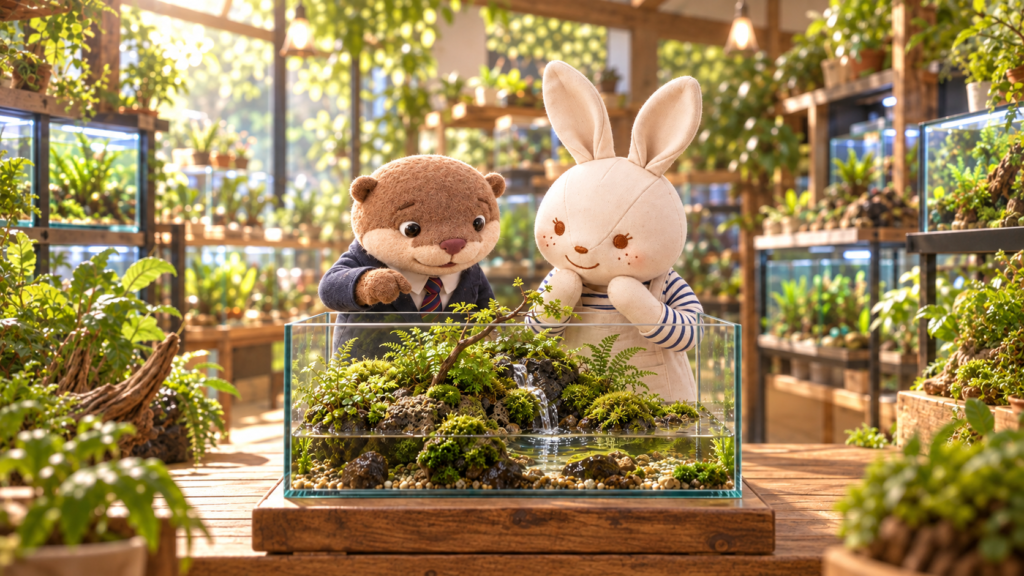 アイのアクアグッズ案内水槽の中に陸地がある!? コタロウと探るアクアテラリウムのメカニズム滝の水はどこから来るの? 白い霧の正体は? アイとコタロウが、水の循環、隠れたポンプ、霧の装置、陸上の植物と水草の葉の変化から、アクアテラリウムのメカニズムを探ります。記事はコチラ →
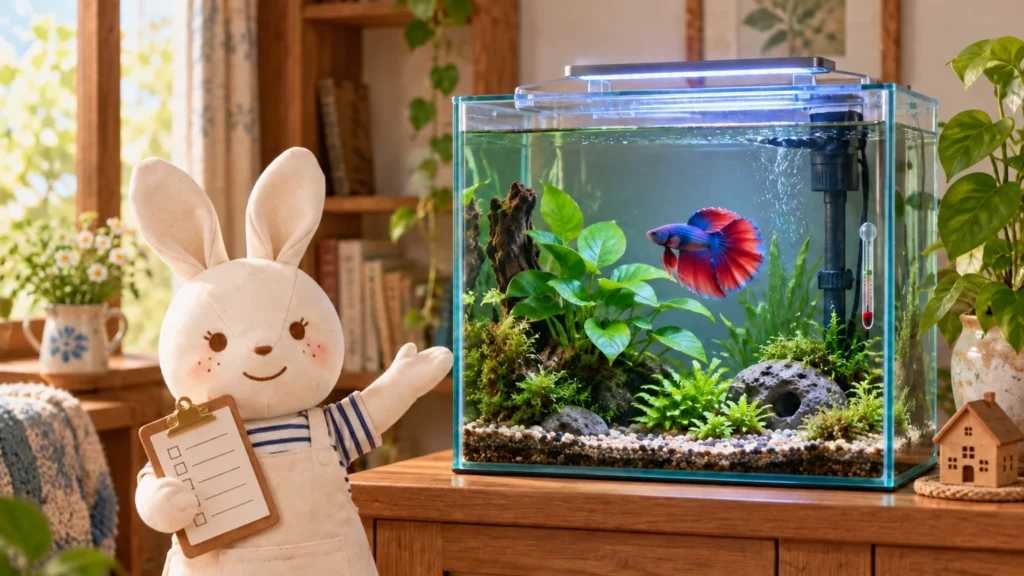 アイのアクアグッズ案内ベタの一匹飼いを楽しむ|水槽・ヒーター・ふた・フィルターの選び方ベタの一匹飼いに向く水槽容量、ふたと空気層、ヒーターと水温計、弱い水流のフィルターを、コタロウとアイの会話で分かりやすく解説します。記事はコチラ →
さまざまな飼育テーマをご紹介。リンク先の記事には広告・商品紹介が含まれます。
案内・紹介記事一覧へ →分布マップ
黒オランダ獅子頭(Carassius auratus)は自然分布を持つ野生型ではなく、人為的に維持・繁殖されている金魚の改良品種です。金魚の家畜化は中国に起源を持ち、現在の黒オランダ獅子頭は日本を含む世界各地の養魚場や観賞魚市場で繁殖・流通しています。地図では、その歴史的起源を示すため中国を中心とした東アジアを概略表示しています。
※この地図は分布・由来を理解するための概略表示です。黒オランダ獅子頭は野生の自然個体群ではなく、現在は世界各地で飼育・繁殖されています。マーカーは金魚の家畜化の起源地域を示すために設定した代表地点であり、黒オランダ獅子頭の実際の採集地点や特定の養魚場を示すものではありません。
参考文献
-
FishBase. Carassius auratus (Linnaeus, 1758).分類、基礎種の分布・生息環境、体サイズ、食性、産卵生態の確認に使用。
-
Wang, S.-Y., Luo, J., Murphy, R. W., Wu, S.-F., Zhu, C.-L., Gao, Y. & Zhang, Y.-P. (2013). Origin of Chinese Goldfish and Sequential Loss of Genetic Diversity Accompanies New Breeds. PLOS ONE, 8(3), e59571.金魚の中国における家畜化起源と、改良品種が人為選抜によって形成されてきた背景の確認に使用。
-
Ornamental Aquatic Trade Association (OATA). How to look after fancy goldfish.オランダを含む丸手の改良金魚について、水温、水質、水槽容量、ろ過、穏やかな水流、給餌、雌雄判別などの飼育条件の確認に使用。
-
Francis-Floyd, R., Yanong, R. P. E. & Petty, B. D. Environmental Diseases of Aquatic Animals in Aquatic Systems. Merck Veterinary Manual.アンモニア、亜硝酸、溶存酸素、pH、水温変動など、水質管理と環境性疾患の基礎資料として使用。
-
Petty, B. D., Francis-Floyd, R. & Yanong, R. P. E. Management of Aquarium Fish. Merck Veterinary Manual.新規導入魚の隔離、30日以上を基準とする検疫、器具の分離、疾病時の診断と薬剤使用に関する基本方針の確認に使用。
-
Kobayashi, M., Iwata, E. & Sorensen, P. W. (2026). Environmental and Physiological Regulation of Reproduction in the Goldfish: Gonadal Development, Maturation, and Spawning Behavior: A Review. Animals, 16(5), 775.金魚の成熟、季節変化、繁殖行動、産卵に関わる生理学的背景の確認に使用。
-
Petty, B. D., Francis-Floyd, R. & Yanong, R. P. E. Bacterial Diseases of Fish. Merck Veterinary Manual.金魚で問題となるAeromonas属細菌、Flavobacterium columnare、外傷や水質悪化などの発症要因、診断と抗菌薬使用の考え方の確認に使用。
-
Trujillo-González, A., Becker, J. A. & Hutson, K. S. (2018). Parasite Dispersal From the Ornamental Goldfish Trade. Advances in Parasitology, 100, 239–281.白点虫を含む金魚の寄生虫相と、観賞魚流通を介した寄生虫伝播・防疫上の注意点の確認に使用。
-
World Organisation for Animal Health (WOAH). Aquatic Manual, Chapter 2.3.6. Infection with koi herpesvirus.KHVの主要宿主と、金魚について感受性を確定する証拠が不十分とされる現在の整理の確認に使用。





コメント