

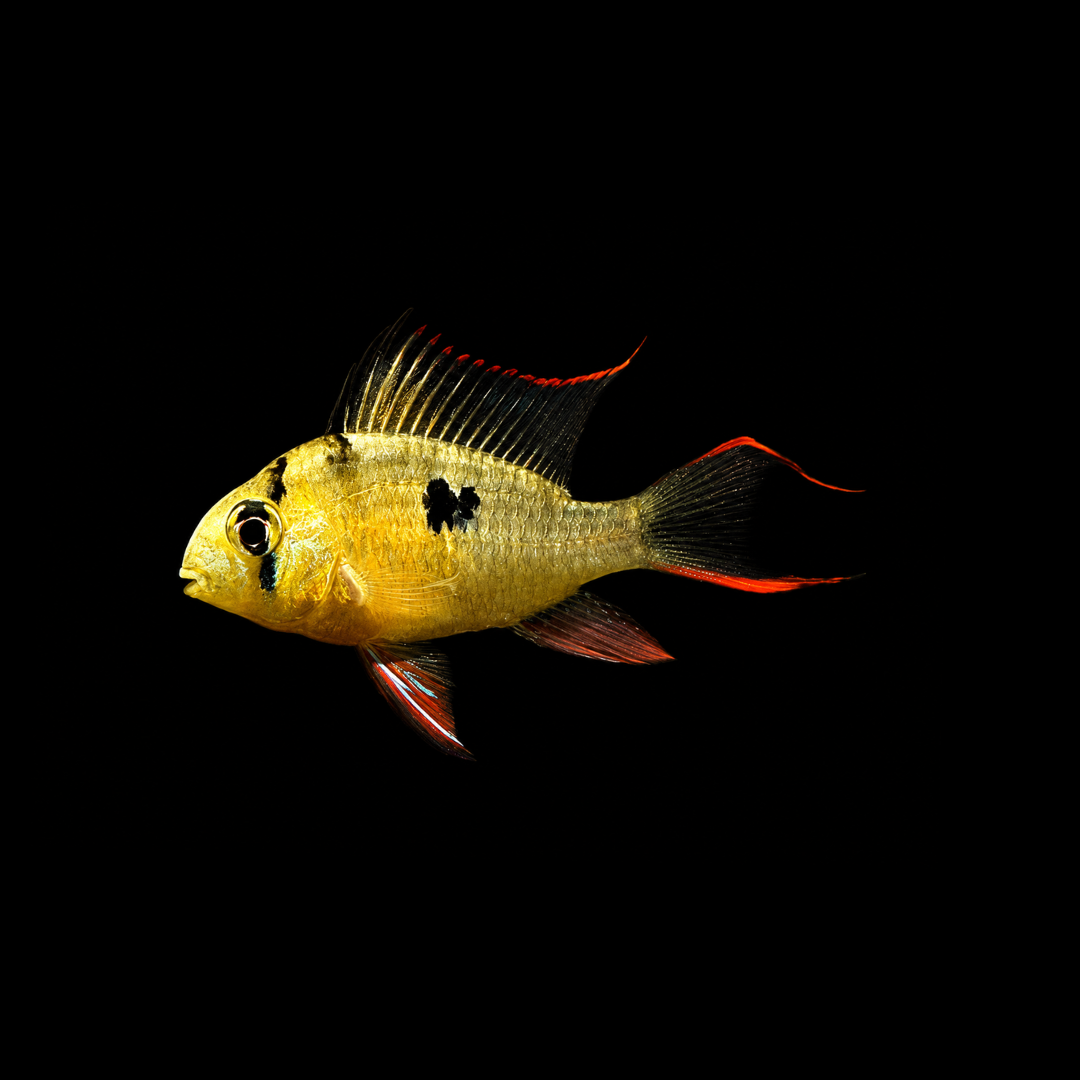
解説 / Description
ミクロゲオファーガス・アルティスピノーサは、南米のグアポレ川水系(ブラジル・ボリビア)とマモレ川水系(ボリビア)に分布する小型シクリッドです。日本では「ボリビアラム」の名で親しまれ、銀灰色から淡いオリーブ色の体に、腹部の黄橙色、目を通る黒帯、背びれや尾びれの赤や青がアクセントとして重なります。落ち着いた環境では色彩が引き立ち、底床の砂を口に含んで餌を選り分ける採餌行動や、ペアが卵や仔魚を守る繁殖行動も観察できます。同属のラミレジィと比べると、一般に幅広い飼育条件に適応しやすいとされますが、細かな砂、安定した水質、落ち着ける環境を整えることが、本来の行動と美しさを引き出す基本になります。 Mikrogeophagus altispinosus is a small South American cichlid native to the Guaporé drainage of Brazil and Bolivia and the Mamoré drainage of Bolivia. Widely known as the Bolivian Ram, it has a silver-gray to pale olive body with warm yellow-orange tones, a dark band through the eye, and red and blue accents on the fins. In a settled aquarium, its colors become more apparent and its characteristic substrate-sifting behavior can be observed, as can the parental care shown by established breeding pairs. Compared with M. ramirezi, it is generally regarded as more adaptable to a range of aquarium conditions, but fine sand, stable water quality, and a calm environment remain important for maintaining natural behavior and good condition.
基本情報 / Basic Information
| 学名 / Scientific Name | Mikrogeophagus altispinosus (Haseman, 1911) |
|---|---|
| 通称 / Common Name | ボリビアラム、アルティスピノーサ、パピリオクロミス・アルティスピノーサ(旧属名に由来する流通名)Bolivian Ram, Bolivian Butterfly Cichlid |
| 分類 / Family | シクリッド目・シクリッド科・ゲオファーガス族・ミクロゲオファーガス属Order Cichliformes, Family Cichlidae, Tribe Geophagini, Genus Mikrogeophagus |
| 英名 / English Name | Bolivian Ram |
| 分布 / Distribution | 南米アマゾン川水系の上部マデイラ川流域に分布します。確認されている主な分布域は、グアポレ川(ボリビア名イテネス川)水系のブラジル・ボリビアと、マモレ川水系のボリビアです。Upper Madeira drainage of the Amazon basin in South America. It is recorded from the Guaporé drainage in Brazil and Bolivia, where the river is known as the Iténez in Bolivia, and from the Mamoré drainage in Bolivia. |
| 最大体長 / Max Size | 最大標準体長として5.6cmの記録があります。標準体長は尾びれを除いて測るため、ひれを含む全長では7〜8cm前後とされることもあり、測定方法によって数値が異なります。成熟したオスはメスよりやや大きくなる傾向があります。A maximum standard length of 5.6 cm has been recorded. Because standard length excludes the caudal fin, total-length figures that include the fins may be around 7–8 cm, so stated sizes vary with the measurement method. Mature males tend to be somewhat larger than females. |
| 寿命 / Lifespan | 飼育下の寿命は個体差や環境差が大きく、一律の値は定まっていません。5年前後が一つの目安ですが、水質、食事、導入時の状態などによって変わります。Lifespan varies considerably among individuals and conditions, so there is no single fixed figure. Around five years is a useful general estimate, but actual longevity depends on water quality, diet, and the condition of the fish at introduction. |
飼育環境 / Aquarium Environment
| 水槽サイズ / Tank Size | 一般飼育では60cm規格水槽(約60L)以上を目安にします。ペアだけの飼育でも、繁殖期の縄張りと水質の安定を考えると、底面積と水量に余裕があるほうが管理しやすく、45cmクラスは繁殖用など限定的な管理に向きます。複数個体から自然にペアを形成させる場合は、90cmクラス(約150〜180L)など、底面積を広く取れる水槽が適しています。For general maintenance, a standard 60 cm aquarium of about 60 L or larger is a practical starting point. Even for a pair, extra floor space and water volume make territorial breeding periods and water-quality management easier; a 45 cm-class tank is better reserved for limited uses such as a dedicated breeding setup. Groups intended for natural pair formation are better housed in a 90 cm-class aquarium of roughly 150–180 L or another tank with generous bottom area. |
|---|---|
| 水温 / Temperature | 22〜27℃程度を目安にします。日常飼育では上限近くの高温を維持することより、急激な温度変化を避けて安定させることを優先します。 Aim for about 22–27°C. Rather than maintaining the fish near the upper end of the range, prioritize stability and avoid sudden temperature swings. |
| 水質 / Water Quality | 弱酸性〜中性付近の軟水から中程度の硬度が扱いやすく、pH 6.0〜7.5程度が目安です。数値を無理に合わせるより、アンモニアと亜硝酸塩が検出されない、よく立ち上がったろ過環境を維持し、急変を避けることを優先します。Slightly acidic to near-neutral water with soft to moderate hardness is suitable; pH 6.0–7.5 is a practical target range. Rather than forcing exact numbers, prioritize a mature biological filter, undetectable ammonia and nitrite, and avoidance of abrupt changes. |
| レイアウト / Layout | 角のない細かな砂を底床に用い、砂を口に含んで選り分けられる開けた場所を残します。流木、石、水草で視線を遮る場所と隠れ家を作りつつ、産卵床になり得る平らな石も配置すると自然な行動を観察しやすくなります。水流は強すぎないほうが向き、水草水槽にも合わせやすい魚です。Use smooth, fine sand and leave open areas where the fish can take substrate into the mouth and sift it naturally. Driftwood, stones, and plants should provide cover and visual barriers, while a few flat stones can serve as potential spawning sites. Moderate to gentle flow is preferable, and the species integrates well into planted aquariums. |
| 注意点 / Precautions | 底床採餌を日常的に行うため、鋭利な砂利や粗すぎる底床は避けます。比較的丈夫ですが、水質の急変や慢性的な汚れには弱く、導入直後は特に慎重な水合わせが必要です。また、繁殖期には普段より縄張り意識が強くなるため、混泳魚が逃げ込める空間を確保してください。Because substrate sifting is a routine behavior, avoid sharp gravel and excessively coarse substrates. Although relatively hardy, the species can suffer from sudden water-parameter changes or chronically poor water quality, so careful acclimation is important. Territorial behavior increases during breeding, making escape routes and visual barriers essential for tank mates. |
餌と給餌 / Feeding
| 餌の種類 / Diet | 雑食性で、底床を探りながら小型の無脊椎動物や有機物などを利用します。飼育下では、口に入りやすい小粒の沈下性顆粒飼料を主食にし、冷凍赤虫、ブラインシュリンプ、ミジンコなどを補助的に与え、特定の餌だけに偏らせないようにします。Omnivorous, feeding from the substrate on small invertebrates and organic material. In aquaria, small sinking granules make a suitable staple and can be supplemented with foods such as frozen bloodworms, brine shrimp, and daphnia. A varied diet is preferable to relying heavily on a single food type. |
|---|---|
| 給餌のポイント / Feeding Tips | 中層〜底層でゆっくり採餌するため、上層の素早い魚と混泳していると餌を取り負けることがあります。沈下する餌を複数箇所へ落とし、本種が確実に口にできているか確認します。1回量は数分で食べ切れる程度に抑え、食べ残しを底床に蓄積させないようにします。Because the fish feeds deliberately in the middle and lower zones, fast surface-feeding tank mates may outcompete it. Distribute sinking food in several areas and make sure each fish is actually feeding. Keep portions small enough to be consumed within a few minutes and avoid allowing leftovers to accumulate in the substrate. |
性格と混泳 / Temperament and Tank Mates
| 性格 / Temperament | シクリッドとしては温和で、普段は他種を執拗に追い回すことは多くありません。一方、同種間では順位関係や縄張りをめぐる小競り合いが見られ、ペアが産卵すると周囲への防衛行動がはっきり強くなります。Peaceful by cichlid standards and usually not persistently aggressive toward unrelated species. However, conspecifics may establish social rank and territories, and a breeding pair will defend the spawning area much more vigorously. |
|---|---|
| 混泳の相性 / Compatibility | 小型〜中型のカラシン、ラスボラ、オトシンクルス、温和なコリドラス類などと合わせやすい魚です。ただし、繁殖期は底層を共有する魚が追われることがあるため、十分な底面積と隠れ場所が必要です。大型で攻撃性の強いシクリッドや、本種を威圧するほど活発な魚との混泳は避けます。Generally compatible with small to medium characins, rasboras, Otocinclus, and peaceful Corydoras. During breeding, bottom-dwelling tank mates may be chased away from the nest area, so ample floor space and cover are important. Avoid large aggressive cichlids and excessively boisterous fish that can intimidate or outcompete Bolivian Rams. |
病気と対策 / Diseases and Prevention
| かかりやすい病気 / Common Diseases | 本種だけに特有の病気があるわけではありません。導入時のストレスや水質悪化などで状態を崩すと、白点病など一般的な寄生虫性疾患や、細菌性の体表・ひれのトラブルが起こることがあります。外見だけで原因を断定せず、水質、食欲、呼吸、遊泳の変化を合わせて確認することが大切です。This species is not known for a single unique disease susceptibility. When stressed by introduction or deteriorating water conditions, it may develop common aquarium problems such as parasitic disease including ich or bacterial lesions of the skin and fins. Visible signs alone do not establish the cause, so water quality, appetite, respiration, and swimming behavior should be considered together. |
|---|---|
| 対策と予防 / Prevention | 予防の基本は、安定した水温、十分に成熟したろ過、過密を避けた飼育、適量給餌、定期的な換水です。新しい魚は可能であれば別容器で状態を観察してから合流させます。異常が出た場合は、まず水質と症状の経過を確認し、必要に応じて症状に合った観賞魚用魚病薬を製品表示に従って使用します。原因が分からないまま複数の薬剤を混用することは避けます。Prevention centers on stable temperature, mature filtration, appropriate stocking density, moderate feeding, and regular water changes. When possible, observe newly acquired fish separately before introduction. If signs of disease appear, first check water quality and how the symptoms are progressing, then use an appropriate aquarium-fish medication according to the product label when treatment is needed. Avoid combining medications without a clear diagnosis or reason. |
増やし方(繁殖) / Breeding
| 雌雄の判別 / Sexing | 幼魚では判別が難しいものの、成熟したオスはメスよりやや大型になり、背びれ前方や尾びれ上下端のひれ条が長く伸びる傾向があります。メスは体つきが丸みを帯び、繁殖期には腹部から胸部にかけて桃色〜赤色が強くなります。産卵直前に見える生殖突起は、メスでは太く丸みがあり、オスでは細く尖る傾向があり、雌雄を判断する材料の一つになります。Juveniles are difficult to sex. Mature males tend to become slightly larger and often develop longer anterior dorsal rays and extensions at the upper and lower edges of the caudal fin. Females are usually rounder-bodied and may develop a stronger pink to reddish belly in breeding condition. Near spawning, the female genital papilla tends to be broader and blunter, while the male’s is narrower and more pointed; this is one useful feature for sexing mature fish. |
|---|---|
| 繁殖形態 / Reproduction | ペアを形成し、両親が子を保護する基質産卵魚です。洞窟の奥ではなく、平らな石、流木、幅広い葉などの開けた面を掃除して産卵し、メスが卵を並べた後をオスが追って受精させます。産卵数は状態や親魚の大きさによって変わりますが、100〜200個前後になることがあります。A biparental substrate spawner that forms breeding pairs. Rather than spawning deep inside a cave, the pair cleans an exposed surface such as a flat stone, piece of wood, or broad leaf. The female lays eggs in passes and the male follows to fertilize them. Clutch size varies with condition and parental size but may reach roughly 100–200 eggs. |
| 繁殖のポイント / Breeding Tips | 気の合うペアを得るには、若魚を複数飼育して自然に組ませる方法が安定しやすく、その場合は広めの水槽と複数の縄張り候補を用意します。産卵後は主にメスが卵へ送水し、オスは周囲を防衛しますが、役割が入れ替わることもあります。孵化した仔魚は、親魚によって砂に掘った浅いくぼみへ移されることがあります。27℃前後では卵はおおむね2〜3日で孵化し、その後数日で自由遊泳へ移行します。稚魚が泳ぎ始めたら、孵化直後のブラインシュリンプなど、口に入る微細な餌を少量ずつ複数回与えます。若いペアは食卵することもあるため、最初から確実な成功を求めず、落ち着いた環境で繁殖経験を重ねさせることが大切です。For reliable pair formation, raising a group of juveniles and allowing them to choose partners naturally often works well; this requires a larger tank with several potential territories. After spawning, the female usually fans the eggs while the male guards the surrounding territory, although the roles may occasionally switch. The parents may move newly hatched larvae into shallow pits dug in the substrate. At around 27°C, hatching commonly occurs in about 2–3 days, followed by free swimming several days later. Once fry become free swimming, offer very small foods such as newly hatched brine shrimp in several light feedings. Young pairs sometimes consume early clutches, so repeated breeding experience in a calm environment often matters more than trying to force success on the first attempt. |
雑学と豆知識 / Trivia and Fun Facts
| 1. 「高い棘」を名に持つ魚 / 1. A Name Referring to Tall Spines | 種小名 altispinosus は、「高い」と「棘のある」という意味をもつラテン語系の語から成り、背びれ前方の棘条が高く伸びる特徴を示す名前です。1911年にJ. D. Hasemanが本種を記載したときの学名は Crenicara altispinosa でした。現在は属名が変わっていますが、種小名には初記載時に重視された形態的な特徴が残されています。The species name altispinosus is formed from Latin-derived words referring to height and spines, reflecting the tall anterior dorsal-fin spines. When J. D. Haseman described the species in 1911, he named it Crenicara altispinosa. Although the genus has since changed, the species epithet still preserves a morphological feature emphasized in the original description. |
|---|---|
| 2. 学名が何度も揺れたドワーフシクリッド / 2. A Dwarf Cichlid with a Complicated Naming History | 本種は1911年に Crenicara altispinosa として記載され、その後は Papiliochromis や Microgeophagus など、異なる属名で扱われた時期がありました。現在の属名 Mikrogeophagus については、S. O. Kullanderが2011年に命名上の経緯を整理し、Meulengracht-Madsenが1968年に用いた Mikrogeophagus を最も古い有効な属名としています。日本で今も「パピリオクロミス・アルティスピノーサ」という旧名に出会うことがあるのは、こうした分類史が観賞魚の流通名に残っているためです。The species was described in 1911 as Crenicara altispinosa and was later treated under other generic names, including Papiliochromis and Microgeophagus. In 2011, S. O. Kullander reviewed the nomenclatural history and concluded that Mikrogeophagus, as used by Meulengracht-Madsen in 1968, is the oldest available generic name. The older trade name Papiliochromis altispinosus can still occasionally be encountered, preserving part of this complicated taxonomic history in the aquarium hobby. |
| 3. 小さな「アースイーター」 / 3. A Miniature “Eartheater” | 属名 Mikrogeophagus は、ギリシャ語で「小さい」を意味する mikros、「地」を意味する gea、「食べる」を意味する phagein に由来し、「小さな、地を食べるもの」といった意味合いをもちます。その名を思わせるように、本種は砂を口に含み、食べられる小さな生物や有機物を選びながら、不要な砂を口やえらの開口部から排出します。細かな砂を用意することは見た目の再現だけでなく、この魚本来の採餌行動を妨げないためにも重要です。The genus name Mikrogeophagus is derived from the Greek mikros, meaning “small,” gea, meaning “earth,” and phagein, meaning “to eat,” giving it the sense of a small “earth-eater.” In keeping with that name, the fish takes mouthfuls of sand, separates small edible organisms and organic material, and expels the remaining substrate through the mouth and gill openings. Fine sand therefore supports a normal feeding behavior rather than serving only as decoration. |
| 4. 2022年に増えた同属の仲間 / 4. A New Congener Described in 2022 | ミクロゲオファーガス属は長く少数の種で知られてきましたが、2022年にはブラジルのグアポレ川上流域から Mikrogeophagus maculicauda が新種として記載されました。大きな尾柄部の黒斑や緑色の金属光沢、成熟オスの長く伸びるひれが特徴です。1990年代からアクアリウム文献で知られていた個体群が、のちに正式な独立種として記載された事例であり、南米淡水魚の多様性が研究の進展によって今も整理され続けていることを示しています。The genus Mikrogeophagus was long known from only a very small number of species, but in 2022 Mikrogeophagus maculicauda was formally described from the upper Guaporé drainage in Brazil. It is distinguished by a large dark mark on the caudal peduncle, a green metallic sheen, and strongly elongated fins in adult males. The fish had been known in aquarium literature since the 1990s before it was formally described as a distinct species, illustrating how scientific understanding of South American freshwater diversity is still being refined. |
| 5. 色は「固定された模様」だけではない / 5. Color Is More Than a Fixed Pattern | ショップでは灰色がかって控えめに見えた個体が、落ち着いた水槽へ移した後に黄橙色や赤、青を強く見せることがあります。本種の体色は固定された模様だけでなく、魚の状態や周囲の環境によって見え方が変わります。導入直後の色だけで評価するより、安心して過ごせる環境を整え、その個体が徐々に本来の発色を見せていく過程も楽しめる魚です。A fish that appears gray and subdued in a shop may show stronger yellow-orange, red, and blue tones after settling into a calm aquarium. Its appearance is not determined by a fixed pattern alone; overall condition and surroundings can influence how strongly the colors are expressed. Rather than judging the species only by its color at purchase, part of its appeal lies in watching a settled fish gradually show its characteristic coloration. |
| 6. 口を使う子育てと、真正の口内保育との違い / 6. Parental Transport by Mouth Is Not True Mouthbrooding | 孵化した仔魚を親が口に含み、砂に掘った別のくぼみへ運ぶ行動は、本種の子育てで特に印象的です。ただし、これは卵や稚魚を長期間口腔内で育てる真正の口内保育とは異なり、危険を避けながら子を移動させる一時的な運搬行動です。平らな場所に産卵し、ひれで卵へ水を送り、孵化後は口で子を運ぶという一連の行動を見ると、小さな魚の中に驚くほど複雑な親子関係が組み込まれていることが分かります。One of the most memorable aspects of parental care is the way adults may pick up newly hatched larvae and carry them to another shallow pit in the sand. This should not be confused with true mouthbrooding, in which eggs or young are retained in the mouth for extended development; in Bolivian Rams, the mouth is used for temporary transport. The sequence of cleaning an open spawning site, fanning the eggs, defending the area, and later moving larvae reveals an unexpectedly complex parental system in a small cichlid. |
まとめ / Conclusion
ミクロゲオファーガス・アルティスピノーサは、穏やかな性格と底床を探る独特の採餌行動に加え、繁殖期の縄張りや子育てまで観察できる南米産の小型シクリッドです。細かな砂、安定した水質、身を隠せる場所を用意すれば、水草を取り入れた落ち着いた水槽にもなじみやすく、成長と状態に応じて赤、黄、青の色彩が引き立ちます。 Mikrogeophagus altispinosus is a small South American cichlid that combines a generally calm temperament with distinctive substrate feeding, territorial behavior during breeding, and parental care. With fine sand, stable water quality, and suitable cover, it can settle well into a planted aquarium, while its red, yellow, and blue markings become more apparent with maturity and good condition.
飼育では極端な水質を狙うことより、急変を避けて清潔で安定した環境を保ち、確実に餌を取れているかを見守ることが大切です。砂を選り分ける仕草や、ペアが卵や仔魚を守る姿を丁寧に観察できることが、ボリビアラムを長く飼う楽しさにつながります。 Successful care depends less on chasing extreme water parameters than on avoiding sudden changes, maintaining clean and stable conditions, and making sure the fish is feeding properly. The quiet details of its behavior—sifting sand and, in a breeding pair, guarding eggs and larvae—are what make the Bolivian Ram rewarding to keep over time.

気になる道具や飼い方を見つけてみませんか?
 アイのアクアグッズ案内海水魚初心者の必需品|水槽・人工海水・比重計・水質検査道具の特徴や使い方、選ぶときのポイントをアイが紹介します。記事はコチラ →
 アイのアクアグッズ案内ラスボラ・ボララスの群泳を楽しむ飼育用品|水槽・ろ過・ヒーター・餌・水草道具の特徴や使い方、選ぶときのポイントをアイが紹介します。記事はコチラ →
 アイのアクアグッズ案内おとひめ物語|養殖生まれの餌を、わが家の魚に合う一粒へ道具の特徴や使い方、選ぶときのポイントをアイが紹介します。記事はコチラ →
 アイのアクアグッズ案内コケを食べるコイの仲間に合わせる飼育用品|フライングフォックス・アルジイーター・ガラ道具の特徴や使い方、選ぶときのポイントをアイが紹介します。記事はコチラ →
さまざまな飼育テーマをご紹介。リンク先の記事には広告・商品紹介が含まれます。
案内・紹介記事一覧へ →分布マップ
ミクロゲオファーガス・アルティスピノーサは、南米アマゾン川水系の上部マデイラ川流域にあたる、ブラジル・ボリビアのグアポレ川(イテネス川)水系と、ボリビアのマモレ川水系に分布します。
※この地図は、記事に記載されたグアポレ川水系およびマモレ川水系をもとにした概略表示です。マーカーは分布域を把握しやすくするために設定した代表地点であり、実際の採集地点・観察地点を示すものではありません。
参考文献
-
California Academy of Sciences. Eschmeyer’s Catalog of Fishes: Mikrogeophagus altispinosus. Online Version, updated 7 July 2026.
分類・有効学名・初記載・模式産地・分布
https://researcharchive.calacademy.org/research/ichthyology/catalog/fishcatget.asp?spid=37603 -
Kullander, S. O. (2011). Nomenclatural availability of putative scientific generic names applied to the South American cichlid fish Apistogramma ramirezi Myers & Harry, 1948 (Teleostei: Cichlidae). Zootaxa, 3131(1), 35–51. DOI: 10.11646/zootaxa.3131.1.2.
Mikrogeophagus属の命名史・旧属名の整理
https://www.mapress.com/zt/article/view/46 -
Kullander, S. O. (2003). Cichlidae (Cichlids). In R. E. Reis, S. O. Kullander & C. J. Ferraris Jr. (Eds.), Check List of the Freshwater Fishes of South and Central America (pp. 605–654). EDIPUCRS, Porto Alegre.
分類・南米における分布・最大標準体長の基礎資料 -
Froese, R. & Pauly, D. (Eds.). FishBase: Mikrogeophagus altispinosus (Haseman, 1911).
分布・淡水性・底中層性・水温・最大標準体長・産卵と親魚による保護行動
https://www.fishbase.org/summary/SpeciesSummary.php?ID=15902 -
Koslowski, I. (2002). Die Buntbarsche Amerikas, Band 2: Apistogramma & Co. Verlag Eugen Ulmer, Stuttgart. ISBN 3-8001-3820-4.
ドワーフシクリッドの生態・飼育・繁殖行動 -
Staeck, W., Ottoni, F. P. & Schindler, I. (2022). Mikrogeophagus maculicauda, a new dwarf cichlid (Teleostei: Cichlidae) from the eastern drainage of the upper Rio Guaporé, Brazil. FishTaxa, 24, 49–58.
Mikrogeophagus属の構成・2022年記載種M. maculicauda・グアポレ川上流域の分類学的情報
https://fishtaxa.com/index.php/FishTaxa/article/view/54 -
University of Florida IFAS Extension. The Ornamental Fish Trade: An Introduction with Perspectives for Responsible Aquarium Fish Ownership (FA124).
飼育環境・生物ろ過・アンモニア管理・給餌・水温順応・検疫などの一般的な観賞魚管理
https://edis.ifas.ufl.edu/publication/fa124 -
Francis-Floyd, R. & Petty, B. D. Disorders and Diseases of Fish. Merck Veterinary Manual. Updated April 2026.
水質悪化・ストレス・過密・検疫と魚病リスク、細菌・原虫・寄生虫などの一般的疾病
https://www.merckvetmanual.com/all-other-pets/fish/disorders-and-diseases-of-fish -
Petty, B. D., Francis-Floyd, R. & Yanong, R. P. E. Parasitic Diseases of Fish. Merck Veterinary Manual.
白点病(Ichthyophthirius multifiliis)の症状・診断・治療上の基本事項
https://www.merckvetmanual.com/exotic-and-laboratory-animals/aquarium-fish/parasitic-diseases-of-fish




コメント