

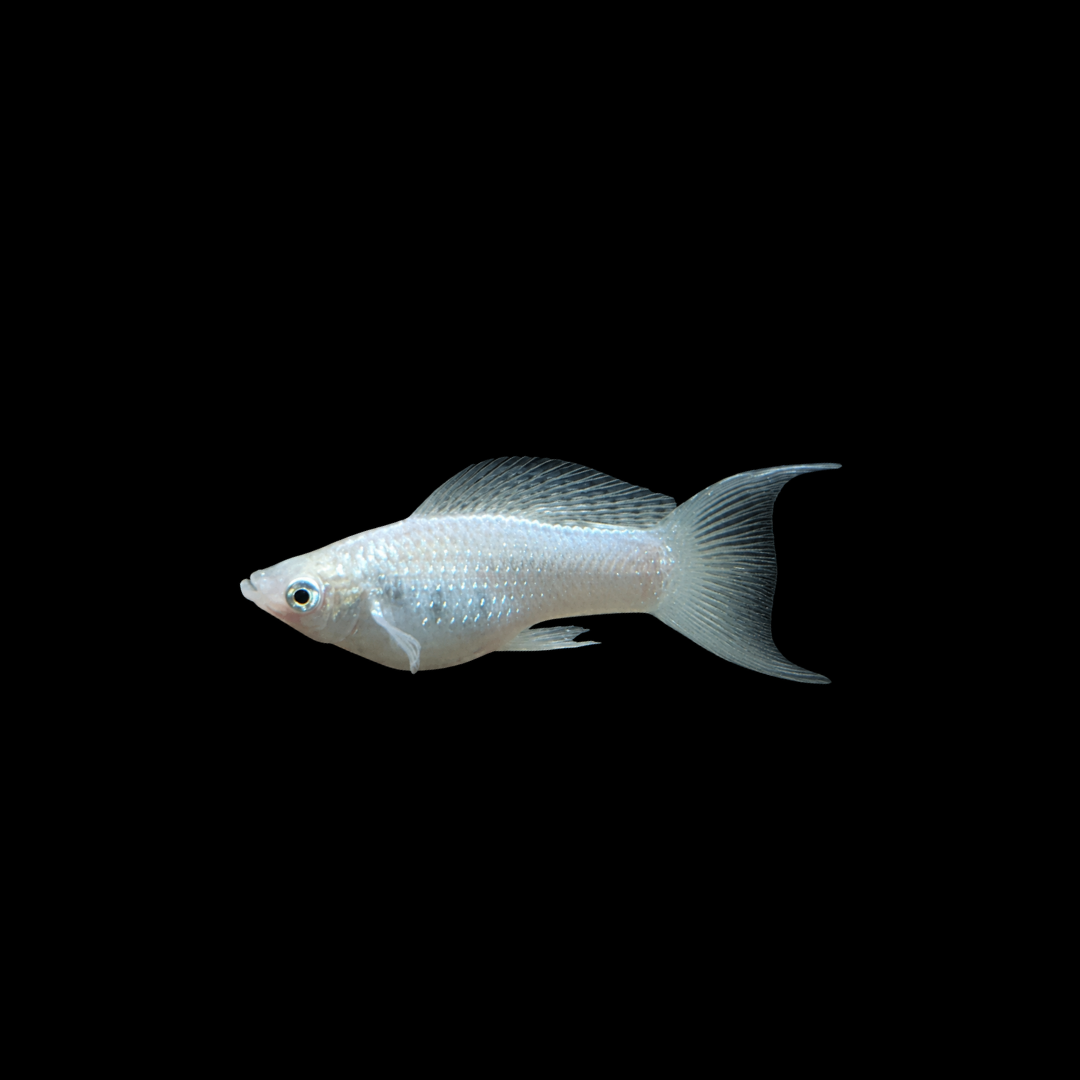
解説 / Description
シルバーライヤーモーリーは、銀白色の体と、尾びれの上下端が長く伸びる「ライヤーテール」を特徴とするモーリーの改良品種です。観賞魚として流通する改良モーリーには、複数のポエキリア属魚類に由来する交雑系統が知られていますが、シルバーライヤーモーリーという販売名で流通するすべての個体について、祖先種の組み合わせが一律に確定しているわけではありません。そのため、同じ名称でも体格、背びれの大きさ、銀白色の濃淡、尾びれの伸び方には系統差が見られます。人工飼料をよく食べ、繁殖もしやすい丈夫な魚ですが、長期飼育では中性から弱アルカリ性で、ある程度ミネラルを含む水を安定して保つことが重要です。水面やガラス面などのバイオフィルム、柔らかい藻類をついばむ姿も見られ、優雅な外見と活発な行動の両方を楽しめます。 The Silver Lyretail Molly is a selectively bred molly distinguished by a silvery-white body and a caudal fin whose upper and lower edges extend into a lyre-like shape. Hybrid ancestry involving more than one Poecilia species is documented in fancy mollies, but the exact parental combination cannot be assumed to be identical for every fish sold as a Silver Lyretail Molly. As a result, fish under the same trade name may differ in body size, dorsal-fin development, intensity of silver coloration, and tail shape. They are generally hardy, readily accept prepared foods, and breed easily, but long-term care is most reliable in stable neutral to slightly alkaline water with adequate mineral content. They also graze on biofilm and soft algae from aquarium surfaces, combining an elegant appearance with active behavior.
基本情報 / Basic Information
| 学名 / Scientific Name | Poecilia spp. |
|---|---|
| 通称 / Common Name | シルバーライヤーモーリー、シルバーライヤーテールモーリーSilver Lyretail Molly, Silver Lyre-tail Molly |
| 分類 / Family | カダヤシ目・カダヤシ科・ポエキリア属Order Cyprinodontiformes, family Poeciliidae, genus Poecilia |
| 英名 / English Name | Silver Lyretail Molly |
| 分布 / Distribution | シルバーライヤーモーリー自体は観賞魚として維持される改良品種であり、特定の自然分布域を持ちません。改良モーリーの背景に関わるポエキリア属のモーリー類は、アメリカ合衆国南部からメキシコ、中米を中心に、一部は南米北部までの淡水域・汽水域・沿岸低地などに分布します。The Silver Lyretail Molly is a domesticated aquarium strain and therefore has no single natural range. Poecilia mollies associated with the background of fancy strains occur mainly from the southern United States through Mexico and Central America, with some lineages extending into northern South America, in freshwater, brackish, and coastal lowland habitats. |
| 最大体長 / Max Size | 全長約8〜10cm前後。系統差があり、一般にメスの方が大きくふっくらと成長します。Approximately 8–10 cm in total length, depending on strain. Females are usually larger and deeper-bodied than males. |
| 寿命 / Lifespan | 目安として3〜5年程度。水質、遺伝的系統、繁殖負荷、給餌量などによって差が出ます。Typically around 3–5 years, although longevity varies with water quality, strain, reproductive stress, and feeding practices. |
飼育環境 / Aquarium Environment
| 水槽サイズ / Tank Size | 60cm規格水槽(約57L)以上を基本にすると管理しやすくなります。モーリーは活発に泳ぎ、よく食べて排泄量も多いうえ、雌雄を飼うと個体数が増えやすいため、少数飼育でも水量と遊泳スペースに余裕を持たせることが長期維持につながります。A standard 60 cm aquarium of roughly 57 L or larger is a practical starting point. Mollies are active swimmers, feed heavily, produce substantial waste, and can multiply quickly when both sexes are present, so generous water volume and swimming space make long-term maintenance easier even with a small group. |
|---|---|
| 水温 / Temperature | 24〜28℃を目安に安定させます。日本では冬季のヒーター管理が基本となり、真夏は高水温と酸欠にも注意します。急激な温度変化を避けることが重要です。 Maintain a stable 24–28°C. In Japan, a heater is generally needed in winter, while summer care should focus on preventing excessive temperature and oxygen depletion. Avoid sudden temperature changes. |
| 水質 / Water Quality | 中性〜弱アルカリ性で、軟水よりもミネラルを含む中硬水〜硬水が向きます。目安としてpH7.2〜8.2、GH10〜30°dH程度の範囲で安定していれば飼育しやすくなります。日本の軟水地域では、必要に応じてサンゴ砂やカキ殻をろ材として少量使う、または観賞魚用ミネラル剤でカルシウムやマグネシウムを補います。食塩はGHを上げるものではないため、硬度不足の補正とは分けて考えます。Neutral to slightly alkaline water with moderate to high mineral content is preferable to very soft water. A practical range around pH 7.2–8.2 and GH 10–30°dH is generally suitable when kept stable. In soft-water areas of Japan, small amounts of crushed coral or oyster shell in the filter, or an appropriate aquarium mineral supplement, can be used when additional calcium and magnesium are needed. Sodium chloride does not raise GH in the same way and should not be treated as a substitute for mineral hardness. |
| レイアウト / Layout | 中央から前面には遊泳スペースを確保し、背面や側面にマツモ、アナカリス、ミクロソリウムなどを配置すると落ち着きやすくなります。繁殖を楽しむ場合は、浮草や細かい葉の水草を増やして稚魚の逃げ場を作ります。底床は大磯砂や砂利など中性寄りの素材が扱いやすく、強くpHを下げるソイルを使う場合は硬度とpHを定期的に測定します。Keep open swimming space through the center and front while planting the rear and sides with hardy plants such as hornwort, Egeria, or Java fern. For breeding, floating plants and fine-leaved vegetation provide valuable refuge for fry. Neutral substrates such as gravel are easy to manage; if an active soil that lowers pH is used, monitor pH and hardness regularly. |
| 注意点 / Precautions | 体をその場で小刻みに震わせる「シミー」は、特定の病原体による病名ではなく、水質や水温の不適合、アンモニア・亜硝酸、急な環境変化などに伴って見られる症状です。異常があれば、まず水温、アンモニア・亜硝酸、pH、GHを確認し、原因となる環境を修正します。モーリーには広塩性を持つ種が含まれますが、淡水飼育で塩が必須という意味ではありません。購入店と自宅の水質差を把握し、塩分やpHを急変させないことが重要です。The trembling behavior commonly called “shimmies” is a symptom rather than a disease caused by one specific pathogen. It can appear with unsuitable water chemistry or temperature, ammonia or nitrite exposure, and other abrupt environmental changes. If it occurs, first check temperature, ammonia, nitrite, pH, and GH and correct the underlying conditions. Mollies include euryhaline species, but this does not mean salt is required for routine freshwater care. The key is to understand differences between the retailer’s water and the home aquarium and avoid abrupt changes in salinity or pH. |
餌と給餌 / Feeding
| 餌の種類 / Diet | 雑食性で、植物質を含むフレークや小粒顆粒を主食にできます。スピルリナなど植物質を含む人工飼料を組み合わせると食性に合わせやすく、冷凍アカムシ、ブラインシュリンプ、ミジンコ類などの動物質も補助的に利用できます。特定の餌だけに偏らせず、複数の餌を組み合わせます。Omnivorous. A quality flake or small pellet containing plant material can form the staple diet. Prepared foods containing ingredients such as spirulina are useful for supplying vegetable matter, while bloodworms, brine shrimp, and daphnia can be offered as supplementary animal foods. A varied diet is preferable to relying on a single food type. |
|---|---|
| 給餌のポイント / Feeding Tips | 成魚は1日1〜2回、数分で食べ切れる量を基本にします。常に餌を探す魚なので、欲しがるまま与えると肥満や水質悪化を招きやすい点に注意します。水面やガラス面、石、流木に付着した柔らかい藻類やバイオフィルムもついばみますが、コケ取りだけで必要な栄養を満たすことはできません。Feed adults once or twice daily, offering only what they can consume within a few minutes. Mollies appear hungry much of the time, so feeding every begging response can lead to obesity and deteriorating water quality. They will graze on soft algae and biofilm from surfaces, but this cannot replace a nutritionally complete diet. |
性格と混泳 / Temperament and Tank Mates
| 性格 / Temperament | 基本的には温和で活発ですが、オスはメスを頻繁に追尾し、オス同士でも軽い張り合いを見せます。追尾が続くとメスが消耗するため、雌雄を混ぜる場合はオス1匹に対してメス2〜3匹を目安にし、隠れ場所も用意すると安定しやすくなります。Generally peaceful and active, although males frequently pursue females and may display mild rivalry toward other males. Persistent courtship can exhaust females, so when keeping mixed sexes, a ratio of about one male to two or three females together with visual cover is a useful guideline. |
|---|---|
| 混泳の相性 / Compatibility | 同程度の水質を好むプラティ、ソードテール、グッピーなどの卵胎生メダカ類や、温和な小〜中型魚と合わせやすい魚です。ただし、相手もモーリー向けの硬めで弱アルカリ性寄りの水質を許容できるかを優先して選びます。長いライヤーテールをかじる魚、強い縄張り性を持つ魚、大型肉食魚との混泳は不向きです。また、別品種のモーリー同士は交配しやすいため、体色や尾形を系統維持したい場合は分けて飼育します。They generally mix well with livebearers such as platies, swordtails, and guppies, as well as other peaceful small to medium-sized fish that tolerate similar conditions. Choose tank mates primarily by whether they can also thrive in the harder, slightly alkaline water preferred by mollies. Avoid fin-nippers, strongly territorial species, and large predatory fish. Different domestic molly varieties also interbreed readily, so strains should be kept separately when preserving a particular color or fin form is important. |
病気と対策 / Diseases and Prevention
| かかりやすい病気 / Common Diseases | 導入直後や水質が不安定な環境では、白点病、尾ぐされ症状、カラムナリス症などが問題になります。ライヤーテールは先端部が長いため、ヒレの白濁や欠損を早期に見つけやすい反面、傷んだ部分も目立ちます。「シミー」は単一の病原体による病名ではなく、水質や水温の不適合、アンモニア・亜硝酸、急な環境変化などに伴って現れることのある症状です。Newly introduced or environmentally stressed fish may develop ich, fin deterioration, or bacterial conditions including columnaris. Because lyretail fin rays are elongated, early whitening or fraying is easy to notice, although damage is also visually conspicuous. “Shimmies” are not a single infectious disease; they are a symptom that can accompany unsuitable water chemistry or temperature, ammonia or nitrite exposure, and other abrupt environmental changes. |
|---|---|
| 対策と予防 / Prevention | 新魚は可能であれば別容器で状態を観察し、本水槽への病原体持ち込みを減らします。日常管理では、定期的な換水、過密の回避、安定した水温と水質の維持が基本です。塩水浴はモーリーで補助的に用いられることがありますが、すべての症状に有効な治療ではなく、淡水水槽への常時添加も必須ではありません。治療が必要な場合は隔離水槽を使い、塩分濃度や水質を管理しながら、症状に合った観賞魚用薬を製品表示どおり使用します。Whenever possible, observe new fish in a separate quarantine tank before introducing them to the display aquarium. Routine prevention depends mainly on regular water changes, avoiding overcrowding, and keeping temperature and water chemistry stable. Salt baths are sometimes used as supportive treatment for mollies, but they are not effective for every condition and continuous salt addition is not required in a freshwater aquarium. When treatment is necessary, use a hospital tank, monitor salinity and water quality carefully, and apply an appropriate aquarium medication according to its label. |
増やし方(繁殖) / Breeding
| 雌雄の判別 / Sexing | 成熟すると尻びれで明確に判別できます。オスは尻びれが細長い交接器「ゴノポディウム」に変化し、メスは扇形の尻びれを保ちます。メスはオスより体格が大きく、成熟すると腹部がふっくらする傾向があります。Mature fish are easily sexed by the anal fin. In males it is modified into the elongated intromittent organ called the gonopodium, while females retain a fan-shaped anal fin. Females are usually larger and become noticeably deeper-bodied as they mature. |
|---|---|
| 繁殖形態 / Reproduction | アクアリウムでは一般に「卵胎生メダカ」と呼ばれますが、魚類学的には体内受精した胚をメスが体内で発生させる胎生魚(ライブベアラー)として扱われます。モーリー類では、胚は主として卵に蓄えられた栄養を使って成長し、自由遊泳できる稚魚として産み出されます。妊娠期間は水温や個体差で変わりますが、おおむね4〜6週間が目安です。1回に数十匹を産むことが多く、大型のメスでは100匹前後以上になることもあります。In the aquarium hobby, mollies are often described as “ovoviviparous,” but in biological terminology they are livebearing fishes in which fertilization is internal and embryos develop within the female. In mollies, developing embryos rely primarily on nutrients provisioned in the egg before fertilization and are born as free-swimming fry. Gestation commonly lasts about four to six weeks depending on temperature and individual condition. Broods often number in the dozens, and large females may sometimes produce around one hundred or more fry. |
| 繁殖のポイント / Breeding Tips | オス1匹にメス2〜3匹ほどを組み合わせると、メス1匹への追尾負担を分散できます。メスは交尾後の精子を体内に保存し、オスがいなくなった後もしばらく複数回出産することがあります。これは貯精によるもので、複数世代の胚を同時に保持する「スーパーフェテーション」とは区別して考えます。稚魚を残したい場合は、マツモやウィローモス、浮草を密にして逃げ場を作るか、出産後に親魚と稚魚を分けます。稚魚は細かく砕いた人工飼料や孵化直後のブラインシュリンプを食べられます。A ratio of one male to two or three females reduces persistent courtship pressure on any single female. Females can store sperm after mating and may produce several broods even after males have been removed. This sperm storage should not be confused with superfetation, in which embryos at multiple developmental stages are carried simultaneously. To save fry, provide dense hornwort, moss, or floating plants, or separate the mother and fry after birth. Newborns can take finely crushed prepared food and newly hatched brine shrimp. |
雑学と豆知識 / Trivia and Fun Facts
| 1. 「シルバーライヤーモーリー」は種名ではなく改良品種名 / 1. A Variety Name Rather Than a Single Species | 観賞魚店ではPoecilia sphenopsなどの学名が添えられることもありますが、改良モーリーには複数のポエキリア属魚類に由来する交雑系統が知られています。米国地質調査所でもライヤーテール・ブラックモーリーをPoecilia spp. hybridとして扱う例があります。ただし、これはシルバーライヤーモーリーのすべてが同じ祖先種の組み合わせから作られたことを示すものではありません。販売名と野生種を一対一で結びつけず、由来が完全には特定されていない改良モーリーとしてPoecilia spp.と表記するのが慎重です。同じ販売名でも体型や背びれ、尾びれに差が見られるのは、こうした系統差を反映していると考えられます。Aquarium shops sometimes attach a name such as Poecilia sphenops to fancy mollies, but hybrid lineages involving more than one Poecilia species are documented in domesticated mollies. The U.S. Geological Survey, for example, treats the lyretail black molly as a Poecilia spp. hybrid. That does not prove that every Silver Lyretail Molly has the same parental combination. It is therefore safer not to match this trade variety one-to-one with a single wild species and to use Poecilia spp. when its exact ancestry is undocumented. Differences in body form, dorsal fin, and caudal fin among fish sold under the same name are consistent with such strain variation. |
|---|---|
| 2. モーリーの系統は「セイルフィン」と2つのショートフィン群に分かれる / 2. Modern Phylogeny Recognizes Three Major Molly Complexes | モーリー類は古くからMollienesiaの名で扱われてきましたが、現在はPoecilia属内のMollienesia亜属として整理されるのが一般的です。分子系統解析では、モーリー類の主要なまとまりとして、P. latipinnaを中心とするセイルフィン群、P. sphenops複合群、P. mexicana複合群の3系統が支持されています。かつて「セイルフィン系とショートフィン系の2つ」と説明されることも多かったのですが、ショートフィン側も少なくとも2つの大きな系統に分かれることが分かってきました。観賞魚のモーリーが非常に多様に見える背景には、もともとの野生系統そのものが一枚岩ではないという事情があります。Mollies were historically associated with the name Mollienesia and are now generally treated within the genus Poecilia, subgenus Mollienesia. Molecular phylogenetic work supports three major groups: the P. latipinna sailfin complex, the P. sphenops complex, and the P. mexicana complex. Older hobby descriptions often reduced this diversity to “sailfin” and “shortfin” mollies, but modern analyses show that the shortfin forms themselves contain at least two major evolutionary lineages. |
| 3. ライヤーテールとシルバーの遺伝は、系統ごとに考える / 3. Lyretail and Silver Genetics Should Be Treated as Strain-Specific | 商業育種家の記録では、特定のモーリー系統でライヤーテールが通常尾に対して優性として扱われ、ライヤーテールのオスでもゴノポディウムが機能する例が示されています。また、シルバーがグリーンに対して劣性として分離する育種例も報告されています。ただし、これらは特定の育種系統で確認された交配結果であり、流通するすべてのシルバーモーリーに同じ単一遺伝子モデルを当てはめられるとは限りません。観賞魚の体色には複数の遺伝要因が関わることもあるため、系統維持では販売名だけで遺伝型を決めつけず、実際の子の出方を確認する必要があります。Commercial breeder records show that in some molly strains the lyretail trait behaves as dominant over the normal tail and that lyretail males can retain a functional gonopodium. Breeding examples also exist in which silver segregates as recessive to green. These observations come from particular breeding lines, however, and should not be treated as a universal single-gene model for every silver molly in the trade. Ornamental body coloration can involve multiple genetic factors, so breeders should verify inheritance from actual offspring rather than infer genotype from a trade name alone. |
| 4. ゴノポディウムは一瞬で大きく動く / 4. The Gonopodium Moves in a Fraction of a Second | セイルフィンモーリーP. latipinnaを高速撮影した研究発表では、オスのゴノポディウムが腹側から前方へほぼ180度動き、平均約0.4秒で挙上される様子が示されています。先端の平均速度は約0.15m/秒で、メスの尻びれより発達した筋肉がこの急速な運動を支えます。つまり、普段は細長い尻びれに見える器官が、交尾の瞬間には水の抵抗を受けながら素早く向きを変える、高度に特殊化した運動器官として働いています。High-speed observations of the sailfin molly P. latipinna have shown the male gonopodium swinging ventrally and forward through nearly 180 degrees, reaching elevation in about 0.4 seconds on average. The tip moves at roughly 0.15 m/s, supported by musculature that is more developed than that of the female anal fin. In practical terms, an organ that normally resembles a narrow fin becomes a highly specialized structure capable of changing orientation extremely quickly against the resistance of the surrounding water. |
| 5. 海水に適応できることと、海水飼育が必要なことは別 / 5. Seawater Tolerance Does Not Mean Seawater Is Required | セイルフィンモーリーP. latipinnaは広塩性を持ち、順化すれば淡水から海水まで異なる塩分環境で浸透圧を調節できます。エラのNa+/K+-ATPaseなど、塩類の出入りを調整する仕組みも塩分に応じて変化します。一方、海水では浸透圧調節に伴う生理的負担が増えることが示され、淡水を選ぶ行動も報告されています。つまり「海水に適応できる能力」と「海水や塩水で飼う必要があること」は同じではありません。海水水槽へ移す場合も、出発時の塩分と個体の状態を確認し、決まった時間の点滴法だけを万能な手順とせず、塩分を急変させないことを優先します。The sailfin molly P. latipinna is euryhaline and, after acclimation, can regulate salt and water balance across environments ranging from freshwater to seawater. Gill mechanisms involved in ion transport, including Na+/K+-ATPase, change with salinity. At the same time, seawater can impose greater osmoregulatory costs, and sailfin mollies have been shown to prefer freshwater when given a choice. The ability to acclimate to seawater is therefore not the same as a requirement to keep mollies in salty water. When moving a fish toward marine conditions, start from its actual current salinity and condition and prioritize avoiding abrupt salinity changes rather than assuming that one fixed drip-acclimation duration is universally safe. |
| 6. 硫化水素の洞窟は、モーリー進化の「自然実験室」 / 6. Sulfur Caves Act as a Natural Evolutionary Laboratory | メキシコ南部のCueva del Azufreなどには、硫化水素を含み酸素にも乏しい水域へ適応したP. mexicanaの個体群が暮らしています。硫化水素環境の魚では頭部が大きく、エラのフィラメントが長くなる傾向が報告され、洞窟内の個体では眼が小さく、体色が薄くなる変化も見られます。ただし眼は完全に失われておらず機能を残しており、「暗闇なので単純に眼を捨てた」と一言で片付けられる現象ではありません。硫化水素への適応では解毒や酸化ストレス応答に関わる遺伝子発現の変化も確認され、同じ属の魚がわずかな距離の環境差に対して大きく分化する進化研究のモデルになっています。Populations of P. mexicana in southern Mexican caves such as Cueva del Azufre live in water containing hydrogen sulfide and very little oxygen. Fish from sulfidic habitats tend to have larger heads and longer gill filaments, while cave populations also show reduced eye size and pigmentation. Their eyes are reduced rather than completely absent and remain functional, so the change cannot be explained simply as “abandoning vision in darkness.” Sulfide-adapted fish also show altered expression of genes involved in detoxification and oxidative-stress responses, making these populations an important model for studying rapid local adaptation. |
| 7. アマゾンモーリーは「オスの精子を借りる」クローン魚 / 7. The Amazon Molly Borrows Sperm Without Usually Inheriting It | 近縁のアマゾンモーリーP. formosaは、P. mexicanaのメスとP. latipinnaのオスの交雑から10万年以上前に成立したと考えられる、ほぼ全メスの系統です。繁殖には近縁種のオスとの交尾が必要ですが、通常は精子が胚発生の開始を刺激するだけで、父親側の遺伝情報は子に取り込まれません。この「雌性発生」により、子は母親と非常によく似たクローン系統になります。長期間のクローン繁殖では有害変異の蓄積が問題になると予測されますが、2026年の研究では、遺伝子変換が変異の組み合わせを変え、自然選択が働く余地を生み出す仕組みの一つとして示されました。The related Amazon molly, P. formosa, is an almost entirely female lineage thought to have arisen more than 100,000 years ago from hybridization between a female P. mexicana and a male P. latipinna. Females must mate with males of related species, but the sperm normally triggers embryonic development without contributing paternal genetic information to the offspring. This gynogenetic system produces highly clonal maternal lineages. Long-term clonality is expected to create problems through the accumulation of harmful mutations, but a 2026 study showed that gene conversion can reshuffle mutational states in ways that allow natural selection to remain effective. |
| 8. 「お掃除役」としては補助的に考えるのがちょうどよい / 8. Useful Grazers, but Not a Complete Cleaning Solution | モーリーは上向きの口で水面や水槽内の表面をついばみ、バイオフィルムや柔らかい藻類を食べる姿が見られます。そのため、油膜や一部の柔らかいコケが目立ちにくくなることはあります。ただし、藍藻やアオミドロを確実に除去する専門的な「コケ取り魚」ではありません。こうした発生物への対策は、水流、光、栄養塩、底床やろ過の汚れなど原因側の見直しが基本です。モーリーのついばみ行動は、水槽管理を補助する副次的な働きとして考えるのが適切です。Mollies graze with their upturned mouths on aquarium surfaces, taking biofilm and some soft algae. This can make surface film or certain soft growths less conspicuous, but mollies are not specialized algae eaters that can be relied upon to eliminate cyanobacteria or persistent filamentous algae. Those problems are best addressed by correcting underlying factors such as circulation, lighting, nutrients, and accumulated waste in the substrate or filter. Grazing by mollies is therefore best regarded as a secondary contribution to aquarium maintenance. |
| 9. 日本の輸入検疫とショップの「トリートメント」は別の仕組み / 9. Legal Import Quarantine and Retailer Treatment Are Different | 日本では海外の養殖場から多くの観賞魚が輸入されていますが、シルバーライヤーモーリーについて、国別の流通比率を示す公的な品種別統計は確認できません。2026年8月時点の農林水産省「水産輸入防疫制度」では、輸入許可の対象となる魚類としてサケ科魚類、コイ、フナ属魚類、コクレン、ハクレン、アオウオ、ソウギョ、ナイルティラピア、マダイなどが挙げられており、モーリー類はこの対象魚種に含まれていません。一方、問屋や専門店が入荷魚を隔離観察し、状態に応じて給餌回復、塩分調整、投薬などを行う「トリートメント」は、販売現場で行われる自主的な管理です。法令上の輸入防疫と、流通段階のトリートメントは別の仕組みとして理解する必要があります。Japan imports many ornamental fishes from overseas farms, but no public variety-specific statistics were found that establish country-by-country market shares for the Silver Lyretail Molly. As of August 2026, Japan’s Ministry of Agriculture, Forestry and Fisheries lists salmonids, common carp, Carassius species, bighead and silver carp, black carp, grass carp, Nile tilapia, and red seabream among the finfish subject to its aquatic-animal import quarantine system; mollies are not included in that list. Wholesalers and specialist retailers may still isolate incoming fish and, depending on their condition, restore feeding, adjust salinity, or medicate them as voluntary husbandry and biosecurity measures. Legal import quarantine and commercial treatment during distribution should therefore be understood as separate systems. |
| 10. ブラックモーリーの改良史は、現代モーリー育種の背景を伝える / 10. Early Black Molly Breeding Helps Explain Modern Fancy Molly History | 現在のシルバーライヤーモーリーそのものを、1920〜30年代の特定の育種家が完成させたと確認できる資料は乏しいため、そのような起源を断定することはできません。一方、米国では1920年代末から1930年代にかけて複数の養殖家がブラックモーリーの改良を進め、その後もセイルフィン系やショートフィン系を用いて色、ヒレ、体型を組み合わせる育種が続きました。シルバーライヤーモーリーも、特定の一回の交配で成立した品種と決めつけるより、こうした長い改良モーリー育種の流れの中で維持されてきた系統として捉える方が自然です。There is not enough firm documentation to state that the modern Silver Lyretail Molly itself was created by one particular breeder in the 1920s or 1930s. What is documented is that several U.S. breeders were developing black mollies during that period and that later fancy-molly breeding continued to combine sailfin and shortfin backgrounds while selecting color, fin shape, and body form. The Silver Lyretail Molly is therefore better understood within this broader, long-running history of fancy-molly selection rather than as the product of one clearly documented founding cross. |
まとめ / Conclusion
シルバーライヤーモーリーは、銀白色の体色と伸びやかな尾びれが目を引く一方、日々の管理では水質を安定させることが何より大切です。中性〜弱アルカリ性でミネラルを含む水を保ち、十分なろ過と遊泳スペースを確保すれば、丈夫さに頼り切ることなく、ヒレを広げて活発に泳ぐ状態を維持しやすくなります。 The Silver Lyretail Molly is immediately recognizable by its silvery body and extended caudal fin, but stable water conditions are more important to its long-term care than its reputation for hardiness. Neutral to slightly alkaline water with adequate mineral content, reliable filtration, and sufficient swimming space help the fish remain active and carry its fins well.
水槽内では表面をついばみながらよく泳ぎ、雌雄をそろえれば繁殖行動や稚魚の成長も観察できます。広い塩分環境に適応できる近縁種や、独特の繁殖・進化を示す同属魚の存在を知ると、身近な改良モーリーにも多様な生物学的背景があることが分かります。安定した環境を整えて付き合うほど、観賞魚としての美しさだけでなく、行動を見続ける面白さも感じられる魚です。 In the aquarium, Silver Lyretail Mollies remain active, graze aquarium surfaces, and, when both sexes are present, offer opportunities to observe courtship, pregnancy, and fry development. The wider Poecilia group also includes fishes with remarkable salinity tolerance and unusual reproductive and evolutionary histories, showing that even a familiar fancy molly belongs to a biologically diverse lineage. With stable conditions, it remains rewarding not only for its appearance but also for the behavior it displays day after day.

気になる道具や飼い方を見つけてみませんか?
 アイのアクアグッズ案内海水魚初心者の必需品|水槽・人工海水・比重計・水質検査道具の特徴や使い方、選ぶときのポイントをアイが紹介します。記事はコチラ →
 アイのアクアグッズ案内マジックリーフ物語|一枚の葉がアクアリウム用品になるまで道具の特徴や使い方、選ぶときのポイントをアイが紹介します。記事はコチラ →
さまざまな飼育テーマをご紹介。リンク先の記事には広告・商品紹介が含まれます。
案内・紹介記事一覧へ →分布マップ
シルバーライヤーモーリー自体は観賞魚として維持される改良品種で、特定の自然分布域を持ちません。背景に関わるポエキリア属のモーリー類は、アメリカ合衆国南部からメキシコ、中米を中心に、一部は南米北部までの淡水域・汽水域・沿岸低地などに分布します。
※この地図は記事中の分布情報をもとに、関連するモーリー類のおおまかな分布地域が見えるよう設定した概略表示です。マーカーは分布域を示すための代表地点であり、実際の採集地点や特定個体の産地を示すものではありません。
参考文献
-
分類・系統Palacios, M., Voelker, G., Arias Rodriguez, L., Mateos, M. & Tobler, M. (2016). Phylogenetic analyses of the subgenus Mollienesia (Poecilia, Poeciliidae, Teleostei) reveal taxonomic inconsistencies, cryptic biodiversity, and spatio-temporal aspects of diversification in Middle America.Molecular Phylogenetics and Evolution, 103, 230–244. DOI: 10.1016/j.ympev.2016.07.025
-
改良モーリーの交雑背景U.S. Geological Survey. Nonindigenous Aquatic Species Database: Lyretail black molly, Poecilia spp. hybrid.U.S. Geological Survey, Gainesville, Florida.
-
分布・生息環境・飼育条件・食性・繁殖Froese, R. & Pauly, D. (eds.). FishBase: Poecilia sphenops Valenciennes, 1846.FishBase species summary.
-
分布・汽水/海水環境・食性・繁殖Froese, R. & Pauly, D. (eds.). FishBase: Poecilia latipinna (Lesueur, 1821).FishBase species summary.
-
広塩性・塩分変化への注意Yang, W.-K., Hseu, J.-R., Tang, C.-H., Chung, M.-J., Wu, S.-M. & Lee, T.-H. (2009). Na+/K+-ATPase expression in gills of the euryhaline sailfin molly, Poecilia latipinna, is altered in response to salinity challenge.Journal of Experimental Marine Biology and Ecology, 375(1–2), 41–50. DOI: 10.1016/j.jembe.2009.05.004
-
胎生・胚発生Uribe, M. C., García Alarcón, A., De la Rosa Cruz, G. & Campuzano Caballero, J. C. (2026). Nutrition During Gestation in 2 Species of Viviparous Fishes (Poeciliidae): Poecilia latipinna (Lecithotrophic) and Heterandria formosa (Matrotrophic).Fishes, 11(1), 3. DOI: 10.3390/fishes11010003
-
繁殖・貯精Hankison, S., Gangloff, E. J., Fry, B., Arnold, A. et al. (2022). Effects of reliance on stored sperm on reproduction in the sailfin molly Poecilia latipinna.Journal of Fish Biology, 101(6), 1628–1633. DOI: 10.1111/jfb.15228
-
水質管理・検疫・治療上の注意Petty, B. D., Francis-Floyd, R. & Yanong, R. P. E. Management of Aquarium Fish.MSD Veterinary Manual, Professional Version.
-
カラムナリス症・細菌性疾患Bacterial Diseases in Aquaculture.Merck Veterinary Manual, Professional Version.
-
白点病・寄生虫対策Parasitic Diseases of Fish.Merck Veterinary Manual, Professional Version.




コメント