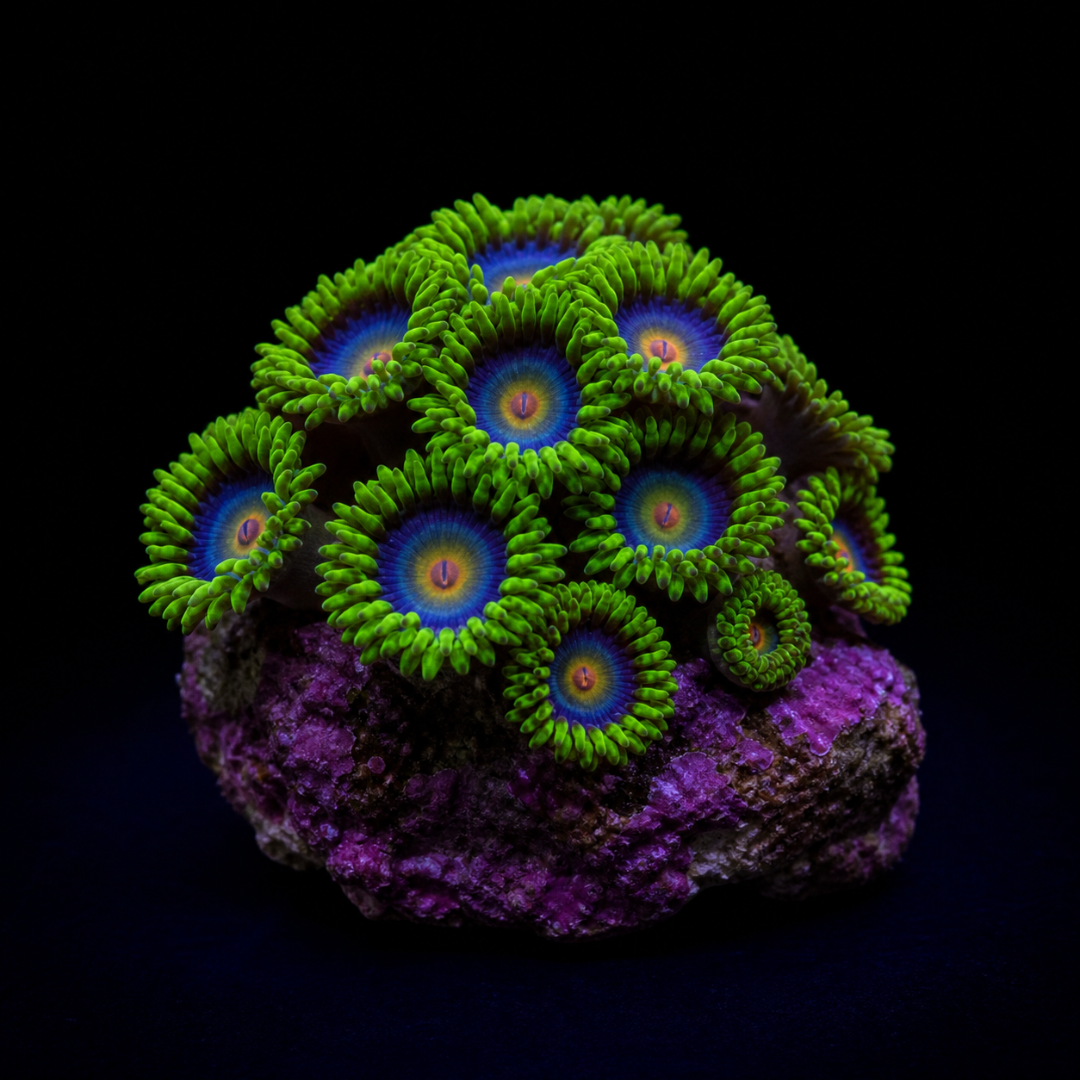
マメスナギンチャクは、円形の口盤と花びらのような触手を持つ小さなポリプが、岩や人工プラグの表面を覆うように群体を広げる刺胞動物です。流通上は「ゾア」や「ゾアンサス」とも呼ばれ、緑、橙、赤、青、紫などが組み合わさった多彩なモルフが知られています。硬い石灰質骨格は作りませんが、種類によっては体壁に砂粒や細かな骨片を取り込み、柔らかな体を補強します。浅海性の多くは、体内の共生藻が行う光合成から主要な栄養を得るため、安定した照明と水質が重要です。丈夫な種類が多い一方で、急激な強光への移行、ゴミの堆積、害虫の持ち込みには注意が必要です。また、一部の個体に含まれる可能性があるパリトキシンに備え、安全な取り扱いを徹底しなければなりません。Zoanthids are cnidarians whose small polyps, each with a round oral disc and a fringe of petal-like tentacles, spread across rockwork or artificial frag plugs to form colonies. In the aquarium trade they are commonly called zoas or button polyps, and many named color morphs combine green, orange, red, blue, purple, and other vivid tones. They do not produce a hard calcareous skeleton, although some species reinforce their soft tissues by incorporating sand grains and tiny skeletal fragments into the body wall. Most shallow-water aquarium forms obtain much of their nutrition from photosynthesis performed by intracellular symbiotic algae, making stable lighting and water quality important. Although many are resilient, abrupt exposure to intense light, accumulated debris, and introduced pests can cause problems. Safe handling is also essential because some specimens may contain palytoxin.
基本情報 / Basic Information
学名 / Scientific Name
Zoantharia Rafinesque, 1815。観賞用としては、主に Zoanthus spp. や Palythoa spp. などが流通します。Zoantharia Rafinesque, 1815. Aquarium specimens are mainly traded as Zoanthus spp., Palythoa spp., and related taxa.
通称 / Common and English Names
マメスナギンチャク、ゾア、ゾアンサス、ボタンポリプ。近縁群を含めてイワスナギンチャク類と呼ばれることもあります。Zoanthid, zoa, button polyp, colonial anemone. Larger sand-encrusted forms are often traded as Palythoa or palys.
分類 / Classification
刺胞動物門、花虫綱、六放珊瑚亜綱、マメスナギンチャク目。伝統的には隔膜配列などを基に短隔膜類と長隔膜類へ大別され、現在は分子系統解析を取り入れた分類の再検討が続いています。Phylum Cnidaria, class Anthozoa, subclass Hexacorallia, order Zoantharia. Traditional systems divided the order into brachycnemic and macrocnemic lineages using mesenterial characters, while modern classification continues to be refined with molecular phylogenetics.
分布 / Distribution
世界各地の海に分布します。観賞用に流通する種類の多くは熱帯・亜熱帯の浅いサンゴ礁、岩礁、潮だまりに生息しますが、他の無脊椎動物に付着する種類や、共生藻を持たず深海や高緯度海域に暮らす系統も知られています。Distributed throughout the world’s oceans. Most aquarium species inhabit shallow tropical and subtropical reefs, rocky shores, and tide pools, but some lineages live attached to other invertebrates, and non-photosynthetic forms also occur in deep or high-latitude waters.
最大サイズ / Maximum Size
種類やモルフにより大きく異なります。口盤径は数mmから約3cm前後のものが多く、大型のイワスナギンチャク類ではさらに大きくなることがあります。群体は成長を続けると数十cm以上の範囲を覆います。Size varies widely among genera and morphs. Many aquarium polyps have oral discs from a few millimeters to around 3 cm across, while larger Palythoa-type forms may exceed this. Expanding colonies can eventually cover areas several tens of centimeters wide or more.
寿命 / Lifespan
個々のポリプの厳密な寿命は不明です。群体は出芽や共肉の伸長を繰り返して更新されるため、安定した水槽では同じ系統を10年以上維持できる例があります。The exact lifespan of an individual polyp is not well established. Because colonies continuously renew themselves through budding and mat growth, the same clonal line can be maintained for well over a decade in a stable aquarium.
飼育環境 / Aquarium Environment
水槽サイズ / Tank Size
小さなフラグなら20〜30L程度の小型水槽でも維持できますが、水温・比重・栄養塩を安定させやすい45cm水槽以上が扱いやすく、初めてのリーフタンクでは約55〜65Lの60cm規格水槽以上がおすすめです。成長後の広がりと他のサンゴとの間隔も見込んでください。A small frag can be maintained in a 20–30 L nano aquarium, but tanks 45 cm or larger are easier to stabilize. For a first reef aquarium, a standard Japanese 60 cm tank of roughly 55–65 L or more is recommended. Allow room for colony expansion and separation from neighboring corals.
水温・比重 / Temperature and Specific Gravity
水温24〜27℃、比重1.023〜1.026を目安にします。日内変動や急変を避け、夏はクーラー、冬は信頼性の高いヒーターで安定させます。蒸発分は真水で補い、自動給水装置を使うと比重変動を抑えやすくなります。Maintain 24–27°C and a specific gravity of 1.023–1.026. Avoid rapid or large daily swings, using a chiller in summer and a reliable heater in winter. Replace evaporation with fresh water; an automatic top-off system helps prevent salinity fluctuations.
水質 / Water Quality
pH 8.1〜8.4、アルカリ度8〜12 dKH、カルシウム400〜450 mg/L、マグネシウム1250〜1350 mg/Lを目安にします。硝酸塩はおおむね5〜15 mg/L、リン酸塩は0.03〜0.10 mg/L程度をひとつの目安とし、完全なゼロが長く続かないように管理します。栄養塩が不足すると色褪せや成長停滞につながる場合がある一方、高すぎると藻類やシアノバクテリアが群体を覆いやすくなります。特定の数値だけを追うのではなく、急変を避けて安定させることを優先してください。Suggested targets are pH 8.1–8.4, alkalinity 8–12 dKH, calcium 400–450 mg/L, and magnesium 1250–1350 mg/L. As a practical guide, maintain nitrate around 5–15 mg/L and phosphate around 0.03–0.10 mg/L rather than allowing either nutrient to remain undetectable for long periods. Nutrient deficiency may contribute to fading or stalled growth, whereas excessive levels encourage algae and cyanobacteria to overgrow the colony. Prioritize stability instead of chasing a single exact reading.
光量 / Lighting
低〜中光量が基本で、PAR 75〜150程度を出発点にします。青〜青紫の420〜460nm付近は蛍光色を見せやすい波長ですが、発色だけを目的に強光へ急に移すのは禁物です。導入直後は水槽下部や減光した位置から始め、2〜4週間ほどかけて徐々に光量を上げます。光が強すぎるとポリプの縮みや白化が見られ、弱すぎると茎が伸びる徒長や褐色化が起こりやすくなります。Low to moderate light is the usual starting point, with PAR around 75–150. Blue to violet-blue wavelengths near 420–460 nm enhance fluorescence, but specimens should never be moved abruptly into intense light solely for color. Begin low in the tank or under reduced output and increase gradually over about two to four weeks. Excessive light may cause the polyps to contract or bleach, whereas insufficient light often leads to elongated stalks and browning.
水流 / Water Flow
弱〜中程度のランダムで間接的な水流が適します。触手が穏やかに揺れ、ポリプ間にゴミが溜まらない程度が目安です。ポンプからの直線的な強い水流を当て続けると開かなくなるため、壁面や岩に当てて拡散させます。Provide low to moderate, random, indirect flow. The tentacles should sway gently while debris is kept from settling between polyps. Continuous direct blast from a pump often prevents opening, so diffuse the current against rockwork or the aquarium wall.
レイアウト・配置 / Layout and Placement
フラグプラグの軸を岩の穴へ差し込み、必要に応じてサンゴ用ジェル状瞬間接着剤で安定させます。群体は共肉を伸ばして周囲へ広がるため、独立した小岩に配置すると増殖範囲を管理しやすくなります。砂が口盤へ継続的にかぶる場所や、デトリタスが吹きだまる窪みは避けてください。Insert the frag plug stem into a rock opening and secure it when needed with reef-safe cyanoacrylate gel. Because the colony spreads outward over the substrate, placement on an isolated rock makes growth easier to control. Avoid locations where sand repeatedly covers the oral discs or detritus collects in a hollow.
注意点 / Precautions
購入直後は水温と比重を合わせ、照明には段階的に順応させます。導入前には別容器で目視確認と市販のコーラルディップを行い、ウミウシやヒラムシなどの持ち込みを防ぎます。閉じた状態が続くときは、まず害虫、砂やゴミの付着、直撃する水流、急な光量変化、水温・比重の変動を順番に確認してください。素手で触れず、加熱や煮沸は絶対に行いません。Match temperature and salinity after purchase, then acclimate gradually to the aquarium lighting. Before introduction, inspect the frag in a separate container and use a commercial coral dip according to its label to reduce the risk of nudibranchs, flatworms, and other hitchhikers. If the colony remains closed, check in sequence for pests, sand or debris, direct flow, abrupt lighting changes, and unstable temperature or salinity. Do not handle bare-handed, and never heat or boil the coral or its rock.
餌と給餌 / Feeding
栄養の得方・餌 / Nutrition and Diet
浅海性の多くは共生藻の光合成から主要なエネルギーを得ます。同時に、水中の溶存有機物や微小な動物プランクトンも利用します。必要に応じて、粒径の細かなサンゴ用粉末フード、液体フード、ワムシや微細な動物プランクトンを与えられます。Most shallow-water forms obtain much of their energy from photosynthesis by symbiotic algae. They can also use dissolved organic matter and very small zooplankton. Suitable supplemental foods include finely powdered coral diets, liquid coral foods, rotifers, and other micro-sized zooplankton.
給餌のポイント / Feeding Tips
直接給餌をしなくても維持できることは多いものの、週1〜2回の少量給餌が、成長やポリプの充実に役立つ場合があります。給餌時はポンプの流量を数分だけ弱め、スポイトで餌を口盤付近へ静かに吹きかけます。餌を大量にかけてポリプを覆ったり、食べ残しを放置したりすると、水質悪化や細菌の増殖を招きます。反応を見ながら、ごく少量ずつ与えてください。微量元素は定期換水で補うことを基本とし、測定せずにヨウ素剤などを過剰添加しないようにします。Many colonies can be maintained without direct feeding, but a small feeding once or twice weekly may support growth and fuller polyps. Reduce pump flow for a few minutes and gently deliver food near the oral discs with a pipette. Do not cover the polyps with excessive food or leave uneaten material in the aquarium, as this can degrade water quality and encourage bacterial growth. Offer only a very small amount while observing the feeding response. Regular water changes should be the primary source of trace elements; avoid heavy iodine or similar supplementation without testing and a clear need.
性質と相性 / Characteristics and Compatibility
形態・成長 / Form and Growth
硬い石灰質骨格を持たず、単独で暮らす種類もいれば、複数のポリプがストロンや共肉でつながって群体を作る種類もいます。状態が良いと共肉が基盤上を伸び、その縁から新しいポリプが出芽して、マット状に拡大します。成長速度はモルフ、光、栄養塩、水流によって大きく異なり、数週間で新しいポリプが増える系統もあれば、数か月ほとんど変化しない系統もあります。いったん定着した群体が、自ら別の場所へ移動することはありません。Zoanthids lack a hard calcareous skeleton. Some species live as solitary polyps, while others form colonies in which multiple polyps are connected by stolons or a shared mat. Under favorable conditions, the mat advances over the substrate and new polyps bud from its edge. Growth rate varies greatly with morph, lighting, nutrients, and flow; some strains add polyps within weeks, while others show little change for months. Once established, a colony does not actively move to another location.
攻撃性 / Aggression
長いスイーパー触手を伸ばすタイプではなく、直接的な攻撃性は低〜中程度です。ただし、接触部では刺胞や粘液による刺激が起こり、成長の速い群体は周囲を覆って光を奪います。化学的な相互作用も考えられるため、他のサンゴとは数cm以上離し、活性炭と定期換水を併用すると管理しやすくなります。They do not normally produce long sweeper tentacles, so direct aggression is low to moderate. However, contact can still cause irritation through nematocysts or mucus, and fast-growing colonies may overtake neighbors and block their light. Chemical interactions may also occur, so leave several centimeters of space and consider activated carbon together with regular water changes.
相性 / Compatibility
サンゴを食害しにくい小型魚や、一般的な観賞用のエビ・貝類とは同居できます。一方、チョウチョウウオ類や一部のヤッコ類など、サンゴをついばむ魚はポリプを傷めることがあります。強い刺胞を持つイソギンチャクや攻撃性の高いサンゴとは接触させず、急速に広がるモルフは独立した岩で管理してください。クマノミが本来の宿主の代わりに体をこすりつけることもありますが、その刺激で群体が閉じ続ける場合は、両者を離します。They are generally compatible with small fishes that do not feed on corals, as well as common aquarium shrimps and snails. Butterflyfishes, some angelfishes, and other coral-nipping species may damage the polyps. Prevent contact with strongly stinging anemones or aggressive corals, and contain fast-spreading morphs on isolated rockwork. Clownfish may occasionally rub against a colony in place of their usual host; separate them if this irritation keeps the polyps closed.
病気と対策 / Diseases and Prevention
不調・病気・害虫 / Problems, Diseases, and Pests
代表的な不調には、強光や高水温による白化、低光量による徒長、栄養塩不足による色褪せ、ゴミや藻類に覆われたことによる長期的なポリプ閉鎖があります。茎に黄白色の小さな隆起が現れる症状は「ゾアポックス」と呼ばれていますが、その原因は十分に確定していません。害虫では、体色を宿主に似せるマメスナギンチャクを食べるウミウシと、その螺旋状の卵塊、ヒラムシ、クモガニ類などに注意します。日中は見つけにくい害虫も、消灯後に観察すると発見できることがあります。Common problems include bleaching from excessive light or heat, elongated stalks under insufficient light, fading associated with nutrient deficiency, and prolonged polyp closure after debris or algae cover the colony. Small yellow-white raised spots on the stalk are commonly called zoa pox, although the exact cause remains uncertain. Important pests include zoanthid-eating nudibranchs that match the host’s color, their spiral egg masses, flatworms, and certain small crabs. Pests that remain hidden during the day may be easier to detect after lights out.
対策と予防 / Prevention
新しく迎えた個体は隔離水槽で観察し、市販のディップ剤を製品表示に従って使用します。ディップで成体の害虫を落とせても、卵には効きにくいことがあるため、卵塊はピンセットで取り除き、数日おきに再点検してください。不調が見られたときは、水温・比重・栄養塩を安定させ、弱めの照明と適度な水流の場所へ移します。表面の堆積物は、スポイトで飼育水を当てて優しく吹き飛ばします。ゾアポックスに対する抗菌薬浴が紹介されることもありますが、原因、用量、安全性は標準化されていません。自己判断で本水槽へ薬剤を入れず、症状が重い場合は、サンゴの疾病に詳しい専門家や経験豊富な専門店へ相談してください。Observe new specimens in quarantine and use a commercial coral dip strictly according to the product label. Dips may remove mobile pests but often do not kill eggs, so remove egg masses with forceps and repeat inspections every few days. When a colony shows signs of stress, stabilize temperature, salinity, and nutrient levels, then move it to gentler light and suitable flow. Use a pipette to direct aquarium water gently across the surface and remove deposits. Antibiotic baths are sometimes discussed in the hobby for zoa pox, but the cause, dosage, and safety are not standardized. Do not medicate the display aquarium without expert guidance; for severe cases, consult a specialist or experienced aquarium retailer familiar with coral disease.
増やし方(繁殖・株分け) / Reproduction and Propagation
無性生殖・株分け / Asexual Reproduction and Fragmentation
水槽内では、共肉の伸長と出芽による無性生殖が中心です。一般的な増殖方法は、群体が人工プラグや小岩へ広がった部分を切り分ける「フラッギング」です。清潔で鋭いメスを使ってポリプ間の共肉を切り、可能であれば基盤ごと切り離すと、ポリプへの傷を抑えやすくなります。切り分けたフラグは、サンゴ用ジェル状瞬間接着剤で新しいプラグへ固定します。Aquarium propagation is mainly asexual, through mat extension and budding. The usual method is fragmentation, in which a section that has spread onto a plug or small rock is divided from the parent colony. Use a clean, sharp scalpel to cut the connecting mat between polyps. Whenever possible, remove the fragment together with part of its substrate to reduce damage to the polyps. Fix the new frag to a clean plug with reef-safe cyanoacrylate gel.
有性生殖 / Sexual Reproduction
野生では種類により雌雄異体または雌雄同体で、放卵放精による繁殖が知られています。成熟や産卵の時期は種と地域の環境条件に左右されます。一般家庭の水槽で、計画的な受精から幼生飼育、着生までを成功させるのは難しく、通常は株分けによって増やします。Depending on the species, wild colonies may be gonochoric or hermaphroditic and reproduce by releasing eggs and sperm. Maturation and spawning season depend on species and local environmental conditions. Completing controlled fertilization, larval culture, and settlement is difficult in an ordinary home aquarium, so routine propagation relies on fragmentation.
増殖のポイント / Propagation Tips
十分に開き、成長が続いていて、病変のない親株を選びます。作業は、子どもやペットが近づかない換気の良い場所で行い、ニトリル手袋、密閉型保護眼鏡、長袖を着用してください。ポリプを強くつかまず、できる限り水中で切断するなど、体液の飛散を抑える方法を選びます。切断後は弱めの光と穏やかな水流の場所で養生します。使用した道具は冷水で洗浄し、適切に消毒してください。熱湯、煮沸、蒸気による洗浄は行いません。Select a healthy parent colony that opens fully, continues to grow, and shows no lesions. Work in a well-ventilated area that children and pets cannot access, wearing nitrile gloves, sealed protective goggles, and long sleeves. Do not grip the polyps tightly. Whenever practical, cut underwater or use another method that minimizes splashing and tissue-fluid spray. Allow the fragment to recover under gentler light and flow. Rinse tools with cool water and disinfect them appropriately; never clean them with boiling water or steam.
毒性と取り扱い / Toxicity and Handling
毒性 / Toxicity
一部の Palythoa 属や Zoanthus 属の個体から、非常に強いパリトキシンまたは類縁化合物が検出されています。ただし、すべてのマメスナギンチャクが同じ量を持つわけではなく、外見から毒量を判断することもできません。パリトキシンはNa⁺/K⁺-ATPaseの働きを乱します。毒を含む飛沫やエアロゾルを吸い込んだり、毒が目に入ったり、傷口に触れたりすると、激しい咳、発熱、筋肉痛、呼吸困難、角膜障害などを起こすおそれがあります。特異的な解毒薬は確立していないため、すべての個体を毒を持つ可能性があるものとして扱います。Some specimens of Palythoa and Zoanthus have been shown to contain extremely potent palytoxin or related compounds. Not every zoanthid contains the same amount, and toxicity cannot be judged by appearance. Palytoxin disrupts Na⁺/K⁺-ATPase function. Exposure through inhalation of toxin-containing droplets or aerosols, contact with the eyes, or entry through broken skin may cause severe cough, fever, muscle pain, breathing difficulty, or corneal injury. Because no specific antidote is established, every specimen should be handled as potentially toxic.
取り扱い上の注意 / Handling Precautions
日常的に移動させるときも、ニトリル手袋を使用します。株分けや除去を行う場合は、密閉型保護眼鏡と長袖も着用し、飛沫が周囲へ広がらない作業環境を整えてください。顔を水槽や作業容器へ近づけず、作業中の飲食や喫煙、目や口への接触を避けます。マメスナギンチャクが付いた岩へ熱湯をかける、電子レンジに入れる、鍋で煮る、焼く、スチームを当てるといった行為は、毒を含む飛沫やエアロゾルを発生させる危険があるため、絶対に行いません。体液などが目や皮膚に付着した場合は、直ちに多量の流水で洗います。吸入後の体調不良、目の痛み、呼吸困難などが現れた場合は速やかに医療機関へ連絡し、「マメスナギンチャクによるパリトキシン曝露の可能性」を伝えてください。Use nitrile gloves even when moving a colony during routine maintenance. For cutting or removal, also wear sealed protective goggles and long sleeves, and work in a setup that prevents splashes from spreading. Keep your face away from the aquarium and work container, and do not eat, smoke, or touch your eyes or mouth during the procedure. Never pour hot water on attached rock, microwave it, boil it in a pot, burn it, or apply steam, because these actions may generate toxin-containing droplets or aerosols. If tissue fluid or other material contacts the eyes or skin, rinse immediately with plenty of running water. Seek urgent medical advice after suspected inhalation exposure or if eye pain or breathing difficulty develops, and state that palytoxin exposure from zoanthid coral is possible.
マメスナギンチャクの研究史では、柔らかな体壁へ砂粒やデトリタス、海綿の骨片などを埋め込む性質が大きな壁になりました。内部構造を観察するための薄い組織切片を作ろうとしても、硬い粒子が刃を傷め、組織を崩してしまうからです。さらに、同じ種でも光や水流によって色やポリプの大きさが変わるため、外見だけの同定は混乱しやすいものでした。21世紀に入り、ミトコンドリアDNAや核DNAを用いた分子系統解析が進んだことで、見た目では分からなかった近縁関係が少しずつ整理されています。The ability of many zoanthids to embed sand, detritus, and sponge spicules into their soft body wall created a major obstacle in their taxonomic history. Hard particles damaged blades and distorted tissues when researchers tried to prepare thin anatomical sections. Identification by appearance was also unreliable because light and flow can alter color and polyp size within the same species. During the twenty-first century, analyses of mitochondrial and nuclear DNA began to reveal relationships that morphology alone could not resolve.
共生藻はすぐには入れ替わらない / Symbiotic Algae Do Not Always Switch Quickly
浅場と深場のキクメマメスナギンチャクを入れ替えた野外実験では、移植後も、元の環境で得た共生藻の組み合わせを維持する傾向が示されました。深場由来の群体を急に強い光へ移すと、共生藻の構成を浅場型へ速やかに切り替えられず、白化や死亡につながった例があります。水槽へ導入したばかりの個体をまず水槽下部に置き、時間をかけて光へ慣らす方法は、単なる経験則ではありません。共生関係が急には変わりにくいという性質を踏まえた管理方法でもあります。Field transplantation experiments that exchanged shallow- and deep-water colonies of Zoanthus sansibaricus found that colonies tended to retain the symbiont communities acquired in their original habitat after transplantation. When deep-origin colonies were moved abruptly into strong shallow-water light, they could not rapidly shift their symbiont communities to a shallow-adapted composition, and some bleached or died. Placing a newly introduced aquarium specimen low in the tank and acclimating it gradually is therefore more than a hobby tradition; it reflects the limited short-term flexibility of this symbiosis.
サンゴ礁だけに暮らす仲間ではない / Not All Zoanthids Live on Coral Reefs
鮮やかな浅海性の群体が有名ですが、マメスナギンチャク目には海綿、ヤギ類、ヤドカリの殻などを生活基盤にする種類もいます。さらに、共生藻を持たず、深海の冷暗な環境で単独生活を送る系統も発見されています。小さなボタン状のポリプという共通の姿の内側には、明るい礁池から深海まで進出した幅広い適応の歴史が隠されています。Colorful shallow-water colonies are the best known, but the order also includes species that live on sponges, gorgonians, and even shells occupied by hermit crabs. Other lineages lack photosynthetic symbionts and live as solitary animals in cold, dark deep-sea habitats. Behind the familiar button-shaped polyp lies an evolutionary history that extends from bright reef flats to the deep ocean.
モルフ名は水槽内で受け継がれる系統名 / Morph Names Act as Aquarium Lineage Names
「Rasta」「Sunny D」「Utter Chaos」などの名称は正式な学名ではなく、特定の色彩パターンに付けられた流通名です。同じ名前でも、照明、撮影条件、販売者によって見え方や判断基準が異なることがあるため、名前だけで同一系統と断定することはできません。それでもモルフ名は、親株から繰り返し株分けされたフラグの来歴をたどり、愛好家同士で特徴を共有するための共通語として、世界のリーフアクアリウム文化に定着しています。Names such as Rasta, Sunny D, and Utter Chaos are trade names for particular color patterns, not formal scientific names. Lighting, photography, and seller criteria differ, so a shared name alone does not prove that two specimens belong to the same lineage. Even so, morph names have become a common vocabulary for tracing the history of repeatedly fragmented aquarium strains and sharing recognizable traits across the international reef-keeping community.
持続可能な流通では付着基盤も確認する / Sustainable Trade Includes Checking the Substrate
マメスナギンチャク目そのものは一般にワシントン条約の附属書掲載群ではありませんが、天然の造礁サンゴ骨格を含むライブロックに付着して国際取引される場合、その基盤が「Scleractinia spp.」として規制対象になることがあります。沖縄県の漁業調整規則が定義する「造礁サンゴ類」にはマメスナギンチャク目は明記されていませんが、海岸や海中からライブロック、サンゴれき、砂などを持ち出す行為は別の法令や区域規制に関わります。由来が明確な人工プラグ付き養殖フラグを選ぶことは、法令順守と天然環境の保全を両立しやすい方法です。Zoantharia itself is generally not a CITES-listed coral group, but when specimens are internationally traded attached to natural live rock containing reef-building coral skeleton, that substrate may be regulated as Scleractinia spp. Zoantharia is not explicitly included in the reef-building coral definition used by Okinawa’s fisheries regulation, yet removing live rock, coral rubble, or sand from coasts and the sea can fall under separate laws and site-specific restrictions. Choosing aquacultured frags on traceable artificial plugs is one of the clearest ways to support both legal trade and reef conservation.
雑学・豆知識 / Trivia & Fun Facts
一部のイワスナギンチャク類は、高水温時の色の変化を観察しやすいことから、サンゴ礁の熱ストレスを追う指標候補として研究されています。防水性の色見本と照らし合わせて定期的に記録する市民参加型の調査は、人工衛星では捉えにくい局所的な海域変化を継続して把握する方法のひとつです。水槽でも、毎週同じ照明時刻と撮影条件でポリプの開き方や色を記録すると、水質検査の数値だけでは見落としやすい変化を早く発見できます。Some Palythoa-type colonies show readily observed color changes during heat stress and have therefore been studied as potential indicators of reef condition. Citizen-science surveys that compare colonies with waterproof color charts can track local changes that satellites may miss. The same approach is useful in an aquarium: photographing polyp extension and color at the same point in the lighting cycle each week can reveal gradual stress that may not be apparent from water-test values alone.
まとめ / Conclusion
マメスナギンチャクは、小さなポリプが寄り集まり、時間をかけて岩肌を色彩豊かな群落へ変えていく生体です。24〜27℃の安定した水温、適度な栄養塩を保った水質、PAR 75〜150前後の低〜中光量、ゴミを溜めない穏やかな水流を整えることで、鮮やかな発色と自然な増殖を楽しみやすくなります。導入時にゆっくりと光へ順応させ、隔離とディップで害虫の持ち込みを防ぐことが、長期飼育の土台になります。Zoanthids form colonies of small polyps that gradually transform bare rockwork into a richly colored display. Stable temperatures of 24–27°C, water with moderate, measurable nutrient levels, low to medium light around PAR 75–150, and gentle flow that prevents debris accumulation support vivid coloration and natural growth. Gradual light acclimation after introduction, together with quarantine and dipping to prevent pest introduction, forms the foundation of long-term care.
丈夫な種類であっても、毎日の開き方や色の変化を丁寧に見守ることが、異変の早期発見につながります。環境が安定すれば、群体は少しずつ新しいポリプを増やし、その水槽ならではの表情を見せてくれます。パリトキシンを含む可能性を忘れず、手袋と保護眼鏡を使い、決して加熱しないという基本を守ることで、多様な色彩と群体が育っていく変化を安全に長く楽しめます。Even resilient varieties benefit from daily observation, because changes in polyp extension or color can reveal trouble at an early stage. In a stable environment, the colony gradually adds new polyps and develops an appearance unique to that aquarium. By treating every colony as potentially palytoxin-bearing, using gloves and eye protection, and never applying heat, aquarists can safely enjoy both its color diversity and the gradual development of the colony over many years.
Low, M. E. Y., Sinniger, F. & Reimer, J. D. (2016).
The order Zoantharia Rafinesque, 1815 (Cnidaria, Anthozoa: Hexacorallia): supraspecific classification and nomenclature.
ZooKeys, 641, 1–80.
https://doi.org/10.3897/zookeys.641.10346
Reimer, J. D. (2010).
Key to field identification of shallow water brachycnemic zoanthids (Order Zoantharia: Suborder Brachycnemina) present in Okinawa.
Galaxea, Journal of Coral Reef Studies, 12(1), 23–29.
https://doi.org/10.3755/galaxea.12.23
Reimer, J. D., Ono, S., Iwama, A., Takishita, K., Tsukahara, J. & Maruyama, T. (2006).
Morphological and molecular revision of Zoanthus (Anthozoa: Hexacorallia) from southwestern Japan, with descriptions of two new species.
Zoological Science, 23(3), 261–275.
https://doi.org/10.2108/zsj.23.261
Reimer, J. D. & Irei, Y. (2008).
Distribution of zooxanthellate zoanthid species (Zoantharia: Anthozoa: Hexacorallia) in southern Japan and environmental factors limiting their distribution.
Galaxea, Journal of Coral Reef Studies, 10(2), 57–67.
https://doi.org/10.3755/galaxea.10.57
Kise, H., Montenegro, J., Santos, M. E. A., Hoeksema, B. W., Ekins, M., Ise, Y., Higashiji, T., Fernández-Silva, I. & Reimer, J. D. (2022).
Evolution and phylogeny of glass-sponge-associated zoantharians, with a description of two new genera and three new species.
Zoological Journal of the Linnean Society, 194(1), 323–347.
https://doi.org/10.1093/zoolinnean/zlab068
Ong, C. W., Reimer, J. D. & Todd, P. A. (2013).
Morphologically plastic responses to shading in the zoanthids Zoanthus sansibaricus and Palythoa tuberculosa.
Marine Biology, 160, 1053–1064.
https://doi.org/10.1007/s00227-012-2158-4
Fujiwara, Y., Kawamura, I., Reimer, J. D. & Parkinson, J. E. (2021).
Zoantharian endosymbiont community dynamics during a stress event.
Frontiers in Microbiology, 12, 674026.
https://doi.org/10.3389/fmicb.2021.674026
飼育条件・繁殖
Leal, M. C., Ferrier-Pagès, C., Petersen, D. & Osinga, R. (2016).
Coral aquaculture: applying scientific knowledge to ex situ production.
Reviews in Aquaculture, 8(2), 136–153.
https://doi.org/10.1111/raq.12087
Bartlett, T. C. (2013).
Small scale experimental systems for coral research: considerations, planning, and recommendations.
NOAA Technical Memorandum NOS NCCOS 165 and CRCP 18.
https://repository.library.noaa.gov/view/noaa/736
Ono, S., Reimer, J. D. & Tsukahara, J. (2005).
Reproduction of Zoanthus sansibaricus in the infra-littoral zone at Taisho Lava Field, Sakurajima, Kagoshima, Japan.
Zoological Science, 22(2), 247–255.
https://doi.org/10.2108/zsj.22.247
Polak, O., Loya, Y., Brickner, I., Kramarski-Winter, E. & Benayahu, Y. (2011).
The widely distributed Indo-Pacific zoanthid Palythoa tuberculosa: a sexually conservative strategist.
Bulletin of Marine Science, 87(3), 605–621.
https://doi.org/10.5343/bms.2010.1088
Kumari, S., Alvin, A., Aju, K. R., Twinkle, S., Sreenath, K. R., Zacharia, P. U. & Joshi, K. K. (2019).
Predatory association of Aeolidiopsis sp. on Palythoa mutuki (Haddon and Shackleton, 1891) along Gujarat coast, India.
Journal of the Marine Biological Association of India, 61(1), 106–109.
https://doi.org/10.6024/jmbai.2019.61.1.2100-16
毒性・安全な取り扱い・法規制
Deeds, J. R., Handy, S. M., White, K. D. & Reimer, J. D. (2011).
Palytoxin found in Palythoa sp. zoanthids (Anthozoa, Hexacorallia) sold in the home aquarium trade.
PLOS ONE, 6(4), e18235.
https://doi.org/10.1371/journal.pone.0018235
Pelin, M., Brovedani, V., Sosa, S. & Tubaro, A. (2016).
Palytoxin-containing aquarium soft corals as an emerging sanitary problem.
Marine Drugs, 14(2), 33.
https://doi.org/10.3390/md14020033
Hamade, A. K., Deglin, S. E., McLaughlin, J. B., Deeds, J. R., Handy, S. M. & Knolhoff, A. M. (2015).
Suspected palytoxin inhalation exposures associated with zoanthid corals in aquarium shops and homes—Alaska, 2012–2014.
Morbidity and Mortality Weekly Report, 64(31), 852–855.
https://www.cdc.gov/mmwr/preview/mmwrhtml/mm6431a4.htm
Harmel, N. & Apell, H.-J. (2006).
Palytoxin-induced effects on partial reactions of the Na,K-ATPase.
Journal of General Physiology, 128(1), 103–118.
https://doi.org/10.1085/jgp.200609505
Convention on International Trade in Endangered Species of Wild Fauna and Flora.
CITES Glossary: Coral rock, live rock, substrate and live coral.
(2026年8月1日閲覧)
https://cites.org/eng/node/12644



 アイのアクアグッズ案内水槽用ヒーターの選び方|固定式・温度調節式と、水量に合うW数の考え方水槽の魚は冬に寒くない? アイとコタロウが水温計から固定式・温度調節式・分離式ヒーターまで比較。水量と室温に合うW数、設置場所、水換えや交換の注意点を、国内メーカーの商品とともに紹介します。記事はコチラ →
 アイのアクアグッズ案内水槽のろ材の選び方|ウール・リング・活性炭の違いとおすすめ商品フィルターの中の綿や石は何をしている? アイとコタロウが、ウール・スポンジ・セラミック・焼結ガラス・活性炭・ゼオライトを比較。機種との相性、入れ方、洗い方と交換まで商品とともに紹介します。記事はコチラ →
 アイのアクアグッズ案内エーハイム、安いのと高いのは何が違う? コタロウと見比べる外部フィルター道具の特徴や使い方、選ぶときのポイントをアイが紹介します。記事はコチラ →
 アイのアクアグッズ案内ショップで見かけるカラフルなバケツ。いったい何が入ってる?道具の特徴や使い方、選ぶときのポイントをアイが紹介します。記事はコチラ →



コメント