

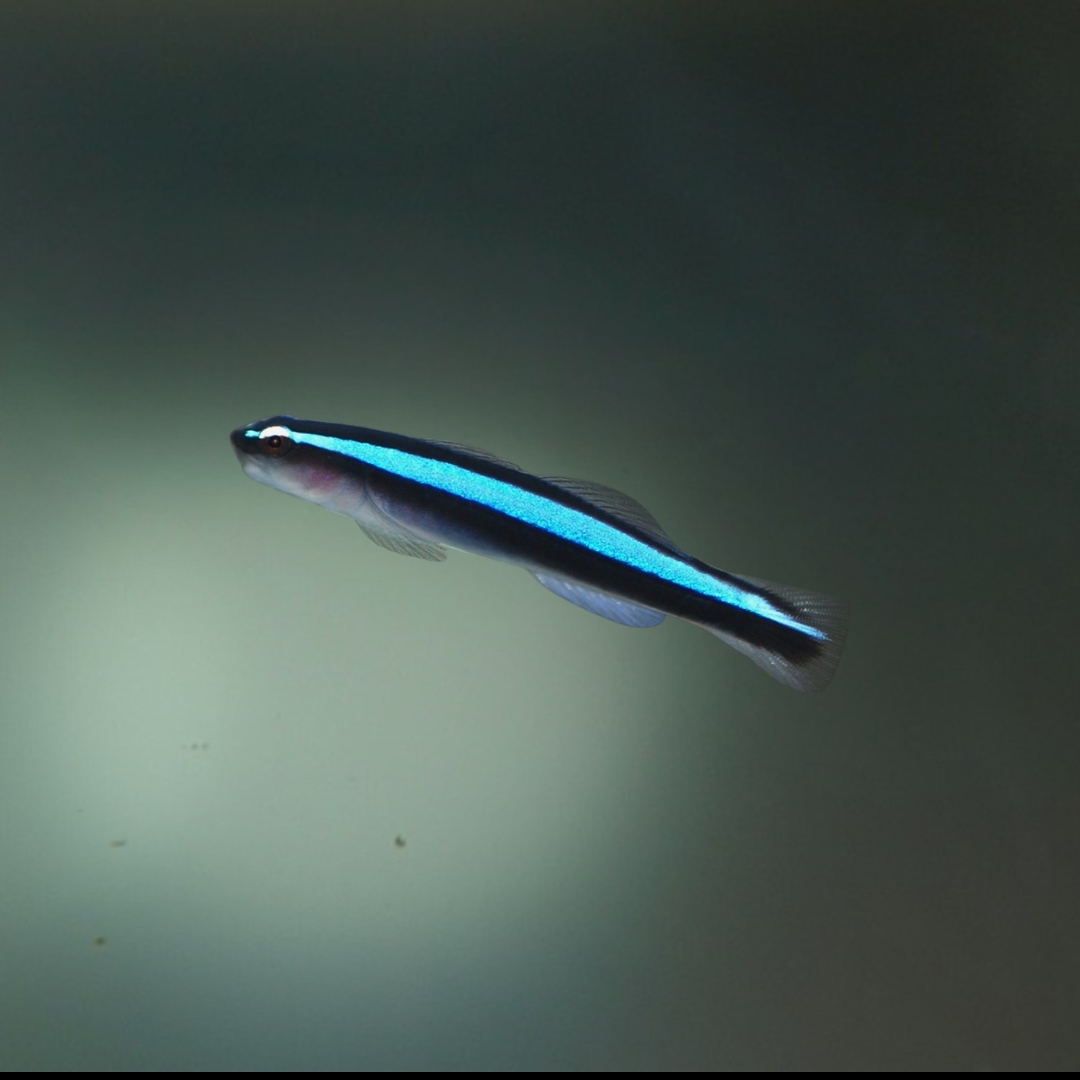
解説 / Description
ネオンゴビーは、フロリダ南部からカリブ海周辺にかけて分布する小型の海水性ハゼです。黒っぽい体に走る鮮やかな青いラインが印象的で、サンゴ礁では大型魚の体表、ヒレ、口内、エラ周辺についた外部寄生虫や細かな有機物をついばむクリーナーゴビーとして知られています。最大体長は約5cmと小さく、性格はおおむね温和で、サンゴを傷めにくいリーフセーフな魚として扱われます。丈夫で人工飼料にも慣れやすい一方、細身で飛び出しやすく、口の大きな魚には捕食される可能性があります。また、白点病などを完全に治療する魚ではないため、病気対策は検疫と水質管理を基本に考えることが大切です。 The Neon Goby is a small marine goby distributed from southern Florida through parts of the Caribbean region. Its vivid blue stripe over a dark body is striking, and on reefs it is known as a cleaner goby that picks external parasites and debris from the skin, fins, mouth, and gill areas of larger fishes. It reaches about 5 cm in total length, is generally peaceful, and is regarded as reef-safe because it does not normally damage corals. It is hardy and usually adapts well to prepared foods, but its slender body makes jumping a real risk, and it can be swallowed by larger predatory tank mates. It should also not be relied upon as a complete cure for marine ich or similar diseases; quarantine and stable water quality remain the foundation of disease prevention.
基本情報 / Basic Information
| 学名 / Scientific Name | Elacatinus oceanops |
|---|---|
| 通称 / Common Name | ネオンゴビー、ブルーネオンゴビー、クリーナーゴビーNeon Goby, Blue Neon Goby, Cleaner Goby |
| 分類 / Family | ハゼ科 Gobiidae。資料やデータベースにより上位分類はスズキ目またはハゼ目として扱われることがありますが、飼育上は海水性の小型ハゼとして理解するとよいでしょう。Family Gobiidae. Higher-level classification may be listed as Perciformes or Gobiiformes depending on the reference, but for aquarium purposes it is best understood as a small marine goby. |
| 英名 / English Name | Neon Goby |
| 分布 / Distribution | 西部中央大西洋。フロリダ南部からテキサス沿岸、カリブ海周辺、ベリーズ方面にかけて記録されています。Western Central Atlantic, recorded from southern Florida to the Texas coast and southward around the Caribbean region toward Belize. |
| 最大体長 / Max Size | 約5cmAbout 5 cm |
| 寿命 / Lifespan | 飼育下では数年程度とされることがありますが、個体差、導入時の年齢、飼育環境による幅が大きい魚です。購入時は、痩せていない若いブリード個体を選ぶと長期飼育を狙いやすくなります。In aquaria it is often described as living for a few years, but there is considerable variation depending on individual condition, age at purchase, and husbandry. Choosing a well-fed young captive-bred specimen improves the chance of long-term success. |
飼育環境 / Aquarium Environment
| 水槽サイズ / Tank Size | 単独飼育なら30cmキューブ水槽、約25〜30L程度から飼育候補になります。ただし水量が少ないほど水質変化が速いため、初心者は45cm規格水槽以上、可能なら60cm規格水槽、約57L前後を目安にすると管理しやすくなります。ペアや複数飼育を考える場合は、隠れ家と縄張りを分けられる広さを優先してください。A single individual can be considered for a 30 cm cube tank of about 25 to 30 L, but smaller systems change more quickly in water quality. Beginners will usually find a 45 cm standard aquarium or larger easier, with a 60 cm standard tank of around 57 L offering better stability. For a pair or multiple individuals, prioritize space that allows separate shelters and territories. |
|---|---|
| 水温 / Temperature | 24〜27℃前後を目安に安定させます。急変は避け、夏場の高水温と冬場の低水温に注意します。Keep the temperature stable at around 24 to 27°C. Avoid sudden changes and watch for overheating in summer and chilling in winter. |
| 水質 / Water Quality | 海水魚・リーフタンクの標準的な範囲を維持します。比重は1.020〜1.026、pHはおおむね8.0〜8.4、KHは8〜12dKH前後を目安にし、アンモニアと亜硝酸は検出されない状態を保ちます。硝酸塩は低めに維持し、急激な塩分変化を避けてください。Maintain standard marine or reef-tank conditions. Specific gravity around 1.020 to 1.026, pH roughly 8.0 to 8.4, and alkalinity around 8 to 12 dKH are practical targets. Ammonia and nitrite should remain undetectable, nitrate should be kept low, and sudden salinity swings should be avoided. |
| レイアウト / Layout | ライブロックや人工ライブロックで小さな隠れ家、くぼみ、平らな岩肌を作ります。砂に潜るタイプのハゼではないため、底砂の深さよりも、落ち着ける岩組みと見通しのよいスペースの両方が重要です。サンゴ水槽ではSPS、LPS、ソフトコーラルのいずれとも組み合わせやすい魚です。Use live rock or artificial live rock to create small shelters, crevices, and flat surfaces. This species is not a sand-burrowing goby, so stable rockwork and visible open space matter more than deep substrate. In reef aquaria it is generally compatible with SPS, LPS, and soft corals. |
| 注意点 / Precautions | 飛び出し事故が起こりやすいため、フタやメッシュスクリーンで水槽上部の隙間を必ずふさぎます。導入は硝化サイクルが安定した水槽で行い、点滴法などでゆっくり水合わせしてください。小型で細身のため、オーバーフローの吸い込み口やポンプ周りにも注意が必要です。Because this fish is prone to jumping, cover all gaps with a lid or mesh screen. Add it only to a biologically stable aquarium and acclimate it slowly, such as by drip acclimation. Its small, slender body also makes overflow intakes and pump areas worth checking for safety. |
餌と給餌 / Feeding
| 餌の種類 / Diet | 肉食寄りの雑食性として扱い、細かい海水魚用ペレット、細かく砕いたフレーク、冷凍コペポーダ、ブラインシュリンプ、細かいイサザアミなどを与えます。ブリード個体は人工飼料に慣れていることが多く、導入後の餌付けが比較的容易です。Treat it as a carnivore-leaning omnivore and offer fine marine pellets, crushed flakes, frozen copepods, brine shrimp, and finely chopped mysid-type foods. Captive-bred specimens are often already accustomed to prepared foods, making feeding easier after introduction. |
|---|---|
| 給餌のポイント / Feeding Tips | 口が小さいため、餌は必ず細かいサイズを選びます。1日1〜2回を基本に、痩せやすい個体や混泳魚に餌を奪われる環境では少量を複数回に分けると安心です。クリーナー行動だけに栄養を頼らせず、毎日きちんと給餌してください。Because the mouth is small, choose very fine food items. Feeding once or twice daily is a practical baseline; in tanks where the fish is thin or outcompeted, offer smaller meals more often. Do not rely on cleaning behavior alone for nutrition; provide food every day. |
性格と混泳 / Temperament and Tank Mates
| 性格 / Temperament | 性格はおおむね温和で、慣れると岩の上や水槽前面に出てくることも多い魚です。ペアを形成すると周辺を縄張りとして意識することがあり、同種同士では追い払いが見られる場合があります。It is generally peaceful and often becomes visible on rockwork or near the front of the aquarium once settled. A formed pair may treat its immediate area as a territory, and individuals of the same species may chase one another. |
|---|---|
| 混泳の相性 / Compatibility | 小型ヤッコ、デバスズメダイ、ゼブラハゼ、カエルウオ類、クマノミ類など、温和で口が大きすぎない魚と組み合わせやすいです。ハタ、ゴンベ、カサゴ、テンジクダイの大型個体など、口に入るサイズの魚を捕食する可能性がある相手は避けます。エビ類では大型のシャコや待ち伏せ型の甲殻類にも注意してください。It can be kept with peaceful fish that are not large enough to swallow it, such as small angelfish, chromis, dartfish, blennies, and clownfish. Avoid groupers, hawkfish, scorpionfish, larger cardinalfish, and other predators that may eat fish small enough to fit in their mouths. Large mantis shrimps or ambush-type crustaceans can also be a risk. |
病気と対策 / Diseases and Prevention
| かかりやすい病気 / Common Diseases | 海水魚全般と同じく、白点病、ウーディニウム病、細菌性の体表トラブル、痩せに注意します。ネオンゴビー自体は比較的丈夫ですが、輸送直後、急な塩分変化、未成熟な水槽、攻撃的な混泳相手は大きなストレスになります。As with marine fish in general, watch for marine ich, marine velvet, bacterial skin problems, and weight loss. The species is fairly hardy, but recent shipping, sudden salinity changes, immature aquaria, and aggressive tank mates can cause significant stress. |
|---|---|
| 対策と予防 / Prevention | クリーナー行動は魅力的ですが、病気の治療法として過信してはいけません。白点虫などは水槽環境中で増殖する段階を持つため、魚の体表をついばむだけでは生活環を断ち切れません。新魚の検疫、水質の安定、過密回避、栄養管理を基本とし、発症時は必要に応じて治療水槽で適切に対処します。Cleaning behavior is attractive, but it should not be overestimated as a treatment. Parasites such as marine ich have life stages that multiply in the aquarium environment, so picking the fish’s body does not break the whole life cycle. Quarantine new fish, keep water quality stable, avoid overcrowding, maintain nutrition, and use a separate treatment tank when proper treatment is needed. |
増やし方(繁殖) / Breeding
| 雌雄の判別 / Sexing | 外見だけでの雌雄判別は難しい魚です。生殖突起の形状で見分けられることがありますが、肉眼での確認は簡単ではありません。繁殖を狙う場合は、若魚を複数導入して自然にペアを形成させる方法が現実的です。Sexing by appearance alone is difficult. The shape of the genital papilla may help, but it is not easy to confirm with the naked eye. For breeding, allowing several juveniles to form pairs naturally is often the most practical approach. |
|---|---|
| 繁殖形態 / Reproduction | 一夫一婦的なペアを作り、貝殻の内側、PVCパイプ、人工基質などの硬い面に粘着性の沈性卵を産みつけます。産卵後は主にオスが卵を守り、ヒレで水を送って酸素供給を助けます。It forms pair bonds and lays adhesive demersal eggs on hard surfaces such as the inside of shells, PVC pipes, or artificial spawning substrates. After spawning, the male mainly guards the eggs and fans them to help oxygenate the clutch. |
| 繁殖のポイント / Breeding Tips | 条件が合うと10日前後の周期で産卵することがあり、1回の卵数は数百個規模になることがあります。孵化までは水温によりおおむね1週間前後、孵化後の仔魚は非常に小さいため、ワムシなどの微小な初期餌料とグリーンウォーター管理が重要です。家庭で産卵を見ることはありますが、稚魚育成には専用水槽、餌料培養、こまめな水質管理が必要です。Under favorable conditions, spawning may occur at roughly ten-day intervals, and a clutch can contain several hundred eggs. Incubation is usually about a week depending on temperature, and the larvae are very small after hatching, making rotifers and green-water style larval management important. Spawning can occur in home aquaria, but raising the fry requires a dedicated larval tank, live-food culture, and careful water management. |
雑学と豆知識 / Trivia and Fun Facts
| 1. 旧学名Gobiosoma oceanopsで知られた魚 / 1. A fish long known as Gobiosoma oceanops | ネオンゴビーは現在Elacatinus oceanopsとして扱われますが、古い観賞魚書籍やショップの記録ではGobiosoma oceanopsという名前で登場することがあります。これは別種というより、分類体系の見直しによって呼び名が整理された結果です。古い名前を知っておくと、1970年代の繁殖記事や海外の古い飼育記録を読むときにも混乱しにくくなります。The Neon Goby is currently treated as Elacatinus oceanops, but older aquarium books and shop records may list it as Gobiosoma oceanops. This usually reflects a historical taxonomic treatment rather than a different fish. Knowing the former name helps when reading older breeding articles and aquarium records from the 1970s. |
|---|---|
| 2. 青いラインは水槽内だけの美しさではない / 2. The blue stripe is more than aquarium beauty | ネオンゴビーの青いラインは、観賞魚として目を引くだけでなく、サンゴ礁で他の魚に自分の存在を知らせる視覚的な合図として働いていると考えられています。大型魚にとっては、食べ物ではなく掃除をしてくれる相手を見分ける手がかりになります。小さな魚が大きな魚の口元に近づける背景には、このような生態的な約束ごとのような関係があります。The blue stripe is not merely decorative. It is thought to function as a visual signal that helps other reef fish recognize the goby as a cleaner rather than prey. For larger fish, the stripe and behavior provide cues that this tiny fish is a service provider. This ecological relationship is one reason such a small fish can approach the mouth area of much larger animals. |
| 3. クリーナーでも治療薬ではない / 3. A cleaner, but not a medicine | クリーナーゴビーという名前から、白点病対策として期待されることがあります。しかし、ネオンゴビーがついばむのは主に魚体表面で見つけたものです。白点虫のように水槽内で生活環を回す寄生虫は、底砂や環境中にも段階を持つため、魚だけに任せても根本的な治療にはなりません。ネオンゴビーは水槽に自然な行動と魅力を加える魚であり、病気対策の主役はあくまで検疫、観察、安定した飼育環境です。Because it is called a cleaner goby, it is sometimes expected to help with marine ich. However, the goby mainly picks what it finds on the fish’s surface. Parasites with environmental life stages, such as marine ich, cannot be eliminated simply by cleaning the fish. The Neon Goby adds natural behavior and charm to an aquarium, but quarantine, observation, and stable husbandry remain the main tools for disease control. |
| 4. 海水魚繁殖史に残る入門的な成功例 / 4. An early success story in marine ornamental breeding | ネオンゴビーは、海水観賞魚の人工繁殖史でも重要な魚です。1970年代にはマーティン・A・モー・ジュニアによる繁殖・育成記録が紹介され、クマノミ類と並んで、海水魚を水槽内で産ませ、仔魚を育てる技術の発展を支えた代表的な魚のひとつになりました。小型でペアを作りやすく、硬い場所に卵を産む性質は、繁殖研究の対象としても扱いやすかったのです。The Neon Goby also has an important place in the history of marine ornamental breeding. In the 1970s, Martin A. Moe Jr. described successful culture of this fish, making it one of the representative early marine species raised through captive spawning and larval rearing alongside clownfishes. Its small size, pair-forming behavior, and habit of laying eggs on firm surfaces made it a practical subject for culture work. |
| 5. 名前が似た淡水ハゼとの取り違えに注意 / 5. Do not confuse it with similarly named freshwater gobies | 英名や流通名には、ブルー、ネオン、ドワーフなど似た言葉が使われることがあります。たとえば淡水性のStiphodon atropurpureusは、Electric Blue Neon Dwarf Gobyのように呼ばれることがありますが、ネオンゴビーとは分布も水質も餌も大きく異なります。購入時は、学名がElacatinus oceanopsであること、そして完全な海水魚であることを確認すると安心です。Trade names can reuse words such as blue, neon, and dwarf for very different fish. For example, the freshwater Stiphodon atropurpureus may be sold under names such as Electric Blue Neon Dwarf Goby, but it differs greatly from the marine Neon Goby in distribution, water requirements, and diet. When buying, confirm that the scientific name is Elacatinus oceanops and that the fish is fully marine. |
まとめ / Conclusion
ネオンゴビーは、鮮やかな青いライン、温和な性格、リーフタンクとの相性、そしてクリーナー行動という見どころを備えた、海水小型魚の定番種です。最大体長が約5cmと小さいため小型水槽でも候補になりますが、水質の安定、飛び出し対策、捕食されない混泳相手の選定は欠かせません。 The Neon Goby is a classic small marine fish with vivid blue coloration, a peaceful nature, reef compatibility, and fascinating cleaner behavior. Its maximum size of about 5 cm makes it a candidate for smaller aquaria, but stable water quality, a secure lid, and careful tank-mate selection are essential.
ブリード個体を選び、細かな餌を毎日与え、白点病対策をこの魚だけに頼らないことが長期飼育のポイントです。小さな体ながら水槽内での存在感は大きく、落ち着いた環境を整えれば、サンゴ水槽に自然な動きと知的な面白さを加えてくれる魚になるでしょう。 Choosing a captive-bred specimen, feeding fine foods daily, and not relying on the fish alone for disease control are key points for long-term care. Although tiny, it has a strong presence in the aquarium, and in a stable reef system it can add both natural behavior and intellectual interest.

気になる道具や飼い方を見つけてみませんか?
 アイのアクアグッズ案内水槽のろ材の選び方|ウール・リング・活性炭の違いとおすすめ商品フィルターの中の綿や石は何をしている? アイとコタロウが、ウール・スポンジ・セラミック・焼結ガラス・活性炭・ゼオライトを比較。機種との相性、入れ方、洗い方と交換まで商品とともに紹介します。記事はコチラ →
 アイのアクアグッズ案内水槽の中に陸地がある!? コタロウと探るアクアテラリウムのメカニズム滝の水はどこから来るの? 白い霧の正体は? アイとコタロウが、水の循環、隠れたポンプ、霧の装置、陸上の植物と水草の葉の変化から、アクアテラリウムのメカニズムを探ります。記事はコチラ →
さまざまな飼育テーマをご紹介。リンク先の記事には広告・商品紹介が含まれます。
案内・紹介記事一覧へ →参考文献・根拠資料
この記事の分類、分布、生息環境、クリーナー行動、飼育上の注意、繁殖、病気対策に関する記述を支えるため、店舗・通販ページ、個人ブログ、一般的なまとめサイトを除外し、学術データベース、公的機関、大学・研究機関、査読論文、専門誌の歴史的資料を中心に選定しました。
-
World Register of Marine Species (WoRMS). “Elacatinus oceanops Jordan, 1904.”
分類学上の有効名、原記載、旧学名 Gobiosoma oceanops がシノニム扱いである点の確認に使用。
https://www.marinespecies.org/aphia.php?id=280616&p=taxdetails -
Froese, R. and D. Pauly, eds. FishBase. “Elacatinus oceanops, Neon goby.”
最大体長、分布、西部中央大西洋、サンゴ礁性の生息環境、水深、クリーナー行動、飼育・繁殖実績の基礎情報に使用。
https://www.fishbase.se/summary/elacatinus-oceanops -
Smithsonian Tropical Research Institute, Shorefishes of the Greater Caribbean. “Species: Elacatinus oceanops, Neon Goby.”
カリブ海域の魚類データベースとして、形態的特徴とサンゴヘッド周辺に見られる生息情報の補強に使用。
https://biogeodb.stri.si.edu/caribbean/en/thefishes/species/4149 -
Lettieri, L. and J. T. Streelman. 2010. “Colourful stripes send mixed messages to safe and risky partners in a diffuse cleaning mutualism.” Journal of Evolutionary Biology 23(11): 2289–2299.
Elacatinus 属の青いストライプがクリーナー行動のシグナルとして機能する可能性、捕食者・クライアント魚との相互作用に関する記述の補強に使用。
https://pubmed.ncbi.nlm.nih.gov/20825524/ -
Corso, A. J. et al. 2023. “Cleaning symbiosis in coral reefs of Jardines de la Reina National Park, Cuba.” PeerJ 11: e16524.
サンゴ礁におけるクリーニング共生ネットワークの背景説明、クリーナー生物とクライアント魚の相利共生を解説するための補助資料。
https://peerj.com/articles/16524/ -
Gunn, R. et al. 2020. “Multiple cleaner species provide simultaneous services to clients on coral reefs.” Biology Letters 16: 20200723.
カリブ海のクリーナーゴビーを含む複数クリーナー種の同時クリーニング行動を示す資料として、クリーニングステーションの説明を補強。
https://royalsocietypublishing.org/doi/10.1098/rsbl.2020.0723 -
Majoris, J. E., F. A. Francisco, J. Atema and P. M. Buston. 2018. “Reproduction, early development, and larval rearing strategies for two sponge-dwelling neon gobies, Elacatinus lori and E. colini.” Aquaculture 483: 286–295.
近縁の Elacatinus 属ネオンゴビー類における繁殖、初期発生、ワムシ・アルテミアを用いた仔魚育成の学術的補強に使用。E. oceanops そのものではなく近縁種の研究として参照。
https://open.bu.edu/items/15f6b0d3-2d7f-44bb-90b6-7d5afdcf45da -
Moe, M. A. Jr. 1975. “Propagating the Atlantic Neon Goby.” The Marine Aquarist, February 1975.
ネオンゴビーの人工繁殖史、初期の商業的マリカルチャー史に関する一次的・歴史的資料として採用。古い専門誌記事のため、数値情報は現代の学術資料と照合して使用。 -
Moorhead, J. A. and C. Zeng. 2010. “Development of Captive Breeding Techniques for Marine Ornamental Fish: A Review.” Reviews in Fisheries Science 18(4): 315–343.
海水観賞魚の人工繁殖技術、野生採集依存の軽減、仔魚飼育上の課題など、ブリード個体の意義を説明するための総説。
https://researchonline.jcu.edu.au/16673/ -
Yanong, R. P. E. 2021. “Cryptocaryon irritans Infections (Marine White Spot Disease) in Fish.” University of Florida IFAS Extension, FA164.
海水白点病の原因、生活環、魚体外ステージ、検疫・防除の考え方を支える資料。ネオンゴビーが白点病の完全な治療手段ではないという注意書きの根拠として使用。
https://ask.ifas.ufl.edu/publication/FA164 -
Francis-Floyd, R. and colleagues. 2011. “Amyloodinium ocellatum, an Important Parasite of Cultured Marine Fish.” Southern Regional Aquaculture Center Publication No. 4705.
海水性ベルベット病、Amyloodinium ocellatum の病原性、生活環、養殖・飼育現場での注意点を支える公的な拡張資料。
https://agrilife.org/fisheries/files/2013/09/SRAC-Publication-No.-4705-Amyloodinium-ocellatum-an-Important-Parasite-of-Cultured-Marine-Fish.pdf
補足:水槽サイズは個体数や設備に応じて調整する目安です。





コメント