

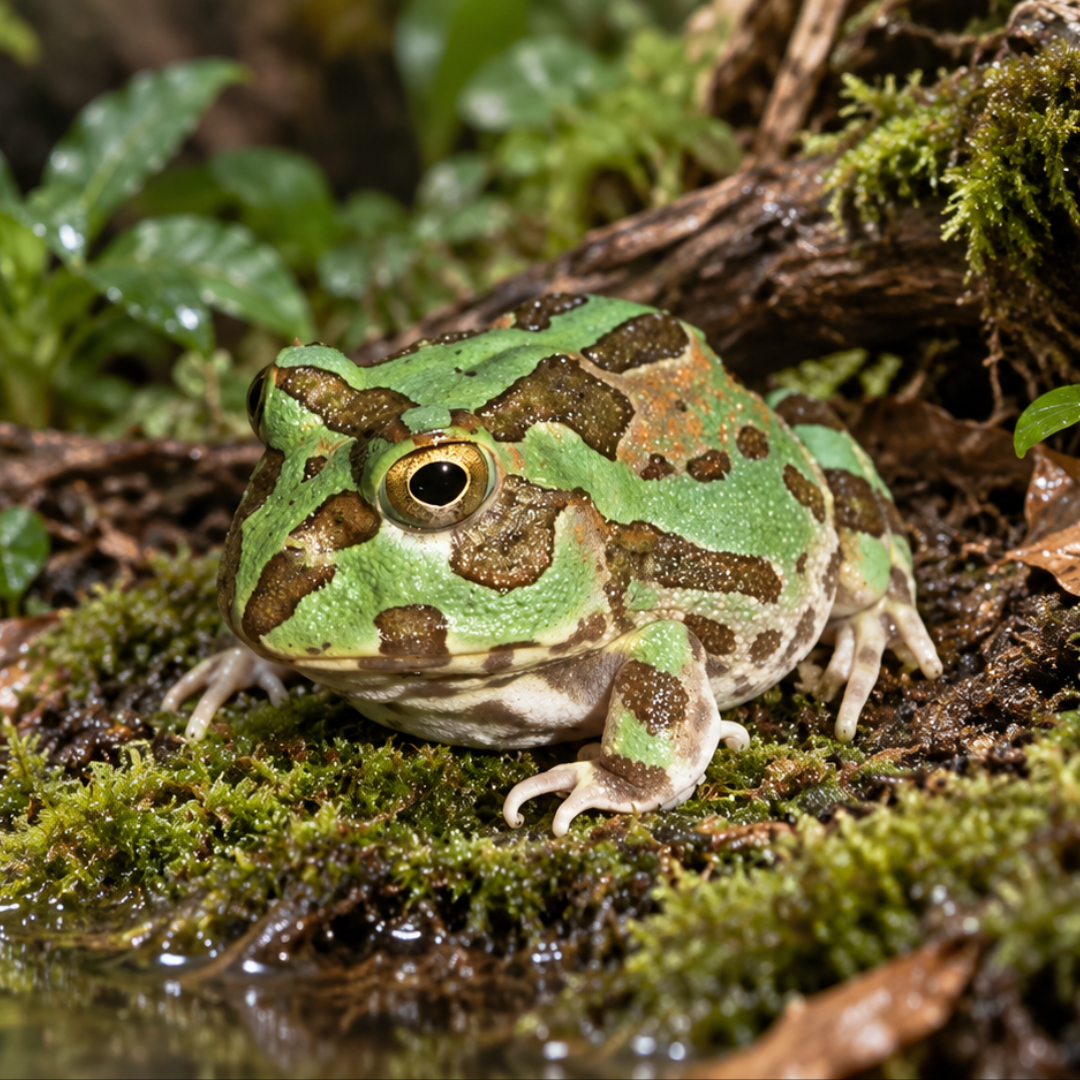
解説Description
チャコガエルは、南米中央部のグランチャコに分布する小型の地中棲ガエルです。丸みを帯びた体、大きな頭部、上向きについた眼が印象的で、ツノガエル科のなかでも独特の姿をしています。普段は地中で過ごす時間が長く、乾季には土中で活動を抑え、体表に水分の損失を防ぐ繭状の層を形成して乾燥をしのぐことがあります。一方、暖かい雨季にまとまった雨が降ると地上へ現れ、一時的にできた水場で短期間に繁殖します。 The Chaco horned frog is a small fossorial frog distributed across the Gran Chaco of central South America. Its rounded body, large head, and upward-facing eyes give it a distinctive appearance even among other members of Ceratophryidae. It spends much of its life underground and can remain inactive during dry periods, forming cocoon-like layers of shed skin that help reduce water loss. When warm-season rains arrive, adults emerge and breed over a short period in temporary pools.
後肢には土を掘るのに適した硬い中足骨結節があり、体を後方へ沈めるようにして地中へ潜ります。さらに、一時的な水たまりで育つ幼生は発育が非常に速く、一部の研究個体では約2週間で変態に達しています。潜るための体、乾燥をしのぐ仕組み、雨季に集中する繁殖、急速な幼生発育は、いずれも季節変化の大きなグランチャコで生きるという同じ生活史につながっています。飼育でも、この「地中で暮らすカエル」であることを前提に環境を整えることが大切です。 Its hind feet possess hardened metatarsal tubercles suited to digging, and the frog burrows by sinking backward into the substrate. Tadpoles developing in temporary pools also grow exceptionally quickly, with some studied individuals reaching metamorphosis in about two weeks. Burrowing, resistance to seasonal dryness, concentrated breeding during the rainy season, and rapid larval development are all parts of the same life-history strategy for surviving in the strongly seasonal Gran Chaco. Captive care should likewise begin with an understanding that this is fundamentally a burrowing frog.
基本情報Basic Information
| 学名Scientific Name | Chacophrys pierottii (Vellard, 1948) |
|---|---|
| 通称Common Name | チャコガエルChaco horned frog; Lesser Chini frog |
| 分類Classification | 両生綱・無尾目・ツノガエル科・チャコガエル属。チャコガエル属 Chacophrys は、現在認められている現生種が本種のみの単型属です。Class Amphibia, Order Anura, Family Ceratophryidae, Genus Chacophrys. The genus is currently monotypic and contains this single recognized living species. |
| 英名English Name | Chaco Horned Frog |
| 分布Distribution | アルゼンチンのチャコ地域を中心に、パラグアイ西部、ボリビア南部のタリハ周辺まで分布します。乾燥・半乾燥環境に暮らし、繁殖には雨季に生じる一時的な水場を利用します。Distributed through the Chaco region of Argentina, western Paraguay, and the Tarija region of southern Bolivia. It inhabits dry to semi-arid environments and uses temporary pools formed during the rainy season for reproduction. |
| 成体サイズAdult Size | 頭胴長(SVL)はおおむね45~65mm前後。雌は雄より大型になる傾向があり、野外個体群を調べた研究でも雌に偏った性的サイズ二型が確認されています。Adults are generally around 45–65 mm in snout–vent length (SVL). Females tend to be larger than males, and female-biased sexual size dimorphism has also been documented in a studied wild population. |
| 寿命Lifespan | アルゼンチン北部の野生個体群を骨年輪から調べた研究では、調査個体の最高年齢は雌雄とも5歳でした。また、骨の成長パターンからは生後1年ほどで性成熟に達すると推定されています。これは特定の野生個体群で得られた値であり、飼育下での寿命を5年と限定するものではありません。A skeletochronological study of a wild population in northern Argentina recorded a maximum age of five years in both sexes and inferred sexual maturity at about one year of age. These figures come from a particular wild population and should not be interpreted as a fixed five-year lifespan in captivity. |
飼育環境Enclosure Environment
| 飼育容器・サイズEnclosure and Size | 成体1匹であれば30cm級の底面を持つケースをひとつの実用的な目安とし、十分な厚さの床材を入れられる容器を選びます。本種は高さのある空間を利用する種類ではないため、飼育容器の高さよりも、体を埋められる床材の深さと底面積を確保することが重要です。蓋は脱走を防ぎつつ、内部が蒸れない程度の通気性を確保します。For a single adult, an enclosure with a floor area in roughly the 30 cm class is a practical starting point, provided that it can hold a sufficiently deep substrate. This species does not make significant use of vertical space, so usable floor area and enough substrate for complete burrowing are more important than enclosure height. The lid should be secure while still allowing adequate ventilation. |
|---|---|
| 温度Temperature | 通常飼育では24~28℃前後がひとつの目安です。急激な温度変化を避け、冬季に加温する場合も局所的な過熱が起こらないようにします。ヒーターを使用する場合は、生体がより暖かい場所と涼しい場所を選べるような配置にすると管理しやすくなります。For routine captive care, approximately 24–28°C is a practical target range. Sudden temperature changes should be avoided, and supplemental heating should not create a localized area of excessive heat. When heaters are used, arranging the enclosure so the frog can choose between warmer and cooler areas is preferable. |
| 環境管理Environmental Management | 乾燥地に生息する種類ですが、通常飼育で床材を完全に乾かしておくカエルではありません。床材の内部に適度な湿り気を保ちながら、常時びしょびしょの状態にもならないよう調整します。湿度は飼育容器の通気性や床材によって大きく変わるため、特定の数値だけで判断せず、床材の水分状態と生体の様子を確認することが大切です。水入れを設置する場合は安全に出入りできるものを使い、カルキを抜いた清潔な水を保ちます。排泄物や食べ残しも早めに除去します。Although this species originates from an arid region, routine captive care does not mean keeping the substrate completely dry. The deeper substrate should retain moderate moisture without remaining constantly waterlogged. Because relative humidity varies greatly with enclosure ventilation and substrate type, husbandry should not rely on a single numerical humidity target; substrate condition and the frog itself should also be observed. If a water dish is provided, it should allow safe entry and exit and contain clean, dechlorinated water. Feces and uneaten food should be removed promptly. |
| レイアウトLayout | ヤシガラ土や細かな赤玉土など、潜る行動を妨げにくい土系の床材を厚めに敷く方法が本種の性質に合っています。誤飲しやすい大粒の砂利や鋭い素材は避けます。ウールマットはツノガエル類で広く使われる床材ですが、チャコガエルは後肢で強く掘るため、本来の潜る行動を行わせたい場合には土系床材のほうが適しています。ウール状の素材を使用する場合は、ほつれや後肢への絡みがないかこまめに確認します。シェルターなどを設置する場合も、掘削の邪魔にならないシンプルな配置が扱いやすいでしょう。A deep layer of diggable soil-based substrate, such as coconut fiber or fine akadama-type soil, suits the natural behavior of this species. Large gravel, sharp materials, and easily swallowed particles should be avoided. Fiber mats are widely used for some horned frogs, but because Chaco horned frogs dig vigorously with the hind feet, a soil-based substrate is better suited when natural burrowing behavior is to be accommodated. If fibrous material is used, it should be checked regularly for fraying or entanglement around the hind feet. Hides may be added, but a simple layout that leaves room for digging is easiest to manage. |
| 注意点Precautions | 野生で乾季を乗り切る能力と、飼育下で常に乾燥させてよいことは別です。乾眠は水分の損失を抑えて不利な季節をしのぐための生理的な状態であり、とくに幼体や痩せた個体へ安易に誘導するべきものではありません。通常の飼育では、安定した温度と適切な床材水分を優先します。また、両生類は皮膚から物質を取り込みやすいため、ハンドクリームや洗剤などが付着した手で触れないようにし、必要のないハンドリングは避けます。The ability to survive a natural dry season does not mean that the species should be kept permanently dry in captivity. Aestivation is a physiological state that reduces water loss during unfavorable conditions and should not be induced casually, particularly in juveniles or underweight animals. Routine husbandry should prioritize stable temperatures and appropriate substrate moisture. Amphibians also absorb substances readily through the skin, so unnecessary handling should be avoided and the frog should not be touched with residues of lotion, detergent, or similar chemicals on the hands. |
餌と給餌Feeding
| 餌の種類Diet | 肉食性で、野生の幼体を調べた胃内容物調査では甲虫類とハチ目が主要な餌となり、そのほか昆虫の幼虫、ハエ目、カメムシ目、クモ、サソリ、カエル類なども確認されています。飼育下ではコオロギ、デュビア、ミミズなど、管理された餌生物を中心に与えます。人工飼料へ餌付く個体もいますが、とくに小さな幼体では生きた昆虫への反応がよい個体も多いため、まず確実に摂餌する餌を把握することが大切です。The species is carnivorous. A stomach-content study of wild juveniles found beetles and hymenopterans to be major prey items, along with insect larvae, flies, true bugs, spiders, scorpions, and frogs. In captivity, safely cultured feeders such as crickets, dubia roaches, and earthworms can form the basis of the diet. Some individuals accept formulated diets, but small juveniles in particular may respond more reliably to live insects, so establishing dependable feeding should take priority. |
|---|---|
| 給餌のポイントFeeding Tips | 成長中の幼体は成体よりこまめな給餌が必要ですが、適切な間隔は個体の大きさ、温度、活動性、餌の種類によって変わります。日数だけで機械的に決めず、体型や消化の様子を見ながら調整します。大きすぎる餌は避け、無理なく飲み込めるサイズを選びます。ピンセット給餌を行う場合は口元を強く刺激せず、餌への反応を見ながら与えます。昆虫中心の食餌では、餌昆虫のガットローディングや適切なカルシウム補給も意識し、特定の餌だけに偏らないようにします。丸みのある体型が正常な種類ですが、過剰給餌による肥満にも注意が必要です。Growing juveniles generally require feeding more often than adults, but the appropriate interval varies with body size, temperature, activity, and food type. Feeding should therefore be adjusted according to body condition and digestion rather than by a rigid number of days. Prey should be small enough to swallow comfortably. When tong-feeding, avoid repeatedly forcing food against the mouth and instead watch the frog’s feeding response. For insect-based diets, appropriate gut-loading and calcium supplementation should also be considered, while avoiding dependence on a single feeder species. The frog is naturally rounded, but chronic overfeeding and obesity should still be avoided. |
行動と同居Behavior and Cohabitation
| 行動・性質Behavior | 地表を長時間歩き回るよりも、床材へ潜って獲物を待つ待ち伏せ型の生活をします。後肢で土を押し分け、体を後ろ向きに沈めるように短時間で潜る行動は、本種を観察するうえで特徴的なものです。雨や水分量の増加は野生での活動や繁殖と強く結びついており、成熟した雄は繁殖期に雌を呼ぶ広告音を発します。飼育下でも環境変化をきっかけに鳴く個体があります。Rather than spending long periods walking over the surface, this species commonly burrows into the substrate and waits for prey as an ambush predator. Its rapid backward-burrowing behavior, in which the hind legs push soil aside while the body sinks into the ground, is particularly characteristic. Rainfall and increased moisture are closely associated with activity and reproduction in the wild, and mature males produce advertisement calls during breeding activity. Captive males may also call after environmental changes. |
|---|---|
| 同居の相性Compatibility | 基本的には単独飼育が安全です。野生の幼体を調べた研究では、カエル類の捕食に加えてチャコガエル同士の共食いも確認されています。体格差のある個体を同居させれば捕食につながる可能性があり、同程度の大きさでも給餌時の誤咬や競合を避けることはできません。他種との同居も、捕食だけでなく病原体の持ち込みや適正環境の違いがあるため推奨されません。繁殖目的で雌雄を合わせる場合も、状態を観察できる環境で行います。Solitary housing is the safest approach. A study of wild juveniles documented predation on other frogs as well as cannibalism among Chaco horned frogs. Animals of different sizes may therefore present a predation risk to one another, while similarly sized individuals can still compete or bite one another during feeding. Mixed-species housing is also discouraged because of predation, pathogen transmission, and differing environmental requirements. Breeding introductions should likewise be carried out under conditions where the animals can be closely observed. |
病気と対策Diseases and Prevention
| かかりやすい病気・不調Common Diseases and Health Problems | 特定の病気だけがチャコガエルに多いと断定できる資料は限られていますが、両生類の飼育では、過湿で不衛生な環境に伴う皮膚トラブル、極端な乾燥による脱水、低温時の消化不良、過剰給餌、異物の誤飲、栄養の偏りなどに注意します。また、カエルツボカビ症を引き起こす Batrachochytrium dendrobatidis(Bd)をはじめ、外見だけでは分からない感染症を新しい個体とともに持ち込む可能性も考慮する必要があります。There is limited evidence for identifying a particular disease as uniquely common in Chaco horned frogs, but captive amphibians can develop problems associated with persistently wet and dirty conditions, dehydration from excessive dryness, impaired digestion at low temperatures, overfeeding, ingestion of unsuitable material, and nutritional imbalance. Infectious disease must also be considered, including chytridiomycosis caused by Batrachochytrium dendrobatidis (Bd), which may be introduced with an apparently healthy new animal. |
|---|---|
| 対策と予防Prevention and Care | 新しく迎えた個体は既存の両生類とすぐに接触させず、別容器と別器具で管理します。日頃から食欲、体型、排泄、皮膚の状態、潜り方などを観察しておくと、普段との違いに気づきやすくなります。原因不明の拒食や急激な体重減少、皮膚の赤み・潰瘍、むくみ、姿勢異常などが続く場合は、自己判断で薬剤を使用せず、両生類・爬虫類を診療できる獣医師へ相談します。使用済みの飼育水や床材、生体そのものを野外へ放出しないことも重要です。New animals should not be placed immediately with established amphibians and should be maintained with separate enclosures and equipment. Routine observation of appetite, body condition, feces, skin condition, and normal burrowing behavior makes changes easier to recognize. Persistent unexplained anorexia, rapid weight loss, redness or ulceration of the skin, swelling, or abnormal posture should be assessed by a veterinarian experienced with amphibians and reptiles rather than treated with medication without a diagnosis. Used enclosure water, substrate, and captive animals themselves should never be released into the environment. |
増やし方(繁殖)Breeding
| 雌雄の判別Sexing | 成熟すると雌のほうが雄より大型になる傾向があります。ただし個体差があるため、大きさだけで確実に判別することはできません。成熟した雄が繁殖期に広告音を発することは、性別を判断するうえで有力な手掛かりになります。幼体では外見だけからの確実な判別は困難です。Mature females tend to be larger than males, although individual variation means that body size alone is not a reliable method of sexing. Advertisement calls produced by mature males during breeding activity provide a useful indication of sex. Juveniles are difficult to sex reliably from external appearance alone. |
|---|---|
| 繁殖形態Reproduction | 野生では暖かい雨季の始まりに、一時的な水場へ個体が集まって短期間に繁殖する「爆発的繁殖」を行います。雄は水場で鳴いて雌を呼び、抱接ののち水中へ産卵します。幼生の成長は非常に速く、研究された大型の幼生群では約2週間、別の発生研究ではおよそ15~18日で変態に達する例が報告されています。ただし、すべての個体が必ず同じ日数で変態するわけではなく、成長速度には餌条件や水場の状態なども関係すると考えられています。In the wild, the species breeds explosively in temporary pools at the beginning of the warm rainy season. Males call from the breeding site, amplexus occurs, and eggs are deposited in water. Larval development is exceptionally rapid: studied groups of large tadpoles have reached metamorphosis in about two weeks, while other developmental work has reported approximately 15–18 days. This should not be interpreted as a fixed timetable for every individual, as growth rate appears to vary with factors including food conditions and the state of the temporary pond. |
| 繁殖のポイントBreeding Tips | 野生で繁殖が雨季の到来と結びついているため、飼育下でも季節的な乾湿変化や水分量の増加が繁殖のきっかけとして利用されることがあります。ただし、「繁殖には必ず長期間の乾眠が必要」と断定できるわけではなく、健康な個体を無理に乾燥させるべきではありません。繁殖を試みる場合は十分に成熟し、体調の整った個体を用います。幼生は発育が速いため、水質悪化を防ぎながら成長を観察し、前肢が現れて尾の吸収が始まる時期には、安全に上陸できる環境を早めに準備します。Because wild reproduction is associated with the onset of the rainy season, captive breeders may use seasonal changes in moisture or an increase in available water as breeding cues. This does not mean that prolonged induced aestivation is proven to be essential for breeding, and healthy frogs should not simply be dried out in an attempt to force reproduction. Only mature animals in good condition should be used. Tadpoles develop rapidly, so water quality must be maintained carefully and safe access to land should be prepared before the forelimbs emerge and tail resorption progresses. |
雑学と豆知識Trivia and Fun Facts
| 1. 1属1種のチャコガエル属1. A One-Species Genus | チャコガエル属 Chacophrys は、現在認められている現生種がチャコガエル1種だけの単型属です。ツノガエル科にはツノガエル属 Ceratophrys とマルメタピオカガエル属 Lepidobatrachus も含まれます。一部の分子系統解析ではチャコガエル属とマルメタピオカガエル属が姉妹群として示されていますが、その関係の統計的支持は強くない解析もあり、細かな属間関係には研究上の検討が残っています。見た目がツノガエルに似ていても、単なる小型版ではありません。The genus Chacophrys is currently monotypic, containing only the Chaco horned frog among living species. Ceratophryidae also includes Ceratophrys and Lepidobatrachus. Some molecular analyses have recovered Chacophrys and Lepidobatrachus as sister taxa, although statistical support for that particular relationship has not always been strong. Its resemblance to other horned frogs therefore should not be mistaken for simply being a smaller version of them. |
|---|---|
| 2. 後ろ向きに地面へ潜る2. Burrowing Backward into the Ground | 後肢の内側には、土を押し分けるのに役立つ硬く発達した中足骨結節があります。チャコガエルはこれを使って土を左右へ押し、体を後ろ向きに沈めるように潜ります。飼育下で床材へすばやく消えていく姿は、本種が地中生活に適応していることを最も分かりやすく示す行動のひとつです。そのため床材は、単に容器の底を覆うものではなく、生活空間そのものと考える必要があります。The inner hind foot bears a hardened metatarsal tubercle that helps push soil aside. Chaco horned frogs use their hind legs to dig while the body sinks backward into the ground. Watching a frog rapidly disappear into the substrate is one of the clearest demonstrations of its fossorial specialization. For this reason, substrate should be regarded as part of the animal’s living space rather than merely as material covering the bottom of the enclosure. |
| 3. 乾季をしのぐ「繭」3. A Cocoon for the Dry Season | チャコ地方に暮らすツノガエル科の仲間では、乾燥する季節に地中へ潜り、脱落した表皮の層を体表へ重ねて繭を形成することが知られています。チャコガエルでもこの仕組みが乾燥期の水分損失を抑えるうえで役立ちます。見た目には薄い膜に包まれたようになりますが、これは病的な皮膚の異常とは異なる季節適応です。ただし、野生でできることと、飼育下で積極的に乾眠させるべきかどうかは分けて考える必要があります。Ceratophryid frogs from the Chaco are known to burrow during dry periods and form a cocoon from accumulated outer skin layers. In Chaco horned frogs, this adaptation helps reduce water loss during unfavorable dry conditions. The animal may appear wrapped in a thin membrane, but this is a seasonal physiological adaptation rather than ordinary pathological shedding. Its occurrence in nature, however, should be distinguished from the question of whether aestivation should deliberately be induced in captivity. |
| 4. 大きな頭の内側には頑丈な骨格がある4. A Reinforced Skull Beneath the Large Head | チャコガエルは頭部が大きいだけでなく、頭蓋骨の骨化が著しく進む「過剰骨化」を示すカエルのひとつです。ツノガエル科では大きな口と強固な頭部が、比較的大きな獲物を利用する食生活と結びついて進化してきたと考えられています。丸く柔らかな外見の内側には、待ち伏せ型の捕食者らしい頑丈な構造が隠されています。The Chaco horned frog is notable not only for its large head but also for extensive cranial ossification, or hyperossification. Within Ceratophryidae, a large gape and robust skull are associated with an evolutionary history of taking relatively large prey. Beneath the frog’s rounded, soft-looking exterior is therefore a strongly reinforced structure characteristic of an ambush predator. |
| 5. 水たまりが消える前に変態する5. Metamorphosing Before the Pond Disappears | チャコガエルの繁殖場所は、雨のあとに一時的に現れる水場です。こうした水場は永続するとは限らないため、幼生には短期間で成長して陸上生活へ移ることが大きな意味を持ちます。研究された大型幼生群では、約2週間という短期間で変態した例があります。すべての幼生が同じ速度で成長するわけではありませんが、水場の寿命が短い環境と急速な発育が深く結びついていることを示す特徴です。Chaco horned frogs reproduce in temporary bodies of water formed after rain. Because such pools may not persist, rapid growth and transition to terrestrial life are highly advantageous to the larvae. Studied groups of large tadpoles have completed metamorphosis in about two weeks. Not every tadpole develops at exactly the same rate, but this accelerated development clearly reflects life in habitats where aquatic breeding sites may be short-lived. |
| 6. 変態とともに消化管まで作り替わる6. The Digestive Tract Is Remodeled During Metamorphosis | 幼生は、初期には池底のデトリタスを中心に、藻類や小型の動物質なども利用します。研究では、大型の幼生が水中で甲殻類などを摂食していた例も確認されています。変態が始まると摂食を止め、長かった腸管は急速に短くなり、胃が分化して、肉食性の成体に適した消化器官へ変化します。外見がオタマジャクシからカエルへ変わる裏側で、食べ物を処理する仕組みそのものも大きく組み替えられているのです。Early tadpoles feed largely on bottom detritus while also taking algae and small animal material. Studies have also found larger larvae feeding on crustaceans in the water column. Once metamorphosis begins, feeding stops, the previously long intestine shortens rapidly, and the stomach differentiates as the digestive system shifts toward the carnivorous adult condition. The transformation from tadpole to frog therefore involves a major internal reorganization as well as the obvious external changes. |
| 7. 大雨のあとに始まる爆発的繁殖7. Explosive Breeding after Rain | 普段のチャコガエルは地中に隠れている時間が長いため、野外では簡単に見つかるカエルではありません。しかし雨季になると、一時的な水場に複数の個体が集まり、短い期間へ繁殖活動が集中します。このような繁殖様式は「爆発的繁殖」と呼ばれます。いつでも使える池を持たない環境では、「雨が降ったときに一気に繁殖する」ことそのものが重要な生存戦略になります。Chaco horned frogs spend so much time underground that they are not easily encountered during much of the year. During the rainy season, however, multiple animals gather at temporary pools and concentrate their reproductive activity into a short period. This pattern is known as explosive breeding. In an environment without permanent breeding ponds, reproducing rapidly when rain creates suitable water is itself an important survival strategy. |
| 8. 幼体でも確認されている旺盛な捕食性8. Strong Predatory Behavior Even in Juveniles | 野生の幼体75匹を調査した研究では、餌を同定できた胃から甲虫類やハチ目を中心にさまざまな節足動物が見つかり、カエル類や同種個体を食べた例も確認されました。つまり、チャコガエルは特定の昆虫だけを食べる専門食者ではなく、利用できる獲物を幅広く捕らえる捕食者です。こうした食性は、同居飼育で共食いに注意しなければならない理由にもつながっています。A study of 75 wild juveniles found a wide variety of arthropods in stomachs containing identifiable prey, particularly beetles and hymenopterans, as well as frogs and cases of cannibalism. The Chaco horned frog is therefore not a specialist restricted to a single type of insect but a generalist predator capable of exploiting a broad range of available prey. This feeding ecology also helps explain why cannibalism must be considered when multiple animals are housed together. |
| 9. 純血個体と交雑個体は分けて考える9. Pure Animals and Hybrids Should Be Distinguished | 日本の流通では、純粋なチャコガエルのほかに、チャコガエルとベルツノガエルを交配した個体が「チャコルツノガエル」などの流通名で販売されていることが確認できます。交雑個体そのものの魅力とは別に、純血個体と混同しないことは重要です。とくに繁殖を目的として個体を迎える場合は、外見だけで判断せず、販売時の表記や親個体、繁殖由来など、確認できる情報を残しておくと血統管理に役立ちます。In the Japanese pet trade, hybrids between the Chaco horned frog and the Argentine horned frog are sold under trade names such as “Chaco horned frog hybrids” or “Chakorutsuno-gairu.” Hybrids can have their own appeal, but they should not be confused with pure Chacophrys pierottii. When animals are acquired for breeding, keeping available information about sales identification, parentage, and breeding origin is more reliable than judging ancestry from appearance alone. |
| 10. 「軽度懸念」でも飼育者にできることはある10. Least Concern Does Not Mean No Responsibility | チャコガエルは現在、IUCNレッドリストでは「軽度懸念(Least Concern)」として扱われています。ただし、保全カテゴリーが軽度懸念であることは、生息地の変化や個々の地域個体群への影響が存在しないという意味ではありません。飼育個体を野外へ放さない、飼育水や床材を自然環境へ直接捨てない、由来が分かる個体を選ぶといった基本的な行動は、外来生物化や病原体の拡散を防ぐためにも大切です。The Chaco horned frog is currently listed as Least Concern on the IUCN Red List. That category does not mean that habitat change or local pressures are nonexistent. Never releasing captive frogs, avoiding disposal of enclosure water or substrate into natural habitats, and choosing animals of known origin are basic practices that help reduce the risks of invasive populations and pathogen transmission. |
まとめConclusion
チャコガエルは、地中生活、乾季への適応、雨季に集中する繁殖、そして急速に成長する幼生という特徴を通して、グランチャコの強い季節変化と結びついて生きているカエルです。丸みを帯びた姿だけを見ると単純な生活をしているようにも見えますが、潜るための足や頑丈な頭部、乾燥をしのぐ仕組みまで、その体には生息環境に応じた特徴が数多く備わっています。 The Chaco horned frog is closely tied to the strong seasonal rhythms of the Gran Chaco through its fossorial lifestyle, adaptations to dry periods, concentrated rainy-season breeding, and rapidly developing larvae. Its rounded appearance may suggest a simple way of life, but its digging feet, reinforced skull, and mechanisms for enduring dry conditions reveal a highly specialized animal shaped by its environment.
飼育では、「乾燥地のカエルだから乾かす」のでも、「ツノガエルの仲間だから同じ方法でよい」と考えるのでもなく、土に潜って暮らす本種の性質を基準に環境を整えることが大切です。適切な床材と水分、安定した温度、無理のない給餌、清潔な管理を続けながら観察すると、地面から顔を出す姿や後ろ向きに潜っていく動きのひとつひとつから、グランチャコで培われたチャコガエルらしい暮らし方が見えてきます。 In captivity, the species is best understood neither as a frog that should simply be kept dry because it comes from an arid region nor as an animal that can automatically be managed exactly like other horned frogs. Husbandry should instead be built around its natural burrowing lifestyle. With suitable substrate and moisture, stable temperatures, appropriate feeding, and clean conditions, even ordinary behaviors such as emerging from the soil or rapidly burrowing backward reveal the distinctive way of life that evolved in the Gran Chaco.

気になる道具や飼い方を見つけてみませんか?
 アイのアクアグッズ案内アカヒレの仲間に合わせる飼育用品|無加温・混泳・繁殖の水槽とろ過道具の特徴や使い方、選ぶときのポイントをアイが紹介します。記事はコチラ →
 アイのアクアグッズ案内バルブの仲間に合わせる飼育用品|チェリーバルブ・スマトラ・中型種の水槽とろ過道具の特徴や使い方、選ぶときのポイントをアイが紹介します。記事はコチラ →
 アイのアクアグッズ案内ダニオの仲間に合わせる飼育用品|ゼブラダニオから超小型種まで水槽・ろ過・餌を選ぶ道具の特徴や使い方、選ぶときのポイントをアイが紹介します。記事はコチラ →
 アイのアクアグッズ案内ラスボラ・ボララスの群泳を楽しむ飼育用品|水槽・ろ過・ヒーター・餌・水草道具の特徴や使い方、選ぶときのポイントをアイが紹介します。記事はコチラ →
さまざまな飼育テーマをご紹介。リンク先の記事には広告・商品紹介が含まれます。
案内・紹介記事一覧へ →分布マップ
チャコガエル(Chacophrys pierottii)は、南米中央部のグランチャコに分布し、主にアルゼンチンのチャコ地域、パラグアイ西部、ボリビア南部のタリハ周辺などで知られています。
※この地図は分布地域を把握するための概略表示です。マーカーはグランチャコ内の代表地点を示したもので、実際の採集地点や特定個体の確認地点を示すものではありません。
参考文献
-
分類・分布
Frost, D. R. Chacophrys pierottii (Vellard, 1948). Amphibian Species of the World: an Online Reference. American Museum of Natural History. https://amphibiansoftheworld.amnh.org/Amphibia/Anura/Ceratophryidae/Chacophrys/Chacophrys-pierottii -
生息環境・地中生活・寿命・性成熟
Marangoni, F., Stănescu, F., Courtis, A., Piñeiro, J. M., Ingaramo, M. R., Cajade, R. & Cogălniceanu, D. (2018). Coping with Aridity: Life History of Chacophrys pierottii, a Fossorial Anuran of Gran Chaco. South American Journal of Herpetology, 13(3), 230–237. https://doi.org/10.2994/SAJH-D-17-00070.1 -
形態・穴掘り適応・発育・系統
Fabrezi, M., Quinzio, S. I., Goldberg, J., Cruz, J. C., Chuliver Pereyra, M. & Wassersug, R. J. (2016). Developmental changes and novelties in ceratophryid frogs. EvoDevo, 7, 5. https://doi.org/10.1186/s13227-016-0043-9 -
幼生・変態・幼生期の食性・繁殖
Fabrezi, M. & Cruz, J. C. (2020). Evolutionary and developmental considerations of the diet and gut morphology in ceratophryid tadpoles (Anura). BMC Developmental Biology, 20, 16. https://doi.org/10.1186/s12861-020-00221-5 -
幼体の食性・共食い
Pueta, M. & Perotti, M. G. (2013). Feeding habits of juvenile Chacophrys pierottii (Ceratophryidae-Ceratophryinae) from northwestern Córdoba Province, Argentina. Herpetological Conservation and Biology, 8(2), 376–384. https://www.herpconbio.org/Volume_8/Issue_2/Pueta_Perotti_2013.pdf -
鳴き声・繁殖行動
Lescano, J. N. (2011). Description of the advertisement and distress call of Chacophrys pierottii and comments on the advertisement call of Lepidobatrachus llanensis (Anura: Ceratophryidae). Journal of Natural History, 45(47–48), 2929–2938. https://doi.org/10.1080/00222933.2011.622056 -
自然史・地中生活・乾燥への適応
Weiler, A., Núñez, K., Airaldi, K., Lavilla, E., Peris, S. & Baldo, D. (2013). Anfibios del Paraguay. Facultad de Ciencias Exactas y Naturales, Universidad Nacional de Asunción – Universidad de Salamanca. https://www.facen.una.py/wp-content/uploads/2015/03/Weiler-et-al.-2013-Anfibios-del-Paraguay_compressed.pdf -
飼育環境・給餌・栄養・隔離管理
Whitaker, B. R. & Yaw, T. J. Environment and Husbandry for Amphibians. Merck Veterinary Manual. Updated February 2026. https://www.merckvetmanual.com/exotic-and-laboratory-animals/amphibians/environment-and-husbandry-for-amphibians -
病気・カエルツボカビ症・バイオセキュリティ
World Organisation for Animal Health (WOAH). Chytridiomycosis (Batrachochytrium dendrobatidis). https://www.woah.org/en/disease/chytridiomycosis-batrachochytrium-dendrobatidis/




コメント