

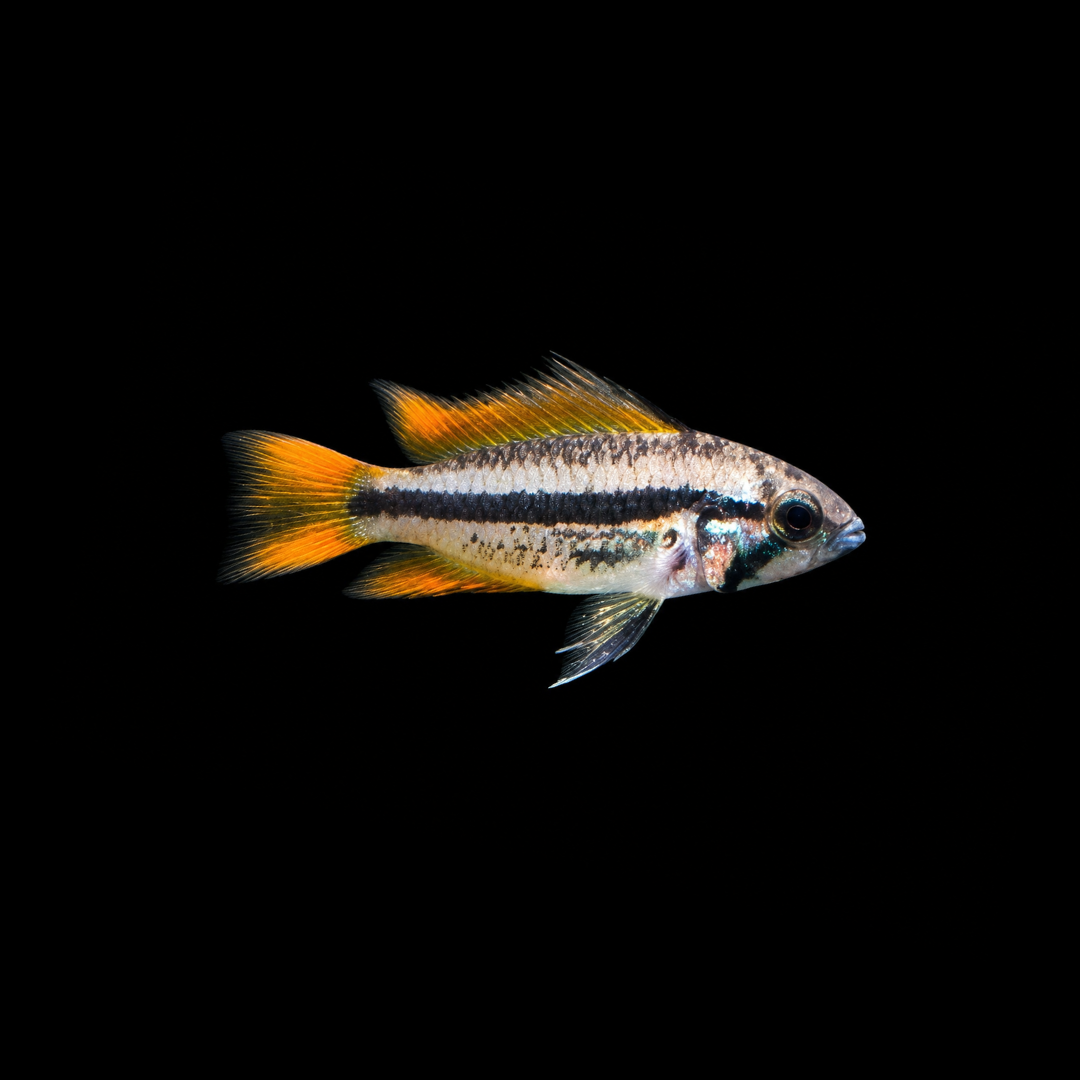
解説 / Description
アピストグラマ・カカトイデス オレンジは、南米アマゾン川流域に分布するアピストグラマ・カカトイデスを基礎に、ヒレの橙色が鮮やかに現れる個体を選抜して維持されてきた観賞魚用の改良系統です。成熟したオスは背ビレ前方の棘条が冠羽のように伸び、尾ビレや尻ビレにもオレンジ色が広がります。一方、メスは小柄で、繁殖期には体の黄色味が強まり、黒い模様との対比が際立ちます。小型ながら、縄張り行動、求愛、洞窟産卵、仔魚の保護といったシクリッドらしい行動を観察できることも大きな魅力です。カカトイデスはアピストグラマ属の中では比較的飼育しやすい種類ですが、長く安定して飼うには、水質の急変を避け、穏やかな水流と十分な隠れ家を用意することが基本になります。 Apistogramma cacatuoides Orange is a selectively bred aquarium strain derived from A. cacatuoides, a dwarf cichlid from the Amazon basin, and maintained for its strong orange fin coloration. Mature males develop elongated anterior dorsal spines that create the characteristic cockatoo-like profile, with orange extending through the unpaired fins. Females remain smaller and become markedly more yellow during breeding. Despite its compact size, the species shows characteristic cichlid behavior, including territorial defense, courtship, cave spawning, and fry guarding. It is comparatively manageable among Apistogramma, but stable water conditions, gentle flow, and adequate cover remain essential for long-term care.
基本情報 / Basic Information
| 学名 / Scientific Name | Apistogramma cacatuoides Hoedeman, 1951 |
|---|---|
| 通称 / Common Name | アピストグラマ・カカトイデス オレンジ、カカトイデス オレンジフラッシュCockatoo Dwarf Cichlid Orange, Orange Flash Apistogramma |
| 分類 / Family | シクリッド科 Cichlidae、アピストグラマ属 ApistogrammaFamily Cichlidae, genus Apistogramma |
| 英名 / English Name | Cockatoo Dwarf Cichlid / Cockatoo Cichlid |
| 分布 / Distribution | 原種は南米アマゾン川流域に分布し、主にペルーのウカヤリ川水系から、隣接するブラジルのアマゾン水系にかけて知られています。オレンジ系統は観賞魚用の改良系統であり、野生の特定地域個体群を示す名称ではありません。The wild species occurs in the Amazon basin, principally from the Ucayali system in Peru into adjacent Amazon drainage areas of Brazil. The Orange form is a domesticated aquarium strain and does not represent a naturally defined geographic population. |
| 最大体長 / Max Size | オスは全長約7〜8cm、メスは約4〜5cmが目安です。個体差や飼育条件があり、長く伸びたヒレを含めるとオスはより大きく見えます。Males typically reach about 7–8 cm total length and females about 4–5 cm. Size varies with strain and husbandry, and extended fins can make mature males appear larger. |
| 寿命 / Lifespan | 飼育下では2〜4年程度がひとつの目安とされます。実際の寿命は、水質、給餌、繁殖による負担、病気の有無などによって変わります。Around 2–4 years in aquaria is a practical estimate. Actual lifespan varies with water quality, feeding, reproductive stress, and disease. |
飼育環境 / Aquarium Environment
| 水槽サイズ / Tank Size | 1ペアを落ち着いて飼育するなら45cm規格水槽以上が扱いやすく、繁殖や混泳まで考える場合は60cm規格水槽(約55〜65L)が安心です。30cmクラスでもペア飼育は可能ですが、逃げ場が限られ、水量も少ないため、縄張り争いと水質変化への注意がより必要になります。A standard 45 cm aquarium or larger is easier to manage for a pair, while a standard 60 cm tank of roughly 55–65 L provides more margin for breeding or tank mates. A 30 cm-class aquarium can house a pair, but limited retreat space and smaller water volume demand closer attention to aggression and water stability. |
|---|---|
| 水温 / Temperature | 24〜27℃を目安とし、長期飼育では25〜26℃前後を安定して保つと管理しやすいです。高温が続くと代謝と酸素消費が増えるため、夏季は溶存酸素の低下にも注意します。 Maintain approximately 24–27°C, with a stable 25–26°C being a practical long-term target. Prolonged high temperatures raise metabolism and oxygen demand, so summer aeration and dissolved oxygen deserve special attention. |
| 水質 / Water Quality | 弱酸性から中性付近の軟水〜中程度の硬度に適応し、目安はpH6.0〜7.5程度です。繁殖ではやや軟らかく弱酸性の水が扱いやすいことが多い一方、改良系統は中性付近にもよく順応します。日本の水道水は地域差が大きいため、「日本の水道水なら必ず適する」と考えず、pH・KH・GHを確認してください。数値を追い込むことより、急変を避けてアンモニアと亜硝酸を検出させず、硝酸塩を低く保つことが重要です。This species adapts well to soft to moderately hard water from slightly acidic to near-neutral conditions; around pH 6.0–7.5 is a useful aquarium range. Slightly softer, mildly acidic water is often convenient for breeding, while domesticated strains commonly adapt well near neutrality. Japanese tap water varies considerably by region, so pH, KH, and GH should be checked rather than assumed. Stability, zero measurable ammonia and nitrite, and low nitrate are more important than chasing an exact pH value. |
| レイアウト / Layout | 流木、石、水草、落ち葉などで視線を遮り、底層に複数の隠れ家を作ります。繁殖を狙う場合は、ココナッツシェルターや小型の素焼き鉢など、入口が狭く内部が暗い産卵場所を複数用意すると選びやすくなります。底床は細粒の砂やソイルが使いやすく、ソイルを使う場合は製品ごとのpH・KHへの影響を確認します。ソイルは水質調整の助けになることがありますが、換水の代わりにはなりません。強い水流は避け、スポンジフィルターや、吐出口を調整した外掛け式・外部式フィルターなどで穏やかな流れを作ります。Use driftwood, rocks, plants, and leaf litter to break lines of sight and create several hiding places near the bottom. For breeding, provide multiple dark shelters with narrow entrances, such as coconut shells or small terracotta caves. Fine sand or aquarium soil is practical; when using active soil, check the product-specific effects on pH and KH. Soil may assist water conditioning, but it does not replace routine water changes. Keep flow gentle with a sponge filter or a suitably adjusted filter outlet. |
| 注意点 / Precautions | 最大の注意点は繁殖期の縄張り争いです。メスは産卵後に非常に攻撃的になり、オスや混泳魚を強く追うことがあります。狭い水槽では逃げ場を失った個体が急激に衰弱するため、隔離ケースや予備水槽を準備しておくと安全です。水換えは不要になるわけではなく、温度・pH・導電率が大きく異なる水を一度に大量投入しないようにします。底床の汚れや食べ残しを放置せず、過密を避けてください。The main concern is territorial aggression during breeding. A guarding female may vigorously drive away the male and other fish, and a chased individual can deteriorate quickly if it has nowhere to escape. Keeping a divider, isolation box, or spare aquarium available is useful. Water changes are still essential; avoid replacing large volumes with water that differs sharply in temperature, pH, or mineral content. Prevent overstocking and remove accumulated waste and uneaten food. |
餌と給餌 / Feeding
| 餌の種類 / Diet | 動物質を好む雑食性で、小型の沈下性顆粒、冷凍アカムシ、冷凍ブラインシュリンプ、ミジンコ、イトミミズ類などを食べます。主食は栄養設計された人工飼料とし、生餌や冷凍餌を補助的に組み合わせると栄養の偏りを抑えやすくなります。オレンジ色の発色維持には、オキアミやブラインシュリンプなどの甲殻類原料や、カロテノイドを適量含む飼料が役立ちます。It is an omnivore with a preference for animal-based foods and readily takes small sinking pellets, frozen bloodworms, frozen brine shrimp, daphnia, and suitable worms. A nutritionally complete prepared food is best used as the staple, with frozen or live foods as supplements. Diets containing crustacean ingredients and appropriate carotenoid levels can help support orange coloration. |
|---|---|
| 給餌のポイント / Feeding Tips | 1日1〜2回、数分で食べ切れる量を基本にします。カカトイデスは底層で餌を探すため、浮上性だけでなく沈下性の小粒を混ぜると食べやすくなります。発色用飼料は便利ですが、過剰給餌で体色を上げようとすると肥満や水質悪化を招きます。未加熱の魚肉を常用するより、観賞魚用に衛生管理された飼料や冷凍餌を利用する方が安全です。繁殖前は良質な生餌・冷凍餌を少量ずつ追加し、体力を整えます。Feed once or twice daily in portions that are consumed within a few minutes. Because these fish forage near the substrate, include small sinking foods rather than relying only on floating feed. Color-enhancing foods are useful, but overfeeding to intensify color can cause obesity and deteriorating water quality. Commercial aquarium foods and properly handled frozen foods are safer routine choices than frequently feeding raw fish flesh. Before breeding, small additions of high-quality live or frozen foods can help condition the pair. |
性格と混泳 / Temperament and Tank Mates
| 性格 / Temperament | 普段は比較的落ち着いていますが、底層に明確な縄張りを持つシクリッドです。特に同種のオス同士と、産卵・育児中のメスは攻撃性が高くなります。個体ごとの性格差も大きく、同じ水槽サイズでもレイアウトによって関係性が変わります。流木や水草で互いの姿が常に見えないようにすると衝突を減らしやすくなります。Usually composed outside the breeding period, this is still a territorial bottom-oriented cichlid. Aggression rises notably between males and in females guarding eggs or fry. Individual temperament varies, and social stability can change dramatically with the layout. Breaking continuous lines of sight with wood and plants reduces repeated confrontations. |
|---|---|
| 混泳の相性 / Compatibility | 十分な広さがあれば、小型テトラ類やラスボラ類など中〜上層を泳ぐ温和な魚と合わせやすい種類です。ただし繁殖を優先する場合、混泳魚は卵や稚魚を狙う存在にもなります。コリドラス類など底層を共有する魚は、繁殖期のメスと行動域が重なりやすいため、狭い水槽では避けた方が無難です。小型エビは稚エビを捕食される可能性があり、逆に大型魚や気の強いシクリッドとの混泳も適しません。In a sufficiently large aquarium it can coexist well with peaceful mid- and upper-water fishes such as small tetras and rasboras. However, tank mates may eat eggs or fry when breeding is the priority. Bottom-dwelling fishes such as Corydoras can repeatedly enter a female’s brood territory, so they are best avoided in small breeding tanks. Small shrimp offspring may be eaten, while large or aggressive cichlids are also unsuitable companions. |
病気と対策 / Diseases and Prevention
| かかりやすい病気 / Common Diseases | カカトイデスだけに特有の病気が目立つわけではありませんが、水質悪化や輸送ストレスが重なると白点病、細菌性のヒレ傷み、体表の感染症、消化管トラブルなどが起こり得ます。痩せが続く、白い糞が長く続く、呼吸が速い、体色が極端に暗い、ヒレを閉じるといった変化は体調不良のサインです。病名を外見だけで決めつけず、まず水質と行動を確認します。There is no single disease uniquely associated with A. cacatuoides, but poor water quality and transport stress can predispose fish to ich, bacterial fin damage, external infections, and gastrointestinal problems. Persistent weight loss, prolonged pale or abnormal feces, rapid breathing, unusually dark coloration, or clamped fins should be treated as warning signs. Avoid diagnosing a specific disease by appearance alone; first assess water quality and behavior. |
|---|---|
| 対策と予防 / Prevention | 予防の中心は、安定した水質、適正な給餌、過密回避、新規導入魚の観察です。新しい魚は可能であれば別水槽で一定期間状態を確認し、ショップの水を飼育水槽へ大量に入れないようにします。病魚が出た場合はアンモニア・亜硝酸・硝酸塩、水温、pHを確認し、必要に応じて隔離します。薬剤は病原体によって選択が異なり、アピストグラマは弱った状態で急激な水質・薬浴条件の変化を受けると負担が大きいため、製品の用法を守って慎重に使用します。Prevention centers on stable water quality, appropriate feeding, avoiding overcrowding, and observing newly acquired fish. When possible, quarantine new arrivals and avoid adding large amounts of store water to the display aquarium. If a fish becomes ill, check ammonia, nitrite, nitrate, temperature, and pH, and isolate the fish when appropriate. Medication choice depends on the actual disease, and stressed Apistogramma can be sensitive to abrupt changes in water or treatment conditions, so follow product directions carefully. |
増やし方(繁殖) / Breeding
| 雌雄の判別 / Sexing | 成熟したオスはメスより大きく、背ビレ前方の棘条が長く伸び、尾ビレ・尻ビレを含めてオレンジ色が強く現れます。メスは小柄でヒレの伸長が少なく、腹ビレ前縁の黒色が目立つ個体が多く、繁殖期には黄色い婚姻色になります。ただし若魚では雌雄差がまだ十分に現れないため、外見だけでは判別しにくいことがあります。後からオスらしい特徴が明瞭になった場合は、性転換と考えるより、若齢時の判別が難しかった可能性をまず考えます。Mature males are larger, develop elongated anterior dorsal spines, and show stronger orange coloration in the dorsal, caudal, and anal fins. Females remain smaller, have less fin extension, often show a dark leading edge on the pelvic fins, and become bright yellow in breeding condition. Juveniles can be difficult to sex because the differences between males and females may not yet be fully expressed. If a fish later develops clear male traits, a juvenile sexing error is a more cautious explanation than assuming female-to-male sex change. |
|---|---|
| 繁殖形態 / Reproduction | 洞窟産卵型の卵生魚です。メスがシェルター内部の天井や壁面に卵を産み付け、卵と仔魚の世話を主に担当します。オスは、その外側を含むより広い範囲を縄張りとして防衛する傾向があります。産卵数はメスの大きさや状態によって変わりますが、数十個規模になることがあります。It is an egg-laying cave spawner. The female attaches eggs to the ceiling or wall inside a shelter and performs most direct care of the eggs and larvae, while the male tends to defend a broader surrounding territory. Clutch size varies with female size and condition and may reach several dozen eggs. |
| 繁殖のポイント / Breeding Tips | 落ち着いたペアに複数の産卵洞窟を用意し、25〜26℃前後を目安に安定した環境で栄養状態を整えます。産卵後はメスの攻撃性が高まりやすいため、オスが追い詰められる場合は隔離します。仔魚が自由遊泳を始めたら、孵化直後のブラインシュリンプ幼生が使いやすい初期飼料です。アピストグラマ属では、育成温度やpHが子の性比に影響することが実験的に示されていますが、影響の大きさや感受性の時期は種によって異なります。カカトイデスについて、特定の温度にすれば望む雌雄比になると考えず、性比操作よりも安定した育成環境を優先するのが適切です。Provide a settled pair with several cave options and condition them well in stable water around 25–26°C. After spawning, the female may become highly aggressive; separate the male if he is persistently driven away. Once fry become free-swimming, newly hatched brine shrimp nauplii are a practical first food. Experimental work in Apistogramma has shown that rearing temperature and, in some species, pH can influence offspring sex ratios, but the strength and sensitive period differ among species. For A. cacatuoides, it is better to prioritize stable rearing conditions than to assume that a particular temperature will produce a desired sex ratio. |
雑学と豆知識 / Trivia and Fun Facts
| 1. 「カカトイデス」という名前は背ビレの冠羽から / 1. The name “cacatuoides” refers to a cockatoo-like crest | 成熟したオスを横から見ると、背ビレ前方の棘条が高く伸び、頭上に小さな冠を立てたように見えます。種小名のcacatuoidesは、一般にこの姿をコカトゥー、すなわち冠羽を持つオウム類になぞらえた名称と説明されています。鮮やかな色彩と並んで、この独特の背ビレは本種を見分ける大きな特徴です。Viewed from the side, a mature male carries elongated anterior dorsal spines that resemble a small crest above the head. The specific name cacatuoides is generally explained as an allusion to the prominent crest of a cockatoo. Along with its coloration, this distinctive dorsal profile is one of the species’ most recognizable features. |
|---|---|
| 2. 1951年の記載と「Apistogramma U2」 / 2. The 1951 description and “Apistogramma U2” | J. J. Hoedemanは1951年に本種を新種として記載しました。その原記載には、当時すでにアクアリウム文献で「Apistogramma U2」として紹介されていた魚と同一かもしれない、という趣旨が記されています。つまりカカトイデスは、学名が正式に整う前から観賞魚として人の目に触れていた歴史を持ちます。初期のアピストグラマは分類が混乱しており、後年の再検討によって現在の同定が整理されていきました。J. J. Hoedeman formally described the species in 1951. In the original description he noted that the fish might be identical to an aquarium form already referred to as “Apistogramma U2.” In other words, A. cacatuoides had entered aquarium awareness before its scientific identity was fully settled. Early Apistogramma taxonomy was confused, and later revisions gradually clarified the names and identifications used today. |
| 3. 広い分布と「隠蔽種」説は慎重に考える / 3. Wide distribution does not automatically mean a proven cryptic-species complex | カカトイデスはアピストグラマとしては比較的広い分布域を持ち、地域による色彩の違いも報告されています。そのため、複数の系統を含むのではないかという見方が語られることがあります。しかし、複数の遺伝マーカーを用いた2017年の研究では、調べられたカカトイデス標本について、複数の隠蔽種に分ける結果は支持されませんでした。つまり、地域差があることと、複数種であることは同じではありません。現時点でカカトイデスを「超種」と確定的に扱うのは適切ではありません。A. cacatuoides has a relatively broad range for an Apistogramma, and geographic variation in coloration has been reported. This has led to suggestions that the name might include more than one lineage. However, a 2017 multilocus study did not support splitting the A. cacatuoides samples it examined into multiple cryptic species. In other words, geographic variation does not by itself demonstrate that several species are involved. At present, it is not appropriate to present A. cacatuoides as a confirmed superspecies. |
| 4. オレンジフラッシュは「野生の産地名」ではない / 4. Orange Flash is a domestic color strain, not a locality form | オレンジフラッシュは、野生で採集される特定産地の地理型ではなく、飼育下でヒレの橙色を重視して選抜されてきた改良系統です。ダブルレッドやトリプルレッドなどとは流通上区別されていますが、これらの名称は学術的な分類名ではありません。また、「1990年代半ばに特定のドイツ人ブリーダーが確立した」といった細かな作出史は、確認できる一次資料が乏しいため、確定した事実として扱わない方が安全です。Orange Flash is not a wild geographic form but a domesticated strain selected for orange fin coloration. It is distinguished in the aquarium trade from names such as Double Red and Triple Red, but these are trade names rather than taxonomic categories. Detailed origin stories assigning Orange Flash to a specific German breeder and an exact mid-1990s date are difficult to verify from primary documentation and should not be presented as established fact. |
| 5. 色彩遺伝は単純な「優性・劣性」だけでは説明しにくい / 5. Color inheritance is more complex than a simple dominant–recessive rule | 観賞魚の世界では、「黒いチェッカー模様は優性」「オレンジは劣性」といった遺伝の説明が語られることがあります。しかし、カカトイデスのオレンジフラッシュについて、その表現全体を単一遺伝子の単純な優性・劣性で説明できることを示した査読済み研究は十分ではありません。したがって、流通上の経験則をそのまま確定した遺伝法則として扱うのは避けるべきです。飼育下で色を維持する場合は、遺伝形式を決めつけるより、望ましい発色と同時に体型や健康状態も見ながら親魚を選ぶ考え方が現実的です。Aquarium breeding lore sometimes describes dark fin checking as “dominant” and the clean orange phenotype as “recessive.” However, there is not sufficient peer-reviewed evidence showing that the entire Orange Flash phenotype follows a simple single-gene dominant–recessive pattern. Such hobby rules should therefore not be treated as established genetic laws. In practical breeding, it is more realistic to select for the desired coloration while also maintaining body form and overall health. |
| 6. メスの配偶者選択には色と学習の両方が関わる / 6. Female mate choice can involve both inherited preference and learning | カカトイデスは、メスがどのオスを選ぶかという配偶者選択の研究にも使われています。2010年の実験では、野生由来のメスが赤いオスを選ぶ割合は採集地域によって大きく異なり、赤い観賞魚系統のメスは自系統のオスを強く選ぶ傾向を示しました。さらに2014年の育て親を入れ替える実験では、メスの選好には生まれつきの傾向だけでなく、成長期に接した親の外見も影響し得ることが示されました。つまり、配偶者選択は遺伝だけで完全に固定されるわけではなく、経験によって変化する余地があるということです。なお、これは「オレンジ色のオスが常に90%選ばれる」という意味ではなく、研究で用いられた赤系観賞魚と野生系統の比較結果です。A. cacatuoides has also been used in studies of female mate choice. A 2010 experiment found strong geographic variation in how often wild-derived females chose red males, while females from a red aquarium strain strongly favored males of their own strain. In a 2014 cross-fostering experiment, later mate choice was also influenced by the appearance of the parents with which the young fish were raised. In practical terms, the preference appears to have an inherited component but is not completely fixed and can be modified by experience. The results do not mean that females choose “orange” males at a universal 90% rate; they refer to specific comparisons between a red aquarium strain and wild populations. |
| 7. 「スニーカー・オス」という呼び方には注意 / 7. Use the term “sneaker male” with care | 若魚では雌雄差がまだ十分に現れず、オスがメスのように見えることがあります。アクアリウムでは、こうした個体を「スニーカー・オス」と呼ぶことがありますが、この言葉は使い方に注意が必要です。生態学でいうスニーカー戦術は、他のオスの繁殖に割り込んで受精機会を得る行動まで含む概念であり、カカトイデスについてその一連の行動を一般的な性質として断定するのは適切ではありません。飼育上は、後からオスの特徴が明瞭になった個体を性転換とみなさず、若齢時には雌雄判別を誤ることがある、と理解するのが安全です。Juveniles may not yet show clear sexual differences, and young males can therefore be mistaken for females. Aquarists sometimes call such fish “sneaker males,” but the term should be used carefully. In behavioral ecology, a sneaker tactic refers to gaining fertilization opportunities by intruding on another male’s reproduction, and it is not appropriate to present that full tactic as a general, proven characteristic of A. cacatuoides. In aquarium practice, a fish that later develops obvious male traits is better understood as a sexing error at a young age rather than as evidence of female-to-male sex change. |
| 8. カロテノイドは発色を支えるが、遺伝的な模様は餌だけでは作れない / 8. Carotenoids support color, but diet cannot create a genetically absent pattern | 橙色や赤色の発色には、餌から取り込むカロテノイドが関わります。アスタキサンチンや甲殻類由来の色素成分を適量含む餌は、オレンジ系統が持つ発色を整える助けになります。ただし、餌によって系統そのものの遺伝的な模様が作られるわけではありません。発色は遺伝的背景に加え、健康状態、成熟度、飼育環境によっても見え方が変わります。発色用飼料に偏らず、栄養バランスと水質を整えることが基本です。Dietary carotenoids contribute to orange and red coloration. Foods containing appropriate levels of astaxanthin and crustacean-derived pigments can help an Orange strain express its coloration, but diet does not create the genetic fin pattern of an Orange Flash line. Genetic background, health, maturity, and husbandry all affect how color appears. Balanced nutrition and stable water quality should take priority over heavy use of color-enhancing feed. |
| 9. 温度とpHが性比に影響する研究は、種ごとの差まで読む / 9. Temperature and pH can affect sex ratios, but the effect is species-specific | アピストグラマ属では、育成時の温度が子の性比に影響し、種によってはpHも関与することが実験的に示されています。高温側でオスが増える傾向は多くの種で見られましたが、影響の大きさは一様ではありません。また、感受性の時期まで詳しく調べられた例は限られているため、属全体の結果をそのままカカトイデスの飼育レシピに置き換えることはできません。つまり、この研究は性比が環境の影響を受け得ることを示すものであり、「この温度なら雌雄が半々になる」という万能な設定値を示したものではありません。Experimental work across Apistogramma has shown that rearing temperature can shift offspring sex ratios and that pH also has an effect in some species. A tendency toward more males at higher temperatures has been reported in many species, but the magnitude is not uniform, and the sensitive developmental period has been examined in detail for only limited cases. The genus-level result therefore cannot simply be converted into a fixed husbandry recipe for A. cacatuoides. The study shows that environment can influence sex ratio; it does not provide a universal temperature that guarantees a 1:1 ratio. |
| 10. 水草水槽では「小さい主役」になれる / 10. A small fish that can become the centerpiece of a planted aquarium | カカトイデス オレンジは水草そのものを主食として食害する魚ではなく、緑の背景に橙色のヒレが強く映えます。中〜上層に小型テトラが群れ、底層の流木の陰からカカトイデスがゆっくり現れる構成は、体長以上の存在感を生みます。ただし「水草水槽向け」という言葉を「何とでも混泳できる温和な魚」と読み替えてはいけません。美しいレイアウトの中でも彼らはあくまで縄張りを持つシクリッドであり、隠れ家と退避空間を設計してこそ、その色と行動の両方が自然に見えてきます。Orange A. cacatuoides do not normally graze down aquarium plants, and their orange fins contrast beautifully against green vegetation. A layout with small schooling fishes in the middle and upper levels and a cockatoo dwarf cichlid emerging slowly from driftwood near the bottom can give this small fish a presence far beyond its size. “Good for planted aquaria,” however, should not be mistaken for “peaceful with anything.” It remains a territorial cichlid, and its color and behavior are best displayed when the aquascape deliberately includes hiding places and retreat routes. |
まとめ / Conclusion
アピストグラマ・カカトイデス オレンジは、鮮やかなヒレ色と冠羽のような背ビレに加え、縄張りや求愛、繁殖といったシクリッドらしい行動を身近に観察できるドワーフシクリッドです。比較的飼育しやすい種類ですが、安定した水質を保ち、流れを穏やかにし、流木や水草で視線を遮るという基本を丁寧に守るほど、落ち着いた行動と本来の発色を楽しみやすくなります。 Apistogramma cacatuoides Orange combines bright fin coloration and a cockatoo-like dorsal crest with characteristic cichlid behavior such as territoriality, courtship, and breeding. It is comparatively manageable, but stable water conditions, gentle flow, and a layout that breaks lines of sight with wood and plants make it easier to see calm behavior and natural coloration.
繁殖期には、黄色く染まったメスが洞窟と仔魚を守り、やがて小さな稚魚の群れを連れて行動する姿が見られます。鮮やかな改良系統として発色を楽しむだけでなく、母魚の保護行動や個体ごとの性格まで観察できることが、この魚を長く飼う面白さにつながります。美しさと行動の両方を楽しみたい水槽で、じっくり付き合える種類です。 During breeding, the female turns bright yellow, guards the cave and fry, and may later lead a small group of young around the bottom of the aquarium. The fish can therefore be appreciated not only for its selectively bred coloration but also for maternal brood care and individual temperament. Its combination of appearance and behavior makes it rewarding to observe over time.

気になる道具や飼い方を見つけてみませんか?
 アイのアクアグッズ案内水草の肥料の選び方|底床用・液肥・メネデールの使い分け道具の特徴や使い方、選ぶときのポイントをアイが紹介します。記事はコチラ →
 アイのアクアグッズ案内コケを食べるコイの仲間に合わせる飼育用品|フライングフォックス・アルジイーター・ガラ道具の特徴や使い方、選ぶときのポイントをアイが紹介します。記事はコチラ →
 アイのアクアグッズ案内小型カラシンの群れを楽しむ|餌と水換えから考える飼育用品ガイド小型カラシンの群れを眺める時間を、もっと楽しく。泳ぐ余白、餌の食べ方、続けやすい水換えを軸に、日本で揃えやすい用品の選び方を紹介します。記事はコチラ →
 アイのアクアグッズ案内テトラミンって、こんなにあるの? アイとコタロウのごはん探究旅道具の特徴や使い方、選ぶときのポイントをアイが紹介します。記事はコチラ →
さまざまな飼育テーマをご紹介。リンク先の記事には広告・商品紹介が含まれます。
案内・紹介記事一覧へ →分布マップ
アピストグラマ・カカトイデス(Apistogramma cacatuoides)の原種は、南米アマゾン川流域のうち、主にペルーのウカヤリ川水系からアマゾン川上流域、隣接するブラジル側のアマゾン水系にかけて分布します。下の地図では、この分布地域を把握しやすいよう概略範囲を表示しています。
※この地図は文献上の分布地域をもとにした概略表示であり、分布境界や生息地点を正確に示すものではありません。地図上のマーカーは分布域を把握するための代表地点として設定したもので、実際の採集地点を示すものではありません。また、「オレンジ」「オレンジフラッシュ」は飼育下で作出・維持されている改良系統であり、野生の特定産地を示す名称ではありません。
参考文献
-
Hoedeman, J. J. (1951). Notes on the Fishes of the Cichlid Family I. Apistogramma cacatuoides sp. n. Beaufortia, 1(4), 1–4.対応範囲:原記載、学名、記載年Naturalis Biodiversity Center
-
California Academy of Sciences. Eschmeyer’s Catalog of Fishes: Apistogramma cacatuoides Hoedeman, 1951.対応範囲:現在の有効学名、分類、タイプ産地の訂正、分布Eschmeyer’s Catalog of Fishes
-
Froese, R. & Pauly, D. (eds.). FishBase: Apistogramma cacatuoides.対応範囲:分類、アマゾン川流域での分布、生息水域、水温・pH・硬度の基礎データ、洞窟産卵とメスによる卵・仔魚保護FishBase
-
Alves, F. C. M., Rojas, N. E. T. & Romagosa, E. (2009). Reprodução do “ciclídeo-anão amazônico”, Apistogramma cacatuoides Hoedeman, 1951 (Perciformes: Cichlidae) em laboratório. Boletim do Instituto de Pesca, 35(4), 587–596.対応範囲:飼育下繁殖、シェルターへの産卵、メスによる卵・仔魚保護、仔魚育成Boletim do Instituto de Pesca
-
Römer, U. & Beisenherz, W. (1996). Environmental determination of sex in Apistogramma (Cichlidae) and two other fresh-water fishes (Teleostei). Journal of Fish Biology, 48, 714–725.対応範囲:アピストグラマ属における育成温度・pHと性比の関係Journal of Fish Biology
-
Tougard, C., García Dávila, C. R., Römer, U., Duponchelle, F., Cerqueira, F., Paradis, E., Guinand, B., Chávez, C. A., Salas, V., Quérouil, S., Sirvas, S. & Renno, J.-F. (2017). Tempo and rates of diversification in the South American cichlid genus Apistogramma (Teleostei: Perciformes: Cichlidae). PLOS ONE, 12(9), e0182618.対応範囲:アピストグラマ属の分子系統、カカトイデスを含む種境界・隠蔽多様性の検討PLOS ONE
-
MSD Veterinary Manual. Management of Aquarium Fish.対応範囲:水質管理、アンモニア・亜硝酸への注意、換水、濾過、隔離・検疫、導入時の衛生管理MSD Veterinary Manual
-
MSD Veterinary Manual. Disorders and Diseases of Fish.対応範囲:観賞魚の感染症、皮膚・鰓の異常、過密や水質悪化との関係、病気の予防と診断上の注意MSD Veterinary Manual




コメント