

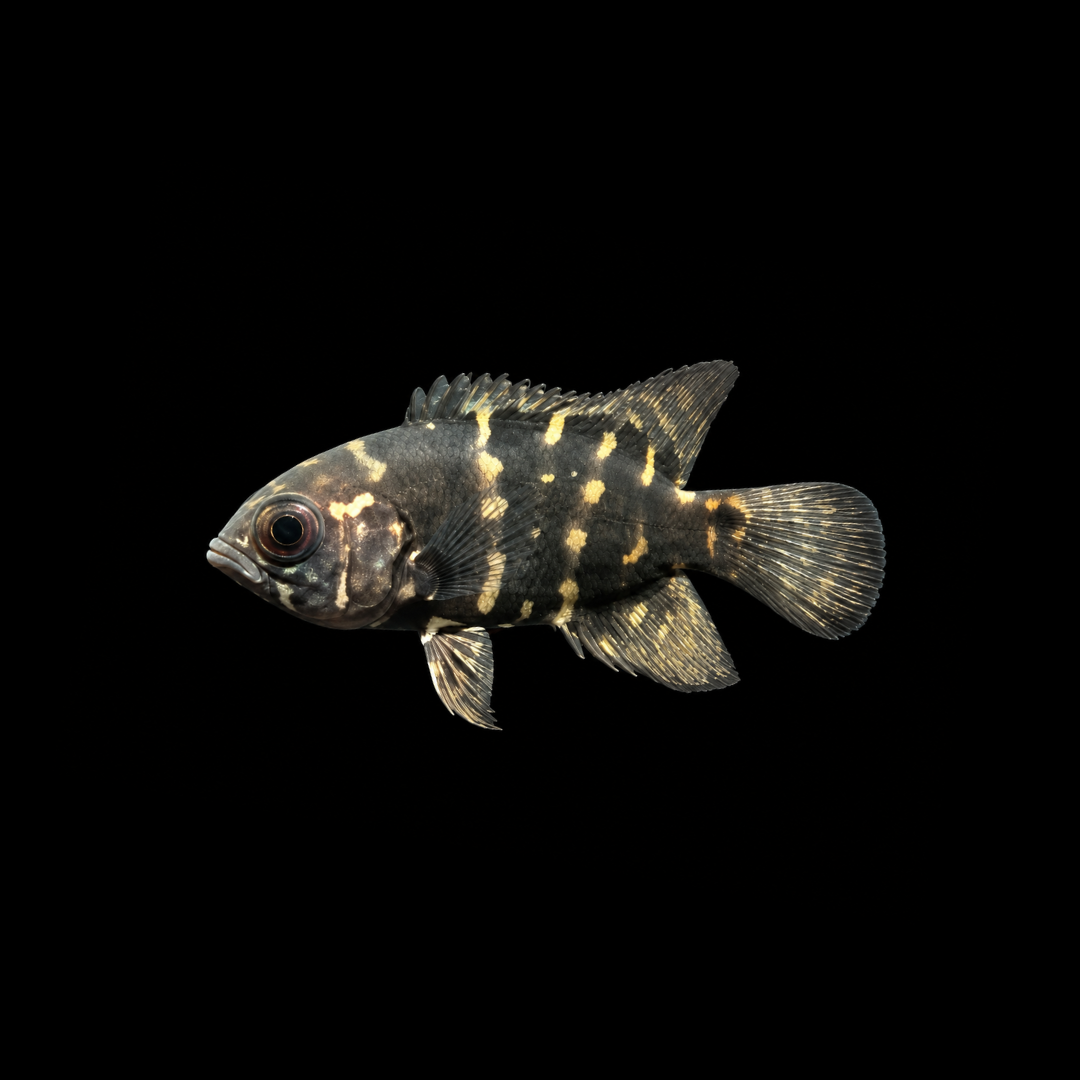
解説 / Description
アストロノータス・クラッシピンニスは、一般に「オスカー」と呼ばれるアストロノータス属の一種で、現在も独立した有効種として扱われています。日本の観賞魚流通では、黒地に黄色からオレンジ色の不規則な模様を持つ幼魚が「バンブルビー・オスカー」などの名で本種として扱われることがあります。ただし、アストロノータス属は地域個体群の分類が複雑で、野生個体を色彩や産地名だけで確実に種同定できない場合があります。飼育面では、成長に伴って動物質への依存が強まる食性、大型シクリッドならではの力強さ、排泄量の多さを踏まえ、十分な水槽サイズと濾過能力を用意して長期飼育する魚です。 Astronotus crassipinnis is currently recognized as a valid species of the Oscar genus Astronotus. In the aquarium trade, wild-type juveniles with irregular yellow to orange markings on a dark body may be sold under names such as “Bumblebee Oscar” and identified as this species. However, species limits within Astronotus are complex, and wild fish cannot always be identified with certainty from color pattern or locality alone. In husbandry, its increasingly animal-based diet with growth, powerful cichlid build and heavy waste production make ample aquarium space, strong filtration and a long-term care plan essential.
基本情報 / Basic Information
| 学名 / Scientific Name | Astronotus crassipinnis |
|---|---|
| 通称 / Common Name | クラッシピンニス、ファット・オスカー、バンブルビー・オスカー(幼魚の流通名として使われることがあります)Fat Oscar; Bumblebee Oscar is also used in the aquarium trade for some juvenile-pattern fish |
| 分類 / Family | シクリッド科(Cichlidae)・アストロノータス属(Astronotus)Family Cichlidae, genus Astronotus |
| 英名 / English Name | Fat Oscar / Bumblebee Oscar (aquarium-trade name) |
| 分布 / Distribution | 南米。主な自然分布として、アマゾン川南部のマデイラ川上流系とパラグアイ川上流域が挙げられます。上部パラナ川氾濫原などには移入個体群が知られています。アストロノータス属は地域個体群の分類が複雑なため、流通時の産地名だけで種を断定しない注意が必要です。South America. Its principal native range is reported from the southern Amazon, especially the upper Madeira system, and the upper Paraguay basin. Introduced populations are known from areas including the upper Paraná floodplain. Because taxonomy within Astronotus remains complex, locality labels alone should not be treated as definitive species identification. |
| 最大体長 / Max Size | 標準体長は24cm前後とされることが多い一方、30.2cmの記録もあります。終生飼育では30cm級に達する可能性を見込み、余裕のある設備を選びます。Standard length is often reported at around 24 cm, but a record of 30.2 cm standard length is also documented. Long-term housing should therefore allow for a fish approaching 30 cm. |
| 寿命 / Lifespan | 本種単独の寿命データは乏しく、正確な年数は定まっていません。短期飼育を前提にする魚ではないため、長期間維持できる設備と飼育計画を用意します。Species-specific lifespan data are limited, so a precise figure is not well established. This is not a fish to keep on a short-term basis, and the aquarium and care routine should be planned for long-term maintenance. |
飼育環境 / Aquarium Environment
| 水槽サイズ / Tank Size | 終生飼育では120cm水槽を基本に考えます。単独飼育でも120×45×45cmクラス(約240L)以上を目安とし、可能であれば120×60×45cmクラス(約320L)など奥行きのある水槽が扱いやすくなります。90cm規格水槽は幼魚から若魚の育成には使えますが、30cm級まで成長する可能性を考えると終生飼育の基準にはしない方が安全です。For lifelong care, a 120 cm aquarium should be treated as the baseline. Even for a single adult, roughly 120 × 45 × 45 cm (about 240 L) or larger is advisable, while a tank around 120 × 60 × 45 cm (about 320 L) provides more useful depth. A standard 90 cm tank can serve for juveniles or young fish, but should not be considered the long-term standard for a fish that may approach 30 cm. |
|---|---|
| 水温 / Temperature | 24~28℃前後を目安に、急変させず安定させます。日本の夏に30℃近い高水温が長く続く場合は、十分なエアレーションを確保し、必要に応じて冷却を行います。 Keep the temperature stable at roughly 24–28°C. During hot Japanese summers, provide strong aeration and use cooling when prolonged temperatures approach 30°C. |
| 水質 / Water Quality | 弱酸性から中性付近を中心に、数値を追い込むことより急変を避けて安定させることを優先します。大型シクリッドで排泄量が多いため、アンモニアや亜硝酸を蓄積させない成熟した濾過と、硝酸塩や有機物を溜めない定期換水を基本にします。Keep the water around mildly acidic to neutral conditions, prioritizing stability over chasing a narrow numerical target. Because this is a large, messy cichlid, mature biological filtration should prevent ammonia and nitrite from accumulating, while regular water changes limit nitrate and dissolved organic waste. |
| レイアウト / Layout | 遊泳空間を広く確保し、倒れにくい大きな流木や石を必要最小限に配置するのが扱いやすい構成です。底砂を掘り返すことがあり、軽い装飾や根の弱い水草は移動・損傷されやすいため注意します。強く驚いた際にぶつからないよう、尖った素材は避けます。Keep a broad open swimming area and use only a limited number of heavy, stable pieces of wood or rock. The fish may dig and rearrange the substrate, so lightweight decor and weakly rooted plants are easily displaced or damaged. Avoid sharp objects that could injure a startled fish. |
| 注意点 / Precautions | 食べ残しや細かな餌片を水中へ散らしやすく、濾過負荷が非常に高い魚です。大型の上部式・外部式などを十分な能力で用い、物理濾過材をこまめに清掃します。野生採集個体は輸送直後に警戒心や体調不良を示すことがあるため、導入時は急激な水質変化を避け、呼吸・体表・糞・摂餌状態をよく観察します。This species creates a heavy filtration load because it scatters food particles and produces substantial waste. Use generously sized filtration and clean mechanical media frequently. Newly imported wild fish may be shy or stressed after transport, so avoid abrupt water-chemistry changes and closely monitor breathing, skin condition, feces and feeding response during acclimation. |
餌と給餌 / Feeding
| 餌の種類 / Diet | 主食は大型シクリッド・肉食魚向けの品質のよい人工飼料とし、補助的に冷凍エビ、オキアミ、昆虫由来の餌などを組み合わせます。幼魚は自然下で水生昆虫や小型甲殻類、植物質なども利用し、成長すると魚類や軟体動物を含む動物質への依存が強くなることが報告されています。Use a high-quality formulated diet for large cichlids or carnivorous fish as the staple, supplemented with foods such as frozen shrimp, krill and insect-based items. In nature, juveniles consume aquatic insects, small crustaceans and some plant material, while larger fish shift toward a more animal-based diet that can include fish and mollusks. |
|---|---|
| 給餌のポイント / Feeding Tips | ワイルド個体は導入直後に人工飼料を警戒することがあります。その場合は嗜好性の高い冷凍餌などから始め、食欲と体調を確認しながら人工飼料へ段階的に慣らします。生きた小魚だけに偏らせず、複数の餌をローテーションして栄養の偏りと水質悪化を防ぎます。1回量は食べ切れる量に抑え、残餌は早めに取り除きます。Wild-caught fish may initially refuse pellets. If necessary, start with palatable frozen foods and gradually transition to formulated feeds as appetite and condition improve. Avoid relying on live feeder fish alone; rotate several food types to reduce nutritional imbalance and unnecessary water pollution. Feed only what can be consumed promptly and remove leftovers. |
性格と混泳 / Temperament and Tank Mates
| 性格 / Temperament | 大型シクリッドらしく個体差が大きく、餌や周囲の動きへの反応がはっきりしています。成長すると小型魚や甲殻類を捕食できる体格になり、同種や他魚に対して縄張り行動を示す個体もいるため、混泳では性格を固定的に決めつけず個体ごとに観察します。Individual temperament varies considerably, as is typical of large cichlids, and the fish responds readily to food and movement around the aquarium. As it grows, it becomes large enough to prey on small fishes and crustaceans, and some individuals may also become territorial toward conspecifics or tank mates. Compatibility should therefore be judged fish by fish rather than assumed from a fixed temperament label. |
|---|---|
| 混泳の相性 / Compatibility | 口に入る小型魚やエビは捕食対象になるため混泳には向きません。同程度の体格を持つ丈夫な大型魚との混泳も可能な場合がありますが、相性は個体差に左右されます。複数飼育では十分な広さと視線を遮る構造を確保し、追い回し、噛みつき、餌の独占が見られる場合は速やかに隔離できる準備を整えます。Small fish and shrimp that fit in the mouth should be regarded as prey rather than tank mates. Cohabitation with similarly sized, robust fish is sometimes possible, but success depends heavily on individual temperament. When keeping multiple large fish, provide ample space and visual barriers, and be ready to separate them if persistent chasing, biting or food monopolization develops. |
病気と対策 / Diseases and Prevention
| かかりやすい病気 / Common Diseases | 大型シクリッドで見られるトラブルとして、白点病などの外部寄生虫症、輸送ストレスに伴う体調不良、細菌性の皮膚・鰭トラブル、頭部や側線周辺にくぼみやびらんが生じる頭部・側線びらんが挙げられます。いわゆる「頭部穴あき病」は原因が一つに確定しておらず、水質、栄養状態、慢性的なストレスなどを含めて評価する必要があります。消化管の鞭毛虫が併発する例はありますが、一律に原因と決めつけるのは適切ではありません。Problems seen in large cichlids include external parasites such as ich, transport-related stress, bacterial skin and fin disorders, and head and lateral line erosion that produces pits or erosions around the head. The cause of so-called hole-in-the-head disease is not established as a single factor; water quality, nutrition and chronic stress should all be evaluated. Intestinal flagellates may be present in some cases, but they should not automatically be treated as the sole cause. |
|---|---|
| 対策と予防 / Prevention | 最も重要なのは、十分な濾過、定期換水、過密回避、偏りの少ない給餌、導入時の観察です。異常がある個体は可能であれば隔離し、原因を見極めてから対応します。塩水浴や薬剤治療が必要な場合でも、症状や原因によって適切な濃度・期間は変わるため、観賞魚用製品の用法を守り、判断が難しい場合は魚類を扱う獣医師や経験ある専門店へ相談するのが安全です。The foundation of prevention is strong filtration, regular water changes, avoiding crowding, providing a varied diet and closely observing newly acquired fish. Isolate affected specimens when practical and identify the likely cause before treating. Salt baths and medications can be useful in specific situations, but correct concentration and duration depend on the diagnosis, so follow aquarium-product directions and seek advice from an aquatic veterinarian or experienced specialist when the cause is uncertain. |
増やし方(繁殖) / Breeding
| 雌雄の判別 / Sexing | 外見上の雌雄差が乏しい雌雄同型で、体格や色彩だけから確実に判別するのは困難です。成熟期に生殖突起の形状を確認する方法が比較的確実ですが、通常は複数の若魚を育て、自然に形成されたペアを見極める方法が現実的です。The species is externally monomorphic, making reliable sexing from body shape or color difficult. Examination of the genital papilla in mature fish is more informative, but in practice many breeders raise several juveniles together and identify naturally formed pairs. |
|---|---|
| 繁殖形態 / Reproduction | 平らな石や流木などの基質表面に産卵する基質産卵型です。ペアは産卵場所を口で清掃し、産卵後は雌雄が協力して卵や稚魚を守る両親保護が見られます。A substrate-spawning cichlid. The pair cleans a flat stone, wood surface or similar site before spawning, and both parents participate in guarding eggs and fry. |
| 繁殖のポイント / Breeding Tips | 幼魚から若魚を5~6匹ほど十分な広さで育て、自然なペア形成を待つ方法が基本です。ペアが成立すると他個体への攻撃性が高まることがあるため、繁殖水槽または隔離できる環境を準備します。産卵床となる平らな石を用意し、水質を安定させ、親魚が落ち着けるよう過度な干渉を避けます。A practical approach is to raise a group of about five or six juveniles in a spacious aquarium and allow a pair to form naturally. Once paired, aggression toward other fish may increase, so a dedicated breeding tank or a separation plan is advisable. Provide a flat spawning surface, maintain stable water conditions and minimize unnecessary disturbance. |
雑学と豆知識 / Trivia and Fun Facts
| 1. 1840年に記載された「もう一つのオスカー」 / 1. The “Other Oscar” Described in 1840 | アストロノータス・クラッシピンニスは1840年、魚類学者ヨハン・ヤーコプ・ヘッケルによって、当初はAcara crassipinnisとして記載されました。その後Astronotus属へ移され、オセラータスの同物異名として扱われた時期を経て、Kullanderによる再検討によって独立種として整理されました。現在も有効種ですが、後の分子系統研究では、従来の色彩や眼状斑だけではアストロノータス属の種境界を十分に説明できないことが示されています。つまり「クラッシピンニスという種は有効である」ことと、「流通個体を外見だけで確実にクラッシピンニスと判定できる」ことは、分けて考える必要があります。Astronotus crassipinnis was described by Johann Jakob Heckel in 1840 as Acara crassipinnis. It was later transferred to Astronotus and spent a period in synonymy with A. ocellatus before Kullander’s revisions re-established it as a distinct species. It remains a valid species today, but later molecular studies showed that traditional color patterns and ocelli do not fully explain species boundaries within Astronotus. In other words, the validity of A. crassipinnis and the certainty of identifying an aquarium-trade wild fish as that species from appearance alone are separate questions. |
|---|---|
| 2. 「Fat Oscar」は肥満体質という意味ではない / 2. “Fat Oscar” Does Not Mean an Obese Fish | 種小名crassipinnisは、ラテン語の「太い・厚い」を意味する語と、鰭を指す語に由来するとされます。そこから英語圏ではFat Oscarという呼び名が生まれました。しかし、これは本種が特別に太りやすいという生態を示す名前ではありません。短い吻、深い体高、厚みのある胴というプロポーションが、真正面や斜めから見たときに独特の重厚感を生み出します。野生個体の魅力はむしろ、氾濫原の複雑な環境で獲物を捉えるために鍛えられたような、引き締まった筋肉質の輪郭にあります。The specific name crassipinnis is generally interpreted from Latin roots referring to thickness or stoutness and a fin. This gave rise to the English nickname “Fat Oscar.” The name does not mean that the species is biologically prone to obesity. Its short snout, deep body and thick trunk simply create a particularly heavy-set silhouette. Wild individuals are better appreciated as compact, muscular predators shaped for life in structurally complex floodplain habitats. |
| 3. 幼魚だけがまとう「バンブルビー」模様 / 3. The Juvenile-Only “Bumblebee” Pattern | 観賞魚流通で「バンブルビー・オスカー」と呼ばれる幼魚では、暗い地色に黄色からオレンジ色の不規則な帯や斑紋が入り、成長に伴って落ち着いた暗色系の模様へ変化していきます。この強いコントラストが幼魚の輪郭を分かりにくくするのではないか、という観察者による考察もありますが、保護色としての機能が行動学的に実証されたわけではありません。また、こうした幼魚がすべて厳密な意味でA. crassipinnisと確認されているとは限らないため、模様そのものを種の決定的な特徴として扱わないことも大切です。Juveniles sold in the aquarium trade as “Bumblebee Oscars” may show irregular yellow to orange bands or blotches over a dark ground color, with the pattern becoming more subdued as they grow. Observers have proposed that the high contrast might break up the outline of young fish, but a protective function has not been demonstrated experimentally. In addition, not every wild Oscar sold with this juvenile pattern has necessarily been confirmed as A. crassipinnis, so the pattern should not be treated as a decisive species character. |
| 4. 成長とともに「食べる世界」が変わる / 4. A Diet That Changes With Growth | 上部パラナ川氾濫原の移入個体群を調べた研究では、幼魚はユスリカ幼虫、カイミジンコ、カゲロウ幼虫など複数の栄養段階の餌を利用する雑食性を示し、成長した個体では魚類や軟体動物が食物の中心になりました。一方、実験ではクラッシピンニスが平均して小魚より淡水エビを多く捕食しており、野外で魚類が中心だった食性との違いが確認されています。これは「成魚は魚しか食べない」という単純な専門食ではなく、成長段階や利用できる獲物によって食物利用を変えられることを示す結果です。A study of an introduced population in the upper Paraná floodplain found that juveniles used food items from several trophic levels, while larger individuals had diets dominated by fish and mollusks. In the laboratory experiment, A. crassipinnis captured on average more freshwater shrimp than fish, contrasting with the fish-dominated diet seen in the field. The result shows that larger fish should not be described simply as obligate fish specialists; they can alter prey use according to growth stage and available feeding opportunities. |
| 5. アストロノータス属の分類は、まだ終わっていない / 5. Astronotus Taxonomy Is Still Developing | 2012年の分子系統研究では、アストロノータス属に外見だけでは区別しにくい複数の深い遺伝系統が存在することが示されました。さらに2022年にはオリノコ川・パリア湾流域からAstronotus mikoljiiが新種として記載され、古くから「オスカー」とひとまとめにされてきた魚群の種境界が、従来考えられていた以上に複雑であることが明確になっています。そのため、野生個体では産地情報を残す価値が高い一方、産地名や色柄だけから未記載種や特定種だと推測して断定するのは避けるべきです。A 2012 molecular study revealed several deeply divergent genetic lineages within Astronotus that are difficult to distinguish by appearance alone. In 2022, Astronotus mikoljii was formally described from the Orinoco and Gulf of Paria basins, confirming that species boundaries within the familiar Oscar group are more complex than once assumed. Locality data are therefore valuable for wild fish, but locality and color pattern should not be used to declare an undescribed or particular species without supporting taxonomic evidence. |
| 6. 日本では「常時いる魚」ではない / 6. A Seasonal Rarity in Japan | 日本で一般的に流通する養殖オスカーに比べ、クラッシピンニス名義の野生個体は専門店へスポット的に入荷することが多く、常時見られる魚ではありません。幼魚の色彩だけで選ぶのではなく、成長とともに模様が変化し、30cm級を見込む大型魚として長期飼育が必要になることまで理解して迎えるのが大切です。野生個体では、購入時の産地情報や輸入名も記録しておくと、後から分類情報が更新された際にも意味のある手掛かりになります。Compared with the commonly traded captive-bred Oscars, wild fish sold in Japan under the name A. crassipinnis tend to appear only sporadically through specialist dealers. They should not be chosen only for juvenile coloration: the pattern changes with growth, and the fish should be planned for as a roughly 30 cm cichlid requiring long-term care. Recording the locality and import name supplied with a wild specimen is also useful if future taxonomic work changes how that population is interpreted. |
まとめ / Conclusion
アストロノータス・クラッシピンニスは、野生個体ならではの重厚な体つきと、成長に伴う色彩や食性の変化を長く観察できる大型シクリッドです。幼魚の「バンブルビー」模様は観賞魚として強い印象を残しますが、模様だけで種を断定できるわけではありません。外見の変化とともに、アストロノータス属そのものの分類の奥深さにも触れられる魚です。 Astronotus crassipinnis is a large cichlid valued for its powerful wild-type build and the changes in coloration and feeding ecology that accompany growth. The juvenile “bumblebee” pattern is striking in the aquarium trade, but pattern alone cannot securely identify the species. Its appeal therefore lies not only in appearance but also in the deeper taxonomic complexity of the Oscar group.
30cm級まで成長する可能性を見込み、120cmクラスの水槽、十分な濾過、安定した水質、捕食性を踏まえた混泳判断を用意しておくことが長期飼育の土台になります。無理のない設備でじっくり飼い込むほど、幼魚から成魚へ移り変わる姿と、大型シクリッドらしい力強い存在感を落ち着いて楽しめます。 Long-term care should allow for a fish that may approach 30 cm, with a 120 cm-class aquarium, strong filtration, stable water quality and careful tank-mate choices that account for predation. When those basics are provided without crowding or compromise, the transition from juvenile to adult can be enjoyed as the fish develops the powerful presence typical of a large cichlid.
気になる道具や飼い方を見つけてみませんか?
 アイのアクアグッズ案内水槽のろ材の選び方|ウール・リング・活性炭の違いとおすすめ商品フィルターの中の綿や石は何をしている? アイとコタロウが、ウール・スポンジ・セラミック・焼結ガラス・活性炭・ゼオライトを比較。機種との相性、入れ方、洗い方と交換まで商品とともに紹介します。記事はコチラ →
 アイのアクアグッズ案内エーハイム、安いのと高いのは何が違う? コタロウと見比べる外部フィルター道具の特徴や使い方、選ぶときのポイントをアイが紹介します。記事はコチラ →
 アイのアクアグッズ案内ラスボラ・ボララスの群泳を楽しむ飼育用品|水槽・ろ過・ヒーター・餌・水草道具の特徴や使い方、選ぶときのポイントをアイが紹介します。記事はコチラ →
 アイのアクアグッズ案内海水魚の底砂の選び方|サンゴ砂・ライブサンドとおすすめ商品道具の特徴や使い方、選ぶときのポイントをアイが紹介します。記事はコチラ →
さまざまな飼育テーマをご紹介。リンク先の記事には広告・商品紹介が含まれます。
案内・紹介記事一覧へ →分布マップ
Astronotus crassipinnis は南米に分布し、主な自然分布としてアマゾン川南部のマデイラ川上流系とパラグアイ川上流域が知られています。また、上部パラナ川氾濫原などには移入個体群が知られています。
※この地図は記事中の分布情報をもとに、上部マデイラ川水系から上部パラグアイ川流域、上部パラナ川周辺までを見渡せるよう設定した概略表示です。マーカーは分布域を把握しやすくするための代表地点であり、実際の採集地点・観察地点を示すものではありません。
参考文献
-
Fricke, R., Eschmeyer, W. N. & Van der Laan, R. (eds.). Eschmeyer’s Catalog of Fishes: Astronotus crassipinnis.
California Academy of Sciences. 分類上の有効性、原記載名、タイプ産地、現在の分類・分布の確認。
Eschmeyer’s Catalog of Fishes -
Kullander, S. O. (1986). Cichlid Fishes of the Amazon River Drainage of Peru.
Swedish Museum of Natural History, Stockholm. Astronotus属の再検討、A. crassipinnisの再評価、形態・分布・分類史の基礎資料。 -
Colatreli, O. P., Meliciano, N. V., Toffoli, D., Farias, I. P. & Hrbek, T. (2012). Deep Phylogenetic Divergence and Lack of Taxonomic Concordance in Species of Astronotus (Cichlidae).
International Journal of Evolutionary Biology, 2012, 915265. 外見・眼状斑だけによる種判別の限界、深い遺伝的分岐、属内分類の複雑さ、縄張り性・親による保護行動の確認。
https://doi.org/10.1155/2012/915265 -
Perez Lozano, A., Lasso-Alcalá, O. M., Bittencourt, P. S., Taphorn, D. C., Perez, N. & Farias, I. P. (2022). A new species of Astronotus (Teleostei, Cichlidae) from the Orinoco River and Gulf of Paria basins, northern South America.
ZooKeys, 1113, 111–152. A. crassipinnisを含む属内の形態・骨格・耳石・分子情報の比較と、現代的な種判別の根拠。
https://doi.org/10.3897/zookeys.1113.81240 -
Lopes, T. M., Ganassin, M. J. M., de Oliveira, A. G., Affonso, I. P. & Gomes, L. C. (2022). Feeding strategy of the introduced Astronotus crassipinnis (Cichlidae) in upper Paraná river floodplain.
Iheringia, Série Zoologia, 112, e2022001. 上部パラナ川氾濫原の移入個体群、成長に伴う食性変化、魚類・甲殻類などの利用と捕食行動の根拠。
https://doi.org/10.1590/1678-4766e2022001 -
Gubiani, É. A., dos Santos Ribas, L. G., Maciel, A. L., Cantanhêde, G., Meier, L. T., Piana, P. A. & Henn, C. (2025). Length–Weight and Length–Length Relationships of Freshwater Fish Species Caught by Professional Fishermen in the Itaipu Reservoir, Brazil.
Journal of Applied Ichthyology, 2025, 6631571. A. crassipinnisの実測体長データと、大型個体を見込んだ飼育設備を考える際の体サイズ資料。
https://doi.org/10.1155/jai/6631571 -
Froese, R. & Pauly, D. (eds.). FishBase: Astronotus crassipinnis.
自然分布、淡水・底中層性の生息情報、標準体長などの生物学的基礎情報の確認。
FishBase species summary -
Francis-Floyd, R., Yanong, R. P. E. & Petty, B. D. Environmental Diseases of Aquatic Animals in Aquatic Systems.
Merck Veterinary Manual. 水温、pH、溶存酸素、アンモニア、亜硝酸、硝酸塩など、水質管理と環境性疾患の基礎。
Merck Veterinary Manual -
Petty, B. D., Francis-Floyd, R. & Yanong, R. P. E. Management of Aquarium Fish.
Merck Veterinary Manual. 観賞魚の水質管理、成熟した生物濾過、換水、導入時の観察・隔離、治療前の原因評価などの飼育管理。
Merck Veterinary Manual -
Morrison, C. M., O’Neil, D. & Wright, J. R. Jr. (2007). Histopathology of “hole-in-the-head” disease in the Nile Tilapia, Oreochromis niloticus; Paull, G. C. & Matthews, R. A. (2001). Spironucleus vortens, a possible cause of hole-in-the-head disease in cichlids.
Aquaculture, 273(4), 427–433; Diseases of Aquatic Organisms, 45(3), 197–202. シクリッド類の頭部・側線びらんについて、環境ストレスや水質との関連、鞭毛虫が関与する例がある一方で原因を一律に単一要因へ限定できないことを検討する資料。
https://doi.org/10.1016/j.aquaculture.2007.10.039 / https://doi.org/10.3354/dao045197




コメント