

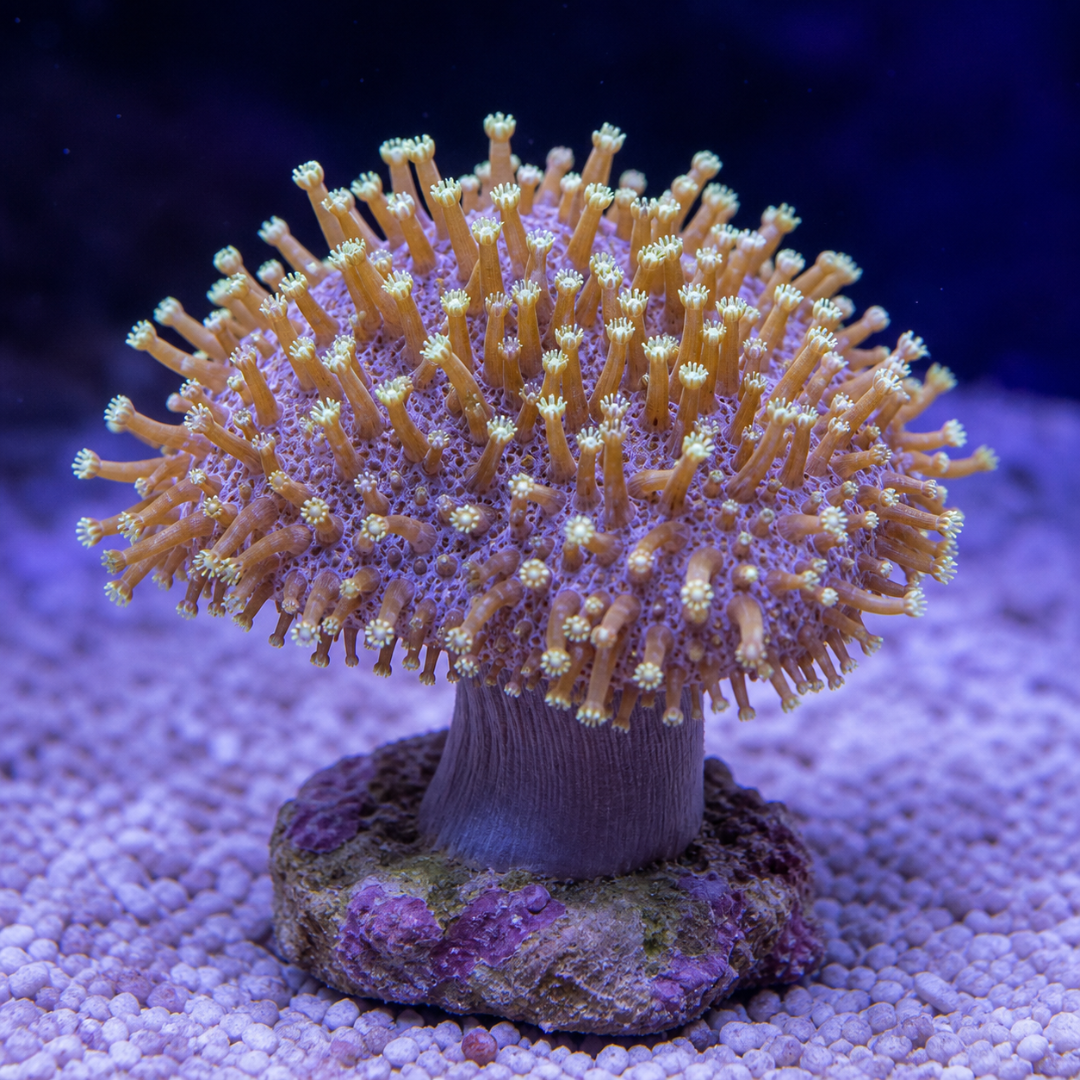
解説 / Description
ウミキノコ・フラワーポリプは、Sarcophyton属のうち、長いポリプが花のように開く個体に用いられる流通名です。円柱状の茎と、傘のように広がる冠部がキノコ状の姿をつくり、ポリプが水流に合わせてゆっくりとなびくことで、ソフトコーラルならではの柔らかな景観を生み出します。体色はベージュや褐色が基本ですが、イエローや蛍光グリーンを帯びる個体も流通し、青色系の照明下では鮮やかな発色を楽しめます。比較的丈夫な一方、長いポリプを美しく開かせるには、適正な比重と安定した水質を保ち、適切な光量と、体表に汚れをためない乱れた水流を与えることが大切です。 Flower-polyp Sarcophyton is a trade name used for Sarcophyton leather corals whose long polyps open like small flowers. A cylindrical stalk and a broad, umbrella-like cap form the familiar mushroom-shaped colony, while the polyps sway gently in the current and create the soft, dynamic appearance characteristic of leather corals. Most specimens are beige or brown, but yellow and fluorescent green forms are also traded and can appear especially vivid under blue-rich lighting. Although generally hardy, full polyp extension depends on stable salinity and water quality, suitable lighting, and irregular flow that prevents debris from settling on the surface.
基本情報 / Basic Information
| 学名 / Scientific Name | Sarcophyton spp.(フラワーポリプ/ロングポリプ系統) (flower-polyp / long-polyp forms) |
|---|---|
| 通称 / Common and English Names | ウミキノコ、フラワーポリプ、ロングポリプ、グリーンウミキノコ、レザーコーラルToadstool Leather Coral, Mushroom Leather Coral, Long-polyp Leather Coral, Flower-polyp Leather Coral |
| 分類 / Classification | 刺胞動物門、花虫綱、八放サンゴ亜綱、ウミトサカ目、ウミトサカ科、Sarcophyton属Phylum Cnidaria, Class Anthozoa, Subclass Octocorallia, Order Alcyonacea, Family Alcyoniidae, Genus Sarcophyton |
| 分布 / Distribution | インド太平洋、紅海、地中海を含む熱帯から亜熱帯の浅海域に分布します。主に、光が届き、水流のあるサンゴ礁や岩礁域に生息します。It is distributed in tropical to subtropical shallow waters of the Indo-Pacific, Red Sea, and Mediterranean region. It mainly inhabits illuminated reef and rocky environments with regular water movement. |
| 最大サイズ / Maximum Size | 最大サイズは種や系統によって大きく異なり、正確な上限は明らかではありません。国内では、数cmのフラグから群体径15cm以上の大型親株まで流通しています。Maximum size varies greatly among species and lineages, and the precise upper limit is unclear. In the Japanese aquarium trade, specimens range from fragments only a few centimeters wide to large parent colonies exceeding 15 cm in diameter. |
| 寿命 / Lifespan | 寿命の詳細は明らかではありません。安定した環境では、成長と株分けを繰り返しながら長期飼育が可能です。Its precise lifespan is unknown. Under stable aquarium conditions, colonies can be kept for many years while continuing to grow and regenerate through fragmentation. |
飼育環境 / Aquarium Environment
| 水槽サイズ / Tank Size | 小型フラグであれば30cmキューブ水槽でも飼育できます。ただし、成長後に冠部が広がる空間と、ほかのサンゴから15〜20cm程度の間隔を確保するには、60cm規格水槽以上のほうが管理しやすくなります。大型の親株や複数のサンゴを収容する場合は、90cm規格水槽以上が適しています。Small fragments can be kept in a 30 cm cube aquarium. However, a standard 60 cm tank or larger is easier to manage because it provides room for the cap to expand and allows a separation of roughly 15–20 cm from neighboring corals. Large parent colonies or aquariums containing several corals are better suited to a standard 90 cm tank or larger. |
|---|---|
| 水温・比重 / Temperature and Specific Gravity | 水温24〜26℃、比重1.023〜1.025を目安にします。蒸発による比重の上昇に注意し、校正した光学式屈折計で定期的に確認します。急な温度変化や極端な高温・低温を避け、日内変動をできるだけ小さく保ちます。Maintain a temperature of 24–26°C and a specific gravity of 1.023–1.025. Watch for increases caused by evaporation and check salinity regularly with a calibrated refractometer. Avoid sudden temperature changes and extreme heat or cold, and keep daily fluctuations as small as possible. |
| 水質 / Water Quality | pH 8.1〜8.4、KH 8.0〜9.5 dKH、カルシウム400〜450 ppm、マグネシウム1250〜1350 ppmが目安です。硝酸塩は1〜10 ppm、リン酸塩は0.01〜0.05 ppm程度を保ちます。栄養塩が過剰に蓄積するとポリプが長期間閉じる原因になります。一方、栄養塩を完全に除去すると共生藻の活動を妨げるため、過度な除去も避けます。Recommended values are pH 8.1–8.4, alkalinity 8.0–9.5 dKH, calcium 400–450 ppm, and magnesium 1250–1350 ppm. Keep nitrate around 1–10 ppm and phosphate around 0.01–0.05 ppm. Excessive nutrient accumulation can cause prolonged polyp retraction. At the same time, stripping nutrients to absolute zero may impair the activity of the symbiotic algae. |
| 光量 / Lighting | 中程度の光量が適し、PAR 75〜150程度を基本の目安とします。状態のよい個体では200 PAR前後まで対応する場合がありますが、導入直後から強光下に置くと光障害を起こすことがあります。最初は低〜中光量の場所に置き、2〜3週間かけて徐々に順応させます。蛍光グリーン系の個体は、400〜500nm付近の青色光で美しく見えます。Moderate lighting is suitable, with approximately 75–150 PAR as a practical target. Healthy colonies may tolerate levels around 200 PAR, but placing a newly introduced specimen directly under intense light can cause photostress. Begin in a low- to moderate-light area and acclimate it gradually over two to three weeks. Fluorescent green forms are visually enhanced by blue wavelengths around 400–500 nm. |
| 水流 / Water Flow | 中〜強程度で、複数方向から変化する間接的な乱水流が適しています。水槽全体で1時間に10〜20回転程度を目安とし、ポリプがゆっくり揺れ、冠部にゴミがたまらない流れを作ります。ポンプからの直線的な強い水流を至近距離で当てると、組織を傷めるため避けます。Provide moderate to strong, indirect and irregular flow from changing directions. A total circulation rate of roughly 10–20 tank volumes per hour is a useful guide, with enough movement to sway the polyps and prevent debris from settling on the cap. Avoid a concentrated laminar jet from a nearby pump, which can damage the tissue. |
| レイアウト・配置 / Layout and Placement | 冠部にデトリタスが積もらず、間接水流が当たる中段から上段に配置します。成長後に傘が広がる空間を確保し、ミドリイシなど感受性の高いサンゴとは15〜20cm以上離します。アレロパシーの影響も考慮し、周囲のサンゴとの位置関係と水槽全体の流れを確認しながら配置します。Place the coral in the middle to upper portion of the aquarium where indirect flow prevents detritus from accumulating on the cap. Leave space for the colony to broaden and keep it at least 15–20 cm away from sensitive corals such as Acropora. Consider both the position of neighboring corals and the direction of water movement, because dissolved allelopathic compounds can affect other livestock in the system. |
| 注意点 / Precautions | 導入後や環境が変化したあとには、数日から2週間ほどポリプを閉じることがあります。表面がつやのある膜で覆われている場合は、正常な脱皮である可能性が高いため、頻繁に触ったり移動させたりせず、適切な水流を保って経過を見守ります。剥がれた膜はネットやスポイトで回収し、必要に応じて活性炭を使用します。After introduction or a change in conditions, the coral may remain closed for several days to about two weeks. A glossy film over the surface often indicates normal shedding, so avoid repeated handling or relocation, maintain suitable flow, and allow the process to run its course. Remove detached sheets of mucus with a net or siphon and use activated carbon when necessary. |
餌と給餌 / Feeding
| 栄養の得方・餌 / Nutrition and Diet | 体内に共生する褐虫藻の光合成産物を主要な栄養源とし、必要なエネルギーの多くを光合成から得ています。オートゾイドも摂食に関わりますが、フラワーポリプ系統に共通する必須の餌や給餌量は明確ではありません。The coral obtains much of its energy from photosynthetic products supplied by symbiotic dinoflagellates living in its tissues. The autozooid polyps also participate in feeding, but no single mandatory food type or feeding amount has been established for all flower-polyp forms. |
|---|---|
| 給餌のポイント / Feeding Tips | 安定した照明と適度な栄養塩を保つことが、栄養管理の基本です。定期給餌の必要性や適切な頻度には一律の基準がないため、給餌する場合は過剰な投入で水質を悪化させないことを優先します。ポリプの開き方と、硝酸塩・リン酸塩の推移を観察しながら慎重に調整します。Stable lighting and moderate nutrient availability form the basis of nutritional management. Because there is no universal rule for the need or frequency of supplemental feeding, any feeding should be kept conservative to avoid deteriorating water quality. Adjust the amount while monitoring polyp extension and changes in nitrate and phosphate. |
性質と相性 / Characteristics and Compatibility
| 形態・成長 / Form and Growth | 硬い炭酸カルシウム骨格を持たない群体性ソフトコーラルです。組織中の微小な骨片と、体内へ取り込んだ海水の圧力による静水力学的な支持で、茎と冠部の形を保ちます。冠部には、摂食を担うオートゾイドと、群体内の水循環を担うシフォノゾイドが存在します。環境が安定すると、冠部を広げながら成長し、切断された組織からも再生します。This is a colonial soft coral without a rigid calcium carbonate skeleton. Microscopic sclerites in the tissue and the hydrostatic support created by internal water pressure allow the stalk and cap to retain their form. The cap bears feeding autozooids and smaller siphonozooids involved in internal water circulation. Under stable conditions, the colony grows while expanding its cap and can regenerate from cut tissue. |
|---|---|
| 攻撃性 / Aggression | 長いスイーパー触手で攻撃するタイプではありませんが、センブラン型ジテルペンなどの二次代謝産物を放出し、周囲のサンゴへ化学的な影響を与えるアレロパシーを示します。特にミドリイシなどの敏感なサンゴでは、ポリプの退縮や組織障害の原因になる可能性があります。15〜20cm以上の間隔を取り、活性炭の使用や適切な換水によって、溶存した化学物質の蓄積を抑えます。It does not primarily attack with long sweeper tentacles, but it can release secondary metabolites, including cembranoid diterpenes, and thereby exert allelopathic effects on neighboring corals. Sensitive corals such as Acropora may show polyp retraction or tissue stress. Maintain a separation of at least 15–20 cm and limit the buildup of dissolved compounds with activated carbon and appropriate water changes. |
| 相性 / Compatibility | 丈夫なソフトコーラルとは比較的同居させやすい一方、SPSを主体とする水槽では化学的な干渉に注意します。魚類との同居は一般に可能ですが、サンゴをついばむ魚や、ウミキノコの体表を傷つける生体は避けます。クマノミがポリプの間へ入り、イソギンチャクの代わりに宿主として利用することがありますが、強くこすり続けるとポリプが閉じる場合があります。It is generally compatible with other hardy soft corals, but chemical interaction deserves special attention in SPS-dominated systems. Most reef-safe fish can coexist with it, while coral-nipping species or animals that damage its surface should be avoided. Clownfish may enter the polyps and use the coral as a substitute host for an anemone, although persistent rubbing can cause it to remain retracted. |
病気と対策 / Diseases and Prevention
| 不調・病気・害虫 / Problems, Diseases, and Pests | よく見られる不調には、長期間ポリプが開かないこと、表面への汚れの堆積、脱皮膜の残留、色落ち、局所的な組織障害などがあります。主な原因として、比重のずれ、硝酸塩の蓄積、水流不足、強すぎる光や光量不足、急な環境変化が挙げられます。ウミウシやヒラムシなどの害虫が夜間に組織を食害する場合もあります。Common problems include prolonged polyp retraction, debris accumulation on the surface, retained shedding membranes, color loss, and localized tissue damage. Major causes include incorrect salinity, nitrate accumulation, insufficient flow, excessive or inadequate light, and sudden environmental changes. Nudibranchs or flatworms may also damage the tissue, particularly at night. |
|---|---|
| 対策と予防 / Prevention | 最初に、校正した屈折計で比重を確認し、水温、pH、KH、硝酸塩、リン酸塩を測定します。冠部に汚れがたまる場合は、直撃を避けながら乱水流を強めます。脱皮中はむやみに移動させず、膜が自然に剥がれる環境を整えます。害虫が疑われる場合は隔離して観察し、規定量を守ってヨウ素系またはサンゴ用ディップ剤で薬浴します。腐敗した組織が広がる場合は、清潔な器具を使い、健全な組織を一部含む位置で患部を切除します。First, verify salinity with a calibrated refractometer and test temperature, pH, alkalinity, nitrate, and phosphate. If debris accumulates, increase irregular flow without directing a harsh jet at the coral. During shedding, avoid unnecessary relocation and provide conditions that allow the film to detach naturally. If pests are suspected, isolate and inspect the coral and use an iodine-based or commercial coral dip at the stated dosage. If decay continues to spread, remove the affected area with clean tools, cutting slightly into healthy tissue. |
増やし方(繁殖・株分け) / Reproduction and Propagation
| 無性生殖・株分け / Asexual Reproduction and Fragmentation | 再生能力が高く、人為的な切断による株分けが可能です。冠部の外周をリング状に切り取り、2〜3cm程度の断片へ分ける方法や、伸びた茎を水平に切る方法があります。親株に残った基部と、切り取った上部のどちらからも再生が期待できます。Sarcophyton has strong regenerative ability and can be propagated by deliberate fragmentation. Common methods include removing a ring from the outer edge of the cap and dividing it into pieces about 2–3 cm wide, or cutting an elongated stalk horizontally. Both the base remaining on the parent colony and the removed upper section can regenerate. |
|---|---|
| 有性生殖 / Sexual Reproduction | フラワーポリプは種を特定する名称ではないため、有性生殖の様式を一律に示すことはできません。水槽内では、一般に株分けによる無性生殖が利用されます。Because “flower polyp” is a trade description rather than a species-level identification, its mode of sexual reproduction cannot be described uniformly. In aquariums, propagation is generally performed through asexual fragmentation. |
| 増殖のポイント / Propagation Tips | 状態のよい親株を選び、清潔で鋭利なメス、ハサミ、カミソリを使用します。切断直後は粘液が多く、瞬間接着剤だけでは固定しにくいため、輪ゴムや爪楊枝、糸を用いるか、ライブロック片を入れた隔離容器に収容して物理的に固定します。必要に応じてヨウ素系ディップで処置し、中〜低光量と穏やかな水流のもとで回復を待ちます。通常は1〜3週間ほどで切断面が癒合し、新しいポリプが伸び始めます。Choose a healthy parent colony and use a clean, sharp scalpel, scissors, or razor. Freshly cut tissue releases abundant mucus and often does not adhere well with cyanoacrylate gel alone. Secure it with a loose rubber band, toothpick, or thread, or place it in an isolation container filled with small pieces of live rock. An iodine-based dip may be used when appropriate, followed by recovery under low to moderate light and gentle flow. The cut surface commonly heals and begins producing new polyps within one to three weeks. |
毒性と取り扱い / Toxicity and Handling
| 毒性 / Toxicity | 刺胞動物として刺胞を備えるほか、サーコフィトキシドに代表されるセンブラン型ジテルペンなどの二次代謝産物を生成します。これらは主に他のサンゴとの空間競争に関わり、閉鎖水槽では周囲のサンゴへ化学的なストレスを与える可能性があります。パリトキシンとの関係は明確ではありません。As a cnidarian, it possesses stinging cells and also produces secondary metabolites such as the cembranoid diterpene sarcophytoxide. These compounds are mainly involved in competition with neighboring organisms and may chemically stress other corals in a closed aquarium. Its relationship with palytoxin is unclear. |
|---|---|
| 取り扱い上の注意 / Handling Precautions | 移動や株分けでは、粘液や切断液が皮膚、目、傷口に触れないよう手袋と保護眼鏡を使用します。作業場所を十分に換気し、使用した器具と手をよく洗浄します。切断作業は本水槽内で行わず、処置に用いた海水や切除片は本水槽に戻さないようにします。体調に異常を感じた場合は作業を中止し、必要に応じて医療機関へ相談します。During handling or fragmentation, wear gloves and eye protection to prevent mucus and tissue fluids from contacting the skin, eyes, or open wounds. Work in a well-ventilated area and wash hands and tools thoroughly afterward. Do not perform cutting in the display aquarium, and do not return treatment water or tissue fragments to the main system. Stop immediately if symptoms occur and seek medical advice when needed. |
雑学と豆知識 / Trivia and Fun Facts
| 骨格がないのに立てる理由 / How It Stands Without a Hard Skeleton | ウミキノコの体を支えているのは、硬いサンゴ骨格ではありません。組織の中に無数に埋め込まれた微小な骨片と、体内へ取り込んだ海水の圧力が、柔らかな体を内側から支えています。触手を持たない小さなシフォノゾイドは、群体内部へ海水を送り込む役割を担い、傘を大きく広げるための静水圧を生み出します。危険を感じたときには、内部の海水を排出して体積を小さくすることで、物理的な損傷を減らします。A Sarcophyton colony is not supported by a rigid coral skeleton. Instead, countless microscopic sclerites embedded in the tissue and the pressure of seawater held inside the colony support the soft body from within. Tiny siphonozooids without feeding tentacles help move seawater through the colony and create the hydrostatic pressure needed to expand the cap. When disturbed, the coral rapidly expels internal water and reduces its volume, helping to limit physical damage. |
|---|---|
| 見た目だけでは種を見分けにくい / Appearance Alone Can Be Misleading | Sarcophyton属は、長いあいだ骨片の形、大きさ、突起の配列などを顕微鏡で比較して分類されてきました。しかし分子系統解析が進むと、外見や骨片が似た個体の中に、遺伝的に異なる複数の系統が含まれることが分かってきました。流通名の「フラワーポリプ」は学術的な種名ではなく、長いポリプと花のような開き方を表す観賞上の呼び名です。Sarcophyton species were traditionally identified by comparing the shape, size, and ornamentation of their microscopic sclerites. Molecular analyses later revealed that specimens with similar appearances and sclerites may belong to several genetically distinct lineages. “Flower polyp” is therefore not a formal species name but an aquarium trade term describing unusually long, flower-like polyps. |
| 脱皮は自己洗浄 / Shedding Is a Cleaning Process | ポリプを閉じ、表面に薄い膜を作ってから、その膜を一気に剥がす脱皮は、ウミキノコの代表的な自己洗浄行動です。膜の中には、体表へ付着したデトリタス、微細藻類、刺激物が取り込まれます。十分な水流があれば古い膜が剥がれ、その下から新しい表面と開いたポリプが現れます。反対に水流が弱いと膜が残り、組織障害へつながることがあります。Closing the polyps, forming a thin surface film, and then peeling it away is a characteristic self-cleaning behavior. Detritus, microalgae, and irritants on the surface become trapped in the film. With sufficient water movement, the old layer detaches and reveals a clean surface with newly extended polyps. If flow is too weak, the film may remain and contribute to tissue damage. |
| クマノミとの不思議な関係 / An Unusual Relationship with Clownfish | ウミキノコはイソギンチャクではありませんが、クマノミが長いポリプの間へ入り、代替の宿主として利用することがあります。研究では、直接接触する前からクマノミの体表細菌叢が、ウミキノコの体表細菌叢に近い構成へ変化する現象が観察され、化学的な認識に微生物が関わる可能性が示唆されています。水槽では愛らしい光景になる一方、クマノミの接触が強すぎるとウミキノコが縮むこともあります。Although Sarcophyton is not an anemone, clownfish sometimes shelter among its long polyps as a substitute host. Research has observed the clownfish skin microbiome shifting toward a composition similar to that of the coral even before direct contact, suggesting that microorganisms may contribute to chemical recognition. In aquariums this can be appealing to watch, but persistent rubbing may cause the coral to retract. |
| 海の化学防御と創薬研究 / Chemical Defense and Drug Research | ウミキノコが周囲の生物との競争に使う二次代謝産物は、水槽ではアレロパシーとして注意が必要ですが、研究の世界では別の価値を持ちます。Sarcophyton属からは多様なテルペノイド類が単離され、抗腫瘍、抗炎症、神経保護、抗菌などの活性が臨床前研究で調べられています。海中で生き残るために進化した化学物質が、将来の創薬候補として研究されている点からも、このサンゴが持つ生態的な奥深さがうかがえます。The secondary metabolites used by Sarcophyton in competition require caution in aquariums because of allelopathy, yet they have a different value in research. Many terpenoid compounds have been isolated from the genus and examined in preclinical studies for antitumor, anti-inflammatory, neuroprotective, and antimicrobial activity. The study of chemicals that evolved for survival on crowded reefs also reveals the ecological complexity of this coral. |
| 日本国内での流通と出所確認 / Trade and Traceability in Japan | 国内では、正規に採捕された天然個体、適法に輸入された個体、ショップや愛好家が株分けした人工増殖株が流通します。天然由来のサンゴやソフトコーラルには採捕や輸入に関する規制があるため、購入時は販売者が出所を説明できる個体を選ぶことが大切です。近年は、小型水槽へ導入しやすく、天然資源への負担も抑えられるフラグ個体の流通量が増えています。In Japan, the market includes legally collected wild colonies, properly imported specimens, and aquacultured fragments produced by shops or hobbyists. Because wild corals and soft corals are subject to collection and import controls, buyers should choose specimens whose origin can be explained by the seller. Small propagated fragments are becoming more widely traded because they suit compact aquariums and reduce pressure on wild resources. |
まとめ / Conclusion
ウミキノコ・フラワーポリプは、柔らかな傘から花のような長いポリプを伸ばし、水流に合わせて揺れる姿が魅力のソフトコーラルです。適正な比重と安定した水質を保ち、中程度の光と乱れた間接水流を与えることで、本来の伸びやかな姿を引き出せます。定期的な脱皮を異常と決めつけずに見守り、ほかのサンゴとの距離やアレロパシーにも配慮すれば、混泳水槽でも穏やかな存在感を長く楽しめます。 Flower-polyp Sarcophyton is valued for the way its long, flower-like polyps rise from a soft cap and sway with the current. Stable salinity and water quality, moderate light, and irregular indirect flow allow the colony to display its naturally open form. By recognizing periodic shedding as a normal process and allowing sufficient space from neighboring corals, aquarists can enjoy its calm presence for many years in a mixed reef aquarium.
環境になじんだ個体は、日ごとにポリプの伸び方や傘の広がりを変え、成長と脱皮を繰り返しながら水槽の景色に溶け込んでいきます。株分けした小さな断片が新しい群体へ育つ過程も観察できるため、長く育てるほど、その生命力と変化の豊かさを実感できるサンゴです。 Once established, the coral varies its polyp extension and cap shape from day to day, gradually becoming part of the aquarium landscape through repeated growth and shedding. A small propagated fragment can also be observed as it develops into a new colony, allowing its resilience and changing character to become more apparent over time.

気になる道具や飼い方を見つけてみませんか?
 アイのアクアグッズ案内コケを食べるコイの仲間に合わせる飼育用品|フライングフォックス・アルジイーター・ガラ道具の特徴や使い方、選ぶときのポイントをアイが紹介します。記事はコチラ →
 アイのアクアグッズ案内エーハイム、安いのと高いのは何が違う? コタロウと見比べる外部フィルター道具の特徴や使い方、選ぶときのポイントをアイが紹介します。記事はコチラ →
 アイのアクアグッズ案内おとひめ物語|養殖生まれの餌を、わが家の魚に合う一粒へ道具の特徴や使い方、選ぶときのポイントをアイが紹介します。記事はコチラ →
 アイのアクアグッズ案内グッピー・プラティ・モーリーを親子で楽しむ飼育用品|水槽・稚魚保護・ろ過・餌・水草道具の特徴や使い方、選ぶときのポイントをアイが紹介します。記事はコチラ →
さまざまな飼育テーマをご紹介。リンク先の記事には広告・商品紹介が含まれます。
案内・紹介記事一覧へ →分布マップ
Sarcophyton spp.は、記事記載上、インド太平洋、紅海、地中海を含む熱帯から亜熱帯の浅海域に分布し、光が届くサンゴ礁や岩礁域で見られます。地図のマーカーは広域分布を示すための概略代表地点であり、実際の採集地点や厳密な生息範囲を示すものではありません。
この地図は記事の分布記述をもとにした概略表示です。マーカーと表示範囲は地理的な位置関係を分かりやすくするための代表値で、実際の採集地点、個体群の確認地点、厳密な生息域、分布境界を保証するものではありません。
参考文献
ウミキノコ属の分類、形態、分布、生息環境、飼育条件、光と水流への反応、繁殖、サンゴ間競争、病変に関する記述の確認に使用した資料です。店舗、通販サイト、個人ブログ、まとめサイトは含めていません。
文献を参照する際の注意
- 現行の分類体系では、Sarcophyton属は八放サンゴ綱、Malacalcyonacea目、Sarcophytidae科に分類されています。Alcyonacea目、Alcyoniidae科という表記は、過去の文献や飼育書で広く使用されてきた旧来の体系です。
- 属の主要な自然分布として、中央・西太平洋、インド洋、紅海は複数の分類・生態資料で確認できます。地中海は、ここに挙げた属の主要な自然分布域には含まれていません。
- 水温、比重、pH、KH、栄養塩などの飼育数値は、特定の一種に対する絶対的な生理限界ではありません。複数の飼育研究と専門的なサンゴ飼育資料を組み合わせた実用上の管理目安として扱う必要があります。
- 活性炭、隔離、薬浴、ヨウ素系ディップ、サンゴ間の固定距離などは、公共水族館やアクアリウムで用いられる実務的な管理方法を含みます。製品ごとの使用量や処置時間を、Sarcophyton属全体に共通する実験的な確定値として扱うことはできません。
分類・形態・種同定
-
World Register of Marine Species. “Sarcophyton Lesson, 1834.” World List of Octocorallia.
WoRMSの分類情報
分類階級、属名、命名者、採用されている現行分類の確認。 -
McFadden, C. S., van Ofwegen, L. P. and Quattrini, A. M. 2022. “Revisionary systematics of Octocorallia (Cnidaria: Anthozoa) guided by phylogenomics.” Bulletin of the Society of Systematic Biologists, 1(3), 1–79.
DOI: 10.18061/bssb.v1i3.8735
八放サンゴ類の分子系統解析と、目・科を含む現行分類体系の根拠。 -
Verseveldt, J. 1982. “A revision of the genus Sarcophyton Lesson (Octocorallia, Alcyonacea).” Zoologische Verhandelingen, 192, 1–91.
Naturalis Biodiversity Center収録PDF
骨片の形状、群体形態、種の識別形質を整理したSarcophyton属の基礎的な分類学的再検討。 -
Aratake, S., Tomura, T., Saitoh, S., Yokokura, R., Kawanishi, Y., Shinjo, R. et al. 2012. “Soft Coral Sarcophyton (Cnidaria: Anthozoa: Octocorallia) Species Diversity and Chemotypes.” PLOS ONE, 7(1), e30410.
DOI: 10.1371/journal.pone.0030410
形態だけでは区別しにくい遺伝的系統、隠蔽的な種多様性、骨片形態と化学型の関係。
分布・生息環境・生態
-
Fabricius, K. E. and Alderslade, P. 2001. Soft Corals and Sea Fans: A Comprehensive Guide to the Tropical Shallow-Water Genera of the Central-West Pacific, the Indian Ocean and the Red Sea. Australian Institute of Marine Science, Townsville, 264 pp. ISBN 0-642-32210-4.
資料PDF
熱帯浅海域に生息するソフトコーラルの分布、群体形態、骨片、ポリプ、生息環境をまとめた基礎資料。 -
Fabricius, K. E. 1995. “Slow population turnover in the soft coral genera Sinularia and Sarcophyton on mid- and outer-shelf reefs of the Great Barrier Reef.” Marine Ecology Progress Series, 126, 145–152.
DOI: 10.3354/meps126145
グレートバリアリーフにおける生息状況、群体の成長、死亡、加入、個体群の長期的な維持特性。 -
Sammarco, P. W., Coll, J. C. and La Barre, S. 1985. “Competitive strategies of soft corals (Coelenterata: Octocorallia). II. Variable defensive responses and susceptibility to scleractinian corals.” Journal of Experimental Marine Biology and Ecology, 91(3), 199–215.
DOI: 10.1016/0022-0981(85)90176-5
Sarcophyton ehrenbergiを含むソフトコーラルと造礁サンゴの競争、接触および非接触条件で生じる組織壊死、化学的干渉の根拠。
飼育条件・光・水流・栄養
-
Leewis, R. J. and Janse, M., eds. 2008. Advances in Coral Husbandry in Public Aquariums. Public Aquarium Husbandry Series, Volume 2.
Burgers’ Zooによる書籍案内
公共水族館における水質、照明、水流、濾過、サンゴの健康管理、増殖、輸送を扱う査読付き専門書。 -
Rocha, R. J. M., Calado, R., Cartaxana, P., Furtado, J. and Serôdio, J. 2013. “Photobiology and growth of leather coral Sarcophyton cf. glaucum fragments stocked under low light in a recirculated system.” Aquaculture, 414–415, 235–242.
DOI: 10.1016/j.aquaculture.2013.08.018
循環式飼育下における50、80、120 µmol photons m⁻² s⁻¹の光条件と、フラグの生残、成長、光生理学的反応。 -
Chang, T. C., Mayfield, A. B. and Fan, T. Y. 2020. “Culture systems influence the physiological performance of the soft coral Sarcophyton glaucum.” Scientific Reports, 10, 20200.
DOI: 10.1038/s41598-020-77071-5
水温約26℃、塩分約35、PAR 100・200、流速5・15 cm毎秒を用いた比較試験。光、水流、給餌、ライブロック、循環方式と成長・発色の関係。
繁殖・株分け・フラグ育成
-
Benayahu, Y. and Loya, Y. 1986. “Sexual reproduction of a soft coral: synchronous and brief annual spawning of Sarcophyton glaucum (Quoy and Gaimard, 1833).” The Biological Bulletin, 170(1), 32–42.
DOI: 10.2307/1541378
Sarcophyton glaucumの生殖腺発達、雌雄、年周期、同期的な放卵放精を扱った有性生殖研究。 -
Sella, I. and Benayahu, Y. 2010. “Rearing cuttings of the soft coral Sarcophyton glaucum (Octocorallia, Alcyonacea): Towards mass production in a closed seawater system.” Aquaculture Research, 41(12), 1748–1758.
DOI: 10.1111/j.1365-2109.2009.02475.x
閉鎖循環式海水システムにおける切断片の育成、活着、生残、成長と量産技術。 -
Chaitanawisuti, N. and Kritsanapuntu, S. 2019. “Asexual propagation of the soft corals Sinularia sp., Cladiella sp. and Sarcophyton sp.” Aquaculture Research, 50(8), 2047–2053.
DOI: 10.1111/are.14067
Sarcophyton属を含むソフトコーラルの小型切断片、固定、活着、無性増殖技術の比較。
病変・白化・健康管理
-
Cervino, J. M., Hauff, B., Haslun, J. A., Winiarski-Cervino, K., Cavazos, M., Lawther, P., Wier, A. M., Hughen, K. and Strychar, K. B. 2012. “Ulcerated yellow spot syndrome: implications of aquaculture-related pathogens associated with soft coral Sarcophyton ehrenbergi tissue lesions.” Diseases of Aquatic Organisms, 102, 137–148.
DOI: 10.3354/dao02541
Sarcophyton ehrenbergiの潰瘍状組織病変と、Vibrio属などの細菌群との関連を調べた病理・微生物学的研究。 -
Raymundo, L. J., Couch, C. S. and Harvell, C. D., eds. 2008. A Coral Disease Handbook: Guidelines for Assessment, Monitoring and Management. Coral Reef Targeted Research and Capacity Building for Management Program.
ハンドブックPDF
病変の観察、症状の記録、環境ストレスとの区別、感染拡大の監視、サンゴの健康状態を評価する際の基本原則。
最終確認日:2026年7月31日。分類情報は更新される場合があるため、公開後もWorld Register of Marine Speciesの採用分類を定期的に確認してください。




コメント