

解説 / Description
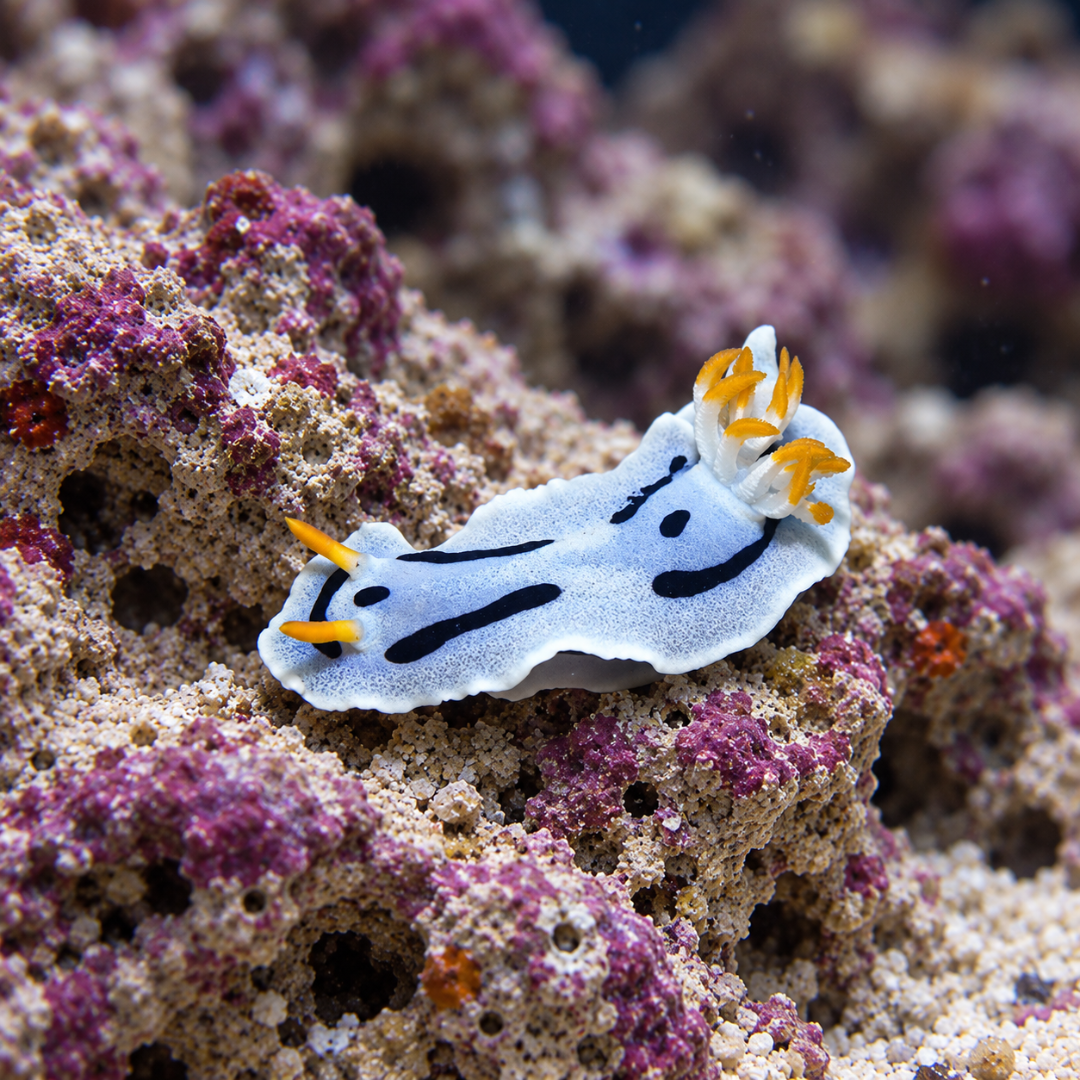
ダイアナウミウシは、現在の分類整理ではChromodoris alcalaiに当てられるイロウミウシ科の裸鰓類です。かつては外見がよく似たChromodoris dianaeと同じ種として扱われていましたが、分子系統解析と形態の再検討によって別種であることが示され、2021年にChromodoris alcalaiとして整理されました。体は白色から淡い青色で、背面には細かな白色斑が密に散らばり、黒色の線や斑紋が入ります。頭部前方の弧状の黒色模様と、基部が白く先端側が黄橙色になる二次鰓は、近縁のC. dianaeと見分ける際の重要な特徴です。美しい外見を持つ一方、海綿を食べる食性のため、家庭のマリンアクアリウムで長期飼育するのは難しい生き物です。 The nudibranch commonly called “Diana umiushi” in Japan is currently treated as Chromodoris alcalai, a member of the family Chromodorididae. It was formerly confused with the very similar Chromodoris dianae, but molecular and morphological re-examination showed that the two represent distinct species, and C. alcalai was formally recognized in 2021. The body is white to pale blue and densely covered with minute opaque white spots, with variable black lines and patches. A curved black marking across the front of the head and gills that are white at the base and yellow-orange toward the outer half are useful features for distinguishing it from C. dianae. Despite its striking appearance, its sponge-feeding ecology makes long-term maintenance in a home marine aquarium difficult.
基本情報 / Basic Information
| 学名 / Scientific Name | Chromodoris alcalai Gosliner, 2021 |
|---|---|
| 通称 / Common Name | ダイアナウミウシ。過去の国内図鑑やウェブ情報にはChromodoris dianaeの和名として掲載された例があり、現在も旧学名との混同が残っています。Diana umiushi in Japanese usage. Older Japanese field guides and web resources may associate this common name with Chromodoris dianae, so legacy records can remain confusing. |
| 分類 / Family | 軟体動物門・腹足綱・裸鰓目・ドーリス亜目・イロウミウシ科・ミスジアオイロウミウシ属(Chromodoris属)Phylum Mollusca, Class Gastropoda, Order Nudibranchia, Suborder Doridina, Family Chromodorididae, Genus Chromodoris. |
| 英名 / English Name | Alcala’s Chromodoris |
| 分布 / Distribution | 沖縄、フィリピン、インドネシア、マレーシア、西オーストラリアから記録されています。原記載では生体が水深10〜30mで観察されており、標本記録にはより浅い場所や深い場所の例も含まれます。Recorded from Okinawa, the Philippines, Indonesia, Malaysia, and Western Australia. The original description reports living animals from depths of 10–30 m, while specimen records also include shallower and deeper localities. |
| 最大体長 / Max Size | 最大約6cm。原記載で確認された生体は15〜60mmです。Up to about 6 cm. Living animals documented in the original description measured 15–60 mm. |
| 寿命 / Lifespan | 本種の寿命を数値で示せる信頼性の高い飼育データは確認されていません。特に家庭水槽では餌となる海綿の確保が難しいため、一般的な寿命の目安を設定するのは適切ではありません。Reliable captive data establishing a numerical lifespan for this species are not available. Because maintaining suitable sponge prey is especially difficult in home aquaria, a general aquarium lifespan should not be stated as a fixed value. |
飼育環境 / Aquarium Environment
| 水槽サイズ / Tank Size | 本種について、長期飼育に適した規格水槽サイズは確立されていません。水槽の大きさそのものより、餌となる海綿を継続して用意できることと、水質を安定させられることが重要です。管理する場合は、他の生体への影響や給餌状況を把握しやすい独立した海水環境が適しています。No standard aquarium size has been established for successful long-term maintenance of this species. More important than tank dimensions are the ability to provide suitable sponge prey continuously and to maintain stable water quality. If kept, an independent marine system is preferable because feeding and any effects on other livestock can be monitored more clearly. |
|---|---|
| 水温 / Temperature | 本種固有の飼育適温を検証した資料は確認されていません。熱帯から亜熱帯の海域に分布する海産無脊椎動物として、導入個体が管理されていた水温から急変させず、安定した環境を維持することを優先します。 A species-specific captive temperature range has not been experimentally established. As a tropical to subtropical marine invertebrate, it should be kept under stable conditions and protected from abrupt temperature changes, especially during acclimation. |
| 水質 / Water Quality | 本種固有の耐容範囲は明らかではありません。一般的なサンゴ礁性の海産無脊椎動物を管理する目安として、比重1.023〜1.026、pH8.1〜8.4程度の安定した海水環境を維持し、アンモニアや亜硝酸の発生、急な塩分変化、有機物の蓄積を避けます。これらの数値は本種だけを対象とした実験値ではありません。Species-specific tolerance limits are not established. As general reef-invertebrate husbandry targets, stable seawater around a specific gravity of 1.023–1.026 and pH 8.1–8.4 can be used, while avoiding ammonia or nitrite accumulation, abrupt salinity shifts, and excessive organic waste. These figures are general marine-aquarium guidelines, not experimentally determined limits for this species. |
| レイアウト / Layout | 安定した岩礁状の足場を用意し、体へ強い水流が直接当たり続ける配置は避けます。水流ポンプやオーバーフローなどの吸い込み口にはガードを設け、柔らかな体が巻き込まれないようにします。餌となる海綿を維持する場合は、その海綿に適した水流や水質も同時に確保する必要があります。Provide stable rocky surfaces and avoid directing a strong continuous jet of flow at the animal. Protect pump and overflow intakes so the soft body cannot be drawn in. If a food sponge is maintained in the system, its own requirements for flow and water quality must also be met. |
| 注意点 / Precautions | 最大の課題は海綿食という特殊な食性です。食べられる海綿を継続して確保できなければ、長期飼育は成立しにくくなります。また、Chromodoris属では餌由来の二次代謝産物を化学防御に利用することが知られていますが、C. alcalaiについて水槽内での毒性や事故リスクを具体的に示した資料は確認できません。そのため、強い毒性を断定するのではなく、死亡個体を放置しない、物理的な損傷を避ける、可能なら独立水系で管理するといった慎重な対応が適切です。The main husbandry challenge is its specialized sponge-feeding ecology. Long-term maintenance is unlikely to succeed unless an edible sponge can be supplied continuously. Species of Chromodoris are known to use prey-derived secondary metabolites in chemical defense, but specific evidence defining aquarium toxicity or tank-crash risk for C. alcalai is lacking. Rather than assuming extreme toxicity, prudent management includes removing dead animals promptly, preventing physical injury, and using a separate system when possible. |
餌と給餌 / Feeding
| 餌の種類 / Diet | 海綿を食べる肉食性のウミウシです。ただし、C. alcalaiが自然下で利用する餌海綿を種レベルで確実に示す情報は、今回確認した資料では十分ではありません。近縁種の餌記録をそのまま本種に当てはめることは避けるべきで、人工飼料やコケを代用食として扱える根拠もありません。This is a carnivorous, sponge-feeding nudibranch. However, the sources reviewed do not provide sufficiently secure species-level identification of the natural sponge prey of C. alcalai. Prey records from closely related species should not simply be transferred to this species, and there is no basis for treating prepared foods or aquarium algae as substitutes. |
|---|---|
| 給餌のポイント / Feeding Tips | 飼育を検討する場合は、購入前に販売側で実際の摂食状況と与えている海綿を確認することが重要です。水槽内に何らかの海綿があるだけでは摂食できるとは限りません。継続して食べられる餌を用意できない場合は、長期飼育を前提に導入しない方が安全です。Before attempting to keep the animal, confirm whether it is actually feeding and what sponge is being provided. The mere presence of an unidentified sponge in the aquarium does not mean the nudibranch will accept it. If a continuous supply of suitable prey cannot be maintained, the animal should not be acquired with the expectation of long-term survival. |
性格と混泳 / Temperament and Tank Mates
| 性格 / Temperament | 魚のように縄張りを争ったり、他の生体を追い回したりする種類ではなく、岩や海綿の表面を這って生活します。ただし、行動がおとなしいことと、一般的な混泳水槽に向くことは別です。食性が特殊で、化学防御を持つ属に含まれる点を考慮する必要があります。It does not defend a territory or chase other livestock like a fish, but instead crawls over rock and sponge surfaces. A quiet behavioral profile does not, however, make it suitable for an ordinary community aquarium. Its specialized diet and membership in a chemically defended genus must be taken into account. |
|---|---|
| 混泳の相性 / Compatibility | 長期維持を試みる場合は単独、または管理目的を限定した独立水系が無難です。柔らかな無脊椎動物をついばむ可能性がある魚や大型甲殻類との同居は避けます。また、餌となる海綿を他の生体に食べられる環境も適しません。For any attempt at extended maintenance, solitary housing or a dedicated system is the safer choice. Avoid fishes or large crustaceans that may nip soft-bodied invertebrates. A system in which other livestock consume or damage the required food sponge is also unsuitable. |
病気と対策 / Diseases and Prevention
| かかりやすい病気 / Common Diseases | 観賞飼育下のC. alcalaiに特有の疾病として確立された情報は確認されていません。飼育では、疾病名を特定する以前に、餌不足による衰弱、急な水質変化、輸送時のダメージ、ポンプなどによる物理的損傷に注意する必要があります。No well-established captive diseases specific to C. alcalai were identified in the sources reviewed. In aquarium care, attention should first be given to non-disease problems such as food deprivation, abrupt water-quality changes, shipping damage, and mechanical injury from equipment. |
|---|---|
| 対策と予防 / Prevention | 安定した海水環境を用い、導入時は水温や塩分の急変を避けて慎重に水合わせを行います。吸い込み事故を防止し、死亡した個体は速やかに取り出します。ウミウシ類に対する薬剤の安全性は十分に確立されていないため、魚病薬を同じ感覚で使用せず、原因が不明なまま安易に薬浴しないことが重要です。Use a stable marine system and acclimate carefully to avoid abrupt changes in temperature or salinity. Prevent intake accidents and remove dead animals promptly. Drug safety in nudibranchs is poorly established, so medications intended for fish should not be used casually and unexplained decline should not automatically be treated with medicated baths. |
増やし方(繁殖) / Breeding
| 雌雄の判別 / Sexing | ウミウシ類は基本的に同時的雌雄同体で、成熟個体は雄性・雌性の両方の生殖機能を持ちます。そのため、外見から個体を「オス」「メス」に分けて判別する種類ではありません。Nudibranchs are generally simultaneous hermaphrodites, with mature individuals possessing both male and female reproductive functions. They are therefore not divided into externally recognizable males and females. |
|---|---|
| 繁殖形態 / Reproduction | 卵生です。Chromodoris属の中核群では、卵リボンを基質に沿わせて平たく巻く産卵様式が知られていますが、C. alcalaiそのものについて産卵から幼生発生までを詳細に追った飼育記録は確認できません。そのため、近縁種で知られる発生様式を本種の確定情報として扱うことは避けます。It is oviparous. Core Chromodoris species are known for laying egg ribbons flat against the substrate, but detailed captive records following C. alcalai from spawning through larval development were not identified. Developmental patterns known from relatives should therefore not be presented as confirmed species-specific data. |
| 繁殖のポイント / Breeding Tips | 家庭水槽での計画的な繁殖方法は確立されていません。親個体が継続して食べられる海綿を確保するだけでも難しく、さらに卵や幼生、着底後の幼体に必要な条件も明らかではありません。現状では、一般的なアクアリウムで再現性のある繁殖を目指せる段階ではありません。A reproducible method for planned breeding in home aquaria has not been established. Even maintaining an appropriate sponge diet for the adults is difficult, and the requirements of eggs, larvae, settlement, and newly metamorphosed juveniles are not sufficiently known. At present, this is not a species for which routine aquarium propagation can be recommended. |
雑学と豆知識 / Trivia and Fun Facts
| 1. 「ダイアナウミウシ」と学名がずれた理由 / 1. Why the Japanese common name no longer matches the old scientific name | 長い間、現在のC. alcalaiとC. dianaeは、色彩変異の大きい一つの種としてまとめて扱われていました。ところが分子系統解析で別系統が見つかり、保存標本や生体写真を改めて比較した結果、2021年にC. alcalaiが別種として整理されました。日本で「ダイアナウミウシ」として掲載されてきた写真の多くは、この新たに区別されたC. alcalaiの特徴を持っています。そのため、古い図鑑や販売情報では「ダイアナウミウシ=C. dianae」という表記が残っており、現在の分類と食い違うことがあります。For many years, animals now recognized as C. alcalai and C. dianae were treated as a single highly variable species. Molecular phylogenetic work revealed separate lineages, and re-examination of preserved specimens and living coloration led to the recognition of C. alcalai as a distinct species in 2021. Many animals historically illustrated in Japan under the common name “Diana umiushi” show the characters of C. alcalai. This is why older field guides and commercial information may still use the combination “Diana umiushi = C. dianae,” even though that treatment conflicts with the current taxonomic separation. |
|---|---|
| 2. alcalaiはフィリピンの海洋生物学者への献名 / 2. The name alcalai honors a Filipino marine biologist | 種小名alcalaiは、フィリピンの海洋生物学者Angel Alcala博士の90歳の誕生日と、同国の海洋生物多様性保全への先駆的な貢献をたたえて付けられました。「ダイアナ」という和名が残っているため少し不思議に見えますが、現在の学名が示しているのはDianaではなくAlcalaという人物です。分類の見直しによって、和名の歴史と学名の由来が別々になった珍しい例といえます。The specific epithet alcalai honors Filipino marine biologist Angel Alcala on the occasion of his 90th birthday and recognizes his pioneering contributions to marine-biodiversity conservation in the Philippines. Because the Japanese common name still contains “Diana,” the combination can seem puzzling: the current scientific name commemorates Alcala, not Diana. It is an unusual example in which taxonomic revision left the history of the common name and the origin of the scientific name pointing to different people. |
| 3. C. dianaeとの見分け方は「顔」と鰓が手掛かり / 3. The head pattern and gills help separate it from C. dianae | C. alcalaiでは、触角より前の頭部に黒い弧状の模様が入ることが大きな特徴です。また、二次鰓は基部が白く、外側の半分ほどが黄橙色になります。これに対してC. dianaeでは頭部前方の弧状模様を欠き、黒色斑が入り、鰓の外側にはより広く橙色が現れます。色柄には個体差がありますが、単に「青白い体に黒線がある」という印象だけで同定せず、頭部と鰓を合わせて見ることが大切です。A major feature of C. alcalai is a curved black marking across the front of the head, anterior to the rhinophores. Its secondary gills are white at the base with yellow-orange coloration on roughly the outer half. C. dianae, in contrast, lacks this anterior arch and instead shows black spots on the head, while orange coloration extends more broadly along the outer gill surface. Because individual color patterns vary, identification should not rely only on the general impression of a pale body with black lines; the head and gills should be examined together. |
| 4. 粉をまぶしたように見える背面 / 4. A dorsum that looks dusted with powder | 生体は白色から淡い青色ですが、その上を細かな不透明の白色斑が密に覆っています。この細点の集まりによって、背面は粉を薄くまぶしたような質感に見えます。原記載でも「powdery appearance」と表現されており、黒色の帯や斑紋との対比が本種らしい印象をつくっています。ここで重要なのは、青く見える理由を特殊な構造色などと決めつけるのではなく、実際に記載されている白色細点の密な分布として理解することです。Living animals are white to pale blue and densely covered with minute opaque white spots. Together these fine markings give the dorsum a lightly powdered appearance, a feature explicitly described as “powdery” in the species description. The contrast between these pale markings and the black bands and spots creates much of the animal’s characteristic look. It is better to describe the documented dense white spotting than to assume an unverified structural-color mechanism. |
| 5. 化学防御は「属で分かっていること」と「本種で分かっていること」を分ける / 5. Chemical defense: separating genus-level evidence from species-level evidence | Chromodoris属では、餌の海綿から取り込んだ二次代謝産物を体内に蓄え、防御に利用する仕組みが詳しく研究されています。2023年の研究では、C. dianaeを含む5種からラトランクリンAが検出され、同属のアクチンにみられる特徴的な変異と毒素耐性の関係も調べられました。ただし、その研究対象にC. alcalaiは含まれていません。したがって、C. dianaeで確認されたラトランクリンAの量や耐性機構を、そのままダイアナウミウシであるC. alcalaiの確定事項として書くことはできません。近縁種で解明された仕組みは興味深い背景ですが、種ごとの証拠を区別して読む必要があります。Within Chromodoris, the sequestration of prey-derived secondary metabolites for defense has been studied in detail. A 2023 study detected latrunculin A in five Chromodoris species including C. dianae and examined the relationship between characteristic actin substitutions and toxin resistance. C. alcalai, however, was not among the species examined in that study. The amount of latrunculin A and the resistance mechanism demonstrated in C. dianae therefore cannot simply be presented as confirmed facts for C. alcalai. Findings from close relatives remain valuable biological context, but species-level evidence must be kept separate. |
| 6. 小さな水槽に入ることと、飼育できることは同じではない / 6. Fitting in a small tank is not the same as being maintainable | 最大でも数cmのウミウシなので、体の大きさだけを見れば小型水槽にも収まります。しかし、長期飼育を左右するのは収容スペースではなく、食べられる海綿を継続して用意できるかどうかです。餌が分からないまま「海綿なら何でも食べる」と考えることはできず、一般的な人工飼料へ切り替えられる根拠もありません。小さく穏やかに見える外見とは反対に、自然界で結び付いている餌との関係まで再現しなければならない点が、本種の飼育を難しくしています。At only a few centimeters long, this nudibranch can physically fit into a small aquarium. Long-term survival, however, is determined far more by whether an edible sponge can be supplied continuously than by the amount of swimming space. It cannot be assumed to eat any sponge, and there is no evidence that it can simply be switched to ordinary prepared foods. Its small and gentle appearance therefore hides a demanding ecological requirement: successful maintenance depends on reproducing its relationship with suitable prey. |
まとめ / Conclusion
ダイアナウミウシは、白から淡い青色の体に細かな白色斑と黒色模様が重なり、黄橙色の触角と二次鰓が映える美しいウミウシです。現在はChromodoris alcalaiとしてC. dianaeと区別されており、頭部前方の黒い弧状模様や二次鰓の色分けが同定の手掛かりになります。 Diana umiushi is a striking nudibranch with a white to pale-blue body, dense fine white spotting, contrasting black markings, and yellow-orange rhinophores and gills. It is now treated as Chromodoris alcalai and distinguished from C. dianae, with the anterior black arch on the head and the pattern of gill coloration providing useful identification clues.
飼育では、体の大きさや水槽サイズよりも海綿食という性質が大きな壁になります。食べられる海綿を継続して確保できる条件が整わなければ、長期維持を前提にした飼育には向きません。色彩だけでなく、特定の餌との結び付きや近縁種との複雑な分類史まで知ることで、サンゴ礁に暮らす小さな生き物としての奥深さがよりはっきり見えてきます。 In captivity, the main obstacle is not its body size or tank dimensions but its sponge-feeding ecology. Without a reliable, continuous supply of suitable prey, it is not appropriate to expect long-term maintenance. Its appeal becomes deeper when its coloration is considered together with its dependence on particular food resources and its complicated taxonomic history among closely related reef nudibranchs.

気になる道具や飼い方を見つけてみませんか?
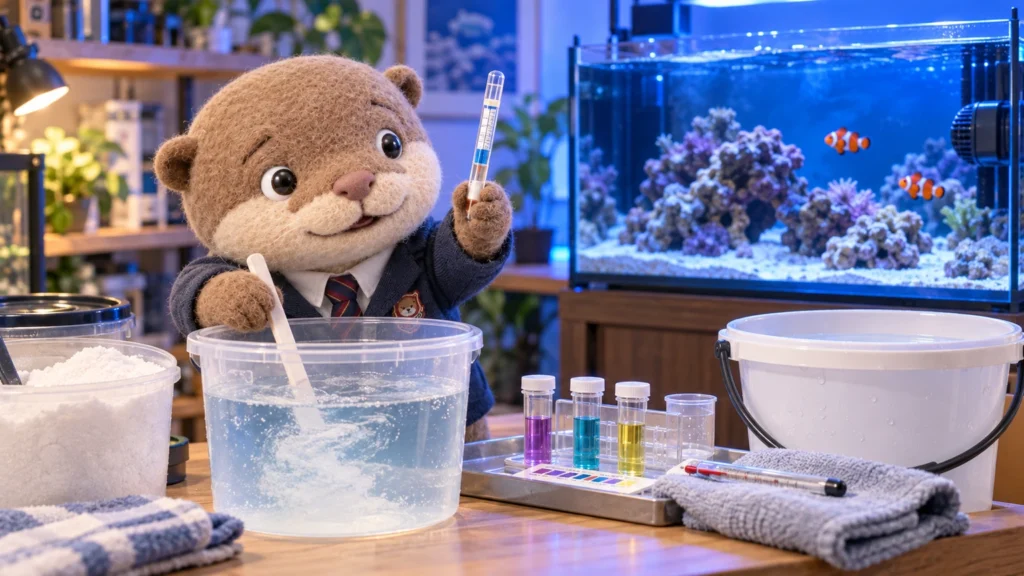 アイのアクアグッズ案内海水魚初心者の必需品|水槽・人工海水・比重計・水質検査道具の特徴や使い方、選ぶときのポイントをアイが紹介します。記事はコチラ →
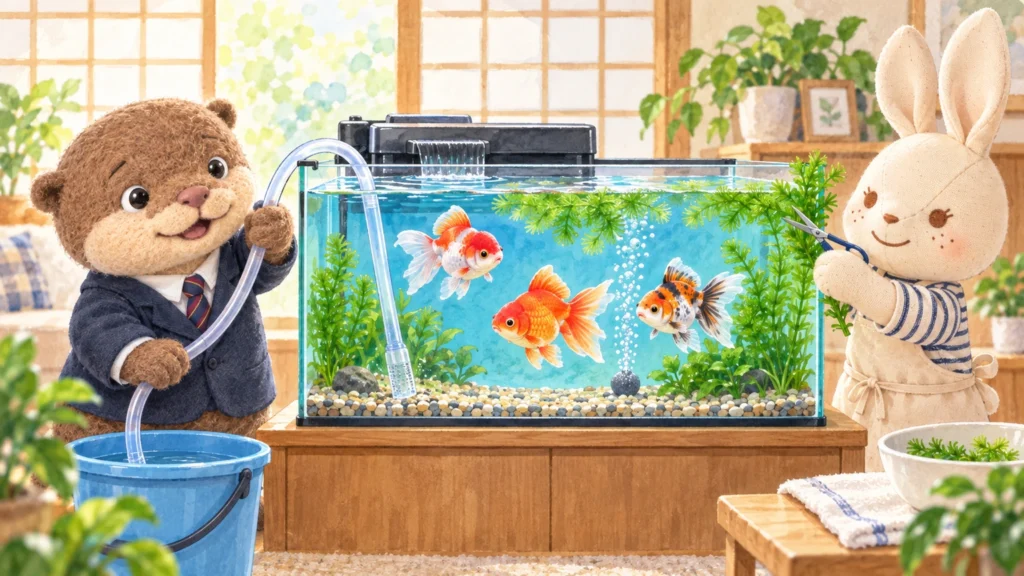 アイのアクアグッズ案内金魚を長く楽しむ飼育用品|水槽・フィルター・エアレーション・水換え道具の特徴や使い方、選ぶときのポイントをアイが紹介します。記事はコチラ →
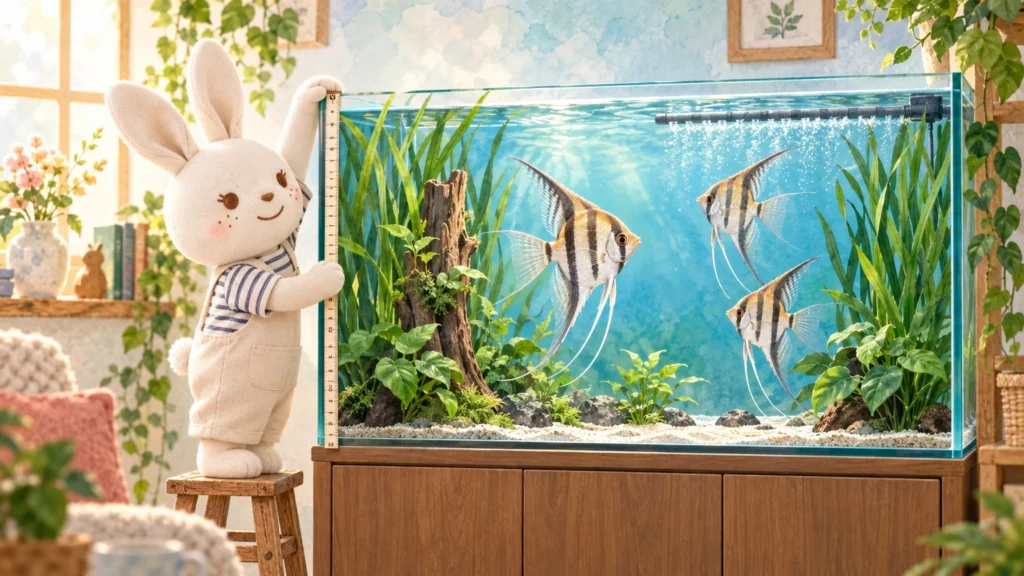 アイのアクアグッズ案内エンゼルフィッシュの飼育用品|高さのある水槽・ろ過・水草・餌の選び方道具の特徴や使い方、選ぶときのポイントをアイが紹介します。記事はコチラ →
 アイのアクアグッズ案内マジックリーフ物語|一枚の葉がアクアリウム用品になるまで道具の特徴や使い方、選ぶときのポイントをアイが紹介します。記事はコチラ →
さまざまな飼育テーマをご紹介。リンク先の記事には広告・商品紹介が含まれます。
案内・紹介記事一覧へ →分布マップ
ダイアナウミウシ(Chromodoris alcalai)は、沖縄からフィリピン、インドネシア、マレーシア、西オーストラリアにかけての熱帯・亜熱帯海域から記録されています。
この地図は既知の分布地域を把握するための概略表示です。マーカーは分布域を示すために設定した代表地点であり、実際の採集地点や観察地点を示すものではありません。
参考文献
-
Gosliner, T. M. (2021). Sleuthing cryptic Chromodorids (Mollusca, Nudibranchia): adding to Philippine marine biodiversity. Philippine Journal of Systematic Biology, 14(2). DOI: 10.26757/pjsb2020b14014.
対応項目:分類、学名、近縁種との識別、分布、生息水深、体長、形態https://doi.org/10.26757/pjsb2020b14014
-
MolluscaBase eds. (2026). Chromodoris alcalai Gosliner, 2021. World Register of Marine Species.
対応項目:現行の学名、分類上の有効性https://www.marinespecies.org/aphia.php?p=taxdetails&id=1533655
-
Wilson, N. G. & Lee, M. S. Y. (2005). Molecular phylogeny of Chromodoris (Mollusca, Nudibranchia) and the identification of a planar spawning clade. Molecular Phylogenetics and Evolution, 36(3), 722–727. DOI: 10.1016/j.ympev.2005.04.003.
対応項目:Chromodoris属の系統関係、平面状の産卵様式https://doi.org/10.1016/j.ympev.2005.04.003
-
Pola, M. & González-Duarte, M. M. (2008). Is self-fertilization possible in nudibranchs? Journal of Molluscan Studies, 74(3), 305–308. DOI: 10.1093/mollus/eyn019.
対応項目:ウミウシ類の同時的雌雄同体、交尾と繁殖の基本的性質https://doi.org/10.1093/mollus/eyn019
-
Hertzer, C., Undap, N., Papu, A., Bhandari, D., Aatz, S., Kehraus, S., Kaligis, F., Bara, R., Schäberle, T. F., Wägele, H. & König, G. M. (2023). Is a Modified Actin the Key to Toxin Resistance in the Nudibranch Chromodoris? A Biochemical and Molecular Approach. Diversity, 15(2), 304. DOI: 10.3390/d15020304.
対応項目:Chromodoris属の化学防御、ラトランクリンA、C. dianaeを含む近縁種での毒素蓄積と耐性研究https://doi.org/10.3390/d15020304
-
Francis-Floyd, R., Yanong, R. P. E. & Petty, B. D. Environmental Diseases of Aquatic Animals in Aquatic Systems. Merck Veterinary Manual.
対応項目:水質管理、pH、アンモニア、亜硝酸、塩分・水温変化など環境要因による不調の予防Merck Veterinary Manual
-
Yanong, R. P. E. Use of Copper in Marine Aquaculture and Aquarium Systems. University of Florida IFAS Extension.
対応項目:海産無脊椎動物への銅の毒性、魚病薬を安易に共用しないための注意点https://ask.ifas.ufl.edu/publication/FA165




コメント