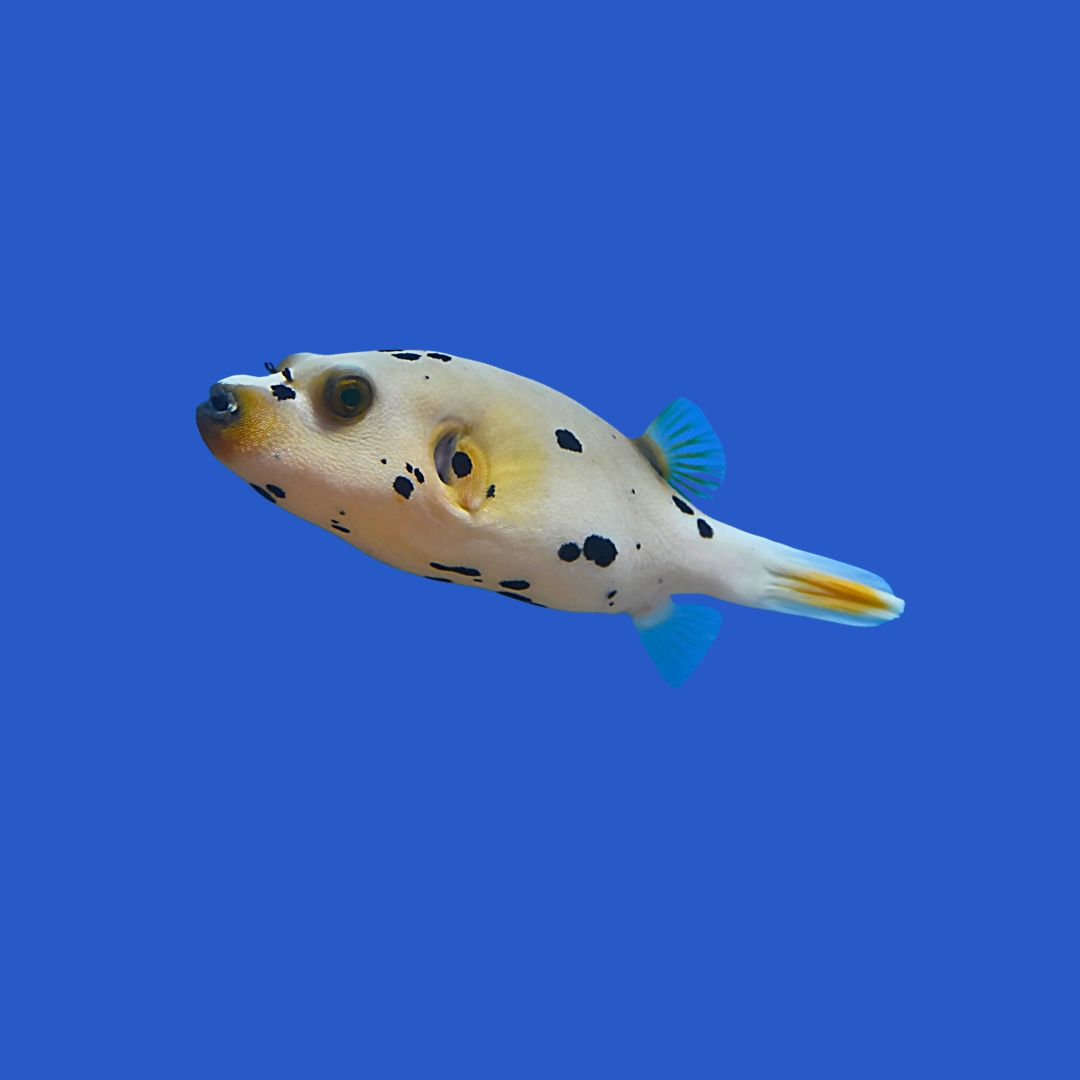
コクテンフグは、黒い斑点をまとった丸みのある体と、犬のように見える親しみやすい表情で人気の高い海水フグです。英名では Dog-faced Puffer や Blackspotted Puffer と呼ばれ、観賞魚としては人に慣れやすく、飼育者を認識するような仕草を見せることもあります。一方で、成長すると30cm前後になる大型魚であり、排泄量が多く、歯が伸び続けるフグ特有の管理も必要です。小型水槽やサンゴ水槽向きではなく、余裕のある大型の魚中心水槽で、長期飼育を前提に迎えたい種類です。The blackspotted puffer is a popular marine pufferfish known for its rounded body, dark spots, and friendly dog-like expression. It is commonly called the Dog-faced Puffer or Blackspotted Puffer, and aquarium specimens often become responsive to their keepers. However, it is a large fish that can approach around 30 cm in captivity and requires strong filtration, spacious housing, and species-specific dental care. It is not suited to small aquariums or reef tanks, and should be kept in a large fish-focused marine system with long-term care in mind.
フグ目 フグ科 モヨウフグ属Order Tetraodontiformes, family Tetraodontidae, genus Arothron
英名 / English Name
Blackspotted Puffer / Dog-faced Puffer
分布 / Distribution
インド洋から太平洋中部にかけての熱帯・亜熱帯域。東アフリカ沿岸、ミクロネシア、サモア、日本南部、オーストラリア北部からニューサウスウェールズ周辺まで広く見られます。ただし紅海には通常分布しないとされています。Tropical and subtropical Indo-Pacific waters, from East Africa through Micronesia and Samoa to southern Japan and parts of Australia. It is generally regarded as absent from the Red Sea.
最大体長 / Max Size
最大で約33cm。飼育下でも20〜30cm前後を想定して設備を準備します。Up to about 33 cm. In aquariums, planning for a 20–30 cm adult is recommended.
寿命 / Lifespan
明確な保証値ではありませんが、適切な大型水槽と安定した水質、栄養管理ができれば10年以上の長期飼育が期待される魚です。There is no guaranteed lifespan figure, but with a large stable aquarium, good water quality, and proper nutrition, long-term care of 10 years or more may be possible.
飼育環境 / Aquarium Environment
水槽サイズ / Tank Size
終生飼育では最低でも120cmワイド水槽相当、できれば150〜180cmクラスの大型水槽が安心です。水量の目安は380L以上、余裕を持つなら500L以上を推奨します。幼魚のうちは小さめの水槽で始められることもありますが、成長後の引っ越し先を先に用意しておくことが大切です。For long-term care, a tank comparable to at least a 120 cm wide Japanese standard tank is recommended, with a 150–180 cm class system preferred. Aim for 380 L or more, and 500 L or more if possible. Juveniles may start in a smaller system, but the adult upgrade should be planned from the beginning.
水温 / Temperature
22〜26℃を目安に、急変を避けて安定させます。日常管理では24〜25℃前後を保つと扱いやすいです。Keep the temperature stable around 22–26°C. A daily target near 24–25°C is easy to manage.
水質 / Water Quality
比重1.020〜1.025、pH8.1〜8.4を目安にします。よく食べてよく排泄するため、強力なろ過、プロテインスキマー、定期的な換水が重要です。アンモニアと亜硝酸は常に検出されない状態を目指し、硝酸塩も蓄積させすぎないようにします。Aim for a specific gravity of 1.020–1.025 and pH 8.1–8.4. Because this fish eats heavily and produces a high waste load, strong filtration, a protein skimmer, and regular water changes are important. Ammonia and nitrite should remain undetectable, and nitrate should be kept from accumulating excessively.
レイアウト / Layout
ライブロックを使ったフィッシュオンリー水槽、いわゆるFOWLRが基本です。遊泳スペースを広く取り、隠れられる岩組みを用意します。サンゴ、エビ、カニ、貝、ウニなどは食べられたり傷つけられたりする可能性が高いため、リーフタンクには向きません。A fish-only-with-live-rock setup is the standard approach. Provide open swimming space along with rockwork for shelter. Corals, shrimps, crabs, snails, clams, and urchins may be eaten or damaged, so this species is not suitable for reef tanks.
注意点 / Precautions
フグ類は驚くと水や空気を飲んで膨らむことがあります。移動時に網ですくうと空気を飲み込みやすいため、できるだけ水ごと容器で移す方法が安全です。また、本種はテトロドトキシンを持つ可能性がある有毒魚です。観賞魚として扱い、食用には絶対にしないでください。素手で無理に扱わず、体表粘膜を傷つけないことも大切です。Pufferfish may inflate by swallowing water or air when frightened. Netting can cause the fish to gulp air, so transferring it submerged in a container is safer. This species may contain tetrodotoxin and must be treated strictly as an ornamental fish, never as food. Avoid rough handling and protect the skin mucus layer.
餌と給餌 / Feeding
餌の種類 / Diet
アサリ、ムール貝、殻付きの小エビ、カニの脚、イカ、白身魚、冷凍オキアミ、大型肉食魚用の人工飼料などを組み合わせます。野生では底生の無脊椎動物、海綿、藻類、サンゴの先端部なども利用するため、飼育下でも単一の餌に偏らせず、必要に応じて海苔などの植物質も少量取り入れます。Offer a varied diet such as clams, mussels, shell-on shrimp, crab legs, squid, white fish, frozen krill, and pellets for large carnivorous marine fish. In the wild it feeds on benthic invertebrates, sponges, algae, and coral tips, so avoid relying on only one food item. Small amounts of marine algae sheets can also be offered when accepted.
給餌のポイント / Feeding Tips
最大のポイントは、歯を自然に摩耗させることです。柔らかい餌ばかりではクチバシ状の歯が伸びすぎ、口が閉じにくくなったり、餌を食べにくくなったりします。殻付きの餌を定期的に与え、食べ方や歯の伸びを観察しましょう。食欲が落ちた、餌を噛み切れない、口元の形が変わったと感じた場合は、無理な自己処置をせず、海水魚に詳しいショップや獣医師に相談するのが安全です。The key feeding point is natural tooth wear. If the diet is too soft, the beak-like teeth may overgrow, making it difficult for the fish to close its mouth or bite food. Regularly include hard-shelled foods and observe feeding behavior and tooth length. If appetite declines, the fish cannot bite properly, or the mouth shape changes, avoid risky do-it-yourself treatment and consult an experienced marine fish specialist or veterinarian.
性格と混泳 / Temperament and Tank Mates
性格 / Temperament
比較的おっとりした印象を持たれやすいフグですが、好奇心が強く、慣れると水槽前面に出てくることが多い魚です。幼魚期は臆病に見えることもありますが、成長すると存在感が増し、個体によっては他魚のヒレや無脊椎動物をかじることがあります。It is often considered one of the calmer large puffers, but it is curious and often becomes very visible once settled. Juveniles may appear shy, while adults become more confident and may nip fins or bite invertebrates depending on the individual.
混泳の相性 / Compatibility
同程度以上のサイズで、泳ぎがしっかりした丈夫な魚との混泳が基本です。候補としては大型のハギ類、チョウチョウウオ類、大型ベラ類、比較的丈夫なヤッコ類などが挙げられます。ただし、相性には個体差があります。同種同士や、噛まれやすい小型魚、動きの遅い魚、甲殻類、貝類、サンゴとの同居は避けるのが無難です。Tank mates should be robust, active, and similar in size or larger. Possible companions include larger tangs, butterflyfish, larger wrasses, and sturdy angelfish, but compatibility varies by individual. Avoid keeping multiple blackspotted puffers together, and avoid small fish, slow-moving fish, crustaceans, mollusks, and corals that may be bitten or eaten.
病気と対策 / Diseases and Prevention
かかりやすい病気 / Common Diseases
白点病、外部寄生虫、細菌性の皮膚トラブル、輸送ストレスによる拒食、水質悪化による体調不良、そしてフグ類特有の歯の過長に注意します。特に新着個体はストレスを受けやすく、入荷直後に状態を崩すことがあります。Watch for marine ich, external parasites, bacterial skin issues, refusal to feed after shipping stress, poor condition caused by water quality problems, and puffer-specific tooth overgrowth. Newly imported or recently shipped individuals can be especially stress-sensitive.
対策と予防 / Prevention
購入時は痩せ、呼吸の荒さ、白点、ヒレの損傷、口元の変形をよく確認します。導入後はできるだけ隔離観察を行い、急な水質変化を避けます。薬浴を行う場合は、フグ類が薬剤や水質変化に敏感なことを考慮し、用量と時間を慎重に管理してください。日常管理では、強いろ過、換水、餌の食べ残し除去、殻付き餌による歯の摩耗が予防の中心になります。Before purchase, check for emaciation, heavy breathing, white spots, fin damage, and mouth deformities. After introduction, quarantine or close observation is recommended, and sudden water quality changes should be avoided. If medication is used, remember that puffers can be sensitive to chemicals and water changes, so dosage and duration must be managed carefully. Strong filtration, water changes, removal of leftover food, and hard-shelled foods for tooth wear are the foundation of prevention.
増やし方(繁殖) / Breeding
雌雄の判別 / Sexing
外見だけで雌雄を判別するのは難しく、一般的な観賞魚飼育では明確な判別法は確立していません。Sexing by appearance is difficult, and no reliable method is commonly used in the aquarium hobby.
繁殖形態 / Reproduction
自然下ではサンゴ礁域で繁殖すると考えられますが、家庭水槽での安定した繁殖例は一般的ではありません。ペア形成や産卵行動には広い環境と成熟した個体が必要になると考えられます。It is believed to reproduce in reef environments in the wild, but stable home-aquarium breeding is not common. Pair formation and spawning would likely require mature individuals and very spacious conditions.
繁殖のポイント / Breeding Tips
家庭での繁殖を目的に飼育する種類というより、長期飼育を楽しむ観賞魚と考えるのが現実的です。繁殖を狙う場合でも、複数飼育による縄張り争いのリスクが高いため、十分な設備と専門的な管理が必要になります。This species is best regarded as a display fish for long-term care rather than a practical home-breeding project. Attempting breeding would require specialized facilities because keeping multiple individuals can lead to territorial conflict.
雑学と豆知識 / Trivia and Fun Facts
1. 学名に刻まれた黒い斑点 / 1. Black spots written into the scientific name
種小名の nigropunctatus は、ラテン語の「黒い」と「斑点のある」に由来するとされます。つまり、コクテンフグの学名そのものが、体に散らばる黒い斑点を説明しているのです。水槽内で個体ごとの模様を見比べると、同じ種類でも顔つきや斑点の入り方に違いがあり、まるで一匹ずつ表情が違うペットのように感じられます。The species name nigropunctatus is generally interpreted as meaning black-spotted in Latin. In other words, the scientific name itself describes the dark spots scattered across the body. In an aquarium, each individual can show a slightly different face and pattern, which adds to its pet-like appeal.
2. ドッグフェイスと呼ばれる理由 / 2. Why it is called the Dog-faced Puffer
丸い吻、黒く縁取られた目、もぐもぐと動く口元の組み合わせが、犬の顔を思わせることから Dog-faced Puffer と呼ばれます。魚でありながら、こちらを見ているような印象を与えるため、海水魚の中でも「個性を感じやすい魚」として愛されてきました。Its rounded snout, dark eye markings, and constantly moving mouth can resemble a dog’s face, giving rise to the name Dog-faced Puffer. Because it often appears to look back at the keeper, it is loved as one of the more characterful marine aquarium fish.
3. 黄色い個体は特に人気 / 3. Yellow individuals are especially popular
コクテンフグには灰色や褐色を基調とした個体だけでなく、腹部が黄色い個体や、全身が黄色味を帯びる個体も知られています。黄色い個体は観賞魚として目を引きますが、似た体色を示す近縁種や個体差もあるため、販売名だけでなく体型や模様、入荷経路も含めて確認すると安心です。Besides gray or brownish forms, some individuals show a yellow belly or an overall yellowish body. Yellow forms are visually striking in the aquarium trade, but similar coloration can occur in related species or unusual individuals, so it is wise to check body shape, pattern, and collection information rather than relying only on a sales name.
4. かわいい顔でも歯は本格派 / 4. A cute face with serious teeth
フグ科の魚は、上下の歯が癒合してクチバシ状の歯板を作ります。野生では貝や甲殻類、サンゴ片など硬いものをかじることで歯が削れますが、水槽では柔らかい餌に偏りやすいため、飼育者が意識して硬い餌を用意する必要があります。かわいらしい見た目とは裏腹に、歯の管理はこの魚の健康を左右する重要なテーマです。Pufferfish have fused teeth that form a strong beak-like plate. In the wild, biting shells, crustaceans, and hard reef material helps wear the teeth down. In aquariums, soft foods can dominate the diet, so the keeper must intentionally provide hard foods. Despite its charming face, dental care is one of the most important parts of keeping this species healthy.
5. 食用ではなく観賞魚として楽しむフグ / 5. A puffer to enjoy as an ornamental fish, not as food
フグという名前から食文化を連想する人もいますが、コクテンフグは観賞魚として扱うべき有毒魚です。テトロドトキシンを持つ可能性があり、食用にすることは非常に危険です。水槽の中で表情や行動を観察し、海の生き物としての魅力を楽しむことが、この魚との最も安全で健全な付き合い方です。The word pufferfish may remind some people of food culture, but the blackspotted puffer should be treated as a poisonous ornamental fish. It may contain tetrodotoxin, and eating it is extremely dangerous. The safest and most appropriate way to enjoy this fish is to observe its expression and behavior in the aquarium.
まとめ / Conclusion
コクテンフグは、愛嬌のある表情と人に慣れやすい行動で、海水魚飼育の中でも特別な存在感を持つフグです。体色の変化や個体ごとの顔つきも魅力的で、じっくり付き合うほど面白さが増していきます。The blackspotted puffer is a uniquely charming marine pufferfish, loved for its expressive face and keeper-responsive behavior. Its color variation and individual personality make it more rewarding the longer it is kept.
一方で、大型水槽、強力なろ過、混泳相手の選定、歯の摩耗を考えた給餌、毒性への理解が欠かせません。小型水槽で気軽に飼う魚ではありませんが、十分な準備ができる飼育者にとっては、長く付き合える魅力的な海水魚です。At the same time, it requires a large aquarium, strong filtration, careful tank mate selection, tooth-wearing foods, and an understanding of its toxicity. It is not a casual choice for a small tank, but for a prepared aquarist, it can become a fascinating long-term marine companion.
Randall, J. E., Allen, G. R. & Steene, R. C. 1990. Fishes of the Great Barrier Reef and Coral Sea. University of Hawaii Press. インド太平洋のサンゴ礁魚類としての分布、生息環境、食性を補強するための専門図鑑。FishBaseでも本種ページの主要参照文献として示されています。
Matsuura, K. 2015. “Taxonomy and systematics of tetraodontiform fishes: a review focusing primarily on progress in the period from 1980 to 2014.” Ichthyological Research, 62, 72–113. https://doi.org/10.1007/s10228-014-0444-5 フグ目魚類の分類体系、分類学的整理を確認するための査読レビュー。
Su, J. & Tyler, J. C. 1986. “Diagnoses of Arothron nigropunctatus and A. meleagris, Two Extremely Polychromatic Indo-Pacific Pufferfishes.” Proceedings of the Academy of Natural Sciences of Philadelphia. コクテンフグと近縁種ミゾレフグの多様な体色、識別上の注意点を補強するための分類学的資料。
Bourjon, P. & Chanet, B. 2017. “Two cases of probable hybridisation between the pufferfishes Arothron meleagris and A. nigropunctatus on a fringing reef at Réunion Island.” African Journal of Marine Science. https://doi.org/10.2989/1814232X.2017.1363818 近縁種との識別や交雑に関する雑学・注意点を裏づける査読論文。
Noga, E. J. 2010. Fish Disease: Diagnosis and Treatment, 2nd edition. Wiley-Blackwell. アンモニア、亜硝酸、外傷、寄生虫、ストレスなど、観賞魚の病気と予防の一般原則を支える獣医学系専門書。
Stoskopf, M. K. 1993. Fish Medicine. W. B. Saunders. 魚類の水質管理、栄養、麻酔、疾病管理に関する基礎的な獣医学資料。大型海水魚の飼育上の注意点を補強するために参照。
Ross, L. G. & Ross, B. 2008. Anaesthetic and Sedative Techniques for Aquatic Animals, 3rd edition. Wiley-Blackwell. 歯の過長などで処置が必要になった場合に、魚類麻酔の考え方とリスクを確認するための専門書。記事内の「無理な自己処置を避ける」という注意喚起の根拠として参照。
Lago, J., Rodríguez, L. P., Blanco, L., Vieites, J. M. & Cabado, A. G. 2015. “Tetrodotoxin, an Extremely Potent Marine Neurotoxin: Distribution, Toxicity, Origin and Therapeutical Uses.” Marine Drugs, 13(10), 6384–6406. https://doi.org/10.3390/md13106384 フグ類のテトロドトキシン、毒性、分布、作用機序に関する注意点を支える査読レビュー。



 アイのアクアグッズ案内水槽用浄水器の選び方|水換えを楽にするタイプとROの違い道具の特徴や使い方、選ぶときのポイントをアイが紹介します。記事はコチラ →
 アイのアクアグッズ案内水草水槽のCO₂添加|3つの方式の選び方とおすすめ用品道具の特徴や使い方、選ぶときのポイントをアイが紹介します。記事はコチラ →
 アイのアクアグッズ案内水槽ライトの選び方|魚の見え方・水草・海水で選ぶおすすめ照明道具の特徴や使い方、選ぶときのポイントをアイが紹介します。記事はコチラ →
 アイのアクアグッズ案内エンゼルフィッシュの飼育用品|高さのある水槽・ろ過・水草・餌の選び方道具の特徴や使い方、選ぶときのポイントをアイが紹介します。記事はコチラ →



コメント