

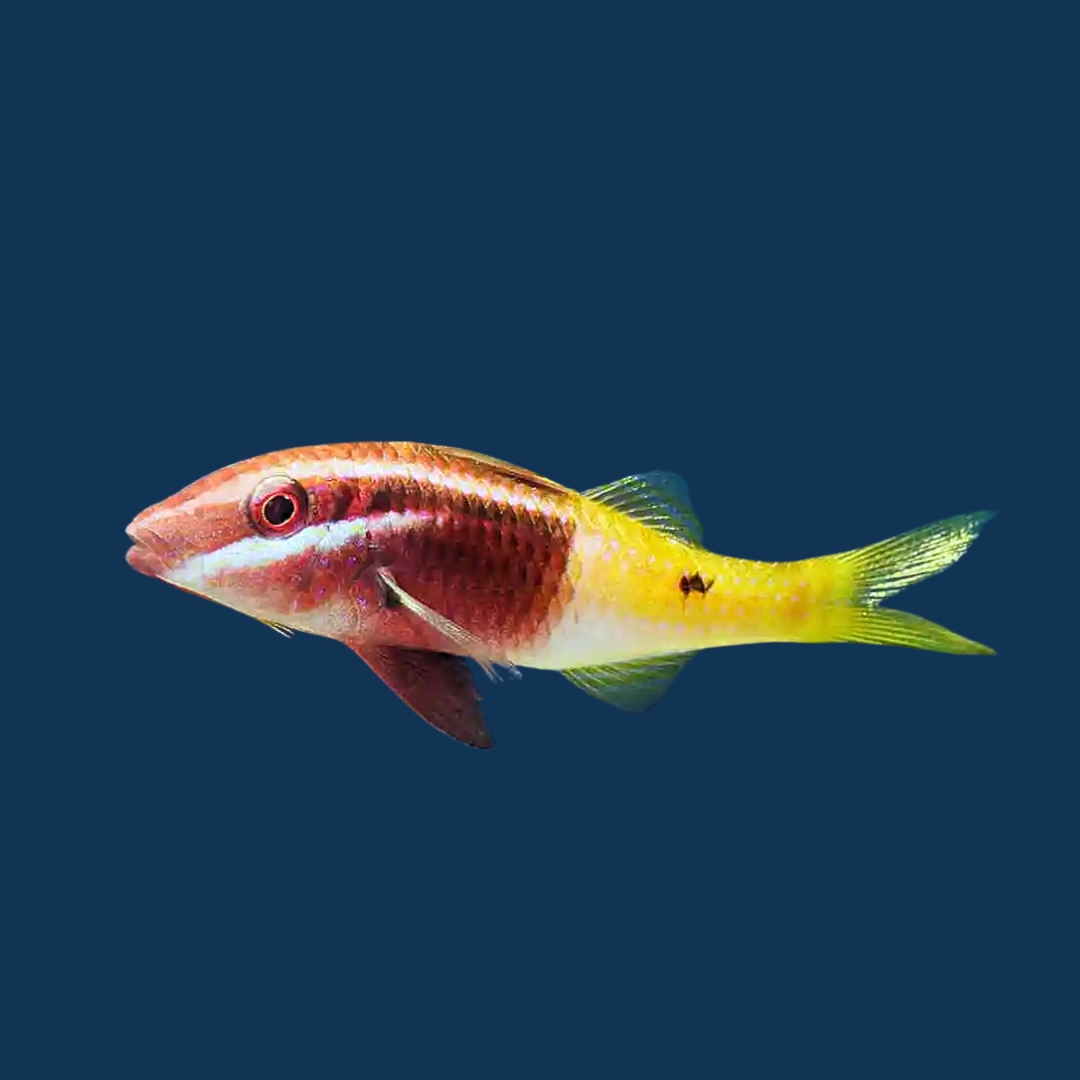
解説 / Description
インドヒメジは、暗赤色の前半部と、白から黄色へ切り替わる後半部を持つ印象的な海水魚です。英名では Bicolor goatfish または Half-and-half goatfish と呼ばれ、くっきり分かれた体色と、下あごの2本の赤い触鬚が大きな特徴です。触鬚を底砂や岩の表面に当てながら、砂中の小型甲殻類や多毛類などを探して食べるため、水槽内でも底面を丹念に探る姿を楽しめます。 The Bicolor goatfish is a striking marine fish with a dark reddish front half and a rear half that shifts from white to yellow. It is commonly known as the Bicolor goatfish or Half-and-half goatfish, and is recognized by its sharply divided coloration and two red barbels under the lower jaw. It uses these barbels to probe sand and rock surfaces for small crustaceans, worms, and other benthic prey, making its bottom-foraging behavior one of its main aquarium attractions.
ただし、見た目のかわいらしさに反して、飼育難度はやや高めです。自然下では広い底面を移動しながら小さな餌を断続的に食べる魚で、餌の回数が少ないと痩せやすくなります。さらに底砂を掘り返すため、リーフタンクでは小型無脊椎動物の捕食や砂の巻き上げにも注意が必要です。 Despite its charming appearance, it is not an especially easy fish to maintain. In nature it moves over large bottom areas and eats small prey items repeatedly throughout the day, so infrequent feeding can lead to weight loss. Because it also stirs the substrate, reef aquaria require extra caution regarding predation on small invertebrates and sand disturbance.
基本情報 / Basic Information
| 学名 / Scientific Name | Parupeneus barberinoides |
|---|---|
| 通称 / Common Name | インドヒメジ、ヒメジ類、カタカシ、オジサン類として扱われることがある魚Bicolor goatfish, Half-and-half goatfish, goatfish |
| 分類 / Family | ヒメジ目相当のグループ Mulliformes、ヒメジ科、ウミヒゴイ属。資料によっては旧来の分類体系や異なる上位分類で示されることがありますが、現在の主要データベースでは Mulliformes > Mullidae として扱われています。Mulliformes, family Mullidae, genus Parupeneus. Some sources may use older or alternative higher-level classifications, but major current databases treat it as Mulliformes > Mullidae. |
| 英名 / English Name | Bicolor goatfish / Half-and-half goatfish |
| 分布 / Distribution | 主に西太平洋の熱帯域に分布し、モルッカ諸島・フィリピン周辺から西サモア方面、北は琉球列島、南はニューカレドニアやトンガ方面まで記録されています。ミクロネシアのパラオ、カロリン諸島、マーシャル諸島などにも分布し、オーストラリア西部からの記録もあります。Primarily distributed in the tropical western Pacific, from the Moluccas and the Philippines toward western Samoa, north to the Ryukyu Islands, and south to New Caledonia and Tonga. It is also recorded from Micronesian areas such as Palau, the Caroline Islands, and the Marshall Islands, with records from Western Australia. |
| 最大体長 / Max Size | 最大で約30cm、よく見られる体長は約20cmです。流通個体は幼魚から若魚サイズで入荷することが多いものの、成長後を前提に水槽を選ぶ必要があります。Up to about 30 cm total length, with a common length of around 20 cm. Aquarium specimens are often sold as juveniles or subadults, but tank planning should assume adult growth. |
| 寿命 / Lifespan | 本種単独の明確な飼育下寿命データは多くありません。状態良く導入し、餌切れと水質悪化を避けられれば数年以上の飼育が期待できますが、長期維持の成否は給餌回数と水質管理に大きく左右されます。Species-specific aquarium lifespan data are limited. With a healthy specimen, frequent feeding, and stable water quality, multi-year maintenance is possible, but long-term success depends heavily on avoiding starvation and water quality decline. |
飼育環境 / Aquarium Environment
| 水槽サイズ / Tank Size | 幼魚の一時飼育でも60cm規格水槽はかなり窮屈です。長期飼育では90cm規格水槽を下限の目安とし、できれば120cm規格水槽以上、余裕を持つなら120cmワイド水槽以上を推奨します。よく泳ぎ、底面を広く使うため、水量だけでなく底面積の広さを重視してください。Even a 60 cm standard tank is cramped and should be viewed only as temporary juvenile housing. For long-term care, a 90 cm standard tank should be considered the lower practical limit, while 120 cm or larger is recommended, and a 120 cm wide tank or larger is preferable. This fish swims actively and uses the bottom extensively, so floor area is as important as water volume. |
|---|---|
| 水温 / Temperature | 24〜28℃前後を目安に、急変を避けて安定させます。一般的な海水魚水槽では24〜26℃付近に保つと管理しやすく、夏場はクーラー、冬場はヒーターで日較差を小さくします。 Keep the temperature stable around 24–28°C and avoid sudden changes. In typical marine aquaria, 24–26°C is easy to manage; use a chiller in summer and a heater in winter to minimize daily fluctuations. |
| 水質 / Water Quality | 比重は1.020〜1.025を目安にします。肉食性で給餌量が増えやすいため、アンモニアと亜硝酸を検出させないことを最優先にし、硝酸塩の蓄積も定期換水で抑えます。外部式、上部式、オーバーフロー式など、底砂に依存しない強めのろ過が向いています。Aim for a specific gravity of 1.020–1.025. Because it is carnivorous and often requires frequent feeding, keeping ammonia and nitrite undetectable is the top priority, and nitrate accumulation should be controlled with regular water changes. Strong filtration that does not rely on the sand bed, such as external, overhead, or overflow filtration, is suitable. |
| レイアウト / Layout | 触鬚を傷つけにくい、角のない細かな底砂を薄く敷きます。厚く敷きすぎると汚れの蓄積や嫌気化のリスクがあるため、撹拌されても掃除しやすい薄層が扱いやすいです。ライブロックは隠れ場所を作りながら、底面の通り道を広く残すように配置します。Use a thin layer of fine, smooth substrate that will not damage the barbels. Avoid overly deep sand beds because they can trap waste or become anaerobic; a thin, easy-to-clean layer is more practical. Arrange live rock to provide shelter while preserving open bottom routes for movement. |
| 注意点 / Precautions | 底砂を掘り返す習性があるため、底面ろ過は不向きです。驚いたときに飛び出す可能性があるので、隙間の少ないフタを設置します。リーフタンクでは、底砂の巻き上げ、サンゴへの砂の堆積、小型エビやカニなどの捕食に注意してください。Because it constantly disturbs the substrate, undergravel filtration is unsuitable. A tight-fitting lid is recommended because startled fish may jump. In reef tanks, watch for sand clouds, sand settling on corals, and predation on small shrimp, crabs, and other invertebrates. |
餌と給餌 / Feeding
| 餌の種類 / Diet | 沈下性の海水魚用人工飼料、冷凍ブラインシュリンプ、イサザアミ、細かく刻んだアサリやエビなどが適しています。慣れれば人工飼料も食べることがありますが、導入直後は底まで届く冷凍餌や細かい生餌系の餌で餌付きを確認します。Suitable foods include sinking marine pellets, frozen brine shrimp, mysids, and finely chopped clam or shrimp. It may learn to accept prepared foods, but newly introduced specimens should first be checked for feeding response with foods that reach the bottom, such as frozen or finely chopped meaty foods. |
|---|---|
| 給餌のポイント / Feeding Tips | 最大のポイントは回数です。自然下では小さな底生生物を探し続けるため、1日1回だけでは不足しやすく、背肉や腹部が落ちることがあります。少量を1日3〜5回に分け、底面に広く散らすように与えます。給餌量を増やすほど水質は悪化しやすいため、ろ過能力、プロテインスキマー、換水頻度をセットで考えてください。The key is feeding frequency. In nature it searches continuously for small benthic prey, so a single daily feeding is often insufficient and may lead to a thin back or belly. Feed small portions 3–5 times per day and spread food across the bottom. Increased feeding raises the waste load, so filtration capacity, protein skimming, and water-change frequency must be considered together. |
性格と混泳 / Temperament and Tank Mates
| 性格 / Temperament | 性格は比較的温和で、他魚へ強く縄張りを主張するタイプではありません。幼魚は群れに入ることがありますが、成長すると単独または少数で行動する傾向があります。Generally peaceful and not strongly territorial toward other fish. Juveniles may join schools, while adults tend to be solitary or form loose small groups. |
|---|---|
| 混泳の相性 / Compatibility | サイズの合う温和な海水魚とは比較的合わせやすい魚です。ハギ類、チョウチョウウオ類、落ち着いた遊泳魚などが候補になります。一方で、口に入る小型魚、観賞用エビ、カニ、小型の貝類、ケヤリムシなどは捕食される可能性があります。幼魚は大型肉食魚、ハタ類、カサゴ類、大型ベラ、カエルアンコウなどに食べられる危険があるため避けます。It can often be kept with peaceful marine fish of suitable size, such as tangs, butterflyfish, and calm open-water swimmers. However, small fish, ornamental shrimp, crabs, small snails, and feather duster worms may be eaten. Juveniles should not be kept with large predators such as groupers, scorpionfish, large wrasses, or frogfish. |
病気と対策 / Diseases and Prevention
| かかりやすい病気 / Common Diseases | 水温や比重の急変、水質悪化、輸送ストレスにより、海水性白点病、外部寄生虫、細菌感染などに注意が必要です。また病気ではありませんが、給餌不足による慢性的な痩せは本種で特に起こりやすいトラブルです。Rapid temperature or salinity changes, poor water quality, and shipping stress can increase the risk of marine white spot, external parasites, and bacterial infections. Chronic weight loss from insufficient feeding is not a disease, but it is one of the most common serious problems in this species. |
|---|---|
| 対策と予防 / Prevention | 導入時は可能であれば隔離観察を行い、餌付きを確認してから本水槽へ移すと安心です。水温と比重を安定させ、底砂に汚れをため込まないように管理します。痩せが見えた場合は、餌の種類だけでなく、給餌回数、餌が底面まで届いているか、他魚に食べ負けていないかを確認してください。Quarantine and observation before introduction are recommended when possible, especially to confirm feeding response. Keep temperature and salinity stable, and prevent waste buildup in the substrate. If weight loss appears, check not only food type but also feeding frequency, whether food reaches the bottom, and whether tank mates are outcompeting it. |
増やし方(繁殖) / Breeding
| 雌雄の判別 / Sexing | 外見だけで雌雄を安定して判別する方法は、一般的な飼育情報としては確立されていません。成熟個体の体格差や産卵行動が手がかりになる可能性はありますが、家庭水槽での判別は難しい魚です。There is no widely established, reliable external method for sexing this species in standard aquarium practice. Adult size differences or spawning behavior may provide clues, but sexing in home aquaria is difficult. |
|---|---|
| 繁殖形態 / Reproduction | ヒメジ類は一般に海中へ卵と精子を放出する産卵様式とされ、卵や仔魚は浮遊生活の段階を持つと考えられます。近年は野外で本種の産卵行動が撮影・報告されることもありますが、家庭水槽での繁殖情報は限られます。Goatfishes are generally considered broadcast spawners that release eggs and sperm into the water column, with eggs and larvae passing through a pelagic stage. Spawning behavior of this species has been observed in the wild, but breeding information from home aquaria remains limited. |
| 繁殖のポイント / Breeding Tips | 家庭水槽での安定した繁殖例は一般的ではありません。広い遊泳空間、成熟個体の複数飼育、産卵条件の再現、微小な仔魚に適した初期餌料など、課題が多い魚です。一般家庭では、まず長期健康飼育を目標にするのが現実的です。Reliable breeding in home aquaria is not commonly reported. Challenges include large swimming space, maintaining mature groups, reproducing spawning conditions, and providing suitable first foods for tiny larvae. For most aquarists, long-term healthy maintenance is the realistic goal. |
雑学と豆知識 / Trivia and Fun Facts
| 1. 名前の混同に注意 / 1. Beware of name confusion | 和名のインドヒメジは Parupeneus barberinoides を指します。一方で、学名に indicus を持つ Parupeneus indicus は別種で、日本ではコバンヒメジと呼ばれます。和名、英名、学名の印象だけで判断すると取り違えが起きやすいため、図鑑記事や流通名を確認するときは学名を基準にするのが安全です。The Japanese name “Indo-himeji” refers to Parupeneus barberinoides. By contrast, Parupeneus indicus is a different species known in Japanese as Koban-himeji. Because Japanese names, English names, and scientific names can give misleading impressions, the scientific name is the safest reference when checking articles or trade names. |
|---|---|
| 2. ヒゲは水中の舌 / 2. Barbels as underwater tongues | ヒメジ科の2本の触鬚は、単なる飾りではありません。触鬚には味を感じる器官が密に分布し、魚はこれを砂や岩に当てながら、見えない獲物の手がかりを探します。研究では、触鬚からの感覚情報が脳の味覚中枢に立体的に表現されることが示されており、あの忙しそうな底砂探索は、視覚だけに頼らない高度な採餌行動といえます。The two barbels of goatfishes are not decorative. They are densely supplied with taste organs and are used to touch sand and rock while searching for hidden prey. Research has shown that sensory input from the barbels is represented in the brain’s taste center in an organized way, so their busy substrate probing is a sophisticated feeding behavior that does not depend on vision alone. |
| 3. 沖縄では「かたかし」として親しまれる仲間 / 3. Relatives known as “katakashi” in Okinawa | 沖縄ではヒメジ科の魚が「かたかし」と総称されることがあり、オジサンやじんばーと呼ばれることもあります。インドヒメジそのものだけでなく、近縁のヒメジ類は地域の魚食文化にも登場し、バター焼き、マース煮、煮付けなどで利用されます。観賞魚として眺める美しさと、地域で食材として親しまれてきた顔をあわせ持つところが、ヒメジ類の面白さです。In Okinawa, goatfishes are sometimes collectively called “katakashi,” and may also be referred to as “ojisan” or “jinba.” Not only this species but also related goatfishes appear in local food culture, including butter-grilled, salt-simmered, and simmered dishes. Their appeal lies in having both an ornamental side and a long-standing role as familiar food fish in the region. |
| 4. 学名の読み解きは慎重に / 4. Read etymology with care | 属名 Parupeneus の由来や種小名 barberinoides の解釈は、資料によって説明の仕方に差があります。信頼できる魚名語源資料では、barberinoides は Parupeneus barberinus に似ることを示す名前として説明されています。近縁種との姿の類似が、名前を読み解く手がかりになります。The explanation of the genus name Parupeneus and the species epithet barberinoides varies among sources. A dedicated fish-name etymology source explains barberinoides as referring to similarity to Parupeneus barberinus. Its resemblance to a related species provides a clue to the meaning of the name. |
| 5. 古代ローマの逸話はヒメジ類全般の話 / 5. Ancient Roman stories concern goatfishes broadly | 地中海のヒメジ類は、古代ローマの食文化に登場する魚として知られます。しばしば、死に際の体色変化が宴席で注目されたという逸話が紹介されますが、これはインドヒメジ単独の話ではなく、地中海産の近縁グループに関する文化史として扱うのが適切です。色彩が人の関心を引いてきたという点では、現代の観賞魚としての魅力ともどこか通じています。Mediterranean goatfishes are known from ancient Roman food culture. Stories often mention that their color changes near death attracted attention at banquets, but this should be treated as cultural history of Mediterranean relatives rather than a fact about this species specifically. The long-standing human fascination with goatfish coloration still echoes in their modern appeal as ornamental fish. |
まとめ / Conclusion
インドヒメジは、二色に分かれた美しい体色と、触鬚で底砂を探る行動が魅力の海水魚です。最大30cmほどになる底生性の肉食魚であり、温和な性格ながら、小型魚や小型無脊椎動物には注意が必要です。 The Bicolor goatfish is a marine fish admired for its two-toned coloration and barbel-based substrate probing. It is a benthic carnivore reaching about 30 cm, generally peaceful toward suitable fish but potentially risky with small fish and small invertebrates.
飼育するなら、成長後を見越して120cmクラス以上の水槽、薄い細砂、強いろ過、飛び出し防止のフタ、そして1日3〜5回の少量給餌を用意しましょう。条件を整えられる水槽では、サンゴ礁の底生生態系を思わせる探索行動を見せてくれる、非常に観察しがいのある魚です。 For best results, prepare a tank in the 120 cm class or larger, a thin layer of fine sand, strong filtration, a secure lid, and 3–5 small feedings per day. In a properly prepared aquarium, this fish offers fascinating reef-bottom foraging behavior that is highly rewarding to observe.

気になる道具や飼い方を見つけてみませんか?
 アイのアクアグッズ案内アフリカンシクリッドの飼育用品|水槽・ろ過・底砂・岩組み・餌の選び方道具の特徴や使い方、選ぶときのポイントをアイが紹介します。記事はコチラ →
 アイのアクアグッズ案内グッピー・プラティ・モーリーを親子で楽しむ飼育用品|水槽・稚魚保護・ろ過・餌・水草道具の特徴や使い方、選ぶときのポイントをアイが紹介します。記事はコチラ →
 アイのアクアグッズ案内水草用ライトの選び方|緑の絨毯と赤い水草を楽しむ照明・植栽用品道具の特徴や使い方、選ぶときのポイントをアイが紹介します。記事はコチラ →
 アイのアクアグッズ案内水換え・底砂掃除の道具の選び方|砂利・砂・ソイルに合うクリーナーとポンプ道具の特徴や使い方、選ぶときのポイントをアイが紹介します。記事はコチラ →
さまざまな飼育テーマをご紹介。リンク先の記事には広告・商品紹介が含まれます。
案内・紹介記事一覧へ →参考文献・根拠資料
本記事では、店舗・通販サイト、個人ブログ、まとめサイトを参考文献から除外し、分類、分布、生息環境、飼育条件、繁殖、病気や注意点を支えるために、学術データベース、公的機関、査読論文、獣医学系資料を中心に選定しています。インドヒメジ固有の情報は主に FishBase と WoRMS に基づき、飼育管理・疾病対策・繁殖に関する一般論は、ヒメジ科魚類または海水魚飼育全般に適用できる範囲の資料として参照しています。
-
Froese, R. and Pauly, D. Editors. FishBase. Parupeneus barberinoides, Bicolor goatfish.
https://www.fishbase.se/summary/parupeneus-barberinoides
分類の確認補助、分布、水深、生息環境、最大体長、食性、幼魚と成魚の行動、利用状況の根拠として参照。 -
World Register of Marine Species. Parupeneus barberinoides (Bleeker, 1852).
https://www.marinespecies.org/aphia.php?p=taxdetails&id=219661
受容名、シノニム、分類階層、命名者表記の確認に使用。記事中の分類を現行表記へ寄せるための主要根拠。 -
Reef Life Survey. Parupeneus barberinoides, Half-and-half goatfish.
https://reeflifesurvey.com/species/parupeneus-barberinoides/
体色パターン、識別上の特徴、熱帯インド太平洋域での分布、幼魚が他のヒメジ類やベラ類と混群を作る記述の補助資料として参照。 -
Kiyohara, S., Sakata, Y., Yoshitomi, T. and Tsukahara, J. 2002. The “goatee” of goatfish: innervation of taste buds in the barbels and their representation in the brain. Proceedings of the Royal Society B.
https://pmc.ncbi.nlm.nih.gov/articles/PMC1691091/
ヒメジ類の触鬚が底面探索と埋在性の餌の検出に使われ、味蕾と顔面葉に関係する高度な感覚器官であることの根拠として参照。 -
Uiblein, F. 2007. Goatfishes (Mullidae) as indicators in tropical and temperate coastal habitat monitoring and management. Marine Biology Research, 3(5), 275–288.
https://doi.org/10.1080/17451000701687129
ヒメジ科魚類の底生環境利用、沿岸生息地との関係、底質を探る採餌行動など、生態解説の背景資料として参照。 -
Shapiro, D. Y., Hensley, D. A. and Appeldoorn, R. S. 1988. Pelagic spawning and egg transport in coral-reef fishes: a skeptical overview. Environmental Biology of Fishes, 22, 3–14.
https://doi.org/10.1007/BF00000540
サンゴ礁魚類に多い浮遊卵・浮遊仔魚型の繁殖様式を説明するための背景資料。記事中では、家庭水槽での繁殖が現実的に難しいという説明の補助根拠として使用。 -
Smith, S. A., et al. 2023. Fish Welfare in Public Aquariums and Zoological Collections. Animals.
https://pmc.ncbi.nlm.nih.gov/articles/PMC10451808/
飼育下の魚類に必要な環境、水質、栄養、行動要求、健康管理を考えるための総説資料。水槽サイズを余裕をもって設定することや、給餌・水質管理を重視する記述の背景に使用。 -
Yanong, R. P. E. 2010. Cryptocaryon irritans Infections (Marine White Spot Disease) in Fish. University of Florida IFAS Extension.
https://journals.flvc.org/edis/article/view/118438
海水魚の白点病、隔離飼育、予防、生活環、管理上の注意点を支える資料として参照。記事中の病気と対策、導入時の注意点の根拠。




コメント