

解説 / Description
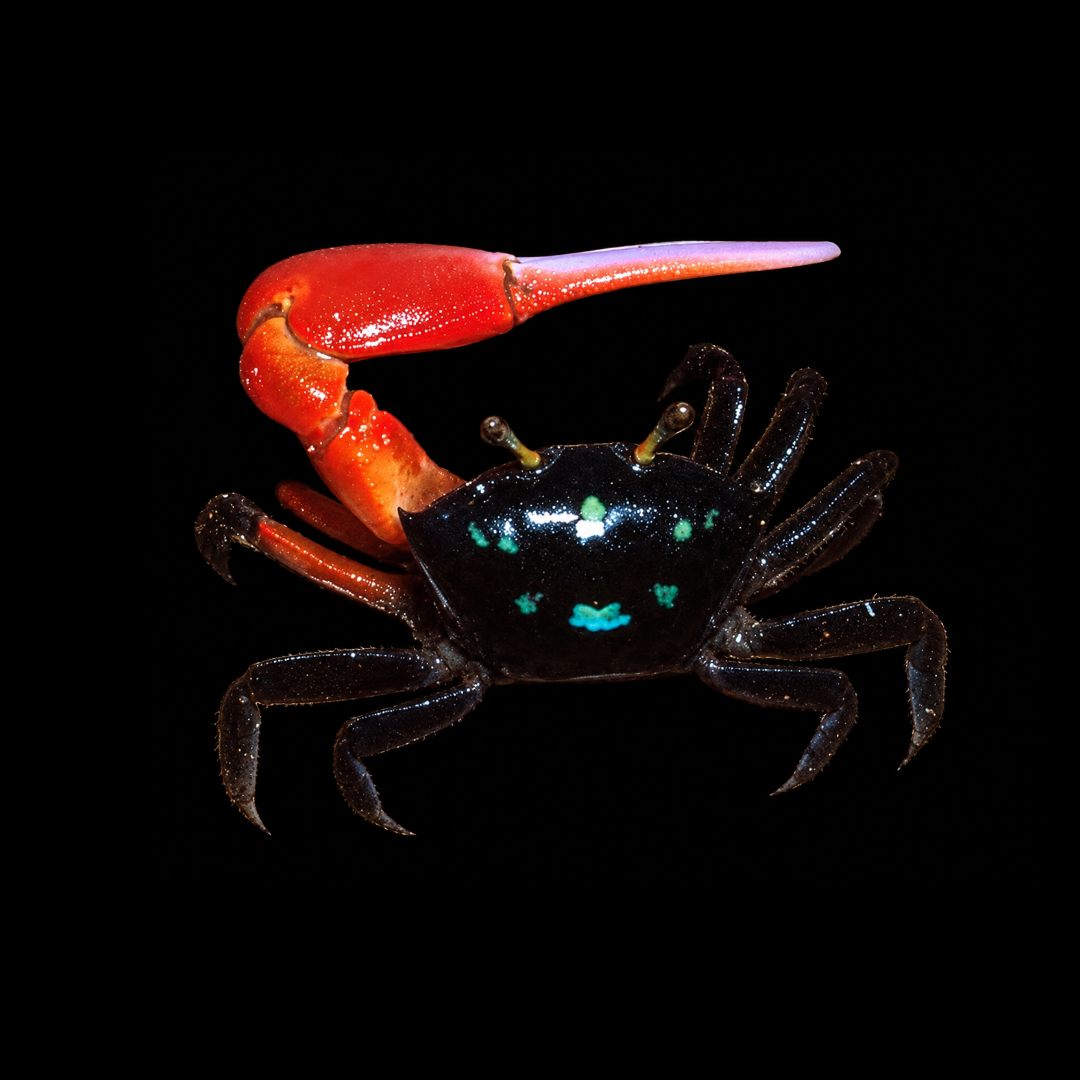
ベニシオマネキは、マングローブ林の周辺や干潟の陸寄りに暮らす、小型のシオマネキです。オスが持つ大きな赤いハサミが目を引きますが、甲羅や脚の色は赤一色とは限らず、黒、紺、水色などが組み合わさった個体も見られます。小さなハサミで泥砂を口へ運ぶ姿や、大きなハサミを振る求愛行動には、魚とはひと味違う観察の楽しさがあります。飼育では、水量だけでなく、歩き回れる陸地、巣穴を掘れる湿った底床、自由に出入りできる水場を整えることが大切です。一般的な淡水水槽にそのまま入れるのではなく、汽水域の岸辺を再現したアクアテラリウムで飼育します。 The thick-legged fiddler crab is a small crab that lives around mangrove forests and on the landward margins of tidal flats. The male’s enlarged red claw is especially striking, but the carapace and walking legs are not always entirely red: individuals may display combinations of black, dark blue, and pale blue. Watching a crab carry sediment to its mouth with its small feeding claw or wave its large claw in courtship offers a different experience from observing fish. Suitable housing depends not only on water volume but also on accessible land, moist burrowing substrate, and water the crab can enter and leave freely. Rather than placing it directly into a conventional freshwater aquarium, provide an aquaterrarium that resembles the edge of a brackish tidal flat.
基本情報 / Basic Information
| 学名 / Scientific Name | Paraleptuca crassipes (White, 1847) |
|---|---|
| 通称 / Common Name | ベニシオマネキ。旧学名のUca crassipesで紹介されることもあります。Thick-legged fiddler crab; also encountered under the former scientific name Uca crassipes. |
| 分類 / Family | 十脚目・短尾下目・スナガニ科・Gelasiminae亜科・Paraleptuca属。Order Decapoda; infraorder Brachyura; family Ocypodidae; subfamily Gelasiminae; genus Paraleptuca. |
| 英名 / English Name | Thick-legged Fiddler Crab |
| 分布 / Distribution | インド洋東部から太平洋西部・中部にかけての、熱帯・亜熱帯の沿岸域に広く分布します。日本では主に奄美群島、沖縄諸島、八重山諸島などの南西諸島で見られます。かつて同種とされた小笠原諸島の個体群は、現在はオガサワラベニシオマネキ(Paraleptuca boninensis)として区別されます。Widely distributed along tropical and subtropical coasts from the eastern Indian Ocean through the western and central Pacific. In Japan, it occurs mainly in the southwestern islands, including the Amami, Okinawa, and Yaeyama island groups. The Ogasawara population formerly included in this species is now recognized separately as Paraleptuca boninensis. |
| 最大体長 / Max Size | 成体の甲幅は約1.5~2cmが目安で、2cmを超える個体も記録されています。甲幅は甲羅の横幅を指し、脚やオスの大きなハサミは含みません。Adults commonly have a carapace width of approximately 1.5–2 cm, and individuals exceeding 2 cm have been recorded. Carapace width measures the width of the shell, excluding the legs and the male’s enlarged claw. |
| 寿命 / Lifespan | 本種に限った寿命の情報は少なく、確かな年数の目安は不明です。野外で採集された個体では、導入時の年齢が分からないこともあるため、購入後の飼育期間と生涯の長さは区別して考える必要があります。Reliable species-specific lifespan information is limited, and a dependable estimate in years is not available. Wild-collected animals may be of unknown age, so the time an individual survives after purchase should be distinguished from its total lifespan. |
飼育環境 / Aquarium Environment
| 水槽サイズ / Tank Size | 規格水槽を選ぶ際は、水量だけでなく、十分な陸地、浅い水場、巣穴を掘れる厚みのある底床を設けられる底面積を重視します。同種を複数飼育する場合も、体が小さいからといって狭い容器に詰め込まないようにしてください。それぞれが距離を取れる広さを確保し、追われる個体を分けられるよう、隔離用の容器も用意します。When choosing a standard aquarium, consider not only water volume but also the floor area needed for substantial land, shallow water, and a sufficiently deep burrowing substrate. Small body size does not justify crowding several crabs into a small container. Provide enough space for individuals to keep their distance from one another, along with a separate enclosure for any crab subjected to persistent harassment. |
|---|---|
| 水温 / Temperature | 25℃前後を管理の目安とし、水温だけでなく陸地側の温度も確認します。冬は保温器具と温度計を使って冷え込みを防ぎ、夏は直射日光や通気不足による過熱を避けます。底床全体を強く加熱せず、個体が過ごす場所を選べるようにしてください。Around 25°C can serve as a practical management target, with temperatures checked on land as well as in the water. Use suitable heating and thermometers to prevent winter chilling, and avoid direct sunlight or overheating caused by inadequate ventilation in summer. Do not heat the entire substrate intensely; allow the crab some choice of resting conditions. |
| 水質 / Water Quality | 人工海水の素を使って汽水を用意し、純淡水を長期飼育の標準条件にはしません。塩分は購入前の管理条件を確認したうえで設定し、急に濃くしたり薄くしたりしないようにします。交換用の水は別容器で準備し、人工海水の素を十分に溶かして、水温と塩分を合わせてから使用してください。蒸発した分はカルキを抜いた真水で補い、塩分を含む飼育水の交換とは区別します。塩分を定期的に測定するとともに、食べ残しによる汚れやアンモニアの蓄積にも注意します。Prepare brackish water with a marine salt mix rather than treating pure freshwater as the standard for long-term care. Check the previous holding conditions before setting the salinity, and avoid abrupt increases or decreases. Prepare replacement water in a separate container, fully dissolve the salt mix, and match its temperature and salinity before use. Replace evaporation losses with dechlorinated freshwater, distinguishing these top-ups from changes that remove and replace saltwater. Measure salinity regularly, and monitor uneaten food and ammonia accumulation. |
| レイアウト / Layout | 陸地を広く取ったアクアテラリウムにします。細かな砂に適度な泥分を含むなど、巣穴の形を保ちやすい底床を厚めに敷き、浅い水場へ緩やかにつなげます。粗い砂利やサンゴ砂だけで全面を覆うよりも、掘る・歩く・採餌する行動ができる底床を重視してください。流木や安定した石で隠れ場所を作り、個体同士の視線を遮れるようにします。水場から容易に上がれる足場も必要です。底床を乾き切らせず、通気を保ちながら、湿った退避場所と利用できる水を常に確保します。Provide an aquaterrarium with a generous land area. Use a substantial layer of substrate that can support stable burrows, such as fine sand with a suitable mud content, and create a gentle transition into shallow water. Prioritize substrate that allows digging, walking, and sediment feeding rather than covering the enclosure entirely with coarse gravel or coral sand. Stable rocks and wood can provide shelter and visual barriers between individuals. Secure footholds must allow easy exit from the water. Prevent the substrate from drying completely while maintaining ventilation, and keep moist refuges and accessible water continuously available. |
| 注意点 / Precautions | 陸地のない完全水没飼育は避けます。脱走防止のふたは通気を確保したうえで取り付け、配線やホースの隙間にも注意してください。照明は昼夜の区別がつくように管理し、終日点灯は避けます。清掃では食べ残しや表面の汚れを中心に取り除き、巣穴のある底床をむやみにかき混ぜないようにします。特に脱皮中の個体が潜んでいる可能性がある場合は、掘り返さずに見守ることが大切です。Avoid permanently submerged housing without land. Fit an escape-resistant lid that still provides ventilation, and check gaps around cables and tubing. Maintain a day–night lighting cycle rather than continuous illumination. Focus cleaning on uneaten food and surface waste, and avoid unnecessarily disturbing substrate containing burrows. In particular, leave areas undisturbed when they may contain a molting crab. |
餌と給餌 / Feeding
| 餌の種類 / Diet | 自然下では、泥砂に含まれる微細な藻類、微生物、有機物の細かなかけらなどを利用します。飼育下では、小さなハサミで扱える大きさの甲殻類用人工飼料や、細かく砕いた沈下性飼料などを与えます。乾燥イトミミズなどの動物性飼料を使う場合も補助として少量にとどめ、一種類の肉食魚用飼料だけに偏らせないようにします。新しく用意した清潔な砂には、自然の干潟と同じだけの餌が含まれているわけではないため、砂を敷くだけで給餌を省くことはできません。In nature, the crab feeds on microscopic algae, microorganisms, and fine organic material within surface sediments. In captivity, offer appropriately sized crustacean food and finely broken sinking foods that can be handled with the small feeding claws. Animal-based foods such as dried tubifex should be offered sparingly as supplements, rather than relying exclusively on a single carnivorous-fish food. Newly prepared clean sand does not contain the food resources available in a natural tidal flat, so providing sand does not remove the need to feed the crab. |
|---|---|
| 給餌のポイント / Feeding Tips | ごく少量を、個体が見つけやすい湿った陸地や浅い場所に与え、実際に食べているか観察します。給餌量と頻度は、個体数、体格、底床で利用できる餌の量、食べ残しの状況に合わせて調整してください。残餌は早めに回収し、食べ残しが続く場合は給餌量だけでなく飼育環境も見直します。脱皮前後には食べなくなることがあるため、餌を増やしたり、無理に食べさせたりしないようにします。Offer very small portions on moist land or in a shallow accessible area, and confirm that the crab actually eats them. Adjust feeding quantity and frequency according to crab number, body size, food available in the substrate, and the amount left uneaten. Remove leftovers promptly. When food repeatedly remains untouched, reassess both the feeding quantity and the enclosure conditions. Feeding may decline around a molt; do not respond by adding more food or attempting to force-feed the animal. |
性格と混泳 / Temperament and Tank Mates
| 性格 / Temperament | 警戒心が強く、人の動きなどに反応して巣穴や物陰へ素早く逃げ込みます。一方、同種間では巣穴や周囲の空間をめぐる争いが起こり、オスは大きなハサミを威嚇や闘争に使います。落ち着いた場所で少し距離を取って観察すると、採餌や巣穴の手入れなど、本来の行動が見られやすくなります。These crabs are wary and may retreat rapidly into burrows or cover when disturbed by movement. They can also compete with one another over burrows and surrounding space, with males using their enlarged claws in threats and fights. Quiet observation from a little distance makes natural behaviors such as feeding and burrow maintenance easier to see. |
|---|---|
| 混泳の相性 / Compatibility | 管理のしやすさと事故防止を優先するなら、単独飼育が基本です。同種を複数飼う場合は、複数の隠れ場所と視線を遮る配置を用意し、繰り返し追われる個体や、攻撃による脚の欠損が見られる個体は分けます。トビハゼ類をはじめ、カニをつついたり捕食したりする可能性のある魚との混泳は勧められません。体色による捕食回避の可能性があっても、閉鎖環境での安全が保証されるわけではなく、脱皮直後は特に注意が必要です。Individual housing is the simplest approach when ease of management and injury prevention are priorities. When keeping several conspecifics, provide multiple refuges and visual barriers, and separate animals subjected to repeated chasing or limb damage from attacks. Mixing them with mudskippers or other fish that may peck at or eat crabs is not recommended. Possible color-based predator avoidance does not guarantee safety in an enclosure, especially immediately after molting. |
病気と対策 / Diseases and Prevention
| かかりやすい病気 / Common Diseases | 飼育中は、脱皮不全、乾燥や不適切な温度による衰弱、水質悪化に伴う不調、争いによる外傷に注意が必要です。これらは必ずしも感染症によるものではありません。また、動かない、隠れている、体色が暗いといった様子だけでは、病気なのか、脱皮前後や警戒時の行動なのかを判断できないことがあります。急な変化が見られたら、まず温度、塩分、水の汚れ、同居個体からの攻撃を確認します。Important captive problems include unsuccessful molting, deterioration associated with drying or unsuitable temperatures, poor water quality, and injuries from fighting. These problems are not necessarily caused by infection. Inactivity, hiding, or dark coloration alone may not distinguish illness from molting-related behavior or a response to disturbance. When behavior changes abruptly, first check temperature, salinity, cleanliness, and harassment by tank mates. |
|---|---|
| 対策と予防 / Prevention | 水温と塩分を合わせた換水、適切な給餌、湿った底床、落ち着ける隠れ場所を維持します。脱皮中の個体を掘り出したり、古い殻を引っ張って外したりせず、他個体から干渉されないようにしてください。ヨウ素などの微量元素は、必要性や濃度が分からないまま添加しないことが無難です。脱皮不全の原因を底床の有無や特定の栄養素だけに決めつけず、餌、水質、温度、湿り気、同居個体との関係を含めて見直します。Maintain temperature- and salinity-matched water changes, appropriate feeding, moist substrate, and secure refuges. Do not excavate a molting animal or pull away its old shell, and prevent interference from other animals. Avoid adding iodine or other trace elements when their necessity or concentration is unknown. Rather than attributing a failed molt solely to the presence of substrate or a particular nutrient, assess the diet, water quality, temperature, moisture, and interactions with tank mates. |
増やし方(繁殖) / Breeding
| 雌雄の判別 / Sexing | 成体のオスは左右どちらか一方のハサミが大きく発達し、もう一方は採餌用の小さなハサミです。メスは左右とも小型のハサミを持ちます。ただし、オスが大きなハサミを失っている場合や、まだ幼い個体では、この特徴だけで判断しにくいことがあります。Adult males have one greatly enlarged claw and one small feeding claw. Females have two small claws. This distinction is less straightforward in juveniles or in males that have lost the enlarged claw. |
|---|---|
| 繁殖形態 / Reproduction | 卵生です。オスは大きなハサミを振る「ウェービング」と呼ばれる求愛行動を行います。メスは腹部に卵を抱え、孵化するとゾエアと呼ばれる浮遊性の幼生を放ちます。親と同じ姿の小さなカニが生まれるのではなく、水中での幼生生活と変態を経て、底生生活を送る稚ガニになります。The species reproduces by laying eggs. Males perform courtship displays known as waving with their enlarged claws. Females carry the eggs beneath the abdomen and release planktonic zoeal larvae when they hatch. The young do not emerge as miniature adult crabs; they pass through aquatic larval development and metamorphosis before becoming bottom-dwelling juveniles. |
| 繁殖のポイント / Breeding Tips | 交尾や抱卵を観察することと、孵化した幼生を稚ガニまで育てることは、分けて考える必要があります。幼生の育成には、成体用の設備とは別に、塩分、水質、通気、微小な餌を管理できる水中の育成環境が必要です。本種の幼生育成に関する情報は限られており、発育期間や給餌方法を一律に示すことはできません。家庭での繁殖には幼生飼育の準備も必要となるため、まずは親個体を安定して飼育することが出発点になります。Observing mating or an egg-bearing female should be distinguished from successfully raising newly hatched larvae to juvenile crabs. Larval rearing requires a separate aquatic environment in which salinity, water quality, aeration, and suitably small food can be managed independently of the adults’ enclosure. Species-specific rearing information is limited, so a fixed development period or feeding protocol cannot be given reliably. Home breeding therefore requires preparation for larval care as well as adult maintenance, with stable care of the adults as the starting point. |
雑学と豆知識 / Trivia and Fun Facts
| 1. 学名が映す、シオマネキ研究の歴史 / 1. A Scientific Name Shaped by Taxonomic History | ベニシオマネキは1847年に、Gelasimus crassipesとして記載されました。その後、シオマネキ類を広くUca属にまとめる分類が普及したため、古い書籍や流通名にはUca crassipesという名前が残っています。1975年に刊行されたジョスリン・クレーンの大著は、世界のシオマネキ類の形態や生態を比較するうえで重要な基盤となりました。さらに2016年には、核DNAの28SとミトコンドリアDNAの16S・COIなどを比較し、進化上の類縁関係を調べた研究に基づいて分類が見直されました。この際、従来はUca属の亜属だったParaleptucaが独立した属として扱われ、本種もそこに位置づけられました。学名の変化は、姿の似た仲間同士の関係が、研究によってより詳しく分かってきたことを反映しています。The species was described in 1847 as Gelasimus crassipes. A broad classification placing fiddler crabs in Uca later became widely used, which explains why Uca crassipes remains in older books and trade descriptions. Jocelyn Crane’s major 1975 monograph provided an important foundation for comparing fiddler-crab morphology and ecology worldwide. In 2016, the classification was revised using research that compared nuclear 28S and mitochondrial 16S and COI markers to investigate evolutionary relationships. Paraleptuca, previously treated as a subgenus of Uca, was recognized as a separate genus, with this species placed within it. The changing scientific name reflects a more detailed understanding of relationships among similar-looking crabs. |
|---|---|
| 2. よく似ていても、同じ種とは限らない / 2. Similar Appearance Does Not Always Mean the Same Species | Paraleptuca属の近縁種には、P. chlorophthalmus、P. splendida、オガサワラベニシオマネキのP. boninensisがいます。P. splendidaは長らく本種と同じ種に含められていましたが、2012年に形態とDNAの違いをもとに独立種として再評価されました。小笠原諸島の個体群も、甲羅や、交尾に使うオスの第一生殖肢の形態、DNAの違いから、2013年に別種として記載されています。見た目が似ていても、単なる地域的な色の違いとは限らないのです。目を支える眼柄や甲羅の色は見分ける手がかりになりますが、色彩には個体差もあるため、産地と体の形を合わせて確認することが大切です。Close relatives in Paraleptuca include P. chlorophthalmus, P. splendida, and the Ogasawara species P. boninensis. Long included within P. crassipes, P. splendida was reassessed as a distinct species in 2012 using morphological and DNA evidence. The Ogasawara population was described separately in 2013 based on differences in the carapace, the male first gonopod used during mating, and DNA. Similar appearance therefore does not necessarily indicate a regional color variation within one species. The colors of the eyestalks and carapace provide useful clues, but individual variation means that locality and body structure also need to be considered. |
| 3. 「ベニ」なのに、体は赤一色ではない / 3. More Than a Red Crab | 赤いハサミを持つオスでも、甲羅や脚まで同じ色とは限りません。暗い地色に水色が入るものや、赤と紺が入り交じるものなど、個体ごとに異なる色や模様が見られます。甲殻類の体色には、食物由来のカロテノイド色素であるアスタキサンチンなどが関わります。また、色素とタンパク質の結びつきや、色素胞と呼ばれる細胞内での色素の広がり方によって、見える色が変わることも知られています。ただし、これらは甲殻類一般で知られる仕組みであり、本種の個々の色や模様との対応には、まだ明らかでない点があります。飼育中も色の濃淡だけで健康状態を判断せず、採餌や歩き方、隠れ方などを合わせて観察します。Even a male with a red major claw may have a different color pattern on its shell and legs. Some individuals combine dark backgrounds with pale blue markings, while others mix red and deep blue. Crustacean coloration can involve dietary carotenoid pigments such as astaxanthin. Pigment–protein interactions and the spread of pigment within cells called chromatophores can also alter the colors that are visible. These are mechanisms known across crustaceans, however, and their relationship to each color and pattern in this species remains incompletely understood. In captivity, assess feeding, walking, and sheltering behavior alongside color rather than judging health from color intensity alone. |
| 4. 大きなハサミは、食器ではなく合図と武器 / 4. The Large Claw Is a Signal and a Weapon | オスの大きなハサミは目立ちますが、日常の食事を担うのは反対側の小さなハサミです。メスが両方のハサミを採餌に使えるのに対し、オスの大きなハサミは求愛や威嚇、闘争に使われます。シオマネキ類では、ハサミの見た目と実際の強さの関係も研究されています。たとえば別種のAustruca mjoebergiでは、失ったあとに再生したハサミは、大きくてもその大きさに見合う力を持たないことが示されています。このように、外見が実際の能力を正確に伝えない場合が「不誠実なシグナル」です。意識的に嘘をつくという意味ではなく、相手が強さを見積もる手がかりと、実際の力が一致しないことを指します。本種で同じ関係が確かめられたわけではありませんが、シオマネキ類のハサミが、武器であると同時に相手へ情報を伝える役割を持つことを示す研究例です。The male’s major claw is conspicuous, but everyday feeding is performed with the small claw on the opposite side. Females can use both claws to feed, whereas the male’s enlarged claw serves in courtship, threats, and fighting. Researchers have also examined the relationship between claw appearance and actual strength in fiddler crabs. In another species, Austruca mjoebergi, a regenerated claw may be large without having the strength its size would suggest. Such a mismatch between appearance and ability is called a dishonest signal. It does not imply conscious deception: the cue a rival uses to estimate strength does not accurately reflect performance. The same relationship has not been demonstrated here for Paraleptuca crassipes, but the example illustrates how fiddler-crab claws function both as weapons and as signals. |
| 5. 赤い体色は、天敵の判断を変えるのか / 5. Can Red Coloration Influence a Predator? | トビハゼの仲間を用いた捕食実験では、赤と黒の体色を持つベニシオマネキは、茶色や白っぽい体色のオキナワハクセンシオマネキ(Austruca perplexa)のメスよりも捕食されにくい結果となりました。攻撃の強さに昼夜の違いがあったことから、体色やオスの大きなハサミが、昼間の捕食者の判断に影響する可能性が示されています。食べにくい赤やオレンジ色のゴカイ類に似ているため攻撃を避けられる、という仮説もありますが、擬態や本種の毒が証明されたわけではありません。実験では実際に食べられた個体もおり、赤い体色が混泳の安全を保証するものではありません。In a laboratory predation experiment using mudskippers, red-and-black Paraleptuca crassipes were less vulnerable than females of the brownish-white Austruca perplexa. Day–night differences in attack intensity suggested that coloration and males’ enlarged claws may influence predators’ daytime decisions. Resemblance to unpalatable red or orange polychaete worms was proposed as an explanation, but neither mimicry nor toxicity in this crab was established. Some individuals were eaten during the experiment, so red coloration does not guarantee safety with fish in captivity. |
| 6. 小さな砂団子と、干潟を耕す仕事 / 6. Feeding Pellets and the Work of a Tidal-Flat Engineer | 干潟に並ぶ小さな砂団子は、シオマネキが食事をしたあとに残すものです。泥砂を小さなハサミで口元へ運び、口器で利用できる細かな有機物を選り分けたあと、残った粒をまとめて外へ出します。巣穴を掘ったり補修したりする行動も堆積物を動かし、巣穴周辺の水や酸素の通り方に影響します。このように、自らの暮らしを通じて周囲の環境を変える生き物は「生態系エンジニア」と呼ばれます。シオマネキ類の小さな動きは、干潟の環境づくりの一部でもあるのです。ただし、水槽の汚れをすべて処理できるわけではなく、食べ残しの回収や清掃は別に必要です。Small sediment pellets scattered across a tidal flat are left behind after fiddler crabs feed. A crab carries sediment to its mouth, separates usable fine organic material with its mouthparts, and deposits the remaining particles. Digging and repairing burrows also moves sediment and affects water and oxygen movement nearby. Animals that modify their surroundings through everyday activities are known as ecosystem engineers. The small movements of fiddler crabs therefore help shape the tidal-flat environment. This does not mean they can process all waste in an aquarium; leftover food still needs to be removed and the enclosure kept clean. |
| 7. 水と陸の境目を生きるための工夫 / 7. Adaptations to Life Between Water and Land | 河口や干潟では、雨や潮の満ち引きによって周囲の塩分が変わります。汽水域に暮らすカニ類は、鰓などを通じて塩類の出入りを調節し、体内の水分と塩類のバランスを保っています。また、陸上で活動する際にも、呼吸のために鰓の周囲の湿り気を保つことが重要です。ベニシオマネキにとって巣穴は、身を隠すだけでなく、地表とは異なる温度や湿り気を利用できる場所でもあります。こうした適応力があっても、乾燥や急な塩分変化に際限なく耐えられるわけではありません。飼育では環境の急変を避け、湿った巣穴と水場を行き来できるようにすることが大切です。Rainfall and tides can change the salinity around estuaries and tidal flats. Crabs living in brackish habitats regulate salt movement through structures such as the gills to maintain their internal water and salt balance. Activity on land also requires moisture to be retained around the gills for respiration. For a thick-legged fiddler crab, a burrow is therefore more than a hiding place: it provides access to temperatures and moisture levels that differ from those at the surface. These adaptations do not confer unlimited tolerance of drying or abrupt salinity changes. In captivity, avoid sudden environmental changes and allow access between moist burrows and water. |
| 8. 日本で迎えるときに確かめたいこと / 8. What to Check Before Bringing One Home in Japan | 生体を選ぶ際は、色の鮮やかさだけでなく、歩き方、採餌の様子、脚の状態、販売店での管理環境を確認します。産地、採集個体か繁殖個体か、管理している塩分、入荷してからの期間も、その後の飼育を考える手がかりになります。「ベニシオマネキ」という販売名だけでは、正確な種や産地、飼育履歴まで分かるとは限りません。輸送後に調子を崩した場合も、輸送条件、温度差、水質、脱皮、同居個体からの干渉などを確認し、原因を一つに決めつけないようにします。購入前に飼育環境を整え、飼育を続けられなくなっても自然の水辺へ放さないことが大切です。When selecting a crab, consider its walking, feeding, limb condition, and the seller’s holding environment as well as its coloration. Locality, wild-collected or captive-bred origin, holding salinity, and time since arrival can all help guide subsequent care. A trade name alone does not necessarily establish the exact species, provenance, or husbandry history. If an animal deteriorates after transport, check transport conditions, temperature differences, water quality, molting, and interference from tank mates rather than assuming a single cause. Complete the enclosure before purchase, and never release a captive crab into a natural waterway if it can no longer be kept. |
まとめ / Conclusion
ベニシオマネキは、赤いハサミと個体ごとに異なる体色が印象的な、干潟の小型のカニです。泥砂から餌を選り分ける採餌、巣穴の手入れ、大きなハサミを使った求愛や威嚇など、その姿だけでなく行動にも、陸と水の境目で暮らす生き物ならではの特徴が見られます。 The thick-legged fiddler crab is a small tidal-flat crab distinguished by its red claw and individually varied coloration. Sediment feeding, burrow maintenance, and enlarged-claw displays in courtship and threats reveal adaptations to life between land and water that extend well beyond its appearance.
飼育では、陸地と水場、巣穴を掘れる湿った底床を設け、温度と塩分の急変を避けることが基本です。脱皮の際に干渉されない環境を保ち、日々の採餌や行動を観察することが、安定した飼育と本来の暮らしを知ることにつながります。 The foundations of care are accessible land and water, moist burrowing substrate, and protection from abrupt changes in temperature and salinity. Providing an undisturbed place to molt and observing daily feeding and activity support stable husbandry while offering a closer understanding of the crab’s natural way of life.

気になる道具や飼い方を見つけてみませんか?
 アイのアクアグッズ案内水合わせの道具とやり方|魚を迎える前にそろえたい容器・点滴キット・ネット買ってきた魚はすぐ水槽に入れていい? 水温合わせと水合わせの違いから、透明ケース・点滴キット・ネットの選び方、時間をかけすぎない注意点まで、アイとコタロウが紹介します。記事はコチラ →
 アイのアクアグッズ案内水槽の底砂の選び方|砂・砂利の違いとおすすめ商品道具の特徴や使い方、選ぶときのポイントをアイが紹介します。記事はコチラ →
 アイのアクアグッズ案内海水魚の底砂の選び方|サンゴ砂・ライブサンドとおすすめ商品道具の特徴や使い方、選ぶときのポイントをアイが紹介します。記事はコチラ →
 アイのアクアグッズ案内ダニオの仲間に合わせる飼育用品|ゼブラダニオから超小型種まで水槽・ろ過・餌を選ぶ道具の特徴や使い方、選ぶときのポイントをアイが紹介します。記事はコチラ →
さまざまな飼育テーマをご紹介。リンク先の記事には広告・商品紹介が含まれます。
案内・紹介記事一覧へ →分布マップ
ベニシオマネキ(Paraleptuca crassipes)は、インド洋東部から太平洋西部・中部にかけての熱帯・亜熱帯の沿岸域に分布します。日本では主に奄美群島・沖縄諸島・八重山諸島などの南西諸島で見られます。小笠原諸島の個体群は、別種のオガサワラベニシオマネキとして区別されます。
※地図は分布地域を見渡すための概略表示です。正確な分布境界を示すものではなく、表示範囲の全域に生息していることを意味しません。マーカーは沖縄諸島付近に設定した代表地点(北緯26.2度、東経127.7度)で、実際の採集地点を示すものではありません。Google Earthのリンクも、この代表地点を開きます。
参考文献
分類・分布
-
World Register of Marine Species(WoRMS).
Paraleptuca crassipes (White, 1847).
AphiaID: 955294. 閲覧日:2026年10月3日。有効学名、命名者、分類階級、旧学名・異名を確認できる海洋生物の分類データベース。
-
Shih, H.-T., Ng, P. K. L., Davie, P. J. F., Schubart, C. D., Türkay, M., Naderloo, R., Jones, D. & Liu, M.-Y.(2016).
Systematics of the family Ocypodidae Rafinesque, 1815 (Crustacea: Brachyura), based on phylogenetic relationships, with a reorganization of subfamily rankings and a review of the taxonomic status of Uca Leach, 1814, sensu lato and its subgenera.
Raffles Bulletin of Zoology, 64, 139–175.DNAに基づくスナガニ科の分類再検討。Paraleptuca属の独立とGelasiminae亜科における位置づけを扱う。
-
Shih, H.-T., Ng, P. K. L., Wong, K. J. H. & Chan, B. K. K.(2012).
Gelasimus splendidus Stimpson, 1858 (Crustacea: Brachyura: Ocypodidae), a valid species of fiddler crab from the northern South China Sea and Taiwan Strait.
Zootaxa, 3490(1), 30–47.本種と近縁種の形態・体色・分布を比較し、現在のP. splendidaを独立種として再評価した研究。
-
Shih, H.-T., Komai, T. & Liu, M.-Y.(2013).
A new species of fiddler crab from the Ogasawara (Bonin) Islands, Japan, separated from the widely-distributed sister species Uca (Paraleptuca) crassipes (White, 1847) (Crustacea: Decapoda: Brachyura: Ocypodidae).
Zootaxa, 3746(1), 175–193.オガサワラベニシオマネキの原記載。小笠原諸島の個体群をベニシオマネキから区別する形態とDNAの比較を示す。
生息環境・食性・行動・繁殖
-
漫湖水鳥・湿地センター.
ベニシオマネキ[スナガニ科].
閲覧日:2026年10月3日。沖縄・漫湖での生息場所、砂泥中の有機物を利用する食性、ハサミや体色の特徴を解説する施設公式資料。
-
Kawaida, S., Nanjo, K., Kanai, T., Kohno, H. & Sano, M.(2017).
Microhabitat differences in crab assemblage structures in a subtropical mangrove estuary on Iriomote Island, southern Japan.
Fisheries Science, 83, 1007–1017.西表島・浦内川で、砂質干潟・泥質干潟・マングローブ林の環境とカニ類の分布を比較した野外調査。
-
Crane, J.(1975).
Fiddler Crabs of the World (Ocypodidae: Genus Uca).
Princeton University Press.シオマネキ類の形態、巣穴の利用、採餌、求愛・縄張り行動を扱う専門書。
-
Zhang, Y.-C. & Shih, H.-T.(2022).
First Zoeal Stage of 15 Species of Fiddler Crabs (Crustacea: Brachyura: Ocypodidae) from Taiwan.
Zoological Studies, 61, 71.ベニシオマネキを含む15種の第1期ゾエアを記載。抱卵個体を陸地と海水のある容器で維持し、放出された幼生を調べた研究。
飼育環境・脱皮・健康管理・混泳上の注意
-
Weis, J. S.(1976).
Effects of Environmental Factors on Regeneration and Molting in Fiddler Crabs.
The Biological Bulletin, 150(1), 152–162.別種のシオマネキ(Uca pugilator・U. pugnax)を対象に、温度・塩分・底床・同居条件などと脚の再生・脱皮の関係を調べた実験研究。
-
Hancock-Ronemus, A. L., Buote, M. & Lewbart, G. A.(2022).
Crustaceans.
Lewbart, G. A.(編), Invertebrate Medicine, 第3版, 第16章, pp. 367–398. John Wiley & Sons.甲殻類一般を対象とした、飼育・健康管理および疾病に関する獣医学的資料。
-
Hamasaki, K., Takahashi, Y. & Dan, S.(2022).
Body colourations affect predation risk from fish in fiddler crabs.
Journal of Experimental Marine Biology and Ecology, 557, 151818.ベニシオマネキとオキナワハクセンシオマネキに対するトビハゼ類の捕食を比較し、体色と捕食リスクを検証した実験研究。





コメント