

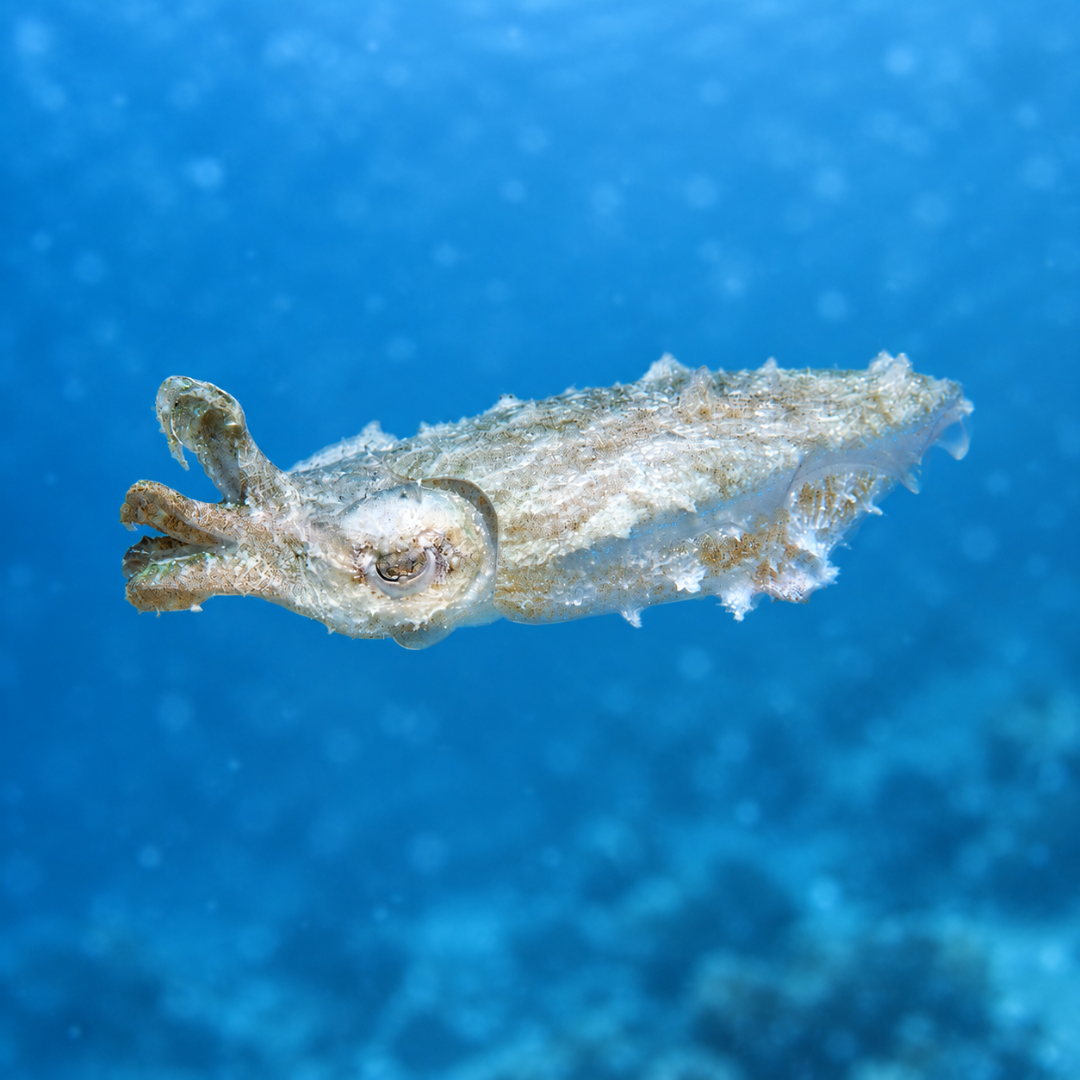
解説 / Description
バンダコウイカは、インド太平洋の浅いサンゴ礁や砂底に暮らす小型のコウイカです。成体でも外套長はおおむね5〜7 cmほどに収まり、コウイカ類の中では非常に小柄ですが、周囲に合わせて体色・模様・皮膚の凹凸を瞬時に変える能力、獲物を狙って伸びる2本の触腕、波打つヒレを使った独特の遊泳など、頭足類らしい魅力を凝縮した存在です。現在の受容学名は Ascarosepion bandense で、旧学名 Sepia bandensis は現在も飼育文献や流通情報で広く見かけます。飼育そのものは可能ですが、水質変化と重金属に敏感で、孵化直後には継続的な活餌の確保が必要になるため、海水魚飼育に十分慣れた上級者向けの生体です。 The dwarf cuttlefish is a small cuttlefish inhabiting shallow coral reefs and sandy bottoms of the Indo-Pacific. Adults usually remain around 5–7 cm in mantle length. Despite its compact size, it displays many of the traits that make cephalopods extraordinary: rapid changes in skin color, pattern and texture, two extendable feeding tentacles, and graceful maneuvering with its undulating fins. The currently accepted scientific name is Ascarosepion bandense, while the former name Sepia bandensis remains common in aquarium literature and trade references. It can be maintained successfully in captivity, but its sensitivity to unstable water quality and metals, together with the need for a reliable supply of live prey for hatchlings, makes it best suited to experienced marine aquarists.
基本情報 / Basic Information
| 学名 / Scientific Name | Ascarosepion bandense (Adam, 1939) |
|---|---|
| 通称 / Common Name | バンダコウイカ、ドワーフ・カトルフィッシュ。旧学名に由来して「セピア・バンデンシス」と呼ばれることもあります。Dwarf cuttlefish, stumpy cuttlefish, stumpy-spined cuttlefish; the former scientific name Sepia bandensis is still widely used in the aquarium hobby. |
| 分類 / Family | 軟体動物門・頭足綱・コウイカ目・コウイカ科(Sepiidae)・Ascarosepion 属Phylum Mollusca, Class Cephalopoda, Order Sepiida, Family Sepiidae, Genus Ascarosepion |
| 英名 / English Name | Stumpy cuttlefish / Dwarf cuttlefish |
| 分布 / Distribution | 熱帯インド太平洋。フィリピン、マレーシア領ボルネオ、インドネシアのジャワ、スラウェシ、アラス海峡周辺、ニューギニアなどから記録され、マーシャル諸島でも確認例があります。北オーストラリアについては、主要な種カタログで「分布する可能性がある」と扱われてきたため、確実な分布域とは分けて考えるのが適切です。主に沿岸の浅いサンゴ礁や砂底に生息し、野外では夜間に活動する傾向が知られています。Tropical Indo-Pacific. Records include the Philippines, Malaysian Borneo, Java, Sulawesi and the Alas Strait region of Indonesia, New Guinea, and the Marshall Islands. Northern Australia has been treated in major species catalogues as a possible rather than firmly established part of the range. The species inhabits shallow coastal coral reefs and sandy habitats, and field observations indicate predominantly nocturnal activity. |
| 最大体長 / Max Size | 外套長で約5〜7 cm。文献では約70 mmに達する記録があり、体重はおおむね数十 gです。腕を含めた全長は外套長より大きく見えます。Approximately 5–7 cm in mantle length, with published records reaching about 70 mm. Adults generally weigh several tens of grams. Total body length appears larger when the arms are included. |
| 寿命 / Lifespan | 飼育研究では約9ヶ月前後がひとつの目安とされる短命種で、飼育条件や個体差によって前後します。繁殖期を過ぎると、視力や運動性の低下を伴う老衰が進むことがあります。Captive research populations typically live for about nine months, although husbandry conditions and individual variation affect lifespan. After the reproductive period, senescence may progress with declining vision and mobility. |
飼育環境 / Aquarium Environment
| 水槽サイズ / Tank Size | 飼育者向け文献での実績を基準にすると、単独成体では約110 L以上がひとつの目安です。日本の規格感では60cmワイド水槽〜75cmクラス以上が扱いやすく、2匹なら約150 L以上で90cm規格水槽相当、3匹なら約200 L以上で90cmワイド〜120cm規格水槽相当を目安にします。これらは絶対的な最低水量ではなく、複数飼育では個体数に加えて、給餌量に見合う濾過能力と隠れ場所の確保が重要です。孵化直後は大水槽へ直接放さず、稚魚用ネットや小型育成容器を本水槽内に設置して給餌管理を行う方法が適しています。Published aquarium husbandry experience suggests about 110 L or more as a practical benchmark for one adult. In common Japanese tank sizes, a 60 cm wide tank to roughly a 75 cm class tank is convenient. Around 150 L or more, roughly equivalent to a standard 90 cm tank, is a useful benchmark for two animals, and around 200 L or more, comparable to a 90 cm wide or standard 120 cm tank, for three. These figures are husbandry benchmarks rather than absolute biological minimums; group housing also depends on filtration capacity, feeding load, and the availability of retreats. Hatchlings should not be released directly into a large display tank; a breeder net or small nursery chamber within the main system makes feeding and observation easier. |
|---|---|
| 水温 / Temperature | 24〜26℃を中心に安定させます。急激な温度変化は避け、夏季は必要に応じてクーラーを使用します。 Maintain a stable 24–26°C. Avoid rapid temperature changes and use a chiller when necessary during hot seasons. |
| 水質 / Water Quality | 清浄で安定した海水が必須です。塩分濃度はおおむね34〜35 ppt、比重の目安は1.024〜1.026、pHは8.0〜8.4程度を維持します。アンモニアと亜硝酸は検出されない状態を保ち、硝酸塩もできるだけ低く抑えます。十分に立ち上がった生物濾過、強いガス交換、適切なプロテインスキマーが有効です。蒸発による塩分変動を抑える自動給水も相性の良い設備です。Pristine, stable seawater is essential. Maintain salinity at roughly 34–35 ppt, specific gravity around 1.024–1.026, and pH around 8.0–8.4. Ammonia and nitrite should remain undetectable, and nitrate should be kept as low as practical. A mature biological filter, vigorous gas exchange, and an appropriately sized protein skimmer are highly useful. Automatic top-off is also valuable for preventing salinity swings caused by evaporation. |
| レイアウト / Layout | 細かな砂地とライブロックを組み合わせ、日中に落ち着ける洞窟やオーバーハングを複数設けます。遊泳空間も残し、ポンプやオーバーフローの吸水口はスポンジやガードで確実に保護します。強い光そのものを要求する生体ではないため、照明は同居させるサンゴなどに合わせつつ、急な点灯・消灯を避けると落ち着きやすくなります。強い刺胞毒を持つサンゴや、狭い場所へ追い込むような複雑すぎる構造は避けます。Combine fine sand with live rock and provide several caves or overhangs where the cuttlefish can rest during the day. Leave open maneuvering space and protect all pump and overflow intakes with sponge or guards. The cuttlefish itself does not require intense lighting, so lighting can be chosen around compatible corals, while abrupt on/off transitions are best avoided. Avoid strongly stinging corals and overly cramped structures that could trap or corner the animal. |
| 注意点 / Precautions | 頭足類は水質悪化や薬品に敏感です。特に銅イオンを含む魚病薬は使用しないでください。バンダコウイカの血液は銅を含むヘモシアニンで酸素を運びますが、それとは別に、環境中の過剰な銅は頭足類に有害です。また、驚いた際に吐いた墨は、閉鎖水槽、とくに水量の少ない環境では水質を急速に悪化させるおそれがあります。十分な水量を確保し、活性炭、プロテインスキマー、水換えですぐに対応できるようにします。海水水槽が十分に成熟してから導入し、急激な比重・温度変化を避けてください。Cephalopods are sensitive to deteriorating water quality and many medications. Do not use fish treatments containing copper ions. Dwarf cuttlefish transport oxygen with copper-containing hemocyanin, but environmental copper exposure is a separate issue and can be toxic. Ink released during a fright response can rapidly compromise water quality in a closed aquarium, especially in a small volume of water. Provide adequate system volume and be prepared to respond promptly with activated carbon, protein skimming, and water changes. Introduce the animal only to a fully matured marine system and avoid sudden changes in salinity or temperature. |
餌と給餌 / Feeding
| 餌の種類 / Diet | 完全な肉食性で、主食は生きた甲殻類です。孵化直後は体に合った活きたイサザアミ類が最も使いやすく、成長に合わせてヨコエビ類、スジエビ類、海産の小型エビや小型カニへ移行します。成長個体では、ピンセットや給餌棒で動きを付けることで、解凍したエビや小魚を受け入れる個体もいますが、活餌を完全に不要にできるとは限りません。This is a strict carnivore that feeds mainly on live crustaceans. Newly hatched cuttlefish are most reliably started on appropriately sized live mysids. As they grow, amphipods, grass shrimp, other small marine shrimp and small crabs can be introduced. Older individuals may learn to accept thawed shrimp or small fish presented with forceps or a feeding stick to simulate movement, although not every animal can be fully weaned from live prey. |
|---|---|
| 給餌のポイント / Feeding Tips | 孵化直後は少量を高頻度で与え、各個体が実際に捕食できているかを確認します。研究施設では幼体を含む個体へ活餌を少なくとも1日3回与えて飼育する例があり、家庭水槽でも成長段階と食べ残しを見ながら複数回に分ける方法が適しています。ただし、給餌量が多いほど排泄物や残餌も増えるため、水質悪化とのバランスが重要です。獲物は体の大きさに合うものを選びます。幼体を稚魚用ネットで育てる場合は、縫い目への絡まりを避けるためネットを裏返して使う方法が知られています。成長後は体型、捕食意欲、繁殖状態を見ながら給餌量と回数を調整します。Feed hatchlings small portions frequently and confirm that each individual is actually catching prey. Research facilities commonly maintain dwarf cuttlefish, including juveniles, with live prey offered at least three times per day, and dividing food into several feedings is also practical in home aquaria when adjusted to growth and uneaten food. Heavy feeding, however, produces substantial waste, so water quality must be watched closely. Choose prey appropriate to the animal’s size. When using a mesh breeder for hatchlings, turning the net inside out is a known method for reducing the risk of animals catching on seams. As the cuttlefish grows, adjust feeding amount and frequency according to body condition, appetite, and reproductive state. |
性格と混泳 / Temperament and Tank Mates
| 性格 / Temperament | 普段は物陰や底付近で落ち着いて過ごし、夜間や給餌時に活発になります。飼育下では、給餌時に人の動きへ反応して水槽前面へ出てくる個体も見られます。同種間では社会的な体色ディスプレイを見せる一方、特に成熟したオス同士では威嚇や噛み付きが起こることがあります。十分な空間と餌が不足すると、争いや共食いの危険が高まります。They often rest near the bottom or in shelter during the day and become more active at night and during feeding. In captivity, some individuals respond to activity around feeding time and move toward the front of the aquarium. They use elaborate visual displays with their own species, but mature males in particular may threaten or bite one another. Crowding and inadequate feeding increase the risk of aggression and cannibalism. |
|---|---|
| 混泳の相性 / Compatibility | 基本的には専用水槽が最も安全です。小型魚は捕食対象になり、大型魚や素早い魚は逆にストレスや外傷の原因になります。エビや小型カニは多くの場合「同居生体」ではなく餌として認識されます。穏やかな巻貝類や一部のサンゴは同居できる場合がありますが、強い刺胞毒を持つサンゴは避けます。同種複数飼育は可能な例がありますが、性比、個体差、広さ、隠れ場所、給餌量を十分に管理する必要があります。A species-focused aquarium is the safest approach. Small fish may be treated as prey, while larger or fast-moving fish can cause stress or injury. Shrimp and small crabs are usually viewed as food rather than tank mates. Peaceful snails and some corals may be compatible, but strongly stinging corals should be avoided. Groups of dwarf cuttlefish can be maintained successfully in some systems, but sex ratio, individual temperament, tank space, retreats and feeding levels must all be managed carefully. |
病気と対策 / Diseases and Prevention
| かかりやすい病気 / Common Diseases | 観賞魚のように「この病気が代表的」と整理できる情報は多くありません。実際の飼育では、水質悪化や輸送ストレスをきっかけとする食欲低下、皮膚・外套の損傷に続く二次感染、呼吸状態の悪化、浮力異常などに注意します。繁殖後の老衰では、視力低下や捕食失敗、活動量の低下が進みますが、これは感染症とは異なる自然な生活史の変化です。There is no single well-defined list of aquarium diseases comparable to those commonly described for ornamental fish. In practice, major concerns include appetite loss after transport or water-quality stress, secondary infection following skin or mantle injury, impaired respiration, and abnormal buoyancy. After reproduction, senescence may bring declining vision, unsuccessful strikes and reduced activity; this is part of the natural life cycle rather than an infectious disease. |
|---|---|
| 対策と予防 / Prevention | 最大の予防策は、成熟した海水水槽で水質を安定させることです。アンモニア・亜硝酸を検出させず、硝酸塩を低く保ち、十分な酸素供給とスキミングを維持します。銅を含む魚病薬や、頭足類への安全性が確認できない薬剤を安易に使用しないでください。活餌は清浄な環境でストックし、普段と異なる動き、呼吸の速さ、食欲低下、外套や腕の傷などを毎日観察します。墨を吐いた場合は原因となった刺激を取り除き、活性炭、スキマー、水換えで速やかに水を清浄化します。The most effective prevention is stable water quality in a fully mature marine system. Keep ammonia and nitrite undetectable, nitrate low, and maintain strong oxygenation and protein skimming. Do not casually use copper-based fish medications or any treatment whose safety for cephalopods is unknown. Hold live prey in clean conditions and inspect the cuttlefish daily for unusual behavior, increased respiratory effort, reduced appetite, or wounds to the mantle and arms. If an inking event occurs, remove the source of disturbance and rapidly restore water quality with activated carbon, skimming, and water changes. |
増やし方(繁殖) / Breeding
| 雌雄の判別 / Sexing | 外見だけでの確実な判別は簡単ではありません。成熟オスは他のオスとの対面時に高コントラストの白黒パターンを示すことがあり、交接時には特殊化した交接腕を使いますが、体色や行動だけでは誤判定もあります。2026年には、皮膚表面を綿棒で軽くぬぐってDNAを採取し、qPCRでZ染色体のコピー数を比較する非侵襲的な性判別法が報告されました。オスがZZ、メスがZ0であることを利用し、孵化約3時間後の個体でも判定できることが示されています。ただし、一般家庭で行う通常の飼育技術ではありません。Reliable visual sexing is not always easy. Mature males may show high-contrast black-and-white patterns when confronting other males, and they use a modified arm during mating, but color pattern and behavior alone can be misleading. In 2026, researchers reported a non-invasive sex-genotyping method that collects DNA with a gentle skin swab and uses qPCR to compare Z-chromosome copy number. Because males are ZZ and females are Z0, the method was shown to work even in hatchlings about three hours old. It remains a research technique rather than a routine home-aquarium procedure. |
|---|---|
| 繁殖形態 / Reproduction | 卵生です。オスとメスは向かい合うように腕を絡め、オスが精莢をメスの口周辺にある受精嚢へ受け渡します。メスは精子を一定期間保持し、産卵時に利用できます。卵は1個ずつ産み付けられ、数個〜数十個がまとまった房状の卵塊になります。卵膜には墨が取り込まれて黒っぽく見えることが多く、岩の下面や枝状構造などに付着します。適温下ではおおむね3〜4週間ほどで孵化します。This is an egg-laying species. The pair mates face-to-face with intertwined arms, and the male transfers spermatophores to a sperm-storage area around the female’s buccal region. The female can retain sperm and use it during subsequent egg laying. Eggs are laid individually and accumulate into grape-like clusters ranging from a few to several dozen eggs. Ink is often incorporated into the egg covering, giving the eggs a dark appearance, and clusters are attached beneath rocks or to branching structures. At suitable temperatures, hatching commonly occurs in roughly three to four weeks. |
| 繁殖のポイント / Breeding Tips | 親魚を十分に給餌し、24〜26℃前後の安定した水質を維持することが基本です。オス同士の競争が強い場合は個体数や性比を調整し、逃げ場を増やします。卵は強い直噴を避けながら緩やかな水流と十分な酸素が得られる位置で管理します。孵化直後は大水槽に放すと餌との遭遇率が下がるため、稚魚用ネットや育成容器に収容し、活きたイサザアミ類を確実に食べさせます。成長に合わせて餌のサイズを段階的に上げ、食べ残しをすぐ除去します。飼育研究ではおおむね孵化後4ヶ月ほどで性成熟するため、繁殖を狙う場合はそれ以前から設備と活餌の供給体制を整えておくことが重要です。Successful breeding begins with well-fed adults and stable water around 24–26°C. If male competition becomes intense, adjust group size or sex ratio and increase shelter. Keep egg clusters where they receive gentle circulation and ample oxygen without being blasted by a direct jet. Hatchlings should be moved to a breeder net or nursery chamber so they can reliably encounter live mysids rather than being released into a large display. Increase prey size gradually as they grow and remove uneaten food promptly. Captive research populations generally reach sexual maturity at about four months, so breeding facilities and a reliable live-food supply should be prepared before that stage. |
雑学と豆知識 / Trivia and Fun Facts
| 1. 学名は「バンダのコウイカ」という由来を持つ / 1. A scientific name tied to the Banda Sea | バンダコウイカは1939年にW. Adamによって Sepia bandensis として記載されました。種小名は模式産地であるインドネシアのバンダ海、バンダ・ネイラに由来します。その後、コウイカ科の分類体系が再検討され、現在は Ascarosepion bandense が受容名となりました。飼育の世界では旧学名が長く使われてきたため、ショップや古い飼育記事で Sepia bandensis と書かれていても、別種を意味しているわけではありません。名前の変化そのものが、形態分類から分子系統を含む現代的な分類へと頭足類研究が進んできた歴史を映しています。The species was described by W. Adam in 1939 as Sepia bandensis. Its specific name refers to the Banda Sea and Banda Neira in Indonesia, the type locality. As cuttlefish classification was revised, the accepted combination became Ascarosepion bandense. Because the former name was used for decades in aquarium literature, seeing Sepia bandensis in older husbandry articles or trade information does not necessarily indicate a different species. The changing name reflects the broader modernization of cephalopod taxonomy from primarily morphological systems toward classifications informed by wider comparative evidence. |
|---|---|
| 2. 体の中にある「甲」は、硬い浮力タンクでもある / 2. The cuttlebone is an internal buoyancy tank | コウイカの背中側に隠れている甲は、単なる骨のような支えではありません。炭酸カルシウムを主成分とする多孔質構造の内部には、薄い隔壁と細かな柱が並び、液体と気体の割合を調整することで浮力を保ちます。魚の浮き袋のような柔らかな袋ではなく、非常に軽く、しかも圧力に耐える微細構造を備えた「内蔵型の浮力装置」です。材料工学の視点からも興味深い構造で、局所的に損傷しても全体が一気に崩壊しにくい形態が研究されています。水槽で見られる滑らかな上下移動の背景には、この目に見えない精巧な器官が働いています。The cuttlebone hidden along the dorsal side is far more than a simple internal support. Its porous calcium-carbonate structure contains thin septa and fine pillars, and buoyancy is regulated by controlling the balance of liquid and gas inside its chambers. Unlike the soft swim bladder of a fish, it is a lightweight but pressure-resistant internal buoyancy device. Its microscopic architecture has also attracted attention from materials science because damage can be localized rather than causing immediate collapse of the entire structure. The cuttlefish’s effortless vertical positioning in an aquarium is supported by this remarkable organ working out of sight. |
| 3. 心臓は3つ、血液は青みを帯びる / 3. Three hearts and blue-tinted blood | バンダコウイカを含む頭足類には、全身へ血液を送る体心臓が1つ、左右のえらへ血液を送る鰓心臓が2つあり、合計3つの心臓があります。酸素運搬には鉄を含むヘモグロビンではなく、銅を含むヘモシアニンを使うため、酸素と結合した血液は青みを帯びます。こうした循環系は高い活動性を支える一方、頭足類は水質変化や低酸素に敏感です。見た目の華やかさに目を奪われがちですが、飼育の成否は意外なほど「安定した酸素と水質」という地味な条件に支えられています。Cephalopods such as the dwarf cuttlefish have three hearts: one systemic heart that pumps blood through the body and two branchial hearts that send blood through the gills. Oxygen is carried by copper-containing hemocyanin rather than iron-containing hemoglobin, giving oxygenated blood a bluish appearance. This circulatory system supports an active lifestyle, but cephalopods are also sensitive to poor oxygenation and unstable water conditions. Behind the animal’s spectacular appearance, successful husbandry depends heavily on the less glamorous fundamentals of stable water chemistry and oxygen supply. |
| 4. 色覚の常識だけでは説明しきれないカモフラージュ / 4. Camouflage that challenges simple ideas about color vision | コウイカ類は、人間のような一般的な色覚を持たないと考えられてきました。それでも周囲の明暗、模様、境界、反射の性質を読み取り、背景に応じたカモフラージュを作ります。バンダコウイカの野外観察では、周囲の色調に近いように見える体色も記録されており、視覚と体色制御の仕組みにはまだ分かっていない部分が残されています。皮膚には色素胞、虹色素胞、白色素胞が重なり、脳からの指令で体表の見え方を変えます。さらに乳頭と呼ばれる皮膚の突起を盛り上げれば、岩やサンゴのような凹凸まで再現できます。単純に「見えた色をそのまま再現する」と考えるだけでは説明しきれない、独特の視覚と皮膚制御を持つ生き物なのです。Cuttlefish have traditionally been considered unable to see color in the same way humans do. Even so, they read brightness, pattern, edges, and reflective properties in their surroundings and produce context-appropriate camouflage. Field observations of dwarf cuttlefish have also documented body colors that appeared to resemble surrounding hues, showing that important questions about their visual perception and skin control remain unresolved. Their skin layers include chromatophores, iridophores, and leucophores, and neural control changes the appearance of the body surface. Muscular papillae can also create three-dimensional textures resembling rock or coral. Their camouflage therefore cannot be explained simply as “seeing a color and copying it,” but reflects a distinctive and still partly unresolved visual-control system. |
| 5. 皮膚は「脳の活動が見えるスクリーン」になる / 5. Skin as a visible readout of neural activity | バンダコウイカが神経科学のモデル生物として注目される大きな理由は、皮膚の色素胞が運動ニューロンによって直接制御されている点にあります。体表に現れる模様は、脳が外界をどう解釈し、どの筋肉へ指令を出したかを外から観察できる手がかりになります。Cuttlebaseでは本種のゲノム、発生段階、3D個体アトラス、脳アトラスが公開され、脳アトラスには多数の脳領域と神経路がラベル付けされています。小さなコウイカの体表を眺めることが、そのまま「神経回路が生み出す行動」を読む研究につながっているのです。One reason the dwarf cuttlefish has become an important neuroscience model is that its chromatophores are controlled directly by motor neurons. Patterns appearing on the skin can therefore provide an external clue to how the brain interprets a scene and sends commands to the body. Cuttlebase makes resources for this species publicly available, including its genome, developmental staging series, 3D body atlas and brain atlas, with numerous brain regions and neural tracts labeled. Watching the changing surface of this tiny animal can therefore become a window into the neural circuits that generate behavior. |
| 6. 体表を走る「波」は、まだ役割が分かっていない / 6. The function of its moving skin waves remains unresolved | バンダコウイカは、暗い帯や模様が外套の上を移動して見える動的な皮膚パターンを作ります。同様の現象は「パッシング・ウェーブ」や「パッシング・クラウド」と呼ばれることがありますが、本種でそれが何のために使われているのかは、まだ十分に分かっていません。他のコウイカ類では狩猟時に似たパターンが見られ、獲物への働きかけや動的カモフラージュなどが仮説として挙げられてきました。しかし、その解釈をそのままバンダコウイカに当てはめることはできません。水槽で見える模様の波は印象的ですが、現在のところは「機能未解明の行動」として観察するのが正確です。Dwarf cuttlefish can generate dynamic skin patterns in which a dark band or wave appears to travel across the mantle. Similar displays are often called passing waves or passing clouds, but their function in this species is still not well understood. In other cuttlefish species, comparable patterns have been observed during hunting and have prompted hypotheses involving prey interaction or dynamic camouflage. Those interpretations, however, cannot simply be transferred to dwarf cuttlefish. The moving waves seen in an aquarium are striking, but the most accurate description at present is that their biological function remains unresolved. |
| 7. 孵化した瞬間から「小さな完成形」 / 7. Hatchlings emerge as miniature hunters | バンダコウイカの発生は細かい段階に分けて研究されており、孵化した幼体はすでに成体に似た体型とカモフラージュ能力を備えています。魚類の稚魚のように長い変態過程を経るのではなく、孵化後まもなく小さな甲殻類を狙って捕食を始めます。その一方で、体が数 mmしかない時期は餌のサイズと遭遇率に非常に左右されます。稚魚用ネットの中で活きたイサザアミを確実に見つけられるようにするという飼育技術は、この「完成した捕食者なのに、まだ極小」という発生上の特徴に合わせた工夫なのです。Dwarf cuttlefish development has been divided into detailed embryonic stages, and hatchlings emerge with a body plan and camouflage abilities already resembling those of adults. Rather than undergoing a long transformation after hatching, they soon begin hunting tiny crustaceans. At the same time, their millimeter-scale size makes them extremely dependent on prey size and encounter rate. The common practice of raising them in a mesh nursery with live mysids is therefore a husbandry solution tailored to a biological paradox: they are already competent predators, but still extraordinarily small. |
| 8. 2026年、孵化直後でも性別を調べられる手法が報告された / 8. In 2026, sex could be identified only hours after hatching | 外見からの性判別が難しいことは、研究施設で繁殖群を管理する上で長年の課題でした。2026年に報告された方法では、生体の皮膚を綿棒で軽くぬぐってDNAを採取し、qPCRでZ染色体のコピー数を比較します。バンダコウイカではオスがZZ、メスがZ0であるため、その差を利用して孵化後約3時間の個体でも性別を判定できるとされています。傷つけて組織を採取する必要がないため、将来的には研究施設や水族館での計画的なペアリング、遺伝的多様性の維持、累代繁殖の効率化に役立つ技術として期待されています。Visual sexing has long complicated the management of breeding populations in research facilities. A method reported in 2026 uses a gentle skin swab to collect DNA, followed by qPCR to compare Z-chromosome copy number. In dwarf cuttlefish, males are ZZ and females are Z0, allowing the dosage difference to identify sex in animals as young as about three hours after hatching. Because tissue does not need to be removed invasively, the approach may help research facilities and aquariums plan pairings, preserve genetic diversity and manage multi-generation captive populations more efficiently. |
| 9. 「短命」であることも、この生き物の生き方の一部 / 9. A short lifespan is part of its life strategy | バンダコウイカは数年を生きる魚とは異なり、わずか数ヶ月で急速に成長し、成熟し、繁殖へ進みます。飼育者から見ると寿命の短さは大きなハードルですが、その短い期間の中で、獲物の捕らえ方を洗練させ、複雑な体色シグナルを使い、交接し、卵を残していきます。老衰期には視力や捕食精度が落ち、動きがゆっくりになることがあります。若い時期の華やかな変化だけでなく、最後まで短い生活史に寄り添うことが、頭足類を飼うということの大切な一面です。Unlike fishes that may live for years, the dwarf cuttlefish grows rapidly, matures and reproduces within only a few months. From the aquarist’s perspective, this short lifespan is a major challenge, yet within that brief period the animal refines its hunting behavior, uses complex visual signals, mates and produces eggs. During senescence, vision and strike accuracy may decline and activity can slow noticeably. Caring for a cephalopod therefore means appreciating not only the spectacular displays of youth but also supporting the animal through the final stage of its naturally compressed life history. |
まとめ / Conclusion
バンダコウイカは、わずか数 cmの体に、高度な視覚、瞬時に変化する皮膚、甲による浮力調整、素早い捕食行動を備えた小型の頭足類です。大型のコウイカより小さな水槽で飼育できますが、飼育条件まで簡単になるわけではありません。成熟した濾過系、安定した塩分と水温、十分な酸素供給、墨を吐いたときの対応、そして成長段階に合った餌を継続して用意できることが重要です。 The dwarf cuttlefish combines sophisticated vision, rapidly changing skin, cuttlebone-based buoyancy control, and fast predatory behavior in a body only a few centimeters long. Its small size allows it to be housed in a more manageable aquarium than large cuttlefish, but that does not make its husbandry simple. Successful care depends on mature filtration, stable salinity and temperature, strong oxygenation, preparation for inking events, and a dependable supply of prey appropriate to each stage of growth.
体色や模様を絶えず変え、底を歩くように移動し、狙いを定めて獲物を捕らえる姿には、一般的な観賞魚とは異なる魅力があります。その一方で寿命は短く、成長から成熟、繁殖、老衰までが数ヶ月のうちに進みます。安定した飼育環境と餌を最後まで維持できる飼育者にとって、バンダコウイカは頭足類ならではの行動と体の仕組みを間近で観察できる、非常に印象深い存在です。 Its constantly changing patterns, bottom-walking movements, and precisely aimed predatory strikes give the dwarf cuttlefish an appeal very different from that of ordinary ornamental fish. At the same time, its life is short, with growth, maturity, reproduction, and senescence unfolding within only a matter of months. For aquarists who can maintain stable conditions and an appropriate food supply throughout that life cycle, it offers an unusually close view of the distinctive behavior and biology of cephalopods.

気になる道具や飼い方を見つけてみませんか?
 アイのアクアグッズ案内コケを食べるコイの仲間に合わせる飼育用品|フライングフォックス・アルジイーター・ガラ道具の特徴や使い方、選ぶときのポイントをアイが紹介します。記事はコチラ →
 アイのアクアグッズ案内エンゼルフィッシュの飼育用品|高さのある水槽・ろ過・水草・餌の選び方道具の特徴や使い方、選ぶときのポイントをアイが紹介します。記事はコチラ →
 アイのアクアグッズ案内海水魚初心者の必需品|水槽・人工海水・比重計・水質検査道具の特徴や使い方、選ぶときのポイントをアイが紹介します。記事はコチラ →
 アイのアクアグッズ案内水草の肥料の選び方|底床用・液肥・メネデールの使い分け道具の特徴や使い方、選ぶときのポイントをアイが紹介します。記事はコチラ →
さまざまな飼育テーマをご紹介。リンク先の記事には広告・商品紹介が含まれます。
案内・紹介記事一覧へ →分布マップ
バンダコウイカ(Ascarosepion bandense)は熱帯インド太平洋に分布し、フィリピン、マレーシア領ボルネオ、インドネシアのジャワ、スラウェシ、アラス海峡周辺、ニューギニア、マーシャル諸島などから記録されています。北オーストラリアについては、分布する可能性がある地域として扱われています。
この地図は、記録されている分布地域全体を把握しやすくするための概略表示です。表示しているマーカーは分布域を視覚的に示すための代表地点であり、実際の採集地点や個体の確認地点を示すものではありません。
参考文献
-
分類 学名World Register of Marine Species (WoRMS). Ascarosepion bandense (Adam, 1939). WoRMS Taxon Details現在受容されている学名、コウイカ科内での分類、旧学名 Sepia bandensis との対応を確認するための資料。
-
分類Lupše N, Reid A, Taite M, Kubodera T, Allcock AL. 2023. Cuttlefishes (Cephalopoda, Sepiidae): the bare bones—an hypothesis of relationships. Marine Biology 170:93. https://doi.org/10.1007/s00227-023-04195-3分子系統と形態情報に基づくコウイカ科の再検討で、Ascarosepion 属を有効な属として再認識し、本種を Ascarosepion bandense とする分類の根拠となる資料。
-
分布 生息環境Jereb P, Roper CFE, eds. 2005. Cephalopods of the World. An Annotated and Illustrated Catalogue of Cephalopod Species Known to Date. Volume 1: Chambered Nautiluses and Sepioids. FAO Species Catalogue for Fishery Purposes No. 4, Vol. 1. Rome: Food and Agriculture Organization of the United Nations. FAO旧学名 Sepia bandensis として収録されている種カタログ。形態、地理的分布、生息環境などの基礎情報を確認するための資料。
-
生息環境 野外生態Gibbons CJ, Rubino FA, Barlow GT, et al. 2025. Natural Habitat and Wild Behaviors of the Dwarf Cuttlefish, Ascarosepion bandense. Ecology and Evolution 15(9):e72001. https://doi.org/10.1002/ece3.72001フィリピン・バタンガスでの野外調査に基づき、サンゴ礁での確認、水深、夜間活動、自然環境下の行動を記録した本種の生息環境に関する直接的な資料。
-
飼育 繁殖 成長Montague TG, Rieth IJ, Axel R. 2021. Embryonic development of the camouflaging dwarf cuttlefish, Sepia bandensis. Developmental Dynamics 250(12):1688–1703. https://doi.org/10.1002/dvdy.375飼育下での水質管理、給餌、群飼育、交接、産卵、胚発生、孵化、性成熟、寿命など、本種の飼育と繁殖を具体的に記載した主要資料。
-
飼育 環境Giancola-Detmering SE, Crook RJ. 2024. Stress produces negative judgement bias in cuttlefish. Biology Letters 20(10):20240228. https://doi.org/10.1098/rsbl.2024.0228本種を用いた研究で、飼育水温、循環濾過、底床、隠れ場所、給餌内容などの飼育条件が明記されており、環境整備とストレス管理を考える際の資料。
-
病気・予防 水質管理 注意点Fiorito G, Affuso A, Basil J, et al. 2015. Guidelines for the Care and Welfare of Cephalopods in Research—A consensus based on an initiative by CephRes, FELASA and the Boyd Group. Laboratory Animals 49(2 Suppl):1–90. https://doi.org/10.1177/0023677215580006頭足類の水質、溶存酸素、窒素化合物、塩分、重金属、墨への対応、外傷、感染症、健康状態の観察などを体系的にまとめた国際的な飼育・福祉ガイドライン。
-
繁殖 性判別Rubino FA, Coffing GC, Gibbons CJ, et al. 2026. A non-invasive method to genotype cephalopod sex by quantitative PCR. iScience 29(5):115594. https://doi.org/10.1016/j.isci.2026.115594Ascarosepion bandense のZZ/Z0型性決定を利用し、皮膚スワブとqPCRで孵化直後から性別を判定する非侵襲的方法を検証した資料。




コメント