

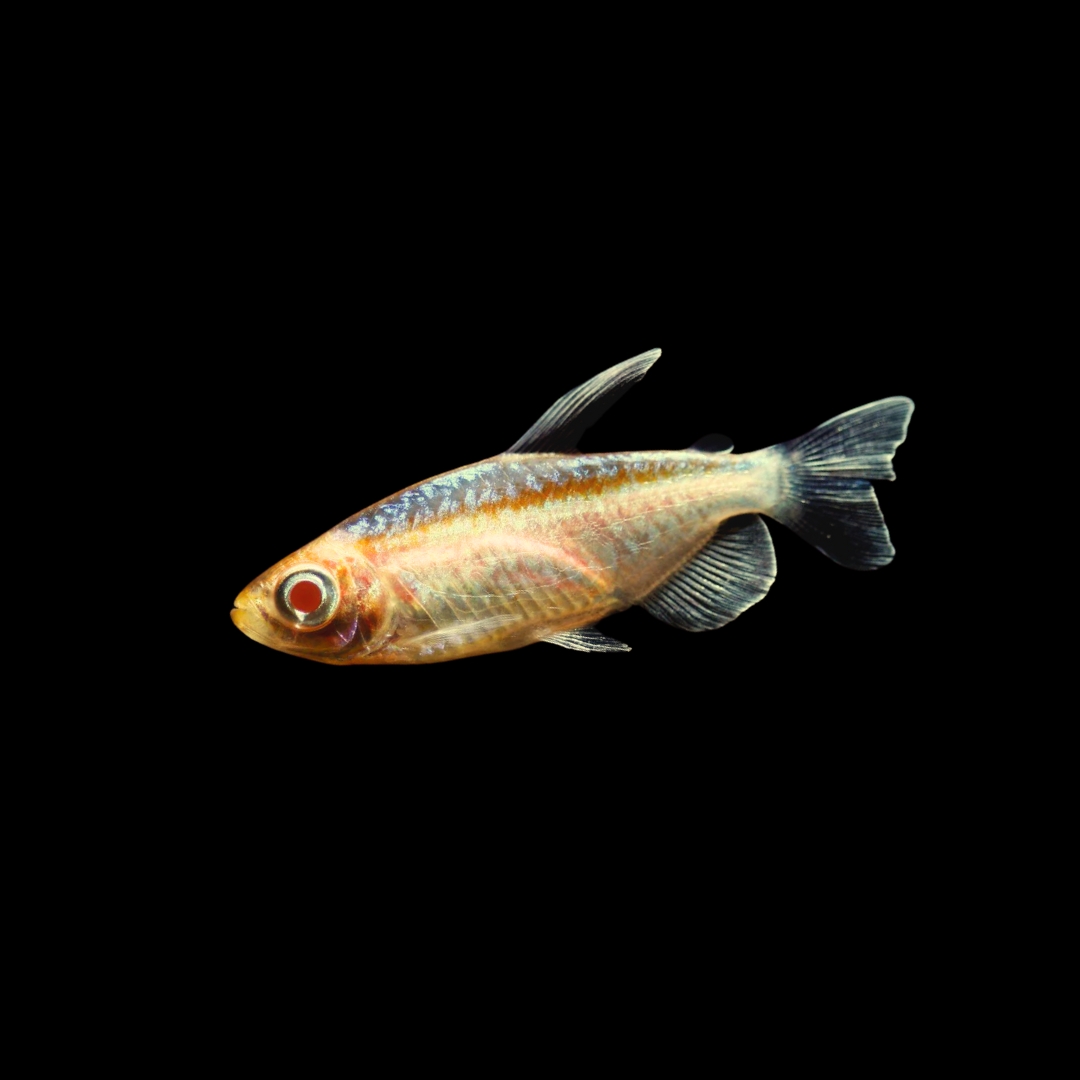
解説 / Description
アルビノコンゴテトラは、アフリカのコンゴ川流域に分布するコンゴテトラをもとに、白化形質を観賞魚として固定した改良品種です。赤みを帯びた目、白銀から淡いクリーム色の体、そして角度によって青、金、淡いオレンジにきらめく光沢が魅力です。アルビノであっても、コンゴテトラらしい虹色の輝きが残るのは、体色の美しさの多くがメラニンなどの色素だけでなく、虹色素胞に含まれるグアニン結晶による構造色に支えられているためです。 The Albino Congo Tetra is an ornamental albino strain derived from the Congo Tetra, a species native to the Congo River basin in Africa. Its red eyes, pearly white to pale cream body, and iridescent sheen that shifts from blue to gold and soft orange depending on the angle of light make it especially attractive. Even in albino form, the fish retains the characteristic glow of the Congo Tetra because much of its beauty is supported not only by pigments such as melanin, but also by structural coloration produced by guanine crystals inside iridophores.
性格は温和で、ゆったりした群泳を楽しめる中型カラシンです。一方で、活発に泳ぐ力があり、体高も出るため、小型テトラと同じ感覚で小さな水槽に入れると本来の魅力を発揮しにくくなります。アルビノ個体は強い照明に敏感になりやすいので、広めの水槽、落ち着いた水流、暗色の底床、浮き草や水草で光をやわらげた環境を用意すると、白い体にのる淡い虹色がいっそう美しく見えます。 It is a peaceful, medium-sized characin that shows its charm best when kept in a relaxed school. However, it is also an active swimmer with a relatively deep body, so it should not be treated like a tiny tetra suited to cramped tanks. Albino individuals may be more sensitive to harsh lighting, so a spacious aquarium with gentle flow, darker substrate, and softened light from floating or background plants helps bring out the delicate rainbow sheen over the pale body.
基本情報 / Basic Information
| 学名 / Scientific Name | Phenacogrammus interruptus のアルビノ改良品種, albino ornamental strain |
|---|---|
| 通称 / Common Name | アルビノコンゴテトラ、白コンゴテトラAlbino Congo Tetra |
| 分類 / Family | カラシン目 アレステス科 フェナコグラムス属。原種の主な同物異名として Micralestes interruptus、Alestopetersius interruptus、Hemigrammalestes interruptus が知られます。Order Characiformes, family Alestidae, genus Phenacogrammus. Major synonyms of the wild species include Micralestes interruptus, Alestopetersius interruptus, and Hemigrammalestes interruptus. |
| 英名 / English Name | Albino Congo Tetra |
| 分布 / Distribution | 原種はアフリカのコンゴ川下流から中流域、主にコンゴ民主共和国およびコンゴ共和国の水系に分布します。アルビノタイプは野生分布を持つ別種ではなく、主に観賞魚用に養殖された個体として流通します。The wild form occurs in the lower and middle Congo River basin of Africa, mainly in the Democratic Republic of the Congo and the Republic of the Congo. The albino form is not a separate wild species, but a captive-bred ornamental strain distributed through the aquarium trade. |
| 最大体長 / Max Size | 原種の記録値ではオスで約8cm、メスで約6cmが目安です。観賞魚としては体格のよいオスを中心に8cm前後、流通上は8〜10cm程度と表現されることもあります。Recorded size for the wild species is about 8 cm in males and about 6 cm in females. In the aquarium trade, well-grown males are often described as around 8 cm, and some listings may use a broader 8 to 10 cm range. |
| 寿命 / Lifespan | おおむね3〜5年が目安です。広い水槽で群れを保ち、水質を安定させると、より長く状態よく楽しめることがあります。A typical lifespan is around 3 to 5 years. With a spacious tank, stable schooling conditions, and consistently good water quality, individuals may remain in good condition for longer. |
飼育環境 / Aquarium Environment
| 水槽サイズ / Tank Size | 最低でも90cm規格水槽以上を推奨します。体長だけでなく遊泳力があるため、6匹以上の群れで飼うなら90cm規格水槽、混泳や余裕を重視するなら100cm以上または120cm規格水槽が扱いやすいです。60cm規格水槽では若魚の一時管理に留めるのが無難です。A standard 90 cm aquarium or larger is recommended. Because this species is an active swimmer, not just a medium-sized fish, a 90 cm tank is suitable for a group of six or more, while a 100 cm or standard 120 cm aquarium is more comfortable for community setups. A standard 60 cm tank is best regarded as temporary housing for juveniles. |
|---|---|
| 水温 / Temperature | 23〜27℃を中心に管理します。高水温が続くと酸欠や水質悪化が起きやすいため、夏場は水温上昇に注意します。 Keep the water mainly between 23 and 27°C. Prolonged high temperatures can reduce dissolved oxygen and accelerate water deterioration, so summer heat should be managed carefully. |
| 水質 / Water Quality | 弱酸性から中性付近、pH 6.0〜7.5を目安にします。原種はpH 6.0〜8.0程度の淡水域に関連づけられますが、飼育では急変を避け、軟水から中硬水で安定させることを優先します。硝酸塩の蓄積や古い水には弱いので、週1回を目安に25〜30%程度の換水を行います。Aim for slightly acidic to near-neutral water, around pH 6.0 to 7.5. The wild species is associated with freshwater habitats around pH 6.0 to 8.0, but in aquaria, avoiding sudden changes and maintaining stable soft to moderately hard water is more important. Because the fish can suffer in old or nitrate-rich water, change about 25 to 30% of the water weekly. |
| レイアウト / Layout | 中央から前面に遊泳スペースを確保し、後景や両脇にアヌビアス、ミクロソリウム、バリスネリア、タイガーロータスなどを配置します。暗色の底床を使うと、アルビノの淡い体色と虹色の光沢が引き立ちます。流木や浮き草で陰影をつけると落ち着きやすく、強い照明を避けたいアルビノ個体にも向きます。Leave open swimming space in the center and front, and plant the back and sides with species such as Anubias, Java fern, Vallisneria, or tiger lotus. A dark substrate enhances the pale albino body and iridescent sheen. Driftwood and floating plants create shade, helping the fish feel secure and making the setup more suitable for albino individuals that dislike harsh light. |
| 注意点 / Precautions | オスのヒレは長く伸びるため、フィルター吸水口にはスポンジを付けると安全です。導入直後は色が薄く見えても、落ち着いた群れと安定した水質が整うと発色が戻りやすくなります。飛び出し防止のため、フタも必ず用意します。Because males develop long fins, a sponge pre-filter on the intake helps prevent fin damage. Newly introduced fish may look pale, but coloration often improves once the group settles and water quality stabilizes. A secure lid is also important to prevent jumping. |
餌と給餌 / Feeding
| 餌の種類 / Diet | 雑食性です。良質なフレーク、顆粒フード、小型カラシン用ペレットを主食にし、冷凍アカムシ、冷凍ブラインシュリンプ、ミジンコ、イサザアミなどを副食として与えます。植物質も摂るため、スピルリナ配合フードを時々加えるとバランスを取りやすいです。This is an omnivorous species. Use high-quality flakes, granules, or small characin pellets as staple foods, and supplement with frozen bloodworms, frozen brine shrimp, daphnia, or mysis-type foods. Because the species also takes plant matter, occasional spirulina-based foods help provide a balanced diet. |
|---|---|
| 給餌のポイント / Feeding Tips | アルビノ個体は餌を見つけるのが遅れることがあるため、素早い魚との混泳では食べ負けに注意します。1日1〜2回、数分で食べきる量を与えるのが基本ですが、痩せやすい個体がいる場合は少量を複数回に分け、スポイトやピンセットで目の前に落とすと確実です。底に残った餌は水質悪化の原因になるため、早めに取り除きます。Albino individuals may be slower to locate food, so be careful that they are not outcompeted by faster tank mates. Feed once or twice daily in amounts that are eaten within a few minutes. If a fish is losing weight, offer smaller meals more often and use a pipette or feeding tweezers to place food directly in front of it. Remove leftover food promptly to prevent water deterioration. |
性格と混泳 / Temperament and Tank Mates
| 性格 / Temperament | 温和で群れを作る魚です。単独や少数では臆病になりやすく、色も出にくくなるため、最低でも6匹以上、できれば8匹以上での飼育が向きます。群れの中でオス同士がヒレを広げて見せ合う行動はありますが、深刻な争いになることは多くありません。It is a peaceful schooling fish. When kept alone or in too small a group, it may become shy and show weaker coloration, so keep at least six individuals, preferably eight or more. Males may display to each other by spreading their fins, but serious fighting is uncommon in a suitable group. |
|---|---|
| 混泳の相性 / Compatibility | 同程度の大きさで温和な魚と相性がよく、コリドラス、ローチの一部、プレコ類、ラミレジィなどの小型シクリッド、やや大きめの温和なテトラと組み合わせやすいです。スマトラのようにヒレをかじる魚、気の強いシクリッド、極端に小さく口に入りそうな魚との混泳は避けます。It does well with similarly sized peaceful fish, including Corydoras, some loaches, plecos, small cichlids such as ram cichlids, and larger peaceful tetras. Avoid fin-nipping fish such as tiger barbs, aggressive cichlids, and very small fish that could be intimidated or swallowed. |
病気と対策 / Diseases and Prevention
| かかりやすい病気 / Common Diseases | 白点病、尾腐れ病、ヒレ裂け、輸送直後の衰弱に注意します。水質が悪化すると、オスの長いヒレが白く濁る、裂ける、閉じるといった形で不調が出やすくなります。Watch for ich, fin rot, torn fins, and weakness after transport. When water quality declines, the long fins of males may become cloudy, torn, or clamped, often showing stress before other symptoms become obvious. |
|---|---|
| 対策と予防 / Prevention | 予防の基本は、急な水質変化を避けること、週ごとの換水を続けること、導入時に水合わせを丁寧に行うことです。新しい個体は可能であれば別水槽で数日から1〜2週間観察し、白点やヒレの傷みがないか確認してから合流させます。薬浴を行う場合は、カラシン類が薬剤に敏感なことを考え、規定量とエアレーションを守って慎重に進めます。Prevention is based on avoiding sudden water changes, maintaining regular weekly water changes, and acclimating new fish carefully. If possible, observe new arrivals in a separate tank for several days to one or two weeks before introducing them to the community. When medication is needed, remember that characins can be sensitive to treatments, so follow the recommended dosage and provide strong aeration. |
増やし方(繁殖) / Breeding
| 雌雄の判別 / Sexing | オスはメスより大きくなり、背ビレ、尻ビレ、尾ビレの中央部が長く伸びます。成熟したオスは体の厚みと光沢が強く、群れの中でヒレを広げてアピールする姿が見られます。メスはやや小柄でヒレの伸長が控えめです。Males grow larger than females and develop extended dorsal, anal, and central caudal fin rays. Mature males show a deeper body and stronger sheen, often displaying by spreading their fins within the group. Females are generally smaller with shorter, less elaborate fins. |
|---|---|
| 繁殖形態 / Reproduction | ばらまき型の卵生魚で、親による保護はありません。産卵後に親が卵を食べることがあるため、繁殖を狙う場合は専用水槽で行い、産卵後すぐに親を戻します。It is an egg-scattering species with no parental care. Adults may eat the eggs after spawning, so controlled breeding is best done in a separate tank, with the adults removed immediately after spawning. |
| 繁殖のポイント / Breeding Tips | 40L前後の繁殖水槽を用意し、弱酸性から中性寄りの軟水、水温24〜27℃を目安にします。底にはウィローモスや産卵モップを多めに入れるか、ネットで二重底を作って卵を親から守ります。産卵数は多い場合で数百個に達することがありますが、卵は光や水質悪化に弱いため、孵化までは遮光気味に管理します。孵化はおおむね数日から1週間程度が目安です。稚魚は最初から大きな餌を食べられないため、初期飼料にはインフゾリアや極小の稚魚用フードを用意し、成長に合わせてブラインシュリンプへ移行します。Prepare a breeding tank of around 40 L with soft, slightly acidic to neutral water at about 24 to 27°C. Add plenty of Java moss or spawning mops, or create a mesh false bottom to protect the eggs from the adults. A female may produce several hundred eggs in a successful spawn, but the eggs are sensitive to light and water deterioration, so keep the tank dim until hatching. Hatching usually takes several days to about a week. The fry cannot take larger foods at first, so prepare infusoria or very fine fry food, then transition gradually to baby brine shrimp as they grow. |
雑学と豆知識 / Trivia and Fun Facts
| 1. アルビノでも虹色が残る理由 / 1. Why the rainbow sheen remains even in albino fish | アルビノというと、色素が抜けて単に白くなる魚を思い浮かべがちです。しかしアルビノコンゴテトラでは、白い体の上に青や金の光がふわりとのります。これは、黒いメラニン色素が少なくなっても、光を反射する虹色素胞の働きが残るためです。魚類の構造色研究では、虹色素胞の中に並ぶグアニン結晶の小板が光を干渉させ、見る角度によって異なる色を返すことが知られています。つまり本種の魅力は、色を塗ったような派手さではなく、体そのものが小さな光学装置のようにふるまうところにあります。Albino fish are often imagined as simply white fish lacking pigment. In the Albino Congo Tetra, however, blue and gold light still floats over the pale body. This is because, even when black melanin is reduced, reflective iridophores can still function. Studies of structural coloration in fish show that guanine crystal platelets inside iridophores can interfere with light and reflect different colors depending on viewing angle. The charm of this fish is therefore not just a painted-looking color, but the way its body behaves like a tiny optical device. |
|---|---|
| 2. 学名に残る「途切れた線」 / 2. The “interrupted line” hidden in the scientific name | コンゴテトラの学名 Phenacogrammus interruptus には、分類学の歴史が刻まれています。属名は「紛らわしい線」、種小名は「途切れた」という意味合いで説明されることがあり、魚の体側にある側線の状態を連想させます。かつては Micralestes interruptus として扱われ、のちに現在の属へ整理されました。水槽で見ると優雅な観賞魚ですが、その名前には、研究者が細かな形態を手がかりに分類を組み立ててきた時代の息づかいが残っています。The scientific name Phenacogrammus interruptus carries a trace of taxonomic history. The genus name is often explained as referring to a “deceptive line,” while the species name means “interrupted,” evoking the condition of the lateral line along the body. The species was once treated as Micralestes interruptus before being placed in its current genus. In the aquarium it appears as an elegant ornamental fish, but its name still reflects the careful morphological work of early taxonomists. |
| 3. 原種と改良品種を分けて考える / 3. Separating the wild species from the ornamental strain | アルビノコンゴテトラは、自然界に独立した分布域を持つ別種ではありません。原種はコンゴテトラで、アルビノとして流通する個体は観賞魚用の改良品種です。この区別をしておくと、原産地の生態を語る部分と、国内ショップで見かける流通個体の話を混同せずに理解できます。The Albino Congo Tetra is not a separate wild species with its own natural distribution. It is an ornamental albino strain of the Congo Tetra, rather than a distinct wild species. This distinction helps separate discussions of wild ecology from the captive-bred fish seen in shops. |
| 4. 水槽の外へ出してはいけない魚 / 4. A fish that should never be released | コンゴテトラには、観賞魚の放流に由来するとされる非在来記録があります。日本の屋外で定着しやすい魚という意味ではありませんが、どの観賞魚にも共通して、水槽で飼われた生き物を野外へ放すことは避けなければなりません。飼いきれなくなった場合は、購入店や引き取り先を探すなど、最後まで人の管理下で責任を持つことが大切です。There are non-native records of Congo Tetras associated with aquarium release. This does not mean the species is likely to establish outdoors in every country, but it highlights a rule shared by all aquarium fish: animals kept in aquaria should never be released into the wild. If keeping them becomes difficult, responsible options such as contacting a shop or finding a new keeper should be sought. |
| 5. 日本の流通で見かける理由 / 5. Why it appears in the Japanese aquarium trade | 現在流通するコンゴテトラの多くは養殖個体とされ、東南アジア、特にインドネシアは代表的な生産地の一つとして知られています。アルビノタイプもその流れの中で安定供給されることがあり、日本では輸入後に問屋や小売店で状態を整え、季節に合わせた梱包で家庭の水槽へ届けられます。白銀の小さな魚の背景には、養殖、輸入、トリートメント、輸送という観賞魚産業の長いリレーがあります。Many Congo Tetras in the modern trade are considered captive-bred, and Southeast Asia, especially Indonesia, is known as one of the important production areas. The albino form may be supplied through the same trade network. In Japan, imported fish are conditioned by wholesalers and retailers, then delivered with seasonal packing suited to live fish transport. Behind this small pearly fish lies a long relay of breeding, importation, conditioning, and logistics. |
まとめ / Conclusion
アルビノコンゴテトラは、コンゴテトラ本来の上品な体型と群泳の美しさに、白化個体ならではの透明感が加わった魅力的な改良品種です。強い色で主張する魚ではなく、光の角度、背景の暗さ、群れの落ち着きによって表情を変える魚なので、水槽全体の雰囲気をやわらかく上質に見せてくれます。 The Albino Congo Tetra is an attractive ornamental strain that adds the translucent beauty of albinism to the graceful body shape and schooling behavior of the Congo Tetra. Rather than relying on loud coloration, it changes expression with the angle of light, the darkness of the background, and the calmness of the group, giving the aquarium a soft and refined atmosphere.
飼育の鍵は、広い遊泳スペース、6匹以上の群れ、清浄で安定した水、そしてアルビノ個体に配慮した控えめな照明です。この条件が整えば、白銀の体に淡い虹をまとった姿を長く楽しめます。中型テトラの存在感と、アフリカン・カラシンらしい優雅さを味わいたい水槽に、アルビノコンゴテトラはとてもよく映える一種です。 The keys to keeping it well are generous swimming space, a group of at least six, clean and stable water, and subdued lighting that suits albino individuals. When these conditions are met, its pearly body and delicate rainbow sheen can be enjoyed for years. For aquariums that need the presence of a medium-sized tetra and the elegance of an African characin, the Albino Congo Tetra is a beautifully fitting choice.

気になる道具や飼い方を見つけてみませんか?
 アイのアクアグッズ案内マジックリーフ物語|一枚の葉がアクアリウム用品になるまで道具の特徴や使い方、選ぶときのポイントをアイが紹介します。記事はコチラ →
 アイのアクアグッズ案内アカヒレの仲間に合わせる飼育用品|無加温・混泳・繁殖の水槽とろ過道具の特徴や使い方、選ぶときのポイントをアイが紹介します。記事はコチラ →
さまざまな飼育テーマをご紹介。リンク先の記事には広告・商品紹介が含まれます。
案内・紹介記事一覧へ →参考文献・根拠資料
この記事では、店舗・通販サイト・個人ブログ・一般的なまとめサイトを除外し、分類、分布、生息環境、飼育条件、繁殖、病気や管理上の注意点を支える資料として、学術データベース、公的機関、獣医学・水産系の専門資料を優先して参照しています。アルビノコンゴテトラは原種 Phenacogrammus interruptus の白化改良品種であるため、分類・分布・繁殖などの基礎情報は原種の資料を基準にしています。
1. Fricke, R., Eschmeyer, W. N. & Van der Laan, R. eds. Eschmeyer’s Catalog of Fishes. California Academy of Sciences.
根拠にした内容:Micralestes interruptus Boulenger, 1899 を原記載名とする分類史、現在の有効名 Phenacogrammus interruptus、アレステス科としての位置づけ、コンゴ川流域産の淡水魚であること。
2. GBIF Secretariat. Phenacogrammus interruptus (Boulenger, 1899). GBIF Backbone Taxonomy.
根拠にした内容:動物界、脊索動物門、カラシン目、アレステス科、Phenacogrammus 属という分類階層、主要な同物異名、英名 Congo tetra の確認。
3. Froese, R. & Pauly, D. eds. FishBase. Phenacogrammus interruptus, Congo tetra.
根拠にした内容:下流から中流のコンゴ川流域という分布、淡水・中層から底層性の環境、水温23〜26℃、pH 6.0〜8.0、硬度5〜19 dH、最大体長の目安、ワーム類・小昆虫・甲殻類・植物質を食べる雑食性、5匹以上での群泳飼育、100cm以上の水槽目安、雌が最大約300個の卵を産み約6日で孵化するという繁殖情報。
4. U.S. Geological Survey. Nonindigenous Aquatic Species Database. Congo tetra (Phenacogrammus interruptus) Species Profile.
根拠にした内容:観賞魚放流に由来する非在来記録、プエルトリコでの記録、pH 6.0〜8.0の水域、食性、卵が底へ沈むこと、巣を守らないこと、導入影響は未評価であり断定を避けるべきこと。
5. Freshwater Ecoregions of the World. Cuvette Centrale; Mai Ndombe.
根拠にした内容:コンゴ盆地の低地熱帯雨林、氾濫原、湿地、浅いブラックウォーター湖、冠水林といった自然環境の背景説明。原種の厳密な採集地点を示す資料ではなく、記事中の「コンゴ川流域らしい生息環境」を説明するための生態地域資料として利用しています。
6. Yanong, R. P. E. Fish Health Management Considerations in Recirculating Aquaculture Systems—Part 1. University of Florida IFAS Extension.
根拠にした内容:アンモニア、亜硝酸、硝酸塩、pH、水温、溶存酸素、硬度、アルカリ度などの水質管理が魚の健康維持に重要であること。記事中の定期換水、水質悪化への注意、過密や給餌量管理の根拠として参照しています。
7. Petty, B. D., Francis-Floyd, R. & Yanong, R. P. E. Management of Aquarium Fish. MSD Veterinary Manual, Professional Version.
根拠にした内容:観賞魚の管理では水質、検疫、バイオセキュリティ、治療時の扱いに注意する必要があること。新規導入魚の観察、治療時の注意点、ストレス低減の重要性を確認するための資料です。
8. Francis-Floyd, R. & Petty, B. D. Disorders and Diseases of Fish. MSD Veterinary Manual, Pet Owner Version.
根拠にした内容:魚病の多くがストレス、水質悪化、過密、新魚の検疫不足と関連すること、細菌・原虫・真菌・寄生虫などによる感染症が起こり得ること。記事中の白点病、尾ぐされ、ヒレ損傷、予防的な水質維持の説明を支える一般獣医学資料です。
9. Gur, D. et al. The physical and cellular mechanism of structural color change in zebrafish. Proceedings of the National Academy of Sciences, 2024.
根拠にした内容:魚類の虹色素胞とグアニン結晶が構造色に関わるという一般的な生理・光学的説明。魚類の構造色の一般原理に関する資料であり、コンゴテトラ固有の結晶サイズを示すものではありません。
10. Federico, J. R. & Krishnamurthy, K. Albinism. StatPearls, NCBI Bookshelf.
根拠にした内容:アルビノがメラニンの減少または欠如に関わる形質であり、眼や視覚に影響し得るという一般生理学的説明。魚種固有の実験資料ではないため、記事内の「強光への配慮」や「赤目の見え方」を補足する資料として扱っています。




コメント