

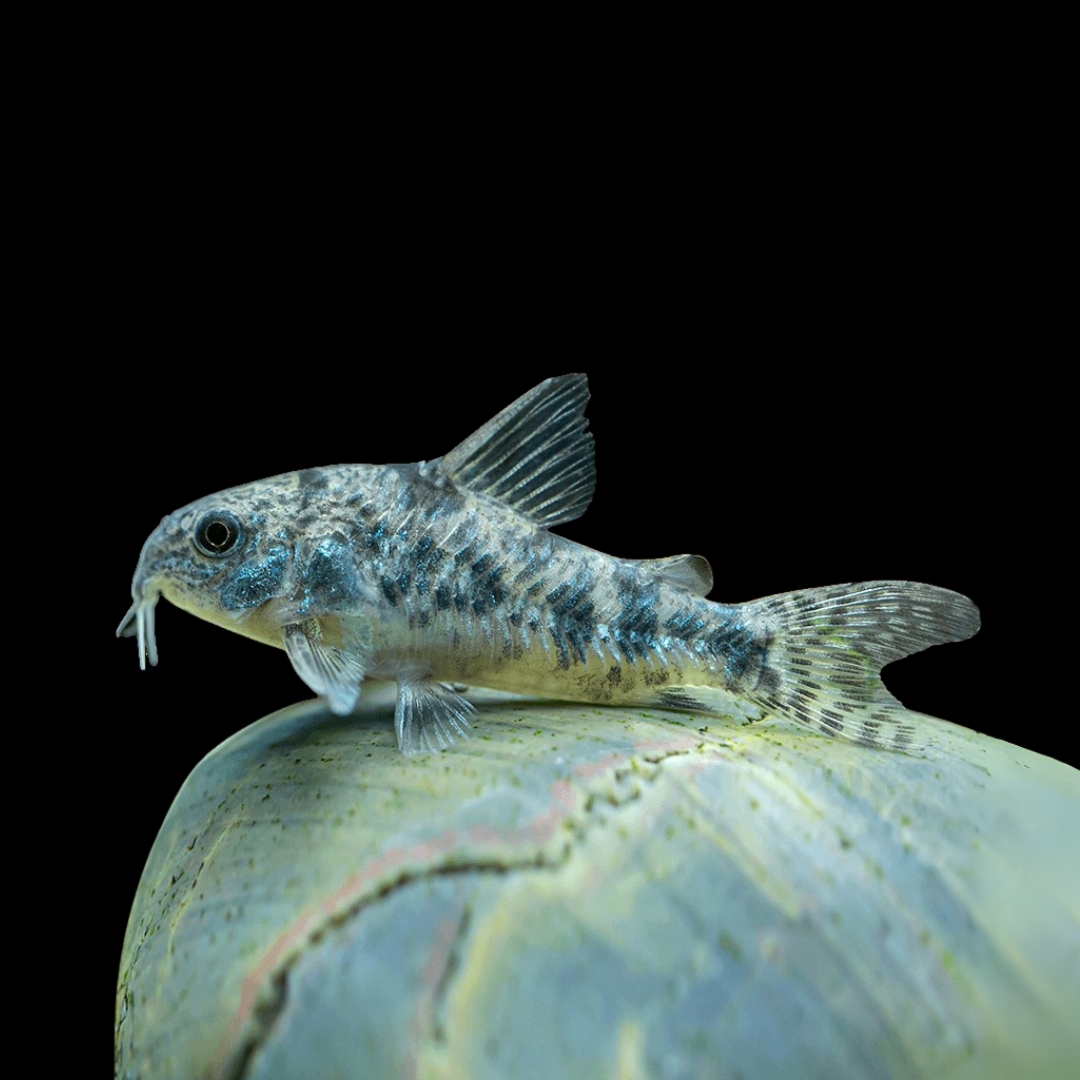
解説 / Description
ホプリソマ・パレアトゥムは、日本では長年「コリドラス・パレアタス」または「青コリ」の名で親しまれてきた、南米南東部原産の小型装甲ナマズです。銀灰色から灰緑色の体に不規則な暗色斑が入り、光の角度によって青みや金属光沢を帯びて見えることがあります。安価で丈夫な入門魚として知られる一方、ダーウィンのビーグル号航海に関わる記載史、近年の分類再編、腸呼吸や発音行動など、学術的にも興味深い要素を数多く持つ魚です。 Hoplisoma paleatum, long known in the aquarium hobby as Corydoras paleatus or the peppered corydoras, is a small armored catfish from southeastern South America. Its silvery gray to gray-green body is covered with irregular dark mottling and may show a bluish or metallic sheen under aquarium lighting. Although it is famous as a hardy beginner-friendly fish, it also has a rich scientific background, including a history linked to Darwin’s voyage on HMS Beagle, recent taxonomic revision, intestinal air-breathing, and sound production.
飼育では、丈夫さに甘えず、細かな丸い砂、清潔でよく酸素を含む水、5匹以上の群れ、そして冷涼寄りの水温管理をそろえることが大切です。特に日本の夏は水温が上がりやすいため、長期飼育では冷却ファンや水槽用クーラーも選択肢に入ります。状態よく飼い込むと、底砂を探る自然な採餌、群れでの移動、繁殖時のTポジションなど、青コリの名前だけでは語り尽くせない奥行きある魅力を見せてくれます。 In aquaria, its hardiness should not be taken as a reason to neglect its needs. Fine rounded sand, clean and well-oxygenated water, a group of five or more, and relatively cool temperature management are all important. Japanese summers can be challenging, so cooling fans or aquarium chillers may be worth considering for long-term care. When kept well, this familiar fish reveals much more than its common name suggests, from natural sand-sifting and group movement to the T-position seen during spawning.
基本情報 / Basic Information
| 学名 / Scientific Name | Hoplisoma paleatum(旧 Corydoras paleatus) |
|---|---|
| 通称 / Common Name | 青コリ、花コリ、パレアタス、旧コリドラス・パレアタスPeppered corydoras, peppered cory, peppered catfish |
| 分類 / Family | ナマズ目・カリクティス科・コリドラス亜科・ホプリソマ属Order Siluriformes, family Callichthyidae, subfamily Corydoradinae, genus Hoplisoma |
| 英名 / English Name | Peppered corydoras, Peppered cory, Peppered catfish |
| 分布 / Distribution | 南米南東部。アルゼンチン、ウルグアイ、ブラジル南部を中心に、下流パラナ川流域や周辺の沿岸河川に分布します。資料によってはボリビアを含む範囲で扱われることもあります。Southeastern South America, mainly Argentina, Uruguay, and southern Brazil, including the lower Paraná River basin and nearby coastal rivers. Some catalogues treat the distribution more broadly and include Bolivia. |
| 最大体長 / Max Size | およそ6〜7cm前後。雌の方が大きく丸みを帯びる傾向があります。About 6–7 cm. Females tend to become larger and rounder than males. |
| 寿命 / Lifespan | 一般的には5〜8年ほどが目安です。清潔な水質、過密を避けた飼育、夏場の高水温対策ができれば、さらに長く飼育できることもあります。Typically around 5–8 years. With clean water, reasonable stocking density, and careful summer heat management, some individuals can live longer. |
飼育環境 / Aquarium Environment
| 水槽サイズ / Tank Size | 群れでの飼育を前提に、60cm規格水槽(約57L)以上を基本に考えると安心です。少数の一時飼育や隔離では45cm規格水槽(約35L)でも管理できますが、本種の社会性や底面を歩き回る行動を引き出すには、5匹以上を60cm以上で飼う方が向いています。For a proper group, a standard 60 cm tank of about 57 L or larger is the safer baseline. A standard 45 cm tank of about 35 L can work for temporary holding or a very small group, but a group of five or more in a 60 cm tank or larger better supports the species’ social behavior and active bottom foraging. |
|---|---|
| 水温 / Temperature | 目安は20〜24℃前後です。原産地が亜熱帯から温帯寄りの水域を含むため、一般的な熱帯魚よりやや低めの水温を好みます。18〜26℃程度には適応しますが、28℃を超える状態が長く続くと負担が大きく、30℃前後では酸欠や体調不良のリスクが高まります。 Aim for about 20–24°C. Because its native range includes subtropical to relatively cool waters, it generally prefers cooler conditions than many tropical community fish. It can adapt to roughly 18–26°C, but prolonged temperatures above 28°C are stressful, and around 30°C the risk of oxygen stress and poor condition increases. |
| 水質 / Water Quality | 弱酸性から中性、場合によっては弱アルカリ性寄りまで幅広く適応します。目安はpH 6.0〜8.0、硬度5〜19dH前後です。数値を極端に追い込むより、急変を避け、硝酸塩や底床の汚れをためない安定管理を優先します。It adapts to a fairly broad range from slightly acidic to neutral, and sometimes slightly alkaline water. A practical range is around pH 6.0–8.0 and 5–19 dH. Stability, low nitrate buildup, and a clean substrate are more important than chasing an extreme target value. |
| レイアウト / Layout | 底床は角の丸い細かな砂を薄めに敷くのがおすすめです。尖った砂利や汚れた底床はヒゲを傷める原因になります。流木、石、水草、落ち葉風の素材などで日陰と隠れ家を作ると落ち着きますが、底面には泳ぎ回れる余白も残してください。Use a shallow layer of fine, rounded sand. Sharp gravel or dirty substrate can damage the barbels. Driftwood, stones, plants, and leaf-litter-style materials can create shade and hiding places, but leave open bottom areas for active foraging. |
| 注意点 / Precautions | 「残餌処理役」として過小評価せず、専用の沈下性飼料を確実に与えます。高水温、酸欠、底床の汚れ、急な水質変化は不調の原因になります。また、コリドラス類では強いストレス時に毒性のある分泌物や棘によるトラブルが報告されているため、輸送袋の水が白濁している個体は早めに清潔な水へ移し、手で扱う際は胸鰭や背鰭の棘に注意します。Do not treat this fish merely as a leftover cleaner; make sure it receives appropriate sinking foods. Heat, low oxygen, dirty substrate, and sudden water-quality changes are common causes of trouble. Corydoradine catfishes are also reported to release toxic secretions under severe stress and have sharp fin spines, so fish arriving in cloudy transport water should be moved promptly to clean water, and handling should be done carefully. |
餌と給餌 / Feeding
| 餌の種類 / Diet | 雑食性です。沈下性タブレット、コリドラス用ペレット、細かめの沈む顆粒飼料を主食にし、冷凍アカムシ、イトメ、ブラインシュリンプ、ミジンコなどを補助的に与えると状態が上がります。野生下では小型の底生動物や昆虫の幼虫、甲殻類、植物質などを利用するとされています。Omnivorous. Use sinking tablets, corydoras pellets, and fine sinking granules as staples, supplemented with frozen bloodworms, tubifex-type foods, brine shrimp, and daphnia. In the wild, it is reported to feed on small benthic animals, insect larvae, crustaceans, and plant matter. |
|---|---|
| 給餌のポイント / Feeding Tips | 上層の魚に餌を食べ尽くされる場合は、消灯前や他魚への給餌直後に沈下性の餌を入れると届きやすくなります。お腹が軽く丸くなる程度を目安にし、食べ残しは水質悪化とヒゲのトラブルにつながるため、数分で食べ切れる量に調整します。繁殖を狙う場合は、冷凍アカムシやミジンコなどで雌の体力をつけます。If surface or midwater fish take all the food, offer sinking foods just before lights-out or immediately after feeding the other fish. Feed enough for a gently rounded belly, but remove excess because leftovers can foul the substrate and harm the barbels. For breeding, condition females with richer foods such as frozen bloodworms and daphnia. |
性格と混泳 / Temperament and Tank Mates
| 性格 / Temperament | 非常に温和で、同種同士でも激しい争いはほとんどありません。単独では臆病になりやすいため、5匹以上の群れで飼うと落ち着き、前面にも出てきやすくなります。底面を活発に探りますが、他魚を追い回すタイプではありません。Very peaceful, with little serious aggression toward its own kind. Single individuals can become shy, while groups of five or more are calmer and more visible. They forage actively along the bottom but do not normally harass other fish. |
|---|---|
| 混泳の相性 / Compatibility | 小型カラシン、ラスボラ、メダカ類、温和な小型グラミー、オトシンクルス、穏やかな小型シクリッドなどと相性がよいです。大型魚、肉食魚、低層で強く縄張りを張る魚、ヒゲやヒレをつつく魚との混泳は避けます。やや低めの水温を好むため、混泳相手も同じ温度帯で無理なく飼える種類を選びます。Good tank mates include small tetras, rasboras, ricefish, peaceful small gouramis, Otocinclus, and calm dwarf cichlids. Avoid large predators, carnivorous fish, strongly territorial bottom dwellers, and fin- or barbel-nipping species. Because it prefers cooler water, choose companions that also thrive in the same temperature range. |
病気と対策 / Diseases and Prevention
| かかりやすい病気 / Common Diseases | 白点病、水カビ、細菌性の皮膚炎、ヒゲの短縮や溶け、底床の汚れに由来するエロモナス症状などに注意します。特にヒゲの異常は、尖った底砂、食べ残し、古い水、酸素不足が重なったときに出やすいサインです。Watch for ich, fungal growth, bacterial skin infections, barbel erosion, and Aeromonas-like symptoms associated with dirty substrates. Barbel problems are often a warning sign of sharp gravel, leftover food, old water, or insufficient oxygen. |
|---|---|
| 対策と予防 / Prevention | 予防の基本は、清潔な細砂、定期的な換水、十分なエアレーション、急な水質変化を避ける導入です。ナマズ類は薬品に敏感な場合があるため、薬浴を行う際は製品の注意書きを確認し、急な高濃度投与を避けて様子を見ながら対応します。夏場は病気の進行と酸欠が重なりやすいため、まず水温と酸素を整えます。Prevention begins with clean fine sand, regular water changes, strong aeration, and careful acclimation that avoids sudden shifts. Catfishes may be sensitive to medications, so follow product instructions and avoid sudden high dosing. In summer, disease progression and oxygen stress can overlap, so temperature and oxygen should be corrected first. |
増やし方(繁殖) / Breeding
| 雌雄の判別 / Sexing | 雌は雄より大きく、上から見ると腹部が丸く張ります。雄はやや小型でスリムになり、背鰭や胸鰭が相対的に長く見えることがあります。繁殖前の雌は抱卵により腹部のふくらみがはっきりします。Females are larger and rounder, especially when viewed from above. Males are usually smaller and slimmer, and their dorsal and pectoral fins can appear proportionally longer. Gravid females show a noticeably swollen abdomen. |
|---|---|
| 繁殖形態 / Reproduction | 卵生です。典型的なコリドラス類と同じく、雄と雌が直角に近い姿勢をとる「Tポジション」を行います。雌は腹鰭で2〜4個ほどの卵を抱え、受精後にガラス面、水草の葉、フィルターやヒーター周辺などへ粘着卵を産み付けます。この行動を繰り返し、1回の産卵でおよそ100個前後の卵を産むことがあります。This is an egg-laying species. Like typical corydoradine catfishes, the pair forms a near-right-angle T-position. The female holds about 2–4 eggs between her pelvic fins, and after fertilization she attaches the sticky eggs to glass, plant leaves, or surfaces near filters and heaters. This sequence is repeated, and a spawning may produce around 100 eggs. |
| 繁殖のポイント / Breeding Tips | 親魚をよく太らせたうえで、普段より少し低い温度の新しい水で換水すると、雨季の刺激に似たきっかけになり産卵しやすくなります。雄2匹に雌1匹程度の比率にすると成功しやすいです。親は卵を守らず、食卵することもあるため、卵を見つけたら別容器や隔離ネットへ移します。軽いエアレーションを行い、無精卵やカビた卵は早めに取り除きます。稚魚はヨークサック吸収後にブラインシュリンプ幼生や微細な初期飼料から始めます。Condition the adults well, then perform a water change with fresh water slightly cooler than usual to imitate rainy-season cues. A ratio of about two males to one female often works well. Parents do not guard the eggs and may eat them, so move eggs to a separate container or breeding net when found. Provide gentle aeration and remove infertile or fungus-covered eggs promptly. After the yolk sac is absorbed, start the fry on newly hatched brine shrimp or very fine first foods. |
雑学と豆知識 / Trivia and Fun Facts
| 1. 「コリドラス」から「ホプリソマ」へ / 1. From Corydoras to Hoplisoma | 本種は長くコリドラス・パレアタスとして親しまれてきましたが、近年のコリドラス亜科の系統分類再編により、現在はホプリソマ・パレアトゥムとして扱われることが増えています。これは流行語のような言い換えではなく、旧コリドラス属に含められていた多様な魚たちを、進化的により自然なまとまりへ整理し直す動きの一部です。とはいえ、日本の店頭や愛好家の会話では「青コリ」「パレアタス」「旧コリドラス・パレアタス」という名前も広く通じます。新旧の学名と流通名を知っておくと、店頭や飼育書でこの魚を探すときに役立ちます。This species was known for generations as Corydoras paleatus, but recent revisions of Corydoradinae increasingly treat it as Hoplisoma paleatum. This is not a casual change of wording; it is part of a broader attempt to reorganize the diverse fishes formerly placed in Corydoras into more natural evolutionary groups. In the aquarium trade, however, names such as peppered corydoras and Corydoras paleatus will likely remain familiar for some time. Knowing the current and older scientific names, as well as trade names, helps when looking for this fish in shops or care books. |
|---|---|
| 2. ダーウィンの航海と模式産地の謎 / 2. Darwin’s Voyage and the Type-Locality Puzzle | ホプリソマ・パレアトゥムの学術史は、チャールズ・ダーウィンのビーグル号航海にまでさかのぼります。19世紀の南米調査で得られた標本をもとに記載された魚ですが、古い標本では採集地ラベルの欠落や記載の曖昧さが問題となり、後世の研究者を悩ませました。近年の再検討では、ウルグアイのマルドナド周辺、特にLaguna del Diarioが有力な候補地の一つとされていますが、元ラベルが失われているため、完全な断定は避けるべきとされています。身近な青コリの背景に、博物学時代から続く分類学の物語が隠れているのです。The scientific history of Hoplisoma paleatum reaches back to Charles Darwin’s voyage on HMS Beagle. It was described from material collected in South America during the 19th century, but missing locality labels and ambiguous early descriptions later complicated its taxonomy. Recent revisionary work has treated the Maldonado region of Uruguay, especially Laguna del Diario, as one plausible candidate for the type locality, but the loss of the original labels means that certainty is not possible. This familiar aquarium fish therefore carries a story that reaches back to the age of classic natural history. |
| 3. 水面へ一瞬上がる理由 / 3. Why It Dashes to the Surface | 水槽内で、突然水面へ上がって空気を飲み、すぐに底へ戻る姿を見ることがあります。これは単なる驚きだけでなく、コリドラス類に見られる補助的な空気呼吸に関係する行動です。飲み込んだ空気から後腸で酸素を取り込む仕組みは、低酸素になりやすい浅い水域や止水域で生きる助けになります。ただし、水槽でこの行動が極端に増える場合は、水温上昇、酸欠、ろ過不足、水質悪化のサインであることもあります。かわいい仕草として眺めるだけでなく、水槽の状態を読み取る手がかりとして観察するとよいでしょう。In aquariums, this fish may suddenly dash to the surface, gulp air, and immediately return to the bottom. This is linked to accessory air-breathing seen in corydoradine catfishes rather than being only a startle response. Oxygen can be absorbed from swallowed air through the hindgut, helping the fish cope with shallow or still waters where dissolved oxygen may drop. If surface gulping becomes unusually frequent, however, it may indicate high temperature, low oxygen, inadequate filtration, or declining water quality. It is therefore both a charming behavior and a useful sign to observe. |
| 4. 実は音を出す魚 / 4. A Fish That Produces Sound | 本種は胸鰭の棘を動かして微小な音を出す魚としても知られています。研究では、求愛、個体同士の接触、強いストレスを受けた状況で発音することが報告されています。水槽の外から常に聞こえるほど大きな音ではありませんが、青コリたちの世界には、見た目だけでは分からない音のコミュニケーションが存在します。群れで飼う意味は、単に寂しがらせないためだけでなく、本来の社会的な行動を引き出す点にもあります。This species is also known as a sound-producing fish. Studies report that it produces small sounds by moving the pectoral spines during courtship, encounters between individuals, and stressful situations. These sounds are not always obvious to a person outside the aquarium, but they reveal that the lives of peppered corydoras include acoustic communication beyond what we can see. Keeping them in a group is therefore important not only to reduce shyness, but also to allow more natural social behavior. |
| 5. 毒性分泌と輸送時の注意 / 5. Toxic Secretions and Transport Care | ナマズ類では、背鰭や胸鰭の棘と関連した毒腺、またはストレス時の毒性分泌が知られるグループがあります。コリドラス類でも、強いストレスや輸送時に水が白濁し、個体が弱る「自己中毒」と呼ばれる現象が報告されています。ただし、種や状況によって程度は異なり、日常飼育で過度に怖がる必要はありません。実用上は、購入後の袋水を水槽へ入れない、白濁が強い場合は早めに清潔な水へ移す、網で追い回しすぎない、素手で棘を押さえない、といった扱いが安全です。Some catfishes are known for venom glands associated with dorsal or pectoral spines, and corydoradine catfishes are also reported to release toxic secretions under severe stress. During transport, cloudy water and weakened fish are sometimes described by aquarists as self-poisoning. The degree varies by species and situation, so this should not be exaggerated in normal aquarium care. Practical precautions are simple: do not pour transport water into the aquarium, move fish from strongly clouded bag water to clean water promptly, avoid excessive chasing with a net, and do not press the fin spines with bare hands. |
| 6. 観賞魚史に残る古参種 / 6. A Veteran of Aquarium History | ホプリソマ・パレアトゥムは、観賞魚としても非常に古い歴史を持つ種類です。19世紀後半にはヨーロッパで飼育・繁殖された記録があり、今日まで世界中の水槽で親しまれてきました。日本でも「青コリ」は、赤コリや白コリと並んで入門種として紹介されることが多く、アクアリウム文化の入口を支えてきた存在です。ただし、店頭で「白コリ」と呼ばれる魚にはアルビノのアエネウス系などが含まれることもあるため、品種や学名を確認すると、より正確に楽しめます。Hoplisoma paleatum also has a long history as an aquarium fish. It was already being kept and bred in Europe in the late 19th century, and it has remained a familiar aquarium species around the world ever since. In Japan, the “ao-cory” has long stood beside the bronze cory and albino cory forms as one of the classic entry points into the hobby. Because trade names such as “albino cory” can refer to different albino forms, checking the variety and scientific name helps aquarists understand exactly what they are keeping. |
まとめ / Conclusion
ホプリソマ・パレアトゥムは、丈夫で温和、群れでの行動を楽しめ、繁殖にも挑戦しやすい底棲魚です。古くから「青コリ」や旧名のコリドラス・パレアタスとして親しまれてきましたが、近年の分類再編により、現在はホプリソマ属の一種として整理されています。身近な入門種でありながら、ダーウィン採集標本に関わる記載史、低酸素環境に対応する腸呼吸、胸鰭棘条を使った発音行動など、学術的にも興味深い特徴を備えています。 Hoplisoma paleatum is a hardy, peaceful bottom-dwelling fish that shows attractive group behavior and is relatively approachable for breeding. Long familiar in the aquarium hobby as the peppered cory or Corydoras paleatus, it is now treated as a member of Hoplisoma following recent taxonomic revision. Although it is a familiar beginner species, it also has scientific interest, including a complex history linked to Darwin’s specimens, intestinal air-breathing in low-oxygen conditions, and sound production using the pectoral-fin spines.
長期飼育では、60cm規格水槽以上で複数匹を飼い、角の丸い細砂、清潔で酸素を含む水、夏場の高水温対策を整えることが重要です。底砂を探る行動や仲間と並んで休む様子を観察できる環境を用意すれば、本種らしい自然な姿を引き出しやすくなります。手に入りやすい魚だからこそ、残餌処理役としてではなく、冷涼な南米水系に適応してきた一種のナマズとして丁寧に扱いたい魚です。 For long-term care, it is important to keep a group in a standard 60 cm tank or larger, use rounded fine sand, maintain clean oxygen-rich water, and prevent excessive summer heat. A setup that allows sand-sifting and calm group resting will bring out more natural behavior. Because this species is so readily available, it is worth treating it not merely as a scavenger, but as a small catfish adapted to the cooler waters of southern South America.

気になる道具や飼い方を見つけてみませんか?
 アイのアクアグッズ案内テトラミンって、こんなにあるの? アイとコタロウのごはん探究旅道具の特徴や使い方、選ぶときのポイントをアイが紹介します。記事はコチラ →
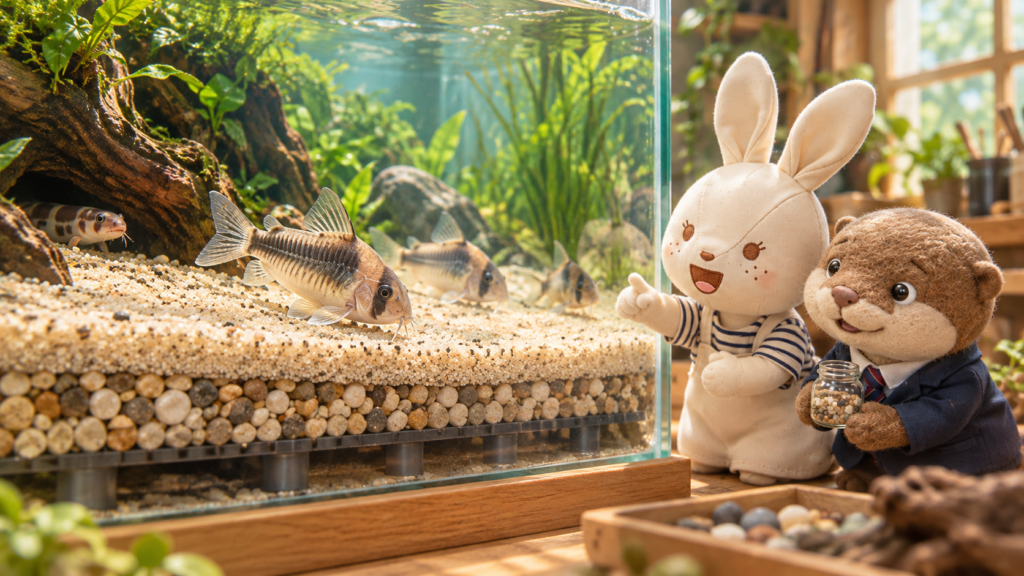 アイのアクアグッズ案内水槽の底砂の選び方|砂・砂利の違いとおすすめ商品道具の特徴や使い方、選ぶときのポイントをアイが紹介します。記事はコチラ →
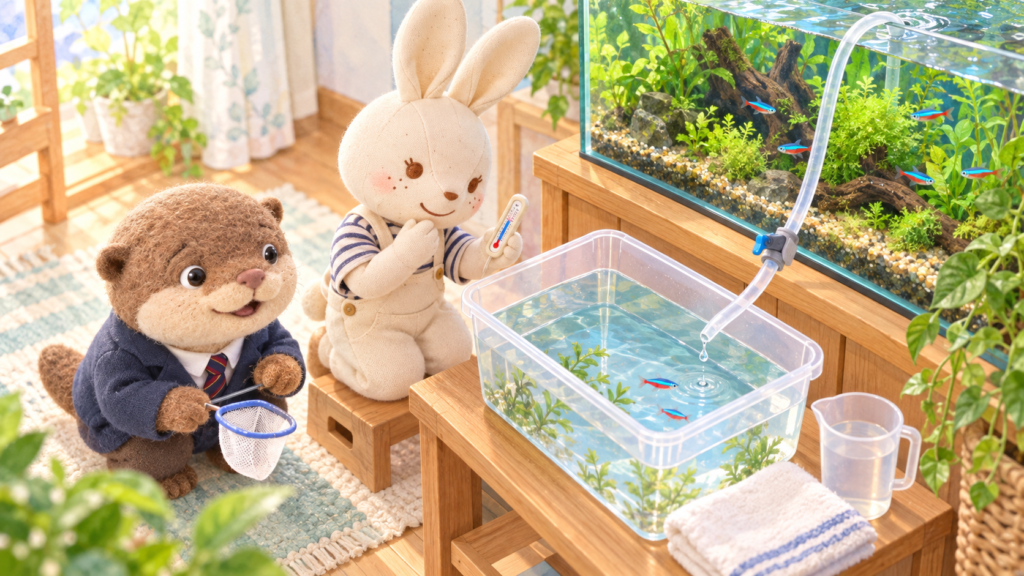 アイのアクアグッズ案内水合わせの道具とやり方|魚を迎える前にそろえたい容器・点滴キット・ネット買ってきた魚はすぐ水槽に入れていい? 水温合わせと水合わせの違いから、透明ケース・点滴キット・ネットの選び方、時間をかけすぎない注意点まで、アイとコタロウが紹介します。記事はコチラ →
 アイのアクアグッズ案内ベタの一匹飼いを楽しむ|水槽・ヒーター・ふた・フィルターの選び方ベタの一匹飼いに向く水槽容量、ふたと空気層、ヒーターと水温計、弱い水流のフィルターを、コタロウとアイの会話で分かりやすく解説します。記事はコチラ →
さまざまな飼育テーマをご紹介。リンク先の記事には広告・商品紹介が含まれます。
案内・紹介記事一覧へ →参考文献・根拠資料
この記事では、ホプリソマ・パレアトゥム(旧コリドラス・パレアタス)の分類、分布、生息環境、飼育条件、繁殖、病気や注意点を確認するため、店舗・通販サイト、個人ブログ、まとめサイトを除外し、学術論文、魚類分類データベース、獣医学・魚病管理資料を中心に参照しました。水槽サイズや給餌の実務表現は、下記資料の体長・水質・生態・健康管理の情報をもとに、観賞魚飼育向けに安全側へ整理したものです。
- Dias, A. C. et al. 2024 Phylogenomic analyses in the complex Neotropical subfamily Corydoradinae (Siluriformes: Callichthyidae) with a new classification based on morphological and molecular data. Zoological Journal of the Linnean Society, zlae053. 支える内容:コリドラス亜科の系統再編、Hoplisoma の復活、旧 Corydoras paleatus を含む分類上の位置づけ。 https://doi.org/10.1093/zoolinnean/zlae053
- Fricke, R., Eschmeyer, W. N. & Fong, J. D. 2026 Eschmeyer’s Catalog of Fishes: Hoplisoma paleatum species record. California Academy of Sciences. 支える内容:現在の有効名、シノニム、タイプ標本・タイプ産地情報、分布、淡水性の生息環境。 https://researcharchive.calacademy.org/research/ichthyology/catalog/fishcatget.asp?spid=67744
- Tencatt, L. F. C., Britto, M. R. & Pavanelli, C. S. 2016 Revisionary study of the armored catfish Corydoras paleatus (Jenyns, 1842) (Siluriformes: Callichthyidae) over 180 years after its discovery by Darwin, with description of a new species. Neotropical Ichthyology, 14(1), e150089. 支える内容:ダーウィン採集標本に関わる記載史、形態識別、胸鰭棘条の鋸歯、体側斑紋、分布、Laguna del Diarioをめぐる慎重なタイプ産地解釈。 https://doi.org/10.1590/1982-0224-20150089
- Tencatt, L. F. C. et al. 2025 Another piece to the Hoplisoma paleatum puzzle, with a discussion on the monophyly of Hoplisoma. Neotropical Ichthyology, 23(3), e250048. 支える内容:Hoplisoma paleatum 周辺の最新分類議論、Urkumayu 提案後の分類安定性、H. microcephalum の扱いに関する補助的確認。 https://doi.org/10.1590/1982-0224-2025-0048
- Froese, R. & Pauly, D. (eds.) 2026 FishBase: Hoplisoma paleatum (Peppered corydoras) species summary. 支える内容:最大体長、分布国、淡水・底生性、pH、硬度、水温範囲、IUCN評価、観賞魚としての利用情報。 https://www.fishbase.se/Summary/SpeciesSummary.php?id=10926
- Pruzsinszky, I. & Ladich, F. 1998 Sound production and reproductive behaviour of the armoured catfish Corydoras paleatus (Callichthyidae). Environmental Biology of Fishes, 53, 183–191. 支える内容:胸鰭棘条を使った発音行動、求愛・ストレス時の音響行動、繁殖時の行動観察。 https://doi.org/10.1023/A:1007413108550
- Plaul, S. E., Barbeito, C. G. & Díaz, A. O. 2016 Histochemical differences along the intestine of Corydoras paleatus (Siluriformes: Callichthyidae). Revista de Biología Tropical, 64(1), 327–340. 支える内容:後腸を用いた補助的な空気呼吸、腸管組織と低酸素環境への適応に関する説明。 https://doi.org/10.15517/rbt.v64i1.18235
- Wright, J. J. 2009 Diversity, phylogenetic distribution, and origins of venomous catfishes. BMC Evolutionary Biology, 9, 282. 支える内容:ナマズ目における毒腺・毒性分泌の進化的背景、棘を扱う際の注意点。ナマズ目全体に関する知見を、本種だけの確定した性質と混同しないよう注意が必要です。 https://doi.org/10.1186/1471-2148-9-282
- Francis-Floyd, R. & Petty, B. D. 2026 Providing a Home for Fish. Merck Veterinary Manual. 支える内容:水槽設置、ろ過、温度管理、清掃、魚の健康維持、輸送袋の水を水槽へ入れないという導入時の基本注意。 https://www.merckvetmanual.com/all-other-pets/fish/providing-a-home-for-fish
- Merck Veterinary Manual. 2024–2026 Environmental Diseases of Aquatic Animals in Aquatic Systems. 支える内容:水質悪化、低酸素、高アンモニア、温度変動が魚の病気・死亡リスクに直結するという病気予防の基礎。 https://www.merckvetmanual.com/exotic-and-laboratory-animals/aquatic-systems/environmental-diseases-of-aquatic-animals-in-aquatic-systems
確認日:2026年6月17日。分類データベースは更新されるため、学名・シノニム・分布の細部は将来変更される可能性があります。




コメント