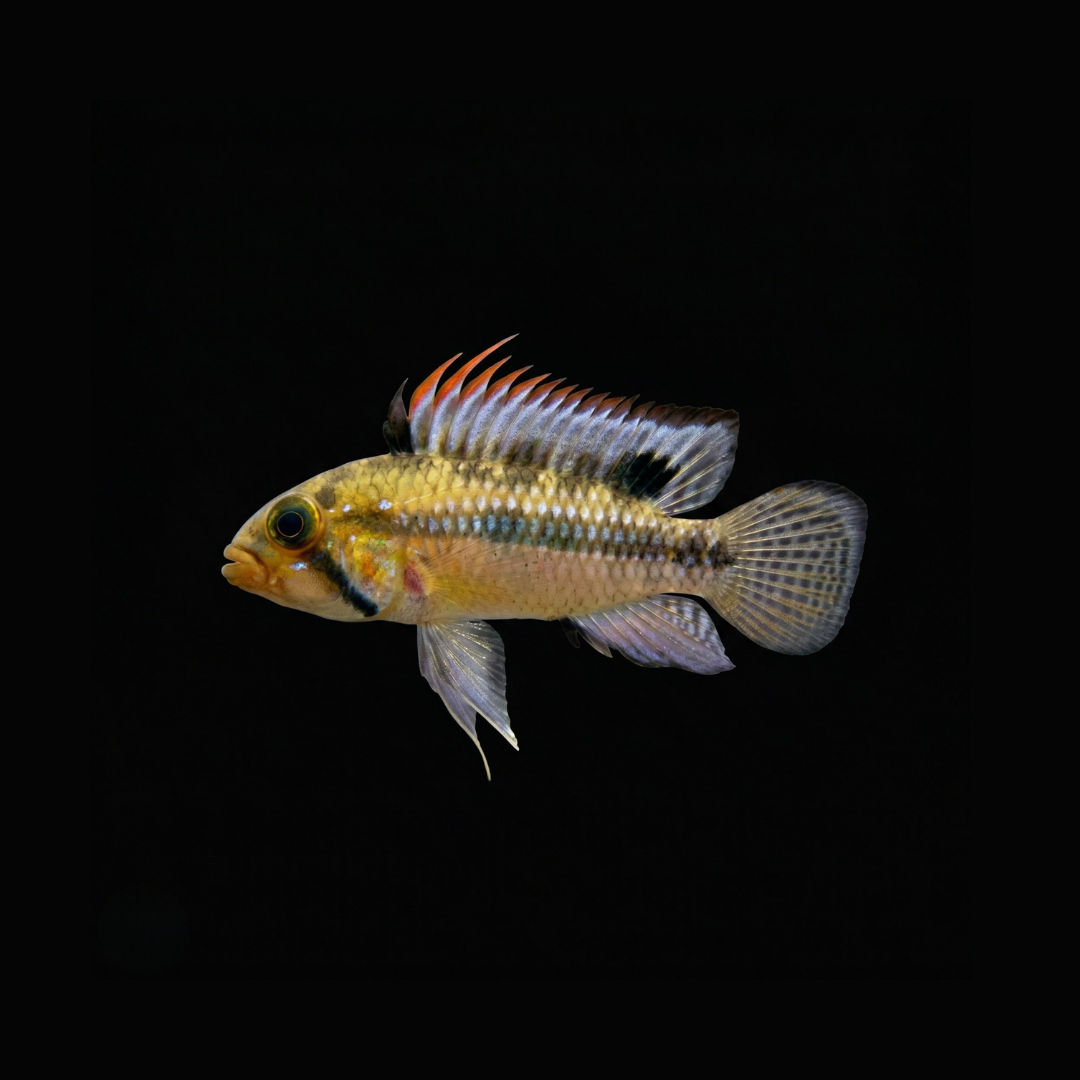
アピストグラマ・ノーベルティは、ペルー北東部ロレト県のタワヨ川流域を中心に知られるドワーフシクリッドです。成熟したオスは青みを帯びた金属光沢をまとい、発達した口と厚い唇、背鰭後方の黒斑、丸みのある尾鰭、腹部に並ぶ波状の暗色線が特徴です。一方、繁殖期のメスは鮮やかな黄色へと変化し、黒い斑紋を強く浮かび上がらせながら卵や稚魚を守ります。色彩だけでなく、縄張り形成、求愛、洞窟での産卵、メスによる保護行動まで観察できる点も、本種の大きな魅力です。Apistogramma norberti is a dwarf cichlid known primarily from the Río Tahuayo drainage in Loreto, northeastern Peru. Mature males develop a metallic bluish sheen, strongly developed lips, a dark blotch on the posterior part of the dorsal fin, a rounded caudal fin, and wavy dark lines along the abdomen. Females can turn vivid yellow during breeding and show strongly contrasting dark markings while guarding eggs and fry. Its appeal lies not only in coloration, but also in the opportunity to observe territorial behavior, courtship, cave spawning, and female parental care in the aquarium.
基本情報 / Basic Information
学名 / Scientific Name
Apistogramma norberti Staeck, 1991
通称 / Common Name
アピストグラマ・ノーベルティ、旧流通名「アピストグラマ・ビッグマウス」Apistogramma norberti; formerly traded as “Big-mouth” Apistogramma
分類 / Family
シクリッド目・シクリッド科・ゲオファーガス亜科・アピストグラマ属。愛好家の形態分類ではノーベルティ・グループに置かれ、カカトゥオイデス・グループやナイスニー・グループに見られる特徴をあわせ持つと整理されています。これらの「グループ」は正式な分類階級ではありません。Order Cichliformes, family Cichlidae, subfamily Geophaginae, genus Apistogramma. In hobbyist morphology-based groupings it is placed in the A. norberti group and is described as combining traits seen in the A. cacatuoides and A. nijsseni groups. These species groups are not formal taxonomic ranks.
英名 / English Name
Big-mouth Apistogramma (historical aquarium name; no widely standardized English common name)
分布 / Distribution
南米ペルー北東部ロレト県。確実な分布域としてタワヨ川流域が知られ、タムシヤク川水系でも採集記録があります。基準産地はタワヨ川下流域のクエブラダ・ヌエボ・オリゾンテへ注ぐ森林内の小川です。Northeastern Peru, Department of Loreto. The Río Tahuayo drainage is the firmly documented range, and collection records also exist from the Río Tamshiyacu system. The type locality is a forest brook flowing into Quebrada Nuevo Horizonte in the lower Río Tahuayo drainage.
最大体長 / Max Size
学術資料では最大標準体長が3.9cm、メスは3.0cmとされています。標準体長は尾鰭を含まないため、流通資料で見られる全長表記とはそのまま比較できません。飼育時は「小型のドワーフシクリッド」と捉えるのが適切です。Scientific references list a maximum standard length of 3.9 cm, with females recorded to 3.0 cm. Standard length excludes the caudal fin, so these figures should not be directly compared with total-length measurements often used in aquarium trade information. In practice, it remains a small dwarf cichlid.
寿命 / Lifespan
本種について、寿命を明確に示した信頼性の高い種別データは十分に確認されていません。長期飼育には、水質の急変や過密、継続的なストレスを避け、安定した環境を保つことが重要です。A well-established species-specific lifespan is not sufficiently documented in reliable references. For long-term maintenance, stable conditions and the avoidance of abrupt water changes, overcrowding, and chronic stress are more important than relying on a fixed lifespan figure.
飼育環境 / Aquarium Environment
水槽サイズ / Tank Size
ペア飼育の最低ラインは45cm規格水槽(約35〜40L)程度ですが、縄張りを分けやすく水質も安定させやすい60cm規格水槽(約60L)以上を推奨します。複数のメスを含む構成や混泳では、さらに底面積の広い水槽が適します。A 45 cm standard aquarium of roughly 35–40 L is a practical minimum for a pair, but a 60 cm standard aquarium of about 60 L or larger is recommended for more stable water and clearer territorial separation. A larger footprint is preferable when keeping multiple females or tank mates.
水温 / Temperature
24〜26℃を基本とし、繁殖を狙う場合は25℃前後で安定させると管理しやすいでしょう。現地では24℃台の記録もあり、常時高温にする必要はありません。Maintain approximately 24–26°C, with around 25°C being a convenient stable target for breeding. Field observations include temperatures in the 24°C range, so continuously high temperatures are unnecessary.
水質 / Water Quality
軟水の弱酸性環境が基本です。一般的な飼育目安としてはpH5.8〜6.8、総硬度0〜4°dGH程度が示されていますが、現地ではpH5.9、総硬度1°dGH未満、導電率10µS/cmという記録があり、別の採集記録ではpH4.74、導電率7µS/cmも報告されています。繁殖ではより軟らかく酸性寄りの水が用いられることがありますが、水槽では数値を急激に動かさず、安定を優先します。Soft, mildly acidic to acidic water is the basic requirement. General aquarium references give about pH 5.8–6.8 and 0–4°dGH, while field records include pH 5.9 with less than 1°dGH and conductivity around 10 µS/cm; another collection record reported pH 4.74 and 7 µS/cm. Softer, more acidic water is often used for breeding, but aquarium stability should take priority over rapid adjustment toward extreme values.
レイアウト / Layout
角のない細かな砂を薄く敷き、流木、石、ココナッツシェルター、産卵用ポットなどで視線を遮りながら複数の隠れ家を作ります。基準産地では、日陰の森林内の小川に落ち葉や枯れ枝が堆積し、透明な黄褐色の水が残る浅い場所から採集されています。水槽でも落ち葉や流木を使って薄暗く落ち着ける環境を作ると、本種の生活場所を再現しやすくなります。水草を使う場合は、低光量でも維持しやすい種類や浮き草が扱いやすいでしょう。Use a thin layer of fine, smooth sand and create several shelters with driftwood, rocks, coconut caves, or spawning pots while breaking lines of sight. At the type locality, the fish was collected from a shaded forest stream with leaf litter and woody debris in shallow pools of clear yellowish water. In the aquarium, leaf litter and driftwood can be used to create a subdued, sheltered environment that reflects this habitat. If plants are used, low-light species and floating plants are practical choices.
注意点 / Precautions
縄張り意識が強く、特に繁殖期のメスはオスに対しても激しく攻撃することがあります。退避場所を多く設け、産卵後に追い詰められる個体が出た場合は隔離します。また、極軟水ではpHを支える緩衝力が小さいため、換水時は新しい水とのpH・硬度・水温差を小さくし、急変を避けます。ろ過は強い水流を作らないスポンジフィルターなどが適しています。Territorial behavior can be intense, and breeding females may attack even the male. Provide many escape routes and separate any fish that becomes trapped or repeatedly attacked after spawning. Very soft water has little buffering capacity, so replacement water should be closely matched in pH, hardness, and temperature to avoid sudden changes. Gentle filtration such as a sponge filter is well suited to this species.
餌と給餌 / Feeding
餌の種類 / Diet
飼育上は肉食性の強い雑食として扱い、冷凍アカムシ、ブラインシュリンプ、ミジンコなどの小型餌生物や冷凍餌に、小型の沈下性顆粒飼料を組み合わせます。底層付近で餌をついばむため、口に入る大きさで沈みやすい餌が使いやすいでしょう。In aquarium care it is best treated as an omnivore with a strong carnivorous tendency. Small live or frozen foods such as bloodworms, brine shrimp, and daphnia can be combined with fine sinking granules. Because it feeds near the bottom, appropriately sized foods that reach the lower part of the aquarium are especially practical.
給餌のポイント / Feeding Tips
一度に大量に与えるより、短時間で食べ切れる量を1日1〜2回に分けます。繁殖前は生餌や冷凍餌を適度に増やして親魚の体づくりを行いますが、肥満させないことも重要です。人工飼料に慣れていないワイルド個体は、嗜好性の高い餌から始めて徐々に沈下性顆粒へ移行すると受け入れやすくなります。Offer only what can be eaten promptly, usually once or twice a day, rather than giving a large amount at once. Before breeding, modestly increasing live or frozen foods can improve parental condition, but overfeeding and obesity should be avoided. Wild-caught fish that do not recognize prepared foods can be started on highly palatable foods and gradually transitioned to sinking granules.
性格と混泳 / Temperament and Tank Mates
性格 / Temperament
普段は物陰を利用しながら底層付近を生活圏とする慎重な魚ですが、同種や近縁種に対しては強い縄張り意識を示します。オスは広めの縄張りを持ち、繁殖期のメスは産卵場所と稚魚の周囲を非常に積極的に防衛します。環境に慣れると前面へ出てくることも多く、個体間の駆け引きを観察できる魚です。It is a cautious bottom-oriented fish that makes frequent use of cover, yet it can be strongly territorial toward its own species and related dwarf cichlids. Males maintain relatively broad territories, while breeding females vigorously defend the spawning site and fry. Once settled, many individuals become visible in the open, making their social interactions especially rewarding to observe.
混泳の相性 / Compatibility
同種のオス同士や他のアピストグラマ類との混泳は争いが激しくなりやすいため、十分な水槽サイズと視線を遮るレイアウトが必要です。上〜中層を泳ぐ小型ペンシルフィッシュや温和な小型カラシンを、警戒心を和らげる同居魚として利用する方法もあります。ただし繁殖を最優先する場合は、卵や稚魚が捕食される可能性を考慮して混泳数を絞ります。Keeping multiple males of the same species or mixing them with other Apistogramma can result in serious territorial conflict unless the aquarium is spacious and heavily structured. Small pencilfish and other peaceful characins occupying the middle and upper levels are sometimes used as companion fish to reduce excessive shyness. If breeding success is the priority, however, keep tank mates to a minimum because eggs or fry may still be eaten.
病気と対策 / Diseases and Prevention
かかりやすい病気 / Common Diseases
本種だけに特有の代表的な病気は知られていませんが、一般的な淡水熱帯魚と同様に、白点病などの外部寄生虫症、鰭や皮膚の細菌性感染、消化器系の不調には注意が必要です。ワイルド個体では、外見だけでは分かりにくい内部寄生虫を持ち込む可能性もあります。水質悪化や過密、輸送直後のストレスは発症のきっかけになりやすいため注意します。No disease is known to be uniquely characteristic of this species, but as with other freshwater tropical fish, watch for external parasites such as ich, bacterial infections of the fins or skin, and digestive disorders. Wild-caught specimens may also carry internal parasites that are not obvious externally. Poor water quality, crowding, and post-shipping stress can increase the likelihood of disease.
対策と予防 / Prevention
新規導入魚は可能であれば隔離水槽で状態を確認し、食欲、呼吸、排泄物、体表を観察してから本水槽へ移します。日常管理では、定期的な換水、食べ残しの除去、過密防止、急激なpH・水温変化の回避が基本です。薬浴が必要な場合は、薬剤によって使用できる水質条件が異なるため、製品の用法を守り、可能なら治療用水槽で慎重に行います。When possible, quarantine new arrivals and observe appetite, respiration, feces, and the skin before introducing them to the main aquarium. Routine prevention relies on regular water changes, removal of uneaten food, avoiding overcrowding, and preventing abrupt shifts in pH or temperature. If medication is required, follow the product directions because suitable water conditions vary by medication, and use a separate treatment aquarium when practical.
増やし方(繁殖) / Breeding
雌雄の判別 / Sexing
成熟したオスはメスより大きく、背鰭や尻鰭が伸び、口と唇が強く発達します。青みを帯びた体色や腹部の波状線もオスを見分ける手掛かりです。メスは小型で鰭の伸長が控えめで、繁殖期には全身が鮮やかな黄色に変化し、黒い斑紋が強調されます。背鰭後方の黒斑は本種の識別に役立つ特徴ですが、雌雄判別の決め手ではなく、個体によっては不明瞭または欠く場合もあります。若魚では複数の特徴を組み合わせて判断します。Mature males are larger than females, with more extended dorsal and anal fins and more strongly developed lips. A bluish body sheen and the wavy abdominal lines are also useful male traits. Females remain smaller with shorter fins and turn vivid yellow with strongly contrasting dark markings when breeding. The dark blotch on the posterior dorsal fin is useful for identifying the species, but it is not a reliable sex character and can be weak or absent in some individuals. Juveniles should therefore be sexed using several traits together.
繁殖形態 / Reproduction
洞窟産卵型です。メスは流木の裏やシェルターの天井などに卵を産み付け、主にメスが卵と仔魚を保護します。アピストグラマ属では一夫多妻的な繁殖行動が広く知られており、本種もその傾向を持つとされています。This is a cave-spawning species. The female attaches eggs to the underside of wood or the ceiling of a shelter and performs most of the direct care of eggs and larvae. Polygynous breeding behavior is widespread in Apistogramma, and A. norberti is also regarded as showing this tendency.
繁殖のポイント / Breeding Tips
繁殖を狙う場合は、軟らかく酸性寄りの水を安定させ、水温を25℃前後に保ち、栄養価の高い餌で親魚の状態を整えます。入口が狭い産卵場所を複数用意すると、メスが選択しやすくなります。産卵後はメスの攻撃性が急激に高まることがあるため、オスが逃げられない状況なら速やかに隔離します。稚魚が自由遊泳を始めた直後は微小な生物を利用し、その後は孵化直後のブラインシュリンプ幼生を少量ずつ与えると育てやすくなります。For breeding, maintain stable soft acidic water near 25°C and condition the adults with nutritious foods. Providing several spawning shelters with narrow entrances allows the female to choose a secure site. After spawning, female aggression can increase sharply; if the male has no safe refuge, separate him promptly. Newly free-swimming fry can first use microscopic foods present in a mature leaf-litter aquarium and can soon be offered freshly hatched brine shrimp nauplii in small portions.
雑学と豆知識 / Trivia and Fun Facts
1. 名前に残された一人のアクアリスト / 1. An aquarist remembered in the species name
種小名のnorbertiは、ドイツのアクアリスト、ノーベルト・ヴィースホイに献名されたものです。ヴィースホイは本種を最初に水槽で飼育した人物とされ、その後、正確な採集地を突き止めるための現地調査にも力を尽くしました。新しい魚が学術的に記載されるまでには、標本を調べる研究者だけでなく、実際に生体を飼育し、産地情報を追う愛好家の観察が重要な手掛かりになることがあります。ノーベルティという名前には、そうしたアクアリウムと魚類学の接点が刻まれています。The species name norberti honors the German aquarist Norbert Wiesheu. He is credited as the first person to keep the species in an aquarium and later made substantial efforts to determine its exact collecting locality. The scientific description of a new aquarium fish can depend not only on researchers examining specimens, but also on observations and locality information gathered by dedicated aquarists. The name norberti preserves that connection between the aquarium hobby and ichthyology.
2. 「ビッグマウス」という強烈な第一印象 / 2. The unforgettable “Big-mouth” identity
本種は発達した口と厚い唇が目立つことから、アクアリウムでは「ビッグマウス」の名でも知られてきました。国内愛好家の記録では、日本へは1997年にドイツ経由で初入荷したとされ、この独特な顔つきが強い印象を残したことがうかがえます。現在は正式な学名で流通することが多いものの、古い流通名は本種の形態的な特徴を端的に伝える呼び名として残っています。Because of its strongly developed mouth and thick lips, this species has long been known in the aquarium hobby by the name “Big-mouth.” Japanese hobby records state that it was first imported into Japan in 1997 via Germany, and its distinctive facial profile made a strong impression. Although the scientific name is now commonly used in trade, the older aquarium name remains a concise description of one of the species’ most recognizable features.
3. 背鰭の黒斑は有力な目印だが、絶対ではない / 3. A useful dorsal blotch that is not universal
ノーベルティの識別では、背鰭の後方に現れる黒い斑紋がよく知られています。丸い尾鰭や成熟オスの腹部に並ぶ波状線と組み合わせると、非常に有力な特徴です。ただし、タムシヤク川水系の一部の個体では、この黒斑を欠く例も報告されています。同じ種でも産地によって見え方が変わることは、ワイルド個体を追う楽しさの一つです。一つの模様だけで決めつけず、体形や他の斑紋まで含めて見ることが、アピストグラマらしい同定の面白さにつながります。A dark blotch on the posterior part of the dorsal fin is one of the best-known identification marks of A. norberti. Together with the rounded tail and the wavy abdominal lines of mature males, it is highly informative. However, some fish from the Río Tamshiyacu drainage have been reported without this blotch. Geographic variation within a species is one of the fascinations of wild Apistogramma, and it is a reminder that identification should rely on a combination of body shape and markings rather than a single feature.
4. 極端な軟水に生きる魚だからこそ「安定」が重要 / 4. Extreme soft water makes stability especially important
現地の乾季には、pHが5を下回り、導電率が10µS/cmにも届かないほどミネラルの少ない水が測定された記録があります。数字だけを見ると、同じ値をそのまま水槽で再現したくなります。しかし、天然の小川では水が絶えず更新される一方、水槽は閉鎖的な環境です。緩衝力の弱い超軟水でpHだけを急激に下げると、かえって不安定になります。本種を長く楽しむうえでは、極端な数値を追うことより、急変を避けながら清潔で軟らかな水を維持することの方が重要です。Field records from the dry season include water below pH 5 with conductivity under 10 µS/cm, showing just how mineral-poor the habitat can be. Such numbers can tempt aquarists to reproduce them exactly. Yet a natural stream is continually renewed, while an aquarium is a closed system. In extremely soft water with little buffering capacity, rapidly lowering pH can make conditions less stable rather than more natural. For long-term success, clean and consistently soft water is more important than chasing the most extreme field values.
5. 黄色いメスが見せる、シクリッドらしい子育て / 5. The yellow female and classic cichlid parental care
繁殖が近づくと、普段は控えめな色のメスが鮮烈な黄色へと変わります。これはアピストグラマ類でよく見られる育児期の体色で、本種でも卵や仔魚を守る時期に黒い斑紋とのコントラストが強くなります。メスは洞窟の天井に産み付けた卵を守り、孵化後も仔魚や稚魚の保護を続けます。小型魚でありながら、繁殖期には行動も体色も大きく変化するため、シクリッドらしい親行動を観察しやすい種類です。As breeding approaches, the normally subdued female can turn an intense yellow. This type of brood coloration is common among Apistogramma, and in A. norberti the contrast with the dark markings becomes especially strong while eggs and young are being guarded. The female protects eggs attached to the cave ceiling and continues to care for larvae and fry after hatching. Although small, the species shows pronounced changes in both color and behavior during reproduction, making classic cichlid parental care easy to appreciate.
まとめ / Conclusion
アピストグラマ・ノーベルティは、発達した口と厚い唇、青みを帯びたオスの色彩、繁殖期に鮮やかな黄色へ変わるメスが印象的なドワーフシクリッドです。飼育では、軟らかく弱酸性から酸性寄りの水を安定させ、細かな砂と複数の隠れ家を用意し、個体同士が追い詰められない環境を整えることが大切です。Apistogramma norberti is a distinctive dwarf cichlid, combining strongly developed lips, bluish male coloration, and females that become vivid yellow during breeding. Successful husbandry depends on keeping soft, mildly acidic to acidic water stable, providing fine substrate and several shelters, and arranging the aquarium so that territorial fish are not trapped or continually harassed.
環境に慣れたオスが姿を見せ、やがて黄色いメスが洞窟を守り、その周囲に稚魚が集まるようになると、本種の魅力は色彩だけではないことがよく分かります。安定した水質と縄張りへの配慮に応えるように、成長による姿の変化から繁殖、子育てまで、ドワーフシクリッドならではの行動をじっくり観察できる一種です。Once an established male becomes more visible and a yellow female begins guarding a cave with fry nearby, it becomes clear that the species offers more than attractive coloration. With stable water conditions and careful management of territorial behavior, aquarists can observe the changes that come with maturity as well as courtship, spawning, and parental care characteristic of dwarf cichlids.
Staeck, W. (1991). Eine neue Apistogramma-Art (Teleostei: Cichlidae) aus dem peruanischen Amazonasgebiet. Ichthyological Exploration of Freshwaters, 2(2), 139–149.
California Academy of Sciences 書誌情報
Kullander, S. O. (2003). Cichlidae (Cichlids). In R. E. Reis, S. O. Kullander & C. J. Ferraris, Jr. (Eds.), Check List of the Freshwater Fishes of South and Central America (pp. 605–654). Porto Alegre: EDIPUCRS. ISBN 85-7430-361-5.
FishBase 書誌情報
California Academy of Sciences. Eschmeyer’s Catalog of Fishes: Apistogramma norberti Staeck, 1991. Online version.
種レコード
Froese, R. & Pauly, D. (Eds.). FishBase: Apistogramma norberti Staeck, 1991. Species Summary.
FishBase 種情報
Koslowski, I. (2002). Die Buntbarsche Amerikas, Band 2: Apistogramma & Co. Stuttgart: Verlag Eugen Ulmer GmbH & Co. 320 pp. ISBN 3-8001-3820-4.
FishBase 書誌情報
Petty, B. D., Francis-Floyd, R. & Yanong, R. P. E. Management of Aquarium Fish. Merck Veterinary Manual. Full review May 2022; updated September 2024.
Merck Veterinary Manual
Petty, B. D., Francis-Floyd, R. & Yanong, R. P. E. Parasitic Diseases of Fish. Merck Veterinary Manual. Full review May 2022; updated September 2024.
Merck Veterinary Manual







コメント