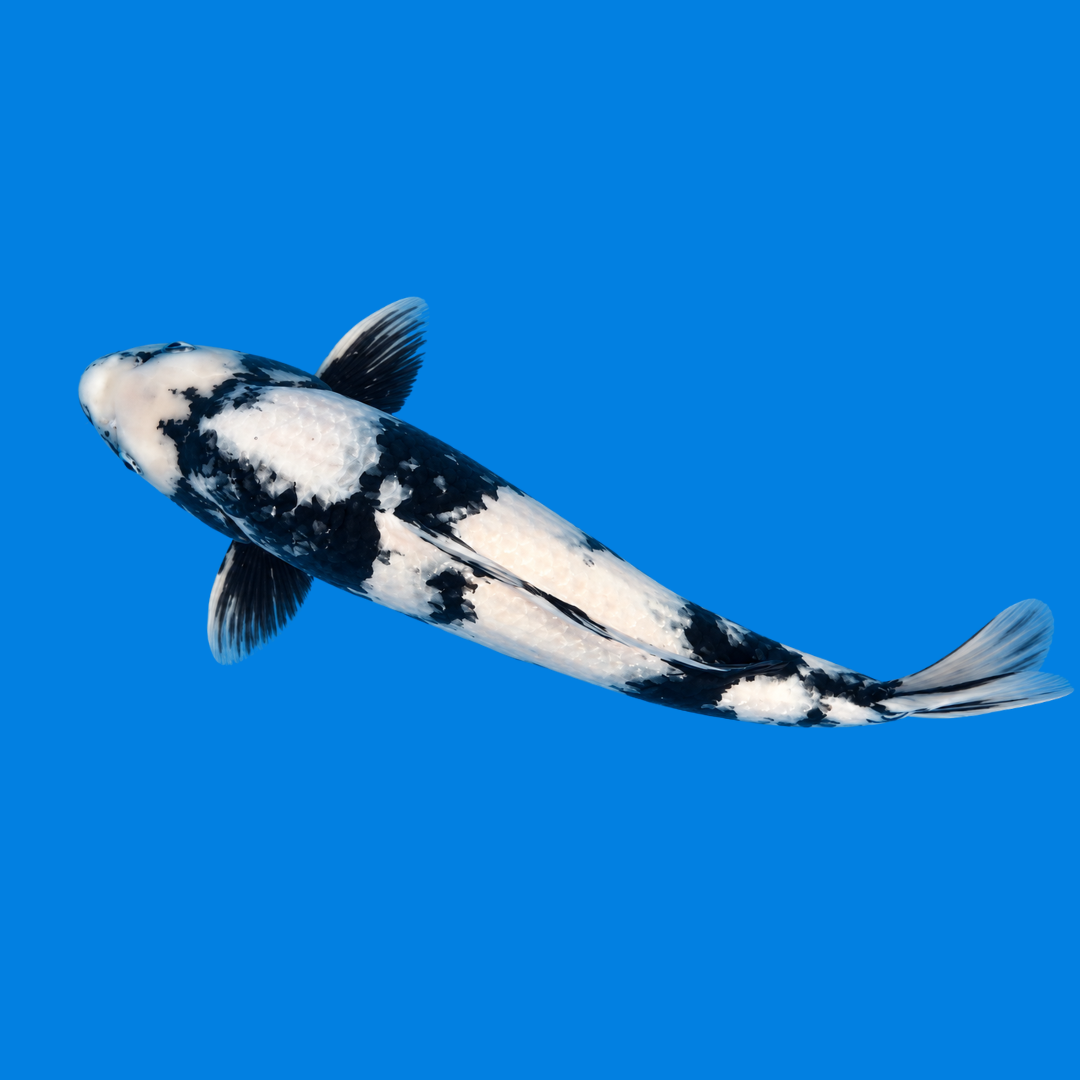
銀白写りは、黒地に白い斑紋と写り墨を持ち、全身が銀白色に光り輝く錦鯉です。錦鯉の品種区分では「光り写り」に属し、白写りを思わせる黒白の模様に、頭部からひれまで続く金属光沢が重なります。深い墨、澄んだ白地、均一な光沢が一尾の中で調和した個体は、とりわけ印象的です。成長に伴って墨の見え方が変わることもあり、その変化を長く見守れる点も魅力です。Gin Shiro Utsuri is a metallic koi variety with a black ground, white markings, utsuri sumi, and a silvery sheen across the body. It belongs to the Hikari Utsuri group and resembles a Shiro Utsuri overlaid with metallic luster extending from the head to the fins. Specimens in which deep black, clean white skin, and even shine are well balanced are especially striking. The appearance of the sumi may change as the fish grows, making long-term development part of its appeal.
基本情報 / Basic Information
学名 / Scientific Name
Cyprinus carpio Linnaeus, 1758
通称 / Common Name
銀白、銀白写りGin Shiro, Gin Shiro Utsuri
分類 / Family
コイ目・コイ科・コイ属。錦鯉の品種区分では光り写りOrder Cypriniformes, family Cyprinidae, genus Cyprinus; classified as a Hikari Utsuri koi variety
英名 / English Name
Gin Shiro Utsuri
分布 / Distribution
日本で作出・発展した改良品種で、自然分布はありません。現在は日本をはじめ世界各地の養鯉場や観賞池で飼育されています。A selectively bred ornamental variety developed in Japan, with no natural distribution of its own. It is now kept in koi farms and ornamental ponds in Japan and around the world.
最大体長 / Max Size
成魚では60~90cmほどが目安です。最終的な大きさは血統、飼育空間、給餌などによって異なります。About 60–90 cm as an adult. Final size varies with genetics, available space, feeding, and other husbandry conditions.
寿命 / Lifespan
20~30年ほどがひとつの目安です。実際の寿命は飼育環境や健康管理によって大きく異なります。Roughly 20–30 years is a useful guide, although actual lifespan varies greatly with environment and health management.
飼育環境 / Aquarium Environment
水槽サイズ / Tank Size
大型になるため、成魚は循環濾過装置を備えた池での飼育が基本です。必要な水量は尾数、魚体の大きさ、濾過能力によって変わるため、一律の最低値ではなく、成長後も過密にならない設計を優先します。120cmワイド水槽(約300L)は幼魚の一時飼育や検疫には使えますが、成魚の終生飼育には適しません。180cm級の大型水槽を使う場合も、魚の成長に合わせて池へ移せる計画が必要です。Because koi grow large, adults are best kept in a pond equipped with recirculating filtration. Required volume depends on the number and size of the fish and the filtration capacity, so the priority is a system that will not become overcrowded as the koi mature rather than a single universal minimum. A 120 cm wide aquarium of about 300 L may be used for temporary juvenile care or quarantine, but it is unsuitable for lifelong adult housing. Even with a 180 cm-class aquarium, plan to move growing fish to a pond.
水温 / Temperature
活動期は15~25℃を目安とし、20℃を超える時期は食欲と消化が活発になります。季節に伴う水温変化には対応できますが、短時間での急変は避けてください。低水温では摂餌量が落ちるため、餌の種類と量を水温に合わせます。Aim for 15–25°C during the active season. Appetite and digestion become more active above about 20°C. Koi can accommodate seasonal temperature changes, but rapid shifts should be avoided. Feeding declines in cold water, so match the food type and quantity to the actual temperature.
水質 / Water Quality
中性付近の安定した水を好み、pH6.8~7.2をひとつの目安とします。アンモニアと亜硝酸は検出されない状態を保ち、硝酸塩の蓄積を定期換水で抑えます。十分な生物濾過とエアレーションを用い、数値そのものだけでなく急変を防ぐことが大切です。Stable, near-neutral water is preferred, with pH 6.8–7.2 as a useful target. Keep ammonia and nitrite undetectable and control nitrate accumulation through regular water changes. Provide adequate biological filtration and aeration, and focus not only on target values but also on preventing sudden change.
レイアウト / Layout
広い遊泳空間を中央に確保し、底面は掃除しやすい裸底、または口やひれを傷つけにくい丸い砂利にします。吸水口や石組みには体を擦らない安全対策を施し、底排水、高性能な濾過、エアレーション、夏の日陰を整えます。水草は掘り返されやすいため、植栽区画を分けるか鉢を保護してください。Leave a broad central swimming area. Use either an easy-to-clean bare bottom or smooth rounded gravel that will not injure the mouth and fins. Shield intakes and stonework from contact injuries, and provide bottom drainage where possible, high-capacity filtration, aeration, and summer shade. Koi readily uproot plants, so separate planted zones or protect pots.
注意点 / Precautions
新しい個体は別容器で検疫し、網や容器の共用を避けます。急な大量換水、過密、酸欠、過給餌は体調不良や水質悪化につながるため注意が必要です。飛び出しやサギ・猫などによる捕食を防ぐ対策も行います。錦鯉は大きく育ち、生態系に影響を与えるおそれがあるため、河川や公共の池へ放流してはいけません。Quarantine every newcomer in a separate system and avoid sharing nets or containers. Sudden large water changes, crowding, oxygen shortage, and overfeeding can impair health and water quality. Measures may also be needed against jumping and predators such as herons or cats. Koi grow large and may affect ecosystems, so they must never be released into rivers or public ponds.
餌と給餌 / Feeding
餌の種類 / Diet
主食は品質の安定した錦鯉用の総合栄養ペレットです。水温が低めの時期は消化性を考えた小麦胚芽配合飼料、成長期は良質なタンパク質を含む飼料を選びます。補助的に水生昆虫やエビ類、加熱して柔らかくした野菜なども食べます。白地を重視する場合、カロテノイドを多く含む色揚げ飼料の常用は黄みを強める可能性があるため、目的と体色を見ながら慎重に使います。Use a reliable, nutritionally complete koi pellet as the staple. In cooler periods, choose an easily digested wheat-germ formulation; during growth, use a diet with quality protein. Aquatic insects, small crustaceans, and softened cooked vegetables may be offered as supplements. When preserving clean white skin is a priority, prolonged use of carotenoid-rich color-enhancing diets may increase yellow tones, so use them carefully according to the goal and the fish’s response.
給餌のポイント / Feeding Tips
水温と魚の動きに合わせ、活動期は1日1~3回を目安に、数分で食べ切る量を与えます。食べ残しはすぐに除去してください。水温が下がるにつれて量と回数を減らし、8℃以下では原則として給餌を控えます。季節の変わり目、導入直後、治療中は食欲と排せつ物を観察し、過給餌を避けます。Match feeding to water temperature and activity. During the active season, offer one to three feedings per day, giving only what is eaten within a few minutes. Remove leftovers promptly. Reduce quantity and frequency as the water cools, and generally withhold food at 8°C or below. During seasonal transitions, after introduction, or during treatment, monitor appetite and feces and avoid overfeeding.
性格と混泳 / Temperament and Tank Mates
性格 / Temperament
温和で社会性があり、複数でゆったり泳ぎます。人にも慣れやすく、給餌時に水面へ寄ってくるようになります。底を探る習性が強く、攻撃ではなく採餌行動によって植栽や底床を動かすことがあります。Peaceful and social, koi cruise calmly in groups. They readily become accustomed to people and often approach the surface at feeding time. Their strong bottom-foraging habit may disturb plants and substrate, but this is feeding behavior rather than aggression.
混泳の相性 / Compatibility
体格が近く、健康状態を確認できる錦鯉同士の混泳が最も安全です。大きな金魚と同居できる場合もありますが、水温、餌、泳力、検疫条件が合うことを確認します。口に入る大きさの小魚や稚魚、動きの遅い魚、ひれをかじる魚、適した水温や酸素量が大きく異なる魚との混泳は避けてください。The safest companions are healthy koi of similar size. Large goldfish may sometimes share a pond, but temperature, diet, swimming ability, and quarantine requirements must be compatible. Avoid small fish or fry that can be swallowed, slow-moving species, fin nippers, and fish with substantially different temperature or oxygen requirements.
病気と対策 / Diseases and Prevention
かかりやすい病気 / Common Diseases
コイヘルペスウイルス病(KHV病)、ウイルス性コイ浮腫症(CEV病)、白点病、吸虫類などの寄生虫症、エロモナス属細菌などに関連する赤斑や潰瘍、尾ぐされが問題になります。KHV病では元気消失、摂餌低下、鰓の退色やびらんが見られることがあり、有効な治療法は確立していません。Important problems include koi herpesvirus disease (KHV disease), carp edema virus disease (CEV disease), white spot disease, fluke and other parasite infestations, Aeromonas-associated redness or ulcers, and fin rot. KHV disease may cause lethargy, loss of appetite, and pale or eroded gills, and no established effective treatment is available.
対策と予防 / Prevention
信頼できる販売元から迎え、新魚は水温管理できる独立設備で十分に検疫します。毎日の食欲、遊泳、鰓の動き、皮膚、ひれを観察し、水温、pH、アンモニア、亜硝酸、溶存酸素を記録すると早期発見に役立ちます。異常時はむやみに薬を混ぜず、他池への移動を止め、魚病に詳しい獣医師や都道府県の水産担当機関へ相談してください。器具は池ごとに分け、使用後に洗浄・消毒します。Buy from a reputable source and quarantine new fish in an independent, temperature-controlled system for an adequate period. Daily checks of appetite, swimming, gill movement, skin, and fins, together with records of temperature, pH, ammonia, nitrite, and dissolved oxygen, support early detection. If disease is suspected, do not combine medications indiscriminately; stop moving fish between systems and consult an aquatic veterinarian or the relevant prefectural fisheries authority. Keep equipment dedicated to each pond and clean and disinfect it after use.
増やし方(繁殖) / Breeding
雌雄の判別 / Sexing
成熟魚では、雌は腹部が幅広く柔らかみを帯び、総排泄孔がやや大きく突出気味になる傾向があります。雄は体つきが比較的細く、繁殖期には鰓ぶたや胸びれに白い追星が現れ、胸びれ前縁がざらつきます。ただし幼魚の外見だけでの判別は難しく、個体差もあります。In mature fish, females tend to have a broader, softer abdomen and a larger, slightly protruding vent. Males are often slimmer and, during the breeding season, develop white breeding tubercles and a rough texture on the gill covers and leading rays of the pectoral fins. Juveniles are difficult to sex visually, and individual variation is substantial.
繁殖形態 / Reproduction
卵生で、春から初夏に水温が上がると浅い場所で追尾行動を行い、水草や産卵ブラシへ粘着性の卵を多数ばらまきます。受精は体外で行われ、親魚は卵やふ化仔魚を保護せず、食べることもあります。Koi are egg-layers. As water warms from spring into early summer, males chase females in shallow areas and numerous adhesive eggs are scattered onto plants or spawning brushes. Fertilization is external. The parents provide no care and may eat both eggs and newly hatched fry.
繁殖のポイント / Breeding Tips
成熟した親魚を大型の専用池へ移し、十分な酸素と柔らかな産卵ブラシを用意します。産卵後は親魚を戻し、卵には穏やかな通水とエアレーションを与えます。過密になりやすい仔魚はサイズ差に応じて選別し、水質悪化を防ぎながら微細な餌から段階的に切り替えます。銀白写り同士からも体色や模様の異なる稚魚が生まれるため、目的の光沢と写り墨を得るには多数の稚魚から長期的に選抜する必要があります。Move mature brood fish to a large dedicated spawning pond with strong oxygenation and soft spawning brushes. Remove the adults after spawning, then provide the eggs with gentle water movement and aeration. Fry quickly become crowded; grade them as size differences appear and progress gradually from fine starter foods while protecting water quality. Even Gin Shiro Utsuri parents produce fry with varied colors and patterns, so obtaining the desired metallic sheen and utsuri sumi requires long-term selection from many juveniles.
雑学と豆知識 / Trivia and Fun Facts
1. 名前が語る二つの美 / 1. Two Forms of Beauty in One Name
銀白写りは、白写りのような黒白の構成に、全身の金属光沢が加わった品種です。「光り写り」の仲間として、黒地、白い斑紋、写り墨、均一な輝きが一体となって見える点に特徴があります。英語圏でも Gin Shiro Utsuri という日本語由来の名称が広く使われています。赤や黄色を持たない配色だからこそ、模様の境界や泳ぐ角度で変わる反射がよく目立ちます。Gin Shiro Utsuri combines a black-and-white pattern reminiscent of Shiro Utsuri with metallic luster across the body. As a member of the Hikari Utsuri group, it is defined by the unified appearance of its black ground, white markings, utsuri sumi, and even sheen. The Japanese-derived name Gin Shiro Utsuri is also widely used in English. Without red or yellow, the pattern edges and changing reflections become especially prominent as the fish swims.
2. 銀色は「色素」だけでは作れない / 2. Silver Is More Than a Pigment
銀白写りの金属光沢を支えるのは、鱗にある虹色色素胞です。その内部では薄いグアニン結晶が幾層にも並び、光を強く反射する構造をつくります。2017年に報告された錦鯉の研究では、成熟した鱗と再生した鱗にある結晶板の95%以上が、鱗の表面とほぼ平行に配置されていました。つまり、銀白色の輝きは白い色素だけによるものではなく、生体が結晶の向きを整えて光を効率よく反射した結果なのです。The metallic sheen of Gin Shiro Utsuri is supported by iridophores in the scales. Within them, thin guanine crystals form layered structures that strongly reflect light. A 2017 koi study found that more than 95% of the crystal plates in mature and regenerated scales were oriented nearly parallel to the scale surface. In other words, the silvery shine is not produced by white pigment alone; it also results from living cells arranging crystals to reflect light efficiently.
3. 光沢と墨を同時に磨く難しさ / 3. The Challenge of Balancing Shine and Sumi
銀白写りでは、全身に高い光沢があることに加え、白と黒の模様が明瞭で、墨が頭から尾にかけて力強く巻き上がることが高く評価されます。光沢だけが強くても、墨だけが印象的でも、この品種らしい調和にはなりません。見る人は一尾の中で、輝きの均一さ、模様の配置、墨の力強さを同時に見ています。銀白写りの選別が難しいのは、複数の美点が同じ魚体でバランスよく現れることを求められるからです。Gin Shiro Utsuri is valued not only for strong luster across the body but also for clear black-and-white patterning and powerful sumi that wraps from head toward tail. Luster alone, or impressive sumi alone, does not create the balance associated with the variety. Viewers assess the evenness of the shine, the placement of the pattern, and the strength of the sumi together. Selection is difficult because several desirable traits must appear in balance on the same fish.
4. 墨は完成図ではなく、時間とともに動く / 4. Sumi Is a Changing Picture
幼魚では、まだ表面に明瞭に現れていない墨が、青灰色の影のように見えることがあります。墨の見え方は成長に伴って変わる場合があるため、若い時点の模様だけで将来の姿を断定することはできません。そこに写りものを育てる面白さがあります。一方で、「特定の水質なら必ず墨が上がる」といった単純な法則は確認できません。模様の変化を急いで求めず、安定した水質と健康を守りながら見守ることが基本です。In juveniles, sumi that has not yet appeared clearly at the surface may look like a blue-gray shadow. Because its appearance can change as the fish grows, the adult pattern cannot be predicted with certainty from a young fish alone. That uncertainty is part of the appeal of raising Utsuri. However, there is no confirmed simple rule that a particular water condition will always bring up the sumi. The sound approach is to avoid forcing change and instead maintain stable water and good health while the fish develops.
5. 水墨画を思わせる「影銀白写り」 / 5. Kage Gin Shiro Utsuri and an Ink-Wash Mood
銀白写りの外観を持ちながら、白い斑紋に網目状の薄い墨模様が入るものは「影銀白写り」と呼ばれます。黒と白が明瞭に分かれる標準的な銀白写りとは異なり、白地に重なる淡い影墨が、煙や水墨画を思わせる奥行きを生みます。同じ光り写りの中でも、明快なコントラストとは別の味わいを持つ表現です。A fish with the overall appearance of Gin Shiro Utsuri and a fine, pale reticulated sumi pattern over the white markings is called Kage Gin Shiro Utsuri. Unlike the crisp black-and-white division of a standard Gin Shiro Utsuri, the soft shadow sumi adds depth reminiscent of smoke or an ink-wash painting. Within Hikari Utsuri, it offers a distinct aesthetic apart from strong, clear contrast.
6. 魚鱗粉と光沢をめぐる新しい研究 / 6. New Research on Fish Scale Meal and Brightness
2026年に公表された8週間の給餌試験では、飼料の魚粉を魚鱗粉で段階的に置き換えた錦鯉で、配合量が多いほど鱗のグアニン量と体表の明度が高まり、中程度の配合群では虹色色素胞の密度が高くなりました。一方、魚鱗粉の配合量が増えるほど成長成績は低下しました。この試験は銀白写りだけを対象にした長期研究ではないため、日常の飼育法として確立した結果ではありません。つまり、魚鱗粉が光沢に関わる細胞へ影響する可能性を示した研究であり、成長との両立や長期的な安全性は別に検討する必要があります。An eight-week feeding trial published in 2026 gradually replaced dietary fish meal with fish scale meal in koi. Scale guanine and body lightness increased with higher inclusion, while iridophore density was greater in the intermediate groups. Growth performance, however, declined as fish scale meal increased. Because the trial was not a long-term study conducted specifically on Gin Shiro Utsuri, it does not establish a routine feeding method. In practical terms, the study suggests that fish scale meal may influence cells involved in sheen, while its balance with growth and its long-term use still require separate evaluation.
まとめ / Conclusion
銀白写りは、力強い写り墨と銀白色の金属光沢が、泳ぐたびに異なる表情を見せる錦鯉です。その美しさを長く楽しむには、成長後の大きさに見合う空間、十分な酸素と濾過、急変の少ない水質、水温に合わせた給餌が欠かせません。模様や光沢を短期間で変えようとせず、まず健康な体を育てることが大切です。Gin Shiro Utsuri is a koi whose powerful utsuri sumi and silvery metallic sheen reveal a different expression with every movement. Enjoying that beauty over the long term requires space suited to adult size, adequate oxygen and filtration, stable water, and feeding matched to temperature. Rather than trying to force rapid changes in pattern or sheen, the priority should be building a healthy fish.
若魚の頃とは墨の見え方が変わり、体格とともに印象が移ろう過程を見守れるのは、長く付き合える錦鯉ならではの楽しみです。十分な時間と空間を用意すれば、銀白写りは黒と銀白だけの静かな色彩の中に力強さを見せ、季節を重ねるほど池になじんでいきます。Watching the appearance of the sumi change from youth and the fish’s overall impression evolve with its body shape is a pleasure unique to a long-lived koi. Given enough time and space, Gin Shiro Utsuri brings strength to a restrained black-and-silver palette and settles naturally into the pond with each passing season.
Francis-Floyd, R. and Petty, B. D. Merck Veterinary Manual Disorders and Diseases of Fish 白点病、吸虫類、エロモナス感染症、ひれや皮膚の異常、水質悪化・過密・検疫不足に伴う疾病リスク。 更新:2026年4月/参照日:2026年9月16日






コメント