

解説 / Description
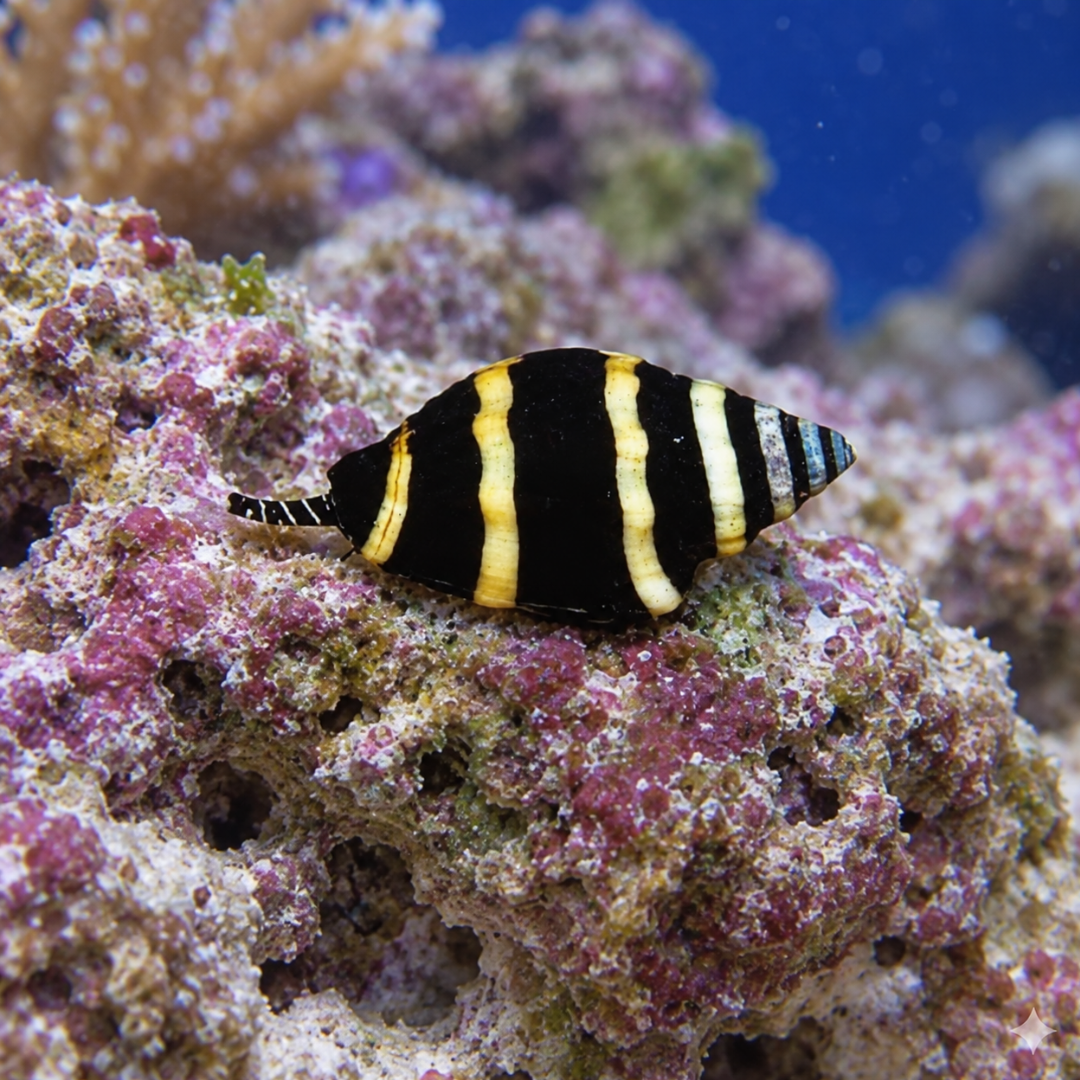
バンブルビースネールは、黒から暗紫色の地に黄白色の帯が走る、小型で印象的な海産巻貝です。日本ではノシガイの和名を持ち、温暖な沿岸の岩礁域などに分布します。成貝の殻長はおおむね10〜20mmほどで、分厚い殻と角質の蓋を備えています。見た目は愛らしいものの、食性は肉食性で、腐肉や残餌だけでなく小型の無脊椎動物も利用します。リーフタンクではヘビガイを食べる例が知られていますが、ヘビガイだけを専食する種ではなく、効果にもばらつきがあります。駆除だけを目的に大量導入するのではなく、その食性を理解したうえで飼育することが大切です。 The Bumble Bee Snail is a small marine gastropod marked by striking yellowish-white bands over a black to dark purple shell. In Japan it is known as Noshigai and occurs along warm rocky coasts. Adults are generally about 10–20 mm in shell length and possess a thick shell and a horny operculum. Despite its charming appearance, it is carnivorous and feeds not only on carrion and leftover food but also on small invertebrates. In reef aquariums there are reports of it feeding on vermetid snails, but it is not an obligate vermetid specialist and results vary. It is therefore best kept with an understanding of its broader diet rather than introduced in large numbers solely for pest control.
基本情報 / Basic Information
| 学名 / Scientific Name | Engina mendicaria |
|---|---|
| 通称 / Common Name | バンブルビースネール、ノシガイBumble Bee Snail |
| 分類 / Family | 軟体動物門・腹足綱・新腹足目・エゾバイ上科・ベッコウバイ科・ホンノシガイ属Phylum Mollusca, Class Gastropoda, Order Neogastropoda, Superfamily Buccinoidea, Family Pisaniidae, Genus Engina |
| 英名 / English Name | Bumble Bee Snail |
| 分布 / Distribution | 熱帯インド太平洋を中心に広く分布し、紅海、東アフリカ沿岸、インド洋の島嶼域、東南アジア、ニューギニア周辺、オーストラリア沿岸などで知られます。日本では伊豆半島、紀伊半島、四国、九州南西部以南など、温暖な沿岸の岩礁域で記録されています。また、スエズ運河を経由して地中海へ入った外来性海産生物の記録にも含まれています。Widely distributed across the tropical Indo-Pacific, including the Red Sea, East African coasts, Indian Ocean islands, Southeast Asia, the New Guinea region, and Australia. In Japan it has been recorded along warm rocky coasts from areas such as the Izu and Kii Peninsulas, Shikoku, and southwestern Kyushu southward. It is also included among records of non-native marine species that entered the Mediterranean through the Suez Canal. |
| 最大体長 / Max Size | 殻長は一般に10〜20mm程度。Generally about 10–20 mm in shell length. |
| 寿命 / Lifespan | 飼育下での寿命について、信頼できる標準値は確認されていません。長期飼育では、安定した海水環境と継続的な餌資源を保つことが重要です。A reliable standard lifespan in captivity has not been established. Long-term maintenance depends on stable marine conditions and a continuing food supply. |
飼育環境 / Aquarium Environment
| 水槽サイズ / Tank Size | 最小水槽サイズに統一された基準はありません。流通上の飼育情報では40〜75L前後、すなわち45cm規格水槽から60cm規格水槽程度を目安とする例がありますが、本種は小型のため、水槽の長さそのものよりも水質の安定性、隠れ場所、餌資源を確保できる成熟した環境であることが重要です。There is no universally established minimum tank size. Aquarium care references commonly suggest roughly 40–75 L, corresponding approximately to Japanese 45 cm to 60 cm standard aquariums. Because the species is small, a mature system with stable water quality, hiding places, and adequate food is more important than tank length alone. |
|---|---|
| 水温 / Temperature | 24〜27℃前後を目安に安定させます。日本では冬季のヒーターに加え、夏季は必要に応じて水槽用クーラーや冷却ファンを用い、短時間の急激な温度変化を避けます。 Maintain approximately 24–27°C with minimal fluctuation. In Japan, a heater is usually needed in winter, while a chiller or cooling fan may be required in summer to prevent rapid temperature changes. |
| 水質 / Water Quality | 比重1.023〜1.025、pH8.1〜8.4を目安に、一般的なリーフ水槽と同様に安定した海水環境を保ちます。アンモニアと亜硝酸塩は検出されない状態を維持し、殻の形成に関わるカルシウムやアルカリ度も大きく崩さないよう管理します。数値を一点に合わせることより、蒸発や換水による急な比重変化を避けることが重要です。Maintain stable reef-like marine conditions, with a specific gravity around 1.023–1.025 and pH around 8.1–8.4. Ammonia and nitrite should remain undetectable, while calcium and alkalinity should be kept within normal reef-aquarium ranges for shell maintenance. Avoiding abrupt salinity changes from evaporation or water changes is more important than targeting a single exact value. |
| レイアウト / Layout | 自然下では岩の裂け目、サンゴ礫の下、岩陰などの暗く狭い場所を利用するため、ライブロックや多孔質の岩を組み、日中に隠れられる空間を複数用意します。夜間に行動する傾向があるため、餌が届く底面や岩組みの隙間を観察しやすいレイアウトが向いています。In nature it uses crevices, coral rubble, and shaded spaces beneath rocks. Provide live rock or porous rockwork with several secure daytime hiding places. Because it tends to become active at night, a layout that allows observation of the substrate and rock gaps where food settles is useful. |
| 注意点 / Precautions | 銅イオンを含む魚病薬は使用できません。海産無脊椎動物は銅に弱いため、銅治療が必要な魚は別のトリートメント水槽で管理します。また、本種はヘビガイだけを食べる専食者ではなく、餌が乏しいと小型巻貝や多毛類などを捕食する可能性があります。駆除目的でも過剰な数を入れないようにします。Copper-based fish medications must not be used with this snail. Marine invertebrates are sensitive to copper, so fish requiring copper treatment should be managed in a separate treatment aquarium. This species is not an obligate vermetid predator, and when food is scarce it may prey on small snails or polychaetes. Avoid overstocking even when using it for pest control. |
餌と給餌 / Feeding
| 餌の種類 / Diet | 肉食性で、小型の底生無脊椎動物、腐肉、魚などの食べ残しを利用します。水槽内で自然に得られる餌が不足する場合は、冷凍イサザアミや細かくした冷凍餌、沈下性の肉食性海水魚向け人工飼料などを少量補助します。Carnivorous, feeding on small benthic invertebrates, carrion, and leftover meaty foods. If naturally available food is insufficient, small amounts of frozen mysid shrimp, finely chopped frozen foods, or sinking foods for carnivorous marine fish can be offered as supplements. |
|---|---|
| 給餌のポイント / Feeding Tips | 夜間に活動しやすいため、補助給餌は消灯後に個体の近くへ少量ずつ与えると確認しやすくなります。ヘビガイ対策を期待する場合でも、残餌など利用しやすい餌が多ければそちらを食べることがあり、効果には個体差と環境差があります。活動や摂食の様子を見ながら、餌不足と過剰給餌の両方を避けます。Because it is often more active after dark, supplemental food is easier to monitor when offered in small amounts near the snail after lights-out. Even when introduced for vermetid control, it may choose easier foods such as leftovers, so results vary among individuals and aquariums. Observe its activity and feeding and avoid both food shortage and overfeeding. |
性格と混泳 / Temperament and Tank Mates
| 性格 / Temperament | 魚を追って攻撃するような生体ではなく、日中は岩陰に隠れ、夜間にゆっくり探索することが多い巻貝です。ただし食性は肉食性で、小型の無脊椎動物を捕食することがあります。行動が穏やかに見えることと、他の無脊椎動物に無害であることは同じではありません。It does not actively chase or attack fish and often hides among rocks by day, slowly foraging after dark. Its diet is nevertheless carnivorous, and it may prey on small invertebrates. A calm appearance should not be taken to mean that it is harmless to all other invertebrates. |
|---|---|
| 混泳の相性 / Compatibility | 多くの海水魚とは同居しやすい一方、小型巻貝やケヤリ類などの多毛類を含む小型無脊椎動物には捕食リスクがあります。サンゴ水槽でも飼育されますが、完全に無脊椎動物へ無害な「リーフセーフ生体」と考えるのは避けた方が安全です。また、貝を食べるベラ類やフグ類、大型の甲殻類などとは、本種側が捕食される可能性があります。It is generally compatible with many marine fish, but small invertebrates, including small snails and polychaetes such as fan worms, may be at risk of predation. It is often kept in reef aquariums, but it is safer not to regard it as completely harmless to all invertebrates. Snail-eating wrasses, puffers, and large crustaceans may in turn prey on the Bumble Bee Snail. |
病気と対策 / Diseases and Prevention
| かかりやすい病気 / Common Diseases | 本種に特有の疾病として、飼育下で広く確立された病名は確認されていません。一方で、銅イオンへの曝露、アンモニアや亜硝酸を伴う水質悪化、長期的な低pHなどは、衰弱や殻の状態悪化につながる要因になります。No widely established list of species-specific captive diseases is available. Important health risks instead include copper exposure, poor water quality involving ammonia or nitrite, and prolonged low pH, all of which can contribute to weakness or deterioration of the shell. |
|---|---|
| 対策と予防 / Prevention | 比重、水温、pHを安定させ、アンモニアと亜硝酸を検出されない状態に保つことが基本です。殻の維持に関わるカルシウムやアルカリ度も、一般的なリーフ水槽の範囲から大きく外れないよう管理します。魚病治療で銅薬を使う場合は、本種を治療水槽から完全に分離します。Prevention begins with stable salinity, temperature, and pH, along with undetectable ammonia and nitrite. Calcium and alkalinity should also remain within normal reef-aquarium ranges for shell maintenance. If copper medication is required for fish, this snail must be completely separated from the treatment aquarium. |
増やし方(繁殖) / Breeding
| 雌雄の判別 / Sexing | 雌雄異体ですが、外見だけで雌雄を確実に判別する実用的な方法は確立されていません。The species has separate sexes, but no practical external method is established for reliably distinguishing males from females. |
|---|---|
| 繁殖形態 / Reproduction | 雌雄異体で、体内受精を行う海産巻貝です。放卵放精によって水中へ配偶子を一斉に放出する型ではないとされています。卵や幼生の詳細な発生については情報が限られているため、淡水性のキラースネールの繁殖情報と混同しないことが重要です。It is a marine gastropod with separate sexes and internal fertilization. It is considered a non-broadcast spawner rather than a species that releases gametes freely into the water column. Detailed information on egg and larval development remains limited, so its reproduction should not be confused with that of the freshwater assassin snail. |
| 繁殖のポイント / Breeding Tips | 家庭の水槽で安定して繁殖させる方法は確立されておらず、飼育下繁殖は難しいとされています。外見から雌雄を判別しにくいことも繁殖計画を難しくする要因です。淡水性キラースネールに見られる四角い卵嚢の情報を、本種の繁殖様式として流用しないよう注意します。A reliable method for breeding this species in home aquariums has not been established, and captive propagation is considered difficult. The lack of an obvious external method for sexing adults also complicates breeding attempts. The square egg capsules known from freshwater assassin snails should not be assumed to apply to this marine species. |
雑学と豆知識 / Trivia and Fun Facts
| 1. 1758年から続く分類学の物語 / 1. A Taxonomic Story Beginning in 1758 | バンブルビースネールの学術的な歴史は、リンネが1758年に『自然の体系』第10版でVoluta mendicariaとして記載したところから始まります。その後、Columbella mendicariaやPusiostoma mendicariaなど別の組み合わせでも扱われてきましたが、現在の標準的な分類ではEngina mendicariaが有効名とされ、Engina属はベッコウバイ科Pisaniidaeに置かれています。古い文献や流通情報ではエゾバイ科Buccinidaeとされることもあるため、資料によって科名が異なるのは分類体系の更新によるものです。The scientific history of the Bumble Bee Snail begins in 1758, when Linnaeus described it as Voluta mendicaria in the tenth edition of Systema Naturae. It was later treated under combinations such as Columbella mendicaria and Pusiostoma mendicaria. In current standard taxonomy, Engina mendicaria is the accepted name and Engina is placed in the family Pisaniidae. Older literature and aquarium references may still list Buccinidae, so differing family names usually reflect changes in classification rather than different animals. |
|---|---|
| 2. 縞模様の名前が生んだ、海水と淡水の混同 / 2. One Striped Name, Two Very Different Snails | 「バンブルビースネール」という呼び名は、その黒と黄色の縞模様から生まれました。しかし同じような配色を持つ淡水性のキラースネールAnentome helenaも、流通現場や海外情報で似た名前で扱われることがあります。両者はどちらも小型巻貝を捕食することがありますが、こちらのEngina mendicariaは海産でベッコウバイ科、キラースネールは淡水性でムシロガイ科です。特に繁殖情報を調べる際は注意が必要で、キラースネールの特徴的な四角い卵嚢を、そのまま海産のバンブルビースネールの情報として扱うことはできません。The common name “Bumble Bee Snail” comes from the black-and-yellow striped shell. Confusion arises because the freshwater assassin snail, Anentome helena, has a similarly banded appearance and is sometimes discussed under overlapping trade names. Both may prey on small snails, but Engina mendicaria is marine and belongs to Pisaniidae, whereas the assassin snail is freshwater and belongs to Nassariidae. This distinction is especially important when researching reproduction: the distinctive square egg capsules of assassin snails cannot simply be applied to the marine Bumble Bee Snail. |
| 3. 小さな体に備わる、捕食者の道具 / 3. Predator Tools in a Tiny Body | この巻貝は、残餌だけを拾う生体ではありません。肉食性の新腹足類らしく、摂食には歯舌を使います。本種の歯舌は短く頑丈で、複数の尖頭を備えた歯が並ぶことが解剖学的に知られています。夜間に岩陰から現れてゆっくり動く姿はおとなしく見えますが、その口器は小型無脊椎動物を利用できる食性に適した構造です。This snail does more than pick up leftover food. Like other carnivorous neogastropods, it feeds with a radula. Anatomical descriptions of this species show a short, sturdy radula with rows of multi-cusped teeth. Although it appears calm as it slowly emerges from rockwork at night, its feeding apparatus is suited to a diet that can include small invertebrates. |
| 4. ヘビガイ対策は「補助役」と考える / 4. Vermetid Control Works Best as a Supporting Role | リーフタンクでは、ヘビガイを食べる例が飼育現場で知られています。ヘビガイはライブロックやサンゴ骨格などに石灰質の管を作り、粘液の網で浮遊物を集めるため、その粘液がサンゴへ慢性的な刺激になることがあります。ただし、バンブルビースネールによる駆除効果を水槽条件を越えて一律に示す十分なデータはなく、本種もヘビガイだけを選んで食べる専食者ではありません。導入だけで解決すると考えず、必要に応じて物理的な除去などと組み合わせる補助的な対策として捉えるのが適切です。In reef aquariums, there are husbandry reports of this species feeding on vermetid snails. Vermetids build calcareous tubes on live rock and coral skeletons and cast mucus nets that can chronically irritate nearby corals. However, there is not enough evidence to treat Bumble Bee Snails as a uniformly effective control method across different aquariums, and the species is not an obligate vermetid specialist. It is better regarded as a possible supporting measure alongside physical removal when needed. |
| 5. スエズ運河を越えたレセップス移動 / 5. A Lessepsian Traveler Through the Suez Canal | 本来はインド太平洋と紅海に分布する本種ですが、地中海ではスエズ運河を経由して入った外来性の海産生物として記録されています。紅海側の生物が運河を通って地中海へ進出する現象は「レセップス移動」と呼ばれます。小さな巻貝の分布にも、人類が造った海上交通路が影響していることを示す興味深い例です。Although native to the Indo-Pacific and Red Sea, this species has been recorded in the Mediterranean as a non-native marine organism associated with movement through the Suez Canal. The spread of Red Sea organisms into the Mediterranean through the canal is known as Lessepsian migration. It is a striking example of how a human-made sea route can influence the distribution of even a very small marine snail. |
| 6. 数千年前から人を惹きつけた殻 / 6. A Shell That Attracted People for Thousands of Years | この貝の殻は、現代の観賞対象になる以前から人の手で利用されてきました。紅海沿岸やアラビア半島、メソポタミアにつながる考古学遺跡では、本種の殻を加工したビーズや装身具が報告されています。自然分布域から離れた場所で見つかる例は、貝殻が人の移動や交換を通じて長距離を運ばれたことを考える手掛かりになります。わずか1〜2cmほどの殻が、生物学だけでなく古代の人々の交流を読み解く資料にもなっている点は、本種ならではの興味深さです。Long before it became an aquarium animal, this shell was used by people. Archaeological sites around the Red Sea, Arabian Peninsula, and exchange networks connected with Mesopotamia have yielded beads and ornaments made from Engina mendicaria shells. Finds far from the animal’s natural range provide clues that the shells moved long distances through human travel and exchange. A shell only one or two centimeters long can therefore inform not only biology, but also the study of ancient human connections. |
まとめ / Conclusion
バンブルビースネールは、黒と黄白色の縞模様が目を引く一方で、小型無脊椎動物も利用する肉食性の海産巻貝です。飼育では安定した海水環境を保ち、銅薬を避けることが基本になります。ヘビガイを食べる例はありますが、それだけを専食するわけではないため、駆除役として過度に期待せず、他の小型無脊椎動物との関係も見ながら飼育することが大切です。 The Bumble Bee Snail is visually striking, but it is also a carnivorous marine snail capable of feeding on small invertebrates. Stable marine conditions and avoidance of copper medications are basic requirements for keeping it. Although there are reports of it feeding on vermetid snails, it does not specialize exclusively on them, so it should not be relied upon as a guaranteed pest-control animal. Its interactions with other small invertebrates should also be considered.
夜になると岩陰から現れ、わずか1〜2cmほどの体でゆっくりと餌を探す姿には、岩礁域で暮らす小型の肉食性巻貝らしい生態が表れています。その殻は古代の装身具にも使われ、自然史と人の歴史の双方に痕跡を残してきました。小さな体ながら、飼育するほどに食性や行動、殻の背景まで観察する楽しみが広がる生き物です。 When it emerges from rockwork at night and slowly searches for food with a body only one or two centimeters long, its ecology as a small carnivorous snail of rocky shores becomes easy to appreciate. Its shell was also used as an ornament in ancient times, leaving traces in both natural history and human history. Despite its small size, it offers aquarists much to observe in its feeding behavior, movement, and distinctive shell.

気になる道具や飼い方を見つけてみませんか?
 アイのアクアグッズ案内水換え・底砂掃除の道具の選び方|砂利・砂・ソイルに合うクリーナーとポンプ道具の特徴や使い方、選ぶときのポイントをアイが紹介します。記事はコチラ →
 アイのアクアグッズ案内カルキ抜き・水質調整剤の選び方|水換えと水槽の種類に合わせて選ぶ道具の特徴や使い方、選ぶときのポイントをアイが紹介します。記事はコチラ →
 アイのアクアグッズ案内海水魚の底砂の選び方|サンゴ砂・ライブサンドとおすすめ商品道具の特徴や使い方、選ぶときのポイントをアイが紹介します。記事はコチラ →
 アイのアクアグッズ案内金魚を長く楽しむ飼育用品|水槽・フィルター・エアレーション・水換え道具の特徴や使い方、選ぶときのポイントをアイが紹介します。記事はコチラ →
さまざまな飼育テーマをご紹介。リンク先の記事には広告・商品紹介が含まれます。
案内・紹介記事一覧へ →分布マップ
バンブルビースネール(Engina mendicaria)は、熱帯インド太平洋を中心に、紅海、東アフリカ沿岸、インド洋の島嶼域、東南アジア、ニューギニア周辺、オーストラリア沿岸、日本の温暖な岩礁域などに分布します。また、スエズ運河を経由して地中海へ入った記録もあります。
この地図は分布地域全体を把握するための概略表示です。表示範囲は厳密な分布境界を示すものではありません。また、マーカーは分布域を見やすくするために設定した代表地点であり、実際の採集地点や個体の確認地点を示すものではありません。
参考文献
-
MolluscaBase editors. Engina mendicaria (Linnaeus, 1758).
MolluscaBase / World Register of Marine Species(WoRMS).
現在の有効学名、分類階級、ベッコウバイ科(Pisaniidae)への所属、旧学名・異名の確認に使用。
https://www.molluscabase.org/aphia.php?p=taxdetails&id=212164 -
Palomares, M.L.D. and Pauly, D. (eds.). Engina mendicaria: Ecology Summary.
SeaLifeBase.
海産・底生性であること、岩礁性の硬い基質やサンゴ礁を利用する生息環境、肉食・腐肉食性の背景確認に使用。
https://www.sealifebase.ca/Ecology/SpeciesEcologySummary.php?GenusName=Engina&SpeciesName=mendicaria&StockCode=59567 -
Palomares, M.L.D. and Pauly, D. (eds.). Engina mendicaria: Reproduction Summary.
SeaLifeBase.
雌雄異体、体内受精、放卵放精型ではないという繁殖形態の確認に使用。
https://www.sealifebase.ca/Reproduction/ReproSummary.php?id=105207&genusname=Engina&speciesname=mendicaria -
海洋研究開発機構(JAMSTEC). Engina mendicaria ノシガイ.
Biological Information System for Marine Life(BiSMaL).
日本で用いられる和名と、日本周辺を含む生物情報の確認に使用。
https://www.godac.jamstec.go.jp/bismal/j/view/9050844 -
Subba Rao, N.V. Catalogue of Marine Molluscs of Andaman and Nicobar Islands.
Zoological Survey of India, Occasional Paper No. 187.
アンダマン・ニコバル諸島での標本記録、および熱帯太平洋・日本などを含む広域分布の確認に使用。
https://zsi.gov.in/public/PDFVolumes/occpapers/187/index.pdf -
Ornamental Aquatic Trade Association. How to look after marine molluscs.
OATA Care Sheets.
海産軟体動物を飼育する際の水温、比重、pH、アンモニア・亜硝酸、炭酸塩硬度、カルシウム、水質安定性などの一般的な管理範囲の確認に使用。
https://ornamentalfish.org/what-we-do/advice-information/care-sheets/caresheets-marine-invertebrates/how-to-look-after-marine-molluscs/ -
Yanong, R.P.E. Use of Copper in Marine Aquaculture and Aquarium Systems.
University of Florida IFAS Extension, FA165.
海産無脊椎動物に対する銅の高い毒性、銅治療時に無脊椎動物を隔離する必要性、銅使用時の水質管理上の注意の確認に使用。
https://ask.ifas.ufl.edu/publication/FA165




コメント