

解説 / Description
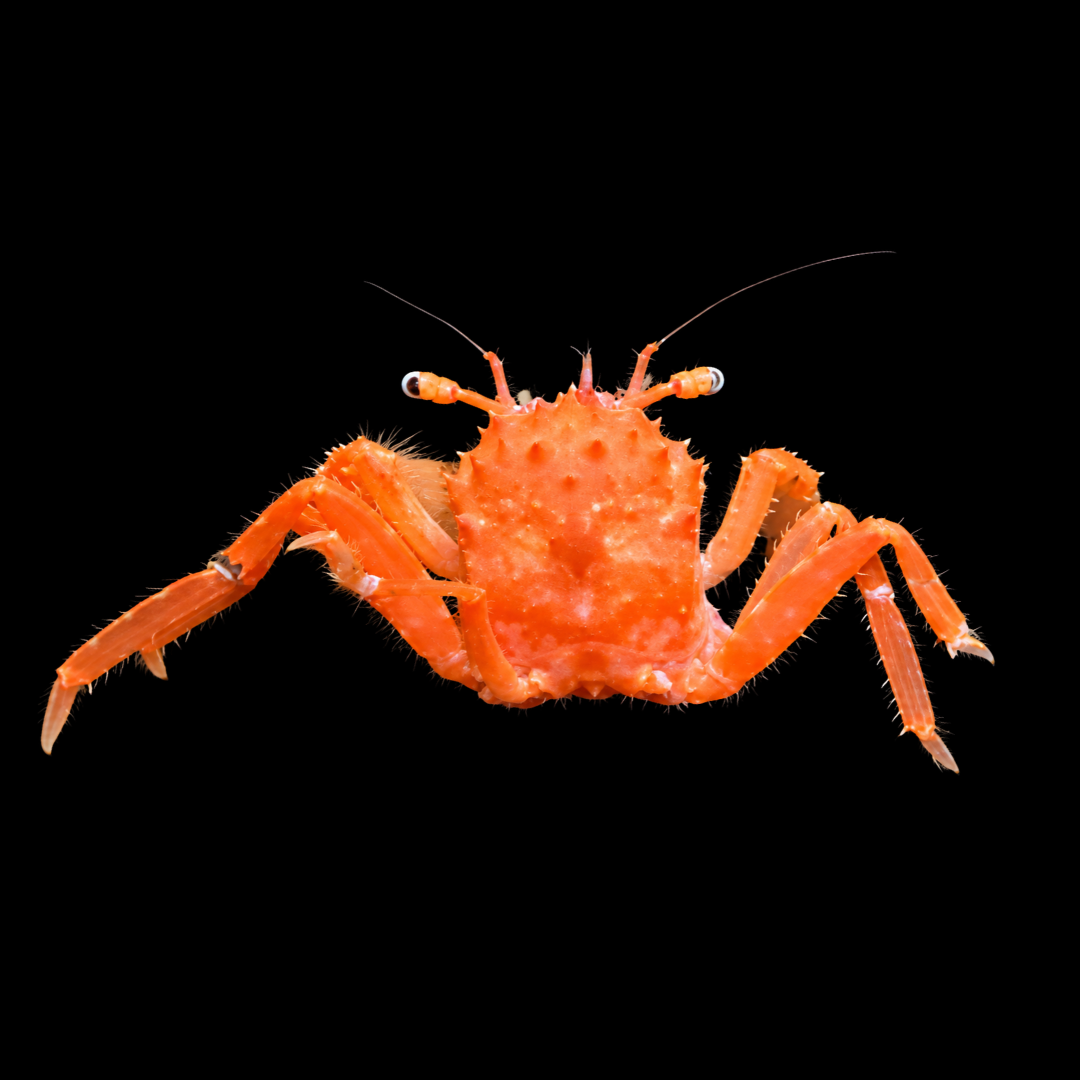
トウヨウホモラは、ホモラ科ホモラ属に分類される海水性のカニです。深場から得られることが多い一方、30m前後の比較的浅い水深からも記録されており、「深海にしか生息しないカニ」と表現するのは正確ではありません。赤橙色を帯びた体と長い眼柄を持ち、最後方の歩脚でカイメン類などの物体を持ち上げて背中側に保持する「背負い行動」でよく知られています。この行動はホモラ科に広く見られ、捕食者に対する隠蔽や防御に関係すると考えられています。 Homola orientalis is a marine crab belonging to the family Homolidae and the genus Homola. Although it is frequently associated with deeper waters, records also exist from comparatively shallow depths of around 30 m, so describing it as an exclusively deep-sea species would be inaccurate. It has a reddish-orange body, elongated eyestalks, and is especially notable for using its rearmost walking legs to hold objects such as sponges above the body. This carrying behavior is widespread within Homolidae and is thought to contribute to concealment or defense against predators.
日本では相模湾、駿河湾、土佐湾、九州沿岸などから記録され、水族館で飼育展示されるほか、専門的な海洋生物販売の分野で生体が扱われる例もあります。ただし、一般的な観賞用甲殻類ほど飼育知見が蓄積されているわけではありません。種として確立された適温や長期飼育プロトコルには不明な点が多いため、入手時の水温や状態を確認し、急激な環境変化を避けながら管理する必要があります。 In Japan, the species has been recorded from areas including Sagami Bay, Suruga Bay, Tosa Bay, and waters around Kyushu. It is maintained in public aquariums and is also occasionally handled by specialist marine-life retailers. However, husbandry knowledge is far less established than for common ornamental crustaceans. A scientifically validated optimum temperature and standardized long-term husbandry protocol have not been established, so careful attention should be paid to the conditions in which an individual was being held before acquisition, while avoiding sudden environmental changes.
基本情報 / Basic Information
| 学名 / Scientific Name | Homola orientalis Henderson, 1888 |
|---|---|
| 通称 / Common Name | トウヨウホモラ。「背負うカニ」「キャリアークラブ」の仲間として紹介されることがあります。Known in Japanese as Toyohomora and sometimes described generally as a carrier crab. |
| 分類 / Family | 十脚目・抱卵亜目・短尾下目・ホモラ上科・ホモラ科・ホモラ属。Order Decapoda, suborder Pleocyemata, infraorder Brachyura, superfamily Homoloidea, family Homolidae, genus Homola. |
| 英名 / English Name | 英語圏では carrier crab の一種として扱われますが、本種だけを指す英名は資料によって一定していません。It is generally regarded as a carrier crab, although a single universally standardized species-level English common name is not consistently used. |
| 分布 / Distribution | インド・西太平洋に広く分布し、東アフリカ、インド洋、東南アジア、日本、オーストラリア、ニュージーランド、ハワイ諸島、フランス領ポリネシアなどから記録されています。日本では相模湾、駿河湾、土佐湾、九州沿岸などで確認されています。多くの記録は数十~数百mの水深からですが、韓国では水深30mからの採集例もあります。Widely distributed in the Indo-West Pacific, with records from East Africa, the Indian Ocean, Southeast Asia, Japan, Australia, New Zealand, Hawaii, and French Polynesia. In Japan it has been recorded from areas including Sagami Bay, Suruga Bay, Tosa Bay, and waters around Kyushu. Many records are from depths of several tens to several hundreds of meters, although a specimen has also been collected at 30 m in Korea. |
| 最大体長 / Max Size | 体サイズは通常、脚を含めた全長ではなく甲長・甲幅で記録されます。博物館標本には甲長約62.8mmの記録があり、少なくとも甲長6cmを超える個体が存在します。脚を含めた最大サイズの統一的な記録は確認されていません。Size is generally recorded as carapace length or width rather than total span including the legs. A museum specimen with a carapace length of approximately 62.8 mm has been recorded, demonstrating that individuals can exceed 6 cm in carapace length. A standardized maximum overall span including the legs is not established. |
| 寿命 / Lifespan | 本種について信頼できる具体的な寿命データは確認されていません。Reliable species-specific lifespan data are not currently established. |
飼育環境 / Aquarium Environment
| 水槽サイズ / Tank Size | 本種について、科学的に検証された最低水槽サイズはありません。そのため「60cm規格水槽以上」などの具体的な最低値を一律に設定することはできません。体の大きさだけでなく、十分な底面積、隠れ場所、背負う物体を扱える空間、水温と水質を安定させられる水量を確保して水槽を選びます。No scientifically validated minimum aquarium size has been established for this species, so a specific standard such as a 60 cm aquarium should not be presented as a universal minimum. Tank choice should take into account not only body size but also floor space, shelters, room for manipulating carried objects, and sufficient water volume for stable temperature and water quality. |
|---|---|
| 水温 / Temperature | 成体の適正水温を15~18℃などの狭い範囲に限定できる科学的根拠は確認されていません。入手時に維持されていた水温を確認し、それを基準に急激な温度変化を避けることが重要です。室温だけでは安定させられない場合には、水槽用クーラーなどを利用します。 There is insufficient scientific evidence to define a narrow adult optimum such as 15–18°C for the species as a whole. The temperature at which the individual was being maintained before acquisition should be confirmed and used as a reference, with sudden temperature changes avoided. An aquarium chiller may be required where room temperature alone cannot provide stable conditions. |
| 水質 / Water Quality | トウヨウホモラに固有の水質基準値は確立されていませんが、安定した海水環境を維持することが基本です。十分に成熟した濾過環境を用意し、アンモニアや亜硝酸の蓄積、塩分や水温の急変を避けます。残餌や有機物をためない管理も重要です。Species-specific water-quality limits have not been established, but a stable marine environment is fundamental. Use mature biological filtration and avoid the accumulation of ammonia or nitrite as well as sudden changes in salinity or temperature. Uneaten food and excess organic matter should not be allowed to accumulate. |
| レイアウト / Layout | 本種に必要な照度について、具体的な基準は確認されていません。落ち着ける隠れ場所を設け、転倒しにくい安定したレイアウトにします。また、本来の背負い行動を観察するため、カニが無理なく持ち上げられる軽量な物体を用意できます。水族館ではカイメン、ホヤ、石、脱皮殻などさまざまな物を背負う様子が観察されています。人工物を使用する場合は、水質に影響せず、脚が挟まらない安全な素材を選びます。No specific lighting requirement has been established for this species. Provide secure shelters and a stable layout that is unlikely to collapse. Lightweight objects that the crab can manipulate may also be offered to encourage natural carrying behavior. Aquarium observations include individuals carrying sponges, ascidians, stones, and discarded molts. Artificial items should be chemically inert and shaped so that the legs cannot become trapped. |
| 注意点 / Precautions | 飼育情報が限られているため、特定の水温や照明条件を「絶対条件」として固定しないことが大切です。採集・輸送された個体では、網による擦れ、歩脚の損傷、輸送中の水質変化などが起きている場合があります。導入時は外傷、歩行状態、摂餌反応を確認し、温度と塩分を急変させないよう慎重に水合わせを行います。Because husbandry information remains limited, specific temperatures or lighting conditions should not be treated as universal absolute requirements. Collected and transported individuals may have suffered abrasion, limb damage, or changes in water conditions during handling. On arrival, inspect for injuries, walking ability, and feeding response, and acclimate carefully without abrupt changes in temperature or salinity. |
餌と給餌 / Feeding
| 餌の種類 / Diet | 水族館ではオキアミを与えた飼育例があります。また、国内の生体販売例では人工飼料、冷凍餌、貝類、イカ、魚の切り身などが給餌候補として挙げられています。ただし、これらは飼育下で利用されている餌であり、野生での食性をそのまま示すものではありません。Public-aquarium husbandry reports include feeding krill. Japanese specialist retailers have also listed prepared foods, frozen foods, shellfish, squid, and pieces of fish as possible captive foods. These are foods used in captivity and should not be interpreted as a direct description of the species’ natural diet. |
|---|---|
| 給餌のポイント / Feeding Tips | 個体の大きさに合わせて少量ずつ与え、食べ切れる量を基準に調整します。長めのピンセットなどを利用すると、摂餌の有無を確認しやすくなります。「週1~2回」といった本種固有の適正給餌頻度を裏付ける資料は確認されていないため、摂餌反応と腹部の状態、水質を見ながら調整し、食べ残しは速やかに取り除きます。Offer small portions appropriate to the size of the individual and adjust according to how much is actually consumed. Long forceps can make it easier to confirm whether food has been accepted. No species-specific evidence establishes a universal schedule such as once or twice per week, so feeding frequency should be adjusted according to feeding response, body condition, and water quality. Uneaten food should be removed promptly. |
性格と混泳 / Temperament and Tank Mates
| 性格 / Temperament | 飼育下では水槽内を歩き回り、最後方の歩脚を使って周囲の物を持ち上げる特徴的な行動が観察されています。一方、個体間の攻撃性や縄張り性を体系的に評価した飼育資料は乏しく、一般的な観賞用カニと同じ性格であるとは断定できません。In captivity, individuals have been observed walking around the aquarium and lifting nearby objects with the rearmost walking legs. However, systematic husbandry information on aggression or territorial behavior is scarce, so its temperament should not simply be assumed to match that of commonly kept ornamental crabs. |
|---|---|
| 混泳の相性 / Compatibility | 確立された混泳データはほとんどありません。長期的な状態観察を優先する場合は、まず単独飼育の方が管理しやすいでしょう。また、水族館ではヒトデや他の生物・物体を背負った例もあるため、繊細な無脊椎動物との混泳では、相手を持ち上げたり移動させたりしないか観察が必要です。Reliable compatibility data are very limited. When careful long-term observation is the priority, solitary maintenance is easier to manage initially. Aquarium observations have also shown individuals carrying starfish and various other organisms or objects, so housing with delicate invertebrates requires observation to ensure that tank mates are not lifted or displaced. |
病気と対策 / Diseases and Prevention
| かかりやすい病気 / Common Diseases | 観賞飼育下のトウヨウホモラについて、特有の疾病や発症率をまとめた資料は確認されていません。野生標本ではフクロムシ類の寄生例がありますが、これは本種が飼育下で特に寄生を受けやすいことを意味するものではありません。実際の飼育では、外傷、脱皮時の異常、食欲低下など日常的に確認できる変化を見逃さないことが重要です。No well-established reference summarizes species-specific aquarium diseases or their incidence in Homola orientalis. Parasitism by rhizocephalan barnacles has been recorded in wild material, but this does not demonstrate that the species is especially prone to such parasites in aquaria. In practice, keepers should watch for observable changes such as injuries, abnormal molts, or loss of appetite. |
|---|---|
| 対策と予防 / Prevention | 安定した水温と塩分、十分な濾過、残餌をためない管理を基本とします。新しく導入した個体は外傷や歩脚の欠損、摂餌状態を確認し、状態が安定するまで刺激を減らします。甲殻類は脱皮時に特に無防備になるため、脱皮が確認された場合は不用意に触れたり、殻を早急に取り除いたりせず、静かな環境で経過を観察します。Maintain stable temperature and salinity, adequate filtration, and good control of uneaten food. Newly acquired individuals should be checked for injuries, missing limbs, and feeding condition, with disturbance minimized until their condition stabilizes. Crustaceans are particularly vulnerable during molting, so a molting individual should not be handled unnecessarily and should be allowed to recover in a quiet environment. |
増やし方(繁殖) / Breeding
| 雌雄の判別 / Sexing | 腹部に卵を抱えている個体は雌と判断できます。非抱卵個体では、腹部や生殖器官など短尾類で用いられる形態を確認して判別しますが、一般の飼育者が外見だけで簡単に利用できる本種固有の判別法は十分に整理されていません。An individual carrying eggs beneath the abdomen can clearly be identified as female. In non-ovigerous specimens, sex can be determined using abdominal and reproductive morphology as in other brachyuran crabs, but a simple species-specific external method for casual aquarium use is not well documented. |
|---|---|
| 繁殖形態 / Reproduction | 雌は腹部に卵を抱えて保護し、孵化した幼生はゾエアとして浮遊生活を送ります。1987年に日本産個体から孵化したゾエアを飼育した研究では、トウヨウホモラについて確認できたのは第1ゾエア期で、約17℃の条件下ですべての幼生が第1期のまま死亡しました。したがって、「ゾエアI~IVの4段階が確認されている」「21℃で9日後にゾエアIIIへ進む」といった記述は、この研究からは裏付けられません。Females brood eggs beneath the abdomen, and newly hatched larvae enter a planktonic zoeal stage. In a 1987 Japanese laboratory study, larvae hatched from Homola orientalis were observed only in the first zoeal stage, and all died while still in Zoea I at approximately 17°C. Therefore, statements that this study demonstrated exactly four zoeal stages or development to Zoea III after nine days at 21°C are not supported by the original experiment. |
| 繁殖のポイント / Breeding Tips | 家庭水槽で再現可能な繁殖手順は確立されていません。孵化幼生は成体とは異なる浮遊生活を送るため、親個体を維持できることと幼生を育てられることは別の問題です。現時点では、抱卵や孵化が確認されても、一般的な観賞甲殻類の繁殖方法をそのまま適用できるとは考えない方が安全です。A reproducible home-aquarium breeding protocol has not been established. Because the newly hatched larvae are planktonic and have very different requirements from adults, successfully maintaining adult crabs does not necessarily mean that the larvae can be reared. Even if egg carrying and hatching occur, methods used for common ornamental crustaceans should not automatically be assumed to work for this species. |
雑学と豆知識 / Trivia and Fun Facts
| 1. チャレンジャー号探検にさかのぼる学名の歴史 / 1. A Scientific History Reaching Back to the Challenger Expedition | トウヨウホモラは、近代海洋学の礎を築いたH.M.S.チャレンジャー号探検で得られた標本をもとに、J.R. Hendersonによって1888年に Homola orientalis として記載されました。基準となった標本はフィリピンのセブ島付近、水深174mの調査地点から得られたものです。興味深いのは、原記載が「Anomura」、つまり現在の異尾下目に相当する生物を扱った報告書に収められていたことです。当時の分類体系が現在とは異なっていたことを示す一例であり、現在では本種は短尾下目、すなわちカニ類に分類されています。Homola orientalis was described by J. R. Henderson in 1888 from material collected during the H.M.S. Challenger Expedition, one of the foundational voyages of modern oceanography. The type locality was near Cebu in the Philippines at a depth of 174 m. Interestingly, the original description appeared in Henderson’s report on “Anomura,” reflecting a nineteenth-century classification that differed from modern usage. The species is now firmly classified within Brachyura, the true crabs. |
|---|---|
| 2. 名前にもなった「ホモラ線」 / 2. The Characteristic Linea Homolica | ホモラ科の背甲には「ホモラ線(linea homolica)」と呼ばれる縦方向の線があります。これは背甲の側方を前後に走る、石灰化の弱い線または溝として知られ、ホモラ科を特徴づける重要な形態の一つです。脱皮時には甲殻がこのような線に沿って開くため、単なる模様ではなく、硬い外骨格から体を抜き出す仕組みに関係する構造です。The carapace of homolid crabs bears a longitudinal feature known as the linea homolica. It is a groove or weakly calcified line extending along each side of the carapace and is an important characteristic of the family. Such lines are associated with the way the carapace opens during molting, so the linea homolica is more than a superficial marking: it is part of the structural organization of the exoskeleton. |
| 3. 「原始短尾類」は現在の正式なまとまりではない / 3. “Primitive Crabs” Are Not a Single Modern Lineage | ホモラ類はかつて、生殖孔の位置などを基準として「Podotremata(原始短尾類)」と呼ばれるグループに含められていました。ただし「原始的」という言葉は、現在生きているトウヨウホモラが進化していないという意味ではありません。さらに、近年の分子系統解析では、従来のPodotremataは一つの共通祖先だけからなる単系統群ではなく、真正短尾類へ至る初期の複数系統を含む側系統的なまとまりとして扱われています。そのため、現在はPodotremataを正式な一つの系統群として単純に分類表へ置くよりも、カニ類の初期に分岐した複数の系統を説明する歴史的・形態学的な概念として理解する方が適切です。Homoloid crabs were historically included in the group known as Podotremata, largely on the basis of reproductive anatomy such as gonopore position. The term “primitive” does not mean that living Homola orientalis has somehow failed to evolve. Moreover, modern molecular phylogenetic studies indicate that the traditional Podotremata is not a single monophyletic lineage, but a paraphyletic assemblage of several early-diverging brachyuran lineages. It is therefore better understood as a historical and morphological concept than as one simple modern branch of the crab family tree. |
| 4. 最後方の脚は「歩くため」だけの脚ではない / 4. The Rearmost Legs Do More Than Walk | カニ類では鋏脚を第1胸脚と数えるため、トウヨウホモラが物を背負うのに使う最後方の脚は「第5胸脚」にあたり、歩脚だけを数える場合には「第4歩脚」と呼ばれます。この脚は背中側へ向き、先端の指節と前節が物を挟みやすい亜鋏状になっています。ホモラ科ではカイメン、ツノサンゴ類、ヤギ類などを背中側に保持する行動が知られており、捕食者から身を隠したり守ったりする働きがあると考えられています。Because the chelipeds are counted as the first pereiopods in crabs, the rearmost legs used for carrying are the fifth pereiopods, or the fourth pair of walking legs when only ambulatory legs are counted. These legs are directed dorsally and terminate in a subchelate grasping structure formed by the dactylus and propodus. Homolid crabs are known to hold materials such as sponges, antipatharians, and gorgonians above the body, a behavior thought to assist concealment or defense. |
| 5. 長い眼柄は特徴的だが、役割の断定には注意 / 5. Distinctive Eyestalks, but Their Function Should Not Be Overstated | トウヨウホモラの外見で目を引く特徴の一つが、細長い眼柄です。この形は本種を見分ける際にも参考になる形態的特徴ですが、「背負った物の陰から周囲を見る潜望鏡として進化した」「深海の微弱光を特別に集めるための構造である」といった機能まで、本種について直接確認された研究結果は見当たりません。形態として確かなことと、その形がなぜ進化したのかという解釈は分けて考える必要があります。One of the most conspicuous features of Homola orientalis is its elongated eyestalks, which are useful morphological characters when recognizing the species. However, species-specific evidence does not establish claims that they evolved as “periscopes” for looking around carried objects or as specialized structures for collecting extremely faint deep-sea light. The observed anatomy and hypotheses about why that anatomy evolved should therefore be kept separate. |
| 6. DNA研究が示したのは「トウヨウホモラ確定」ではない / 6. DNA Evidence Suggested Homola, Not a Certain Species Identification | ニュージーランドのスキャンピ Metanephrops challengeri の食性をDNAメタバーコーディングで調べた研究では、胃内容物から Homola 属に一致するDNA配列が検出されました。研究者は、ニュージーランドに分布することからトウヨウホモラである可能性を挙げていますが、種レベルで Homola orientalis と確定されたわけではありません。この研究から確実に言えるのは、形態では判別できないほど消化された餌でもDNAから分類群を推定でき、Homola 属のカニがスキャンピの餌になっている可能性が示されたという点です。A DNA metabarcoding study of the diet of New Zealand scampi, Metanephrops challengeri, detected a sequence assigned to the genus Homola in stomach contents. Because Homola orientalis occurs in New Zealand waters, the authors suggested that species as a possibility, but the sequence was not definitively identified as H. orientalis. What the study clearly demonstrates is that metabarcoding can reveal heavily digested prey that can no longer be identified visually, and that a Homola crab may form part of the scampi diet. |
| 7. 日本でも展示・流通例があるが、一般的な観賞種ではない / 7. Kept and Occasionally Traded in Japan, but Not a Common Aquarium Species | トウヨウホモラは日本の水族館で実際に飼育展示されており、専門的な海洋生物販売店で生体が扱われた例も確認できます。一方、「国内流通の大部分が戸田港から供給される」「一般アクアリスト向け市場が急速に拡大している」といった市場全体の規模や流通比率を示す客観的な資料は確認できません。駿河湾は本種の国内産地の一つですが、観賞用としては現在も入手機会の限られた特殊な生体と考えるのが実態に近いでしょう。Homola orientalis has genuinely been maintained in Japanese public aquariums, and live specimens have also occasionally been offered by specialist marine-life retailers. However, objective data were not found to support broader claims that most domestic supply originates from a single port or that a rapidly expanding mass aquarium market exists for the species. Suruga Bay is one of its known Japanese localities, but the crab remains an unusual and sporadically available aquarium animal. |
| 8. 水槽では吸盤まで背負う / 8. In Aquaria, Even a Suction Cup May Be Carried | トウヨウホモラの背負い行動にはかなりの柔軟性があります。沖縄美ら海水族館では、カイメンやホヤ、石だけでなく、深海に沈んだ木、他のカニの脱皮殻、ヒトデなどを背負った例が紹介されています。さらに、水槽内に落ちていた機材の吸盤まで持ち上げたことが報告されています。自然界で利用する物と人工物を同じ意味で認識しているとは限りませんが、「適当な大きさの物を最後方の脚で保持する」という行動そのものが、飼育環境でも強く現れることが分かる興味深い観察例です。The carrying behavior of Homola orientalis is remarkably flexible. Okinawa Churaumi Aquarium has reported individuals carrying not only sponges, ascidians, and stones, but also pieces of sunken wood, discarded crab molts, and starfish. One individual even picked up a suction cup that had fallen from aquarium equipment. This does not mean that the crab interprets artificial objects in the same way as natural materials, but it clearly demonstrates that the underlying behavior of grasping suitably sized objects with the rearmost legs remains strongly expressed in captivity. |
まとめ / Conclusion
トウヨウホモラは、長い眼柄とホモラ線を備えた背甲、そして最後方の歩脚で物を背負うという特徴的な姿を持つカニです。インド・西太平洋の広い範囲に分布し、日本近海でも確認されています。深場から得られることの多い種ですが浅い海域からの記録もあり、その生態を「典型的な深海性」という一言だけで説明することはできません。分類学的にも、かつて「原始短尾類」としてまとめられていたカニ類の系統関係を考える上で興味深い存在です。 Homola orientalis is a distinctive crab characterized by elongated eyestalks, a carapace bearing the linea homolica, and the unusual ability to carry objects using its rearmost walking legs. It is widely distributed through the Indo-West Pacific and is also recorded from Japanese waters. Although frequently encountered in deeper habitats, records from shallower water show that its ecology cannot be summarized simply as that of an exclusively deep-sea crab. Its systematic position is also of interest in understanding the early-diverging lineages that were historically grouped together as “primitive” brachyurans.
飼育下でも背負い行動を観察できる一方、本種について確立された適正水温、最低水槽サイズ、給餌頻度、繁殖方法などはまだ限られています。そのため、一般的な観賞用カニの飼育条件を機械的に当てはめるのではなく、入手時の環境と個体の状態を確認しながら、安定した海水環境を維持することが重要です。身近な水槽の中で石やカイメン、時には思いがけない物まで器用に持ち上げる姿は、ホモラ科ならではの体の構造と行動を直接観察できる、本種の大きな魅力といえるでしょう。 Its characteristic carrying behavior can also be observed in captivity, but reliable species-specific information on optimum temperature, minimum tank size, feeding frequency, and breeding remains limited. Rather than mechanically applying the husbandry requirements of common ornamental crabs, keepers should pay close attention to the conditions in which the individual was acquired and maintain a stable marine environment. Watching the crab carefully lift stones, sponges, or occasionally unexpected objects provides a direct view of the unusual anatomy and behavior that make the Homolidae so distinctive.

気になる道具や飼い方を見つけてみませんか?
 アイのアクアグッズ案内水槽用ヒーターの選び方|固定式・温度調節式と、水量に合うW数の考え方水槽の魚は冬に寒くない? アイとコタロウが水温計から固定式・温度調節式・分離式ヒーターまで比較。水量と室温に合うW数、設置場所、水換えや交換の注意点を、国内メーカーの商品とともに紹介します。記事はコチラ →
 アイのアクアグッズ案内水草用ソイルの選び方|土・砂の違いとおすすめ商品道具の特徴や使い方、選ぶときのポイントをアイが紹介します。記事はコチラ →
 アイのアクアグッズ案内アフリカンシクリッドの飼育用品|水槽・ろ過・底砂・岩組み・餌の選び方道具の特徴や使い方、選ぶときのポイントをアイが紹介します。記事はコチラ →
 アイのアクアグッズ案内エンゼルフィッシュの飼育用品|高さのある水槽・ろ過・水草・餌の選び方道具の特徴や使い方、選ぶときのポイントをアイが紹介します。記事はコチラ →
さまざまな飼育テーマをご紹介。リンク先の記事には広告・商品紹介が含まれます。
案内・紹介記事一覧へ →分布マップ
トウヨウホモラ(Homola orientalis)は、東アフリカからインド洋、東南アジア、日本、オーストラリア、ニュージーランド、ハワイ諸島、フランス領ポリネシアなど、インド・西太平洋の広い範囲から記録されています。
この地図は分布地域全体を把握するための概略表示です。マーカーは分布範囲を示すために設定した代表地点であり、実際の採集地点を示すものではありません。
参考文献
-
DecaNet eds. (2026). Homola orientalis Henderson, 1888. World Register of Marine Species (WoRMS).
WoRMS taxon record
主な参照範囲:有効学名、著者・記載年、分類、シノニム。 -
JAMSTEC. Biological Information System for Marine Life (BISMaL). Homola orientalis Henderson, 1888 トウヨウホモラ.
BISMaL species record
主な参照範囲:和名、日本で用いられる分類体系、国内記録と関連文献。 -
Guinot, D. & Richer de Forges, B. (1995). Crustacea Decapoda Brachyura: Révision de la famille des Homolidae de Haan, 1839. Mémoires du Muséum national d’Histoire naturelle, 163: 283–517.
Biodiversity Heritage Library
主な参照範囲:ホモラ科の分類、形態、分布、ホモラ線、歩脚の特徴。 -
Lee, S. H. & Ko, H. S. (2013). First Records of Two Species of Crabs (Crustacea: Decapoda: Brachyura) Collected from Southern Korea. Animal Systematics, Evolution and Diversity, 29(2): 129–135. DOI: 10.5635/ASED.2013.29.2.129.
DOI
主な参照範囲:水深30mからの記録、軟底環境、形態、分布、背負い行動に関わる第4歩脚。 -
Richer de Forges, B. & Ng, P. K. L. (2008). New western Pacific records of Homolidae De Haan, 1839, with descriptions of new species of Homolochunia Doflein, 1904, and Latreillopsis Henderson, 1888 (Crustacea: Decapoda: Brachyura). Zootaxa, 1967(1): 1–35. DOI: 10.11646/zootaxa.1967.1.1.
DOI
主な参照範囲:西太平洋の採集記録、生息水深、底質、抱卵個体、標本サイズ、野生個体で確認された Sacculina の寄生例。 -
Wicksten, M. K. (1985). Carrying Behavior in the Family Homolidae (Decapoda: Brachyura). Journal of Crustacean Biology, 5(3): 476–479. DOI: 10.2307/1547919.
DOI
主な参照範囲:ホモラ科の背負い行動、第5胸脚の把持構造、カイメン・ツノサンゴ類・ヤギ類の利用、防御行動としての解釈。 -
Tsang, L. M., Schubart, C. D., Ahyong, S. T., Lai, J. C. Y., Au, E. Y. C., Chan, T.-Y., Ng, P. K. L. & Chu, K. H. (2014). Evolutionary History of True Crabs (Crustacea: Decapoda: Brachyura) and the Origin of Freshwater Crabs. Molecular Biology and Evolution, 31(5): 1173–1187. DOI: 10.1093/molbev/msu068.
DOI
主な参照範囲:短尾類の分子系統、従来のPodotremataが側系統的なまとまりであること。 -
Terada, M. (1987). Zoeal Forms of 14 Species of Crabs from the Enshunada. Researches on Crustacea, 16: 93–120. DOI: 10.18353/rcustacea.16.0_93.
DOI
主な参照範囲:トウヨウホモラを含むカニ類の孵化幼生、ゾエア形態、飼育下での幼生観察。 -
Crump, A., Fischer, B., Arnott, G., Birch, J., Briffa, M., Browning, H., Coates, C., Elwood, R., Khan, N., Thakrar, U. & Barrett, M. (2024). Guidelines for Protecting and Promoting Decapod Crustacean Welfare in Research. Insect Welfare Research Society.
Institutional repository
主な参照範囲:十脚甲殻類を飼育する際の水質管理、温度・溶存酸素への配慮、収容環境、ストレスを抑える一般的な管理原則。 -
沖縄美ら海水族館 (2021). 「こんなものも背負うの?」美ら海だより.
沖縄美ら海水族館公式サイト
主な参照範囲:飼育下での背負い行動、石・カイメン・脱皮殻・ヒトデ・人工物を保持した観察例。




コメント