

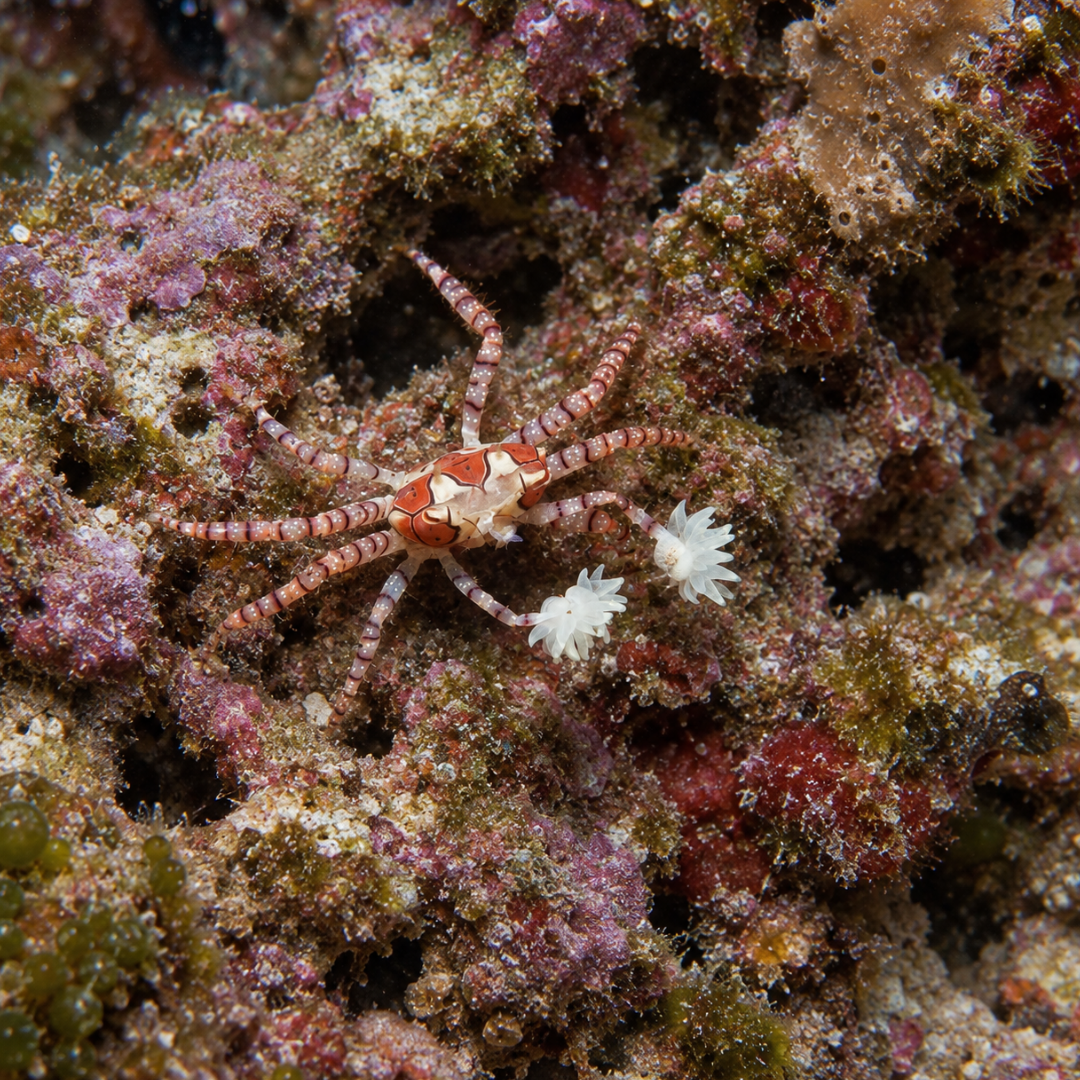
解説 / Description
キンチャクガニは、両方の小さなハサミにイソギンチャクを持って生活することで知られる、非常に個性的な海産のカニです。英語では「Pom-pom crab」や「Boxer crab」と呼ばれ、イソギンチャクを左右に掲げる姿がポンポンやボクシンググローブを持っているように見えることが名前の由来になっています。最大甲幅は約2.5cmと小型ですが、背甲にはモザイクやステンドグラスを思わせる複雑な幾何学模様があり、独特の存在感があります。夜行性で警戒心が強く、日中は岩やサンゴ礫の隙間に隠れて過ごすことが多いため、落ち着いて暮らせる隠れ家を十分に用意することが長期飼育の基本です。 Lybia tessellata is a distinctive marine crab famous for carrying a small sea anemone in each claw. In English it is commonly called the “Pom-pom crab” or “Boxer crab,” referring to the way the anemones resemble pom-poms or boxing gloves when held up. Although it reaches only about 2.5 cm in maximum carapace width, its shell displays an intricate geometric pattern reminiscent of mosaics or stained glass. It is mainly nocturnal and rather shy, usually spending the daytime hidden beneath rocks or among coral rubble, so providing plenty of secure shelters is an important part of successful long-term care.
基本情報 / Basic Information
| 学名 / Scientific Name | Lybia tessellata (Latreille, 1812) |
|---|---|
| 通称 / Common Name | キンチャクガニ、ポンポンクラブ、ボクサークラブPom-pom Crab, Boxer Crab, Cheerleader Crab |
| 分類 / Family | 節足動物門・軟甲綱・十脚目・オウギガニ科・Polydectinae亜科・Lybia属Phylum Arthropoda, Class Malacostraca, Order Decapoda, Family Xanthidae, Subfamily Polydectinae, Genus Lybia |
| 英名 / English Name | Pom-pom Crab / Boxer Crab |
| 分布 / Distribution | 紅海、アフリカ東岸からインドネシア、ニューギニア、フィリピン、ハワイなどに至る熱帯インド太平洋域。浅いサンゴ礁の岩陰やサンゴ礫の下などに生息します。Widely distributed across the tropical Indo-Pacific, from the Red Sea and East African coast to Indonesia, New Guinea, the Philippines, and Hawaii. It inhabits shallow reef environments, often sheltering beneath rocks and coral rubble. |
| 最大体長 / Max Size | 最大甲幅約2.5cm。非常に小型のカニです。Approximately 2.5 cm in maximum carapace width. It is a very small crab. |
| 寿命 / Lifespan | 明確な寿命については情報が十分に確立されていません。A well-established typical lifespan has not been clearly documented. |
飼育環境 / Aquarium Environment
| 水槽サイズ / Tank Size | 最低20L程度以上が目安です。日本で一般的な水槽では30cmキューブ水槽前後から飼育しやすく、安定した水質を維持できる容量を確保することが重要です。A minimum volume of around 20 liters is recommended. A tank roughly comparable to a 30 cm cube aquarium provides a practical starting point, with sufficient volume to maintain stable water conditions. |
|---|---|
| 水温 / Temperature | 22~25℃を目安に、急激な温度変化を避けて安定させます。 Maintain approximately 22–25°C and avoid sudden temperature fluctuations. |
| 水質 / Water Quality | 海水比重1.023~1.025、pH8.1~8.4程度が目安です。脱皮を繰り返す甲殻類であるため、急激な水質変化を避け、海水の化学組成を安定させることが重要です。カルシウムやヨウ素などの成分についても不足や過剰を避け、使用する人工海水や添加剤の指示に従って適切に管理します。A specific gravity of about 1.023–1.025 and pH of 8.1–8.4 are suitable targets. As a crustacean that molts periodically, it benefits from stable water chemistry without sudden changes. Calcium, iodine, and other seawater constituents should be maintained appropriately while avoiding both deficiency and excessive supplementation. |
| レイアウト / Layout | ライブロックやサンゴ礫などを組み、体がすっぽり隠れる隙間を複数作ります。自然界では岩の下や瓦礫の隙間に潜むため、開けた水槽よりも細かな隠れ場所を多く用意した環境が適しています。マクロアルジーを組み合わせることもできます。Arrange live rock and coral rubble to create multiple narrow shelters where the crab can hide completely. In nature it occupies crevices beneath rocks and rubble, so a structurally complex aquarium with many hiding places is preferable to a highly open layout. Macroalgae can also be incorporated. |
| 注意点 / Precautions | 夜行性で臆病なため、導入直後に姿が見えなくても無理に探し回らないようにします。特に脱皮前後は刺激を避けることが大切です。脱皮直後は新しい外骨格が柔らかく、外敵への抵抗力が大きく低下します。また、本種が保持するイソギンチャクを無理に取り外さないようにしてください。Because this species is nocturnal and shy, avoid repeatedly disturbing the aquarium if it disappears into hiding after introduction. Disturbance should be minimized around molting periods in particular, as the newly formed exoskeleton is soft and leaves the crab vulnerable. Its carried sea anemones should not be forcibly removed. |
餌と給餌 / Feeding
| 餌の種類 / Diet | 雑食性で、飼育下では沈下性の人工飼料、藻類を原料としたフード、冷凍イサザアミ、ブラインシュリンプ、細かくした海苔などを利用できます。自然界では保持しているイソギンチャクを利用し、微小な餌やデトリタスを集めて食べる行動もみられます。It is omnivorous and can accept sinking prepared foods, algae-based foods, frozen mysid shrimp, brine shrimp, and finely divided dried seaweed in captivity. In nature it also uses the sea anemones held in its claws to gather small food particles and detritus. |
|---|---|
| 給餌のポイント / Feeding Tips | 導入直後は警戒心が強いため、消灯後や照明を落とした時間帯に少量を与えると食べやすくなります。餌が大型魚や活発な魚に先に取られてしまう場合は、スポイトやピンセットなどで隠れ家の近くに届けると確実です。環境に慣れると日中の給餌時に姿を見せることもあります。Newly introduced individuals are often cautious, so feeding small amounts after the lights go out can improve feeding success. If faster fish consume the food first, a pipette or feeding tool can be used to place food near the crab’s shelter. Once acclimated, some individuals may begin appearing during daytime feeding. |
性格と混泳 / Temperament and Tank Mates
| 性格 / Temperament | 基本的には臆病で、日中は隠れていることが多い夜行性のカニです。一般的なカニのような太く強力なハサミではなく、イソギンチャクを保持することに特化した細い鋏脚を持つため、積極的に他の生体へ物理的な攻撃を仕掛けるタイプではありません。It is generally shy and largely nocturnal, spending much of the daytime hidden. Unlike many crabs, it lacks heavy crushing claws; instead, its slender chelae are specialized for holding sea anemones. It is therefore not typically an aggressive physical attacker of other aquarium inhabitants. |
|---|---|
| 混泳の相性 / Compatibility | 小型のハゼやギンポ、カクレクマノミ、穏やかな小型魚、同程度の大きさのヤドカリや巻貝などとは比較的合わせやすい生体です。一方、ハタ類、ミノカサゴ、大型のベラ、ゴンベ類、フグ類、モンガラカワハギ類など甲殻類を捕食する魚、大型で攻撃的なヤドカリや肉食性の強い大型エビとの同居は避けます。小型で外骨格も薄いため、捕食者に襲われるとイソギンチャクによる防御だけでは耐えられない場合があります。It is generally compatible with small gobies, blennies, clownfish, other peaceful small fish, similarly sized hermit crabs, and snails. Avoid predatory fishes that readily consume crustaceans, including groupers, lionfish, large wrasses, hawkfish, puffers, and triggerfish, as well as large aggressive hermit crabs and strongly predatory shrimp. Its small size and relatively light armor make it vulnerable despite the defensive anemones it carries. |
病気と対策 / Diseases and Prevention
| かかりやすい病気 / Common Diseases | 本種特有の代表的な疾病については明確な情報がありませんが、飼育上は脱皮不全が重要なトラブルになります。脱皮時に古い殻から正常に抜けられないと、脚やハサミを失ったり、重症の場合は死亡につながったりすることがあります。No characteristic disease specific to this species is clearly established, but unsuccessful molting is an important husbandry concern. Failure to shed the old exoskeleton normally can result in loss of legs or claws and may be fatal in severe cases. |
|---|---|
| 対策と予防 / Prevention | 安定した水温・比重・pHを維持し、急激な水質変化を避けることが基本です。カルシウムやヨウ素を含む海水成分の管理にも注意しますが、添加剤を使用する場合は過剰添加を避け、製品の使用量や水槽の測定値を確認しながら管理します。脱皮の兆候がみられる個体はなるべく刺激せず、安全な隠れ家を確保します。脚やハサミを失った場合でも、その後の脱皮に伴って再生する能力があります。Prevention centers on maintaining stable temperature, salinity, and pH while avoiding abrupt changes in water chemistry. Seawater constituents including calcium and iodine should also be managed appropriately, but supplements should not be overdosed and should be used according to product instructions and measured aquarium conditions. When signs of an approaching molt are observed, disturbance should be minimized and safe shelter provided. Lost legs and claws have the ability to regenerate through subsequent molts. |
増やし方(繁殖) / Breeding
| 雌雄の判別 / Sexing | 外見だけで容易に雌雄を判別する方法については明確な情報がありません。繁殖を目的とする場合は、腹部の形状など甲殻類の性的特徴を慎重に観察する必要があります。A simple and clearly established method of sexing individuals by general external appearance is not well documented. For breeding attempts, sexual characteristics such as abdominal morphology need to be examined carefully. |
|---|---|
| 繁殖形態 / Reproduction | 交尾後、雌は数百個の卵を腹部の遊泳脚に付着させて抱卵します。卵は発生が進むにつれて灰色から濃い紫色へ変化します。孵化した幼生はゾエアと呼ばれる浮遊幼生で、複数回の脱皮を経てメガロパへ変態し、その後に着底して稚ガニの姿になります。After mating, the female carries several hundred eggs attached to the pleopods beneath the abdomen. The egg mass changes from gray toward a darker purple as development proceeds. Newly hatched larvae are planktonic zoeae, which undergo several molts before transforming into the megalopa stage and eventually settling as juvenile crabs. |
| 繁殖のポイント / Breeding Tips | 飼育下繁殖は非常に難しいとされています。ゾエア幼生はメガロパになるまで複数回の脱皮を必要とし、着底までおよそ10~12日を要します。この期間に適切な微小餌を高頻度で与えながら、残餌や排泄物による水質悪化を防ぐ必要があります。一般的なワムシや植物プランクトンだけでは十分な栄養要求を満たせないとされ、幼生期の餌料確保と水質維持が大きな課題です。Captive breeding is considered extremely difficult. Zoeal larvae must pass through multiple molts before becoming megalopae, with settlement taking roughly 10–12 days. During this period they require frequent access to suitable microscopic prey while excellent water quality must be maintained despite uneaten food and waste. Standard rotifers and phytoplankton alone are reported to be insufficient for their nutritional requirements, making larval feeding and water-quality management major challenges. |
雑学と豆知識 / Trivia and Fun Facts
| 1. ハサミは「武器」ではなくイソギンチャク専用の道具 / 1. Claws Specialized for Holding Anemones | 一般的なカニのハサミといえば、硬い餌を砕いたり敵を挟んだりするための強力な武器を思い浮かべます。しかしキンチャクガニの鋏脚は細く、イソギンチャクを保持することに大きく特殊化しています。指の内側には小さなフック状の突起が並び、柔らかなイソギンチャクをつかみやすい構造になっています。自分自身の大型武器を発達させる代わりに、別の生物が持つ刺胞という防御能力を利用する方向へ特殊化した姿は、このカニの生態を象徴しています。The claws of most crabs bring to mind powerful tools for crushing food or pinching enemies, but those of Lybia tessellata are slender and strongly specialized for carrying sea anemones. Small hook-like structures line the inner surfaces of the claw fingers, helping the crab grip the soft-bodied anemones. Rather than relying on large crushing claws of its own, the crab has evolved a remarkable lifestyle centered on using the stinging defenses of another animal. |
|---|---|
| 2. 学名「tessellata」が表すモザイク模様 / 2. The Mosaic Meaning Behind “tessellata” | 種小名の「tessellata」は、モザイク細工などに使われる小さな四角形のピースを意味するラテン語「tessella」に由来します。背甲をよく見ると、複数の色が組み合わさった三角形や多角形が連なり、まるで細かなタイルやステンドグラスを組み合わせたような模様が広がっています。小さな体に描かれたこの複雑な模様は観賞上の魅力であるだけでなく、自然界ではサンゴ礁や砂礫の複雑な背景に体の輪郭を溶け込ませる効果もあると考えられます。The specific name “tessellata” derives from the Latin “tessella,” referring to the small pieces used in mosaic work. A close look at the carapace reveals interconnected triangles and polygons in several colors, creating an appearance reminiscent of tiny tiles or stained glass. Besides making the crab visually attractive, this complex pattern is also thought to help break up its outline against the varied background of reef rubble. |
| 3. 片方を失うとイソギンチャクを二つに分ける / 3. One Anemone Can Become Two | キンチャクガニの研究で特に注目されたのが、片方のイソギンチャクを失ったときの行動です。片手だけにイソギンチャクが残ると、カニはその個体をゆっくり二つに分け、左右のハサミに一つずつ持つことがあります。分けられたイソギンチャクは再生し、それぞれ一個体として形を整えていきます。遺伝子解析では、このようにして生じた左右のイソギンチャクが同一の遺伝的構成を持つクローンであることが確認されました。別の動物が物理的に介入し、相手の無性生殖を引き起こすという非常に珍しい現象です。One of the most striking observations of boxer crabs concerns what happens when one anemone is lost. If only a single anemone remains, the crab may slowly divide it into two pieces and place one in each claw. The fragments regenerate and develop into complete anemones. Genetic analysis has shown that pairs produced this way can be genetically identical clones, making this an unusual example in which one animal physically induces asexual reproduction in another. |
| 4. イソギンチャクを「盆栽」のように小さく保つ / 4. Keeping “Bonsai Anemones” | イソギンチャクとカニの関係は、単純に双方が利益を得る関係として語り切れない複雑さを持っています。観察研究では、カニがイソギンチャクの触手で集めた餌を自分で食べ、イソギンチャク側の摂餌量を強く制限する行動が報告されています。カニから離されたイソギンチャクが短期間に大きく成長したことから、カニが持ち運びやすい小さなサイズに成長を抑えている可能性が示され、この状態は「ボンサイ・イソギンチャク」と表現されました。かわいらしい外見の裏側には、かなり複雑な生物間関係が隠れています。The relationship between the crab and its anemones is more complicated than a simple partnership in which both sides always benefit equally. Observations have reported that the crab takes much of the food collected by the anemone’s tentacles and strongly limits how much the anemone itself can consume. Anemones separated from the crab were observed to grow rapidly, suggesting that the crab may keep them at a conveniently portable size. This phenomenon has been described as maintaining “bonsai anemones,” revealing a surprisingly complex interaction behind the crab’s charming appearance. |
| 5. イソギンチャクをめぐって同種同士で奪い合うことがある / 5. Anemones May Be Stolen Between Crabs | 両方のイソギンチャクを失った個体は、イソギンチャクを持つ別の個体から一部または全部を奪おうとすることがあります。その争いでは、貴重なイソギンチャクそのものを激しくぶつけ合うのではなく、互いの歩脚を使いながら争う行動が観察されています。奪い合いの途中でイソギンチャクが分断されれば、その断片を持ち帰って再生させることもできます。イソギンチャクが単なる飾りではなく、生存と密接に結びついた重要な存在であることがよく分かる行動です。A crab that loses both of its anemones may attempt to take part or all of an anemone from another individual. During these encounters, the crabs have been observed to avoid simply smashing their valuable anemones together, instead interacting largely with their walking legs. If an anemone is torn during the contest, the resulting fragments can potentially be retained and regenerated. The behavior demonstrates how important these anemones are to the crab’s way of life rather than being merely decorative accessories. |
| 6. 脱皮の直後にイソギンチャクを回収する / 6. Recovering the Anemones After Molting | 脱皮の瞬間にもキンチャクガニらしい行動が見られます。古い殻から抜け出すとき、保持していたイソギンチャクは一時的に古い鋏脚側へ残されます。新しい殻はまだ柔らかく、カニにとって非常に危険な時間ですが、それでも脱皮後には古い殻へ向かい、残してきたイソギンチャクを回収して新しいハサミで持ち直します。自分が最も無防備な時間であっても回収を優先する行動から、イソギンチャクへの強い依存性がうかがえます。Molting reveals another behavior characteristic of this remarkable crab. As it leaves the old exoskeleton, the anemones can temporarily remain with the old claw coverings. Although the freshly molted crab is soft and extremely vulnerable, it then returns to recover the anemones and takes them up again in its new claws. The urgency of this recovery behavior illustrates just how closely the crab’s life is tied to its living defensive tools. |
| 7. イソギンチャクを失うと別の生物を持つこともある / 7. Substitute Organisms May Be Used | 飼育環境では、本来持っていたイソギンチャクを失った個体が、カーリーと呼ばれるAiptasia属のイソギンチャクを利用したり、マメスナギンチャクなど別のポリプ状生物をハサミで保持したりする例が報告されています。通常ならサンゴ水槽で厄介者とされるカーリーを「代わりの道具」として利用することがあるというのは興味深いところです。ただし、代用品を持たせる目的で生体を人為的に引き剥がしたり、無理にハサミへ挟ませたりすることは避け、自然な行動として観察するのが適切です。In aquariums, individuals that have lost their original anemones have been reported to carry Aiptasia anemones or other small polyp-like organisms such as zoanthids. Aiptasia is normally regarded as a nuisance in reef aquariums, making its occasional use as a substitute tool especially interesting. However, organisms should not be forcibly detached or pushed into the crab’s claws simply to reproduce this behavior; it is best observed only when it occurs naturally. |
| 8. 人工繁殖が難しく、幼生期が大きな壁になる / 8. The Difficult Larval Stage | 親ガニの飼育そのものよりも難しいのが、孵化した幼生を稚ガニまで育てることです。ゾエア幼生は小さな浮遊生活者で、複数回の脱皮を成功させながら十分な餌を取り続けなければなりません。その一方で、小さな幼生用水槽では残餌や排泄物による水質悪化が急速に進みます。適切な微小餌を絶えず確保しながら清浄な水を維持する必要があるため、繁殖サイクルを安定して成立させることは非常に難しい課題となっています。Raising the adults is considerably easier than bringing newly hatched larvae through to the juvenile crab stage. Tiny planktonic zoeae must continue feeding successfully while completing a series of molts. At the same time, uneaten food and waste can rapidly degrade water quality in the small systems typically used for larval culture. The need to provide suitable microscopic prey continuously while maintaining clean and stable water makes successful captive propagation particularly challenging. |
まとめ / Conclusion
キンチャクガニは、わずか数センチほどの小さな体に、他の生物を「道具」のように利用する驚くほど高度な生態を秘めています。イソギンチャクをただ持ち歩くだけでなく、失えば分割して再生させ、時には同種から一部を得ようとし、脱皮後には真っ先に回収する行動まで見せます。両手のイソギンチャクは愛らしい外見を作り出す飾りではなく、このカニの暮らしそのものと深く結びついた存在です。 Lybia tessellata packs an extraordinary biological strategy into a body only a few centimeters wide. It does far more than simply carry sea anemones: it can divide a remaining anemone so that it regenerates into two, may obtain anemone material from another crab, and quickly retrieves its partners after molting. The pair of anemones that gives this species its charming appearance is therefore not merely decorative, but deeply integrated into the crab’s entire way of life.
水槽では、小さな体を安心して隠せる岩組み、安定した海水環境、捕食者を避けた穏やかな混泳、そして脱皮期への十分な配慮が大切です。普段は岩陰に潜みながらも、ふと姿を現して両手のイソギンチャクを掲げる様子は、サンゴ礁に暮らす生き物たちの複雑な関係を身近に感じさせてくれます。その小さな姿をじっくり観察するほど、見た目のかわいらしさだけでは語れない奥深さに気づかされるカニです。 In the aquarium, its care depends on providing secure rocky shelters, stable marine water conditions, peaceful tank mates that will not prey on it, and special consideration during molting. Although it often remains hidden, the sight of this tiny crab emerging from the rocks with an anemone raised in each claw offers a fascinating glimpse into the intricate relationships of reef organisms. The more closely it is observed, the more its appeal extends far beyond its famously charming appearance.

気になる道具や飼い方を見つけてみませんか?
 アイのアクアグッズ案内水草用ソイルの選び方|土・砂の違いとおすすめ商品道具の特徴や使い方、選ぶときのポイントをアイが紹介します。記事はコチラ →
 アイのアクアグッズ案内海水魚初心者の必需品|水槽・人工海水・比重計・水質検査道具の特徴や使い方、選ぶときのポイントをアイが紹介します。記事はコチラ →
 アイのアクアグッズ案内水草の肥料の選び方|底床用・液肥・メネデールの使い分け道具の特徴や使い方、選ぶときのポイントをアイが紹介します。記事はコチラ →
 アイのアクアグッズ案内プレコ飼育に必要なもの|餌・流木・ろ過・隠れ家・掃除用品道具の特徴や使い方、選ぶときのポイントをアイが紹介します。記事はコチラ →
さまざまな飼育テーマをご紹介。リンク先の記事には広告・商品紹介が含まれます。
案内・紹介記事一覧へ →分布マップ
キンチャクガニ(Lybia tessellata)は、インド西太平洋域に広く分布し、浅い海の岩陰やサンゴ礫の下など、身を隠せる環境で見られます。
※この地図は分布地域全体を把握するための概略表示です。マーカーは分布域を視覚的に示すための代表地点であり、実際の採集地点や個体の確認地点を示すものではありません。
参考文献
-
DecaNet eds. (2026). Lybia tessellata (Latreille in Milbert, 1812). World Register of Marine Species (WoRMS).
学名、現在の分類、記録された分布の確認。
https://www.marinespecies.org/aphia.php?p=taxdetails&id=208964 -
Ng, P. K. L., Guinot, D. & Davie, P. J. F. (2008). Systema Brachyurorum: Part I. An annotated checklist of extant brachyuran crabs of the world. The Raffles Bulletin of Zoology, Supplement 17, 1–286.
短尾類およびオウギガニ科を含む分類体系の確認。
https://decapoda.nhm.org/pdfs/27562/27562.pdf -
柳 研介・岩尾 研二 (2012). キンチャクガニ Lybia tessellata が保持するイソギンチャクの謎. みどりいし, 23, 31–36.
キンチャクガニが保持するイソギンチャク、形態変化、両者の関係に関する日本語資料。
https://www.amsl.or.jp/midoriishi/23_31.pdf -
Schnytzer, Y., Achituv, Y., Fiedler, G. C. & Karplus, I. (2022). The intimate relationship between boxer crabs and sea anemones: What is known and what is not. In Oceanography and Marine Biology: An Annual Review, Volume 60, 495–531. CRC Press.
キンチャクガニ類の分布・生息環境、鋏脚の特殊化、イソギンチャクとの関係、繁殖研究の現状を整理した総説。
https://doi.org/10.1201/9781003288602-10 -
Schnytzer, Y., Giman, Y., Karplus, I. & Achituv, Y. (2013). Bonsai anemones: Growth suppression of sea anemones by their associated kleptoparasitic boxer crab. Journal of Experimental Marine Biology and Ecology, 448, 265–270.
近縁種 Lybia leptochelis における、保持されたイソギンチャクの摂餌制限と成長抑制の実験的検証。
https://doi.org/10.1016/j.jembe.2013.07.011 -
Schnytzer, Y., Giman, Y., Karplus, I. & Achituv, Y. (2017). Boxer crabs induce asexual reproduction of their associated sea anemones by splitting and intraspecific theft. PeerJ, 5, e2954.
近縁種 Lybia leptochelis におけるイソギンチャクの分割、再生、同種間での取得行動と遺伝解析。
https://doi.org/10.7717/peerj.2954 -
Calado, R., Lin, J., Rhyne, A. L., Araújo, R. & Narciso, L. (2003). Marine Ornamental Decapods—Popular, Pricey, and Poorly Studied. Journal of Crustacean Biology, 23(4), 963–973.
海産観賞用十脚類の流通、分布、幼生発生・養殖技術の研究状況を整理し、Lybia tessellata についても収録。
https://doi.org/10.1651/C-2409 -
Ornamental Aquatic Trade Association (OATA). How to look after marine crustaceans.
海産甲殻類の一般的な飼育条件、水質管理、給餌、脱皮時の隠れ家、銅を含む薬剤への注意に関する飼育指針。
https://ornamentalfish.org/what-we-do/advice-information/care-sheets/caresheets-marine-invertebrates/how-to-look-after-marine-crustaceans/ -
Hancock-Ronemus, A. L., Buote, M. & Lewbart, G. A. (2022). Crustaceans. In G. A. Lewbart (Ed.), Invertebrate Medicine. Wiley.
甲殻類の健康管理、疾病、診断、飼育下での管理を扱う獣医学的専門資料。
https://doi.org/10.1002/9781119569831.ch16





コメント