

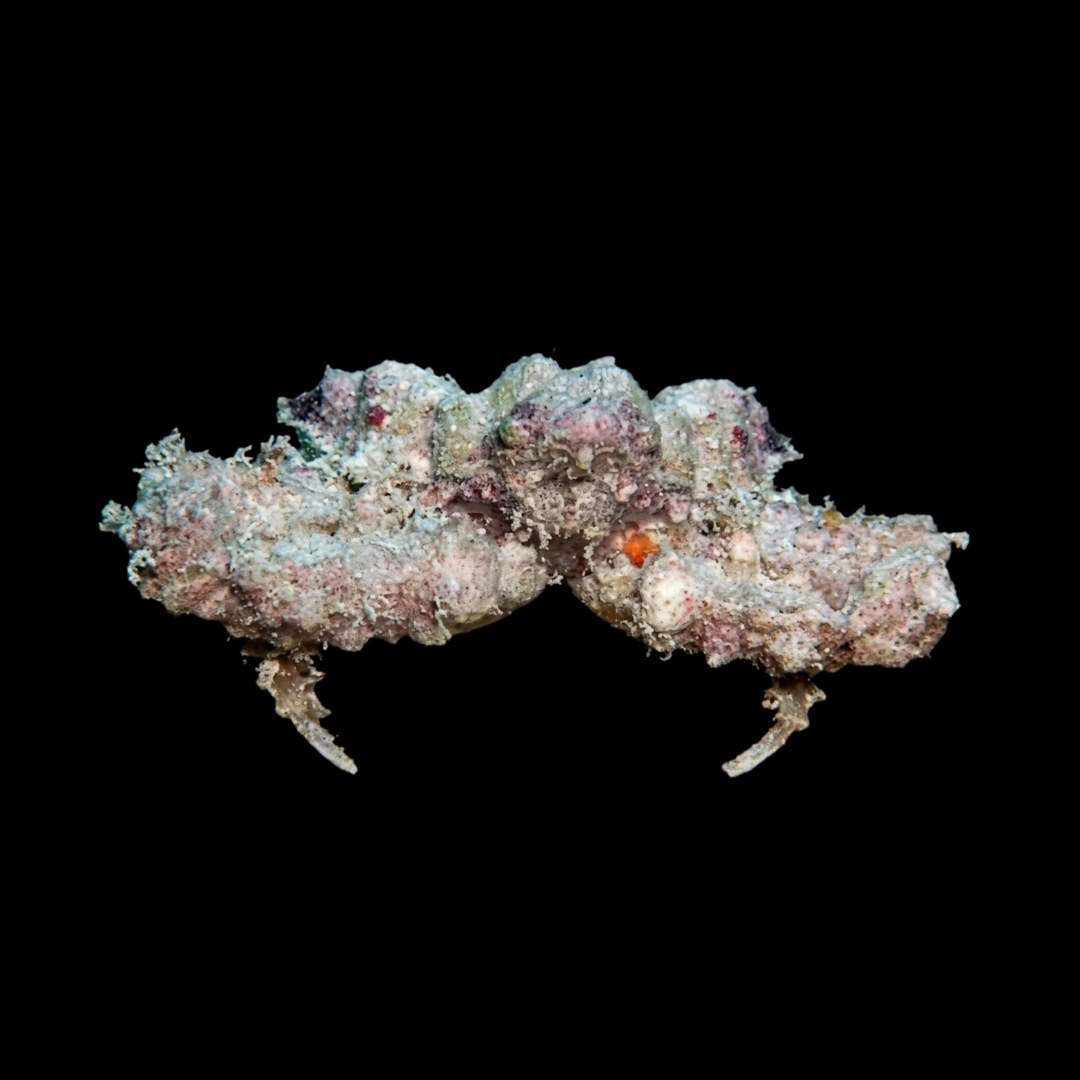
解説 / Description
カルイシガニは、サンゴのかけらや海底の岩を思わせる姿が印象的な、ヒシガニ科の海水生のカニです。凹凸の多い甲羅と長く発達したハサミをもち、静止していると周囲の石と見分けにくく、動き始めて初めてその存在に気づくこともあります。左右で形の異なるハサミは、硬い殻をもつ獲物を扱うための道具でもあります。活発に泳ぐ魚とは違い、岩陰での姿勢や餌をつかむ仕草をじっくり観察する楽しみがあります。ただし、ほかの生き物を捕食するおそれがあり、本種に特化した長期飼育の知見も限られています。また、有毒性が報告されているため、観賞専用とし、人が食べたり、ペットの餌にしたりすることは絶対に避けてください。 The horrid elbow crab is a marine crab in the family Parthenopidae, notable for its resemblance to coral rubble and seafloor rocks. Its heavily textured carapace and elongated claws make a motionless animal difficult to distinguish from the surrounding stones. Sometimes its presence only becomes apparent when it moves. The differently shaped claws also serve as tools for handling hard-shelled prey. Unlike an actively swimming fish, this crab rewards patient observation of its posture in a shelter and the way it takes food. It may prey on other aquarium animals, however, and species-specific knowledge of long-term husbandry remains limited. Toxicity has also been reported: keep it strictly as an ornamental animal, and never eat it or feed it to pets.
基本情報 / Basic Information
| 学名 / Scientific Name | Daldorfia horrida (Linnaeus, 1758) |
|---|---|
| 通称 / Common Name | カルイシガニ。国内の観賞用流通でも、この名称で扱われています。Karuishi-gani in Japanese; the same name is used in Japan’s ornamental aquarium trade. |
| 分類 / Family | 十脚目・短尾下目・ヒシガニ上科・ヒシガニ科・カルイシガニ亜科・カルイシガニ属。Order Decapoda; infraorder Brachyura; superfamily Parthenopoidea; family Parthenopidae; subfamily Daldorfiinae; genus Daldorfia. |
| 英名 / English Name | Horrid elbow crab, Rubble crab |
| 分布 / Distribution | インド洋から太平洋にかけての熱帯・亜熱帯域に広く分布します。日本では紀伊半島周辺、伊豆諸島、小笠原諸島、琉球列島などに記録があり、2026年には静岡県南伊豆で採集された個体も報告されました。サンゴ礁や岩礁の転石帯、サンゴ片が散らばる海底などで見られます。Widely distributed through tropical and subtropical parts of the Indian and Pacific oceans. Japanese records include the Kii Peninsula region, the Izu Islands, the Ogasawara Islands, and the Ryukyu Islands. A specimen collected in southern Izu, Shizuoka Prefecture, was reported in 2026. Habitats include coral reefs, rocky bottoms with loose stones, and areas of coral rubble. |
| 最大体長 / Max Size | 甲幅約12cmになるカニで、これを超える標本も記録されています。そのため、12cmを最大値とみなすことはできません。甲幅とは甲羅の横幅のことで、ハサミを広げた全幅とは異なります。水槽選びでは、甲羅だけでなく、ハサミを含めた体全体の大きさを確認してください。This crab reaches approximately 12 cm in carapace width, and larger specimens have been documented, so 12 cm should not be treated as a maximum. Carapace width is the width of the shell alone, not the overall span of the extended claws. Aquarium planning must account for the entire animal rather than the carapace alone. |
| 寿命 / Lifespan | 野外・飼育下ともに、一般的な寿命を判断できる十分な情報はありません。採集個体は年齢が分からないことも多いため、入手後の飼育期間が、その個体の生涯の長さを示すわけではありません。Insufficient information is available to establish a typical lifespan in the wild or in captivity. Wild-collected animals may be of unknown age, so the length of time an individual lives after purchase does not represent its entire lifespan. |
飼育環境 / Aquarium Environment
| 水槽サイズ / Tank Size | 長期飼育の設備を考える際は、90cm規格水槽(幅90×奥行45×高さ45cm、寸法からの概算容量約180L)などを候補に、個体の大きさに合う広い底面を確保します。これは本種で検証された最低サイズではなく、設備を検討するための例です。岩組みを入れた状態でも、ハサミを広げ、向きを変え、脱皮できる空間が必要で、大型個体にはさらに広い水槽を検討してください。小型個体を60cm規格水槽(約60~65L)で管理する場合も、成長後の移設先をあらかじめ用意します。実際に入る水量は、水位や底砂、岩などによって少なくなります。When planning long-term accommodation, consider a standard Japanese 90 cm aquarium measuring 90 × 45 × 45 cm, with a calculated gross volume of approximately 180 L, or another tank with sufficient floor space for the individual. This is a planning example, not a validated minimum size for the species. Even after rockwork is installed, the crab needs room to extend its claws, turn, and molt; larger individuals may require a larger aquarium. If a small specimen is kept in a standard 60 cm aquarium of approximately 60–65 L, arrange its larger accommodation in advance. Actual water volume will be lower because of the operating water level, substrate, and rockwork. |
|---|---|
| 水温 / Temperature | 国内の販売店では、24℃前後が飼育の目安として案内されています。ただし、本種の最適水温や高温への耐性が十分に確かめられた値ではありません。入手先での管理水温や採集情報を確認し、急な温度変化を避けてください。夏は室温と水温を測定し、必要に応じて空調や水槽用クーラーを使用します。冬も、ヒーターなどで安定した水温を保つことが基本です。Japanese retail guidance gives approximately 24°C as a husbandry reference. This should not be taken as a well-established optimum or evidence of the species’ upper thermal tolerance. Check the supplier’s holding temperature and any collection information, and avoid abrupt temperature changes. Monitor room and water temperatures in summer, using room cooling or an aquarium chiller when necessary. In winter, use heating as needed to maintain stable conditions. |
| 水質 / Water Quality | 海水で飼育し、淡水や低塩分の汽水環境には入れません。一般的な海水水槽の管理を参考に、比重1.023~1.025前後、pH8.1~8.4を暫定的な目安としますが、いずれも本種で検証された最適値ではありません。比重は水温や測定器の基準によって値の扱いが変わるため、説明書に従い、測定条件をそろえて管理してください。十分に機能する生物ろ過と酸素供給を確保し、アンモニアと亜硝酸が検出されない状態を目指します。残餌の回収と定期的な換水を基本に、必要に応じてプロテインスキマーを併用します。Keep this crab in seawater, not freshwater or low-salinity brackish conditions. A specific gravity of approximately 1.023–1.025 and a pH of 8.1–8.4 can serve as provisional references drawn from general marine aquarium practice, but neither range is a validated optimum for this species. The interpretation of specific gravity depends on temperature and instrument calibration, so follow the instrument’s instructions and measure consistently. Provide functioning biological filtration and adequate oxygenation, aiming for undetectable ammonia and nitrite. Remove uneaten food and carry out regular water changes; a protein skimmer may be used as an additional aid. |
| レイアウト / Layout | 安定した岩組みで、体とハサミを無理なく収められる隠れ家を用意します。カニが下に入り込んでも崩れないように土台を固定し、砂の上に石を積み重ねるだけの構造は避けてください。隠れ家の周囲には、移動や脱皮のための空間を残します。照明は観察に必要な明るさとし、陰になる場所も設けます。配管や吸水口は、体が挟まったり、カニが機器を動かしたりしないように配置・保護してください。Build secure rockwork with a shelter large enough to accommodate both the body and claws. Anchor the structure so that it cannot collapse when the crab moves underneath, rather than simply stacking rocks on loose sand. Leave room around the shelter for movement and molting. Lighting need only support observation, and shaded areas should remain available. Position and protect pipes and intake openings to reduce the risk of entrapment or equipment being displaced. |
| 注意点 / Precautions | 食用にしないでください。死亡個体も、ほかの動物の餌には使用しません。子どもや犬・猫などが触れたり口にしたりできない場所で管理します。脱走を防ぐため、配管周囲を含む隙間をふさぎ、蓋を確実に固定してください。ただし、水槽を気密状態にはせず、通気と酸素供給を確保します。移動には丈夫な容器を使い、素手でつかんだり、脚やハサミを持って吊り上げたりしないでください。人の誤食が疑われた場合は、症状を待たずに医療機関や中毒110番へ相談し、呼吸困難や意識の異常があれば119番へ連絡してください。ペットが口にした場合は、すぐに動物病院へ相談します。Never eat this crab or use a dead specimen as food for other animals.Keep it inaccessible to children, dogs, cats, and other pets. Close escape routes, including gaps around plumbing, and secure the lid without making the aquarium airtight; ventilation and oxygenation remain essential. Use a sturdy container for transfers, and do not grasp the crab with bare hands or lift it by its legs or claws. If a person may have eaten it, contact a medical service or Japan’s poison information service, Chudoku 110-ban, immediately rather than waiting for symptoms. In Japan, call 119 if breathing difficulties or altered consciousness occur. If a pet has taken it into its mouth or swallowed any part, contact a veterinarian immediately. |
餌と給餌 / Feeding
| 餌の種類 / Diet | 貝類などの動物質を中心に考えます。飼育下では、海産甲殻類向けの沈下性配合飼料を食べるか確認し、アサリなどの貝肉、エビ、イカの小片を組み合わせます。特定の切り身だけに偏らせず、実際に食べる餌を複数確保しておくと管理しやすくなります。ただし、本種の長期的な栄養要求には不明な点があり、「カニ用」などの表示だけで、その飼料のみで必要な栄養を満たせるとは判断できません。Base feeding on animal foods, including molluscs. Check whether the individual accepts sinking formulated foods intended for marine crustaceans, and combine these with small portions of clam meat, shrimp, and squid. Avoid relying exclusively on one type of seafood, and establish several foods the crab will reliably accept. Its long-term nutritional requirements remain incompletely understood, however, so a product labeled for crabs should not automatically be assumed to provide a complete diet for this species. |
|---|---|
| 給餌のポイント / Feeding Tips | 本種に適した給餌量や頻度を一律に決められるだけの情報はありません。まず少量を提示し、個体の大きさ、食欲、水温、残餌の量に応じて調整します。隠れ家の近くに餌を置き、つかんで食べ始めるか確認してください。食べなかった餌は放置せず回収し、水を汚さないようにします。脱皮前後には食欲が落ちることがあるため、食べないからといって餌を入れ続けたり、隠れ家から無理に出したりしないでください。There is insufficient information to prescribe a single feeding amount or schedule for this species. Begin with a small portion and adjust according to the individual’s size, appetite, water temperature, and leftovers. Place food near its shelter and confirm that it takes and eats it. Retrieve rejected food rather than allowing it to decompose. Appetite may decrease around molting, so do not keep adding food or force the animal out of its refuge simply because it is not eating. |
性格と混泳 / Temperament and Tank Mates
| 性格 / Temperament | 普段はじっとしていることが多く、周囲にまぎれる姿を楽しむカニです。ただし、動きが少ないことと、ほかの生き物に無害であることは別です。餌を扱う際には大きなハサミを使うため、観察中も不用意に手を近づけないでください。落ち着いて隠れられる環境を整え、頻繁な移動や接触を避けて見守る飼い方が向いています。This crab often remains still, making its camouflage a major part of its appeal. Inactivity should not be confused with harmlessness toward other animals. Its large claws are used to handle food, so hands should not be placed carelessly within reach. Provide a secure refuge and favor quiet observation over frequent handling or relocation. |
|---|---|
| 混泳の相性 / Compatibility | 安全を優先し、1個体での単独飼育を基本とします。貝類、エビ、ヤドカリ、小型魚などには捕食の危険があり、泳ぎの速い魚でも安全とは断定できません。サンゴも、食べるかどうかとは別に、移動やハサミによる接触で傷つけられるおそれがあります。同種同士でも、争いや脱皮直後の共食いには注意が必要です。複数個体を管理する場合は、互いに接触できない独立した区画を用意してください。For safety, keep a single individual on its own. Molluscs, shrimp, hermit crabs, and small fish may be eaten, and fast-swimming fish cannot be assumed safe. Corals may also be damaged by movement or claw contact, regardless of whether the crab consumes living coral tissue. Conspecifics may fight or attack a recently molted individual. Multiple animals should therefore be housed in separate, secure compartments that prevent contact. |
病気と対策 / Diseases and Prevention
| かかりやすい病気 / Common Diseases | 本種で特に多い感染症や、その標準的な治療法については、十分な情報がありません。飼育上は、輸送時の損傷、水質悪化や酸素不足に伴う不調、脱皮のトラブルなどに注意します。これらは海産甲殻類に共通する管理上の注意点で、本種に特有の病気というわけではありません。長く動かない、餌を食べないといった様子だけで病気と決めつけず、普段との違いや水質を合わせて確認してください。Information on infections that are especially common in this species, and on standardized treatments, is limited. Practical concerns include transport injuries, problems associated with poor water quality or low oxygen, and molting difficulties. These are general marine crustacean husbandry concerns rather than diseases unique to this species. Prolonged inactivity or food refusal alone does not establish a diagnosis; compare behavior with the individual’s normal pattern and check water conditions. |
|---|---|
| 対策と予防 / Prevention | 導入時は急な水温・塩分変化を避け、落ち着いて隠れられる環境で状態を観察します。日常的には残餌を回収し、ろ過と通気を確認するとともに、水温、比重、pH、アンモニアや亜硝酸などを測定します。脱皮中に古い殻を引っ張って外したり、栄養不足と決めつけてカルシウムやヨウ素を過剰に添加したりしないでください。魚用の治療薬、とくに銅を含む薬剤には無脊椎動物に有害なものがあるため、自己判断で使用しないことが大切です。異常が続く場合は、水生動物の診療や飼育に詳しい専門家へ相談してください。Avoid abrupt changes in temperature or salinity during introduction, and observe the crab in a sheltered setting. Routine care includes removing leftovers, checking filtration and aeration, and monitoring temperature, specific gravity, pH, ammonia, and nitrite. Do not pull away the old shell during a molt or add excessive calcium or iodine on the assumption that a deficiency is responsible. Some fish medications, particularly copper-containing products, can harm invertebrates and should not be used without appropriate guidance. Seek advice from a professional experienced in aquatic-animal health or husbandry if abnormalities persist. |
増やし方(繁殖) / Breeding
| 雌雄の判別 / Sexing | 腹側に折りたたまれた腹部や、生殖器の形態を手掛かりに判別します。成熟した雌では、卵を抱えるために広がった腹部が目安になりますが、幼体や未成熟個体は外見だけでは判断しにくい場合があります。本種は雌雄ともに左右で異なるハサミをもつため、ハサミの大小だけで雌雄を決めることはできません。確認のために、無理に裏返して押さえつけることは避けてください。Sexing relies on the structure of the abdomen folded beneath the body and on reproductive anatomy. The broader abdomen of a mature female, adapted for carrying eggs, is a useful clue, but external identification may be difficult in juveniles and immature individuals. Both sexes have unequal claws, so claw size or asymmetry alone does not determine sex. Avoid forcibly restraining or overturning an animal merely to inspect it. |
|---|---|
| 繁殖形態 / Reproduction | 卵生で、雌が腹部に卵を抱えることが知られています。一方、飼育下での産卵条件や、ふ化後の発育に要する日数、成長段階ごとの餌・水質の条件については、一般飼育に利用できる十分な情報がありません。他種のカニで成功した繁殖方法が、そのまま本種にも適するとは限りません。This species lays eggs, which are carried beneath the female’s abdomen. However, information suitable for routine husbandry is insufficient to establish captive spawning conditions, development times after hatching, or stage-specific feeding and water requirements. A breeding method that works for another crab species should not be assumed to apply directly. |
| 繁殖のポイント / Breeding Tips | 家庭水槽で安定して繁殖させ、稚ガニまで育てる方法については、十分な情報がありません。繁殖を目的に雌雄を同居させても、争いや脱皮時の負傷につながるおそれがあります。また、抱卵個体を入手しただけで、ふ化後の育成まで成功するとは限りません。育成を試みる場合は、親とは別の管理環境、発育段階に合う餌、ろ過装置への吸い込みを防ぐ設備などを検討する必要があり、通常の観賞飼育とは別の準備が求められます。There is insufficient information to describe a reliable method for breeding this species and rearing it to the juvenile crab stage in a home aquarium. Pairing animals to encourage reproduction may lead to fighting or injury during molting. Obtaining an egg-bearing female also does not guarantee successful rearing after hatching. Any rearing attempt would require consideration of a separate management system, foods appropriate to each developmental stage, and equipment that prevents young animals from being drawn into filtration. This requires preparation beyond ordinary ornamental care. |
雑学と豆知識 / Trivia and Fun Facts
| 1. 岩にまぎれる凹凸のある体 / 1. A Textured Body That Blends into Rock | カルイシガニは、甲羅だけでなくハサミや脚まで、全身がひとつの岩のように見えるカニです。突起や溝の多い表面と、じっと動かずにいる姿が重なることで、サンゴ片や転石の中では輪郭を見分けにくくなります。体表に藻類などが付着すると、色や質感の見え方も変わります。ただし、自然に付着物が育つことと、自分で物を貼り付ける装飾行動は同じではありません。水槽でも、無理に動かそうとするより、岩陰でどのような姿勢をとるのかを眺めると、その姿が周囲に溶け込む様子を観察できます。The crab’s entire body—not only its carapace, but also its claws and legs—can resemble a piece of rock. Its projections and grooves, combined with its habit of remaining still, make the outline difficult to distinguish among stones and coral fragments. Algae and other growth on the surface can also change its apparent color and texture. Such natural growth should not be confused with the deliberate attachment of materials seen in decorating crabs. In an aquarium, observing the posture it chooses beneath a ledge can reveal how it blends into its surroundings without repeatedly encouraging it to move. |
|---|---|
| 2. 「砕く手」と「切る手」、そして0.55の意味 / 2. A Crusher, a Cutter, and the Meaning of 0.55 | 本種のハサミは左右で形が異なり、大きい側は硬いものを砕くことに、小さい側は切ることに適しています。その働きを考える指標の一つが「機械的有利さ(MA)」です。これは、関節を支点としたてこの腕の長さの比で、筋肉の力が挟む力にどのように伝わるかを表します。1977年の比較研究では、カルイシガニとして調べられた標本の大きいハサミについて、先端での値が約0.55と報告されています。ただし、これはエネルギー効率が55%という意味ではなく、種全体に共通する一定の値でもありません。実際に獲物を挟む力には、筋肉の大きさ、関節の角度、挟む位置なども関わります。ひとつの数字で強さを比べるより、形の異なる左右のハサミが、それぞれどのように餌を扱うのかに注目すると、その仕組みが分かりやすくなります。The larger claw is shaped for crushing hard objects, while the smaller claw is suited to cutting. One measure of claw function is mechanical advantage, or MA: the ratio of the lever arms around the joint, describing how muscle force is transmitted into gripping force. A 1977 comparative study reported a value of approximately 0.55 at the tip of the larger claw in a specimen identified as Daldorfia horrida. This does not mean an energy efficiency of 55%, nor is it a fixed value for every individual of the species. Actual gripping force also depends on muscle size, joint angle, and where the prey is held. Observing how the two differently shaped claws handle food is more informative than treating a single number as a ranking of strength. |
| 3. リンネの時代から続く学名の歴史 / 3. A Scientific Name with an Eighteenth-Century History | カルイシガニは1758年、リンネによってCancer horridusとして記載されました。その後はParthenope horridaという学名でも扱われ、現在は1904年にラスバンが設けたDaldorfia属に分類されています。こうした学名の変化は、近縁関係や属の区分が整理されてきた歴史を反映しています。2007年にはカルイシガニ亜科の大きな見直しが行われ、近縁種との違いが詳しく検討されました。古い記録では、同じ種が別の学名で登場するだけでなく、本種とされていた標本が近縁種に訂正される場合もあります。名前の変遷を知ることは、過去の分布や生態の記録を読み解く手掛かりにもなります。Linnaeus described this crab in 1758 as Cancer horridus. It was subsequently treated as Parthenope horrida and is now placed in Daldorfia, the genus established by Rathbun in 1904. These name changes reflect the continuing refinement of relationships and genus boundaries. A major review of the subfamily Daldorfiinae in 2007 examined the distinctions between closely related species. Older records may therefore contain both different names for the same species and specimens that were later reidentified as relatives. Understanding this history helps when interpreting past distribution and ecological records. |
| 4. 小さな脚の突起にも分類の手掛かりがある / 4. Small Leg Features Can Carry Taxonomic Clues | 目を引くのは大きなハサミですが、分類学では歩くための脚にある小さな突起も調べられます。カルイシガニ亜科では、脚を構成する節の一つである「長節」に並ぶ、歯のような突起の形や配列が重要な特徴です。岩のような外見がよく似ていても、こうした細部には違いが見つかります。ただし、ひとつの突起だけで種を決めるのではなく、甲羅や脚、生殖器など、複数の特徴を合わせて見分けます。全体の印象と細かな構造の両方を見ることが、近縁のカニを区別するうえで大切なのです。The large claws attract attention, but taxonomy also examines small projections on the walking legs. In daldorfiine crabs, the shape and arrangement of tooth-like projections on the merus, one of the leg segments, are important features. Animals with a similar rock-like appearance may differ in these details. A species is not identified from a single projection alone, however; researchers combine features of the carapace, legs, and reproductive structures. Both the overall form and the finer anatomy help distinguish closely related crabs. |
| 5. 毒性の報告と「食べない」という判断 / 5. Toxicity Reports and the Decision Not to Eat It | カルイシガニには有毒性の報告があります。フィリピン産個体を調べた研究では、抽出物を投与したマウスに症状が現れた後に回復し、弱い毒性を示す種の一つとして報告されました。この「弱い」は試験条件下での反応を表しており、人が食べても安全という意味ではありません。また、毒性が現れたことだけでは、原因となる物質の種類までは特定できません。ほかの有毒ガニでは、サキシトキシン類やテトロドトキシンという神経毒が知られています。これらは、神経や筋肉の細胞膜にあるナトリウムイオンの通り道をふさぎ、体を動かすための電気信号を妨げる物質です。ただし、この一般的な知識をもとに、カルイシガニも両方を含むと結論づけることはできません。毒の種類や量に不明な点があっても、食用として安全だという意味にはならず、加熱すれば食べられるとも考えないでください。外見や過去の経験で安全性を判断せず、観賞だけにとどめることが大切です。Toxicity has been reported in this species. A study of Philippine specimens classified it as mildly toxic after mice given extracts developed symptoms and subsequently recovered. “Mild” describes the response under those test conditions; it does not establish safety for human consumption. A toxic response alone also does not identify the responsible substance. Saxitoxins and tetrodotoxin are neurotoxins known from other poisonous crabs. They block sodium-ion pathways in nerve and muscle cell membranes, disrupting the electrical signals needed for movement. This general knowledge does not establish that the horrid elbow crab contains both toxins. Uncertainty about toxin identity or quantity is not evidence of food safety, and cooking should not be regarded as a way to make it edible. Neither appearance nor a previous uneventful meal justifies experimentation: this crab should remain an ornamental animal only. |
| 6. 南伊豆で見つかった一個体が伝えること / 6. What a Specimen from Southern Izu Can Tell Us | 2025年9月20日、静岡県南伊豆町の中木沖、水深約15mの場所でカルイシガニが採集されました。この個体は2026年3月に、静岡県からの初記録であり、それまでに知られていた分布の北限を更新する記録として報告されています。こうした発見は、日本沿岸のどこに本種が現れるのかを知る手掛かりになります。ただし、一個体が見つかったことと、その場所に繁殖を続ける集団がいることは別です。この採集記録だけで定着したと断定することはできません。分布を理解するには、発見場所だけでなく、その後も継続して確認されるかどうかを分けて捉える必要があります。On September 20, 2025, a horrid elbow crab was collected at approximately 15 m depth off Nakagi in Minami-Izu, Shizuoka Prefecture. Published in March 2026, the record was reported as the first for Shizuoka and an extension of the previously documented northern distribution limit. Such discoveries help establish where the species occurs along the Japanese coast. Finding one individual is not the same as demonstrating a resident breeding population, however, and this record alone does not establish that the species has become permanently established there. Understanding distribution requires distinguishing an occurrence from evidence of continued presence. |
| 7. 国内流通では、価格より個体の情報を確認 / 7. In the Japanese Trade, Individual History Matters | 国内では観賞用として販売されていますが、入荷状況や価格は、その都度販売店に確認する必要があります。迎える前には、表示された大きさが甲羅だけの幅なのか、ハサミを含む全幅なのかを確かめましょう。脚やハサミに損傷がないか、どの餌を食べているか、何℃で管理されているかも重要な情報です。採集場所や採集方法も、分かる範囲で確認しておくと、個体の来歴を把握する助けになります。珍しさや価格だけで選ばず、個体の状態と受け入れ設備が合っているかを確認することが、飼育を始めるうえで大切です。The species is sold in Japan’s ornamental aquarium trade, but availability and prices should be checked with the retailer at the time of purchase. Confirm whether the listed size refers to carapace width or the overall span including the claws. Also check for damaged appendages, the foods being accepted, and the holding temperature. Collection location and method, when known, help establish the individual’s history. Matching its condition and size to a prepared aquarium is more important than choosing it solely for rarity or price. |
| 8. 運搬時も、飼育を終えた後も慎重に / 8. Careful Handling during Transport and after Death | 鋭い突起と大きなハサミをもつため、運搬では袋を直接傷つけにくい梱包が必要です。丈夫な内側容器を使う場合も、酸素を確保し、生体が容器の中で強くぶつからない構造にすることが大切です。梱包方法は、海産甲殻類の輸送に慣れた販売店と相談してください。また、造形が美しいからといって、死亡個体を気軽に乾燥標本へ加工することは勧められません。乾燥やアルコール処理を行っただけで無毒化できたとは判断できず、作業場所や道具の扱いにも注意が必要です。標本として残す場合は専門家へ相談し、保管や処分の際も、子どもやペットが触れたり口にしたりできない状態を保ちましょう。Sharp projections and large claws require packaging that reduces the risk of puncturing transport bags. If a sturdy inner container is used, the arrangement must also provide adequate oxygen and protect the animal from excessive impact. Discuss packaging with a retailer experienced in transporting marine crustaceans. Its striking form should not encourage casual preparation of a dried specimen after death. Drying or alcohol treatment alone does not establish detoxification, and work surfaces and tools also require careful handling. Seek specialist advice for preservation, and keep stored remains or material awaiting disposal inaccessible to children and pets. |
まとめ / Conclusion
カルイシガニは、岩にまぎれる凹凸のある体と、左右で形の異なるハサミが特徴的なカニです。静止した姿が動き出し、餌をつかむ瞬間には、その造形と暮らしの結びつきが見えてきます。十分な底面の広さ、崩れない隠れ家、安定した海水環境を用意し、単独で落ち着いて過ごせるようにすることが飼育の基本です。 The horrid elbow crab is distinguished by its rock-like, textured body and differently shaped claws. When a motionless animal begins to move and handle food, the connection between its form and way of life becomes apparent. Generous floor space, secure shelter, stable seawater, and solitary accommodation provide the foundation for its care.
一方で、寿命や繁殖、長期飼育に適した条件には、まだ不明な点が残っています。観賞専用として誤食を防ぎ、無理な混泳や不用意な接触を避けながら、個体ごとの状態を丁寧に観察することが大切です。活発な動きを求めるより、岩陰での姿勢や餌を扱う仕草を静かに見守ることで、このカニならではの存在感を感じられます。 Important uncertainties remain about lifespan, reproduction, and suitable long-term conditions. Keep the animal strictly for observation, prevent accidental ingestion, avoid risky tank mates and unnecessary handling, and monitor the individual carefully. Rather than expecting constant activity, patient observation of its posture in a shelter and its feeding movements reveals the crab’s distinctive presence.

気になる道具や飼い方を見つけてみませんか?
 アイのアクアグッズ案内エンゼルフィッシュの飼育用品|高さのある水槽・ろ過・水草・餌の選び方道具の特徴や使い方、選ぶときのポイントをアイが紹介します。記事はコチラ →
 アイのアクアグッズ案内そのごはん、泳いでる! 卵から始めるブラインシュリンプの孵化と道具選び道具の特徴や使い方、選ぶときのポイントをアイが紹介します。記事はコチラ →
 アイのアクアグッズ案内バルブの仲間に合わせる飼育用品|チェリーバルブ・スマトラ・中型種の水槽とろ過道具の特徴や使い方、選ぶときのポイントをアイが紹介します。記事はコチラ →
 アイのアクアグッズ案内水換え・底砂掃除の道具の選び方|砂利・砂・ソイルに合うクリーナーとポンプ道具の特徴や使い方、選ぶときのポイントをアイが紹介します。記事はコチラ →
さまざまな飼育テーマをご紹介。リンク先の記事には広告・商品紹介が含まれます。
案内・紹介記事一覧へ →分布マップ
カルイシガニ(Daldorfia horrida)は、インド洋から太平洋にかけての熱帯・亜熱帯域に広く分布します。日本では紀伊半島周辺、伊豆諸島、小笠原諸島、琉球列島などに記録があり、静岡県南伊豆からも報告されています。
※地図は分布地域の位置関係を示す概略表示です。正確な分布境界や、表示範囲の全域に生息することを示すものではありません。マーカーは表示用に設定した代表地点(北緯5度・東経130度)であり、実際の採集地点ではありません。「Google Earthで開く」も、この代表地点を表示します。
参考文献・参考資料
分類・分布・形態・繁殖
-
海洋研究開発機構(JAMSTEC).BISMaL「Daldorfia horrida(Linnaeus, 1758)カルイシガニ」.
学名・和名、分類階級、同物異名。
-
Tan, S. H. & Ng, P. K. L.(2007).Review of the subfamily Daldorfiinae Ng & Rodríguez, 1986 (Crustacea: Decapoda: Brachyura: Parthenopidae).The Raffles Bulletin of Zoology, Supplement 16: 121–167.[PDF]
分類の再検討、分布・生息環境、雌雄の形態、抱卵雌の標本記録。
-
中西 健(2026).静岡県初記録および分布北限記録のカルイシガニ.Nature of Kagoshima, 52: 211–213.
南伊豆の採集記録と、2026年の報告時点における分布北限。
-
沖縄美ら海水族館.美ら海生き物図鑑「カルイシガニ」.
甲羅の大きさと凹凸、岩に似た外見、静止行動。
-
Vermeij, G. J.(1977).Patterns in Crab Claw Size: The Geography of Crushing.Systematic Zoology, 26(2): 138–151.
ハサミの形態と、機械的有利さ(MA)による比較。
飼育環境・健康管理の一般資料
-
Ornamental Aquatic Trade Association(OATA).How to look after marine crustaceans.
海産甲殻類全般の水質・設備、給餌、脱皮、混泳、幼生育成に関する一般的な飼育指針。
-
Francis-Floyd, R., Watson, C., Petty, D. & Pouder, D. B.(2022年改訂).Ammonia in Aquatic Systems.フロリダ大学 UF/IFAS Extension, FA16.
魚類の飼育水を対象とした、アンモニア、窒素循環、生物ろ過、水質測定の基礎資料。
-
Yanong, R. P. E.(2024年改訂).Use of Copper in Marine Aquaculture and Aquarium Systems.フロリダ大学 UF/IFAS Extension, FA165.
海水飼育系での銅の挙動、無脊椎動物と生物ろ過を担う細菌への毒性。
毒性・誤食時の対応
-
Garth, J. S. & Alcala, A. C.(1977).Poisonous crabs of Indo-West Pacific coral reefs, with special reference to the genus Demania Laurie.Proceedings of the Third International Coral Reef Symposium, pp. 645–651.University of Miami.[PDF]
フィリピン産カルイシガニについて、マウス試験で毒性が報告された資料。
-
厚生労働省.自然毒のリスクプロファイル(詳細版):魚類:フグ毒/二枚貝:麻痺性貝毒.
テトロドトキシンとサキシトキシン類の作用、中毒症状、加熱に対する性質を扱う一般資料。
-
公益財団法人 日本中毒情報センター.中毒事故が起こったら(家庭でできること、やってはいけないこと)/イヌの中毒事故を防ぐために.
人の誤食時の相談・応急対応と、犬の誤食事故の予防。





コメント