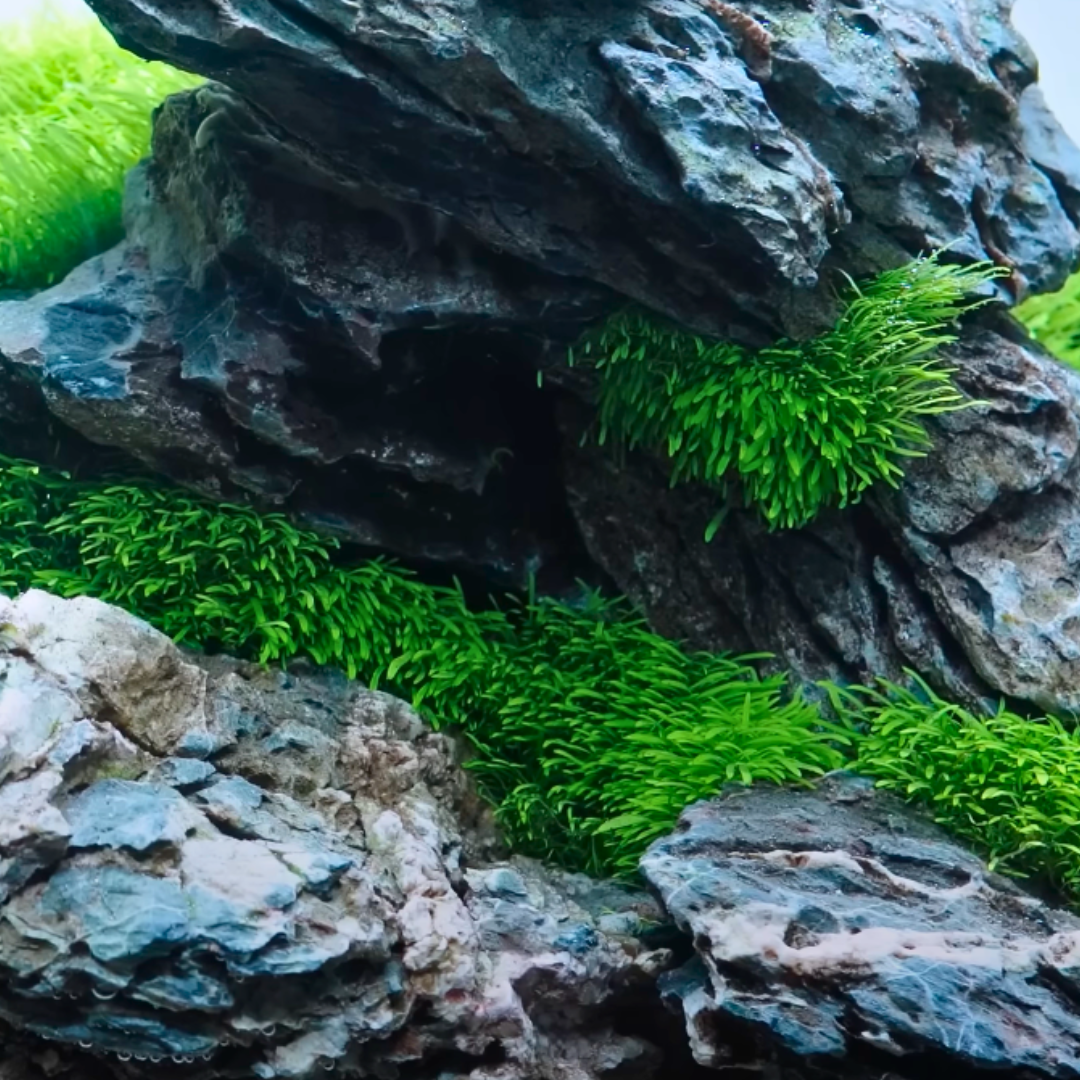
ウォーターローンは、明るく鮮やかなライトグリーンの細葉が、まるで水底に敷かれた芝生のように広がる美しい前景草です。しかし、その清涼感あふれる姿とは裏腹に、植物学的には微小な動物プランクトンを捕食する高度に進化した食虫植物であるという、驚くべき一面を持っています。水草レイアウトにおいては、その淡い色彩が流木や濃い緑色の植物と素晴らしいコントラストを生み出し、幻想的な景観を演出してくれます。真の根を持たず、ランナー(匍匐茎)を伸ばして増殖する独特の生態を持ち、環境が整った際に見せる爆発的な成長は、アクアリストに大きな達成感を与えてくれるでしょう。Utricularia graminifolia is a beautiful foreground plant with bright, vivid light-green narrow leaves that spread across the water’s bottom like a lush lawn. Despite its refreshing appearance, it is botanically a highly evolved carnivorous plant that preys on microscopic zooplankton. In aquascaping, its pale colors create a wonderful contrast with driftwood and dark green plants, producing a fantastic landscape. It has a unique ecology, growing without true roots and instead spreading through runners (stolons). The explosive growth seen when conditions are optimal provides a great sense of achievement for aquarists.
インド、スリランカ、タイ、ミャンマー、ベトナム、中国南部などアジア圏に広く分布Widely distributed across Asia, including India, Sri Lanka, Thailand, Myanmar, Vietnam, and Southern China.
育成難易度 / Difficulty
やや高い(コツが必要)Medium-High (Requires specific techniques)
育成環境 / Cultivation Environment
光量 / Light
中〜高(60cm規格水槽でLEDライト2灯以上推奨)Medium to High (2 or more LED lights recommended for a standard 60cm aquarium)
CO2添加 / CO2 Injection
添加を強く推奨(1秒に2〜3滴程度)Highly recommended (approx. 2-3 drops per second)
水質 / Water Quality
弱酸性〜中性(pH 4.5から7.5)、軟水(硬度は極力抑える)Slightly acidic to neutral (pH 4.5 to 7.5), Soft water (Keep hardness as low as possible)
底床 / Substrate
ソイル(栄養系ソイルからの初期アンモニアには極めて敏感なため、吸着系ソイルや、栄養系でも窒素分が落ち着いた状態での使用を推奨)Soil (Highly sensitive to initial ammonia from nutrient-rich soils; recommend using absorbent soil or nutrient soil only after nitrogen levels have stabilized)
レイアウト / Layout
配置 / Positioning
前景(水槽の前面を覆う絨毯として)Foreground (As a carpet covering the front of the tank)
注意点 / Precautions
非常に強い浮力を持つため、深く植え込む必要があります。石や流木に着生させることも可能です。Due to its high buoyancy, it must be planted deeply. It can also be attached to stones or driftwood.
増やし方(トリミング) / Propagation & Trimming
増やし方 / Propagation
ランナー(匍匐茎)を伸ばして周囲に広がります。組織培養カップを小分けにして植えるのが一般的です。It spreads by sending out runners (stolons). It is common to divide tissue culture cups into small clumps for planting.
トリミング / Trimming
ソイルに対して垂直にハサミを入れ、ネットワークを分断(または間引き)します。引き抜くと周囲のランナーまで広範囲に剥がれてしまうことがあるため、カットを優先してください。Insert scissors vertically into the substrate to divide the network (thinning). Prioritize cutting over pulling, as pulling can cause large areas of runners to peel away from the substrate.
病気と対策(コケなど) / Pests & Algae
かかりやすい病気 / Common Issues
導入初期の「溶け」、夏季の高水温による崩壊、糸状のコケ、黒髭苔など“Melting” during the initial introduction, collapse due to high summer temperatures, filamentous algae, and black beard algae.
対策と予防 / Prevention
水温を25度前後に保ち、バクテリアが定着した安定した水質に導入することが最大の予防策です。The best prevention is keeping the water temperature around 25 degrees Celsius and introducing it into stable water with established bacteria.
雑学と豆知識 / Trivia and Fun Facts
1. 捕虫嚢による吸引捕食1. Suction Feeding with Bladder Traps
ウォーターローンは、小さな捕虫嚢を持つ食虫植物です。同じタヌキモ属の別種 Utricularia australis、U. inflata、U. vulgaris を調べた2011年の研究では、負圧を利用した吸引が1ミリ秒未満で起こることが報告されています。この研究の速度や加速度を、本種で測定された値として扱うことはできません。Water Lawn is a carnivorous plant with small bladder traps. A 2011 study of other Utricularia species—U. australis, U. inflata and U. vulgaris—reported pressure-driven suction in less than one millisecond. Its speed and acceleration measurements are not measurements of U. graminifolia.
2. 捕虫嚢と水槽の生き物2. Bladder Traps and Aquarium Animals
本種の小さな捕虫嚢は微小な生き物を捕らえます。トロピカ社は魚には無害と説明していますが、稚エビへの影響まで同じ資料から保証することはできません。Its small bladder traps capture microscopic organisms. Tropica describes the plant as harmless to fish, but that information does not establish a guarantee for newborn shrimp.
3. 「溶け」を回避する科学的アプローチ:ダークスタートメソッド3. A Scientific Approach to Avoid Melting: The Dark Start Method
本種が難しいと言われる最大の理由は、注水直後のアンモニアに対する過敏さです。ソイルから放出されるアンモニアによって細胞が崩壊し、一気に溶けてしまうことが多いのです。これを防ぐ先進的な手法が、植栽前に水槽を暗黒状態で数週間空回しするダークスタートです。バクテリアサイクルを先に完成させ、アンモニアが硝酸塩へと変化する安定した環境を作ってから植えることで、溶けのリスクを劇的に抑えることができます。The main reason this plant is considered difficult is its extreme sensitivity to ammonia following submersion. Ammonia released from the soil often causes cells to collapse and melt. An advanced method to prevent this is the Dark Start, where the tank is cycled in the dark for several weeks before planting. By establishing the bacterial cycle and ensuring ammonia is converted to nitrate before planting, the risk of melting can be drastically reduced.
4. 飽食すると「罠」を畳む?肥料と捕虫嚢の関係4. Closing Traps When Full? The Relationship Between Fertilizer and Bladders
捕虫嚢は、本来リンや窒素が極度に不足する貧栄養環境で生き残るために進化した器官です。そのため、液体肥料が潤沢に添加され、二酸化炭素が強制添加された現代的なハイテク水槽では、面白い変化が起こります。植物は多大なエネルギーを消費して捕虫嚢を作る必要がなくなるため、捕虫嚢の数を減らし、光合成による成長に専念する傾向があるのです。この環境適応能力の高さも、ウォーターローンがアクアリウムで爆発的に増える理由の一つと考えられています。Trapping bladders evolved as organs to survive in nutrient-poor environments lacking phosphorus and nitrogen. In modern high-tech aquariums with abundant liquid fertilizer and CO2 injection, an interesting change occurs. The plant tends to reduce the number of bladders, as it no longer needs to expend significant energy creating them, and instead focuses on growth via photosynthesis. This strong adaptive ability is one reason why Water Lawn can grow explosively in aquariums.
5. 日本の夏を乗り切る:垂直トリミングの重要性5. Surviving Japanese Summers: The Importance of Vertical Trimming
日本の蒸し暑い夏、厚く重なりすぎたウォーターローンのマット内部は酸欠になりやすく、一度崩壊が始まると一晩で全滅することもあります。夏を迎える前に、ソイルに対して垂直にハサミを入れ、ネットワークを分断して間引く垂直カットを行いましょう。一般的な芝刈りのように表面だけを刈るのではなく、垂直にカットを入れて部分的に除去することで、内部の通水性を確保し、高水温期の崩壊リスクを下げることができます。During Japan’s humid summers, the inside of a thick Water Lawn mat can easily become oxygen-deprived, leading to a total collapse overnight. Before summer arrives, perform vertical cuts by inserting scissors vertically into the substrate to thin out the network. Rather than just mowing the surface, making vertical cuts and partially removing clumps ensures water flow within the mat and reduces the risk of collapse during high-temperature periods.
まとめ / Conclusion
ウォーターローンは、その繊細で美しい緑の絨毯で、水槽の中にアジアの清流の風景を再現してくれます。食虫植物としての特異な生態を理解し、特にアンモニアへの耐性の低さと軟水環境の維持というポイントを押さえることが、育成成功への近道です。The Water Lawn recreates the scenery of Asian clear streams in your aquarium with its delicate and beautiful green carpet. Understanding its unique ecology as a carnivorous plant—especially its low tolerance for ammonia and the need for soft water—is the key to successful cultivation.
最初は少し気難しい面もありますが、一度環境に馴染めば驚くほどの速さで広がっていく力強さを持っています。皆様の水槽でも、この神秘的で美しい命の絨毯をぜひ育ててみてください。While it may be a bit finicky at first, once it adapts to the environment, it possesses the strength to spread with surprising speed. We hope you will try growing this mysterious and beautiful carpet of life in your own aquarium.
Plants of the World Online (Kew Science) – Utricularia graminifolia VahlPlants of the World Online (Kew Science) – Utricularia graminifolia Vahlhttps://powo.science.kew.org/taxon/urn:lsid:ipni.org:names:526915-1
Tropica Aquarium Plants – Utricularia graminifolia Care SheetTropica Aquarium Plants – Utricularia graminifolia Care Sheethttps://tropica.com/en/plants/plantdetails/Utriculariagraminifolia(021B)/4438
ADA (Aqua Design Amano) – ネイチャーアクアリウムにおける前景草の管理ADA (Aqua Design Amano) – Maintenance of foreground plants in Nature Aquariumhttps://www.adana.co.jp/jp/contents/process/index.html
Vincent, O., et al. (2011). Ultra-fast underwater suction traps. Proceedings of the Royal Society B, 278(1720), 2909–2914. (タヌキモ属の別種における吸引機構。本種の速度の実測資料ではない)Vincent, O., et al. (2011). Ultra-fast underwater suction traps. Proceedings of the Royal Society B, 278(1720), 2909–2914. (Suction mechanics in other Utricularia species; not speed measurements of U. graminifolia.)doi:10.1098/rspb.2010.2292




 アイのアクアグッズ案内テトラミンって、こんなにあるの? アイとコタロウのごはん探究旅道具の特徴や使い方、選ぶときのポイントをアイが紹介します。記事はコチラ →
 アイのアクアグッズ案内バクテリアって、結局なんなんだ? タマスとアイのボトル探究ロック好きのカバ・タマスが初登場。サイクル、ベストバイオ、バイコムのボトルから、菌の役割と保存の工夫、二本組の歴史をアイと探ります。記事はコチラ →



コメント