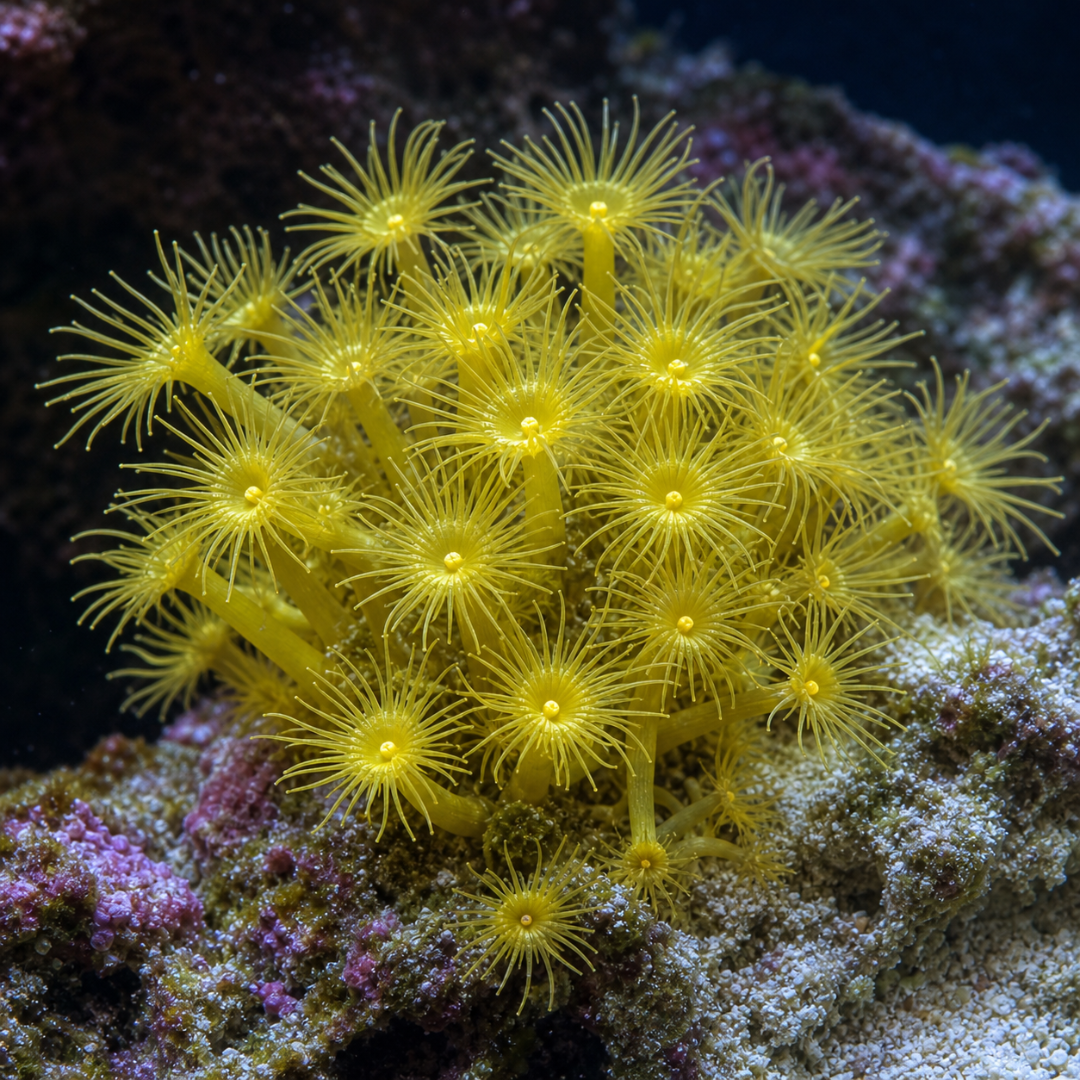
イエローポリプは、鮮やかな黄色のポリプが共肉でつながり、水流に合わせて細い触手を揺らす群体性のスナギンチャクです。日本のマリンアクアリウムでは丈夫で増やしやすい入門向け生体として親しまれていますが、光だけに頼らず小さな動物質の餌を捕らえる性質、周囲の岩へ広がる強い増殖力、取り扱い時に考慮すべき毒性など、長期飼育には理解しておきたい特徴があります。流通名では Parazoanthus gracilis とされることが多い一方、現在の分類では Hydrozoanthus gracilis が受容名とされており、見た目だけで種を確定できない個体も少なくありません。Yellow Polyps are colonial zoantharians whose bright yellow polyps are joined by common tissue and wave slender tentacles in the current. They are popular in Japanese marine aquariums as hardy, easily propagated beginner animals, yet successful long-term care depends on understanding their need for small animal-based foods, their rapid spread across rock, and the potential toxicity involved in handling. Although the trade often uses the name Parazoanthus gracilis, current taxonomy accepts Hydrozoanthus gracilis, and many visually similar colonies cannot be identified to species by appearance alone.
刺胞動物門・花虫綱・六放サンゴ亜綱・スナギンチャク目・マクロクネム亜目・ヒドロゾアンサス科・ヒドロゾアンサス属。流通名には旧来のセンナリスナギンチャク科・パラゾアンサス属の表記も残っています。Phylum Cnidaria, Class Anthozoa, Subclass Hexacorallia, Order Zoantharia, Suborder Macrocnemina, Family Hydrozoanthidae, Genus Hydrozoanthus. Older trade references may still place it in Parazoanthidae and Parazoanthus.
分布 / Distribution
インド太平洋の熱帯・亜熱帯海域。浅いサンゴ礁からより深い場所まで見られ、岩や海綿、ヒドロ虫などの表面に群生します。Hydrozoanthus gracilis は扇状のヒドロ虫 Dentitheca habereri に着生することで知られています。Tropical and subtropical Indo-Pacific waters, from shallow reefs to deeper habitats. Colonies grow on rock, sponges, hydroids, and other firm living or non-living surfaces. Hydrozoanthus gracilis is well known for growing on the fan-shaped hydroid Dentitheca habereri.
最大サイズ / Maximum Size
1ポリプは口盤径約5mm、高さは触手を含めて最大約20mmが目安です。群体は共肉を伸ばしながら連続的に広がり、飼育環境では配置した岩の全面を覆うことがあります。An individual polyp is about 5 mm across and may reach roughly 20 mm in height including the tentacles. The colony can spread continuously through its connecting tissue and may cover an entire isolated rock in an aquarium.
寿命 / Lifespan
個々のポリプおよび群体の寿命を示す確かな資料は限られています。水質、給餌、光、水流が安定した環境では、群体として長期間維持できます。Reliable lifespan data for individual polyps and whole colonies are limited. Under stable water quality, feeding, light, and flow, a colony can be maintained for many years.
飼育環境 / Aquarium Environment
水槽サイズ / Tank Size
厳密な最低水量は定められていません。実用上は水質を安定させ、ほかのサンゴから隔離した岩を置きやすい45cm規格水槽(約35L)以上が扱いやすく、増殖を見越すなら60cm規格水槽(約55〜60L)以上が安心です。There is no fixed minimum volume. In practice, a standard 45 cm aquarium of about 35 L or larger is easier to stabilize and provides room for an isolated rock. A standard 60 cm aquarium of about 55–60 L or larger is more comfortable when allowing for colony expansion.
水温・比重 / Temperature and Specific Gravity
水温23〜26℃、比重1.022〜1.026を目安にします。28℃を超える高温や、蒸発による比重の急上昇は組織の傷みやポリプ閉鎖につながるため、夏季の冷却と足し水管理が重要です。Aim for 23–26°C and a specific gravity of 1.022–1.026. Temperatures above 28°C and sudden salinity increases from evaporation can damage tissue or keep polyps closed, so summer cooling and freshwater top-off are important.
水質 / Water Quality
pH8.1〜8.4、アルカリ度8〜12dKHを目安に、急変を避けます。骨格を作らないためカルシウムやマグネシウムの消費はイシサンゴほど大きくありません。硝酸塩は50ppm未満でも耐えることがありますが、色彩と衛生状態を保つため低めに管理し、リン酸塩や有機物も過剰に蓄積させないようにします。Keep pH around 8.1–8.4 and alkalinity around 8–12 dKH while avoiding sudden changes. Because it does not build a stony skeleton, calcium and magnesium demand is much lower than in stony corals. It may tolerate nitrate below 50 ppm, but lower nutrient levels and control of phosphate and organic waste support better color and hygiene.
光量 / Lighting
弱光から中程度が適します。資料上、一律のPAR値は示されていないため、導入時は水槽下部やわずかな陰から始め、ポリプの開き方と色を見ながら数週間かけて調光します。青色成分を含む10,000〜20,000K相当の照明では黄色から黄緑色の蛍光が引き立ちます。Low to moderate light is suitable. A universal PAR target is not established, so begin low in the aquarium or in partial shade and increase light gradually over several weeks while watching polyp extension and color. Lighting with a blue component around 10,000–20,000 K enhances the yellow to yellow-green fluorescence.
水流 / Water Flow
弱めから中程度の、向きが一定でない穏やかな水流を好みます。触手がゆっくりなびき、共肉の隙間に汚れがたまらない程度が目安です。ポンプの直線的な強い流れを直接当てると、ポリプが開かなくなったり組織を傷めたりします。Provide gentle, irregular low-to-moderate flow. The tentacles should sway slowly while debris is kept from settling between polyps. A strong direct jet can prevent expansion and damage tissue.
レイアウト・配置 / Layout and Placement
メインの岩組みから離した単独の岩に固定し、底砂上の「アイランド」として配置する方法が向いています。環境に適応すると共肉が速く広がるため、周囲に空間を取り、隣の岩へ橋渡ししないようにします。導入直後は低い位置から始めます。Mount the colony on a separate rock placed as an island on the sand, away from the main rockwork. Once established, the connecting tissue can spread quickly, so leave open space and prevent contact with neighboring rocks. Start new arrivals in a lower, dimmer position.
注意点 / Precautions
比重、温度、照明の急変を避け、導入時はゆっくり水合わせと光順応を行います。共肉に汚れがたまらないよう定期的に軽く吹き飛ばします。流通個体は正確な種同定が難しく毒性にも個体差が考えられるため、移動や清掃でも素手で触れないようにします。Avoid abrupt changes in salinity, temperature, and lighting. Acclimate new colonies slowly and remove settled debris with a gentle flow of water. Because traded specimens can be difficult to identify and toxin levels may vary, do not handle them with bare hands even during routine cleaning or repositioning.
餌と給餌 / Feeding
栄養の得方・餌 / Nutrition and Diet
光合成への依存度が低い、または褐虫藻を持たない個体群として扱われることが多く、触手で動物プランクトンや微細な有機物を捕らえる従属栄養性が重要です。冷凍コペポーダ、細かくしたイサザアミ、ブラインシュリンプ、サンゴ用の微粒子フードなどが適します。It is commonly treated as weakly dependent on photosynthesis, and some populations may lack symbiotic algae. Heterotrophic feeding is therefore important: the tentacles capture zooplankton and fine organic particles. Suitable foods include frozen copepods, finely minced mysid shrimp, brine shrimp, and fine coral foods.
給餌のポイント / Feeding Tips
週1〜2回を目安に、水流ポンプを一時停止または弱め、スポイトで触手の近くへ少量ずつ与えます。口より大きな粒は避け、ポリプが餌を包み込むのを確認したら数分後に水流を戻します。過剰給餌は硝酸塩、リン酸塩、シアノバクテリアの増加につながるため、食べ残しを残さない量にします。Target-feed once or twice a week. Temporarily stop or reduce flow and gently deliver a small amount near the tentacles with a pipette. Avoid particles larger than the mouth, and restore flow after the polyps have enclosed the food for several minutes. Overfeeding can raise nitrate and phosphate and encourage cyanobacteria, so offer only what is captured.
性質と相性 / Characteristics and Compatibility
形態・成長 / Form and Growth
石灰質の骨格を持たず、複数のポリプが共肉で連結された群体を作ります。共肉を伸ばして出芽し、適応後は岩の表面を覆うように増殖します。移動するイソギンチャクとは異なり、群体全体が歩き回ることはありません。It has no calcareous skeleton and forms a true colony whose polyps are connected by common tissue. New buds arise as this tissue extends, and an established colony can cover rock surfaces. Unlike a mobile sea anemone, the colony does not roam around the aquarium.
攻撃性 / Aggression
長いスイーパー触手は持ちませんが、刺胞と接触による刺激、さらに速い被覆成長によって周囲のサンゴを傷めることがあります。接触させず、増殖後も十分な間隔を保ちます。It does not produce long sweeper tentacles, but its nematocysts, direct contact, and rapid overgrowth can damage neighboring corals. Prevent contact and maintain a clear buffer as the colony expands.
相性 / Compatibility
一般的なリーフセーフの魚や移動性の無脊椎動物とは同居しやすい一方、ポリプをついばむ魚には注意が必要です。成長の遅いソフトコーラル、LPS、SPSとは離して配置します。クマノミの標準的な共生相手ではありません。It is generally compatible with reef-safe fish and mobile invertebrates, although fish that nip polyps may cause damage. Keep it away from slow-growing soft corals, LPS, and SPS. It is not a normal host for clownfish.
病気と対策 / Diseases and Prevention
不調・病気・害虫 / Problems, Diseases, and Pests
開かない、粘液を出す、茶色化、色抜け、白化、共肉の白濁や溶解が主な不調です。原因には導入ストレス、強光、高水温、比重やアルカリ度の急変、汚れの堆積、栄養塩過多、細菌性の組織障害が考えられます。特定の害虫情報は限られるため、付着生物や捕食痕も含めて観察します。Common problems include failure to open, excess mucus, browning, fading, bleaching, clouding, or tissue loss. Possible causes include acclimation stress, excessive light, high temperature, sudden salinity or alkalinity changes, debris accumulation, excess nutrients, and bacterial tissue damage. Specific pest information is limited, so inspect for hitchhikers and feeding damage.
対策と予防 / Prevention
まず水温、比重、pH、アルカリ度、硝酸塩を確認し、照明と水流を急に変えず段階的に調整します。溶けた組織は水槽内へ広げないよう吸い出し、必要に応じて30〜50%の換水と活性炭の交換を行います。新規個体は隔離観察し、薬浴を行う場合は対象生体に使用できるサンゴ用製品の説明に従います。Check temperature, salinity, pH, alkalinity, and nitrate first, then adjust light and flow gradually rather than abruptly. Siphon away decaying tissue before it disperses, and use a 30–50% water change and fresh activated carbon when necessary. Quarantine new arrivals, and if dipping is used, follow the directions of a coral product that is explicitly suitable for the animal.
増やし方(繁殖・株分け) / Reproduction and Propagation
無性生殖・株分け / Asexual Reproduction and Fragmentation
共肉の伸長と出芽によって自然に増えます。人為的には、複数のポリプを共肉ごと切り分けるか、付着した岩ごと小さく割り、セラミック製のプラグへ固定してフラグ化できます。It naturally expands by extension of the common tissue and budding. For propagation, several connected polyps can be cut together, or a small piece of the attached rock can be broken off and secured to a ceramic frag plug.
有性生殖 / Sexual Reproduction
自然界での有性生殖に関する詳細や、流通個体の雌雄・放卵放精の条件は十分に整理されていません。家庭水槽で一般的に利用される増殖方法は無性生殖とフラグ化です。Details of sexual reproduction in the wild, including sex and spawning conditions of traded colonies, are not well established. In home aquaria, propagation is normally achieved through asexual growth and fragmentation.
増殖のポイント / Propagation Tips
十分に開き、組織が厚く、最近不調のない親群体を使います。手袋と保護眼鏡を着用し、清潔なメスや骨切りバサミで短時間に作業します。切片の裏面とプラグの水分を軽く取り、ゲル状シアノアクリレート接着剤で固定した後、弱めの水流と控えめな光で養生します。Use a healthy parent colony with fully opening polyps and intact tissue. Wear gloves and eye protection, work quickly with a clean scalpel or coral cutter, blot only the attachment surfaces, and secure the fragment with cyanoacrylate gel. Recover it under gentle flow and subdued light.
毒性と取り扱い / Toxicity and Handling
毒性 / Toxicity
スナギンチャク類には刺胞毒があり、Parazoanthus sp. とされた水槽個体との接触後にパリトキシン中毒が疑われた症例も報告されています。すべてのイエローポリプが同じ濃度の毒を持つとは限りませんが、流通個体は種同定が難しいため、毒性の有無を外見だけで判断できません。Zoantharians possess nematocyst toxins, and a documented aquarium case attributed to Parazoanthus sp. was consistent with palytoxin poisoning after contact through injured skin. Not every yellow-polyp colony necessarily contains the same toxin level, but traded specimens are difficult to identify and toxicity cannot be judged by appearance.
取り扱い上の注意 / Handling Precautions
厚手のニトリル手袋またはゴム手袋と保護眼鏡を着用し、傷のある手で触れません。切断、ブラッシング、高圧の水流を当てる作業では飛沫を吸い込まないよう換気し、顔を近づけないでください。生体や付着岩を煮沸、加熱、熱湯処理してはいけません。作業後は器具と手を十分に洗い、目や傷口に入った場合や全身症状が出た場合は、直ちに医療機関へ相談します。Wear heavy nitrile or rubber gloves and protective eyewear, and never handle the colony with broken skin. During cutting, brushing, or high-pressure rinsing, ensure good ventilation and avoid inhaling spray. Never boil, heat, or pour hot water over the animal or its rock. Wash tools and hands thoroughly, and seek medical care promptly after eye or wound exposure or if systemic symptoms develop.
雑学と豆知識 / Trivia and Fun Facts
分類名が変わった理由 / Why the name changed
長く Parazoanthus gracilis と呼ばれてきましたが、分子系統解析によってヒドロ虫に着生する系統の独自性が明らかになり、現在の海洋生物分類データベースでは Hydrozoanthus gracilis が受容名とされています。店頭名がすぐに変わらないのは、古い学名が飼育書や流通に深く定着しているためです。For many years it was called Parazoanthus gracilis. Molecular phylogenetic work revealed that hydroid-associated lineages form a distinct group, and current marine taxonomic databases accept Hydrozoanthus gracilis. The older name remains common because it is deeply established in aquarium books and trade listings.
ヒドロ虫を足場にする暮らし / Life on a hydroid host
自然界では Dentitheca habereri という大きな扇状ヒドロ虫に群生する姿が知られています。ポリプは潮通しのよい高い位置を利用して餌を待ち受けますが、着生されたヒドロ虫は小型化し、枝分かれが不規則になることがあります。単なる同居ではなく、宿主へ負担を与える関係が含まれる可能性を示す興味深い例です。In nature it is often seen covering the large fan-shaped hydroid Dentitheca habereri. The polyps gain an elevated feeding position in moving water, while colonized hydroids may remain smaller and branch irregularly. This suggests a relationship that can impose costs on the host rather than a simple neutral association.
黄色い蛍光と海洋天然物 / Yellow fluorescence and marine natural products
鮮やかな黄色は、ゾアントキサンチン類と呼ばれる蛍光性アルカロイド群と関係します。青色光の下で黄緑色に輝く美しさは観賞価値を高めるだけでなく、天然物化学の研究対象にもなってきました。日本で採取された個体からは1970年代にパラグラシンが単離され、独特な化学骨格とナトリウムチャネルへの作用が研究されました。Its vivid yellow coloration is associated with fluorescent alkaloids known as zoanthoxanthins. Their yellow-green glow under blue light adds aquarium appeal and has also attracted natural-products research. In the 1970s, paragracine was isolated from Japanese material and studied for its unusual chemical skeleton and effects on sodium channels.
「千成」の名に表れた群体性 / A Japanese name inspired by colony growth
和名のセンナリスナギンチャクは、多数のポリプが一つの基部から鈴なりに広がる姿を「千成」に見立てた名前です。個々のポリプは小さくても、共肉でつながった群体として岩を覆う様子は、水槽内でもこの名前の意味を実感させます。The Japanese name Sennari-sunaginchaku compares the many clustered polyps to a plant bearing countless fruits. Each polyp is small, but the connected colony spreading over rock makes the image behind the name easy to understand in an aquarium.
流通と国際取引 / Trade and international regulation
石灰質骨格を作るイシサンゴ目はCITES附属書に掲載されていますが、2026年3月5日発効の附属書では Hydrozoanthus 属や Parazoanthus 属は同じ包括指定の対象として掲載されていません。ただし、輸出国の国内法や採集規制、検疫条件は別に存在するため、輸入や商用取引では常に最新の制度確認が必要です。Stony corals in the order Scleractinia are listed in the CITES Appendices, whereas the Appendices effective 5 March 2026 do not list Hydrozoanthus or Parazoanthus under the same broad coral designation. National collection rules, export laws, and quarantine requirements may still apply, so current regulations must always be checked for import or commercial trade.
まとめ / Conclusion
イエローポリプは、丈夫さと鮮やかな蛍光色をあわせ持ち、穏やかな水流の中で群体が広がる変化を楽しめる生体です。弱めから中程度の光、汚れをためないランダムな水流、安定した海水環境を整え、週1〜2回の少量給餌を続けることで、細いポリプをふっくらと開かせやすくなります。Yellow Polyps combine hardiness with vivid fluorescence, and their colony growth can be enjoyed as the tentacles sway in gentle current. Low-to-moderate light, irregular flow that prevents debris buildup, stable seawater, and small feedings once or twice a week help the polyps remain full and open.
成長が始まると周囲を覆う力が強いため、独立した岩へ配置して広がり方を管理することが大切です。また、株分けや清掃では毒性を外見で判断せず、手袋、保護眼鏡、換気を徹底します。適切な距離と安全な取り扱いを守れば、黄色い群体は水槽の中で長く育ち、日々少しずつ増えていく生命力を見せてくれます。Once established, the colony can overgrow nearby surfaces, so placement on an isolated rock is essential. During propagation or cleaning, never judge safety by appearance; use gloves, eye protection, and good ventilation. With controlled spacing and careful handling, the yellow colony can thrive for years and display its steady, resilient growth in the aquarium.
Borneman, E. H. 2008.
Introduction to the husbandry of corals in aquariums: a review.
In: Leewis, R. J. and Janse, M. eds.,
Advances in Coral Husbandry in Public Aquariums.
Public Aquarium Husbandry Series, Vol. 2, Burgers’ Zoo, Arnhem, pp. 3–14.
Osinga, R., Schutter, M., Wijgerde, T. H. M., Rinkevich, B., Shafir, S., Shpigel, M., Luna, G. M., Danovaro, R., Bongiorni, L., Deutsch, A., Kuecken, M., Hiddinga, B., Janse, M., McLeod, A., Gili, C., Lavorano, S., Henard, S., Barthélémy, D., Westhoff, G., Baylina, N., Santos, E., Weissenbacher, A., Kuba, M., Jones, R., Leewis, R., Petersen, D. and Laterveer, M. 2012.
The CORALZOO project: a synopsis of four years of public aquarium science
.
Journal of the Marine Biological Association of the United Kingdom, 92(4), 753–768.


 アイのアクアグッズ案内ダニオの仲間に合わせる飼育用品|ゼブラダニオから超小型種まで水槽・ろ過・餌を選ぶ道具の特徴や使い方、選ぶときのポイントをアイが紹介します。記事はコチラ →
 アイのアクアグッズ案内水槽ライトの選び方|魚の見え方・水草・海水で選ぶおすすめ照明道具の特徴や使い方、選ぶときのポイントをアイが紹介します。記事はコチラ →
 アイのアクアグッズ案内ローチの仲間に合わせる飼育用品|クーリー・流水性・ボーシャの水槽と底砂道具の特徴や使い方、選ぶときのポイントをアイが紹介します。記事はコチラ →
 アイのアクアグッズ案内小型カラシンの群れを楽しむ|餌と水換えから考える飼育用品ガイド小型カラシンの群れを眺める時間を、もっと楽しく。泳ぐ余白、餌の食べ方、続けやすい水換えを軸に、日本で揃えやすい用品の選び方を紹介します。記事はコチラ →



コメント