

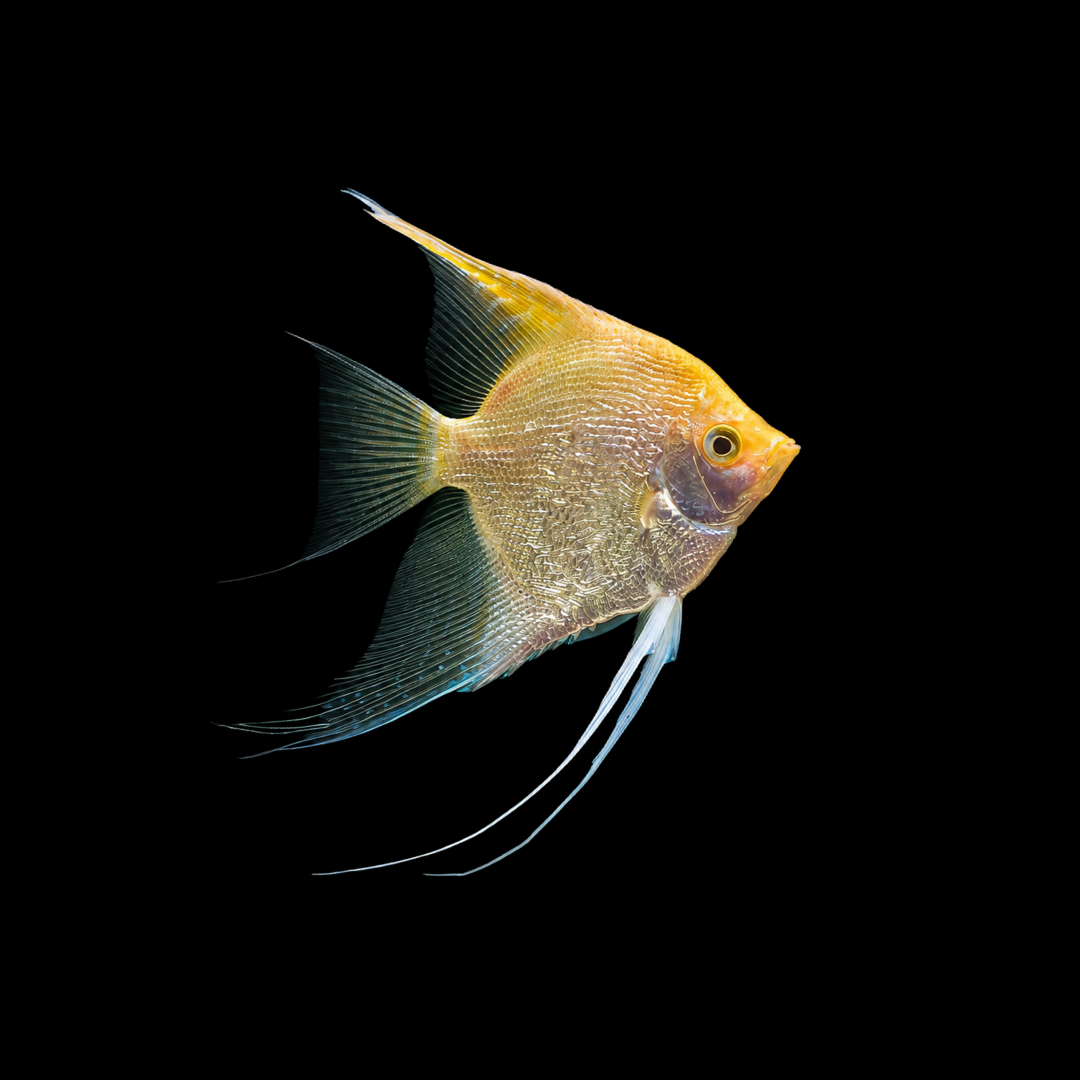
解説 / Description
ゴールデンエンゼルフィッシュは、南米原産のエンゼルフィッシュ、Pterophyllum scalareをもとに作出された代表的な改良品種です。野生型に見られる銀色の体と黒い縦帯が大きく抑えられ、淡いバターイエローから金色の体色と、頭部から背中にかけて現れる黄橙色の発色を楽しめます。赤い眼になるアルビノとは異なり、眼には黒い色素が残ります。円盤状に強く側扁した体、高く伸びる背ビレと尻ビレ、糸のように長い腹ビレがつくるシルエットは原種譲りで、ゆったり泳ぐ姿にはエンゼルフィッシュらしい気品があります。長くブリードされてきた改良品種ですが、成長すると縄張り意識が強くなり、小型魚や稚エビを捕食することもあるため、成魚の大きさとシクリッドらしい性質を理解したうえで飼育することが大切です。 The Gold Angelfish is one of the best-known domestic color varieties of Pterophyllum scalare, the freshwater angelfish native to South America. Unlike the wild type, in which a silver body is crossed by dark vertical bars, this variety shows a pale butter-yellow to golden body with deeper yellow or orange coloration around the crown and upper back. It is not an albino; the eyes retain dark pigment rather than becoming red. Its strongly compressed, disk-like body, tall dorsal and anal fins, and thread-like pelvic fins retain the elegant silhouette of the species. This is a long-established domestic variety, but adults can become territorial and may prey on very small fish or juvenile shrimp, so their eventual size and typical cichlid behavior should be considered when planning the aquarium.
基本情報 / Basic Information
| 学名 / Scientific Name | Pterophyllum scalare (Schultze, 1823) |
|---|---|
| 通称 / Common Name | ゴールデンエンゼル、ゴールドエンゼルGold Angelfish, Golden Angelfish |
| 分類 / Family | シクリッド目(Cichliformes)・シクリッド科(Cichlidae)・プテロフィルム属(Pterophyllum)Order Cichliformes, family Cichlidae, genus Pterophyllum |
| 英名 / English Name | Gold Angelfish / Golden Angelfish |
| 分布 / Distribution | 原種のPterophyllum scalareは南米のアマゾン川流域を中心に、ペルー、コロンビア、ブラジル、フランス領ギアナ、ガイアナなどに分布します。ゴールデンエンゼルフィッシュ自体は人工的に維持されている改良品種であり、自然界に固有の分布域を持つ品種ではありません。Wild Pterophyllum scalare occurs in South America, primarily within the Amazon basin, including waters of Peru, Colombia and Brazil, as well as parts of French Guiana and Guyana. The Gold Angelfish itself is a domesticated aquarium strain and does not have a natural geographic range as a distinct variety. |
| 最大体長 / Max Size | 全長はおおむね10〜15cm程度。背ビレと尻ビレが大きく伸びるため、上下のヒレを含む高さは20cmを超えることがあります。Usually about 10–15 cm in total length. Because the dorsal and anal fins grow tall, the total vertical span can exceed 20 cm. |
| 寿命 / Lifespan | 飼育下では8〜10年前後がひとつの目安です。安定した水質、適切な給餌、十分な遊泳空間を維持することで長期飼育が期待できます。Around 8–10 years is a practical captive-care guideline. Stable water quality, balanced feeding and adequate swimming space can support long-term health. |
飼育環境 / Aquarium Environment
| 水槽サイズ / Tank Size | 成魚は体長以上に上下方向へ大きく見えるため、水深を確保できる水槽が向きます。ペア飼育では最低でも90cm規格水槽を目安とし、できれば高さ45cm以上を確保してください。5〜6匹を長期飼育する場合は、120cm規格水槽〜120cmワイド水槽(おおむね200〜300L以上)を推奨します。幼魚を小型水槽で育てる場合も、成長に合わせて早めにサイズアップします。Adult angelfish require substantial vertical as well as horizontal space. For a pair, a Japanese-standard 90 cm aquarium should be regarded as a minimum practical starting point, preferably with a height of at least 45 cm. For a long-term group of about five to six fish, a 120 cm standard to 120 cm wide aquarium, roughly 200–300 L or more, is recommended. Juveniles can be started in smaller tanks but should be moved to larger quarters before crowding develops. |
|---|---|
| 水温 / Temperature | 26〜28℃を中心に安定させると飼育しやすいです。種としては24〜30℃程度に適応しますが、急激な温度変化は避けてください。 A stable 26–28°C is a convenient routine range. The species can tolerate roughly 24–30°C, but sudden temperature changes should be avoided. |
| 水質 / Water Quality | 原種の生息情報ではpH6.0〜8.0、総硬度5〜13dGH程度の範囲が示されています。長く養殖されてきた系統は幅広い水質に順応しますが、数値を細かく追い込むことより、急激な変化を避けて安定させることが重要です。ろ過を安定させ、週1回を目安に25〜40%程度の換水を行い、硝酸塩や有機物の蓄積を抑えます。Published habitat information for the species gives a range of about pH 6.0–8.0 and 5–13 dGH. Long-established domestic strains can adapt to a fairly broad range of water conditions, but avoiding sudden changes is more important than pursuing an exact number. Maintain mature biological filtration and perform approximately 25–40% weekly water changes to limit nitrate and organic waste accumulation. |
| レイアウト / Layout | 中央にはヒレを傷めず旋回できる遊泳空間を残し、後景や側面にアマゾンソードなどの幅広い葉を持つ水草、細めの流木を配置すると落ち着きやすくなります。強い水流を常時当てるより、緩やかな流れと休める場所を作るのが向いています。暗色の底床や背景は黄金色との対比が出やすく、魚の輪郭や色彩を観察しやすくなります。尖った石や狭すぎる流木の隙間は、長いヒレを傷めるため避けます。Leave an open central swimming area where the long fins can turn without contact, while providing broad-leaved plants such as Amazon swords and slender driftwood along the back and sides. Gentle circulation with calmer resting zones is preferable to constant strong current. Dark substrates and backgrounds provide attractive contrast with the golden coloration and make the fish’s outline and coloration easier to observe. Avoid sharp rocks or narrow gaps that may tear the extended fins. |
| 注意点 / Precautions | 幼魚期は群れで過ごせますが、成長してペアができると縄張り争いが強くなることがあります。体格差の大きい個体は隔離できるよう準備しておくと安全です。口に入るサイズの小型魚や稚エビは捕食される可能性があります。また、新しく迎えた個体は既存魚とすぐに混ぜず、別水槽と専用器具で2〜4週間ほど健康状態を確認すると、寄生虫や細菌性疾患の持ち込みを減らせます。Juveniles can live socially, but territorial disputes often increase as fish mature and pairs form. Be prepared to separate individuals if size differences or persistent aggression develop. Very small fish and juvenile shrimp may be eaten. New arrivals should ideally be observed in a separate quarantine aquarium with dedicated equipment for about two to four weeks to reduce the risk of introducing parasites or infectious disease. |
餌と給餌 / Feeding
| 餌の種類 / Diet | 主食は良質なシクリッド用の顆粒・フレークなどの人工飼料とし、冷凍アカムシ、ブラインシュリンプ、ミジンコなどを副食として組み合わせます。頭部の黄橙色はカロテノイドの摂取によって見え方が変わるため、アスタキサンチンやスピルリナを配合した色揚げ飼料を補助的に使う方法もあります。単一の生餌だけに偏らず、栄養バランスを優先します。Use a high-quality cichlid pellet or flake as the staple diet, supplemented with foods such as frozen bloodworms, brine shrimp and daphnia. The yellow-orange crown can be influenced by dietary carotenoids, so foods containing ingredients such as astaxanthin or spirulina may be used as part of a balanced color-supporting diet. Avoid relying on a single live or frozen food as the entire diet. |
|---|---|
| 給餌のポイント / Feeding Tips | 成魚は1日1〜2回、数分で食べ切れる量を目安にします。食欲旺盛で人の姿を覚えると前面に寄ってくるため、ねだる様子に合わせて与え過ぎないことが大切です。幼魚や繁殖を狙う親魚は成魚より少量多回の給餌が有効ですが、その分だけ残餌を取り除き、換水頻度を調整します。腹部が常に大きく膨らむほどの過給餌は避けてください。Feed adults once or twice daily, offering only what they can finish within a few minutes. Angelfish quickly learn to approach the front of the tank when people appear, so begging behavior should not be mistaken for a need for constant feeding. Juveniles and conditioned breeding fish can benefit from smaller, more frequent meals, provided uneaten food is removed and water-change frequency is adjusted. Avoid chronic overfeeding that leaves the abdomen persistently distended. |
性格と混泳 / Temperament and Tank Mates
| 性格 / Temperament | 普段は落ち着いた泳ぎを見せますが、シクリッドらしく個体差と順位関係がはっきりしています。幼魚期は緩やかな群れを作る一方、成長すると縄張り意識が強まり、特にペア形成後や産卵期には他魚を激しく追い払うことがあります。飼育者を認識するような行動も見せやすく、給餌時には前面へ集まり活発に反応します。Although usually graceful and composed, angelfish have the pronounced individual personalities and social hierarchy typical of cichlids. Juveniles often form loose groups, while adults become increasingly territorial, particularly after pairing and during spawning. They also readily learn feeding routines and often gather at the front of the aquarium in response to their keeper. |
|---|---|
| 混泳の相性 / Compatibility | 同程度の水温を好み、極端に小さくなく、ヒレをかじらない温和な中小型魚が候補になります。ただし、ネオンテトラ級の細身の小型魚は成魚に捕食される可能性があり、稚エビも安全とはいえません。スマトラなどヒレをつつきやすい魚や、激しく泳ぎ回る魚とは相性が悪い傾向があります。同種を複数飼育する場合は、隠れ場所と十分な水槽サイズを確保し、特定個体への集中攻撃が続く場合は隔離します。Suitable companions are generally peaceful fish that share similar temperature requirements, are not small enough to be swallowed and are unlikely to nip long fins. Slender tetra-sized fish may eventually be regarded as prey by large adults, and juvenile shrimp are not reliably safe. Persistent fin-nippers and very boisterous species are poor choices. When keeping several angelfish together, provide visual barriers and ample space, and separate fish if one individual becomes the target of sustained aggression. |
病気と対策 / Diseases and Prevention
| かかりやすい病気 / Common Diseases | 白点病、尾ぐされ病やカラムナリス症を含む細菌性疾患、エロモナス属細菌が関与する症状、エラや体表の寄生虫などには注意が必要です。食欲低下、呼吸の速まり、ヒレをたたむ、体をこすりつける、粘液の増加、充血、ヒレの欠損などは早期の異常サインです。観賞魚流通では、重い全身症状を示す状態が「エンゼル病」などの通称で呼ばれることがあります。ただし、この呼称は診断名として統一されたものではないため、症状だけから特定のウイルス病と決めつけないことが重要です。Potential problems include ich, bacterial diseases such as fin rot and columnaris, conditions associated with Aeromonas bacteria, and gill or skin parasites. Early warning signs include reduced appetite, rapid breathing, clamped fins, flashing against objects, excess mucus, reddening and progressive fin damage. In the aquarium trade, severe systemic illness in angelfish is sometimes informally described with names such as “angelfish disease.” Because this is not a standardized diagnostic term, symptoms alone should not be used to assume one specific viral disease. |
|---|---|
| 対策と予防 / Prevention | 最大の予防は、水質を安定させ、過密と過給餌を避け、新規導入魚を隔離することです。ネットやホースを水槽間で共用しない管理も感染拡大の抑制に役立ちます。異常個体は早めに隔離し、水温、pH、アンモニア・亜硝酸などの基本項目を確認してから原因を絞ります。治療薬は病原体によって適否が異なるため、症状だけで薬を重ねず、観賞魚用医薬品の対象疾病と用法・用量を確認して使用してください。The most effective prevention is stable water quality, sensible stocking density, restrained feeding and quarantine of new fish. Using separate nets and hoses between aquariums also helps reduce cross-contamination. Isolate affected fish early and check basic conditions such as temperature, pH, ammonia and nitrite before narrowing down the cause. Because medications differ in their target organisms and safety margins, avoid combining treatments solely on the basis of symptoms and follow the labeled indications and dosage of approved aquarium medications. |
増やし方(繁殖) / Breeding
| 雌雄の判別 / Sexing | 平常時の外見だけで確実に雌雄を見分けるのは難しく、体型や頭部の盛り上がりだけでは判断できません。成熟して繁殖行動に入ると、生殖突起が最も参考になります。雌は産卵管が比較的太く丸みを帯び、雄の生殖突起はより細く尖って見える傾向があります。確実なペアを得たい場合は、幼魚を複数匹育てて自然に形成されたペアを選ぶ方法が一般的です。Reliable sexing is difficult from ordinary external appearance alone, and body shape or forehead profile is not definitive. Once mature fish enter breeding condition, the genital papilla becomes the most useful clue: the female ovipositor is typically broader and more blunt, while the male papilla tends to be narrower and more pointed. A common way to obtain a compatible pair is to raise a group of juveniles and allow a pair to form naturally. |
|---|---|
| 繁殖形態 / Reproduction | 基質産卵型です。形成されたペアはアマゾンソードの葉、流木、フィルターのパイプ、産卵用の板などの垂直面を口で掃除し、雌が粘着性の卵を列状に産み付けた後を雄が追って受精させます。一度に数百個の卵を産むことがあり、親魚は卵を守り、ヒレで水を送るなどの保護行動を行います。This is a substrate-spawning cichlid. A bonded pair cleans a vertical surface such as an Amazon sword leaf, driftwood, filter pipe or spawning slate. The female deposits rows of adhesive eggs and the male follows to fertilize them. A spawn may contain several hundred eggs, and the parents normally guard and fan the clutch. |
| 繁殖のポイント / Breeding Tips | 繁殖水槽は27〜28℃前後の安定した水温と清浄な水を保ち、産卵しやすい垂直面を用意します。受精卵は条件が良ければ2〜3日ほどで孵化し、仔魚はしばらく基質に付着して卵黄を吸収した後、孵化後およそ4〜5日で自由遊泳へ移ります。自由遊泳を始めたら、孵化したてのブラインシュリンプなど小さく栄養価の高い餌を少量ずつ与えます。親が卵を食べる場合は人工孵化も可能ですが、十分に落ち着いたペアでは親による保護行動も観察できます。品種改良で用いられる遺伝表記では、Gold形質がg/gの親同士を交配すると、子もすべてg/gとなります。Keep a breeding aquarium stable at around 27–28°C with clean water and provide an easy-to-clean vertical spawning surface. Under suitable conditions the eggs hatch in about two to three days. The larvae remain attached while absorbing their yolk, then generally become free-swimming roughly four to five days after hatching. At that stage, offer small nutritious foods such as newly hatched brine shrimp in frequent small portions. Artificial incubation can be used if a pair repeatedly eats its eggs, although settled pairs may provide excellent parental care. In the classical breeding notation used for angelfish, crossing two Gold parents with the g/g genotype produces offspring that are also g/g. |
雑学と豆知識 / Trivia and Fun Facts
| 1. 「翼」と「葉」が描いた学名 / 1. A Name Built from “Fin” and “Leaf” | Pterophyllum scalareは1823年に記載された歴史の古い熱帯魚です。属名Pterophyllumはギリシャ語のpteronとphyllonに由来し、「ヒレ・帆」と「葉」を組み合わせた名とされています。真横から見ると木の葉のように薄く、背ビレと尻ビレを大きく広げる姿を思えば、二百年ほど前の命名者が何を見てこの言葉を選んだのかが伝わってきます。野生下では水生植物が密な湿地や氾濫域にも生息しており、観賞魚として印象的なこの側扁した体型は、自然下でも同じ姿のまま見られる本種の基本的な特徴です。Pterophyllum scalare was described in 1823 and has a long scientific history among aquarium fishes. The genus name Pterophyllum is derived from the Greek words pteron and phyllon, referring to a fin or sail and a leaf. Viewed from the side, the fish is strikingly leaf-thin while its dorsal and anal fins rise like sails, making the old name surprisingly intuitive even two centuries later. In nature, the species also inhabits swamps and flooded areas with dense aquatic vegetation, and this strongly compressed form is a basic characteristic of the fish rather than a feature created by domestication. |
|---|---|
| 2. ゴールドは一度だけ生まれた色ではない / 2. “Gold” Did Not Appear Only Once | エンゼルフィッシュの改良史をたどると、「ゴールド」と呼ばれた系統は一種類だけではありません。1970年には成長につれて黒色が抜けていくNaja Goldが知られ、1971年にはHong Kong Goldが登場しました。そして現在のGold形質につながるNew Goldは、1973年にシンガポールからアメリカへ輸入されたと記録されています。幼い時から淡い金色を示すNew Goldは扱いやすく、後に広く普及しました。水槽の中では一見ひとつの完成された色に見えても、その背景には複数の突然変異と選別の歴史が重なっています。The breeding history of angelfish reveals that “gold” did not refer to a single mutation from the beginning. Naja Gold, known by 1970, lost much of its dark pigmentation as it matured; Hong Kong Gold followed in 1971. The New Gold line associated with the modern Gold phenotype was recorded as being imported from Singapore into the United States in 1973. Because New Gold already showed a light golden appearance at a young age, it became far more practical for breeders and eventually spread widely. What looks like one finished color in an aquarium is therefore the product of several separate mutations and decades of selective breeding. |
| 3. 黄金色を支える劣性遺伝子「g」 / 3. The Recessive “g” Behind the Gold Phenotype | 現在広く扱われるGold形質は、エンゼルフィッシュの品種改良で用いられてきた遺伝表記では、Dark遺伝子座の劣性対立遺伝子gとして整理されています。これは交配結果にもとづく古典遺伝学上の表記で、外見にGoldを現すには両親からgを一つずつ受け取り、g/gのホモ接合になる必要があります。片方だけにgを持つ個体は、外見上はシルバーや別の色彩型として見えることがあるため、見た目だけで保因の有無を判断することはできません。この仕組みを知ると、g/g同士なら子がすべてg/gになる一方、他系統との交配では次世代に隠れて受け継がれる場合があることも理解しやすくなります。In the classical breeding notation used for domestic angelfish, the modern Gold phenotype is assigned to the recessive g allele at the Dark locus. This notation is based on breeding inheritance patterns. A fish must receive one g allele from each parent and become homozygous g/g for the Gold phenotype to be expressed. A fish carrying only one copy can look silver or show another color phenotype, so appearance alone cannot reveal every carrier. This Mendelian relationship explains why g/g × g/g produces only g/g offspring, while crosses to other strains may carry the allele invisibly into later generations. |
| 4. 黒い縦帯がない魚は、行動をより丁寧に読む / 4. Without Dark Bars, Behavior Becomes an Even Better Signal | 野生型のエンゼルフィッシュでは黒い縦帯が目立ち、その濃淡が変化することがあります。Goldでは通常の黒いバーがほとんど現れないため、飼育者が体調を読むときは体色の暗化だけに頼れません。食欲、呼吸の速さ、ヒレの開き方、遊泳位置や動き方など、普段の行動との違いをいくつか組み合わせて見ることが大切です。改良された体色を楽しむ魚だからこそ、色だけでなく行動も含めて観察すると、小さな異変に気づきやすくなります。Wild-type angelfish display conspicuous dark vertical bars whose intensity can change. Gold fish largely lack the normal expression of those bars, so a keeper cannot depend on darkening alone as a visual health cue. Appetite, breathing rate, fin posture, swimming position and changes in normal activity are more useful when considered together. For a color variety such as Gold, observing behavior as well as appearance makes subtle problems easier to notice. |
| 5. 昭和初期の日本ですでに観察されていたエンゼルフィッシュ / 5. Angelfish Were Already Being Watched in Early Showa Japan | エンゼルフィッシュは日本へ1930年頃から輸入され始めたとされ、まだ熱帯魚が珍しかった時代から人々の目を引いていました。物理学者で随筆家の寺田寅彦は随筆『破片』の中で、店先の水槽にいた「エンゼルフィッシ」の子が、一尾の上昇や下降に呼応するように仲間も動く様子を書き残しています。現在なら群れ行動や社会的反応という言葉で説明したくなる場面を、約一世紀前の観察者も同じように面白がっていたことになります。エンゼルフィッシュの魅力は、色や形だけでなく、眺めているうちに行動そのものへ目が向いてしまうところにもあります。Angelfish are generally considered to have reached the Japanese aquarium trade around 1930, when tropical fish were still unusual and expensive. The physicist and essayist Torahiko Terada later wrote about juvenile “angelfish” in a shop aquarium, noting how several fish seemed to rise or descend in response to one another. Today we might describe such observations in terms of shoaling or social responses, yet an observer nearly a century ago was already captivated by the same behavior. The enduring appeal of angelfish lies not only in color and form, but in the way prolonged watching gradually turns attention toward the fish’s actions and relationships. |
| 6. 孵化した仔魚を支える「小さな接着装置」 / 6. A Tiny Attachment System in Newly Hatched Larvae | エンゼルフィッシュの繁殖で、卵が孵った直後に仔魚がすぐ泳ぎ出さないのには理由があります。孵化した仔魚は頭部付近のセメント腺から分泌される粘着性の糸で基質に付着し、卵黄の栄養を使いながら成長します。やがて卵黄を吸収し、自由遊泳へ移ると、その小さな体は急速に「エンゼルフィッシュらしい」形へ近づいていきます。親魚が卵へ水を送って世話をする姿と合わせて観察すると、シクリッドの繁殖が単なる産卵ではなく、親と仔魚の行動が連続するひとつの育児過程であることがよく分かります。There is a reason newly hatched angelfish larvae do not immediately swim away. After hatching, they attach to the substrate with adhesive threads produced by cement glands near the head and continue developing while absorbing their yolk reserves. Once the yolk is depleted, they enter the free-swimming stage and soon begin to take on the miniature outline of an angelfish. Observed together with the parents fanning and guarding the eggs, this stage shows that cichlid reproduction is not merely egg laying but a continuous sequence of parental and larval behaviors. |
まとめ / Conclusion
ゴールデンエンゼルフィッシュは、エンゼルフィッシュ本来の優雅な体型に、淡い金色と黄橙色の発色を重ねた存在感のある改良品種です。長く飼い込むには、長いヒレを無理なく広げられる水深、成魚の縄張りを受け止める水槽の広さ、穏やかな水流、安定した水質を整えることが大切です。そうした環境では、エンゼルフィッシュらしい体型と落ち着いた泳ぎをより自然に楽しめます。 The Gold Angelfish combines the classic elegance of Pterophyllum scalare with a soft golden body and warm yellow-orange highlights. Long-term care is most successful when the fish are given enough depth to spread their fins naturally, sufficient space for adult territories, gentle current and consistently stable water quality. Under those conditions, the classic angelfish form and calm swimming style can be appreciated more naturally.
人の姿や給餌の時間に反応し、やがてペアをつくって産卵場所を守る姿には、シクリッドらしい社会行動が表れます。黄金色の体が静かに水草の間を抜けていく姿を長く楽しむためにも、毎日の食欲や呼吸、ヒレの状態を丁寧に観察し、その一匹ごとの性格に合わせて付き合っていきたい魚です。 Their appeal also extends beyond appearance: they learn feeding routines, form pairs and defend spawning sites with distinctly cichlid-like social behavior. To enjoy the sight of a golden fish gliding between plants for many years, watch appetite, breathing and fin posture closely and respond to the personality and needs of each individual rather than treating every angelfish as identical.

気になる道具や飼い方を見つけてみませんか?
 アイのアクアグッズ案内水草用ソイルの選び方|土・砂の違いとおすすめ商品道具の特徴や使い方、選ぶときのポイントをアイが紹介します。記事はコチラ →
 アイのアクアグッズ案内ダニオの仲間に合わせる飼育用品|ゼブラダニオから超小型種まで水槽・ろ過・餌を選ぶ道具の特徴や使い方、選ぶときのポイントをアイが紹介します。記事はコチラ →
 アイのアクアグッズ案内小型カラシンの群れを楽しむ|餌と水換えから考える飼育用品ガイド小型カラシンの群れを眺める時間を、もっと楽しく。泳ぐ余白、餌の食べ方、続けやすい水換えを軸に、日本で揃えやすい用品の選び方を紹介します。記事はコチラ →
 アイのアクアグッズ案内水槽用ヒーターの選び方|固定式・温度調節式と、水量に合うW数の考え方水槽の魚は冬に寒くない? アイとコタロウが水温計から固定式・温度調節式・分離式ヒーターまで比較。水量と室温に合うW数、設置場所、水換えや交換の注意点を、国内メーカーの商品とともに紹介します。記事はコチラ →
さまざまな飼育テーマをご紹介。リンク先の記事には広告・商品紹介が含まれます。
案内・紹介記事一覧へ →分布マップ
原種のPterophyllum scalareは、南米のアマゾン川流域を中心に、ペルー、コロンビア、ブラジル、フランス領ギアナ、ガイアナなどに分布します。ゴールデンエンゼルフィッシュは人工的に維持されている改良品種のため、自然界に固有の分布域はありません。
※この地図は記事中の分布情報をもとに、原種の分布地域全体が見えるよう設定した概略表示です。マーカーは分布域を把握するための代表地点であり、実際の採集地点・確認地点を示すものではありません。
参考文献
-
Fricke, R., Eschmeyer, W. N. & Van der Laan, R. (eds.). Eschmeyer’s Catalog of Fishes: Genera, Species, References. California Academy of Sciences.分類・学名・命名者・分布California Academy of Sciences
-
Froese, R. & Pauly, D. (eds.). FishBase: Pterophyllum scalare (Schultze, 1823).分類・分布・生息環境・体サイズ・水温・pH・硬度・繁殖行動・飼育条件FishBase
-
Cacho, M. S. R. F., Yamamoto, M. E. & Chellappa, S. (2007). Mating system of the Amazonian cichlid angel fish, Pterophyllum scalare. Brazilian Journal of Biology, 67(1), 161–165.ペア形成・縄張り行動・繁殖行動・親魚の行動https://doi.org/10.1590/S1519-69842007000100022
-
Thilakarathne, K. G. D. D., Hirimuthugoda, G. N., Lakkana, P. H. T. & Kumburegama, S. (2021). Embryonic and larval development in the freshwater angelfish (Pterophyllum scalare). Sri Lanka Journal of Aquatic Sciences, 26(1), 25–36.基質産卵・両親による保護・孵化時期・仔魚の発生https://doi.org/10.4038/sljas.v26i1.7586
-
Bennemann, R. & Pietzsch-Rohrschneider, I. (1978). The morphology of the cement gland apparatus of larval Pterophyllum scalare Cuv. & Val. (Cichlidae, Teleostei). Cell and Tissue Research, 193(3), 491–501.孵化仔魚のセメント腺と付着機構https://doi.org/10.1007/BF00225346
-
Kawato, Y., Mohr, P. G., Crane, M. St. J., Williams, L. M., Neave, M. J., Cummins, D. M., Dearnley, M., Crameri, S., Holmes, C., Hoad, J. & Moody, N. J. G. (2020). Isolation and characterisation of an ISKNV-genotype megalocytivirus from imported angelfish Pterophyllum scalare. Diseases of Aquatic Organisms, 140, 129–141.エンゼルフィッシュで確認されたウイルス感染と病原体同定https://doi.org/10.3354/dao03499
-
Yanong, R. P. E. & Waltzek, T. B. Megalocytivirus Infections in Fish, with Emphasis on Ornamental Species. University of Florida IFAS Extension, FA182.観賞魚の感染症管理・診断の必要性・隔離・専用器具・バイオセキュリティUniversity of Florida IFAS Extension




コメント