

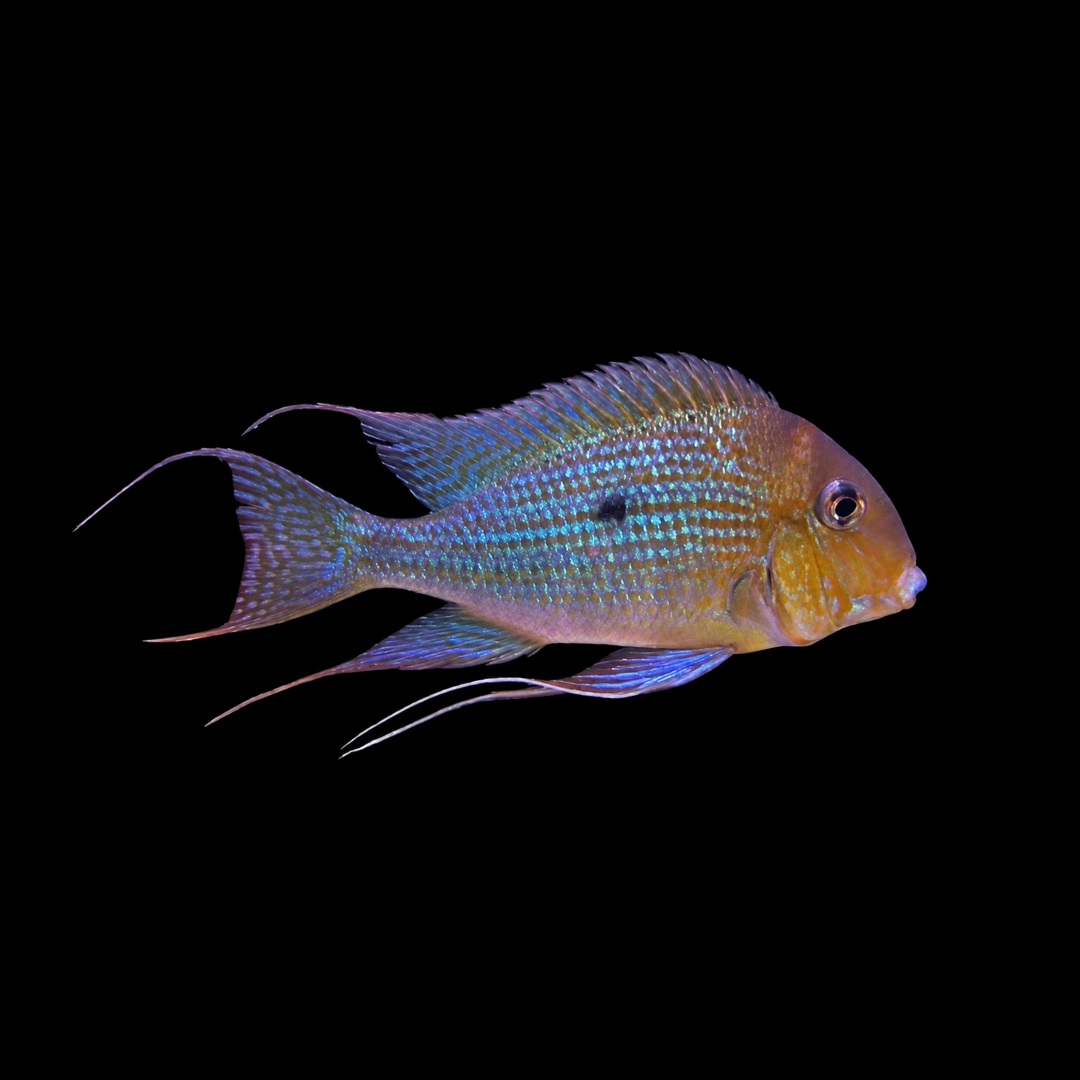
解説 / Description
ゲオファーガス・ネアンビは、ブラジルのトカンチンス川水系に分布する中型の南米シクリッドです。底床の細かな砂を口いっぱいに含み、その中から小さな餌を選り分け、不要な砂を口やエラから戻す独特の摂食行動で知られます。成長した個体は体側に青緑色から金属光沢のある輝きを帯び、繁殖期には胸部のオレンジ色や尾鰭の青白いスポットがいっそう目立ちます。堂々とした体格を持ちながら、シクリッドとしては比較的社会性が高く、十分な広さと細砂の底床を用意すると、群れの動きや砂を選り分ける自然な行動をじっくり観察できる魅力的な種類です。 Geophagus neambi is a medium-sized South American cichlid native to the Rio Tocantins drainage in Brazil. It is best known for taking fine sand into its mouth, separating small food items from the substrate, and expelling the unwanted sand through the mouth and gill openings. Mature fish develop attractive blue-green to metallic body sheen, while breeding adults can show a brighter orange chest and conspicuous pale blue spots on the caudal fin. Despite its substantial size, it is comparatively social for a cichlid, and in a spacious aquarium with fine sand it displays fascinating group behavior and natural substrate-sifting activity.
基本情報 / Basic Information
| 学名 / Scientific Name | Geophagus neambi Lucinda, Lucena & Assis, 2010 |
|---|---|
| 通称 / Common Name | ゲオファーガス・ネアンビ。記載以前には、トカンチンス産の個体が「ゲオファーガス sp. トカンチンス」や「ゲオファーガス aff. アルティフロンス “トカンチンス”」などの名称で扱われた例があります。Geophagus neambi. Before its formal description, Tocantins specimens were also kept and traded under names such as Geophagus sp. “Tocantins” and Geophagus aff. altifrons “Tocantins”. |
| 分類 / Family | シクリッド科(Cichlidae)・シクリッド亜科(Cichlinae)・ゲオファーガス属(Geophagus)Family Cichlidae, subfamily Cichlinae, genus Geophagus |
| 英名 / English Name | Geophagus neambi; no widely standardized English common name is established |
| 分布 / Distribution | 南米ブラジルのトカンチンス川水系上流〜中流域。基準産地はトカンチンス州ポルト・ナシオナルのラジェアード水力発電所貯水池です。Upper and middle portions of the Rio Tocantins drainage in Brazil, South America. The type locality is the Lajeado Hydroelectric Reservoir at Porto Nacional, Tocantins. |
| 最大体長 / Max Size | 標準体長で約20.3cm。飼育下では個体差や尾鰭を含む全長によって、見た目のサイズはさらに大きく感じられます。About 20.3 cm standard length. Total length including the caudal fin can make mature aquarium specimens appear noticeably larger. |
| 寿命 / Lifespan | 本種単独について信頼性の高い寿命年数は十分に整理されていません。良好な水質と適切な栄養管理のもとでは長期飼育が期待できますが、明確な年数は情報不足です。A well-supported species-specific lifespan has not been clearly established. Long-term maintenance is expected under good water quality and nutrition, but a precise lifespan figure is not sufficiently documented. |
飼育環境 / Aquarium Environment
| 水槽サイズ / Tank Size | 最低でも120cm規格水槽(底面120×45cm、約240L級)を目安とし、5匹以上のグループを余裕を持って飼育するなら180×60cm以上の大型水槽(約600L級以上)が理想的です。体長だけでなく、底床を広く使って採餌する習性と群れ内の距離を確保することが重要です。As a minimum, use a 120 cm standard aquarium with a 120 × 45 cm footprint, roughly in the 240 L class. For a group of five or more adults, a tank around 180 × 60 cm or larger, roughly 600 L class or above, is preferable. Floor area is especially important because the fish forage extensively over the substrate and need room to manage social spacing. |
|---|---|
| 水温 / Temperature | 飼育目安として24〜32℃程度が挙げられます。日常飼育では25〜28℃前後を安定して保つと管理しやすく、急激な温度変化は避けます。 Aquarium references commonly give a range of approximately 24–32°C. For routine care, keeping the water stable around 25–28°C is practical, and rapid temperature changes should be avoided. |
| 水質 / Water Quality | 弱酸性〜中性を中心に、pH 5.5〜7.5程度、軟水〜やや軟らかめの水が目安です。溶存有機物や硝酸塩の蓄積を避け、安定した生物ろ過と十分な換水を重視します。大型個体を複数飼育するため、ろ過能力には余裕を持たせてください。Slightly acidic to neutral water is suitable, around pH 5.5–7.5, with soft to moderately soft hardness. Avoid the accumulation of dissolved organic waste and nitrate, and prioritize mature biological filtration and substantial regular water changes. Filtration capacity should be generous because several large fish produce a considerable waste load. |
| レイアウト / Layout | 最重要なのは、口に含める細かな砂を広く敷くことです。角の鋭い砂利や大粒の底床材は避け、粒径0.5〜1mm程度を目安とした川砂や細粒のシリカサンドなどを選びます。流木や丸みのある石で視線を遮る場所をつくりつつ、砂を掘り返せる広い開放部を残します。水草を使う場合は、掘り返されにくいアヌビアス類やミクロソリウム類などを流木や石に活着させる方法が向いています。The most important feature is a broad area of fine sand that can be safely taken into the mouth. Avoid sharp gravel and coarse substrate; fine river sand or silica sand around 0.5–1 mm grain size is suitable. Use driftwood and smooth stones to create visual barriers while leaving large open areas for sifting. If plants are included, epiphytic species such as Anubias and Microsorum attached to wood or rock are more practical than rooted plants that can be excavated. |
| 注意点 / Precautions | 未成熟な水槽への導入、底床の汚泥蓄積、急激な水質変化を避けます。砂を巻き上げるため、吸水口には細目のスポンジプレフィルターを付けると、砂粒によるポンプのインペラー摩耗を防ぎやすくなります。また、強すぎる直線的な水流は避け、吐出口をガラス面や流木に当てて分散させると落ち着きやすくなります。Avoid introducing the fish to an immature aquarium, allowing excessive detritus to accumulate in the substrate, or causing sudden changes in water chemistry. Because sand is frequently suspended, a fine sponge prefilter on the intake helps protect pump impellers from abrasion. Very strong direct current should also be avoided; diffusing the outlet against glass or driftwood usually creates a calmer environment. |
餌と給餌 / Feeding
| 餌の種類 / Diet | 主食には微粒〜小粒の高品質な沈下性人工飼料を使い、冷凍アカムシ、ブラインシュリンプなどの小型餌を補助的に与えます。自然下では底床中の小型無脊椎動物、有機物、植物質などを取り込むため、スピルリナなど植物性原料を含む飼料も組み合わせると栄養の偏りを抑えやすくなります。Use high-quality fine to small sinking pellets as the staple diet, supplemented with small foods such as frozen bloodworms and brine shrimp. In nature the fish ingest small invertebrates, organic matter, and some plant material from the substrate, so including foods with plant ingredients such as spirulina helps provide a more varied nutritional profile. |
|---|---|
| 給餌のポイント / Feeding Tips | 一度に大量に与えるより、1日3〜4回を目安に食べ切れる少量を分けて与えると、底床を探り続ける本来の採餌リズムに近づけられます。口の構造に対して大きすぎる硬い餌は避け、底まで届く粒を複数箇所に落として群れ全体へ行き渡らせます。残餌が砂の中にたまらないよう、給餌量と換水量を調整してください。Rather than offering one large meal, provide small portions about three to four times per day when practical, reflecting the species’ natural pattern of repeated substrate foraging. Avoid hard food items that are too large for the mouth and distribute sinking food over several areas so subordinate fish can feed. Adjust portions and maintenance so uneaten food does not accumulate in the sand. |
性格と混泳 / Temperament and Tank Mates
| 性格 / Temperament | シクリッドの中では比較的温和ですが、同種間には順位関係が形成され、繁殖期のペアは明確な縄張りを持ちます。単独や2〜3匹の少数飼育では弱い個体へ攻撃が集中しやすいため、十分な水槽サイズを確保したうえで5〜8匹程度のグループから始める方法が適しています。It is comparatively peaceful for a cichlid, but a social hierarchy develops within the group and breeding pairs become distinctly territorial. Keeping only one fish or a small group of two or three can concentrate aggression on weaker individuals, so a group of roughly five to eight fish is preferable when adequate tank space is available. |
|---|---|
| 混泳の相性 / Compatibility | 十分な広さがあれば、遊泳層の異なる温和な中型カラシン類や、攻撃性の低い南米産魚との混泳が考えられます。口に入るほど小さな魚は捕食される可能性があるため避けます。底層で強い縄張りを持つ大型プレコ類や攻撃性の高いシクリッドとは生活圏が競合しやすく、相手の性格と水槽サイズを慎重に見極める必要があります。繁殖期は普段より攻撃性が高まるため、退避場所を多く用意します。In a sufficiently large aquarium, it can be combined with peaceful medium-sized characins and other non-aggressive South American fishes that occupy different swimming levels. Fish small enough to be swallowed should be avoided. Large territorial loricariids and aggressive cichlids can compete strongly for bottom space, so compatibility must be judged carefully in relation to tank size and individual temperament. Breeding pairs become more aggressive, making multiple retreat areas important. |
病気と対策 / Diseases and Prevention
| かかりやすい病気 / Common Diseases | 特定の病気だけに弱い魚ではありませんが、水質悪化や慢性的なストレスが続くと、シクリッド類でみられる頭部の孔状・びらん性病変や、エロモナス属細菌などが関与する体表の発赤、潰瘍、腹部膨満などの細菌性症状が現れることがあります。The species is not known for a single uniquely characteristic disease, but prolonged poor water quality and chronic stress can predispose cichlids to pitting or erosive lesions around the head and to bacterial problems, including redness, ulcers, or abdominal swelling associated with opportunistic bacteria such as Aeromonas. |
|---|---|
| 対策と予防 / Prevention | 予防の中心は、十分に成熟したろ過、定期的な大幅換水、砂底にたまる汚泥の除去、適切な給餌量、過密を避けた飼育です。異常が出た個体は早めに隔離し、症状を観察したうえで原因に合った魚病薬を製品表示どおりに使用します。薬浴時は水温、溶存酸素、pHの急変にも注意し、原因が特定できない場合や重症例では魚類診療に対応できる獣医師へ相談するのが安全です。Prevention centers on mature filtration, substantial regular water changes, removal of accumulated detritus from the sand, appropriate feeding, and avoiding overcrowding. Isolate abnormal fish early and use aquarium medications only when appropriate for the observed condition and according to the product label. During treatment, monitor temperature, dissolved oxygen, and pH carefully; uncertain or severe cases are best assessed by a veterinarian experienced with fish. |
増やし方(繁殖) / Breeding
| 雌雄の判別 / Sexing | 外見だけでの雌雄判別は難しく、非繁殖期は確実な特徴に乏しい種類です。産卵が近づくとメスの産卵管が確認しやすくなる場合があります。繁殖を狙うなら幼魚を5〜8匹ほど育て、成長とともに自然に形成されるペアを見つける方法が現実的です。Sexing by external appearance is difficult, and reliable differences are limited outside the breeding period. The female’s ovipositor may become easier to see shortly before spawning. A practical breeding approach is to raise a group of roughly five to eight juveniles and allow compatible pairs to form naturally as they mature. |
|---|---|
| 繁殖形態 / Reproduction | 平らな石や流木などの基質を掃除して産卵し、受精後は卵を口に取り込んで保育する両親性の口内保育を行います。繁殖中の親魚は産卵場所と仔魚の周囲を強く防衛します。The fish clean a solid surface such as a flat stone or piece of wood for spawning, then take the fertilized eggs into the mouth for biparental brood care. During reproduction, the parents strongly defend the spawning area and later the fry. |
| 繁殖のポイント / Breeding Tips | 成熟したペアには、落ち着ける広い水槽、清浄で安定した水質、栄養状態の良い餌、産卵床になる平らで滑らかな石を用意します。産卵数は条件によって変わりますが、まとまった数の卵を産むことがあります。25〜28℃前後では、保育された仔魚が1週間余りから十日ほどで自由遊泳へ移る例が知られます。自由遊泳後は孵化したてのブラインシュリンプや細かな人工飼料を与えます。混泳水槽では他魚による仔魚の捕食を避けるため、親子が落ち着ける区画や別水槽を用意すると生存率を高めやすくなります。Provide a mature pair with a spacious, quiet aquarium, stable clean water, a nutritious diet, and smooth flat stones suitable for spawning. Egg numbers vary with condition, but substantial clutches may be produced. At around 25–28°C, aquarium observations indicate that guarded fry can progress to free swimming after roughly a little over one week to around ten days. Newly free-swimming fry can take freshly hatched brine shrimp and fine prepared foods. In community aquaria, giving the parents and fry a protected section or separate tank can improve fry survival. |
雑学と豆知識 / Trivia and Fun Facts
| 1. 2010年に名前を得た、比較的新しい「正式種」 / 1. A formally named species only since 2010 | ゲオファーガス・ネアンビが学術的に新種として記載されたのは2010年です。それ以前からトカンチンス産のゲオファーガスは観賞魚として知られ、別の名称で扱われることがありました。Lucinda、Lucena、Assisの3名による原記載では、8〜9本の明瞭な体側横帯、その一部が二又に分かれる模様、頭部に黒い斑紋を持たないことなどが重要な識別点として示されました。長く流通名で親しまれていた魚が、形態的な特徴に基づいて正式な学名を与えられた例としても興味深い存在です。Geophagus neambi was formally described as a new species in 2010. Tocantins eartheaters had already been known in the aquarium hobby and were sometimes kept under other names. The original description by Lucinda, Lucena, and Assis emphasized characters such as eight or nine conspicuous vertical flank bars, bifurcation of some bars around the mid-lateral blotch, and the absence of black head markings. It is an interesting example of an aquarium fish that was later given a formal scientific name based on diagnostic morphology. |
|---|---|
| 2. 種小名「neambi」は研究拠点への敬意 / 2. The name “neambi” honors a research center | 種小名の「neambi」は、トカンチンス連邦大学の環境研究拠点「Núcleo de Estudos Ambientais(NEAMB)」にちなみます。トカンチンス川流域の魚類相研究を積み重ねてきた組織への敬意が、一匹の魚の学名として残された形です。学名というと姿形だけを表す無機質な記号に見えますが、ときには地域の自然を調べ続けた人々や研究機関の歴史まで封じ込められています。The specific name “neambi” honors the Núcleo de Estudos Ambientais, or NEAMB, an environmental research center at the Federal University of Tocantins. Its work on the fishes of the Tocantins drainage is thus preserved in the scientific name of the species. Scientific names may look like neutral labels, but they can also carry the history of the people and institutions that studied a region’s biodiversity. |
| 3. 「Geophagus」は文字どおり「土を食べるもの」 / 3. “Geophagus” literally refers to eating earth | 属名Geophagusは、ギリシャ語系の語要素で「土・大地」を意味するgeoと、「食べるもの」を意味するphagosに由来します。もちろん砂そのものを栄養として食べているわけではありません。細砂と一緒に小さな無脊椎動物や有機物を吸い込み、口腔とエラ周辺で食べられるものを巧みに選り分けています。水槽で砂を一口すくい、少し移動してからさらさらと吐き戻す姿は、属名がそのまま行動になったような光景です。The genus name Geophagus is derived from Greek-based elements meaning “earth” and “eater.” The fish do not obtain nutrition from sand itself. Instead, they take in fine substrate together with tiny invertebrates and organic particles, then skillfully separate edible material inside the mouth and branchial region. Watching a fish scoop up sand, move a short distance, and release a fine stream of grains makes the meaning of the genus name immediately understandable. |
| 4. 砂を選り分ける行動は、単なる「穴掘り」ではない / 4. Sand sifting is more than simple digging | 砂を口に含む行動は、底床を荒らしているのではなく、ゲオファーガス類が進化させた採餌法そのものです。口腔やエラ周辺の動きを使って砂粒と食物を分離し、食べられるものだけを咽頭側へ送ります。このため細かな砂底は見た目の演出ではなく、自然な採餌行動を成立させる飼育設備の一部です。粗い砂利しかない環境では、彼らの代表的な行動そのものが発揮しにくくなります。Taking sand into the mouth is not random digging; it is the feeding strategy for which Geophagus species are specialized. Movements of the oral and branchial regions help separate food particles from mineral grains before edible material is passed toward the pharyngeal apparatus. Fine sand is therefore not merely decorative. It is part of the functional environment that allows the fish to perform a central natural behavior. |
| 5. 近縁のゲオファーガス・スベニとの見分け方 / 5. Distinguishing it from Geophagus sveni | 同じトカンチンス川水系にはゲオファーガス・スベニも分布し、両種は一見よく似ています。ネアンビでは体側に8〜9本の明瞭な横帯が現れ、そのうちミッドラテラル・スポットを含む帯や周辺の帯に二又へ分かれる特徴がみられます。一方、スベニは5本の比較的淡い、分岐しない帯が基本です。生きた魚では色彩の差も手掛かりになりますが、照明や興奮状態で発色は変わるため、帯の数と形を組み合わせて見るほうが確実です。Geophagus sveni occurs in the same Tocantins drainage and can look quite similar at first glance. G. neambi has eight or nine conspicuous vertical bars, with characteristic bifurcation around the bar containing the mid-lateral blotch and nearby bars. G. sveni instead has five comparatively faint, undivided bars. Live coloration can provide additional clues, but because color changes with lighting and condition, the number and shape of the flank bars are more dependable characters to consider together. |
| 6. 口の中は「食卓」であり「保育室」でもある / 6. The mouth serves as both feeding apparatus and nursery | 普段は砂から餌を選り分けるために使われる口が、繁殖期には卵や仔魚を守る保育の場へと役割を変えます。採餌では底床の中から食べられるものを選び、繁殖では次世代を口内で守るという、同じ口腔周辺がまったく異なる二つの役割を担います。この行動の切り替わりは、ゲオファーガス類を観察する大きな面白さのひとつです。The same mouth used every day to separate food from sand becomes a protected space for eggs and fry during reproduction. In feeding, the oral region helps sort edible material from substrate; in breeding, it becomes central to brood care. This shift between two very different functions is one of the most fascinating aspects of observing Geophagus behavior. |
まとめ / Conclusion
ゲオファーガス・ネアンビの魅力は、美しい発色だけではありません。細かな砂を口に含んで餌を選り分ける姿、群れの中で絶えず変化する距離感、そして繁殖期に見せる丁寧な口内保育まで、日常の行動そのものに南米シクリッドらしい奥深さがあります。広い底面と清浄な水、そして安全に砂を扱える環境を用意することで、その個性はより自然な形で現れます。 The appeal of Geophagus neambi extends far beyond its coloration. Its constant sand-sifting, shifting social distances within the group, and careful mouthbrooding during reproduction reveal the behavioral depth typical of South American cichlids. With generous floor space, clean stable water, and a safe fine-sand substrate, the fish can express these qualities in a much more natural way.
大型水槽と丁寧な維持管理を必要とするため気軽な小型魚ではありませんが、環境を整えたぶんだけ行動で応えてくれる種類です。成長した群れが砂の上をゆったり移動し、光の角度によって青やオレンジの輝きを変える姿は、落ち着いた大型南米水槽の中心魚として長く付き合いたくなる存在感を持っています。 This is not a casual small-tank species, and it rewards aquarists who can provide a large aquarium and consistent maintenance. A mature group moving calmly over open sand, shifting between blue and orange highlights as the light changes, has a distinctive presence that makes G. neambi an exceptional centerpiece for a thoughtfully designed South American aquarium.

気になる道具や飼い方を見つけてみませんか?
 アイのアクアグッズ案内お魚を撮ったのに、ボクが写ってる! スマホで楽しむ水槽撮影と便利な道具道具の特徴や使い方、選ぶときのポイントをアイが紹介します。記事はコチラ →
 アイのアクアグッズ案内コケを食べるコイの仲間に合わせる飼育用品|フライングフォックス・アルジイーター・ガラ道具の特徴や使い方、選ぶときのポイントをアイが紹介します。記事はコチラ →
 アイのアクアグッズ案内水槽ライトの選び方|魚の見え方・水草・海水で選ぶおすすめ照明道具の特徴や使い方、選ぶときのポイントをアイが紹介します。記事はコチラ →
 アイのアクアグッズ案内アフリカンシクリッドの飼育用品|水槽・ろ過・底砂・岩組み・餌の選び方道具の特徴や使い方、選ぶときのポイントをアイが紹介します。記事はコチラ →
さまざまな飼育テーマをご紹介。リンク先の記事には広告・商品紹介が含まれます。
案内・紹介記事一覧へ →分布マップ
Geophagus neambi は、南米ブラジルのトカンチンス川水系上流〜中流域に分布し、基準産地はトカンチンス州ポルト・ナシオナルのラジェアード水力発電所貯水池とされています。
※この地図は記事に記載された「トカンチンス川水系上流〜中流域」という分布情報をもとに、分布地域全体を把握しやすいよう概略表示したものです。マーカーは地図上の目安としてポルト・ナシオナル周辺に設定した代表地点であり、本種の実際の採集地点を示すものではありません。
参考文献
-
Lucinda, P. H. F., Lucena, C. A. S. & Assis, N. C. (2010). Two new species of cichlid fish genus Geophagus Heckel from the Rio Tocantins drainage (Perciformes: Cichlidae). Zootaxa, 2429(1), 29–42.
https://doi.org/10.11646/zootaxa.2429.1.2
主な参照範囲:原記載、分類、分布、基準産地、形態的識別点、学名の由来
-
Fricke, R., Eschmeyer, W. N. & Van der Laan, R. (eds.). Eschmeyer’s Catalog of Fishes: Genera, Species, References. California Academy of Sciences. Geophagus neambi(オンライン版、2026年7月7日更新)。
California Academy of Sciences
主な参照範囲:現在の有効学名、分類学的位置、タイプ情報、分布
-
Lima, R. G. S. F., Soares, B. E., de Barros, T. F., Mazzoni, R. & Caramaschi, E. P. (2022). Length-weight relationships in 45 Neotropical fish species from the upper Tocantins River basin (Brazil). Journal of Applied Ichthyology, 38, 355–363.
https://doi.org/10.1111/jai.14314
主な参照範囲:上部トカンチンス川流域の実測標本に基づく体長・体重情報
-
López-Fernández, H., Winemiller, K. O., Montaña, C. & Honeycutt, R. L. (2012). Diet-morphology correlations in the radiation of South American geophagine cichlids (Perciformes: Cichlidae: Cichlinae). PLoS ONE, 7(4), e33997.
https://doi.org/10.1371/journal.pone.0033997
主な参照範囲:ゲオファギニの底生摂食、上鰓器官、口内保育と形態の関係
-
López-Fernández, H., Arbour, J., Willis, S., Watkins, C., Honeycutt, R. L. & Winemiller, K. O. (2014). Morphology and efficiency of a specialized foraging behavior, sediment sifting, in Neotropical cichlid fishes. PLoS ONE, 9(3), e89832.
https://doi.org/10.1371/journal.pone.0089832
主な参照範囲:砂や堆積物を選り分ける採餌行動と、それに対応した形態的適応
-
Weller, H. I., López-Fernández, H., McMahan, C. D. & Brainerd, E. L. (2022). Relaxed Feeding Constraints Facilitate the Evolution of Mouthbrooding in Neotropical Cichlids. The American Naturalist, 199(6).
https://doi.org/10.1086/719235
主な参照範囲:ゲオファギニにおける砂を選り分ける摂食行動と口内保育の進化的関係、Geophagus sensu stricto の口内保育
-
American Fisheries Society, American Institute of Fishery Research Biologists & American Society of Ichthyologists and Herpetologists (2014). Guidelines for the Use of Fishes in Research. American Fisheries Society, Bethesda, Maryland.
American Fisheries Society
主な参照範囲:飼育下における水質、収容環境、給餌、ろ過、ストレス管理の基本原則
-
Amesberger-Freitag, A., Tichy, A., El-Matbouli, M. & Lewisch, E. (2019). Hole-in-the-head disease in discus fish, Symphysodon (Heckel, 1840): Is it a consequence of a dietary Ca/P imbalance? Journal of Fish Diseases, 42(8), 1133–1142.
https://doi.org/10.1111/jfd.13023
主な参照範囲:シクリッド類でみられる頭部の孔状・びらん性病変と、その原因を単一要因に限定できないこと
-
Petty, B. D., Francis-Floyd, R. & Yanong, R. P. E. Bacterial Diseases of Fish. Merck Veterinary Manual. 2024年9月更新。
Merck Veterinary Manual
主な参照範囲:エロモナス属などによる発赤・潰瘍性病変、水質悪化やストレスとの関係、診断と治療の基本
-
Yanong, R. P. E. Use of Antibiotics in Ornamental Fish Aquaculture. University of Florida IFAS Extension, Circular 84 / FA084.
University of Florida IFAS Extension
主な参照範囲:観賞魚の細菌感染症におけるストレス要因の除去、抗菌薬の適正使用、診断に基づく治療の重要性




コメント