

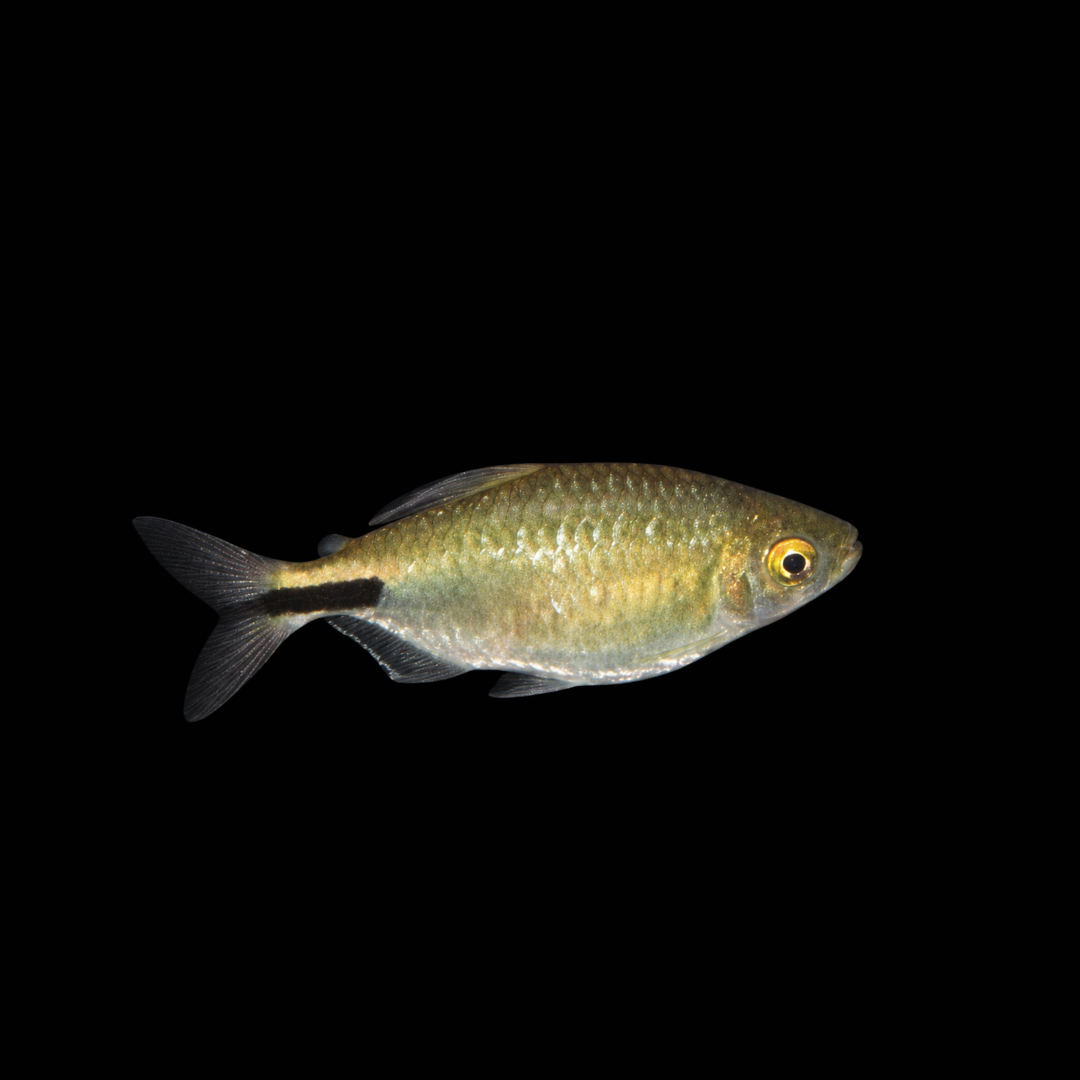
解説 / Description
アレステス・ロンギピニスは、アフリカ大西洋岸の河川に広く分布するアレステス科の中型カラシンです。日本の観賞魚流通では、旧来の属名に由来する「アレステス」の呼び名で親しまれていますが、現在の有効名としては Bryconalestes longipinnis が広く用いられます。銀色の体側には青緑色の光沢が浮かび、尾柄から尾ビレ中央へ続く黒いライン、眼の上部や尾ビレ周辺に入る黄色味がよく目立ちます。 Bryconalestes longipinnis is a medium-sized African tetra widely distributed in Atlantic coastal river systems of Africa. In the Japanese aquarium trade it is still commonly called “Alestes,” a name derived from its former generic placement, while the currently accepted name is generally treated as Bryconalestes longipinnis. The fish shows a silvery body with a greenish-blue sheen, a dark stripe running from the caudal peduncle into the middle of the tail, and yellowish highlights around the upper eye and caudal area.
成熟したオスでは背ビレが長く伸び、よく泳ぐ群れの中でもひときわ華やかな印象を与えます。一方で、活発な遊泳性を持つため、小型テトラと同じ感覚で狭い水槽へ入れる魚ではありません。直線的な遊泳距離、落ち着ける群れの数、硝酸塩をためない清潔な水質を整えることで、本種らしい力強い泳ぎと発色を楽しみやすくなります。 Mature males develop an elongated dorsal fin, giving the species a striking appearance within an active school. However, it is not a fish to be treated like a small community tetra in a cramped aquarium. Long swimming space, a proper shoal, and clean water with low nitrate levels are essential for bringing out its natural movement and coloration.
基本情報 / Basic Information
| 学名 / Scientific Name | Bryconalestes longipinnis (Günther, 1864) |
|---|---|
| 通称 / Common Name | アレステス・ロンギピニス、アレステス・ロンギピンニス、ロングフィン・テトラLongfin tetra, African long-finned tetra, long-finned characin |
| 分類 / Family | カラシン目・アレステス科・ブリコナレステス属Order Characiformes, family Alestidae, genus Bryconalestes |
| 英名 / English Name | Longfin tetra / African long-finned tetra / Long-finned characin |
| 分布 / Distribution | 西アフリカから中央アフリカ西部にかけての大西洋岸水系。ガンビア方面からコンゴ民主共和国、ガボン方面まで記録され、河川の上流・下流、小河川、河口付近の汽水域にも現れます。Atlantic coastal drainages from West Africa to western Central Africa. It is recorded from the Gambia region toward the Democratic Republic of the Congo and Gabon, occurring in upper and lower river courses, smaller streams, and sometimes estuarine brackish waters. |
| 最大体長 / Max Size | 最大記録は全長約16.4cmです。水槽内では10〜13cm前後で扱われることが多く、観賞魚としては3〜5cm程度の若魚で流通する例が多く見られます。The recorded maximum is about 16.4 cm total length. In aquaria it is more commonly encountered around 10–13 cm, and ornamental imports are often juveniles of roughly 3–5 cm. |
| 寿命 / Lifespan | 飼育下での寿命は資料により幅がありますが、清浄な水質と十分な遊泳空間を保てれば5年前後からそれ以上の長期飼育が期待できます。Published aquarium lifespan estimates vary, but with clean water and adequate swimming space, a lifespan of around five years or more can be expected. |
飼育環境 / Aquarium Environment
| 水槽サイズ / Tank Size | 若魚でも90cm規格水槽を基準に考え、成魚を群れで飼う場合は120cm規格水槽以上、可能であれば120cmワイド水槽以上が理想です。体長以上に遊泳力が目立つ魚なので、総水量だけでなく、端から端まで泳げる直線距離を重視します。A standard 90 cm aquarium should be considered the practical starting point even for juveniles. For a group of adults, a 120 cm tank or larger is preferred, and a wide 120 cm-class aquarium is ideal. Because this species is a strong swimmer, long open swimming distance matters as much as overall volume. |
|---|---|
| 水温 / Temperature | 22〜26℃を基本に管理します。繁殖を意識して親魚を仕上げる場合は、24〜26℃付近で安定させると扱いやすくなります。 Maintain at 22–26°C. When conditioning adults for breeding, a stable range around 24–26°C is often easier to manage. |
| 水質 / Water Quality | pH6.0〜8.0、総硬度5〜19°dH程度まで適応します。実際の飼育では、弱酸性から中性付近の清浄な水を維持すると管理しやすくなります。硝酸塩の蓄積や急な水質変化で調子を崩しやすいため、定期的な換水と安定したろ過を保ちます。It adapts to approximately pH 6.0–8.0 and 5–19°dH. In practice, clean slightly acidic to neutral water is easy to manage. Avoid nitrate build-up and abrupt changes by maintaining regular water changes and stable filtration. |
| レイアウト / Layout | 中央から前面には広い遊泳スペースを残し、背面や側面に水草、流木、陰になる場所を配置します。暗色系の底砂や背景は体色を引き締め、浮草や水草の茂みは急な人影や照明への反応を和らげます。ブラックウォーター風にする場合も、色づけより水質の安定を優先します。Leave wide open swimming space in the center and front, and place plants, driftwood, and shaded areas along the back and sides. Dark substrate and background improve visual contrast, while floating plants or dense plant cover help reduce skittish reactions to sudden movement or light. If a blackwater-style setup is used, stability matters more than strong staining. |
| 注意点 / Precautions | 驚くと勢いよく跳ねることがあるため、フタの隙間は必ずふさぎます。導入直後の個体は輸送疲れや痩せが見られることがあるので、慎重な水合わせと隔離観察を行うと安全です。狭い水槽や少数飼育ではパニックを起こしやすく、体をぶつけてスレ傷を作ることがあります。This fish may leap forcefully when startled, so every gap in the lid should be closed. Newly imported specimens may be thin or stressed, making careful acclimation and quarantine advisable. In undersized tanks or small groups, panic swimming can cause abrasions and collision injuries. |
餌と給餌 / Feeding
| 餌の種類 / Diet | 雑食性で、人工飼料、顆粒、フレーク、冷凍アカムシ、ブラインシュリンプ、ミジンコ、イトミミズなどをよく食べます。自然界では水生昆虫、小型甲殻類、動物プランクトン、落下昆虫、種子、藻類なども利用するとされるため、動物性の餌を中心にしつつ、偏りすぎないローテーション給餌が向いています。It is omnivorous and usually accepts prepared foods, pellets, flakes, frozen bloodworms, brine shrimp, daphnia, and tubifex-type foods. In nature it feeds on aquatic insects, small crustaceans, zooplankton, fallen terrestrial insects, seeds, and algae, so a varied diet with a strong animal-protein component is suitable. |
|---|---|
| 給餌のポイント / Feeding Tips | 導入直後は食が細い場合があるため、冷凍餌や活餌に近い餌で反応を見ながら徐々に人工飼料へ慣らします。よく食べる反面、水を汚しやすい魚でもあるため、1回量を控えめにし、残餌が出ない範囲で1日1〜2回を目安に与えます。繁殖を狙う親魚には、数週間から数か月かけて高栄養の餌を少量多回で与えると状態を作りやすくなります。New arrivals may feed cautiously at first, so frozen or live-type foods can be used to stimulate appetite before gradually introducing prepared foods. Because the species eats heavily and can pollute the water, feed modest portions once or twice daily without leaving leftovers. For breeding preparation, condition adults over several weeks or months with small frequent meals of rich foods. |
性格と混泳 / Temperament and Tank Mates
| 性格 / Temperament | 中層から上層を群れで泳ぐ、活発でよく動く魚です。基本的には温和ですが、俊敏で存在感があるため、落ち着いた魚や泳ぎの遅い魚には圧を与えることがあります。最低でも6匹、できれば8匹以上の群れで飼育すると、警戒心が和らぎ自然な行動を見せやすくなります。It is an active shoaling fish that swims mainly in the middle to upper levels. It is generally peaceful, but its speed and presence can intimidate quieter or slower fish. Keep at least six individuals, preferably eight or more, to reduce nervousness and encourage natural behavior. |
|---|---|
| 混泳の相性 / Compatibility | コンゴテトラ、アフリカン・レッドアイカラシン、ペルヴィカクロミス属の小型シクリッド、シノドンティス属の中小型種など、同程度のサイズと活動量を持つ魚と相性が良いです。極端に小さな魚、長いヒレを持つおとなしい魚、動きの遅い魚は、ストレスや誤食、ヒレへの接触のリスクがあるため避けます。Good companions include similarly sized and active species such as Congo tetras, African red-eye characins, small Pelvicachromis cichlids, and medium-small Synodontis catfish. Avoid very small fish, delicate long-finned species, and slow-moving tank mates, as they may be stressed, injured, or mistaken for food. |
病気と対策 / Diseases and Prevention
| かかりやすい病気 / Common Diseases | 本種だけに特有の病気は知られていません。ワイルド個体では、導入初期の白点病、外部寄生虫、輸送中のスレ傷からの細菌感染に注意します。水質が悪化すると、ヒレの傷み、体表の白濁、食欲低下が出やすくなります。繁殖時の卵は水カビに侵されることがあります。No disease is known to be unique to this species. Wild imports should be monitored for white spot disease, external parasites, and bacterial infection following transport abrasions. Poor water quality may lead to fin damage, cloudy skin, and loss of appetite. Eggs may be affected by fungal growth during breeding attempts. |
|---|---|
| 対策と予防 / Prevention | 新規導入魚は隔離水槽で観察し、少量多回の換水でアンモニアと硝酸塩を抑えます。水槽内には鋭い石や硬い枝先を避け、驚いたときに体を傷つけにくい構成にします。繁殖時の卵管理では、遮光、清潔な水、十分なエアレーション、必要に応じた薄い抗菌・抗カビ処置が有効です。Quarantine new fish and control ammonia and nitrate with small frequent water changes. Avoid sharp rocks or hard protruding wood that may injure startled fish. During egg incubation, dim light, clean water, ample aeration, and mild antifungal or antibacterial treatment when necessary can be useful. |
増やし方(繁殖) / Breeding
| 雌雄の判別 / Sexing | 成熟したオスは背ビレが長く伸び、体高が出て、尻ビレの下縁が丸みを帯びます。状態が上がるとヒレや体側の色も強く見えます。メスは背ビレが伸びにくく、全体に流線型で、抱卵すると腹部がふくらみます。若魚では判別が難しいため、複数匹を育てながら選別する方法が現実的です。Mature males develop a much longer dorsal fin, a deeper body, and a more rounded anal-fin profile. Their fins and body colors also intensify when in good condition. Females usually retain shorter fins and a more streamlined body, becoming fuller when carrying eggs. Juveniles are difficult to sex, so raising a group and selecting adults is the most practical approach. |
|---|---|
| 繁殖形態 / Reproduction | ばらまき型の産卵を行う卵生魚です。親魚は卵を食べるため、産卵後は速やかに取り出します。条件が合えば数百粒規模のオレンジ色の卵を産むとされ、孵化には数日を要します。繁殖例はありますが、一般的な家庭水槽で安定して増やせる魚ではなく、上級者向けの挑戦と考えるのが適切です。It is an egg-scattering oviparous species. Adults will eat the eggs and should be removed immediately after spawning. Under suitable conditions, several hundred orange eggs may be laid, and hatching takes several days. Captive spawning has been reported, but reliable breeding in a typical home aquarium remains an advanced challenge. |
| 繁殖のポイント / Breeding Tips | 親魚は高栄養の餌で十分に仕上げ、45cm水槽から60cm規格水槽程度の産卵水槽にウィローモスや人工産卵床を多めに入れます。pH6.0〜6.5程度の軟水、24〜26℃、薄暗い環境、弱いスポンジフィルターやエアレーションを用意します。卵と初期稚魚には清潔な水と高い溶存酸素が重要で、初期餌はインフゾリアなどの微細な餌から始め、成長に合わせてブラインシュリンプ幼生へ移行します。Condition the adults well with rich foods, then prepare a spawning tank of roughly 45–60 cm with plenty of Java moss or spawning mops. Use soft water around pH 6.0–6.5, a temperature of 24–26°C, dim lighting, and gentle sponge filtration or aeration. Clean water and high dissolved oxygen are important for eggs and early fry. Start with infusoria-sized foods and move to newly hatched brine shrimp as the fry grow. |
雑学と豆知識 / Trivia and Fun Facts
| 1. 名前に残る「長いヒレ」 / 1. The long fin in the name | 種小名 longipinnis は、ラテン語の「長い」と「ヒレ」に由来します。若魚のうちは地味に見えることもありますが、成熟したオスの背ビレが伸びてくると、この名が姿の印象を端的に表していることが分かります。国内流通名に残る「アレステス」は旧来の分類名に由来し、学術名が更新されても趣味の世界に呼び名が残り続ける好例です。The specific name longipinnis comes from Latin roots meaning “long” and “fin.” Juveniles can appear modest, but once mature males develop their extended dorsal fin, the name clearly reflects the fish’s appearance. The Japanese trade name “Alestes” comes from an older classification and is a good example of how hobby names can persist even after scientific names change. |
|---|---|
| 2. Brycinus から Bryconalestes へ / 2. From Brycinus to Bryconalestes | 本種は長く Brycinus longipinnis として扱われてきましたが、アレステス科内の再検討により、現在は Bryconalestes longipinnis として掲載される資料が増えています。観賞魚店のラベルに旧名が残る場合もありますが、それは流通名と学術分類の更新速度が異なるためです。This species was long treated as Brycinus longipinnis, but revisions within Alestidae have led many current references to list it as Bryconalestes longipinnis. Older names may still appear on aquarium shop labels because trade names and scientific revisions do not always move at the same speed. |
| 3. 外見だけでは分かりにくい隠れた多様性 / 3. Hidden diversity not obvious from appearance | DNAバーコーディング研究では、広い分布域の個体群間に大きな遺伝的分化が示され、本種は複数の近縁系統を含む隠蔽種複合体である可能性が高いと考えられています。一方で、外見だけで各系統を確実に見分けることは簡単ではありません。同じように見える銀色の群れの背後に、河川ごとの長い分化史が隠れている点は、ワイルド個体ならではの奥深さといえます。DNA barcoding studies have revealed deep genetic divergence among populations across the wide range, suggesting that the name may cover a cryptic species complex. At the same time, those lineages are not easily separated by appearance alone. Behind a school of similar-looking silver fish may lie a long river-by-river evolutionary history, adding depth to wild-caught specimens. |
| 4. 淡水魚でありながら汽水域にも現れる / 4. A freshwater fish that also reaches brackish zones | 本種は基本的には淡水河川の魚ですが、河口付近の汽水域にも記録があります。これは海水寄りの飼育が必要という意味ではありません。むしろ、自然界では水位や塩分、流れが変化する環境にも入り込める柔軟さを持つ魚と考えると分かりやすいでしょう。水槽では塩を常用するよりも、清潔で安定した淡水環境を用意することが大切です。This species is primarily a freshwater river fish, but it has also been recorded from estuarine brackish zones. This does not mean it needs marine-style conditions in the aquarium. Rather, it shows that the fish can enter environments where water level, salinity, and current fluctuate. In captivity, clean and stable freshwater is more important than routine salt use. |
| 5. 若魚で流通しやすい理由 / 5. Why juveniles are common in the trade | 本種は、観賞魚として3〜5cm前後の若魚で見かけることが多い魚です。小さめの個体は輸送後の環境に慣れやすく、成魚より扱いやすい傾向があるためです。購入時に背ビレがまだ短くても、広い水槽と良い餌で育てることで、成長とともに本種らしい姿へ変わっていきます。In the ornamental trade, this species is often encountered as juveniles of around 3–5 cm. Smaller individuals generally adapt more readily after transport and are easier to handle than adults. Even if the dorsal fin is still short at purchase, spacious housing and good feeding allow the fish to develop its characteristic adult form over time. |
まとめ / Conclusion
アレステス・ロンギピニスは、銀色の体を輝かせながら群れで泳ぐ姿に、アフリカンカラシンらしい力強さが表れる魚です。広い遊泳空間、清潔で安定した水、まとまった匹数を用意できる環境では、若魚の素朴な姿から、成熟したオスの長い背ビレが映える堂々とした姿へと変化していきます。 Bryconalestes longipinnis is an African tetra whose strength is best seen when a school flashes through the water with silver bodies and steady movement. In an aquarium that provides open swimming space, clean stable water, and a proper group, modest juveniles gradually develop into confident adults with impressive male finnage.
分類学的にも飼育面でも奥行きがあり、単なる丈夫な中型カラシンとして片づけられない魅力を持ちます。十分な設備を整えて迎えれば、流通名に残る歴史、地域個体群の多様性、そして水槽内で育ち上がる過程まで含めて、長く向き合う価値のある存在になります。 It has depth both taxonomically and as an aquarium fish, and it should not be reduced to merely a hardy medium-sized tetra. With suitable preparation, the keeper can appreciate its trade-name history, hidden population diversity, and the rewarding process of watching it mature in the aquarium.

気になる道具や飼い方を見つけてみませんか?
 アイのアクアグッズ案内水槽の流木の選び方|枝・マングローブ・アク抜きとおすすめ商品水槽に小さな森を作る流木。枝流木やマングローブという名前の違いから、魚の隠れ家、水草の取り付け、浮く・水が茶色くなるときの準備まで、アイとコタロウが商品とともに案内します。記事はコチラ →
 アイのアクアグッズ案内ベタの一匹飼いを楽しむ|水槽・ヒーター・ふた・フィルターの選び方ベタの一匹飼いに向く水槽容量、ふたと空気層、ヒーターと水温計、弱い水流のフィルターを、コタロウとアイの会話で分かりやすく解説します。記事はコチラ →
 アイのアクアグッズ案内ローチの仲間に合わせる飼育用品|クーリー・流水性・ボーシャの水槽と底砂道具の特徴や使い方、選ぶときのポイントをアイが紹介します。記事はコチラ →
 アイのアクアグッズ案内水草の肥料の選び方|底床用・液肥・メネデールの使い分け道具の特徴や使い方、選ぶときのポイントをアイが紹介します。記事はコチラ →
さまざまな飼育テーマをご紹介。リンク先の記事には広告・商品紹介が含まれます。
案内・紹介記事一覧へ →分布マップ
アレステス・ロンギピニスは、西アフリカから中央アフリカ西部にかけての大西洋岸水系に分布するとされます。ここでは、ガンビア方面からガボン・コンゴ民主共和国方面までの広い分布イメージを、概略範囲と代表地点で示しています。
この地図は分布欄の記述をもとにした概略プロットです。実際の採集地点、厳密な生息範囲、個体群ごとの分布境界を示すものではありません。
参考文献・参照資料
分類、分布、生息環境、飼育条件、繁殖、病気や注意点を確認するために参照した資料です。店舗・通販サイト、個人ブログ、一般的なまとめサイトは含めず、公的データベース、査読論文、獣医学・水産学系の資料に絞っています。
-
Fricke, R., Eschmeyer, W. N. & Van der Laan, R. (eds.). Eschmeyer’s Catalog of Fishes: Species by Family/Subfamily.
学名の有効性、原記載名、シノニム、アレステス科内での位置づけ、分布の確認に使用。 -
Froese, R. & Pauly, D. (eds.). FishBase: Bryconalestes longipinnis, Longfin tetra.
最大体長、水温、pH、硬度、淡水・汽水環境、分布、生息環境、群泳性、水槽サイズ、生殖情報、IUCN評価の確認に使用。 -
Arroyave, J., Martinez, C. M. & Stiassny, M. L. J. (2019). DNA barcoding uncovers extensive cryptic diversity in the African long-fin tetra Bryconalestes longipinnis (Alestidae: Characiformes). Journal of Fish Biology, 95, 379–392.
隠蔽種複合体の可能性、COIバーコーディングによる遺伝的分化、上部ギニア・下部ギニア水系の系統差、外部形態差が明瞭でない点の確認に使用。 -
Zanata, A. M. & Vari, R. P. (2005). The family Alestidae (Ostariophysi, Characiformes): a phylogenetic analysis of a trans-Atlantic clade. Zoological Journal of the Linnean Society, 145, 1–144.
アレステス科の系統関係と、旧Brycinus周辺の分類整理を理解するための基礎資料として使用。 -
Yanong, R. P. E. (2026). Fish Health Management Considerations in Recirculating Aquaculture Systems—Part 1: Introduction and General Principles. UF/IFAS Extension.
アンモニア、亜硝酸、硝酸塩、pH、水温、溶存酸素、硬度、塩分など、閉鎖水槽での水質管理と病気予防の考え方の確認に使用。 -
Francis-Floyd, R. & Petty, B. D. Disorders and Diseases of Fish. Merck Veterinary Manual.
ストレス、水質悪化、過密、隔離不足が魚病リスクを高めること、外部寄生虫・細菌・真菌感染など一般的な魚病リスクの確認に使用。 -
Routine Health Care of Fish. MSD Veterinary Manual.
新規導入魚の隔離、観察、感染拡大防止の考え方を確認するために使用。 -
Francis-Floyd, R., Yanong, R. P. E. & Pouder, D. B. Ichthyophthirius multifiliis (White Spot) Infections in Fish. UF/IFAS Extension.
白点病が淡水魚全般に問題となること、導入時の隔離や器具・水槽間の伝播防止が有効であることの確認に使用。





コメント