

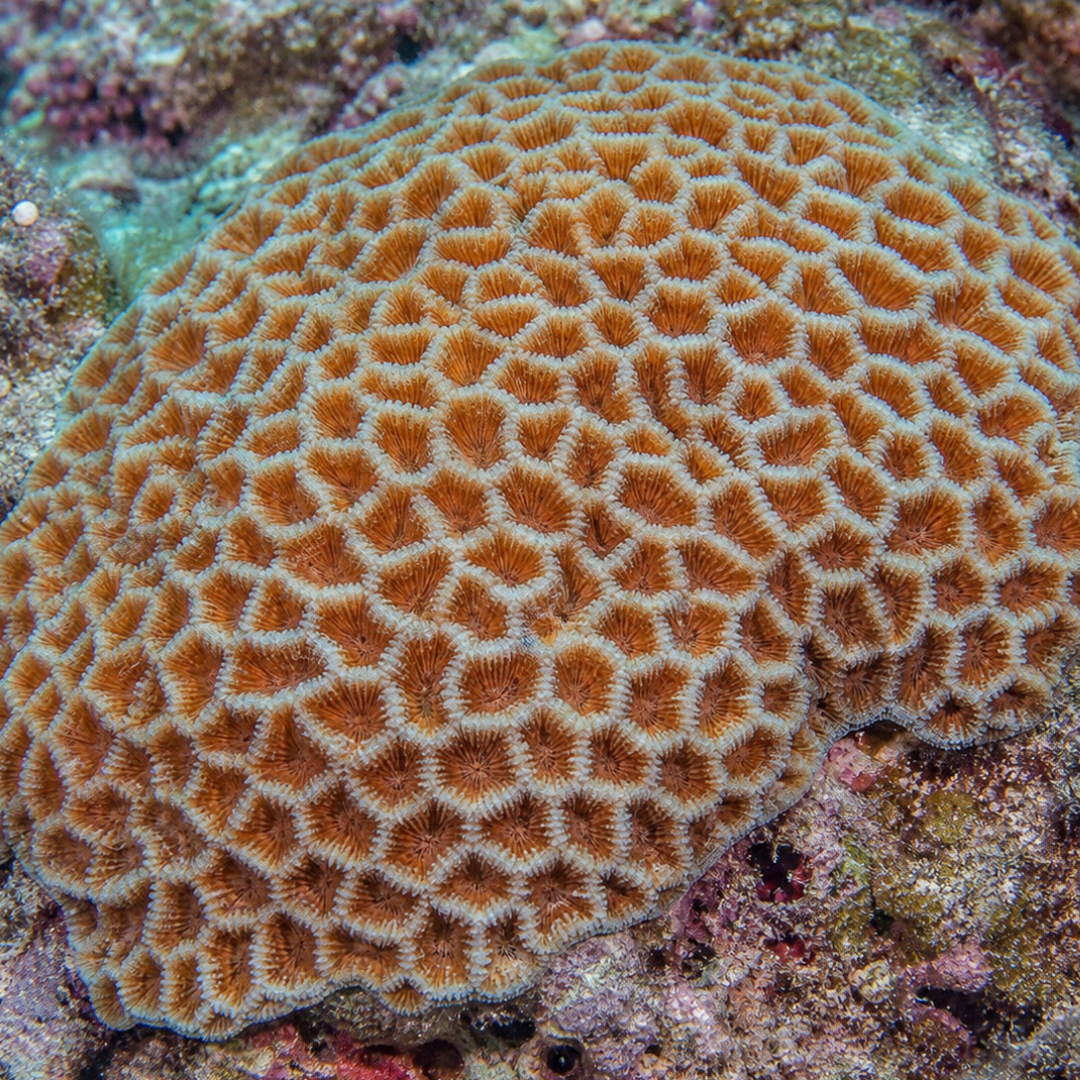
解説 / Description
コカメノコキクメイシは、インド太平洋に広く分布する造礁性イシサンゴです。群体の表面には多角形の莢が密に並び、隣り合う莢が壁を共有するセリオイド型から、複数の中心が短い溝状につながるサブメアンドロイド型まで変化に富んだ形を示します。褐色や灰褐色を基調とするもののほか、緑、黄、橙、赤などが入り交じる個体も流通し、青色成分の多い照明下では蛍光色が際立ちます。水槽ではLPSとして扱われ、急激な環境変化を避けながら光と水流を穏やかに調整することが、厚みのある共肉を保つ基本となります。 Goniastrea pectinata is a reef-building stony coral widely distributed across the Indo-Pacific. Its colony surface is densely covered with polygonal corallites, ranging from cerioid arrangements with shared walls to submeandroid forms in which several centers are connected by short valleys. Colonies are often brown or gray-brown, but aquarium specimens may also show combinations of green, yellow, orange, and red that fluoresce strongly under blue-rich lighting. In aquariums it is kept as an LPS coral, and the key to maintaining full, healthy tissue is to avoid abrupt environmental changes while adjusting light and water flow gradually.
基本情報 / Basic Information
| 学名 / Scientific Name | Goniastrea pectinata (Ehrenberg, 1834) |
|---|---|
| 通称・英名 / Common and English Names | コカメノコキクメイシ。国内流通では「キクメイシ」「Goniastrea」「ブレインコーラル」など、近縁種を含む広い名称で販売されることがあります。Commonly known as Goniastrea coral, closed brain coral, or brain coral. Trade names are often applied broadly to similar-looking merulinid corals, so the label does not always guarantee species-level identification. |
| 分類 / Classification | 刺胞動物門・花虫綱・六放サンゴ亜綱・イシサンゴ目・サザナミサンゴ科・コカメノコキクメイシ属。かつては広い意味のキクメイシ科に含められていましたが、分子系統と骨格形態を組み合わせた再検討により、現在はサザナミサンゴ科に置かれています。Phylum Cnidaria, Class Anthozoa, Subclass Hexacorallia, Order Scleractinia, Family Merulinidae, Genus Goniastrea. It was formerly placed in a broadly defined Faviidae, but combined molecular and morphological studies support its current placement in Merulinidae. |
| 分布 / Distribution | 紅海を含むインド洋から東南アジア、オーストラリア、太平洋の熱帯・亜熱帯域に分布します。主に浅い礁原、礁池、礁斜面、岩礁域などに生息し、記録は数十mの水深にも及びます。日本では南西諸島のサンゴ礁域だけでなく、本州の温帯海域にも記録があります。ただし、近縁種との識別が難しいため、古い分布記録には再検討を要するものも含まれます。Distributed from the Red Sea and Indian Ocean through Southeast Asia, Australia, and the tropical to subtropical Pacific. It is most often found on shallow reef flats, lagoons, slopes, and rocky reef habitats, with records extending to depths of several tens of meters. In Japan it has been recorded not only in the coral-reef regions of the Nansei Islands but also in temperate waters of Honshu. Because it can be difficult to distinguish from related species, some historical records require taxonomic re-evaluation. |
| 最大サイズ / Maximum Size | 群体は被覆状から準塊状、半球状に成長し、年月をかけて広い岩面を覆うことがあります。莢の長径は、中心が一つのものではおよそ4mm〜1cm、複数の中心が並ぶ細長い莢では約1.6〜3cmです。群体全体の明確な最大径は定めにくく、生息環境と成長年数によって大きく異なります。Colonies grow from encrusting to submassive or hemispherical forms and may spread over a broad area of substrate with time. Corallites with a single center are roughly 4 mm to 1 cm long, while elongated corallites with several centers may reach about 1.6 to 3 cm. A fixed maximum colony diameter is difficult to define because size varies greatly with habitat and age. |
| 寿命 / Lifespan | 本種に限った正確な寿命は明らかになっていません。造礁サンゴの群体は、出芽による成長と部分的な再生を重ねながら維持されるため、安定した環境では水槽内でも長期飼育が可能です。A precise species-specific lifespan has not been established. Reef-building coral colonies persist through budding, continued skeletal growth, and partial regeneration, allowing long-term maintenance in a stable aquarium. |
飼育環境 / Aquarium Environment
| 水槽サイズ / Tank Size | 小さなフラグだけであれば30〜45cm規格水槽でも飼育できますが、水質と水温を安定させやすい60cm規格水槽以上が長期飼育には扱いやすい目安です。複数のサンゴを配置する場合や、群体の成長と周囲との間隔を確保したい場合は、90cm規格水槽以上が管理しやすくなります。必要な水槽サイズは生体そのものの水量よりも、環境の安定性とレイアウトの余裕を基準に考えます。A small frag can be kept in a standard 30 to 45 cm aquarium, but a standard 60 cm tank or larger is easier to stabilize for long-term care. A standard 90 cm aquarium or larger is preferable when keeping several corals or allowing room for colony growth and safe spacing. Tank size should be chosen primarily for environmental stability and layout space rather than a species-specific minimum water volume. |
|---|---|
| 水温・比重 / Temperature and Specific Gravity | 熱帯性リーフ水槽の実用的な開始目安として、水温24〜26℃、塩分33〜35‰前後、25℃での比重1.024〜1.026程度を維持します。本種だけに定められた固定値ではなく、急な高温や比重変化を避けることが重要です。高水温が長く続くと、褐虫藻との共生が崩れて白化するおそれがあります。As a practical starting range for a tropical reef aquarium, maintain 24 to 26°C, salinity around 33 to 35‰, and a specific gravity of roughly 1.024 to 1.026 at 25°C. These are not fixed species-specific limits; avoiding rapid temperature and salinity changes is more important. Prolonged heat stress can disrupt the symbiosis with dinoflagellates and lead to bleaching. |
| 水質 / Water Quality | 一般的な造礁サンゴ向けの開始目安は、pH 8.0〜8.4、KH 7〜10dKH、カルシウム400〜450mg/L、マグネシウム1250〜1400mg/L程度です。ただし、個々の数値を追いかけるより、日ごとの変動を小さく保つことを優先します。硝酸塩とリン酸塩は過剰に蓄積させず、極端な無栄養にも偏らないよう、給餌量、換水、ろ過のバランスを整えます。Practical starting targets for a reef aquarium are pH 8.0 to 8.4, alkalinity 7 to 10 dKH, calcium 400 to 450 mg/L, and magnesium 1,250 to 1,400 mg/L. Keeping day-to-day changes small is more important than chasing exact numbers. Prevent excessive nitrate and phosphate accumulation while avoiding extreme nutrient depletion by balancing feeding, water changes, and filtration. |
| 光量 / Lighting | 水槽では弱めから中程度の光から始めます。本種に固有の最適PARは確立されていないため、導入時は実用上の目安として50〜100 PAR前後に置き、共肉の膨らみ、色調、骨格の露出を観察しながら段階的に調整します。自然下では幅広い光環境に適応しますが、水槽内で照明を急に強くすると、色抜けや収縮を招くことがあります。青色系の光は蛍光を見やすくしますが、発色だけを目的に照度を上げすぎないようにします。Begin with low to moderate aquarium lighting. Because no species-specific optimal PAR has been established, about 50 to 100 PAR can be used as a practical acclimation range, followed by gradual adjustment based on tissue expansion, color, and skeletal exposure. The species occupies a range of light environments in nature, but sudden increases in aquarium intensity may cause paling or contraction. Blue-rich light makes fluorescence easier to see, but intensity should not be raised solely for visual effect. |
| 水流 / Water Flow | 弱めから中程度の、間接的で変化のある水流が適します。共肉や摂餌触手がゆるやかに動き、表面にデトリタスがたまり続けない程度を目安にします。造波ポンプの噴流を直接当て、組織が骨格へ押しつけられたり、めくれ上がったりする状態は避けます。Provide low to moderate, indirect, variable flow. The fleshy tissue and feeding tentacles should move gently, and detritus should not remain settled on the surface. Avoid aiming a pump jet directly at the colony, as this can press tissue against the skeleton or lift it from the corallite walls. |
| レイアウト・配置 / Layout and Placement | 測定した光量に合わせて、水槽の下部から中段にある安定した岩上へ配置するのが基本です。フラグプラグや骨格底面はサンゴ用接着剤やエポキシパテで固定し、転倒、砂の堆積、他のサンゴとの接触を防ぎます。成長による広がりだけでなく、夜間に伸びる触手も考慮して周囲に余白を設けます。A stable rock in the lower to middle part of the aquarium is a useful starting position, provided the measured light level is appropriate. Secure the plug or skeletal base with coral-safe adhesive or epoxy to prevent falls, sand accumulation, and contact with neighboring corals. Leave space not only for colony growth but also for tentacle extension at night. |
| 注意点 / Precautions | 販売元の飼育条件を確認し、導入時に水温、比重、照明環境を大きく変えないようにします。不調は、開きの低下、色調の変化、共肉の後退、骨格露出として現れます。複数の要因を一度に動かすと原因を判断しにくくなるため、光、水流、水質は一項目ずつ小さく調整します。転倒や擦れも組織障害のきっかけになるため、固定状態を定期的に確認します。Check the seller’s holding conditions and avoid large changes in temperature, salinity, and lighting during introduction. Decline may appear as reduced expansion, color change, tissue recession, or exposed skeleton. Adjust light, flow, and water chemistry one factor at a time so the response can be evaluated. Check mounting regularly because falls and abrasion can initiate tissue damage. |
餌と給餌 / Feeding
| 栄養の得方・餌 / Nutrition and Diet | 体内に共生する褐虫藻がつくる光合成産物を重要な栄養源とする一方、触手と刺胞を使って動物プランクトンや微細な有機物も捕らえます。水槽では、粒の細かいLPS用フード、細かくした海産動物性飼料、粉末状や液状のサンゴ用飼料を利用できます。It obtains a major share of its energy from photosynthetic products supplied by symbiotic dinoflagellates, while also using tentacles and stinging cells to capture zooplankton and fine organic particles. In aquariums it can accept fine LPS foods, finely minced marine foods, and powdered or liquid coral diets. |
|---|---|
| 給餌のポイント / Feeding Tips | 安定した照明と水質があれば給餌は必須ではありませんが、成長を促したい場合は、週1回程度の少量給餌から様子を見ます。消灯後や、餌の匂いに反応して触手が伸びたときに、各ポリプが無理なく取り込める量をスポイトで与えます。必要に応じて水流を一時的に弱め、摂餌を確認したら元に戻します。食べ残しは栄養塩の上昇につながるため、量を増やすより確実に食べ切れることを優先します。Supplemental feeding is not essential when lighting and water quality are stable, but a small meal about once a week is a reasonable starting point when additional growth is desired. Feed after lights-out or when tentacles extend in response to food, using only an amount each polyp can capture comfortably. Reduce flow briefly if necessary and restore it after feeding. Prioritize complete consumption rather than increasing the portion, because leftovers can elevate nutrients. |
性質と相性 / Characteristics and Compatibility
| 形態・成長 / Form and Growth | 硬い炭酸カルシウム骨格をつくる群体性サンゴで、被覆状、準塊状、半球状に成長します。シンガポールで行われた相互移植実験では、強い光を受ける浅所で自己遮光に適した莢の形へ、弱い光の深所では光を受けやすい形へ変化することが示されました。この表現型可塑性により、同じ種でも環境によって骨格の印象が変わります。水槽での成長速度には個体差がありますが、安定した環境では周囲へゆっくりと広がります。This colonial coral builds a hard calcium-carbonate skeleton and develops encrusting, submassive, or hemispherical growth. A reciprocal-transplant experiment in Singapore showed that corallite architecture shifted toward more effective self-shading in bright shallow water and toward improved light capture in dimmer deeper water. This phenotypic plasticity means that colonies of the same species may look different under different conditions. Aquarium growth varies among specimens, but stable colonies gradually spread over the substrate. |
|---|---|
| 攻撃性 / Aggression | 他のイシサンゴと同様に、刺胞を備えた触手や隔膜糸が接触した相手の組織へ影響を及ぼす可能性があります。夜間や給餌時には日中より触手が目立つため、配置直後は少なくとも数cmの間隔を取り、実際の伸び方を確認して必要に応じて距離を広げます。より攻撃性の強いサンゴと接触すると、本種の共肉が損傷することもあります。As with other stony corals, contact by stinging tentacles or mesenterial filaments may damage neighboring tissue. Tentacles are often more evident at night or during feeding, so begin with at least several centimeters of space and increase the distance after observing their actual reach. Contact with a more aggressive coral can also damage Goniastrea tissue. |
| 相性 / Compatibility | 一般的なリーフセーフの魚や小型無脊椎動物とは同居させやすい一方、サンゴをついばむチョウチョウウオ類、一部の大型ヤッコ類、群体を倒す力の強い生体には注意が必要です。他のLPS、SPS、ソフトコーラルとは直接触れないように配置します。クマノミの自然な宿主ではなく、繰り返し体を擦りつけられると共肉が傷むことがあります。It is generally compatible with reef-safe fish and small invertebrates, but coral-feeding butterflyfish, some large angelfish, and animals capable of toppling the colony require caution. Position it so that it cannot directly contact other LPS, SPS, or soft corals. It is not a natural host for clownfish, and repeated rubbing may injure the fleshy tissue. |
病気と対策 / Diseases and Prevention
| 不調・病気・害虫 / Problems, Diseases, and Pests | 高水温、急な照明変化、強い直流、水質の変動、転倒や接触による傷では、開きの低下、色抜け、白化、共肉の後退、骨格露出が起こります。傷口や切断面から急速に組織が崩れ、褐色の粘液状物を伴うこともありますが、外観だけで細菌などの原因を断定することはできません。デトリタスの堆積や隣接サンゴからの攻撃も、局所的な組織障害を招きます。Heat stress, sudden lighting changes, forceful direct flow, unstable water chemistry, falls, and contact injuries can cause reduced expansion, paling, bleaching, tissue recession, and exposed skeleton. Rapid tissue breakdown may begin at a wound or cut edge and can be accompanied by brown mucus, but appearance alone cannot identify a bacterial or other specific cause. Detritus accumulation and aggression from neighboring corals may also produce localized tissue loss. |
|---|---|
| 対策と予防 / Prevention | まず水温、比重、光量、水流、主要な水質項目、接触や転倒の有無を確認し、原因候補を一つずつ修正します。組織の崩壊が進む個体は他のサンゴから離して観察し、広がりが速い場合は、十分な健全部を残して患部を切り離す方法が検討されます。ただし、切除自体も大きな負担になるため、経験者や専門店へ相談できる場合は状態を確認してから行います。新規個体の隔離観察と器具の洗浄を徹底し、ディップ剤は対象生体への適合と製品表示を確認して使用します。First check temperature, salinity, lighting, flow, major water parameters, and possible contact or fall damage, then correct one likely cause at a time. Move a colony with advancing tissue loss away from other corals for observation. If deterioration spreads rapidly, removing the affected area while retaining a generous margin of healthy tissue may be considered, although cutting is itself a major stress and should be discussed with an experienced keeper or specialist when possible. Quarantine new arrivals, clean tools carefully, and use coral dips only after confirming that the product is appropriate and following its instructions. |
増やし方(繁殖・株分け) / Reproduction and Propagation
| 無性生殖・株分け / Asexual Reproduction and Fragmentation | 群体は莢内出芽を繰り返して成長します。水槽内では、十分に成長した群体を骨格ごと切り分けるフラグ化によって増やせます。ダイヤモンドバンドソーなどを使い、口や共肉をできるだけ避けて骨格を切断し、切り分けた部分をサンゴ用のシアノアクリレート系接着剤やエポキシパテでプラグへ固定します。The colony expands through intracalicular budding. In aquariums, a mature colony can be propagated by cutting through the skeleton. A diamond band saw or similar tool is used to avoid mouths and living tissue as much as possible, and the fragment is then secured to a plug with coral-safe cyanoacrylate gel or epoxy. |
|---|---|
| 有性生殖 / Sexual Reproduction | 本種は雌雄同体の放卵放精型として記録されており、卵と精子を含むバンドルを海中へ放出して体外受精します。受精後の幼生は一定期間を浮遊したのち、適した基盤へ着底して新しい群体の起点になります。産卵時期は地域や水温、月齢などに左右されるため、一般家庭で計画的に再現するのは容易ではありません。This species has been recorded as a hermaphroditic broadcast spawner, releasing egg-sperm bundles for external fertilization. The resulting larvae remain planktonic for a period before settling on suitable substrate and establishing new colonies. Spawning timing varies with region, temperature, and lunar conditions, making planned sexual propagation difficult in a typical home aquarium. |
| 増殖のポイント / Propagation Tips | 十分に膨らみ、共肉の後退や感染を疑う症状がない親株を選びます。作業前に飼育水を入れた容器、洗浄した切断器具、固定材料を準備し、作業時間と空気への露出を必要最小限にします。切断後は通常より控えめな光と、傷口へ直接当たらない穏やかな水流で管理し、切断縁の共肉が安定するまで急な環境変更や追加の切断を避けます。回復に必要な期間は個体と環境によって異なります。Choose a fully expanded parent colony without tissue recession or signs of infection. Prepare aquarium water, cleaned cutting tools, and mounting materials in advance so handling time and air exposure remain minimal. After cutting, use reduced light and gentle flow that does not strike the wound directly, and avoid additional cutting or abrupt environmental changes until tissue at the cut margin stabilizes. Recovery time varies with the specimen and conditions. |
毒性と取り扱い / Toxicity and Handling
| 毒性 / Toxicity | 刺胞動物であるため、触手には餌の捕獲や防御に使う刺胞があります。他のサンゴや小型生物へ影響を与える可能性はありますが、人に対する本種固有の毒性は十分に整理されていません。また、本種がパリトキシンを持つとする信頼できる根拠は確認されていません。危険性を過大評価する必要はありませんが、粘液や切断面を素手で扱わないことが安全です。As a cnidarian, it has stinging cells in its tentacles for prey capture and defense. These may affect neighboring corals and small organisms, but species-specific effects on humans are not well characterized. Reliable evidence that Goniastrea pectinata contains palytoxin has not been established. There is no need to exaggerate the risk, but direct bare-skin contact with mucus and cut tissue should be avoided. |
|---|---|
| 取り扱い上の注意 / Handling Precautions | 移動やフラグ化ではニトリル手袋を着用し、切断作業では保護眼鏡も使用します。骨格の鋭い縁による切り傷と、粘液や切断時の飛沫が目、口、傷口へ入ることを防ぎます。作業後は手、器具、作業面を十分に洗浄し、サンゴに触れた手で顔を触らないようにします。Wear nitrile gloves when moving or fragmenting the coral, and use eye protection during cutting. Prevent injuries from sharp skeletal edges and keep mucus or cutting spray away from the eyes, mouth, and open wounds. Wash hands, tools, and work surfaces thoroughly afterward, and do not touch the face with contaminated gloves or hands. |
雑学と豆知識 / Trivia and Fun Facts
| 光に合わせて形を変える莢 / Corallites That Change with Light | コカメノコキクメイシの骨格は、遺伝だけで一つの形に固定されているわけではありません。シンガポールで浅所と深所の間にフラグを移植した研究では、強い光を受ける環境で自己遮光に適した莢へ、弱い光の環境では光を取り込みやすい莢へ変化しました。こうした表現型可塑性は、環境への適応に役立つ一方、骨格だけを手掛かりに種を識別する難しさにもつながっています。The skeleton of Goniastrea pectinata is not fixed into a single form by genetics alone. In a Singapore study that transplanted fragments between shallow and deeper sites, corallites shifted toward shapes suited to self-shading under strong light and toward improved light capture under dimmer conditions. This phenotypic plasticity helps the coral adjust to its environment, but it also makes identification from skeletal form alone more difficult. |
|---|---|
| DNA研究で見直された分類 / Classification Revised by DNA Research | 脳のしわや蜂の巣に似た塊状サンゴは、長い間、外見を中心に広い意味のキクメイシ科へまとめられていました。分子系統解析が進むと、似た姿でも系統的に離れた仲間や、姿が異なっていても近縁な仲間が見つかりました。現在のコカメノコキクメイシはサザナミサンゴ科に置かれていますが、近縁群の分類は今も研究が続く分野です。市場で属名や流通名が揺れやすい背景には、この複雑な分類史があります。Massive corals resembling brains or honeycombs were long grouped mainly by appearance within a broadly defined Faviidae. Molecular phylogenetics later revealed that some similar forms are distantly related, while some different-looking forms share close ancestry. Goniastrea pectinata is now placed in Merulinidae, although the classification of related groups remains an active field of research. This history helps explain why genus names and trade labels vary in the aquarium market. |
| 蛍光タンパク質の役割は一つではない / Fluorescent Proteins Have Multiple Roles | 青色照明の下で見える緑や橙の蛍光は、サンゴが持つ蛍光タンパク質によって生じます。浅い場所では過剰な光から共生藻を守る光防御に関わる例がある一方、弱い光の環境では組織内の光を調整し、共生藻が利用できる光を増やす働きも報告されています。すべての蛍光色を単純に「日焼け止め」と説明することはできず、色素の種類、組織内の位置、光環境によって役割が異なると考えられています。Green and orange fluorescence under blue lighting is produced by coral fluorescent proteins. Some pigments can protect symbiotic algae from excessive light in shallow habitats, while others may modify the internal light field and improve usable light under dim conditions. Fluorescence therefore cannot be described simply as sunscreen; its function depends on the pigment, its location in the tissue, and the surrounding light environment. |
| 共生藻は耐暑性の一部を担う / Symbionts Contribute to Heat Tolerance | サンゴの高水温耐性は宿主だけで決まらず、体内に共生する褐虫藻の系統や、生息してきた環境にも左右されます。一般にDurusdinium属などを多く持つ組み合わせで高い耐熱性が見られる例がありますが、コカメノコキクメイシが常に特定の耐熱型褐虫藻を持つとは限りません。塊状で丈夫に見える群体でも、強い熱ストレスが長く続けば白化や組織損失が起こります。Coral heat tolerance is influenced not only by the host but also by the lineage of symbiotic dinoflagellates and the environment in which the colony developed. Associations dominated by groups such as Durusdinium can show higher thermal tolerance in some cases, but Goniastrea pectinata cannot be assumed to always host a particular heat-tolerant symbiont. Even a massive, robust-looking colony can bleach or lose tissue during prolonged severe heat stress. |
| 日本では温帯海域にも記録がある / Records Extend into Temperate Japan | 本種は沖縄などのサンゴ礁域を代表する仲間ですが、日本の記録は南西諸島だけに限られません。環境省の分布資料には九州、四国、紀伊半島、伊豆半島などの記録が含まれ、近年の調査でも静岡県の駿河湾から報告されています。ただし、サンゴの分布は加入と局所的な消失を繰り返し、分類の見直しによって種名が変わることもあります。地図上の一点は、永久に固定された境界ではなく、その時代の海と調査精度を映す記録です。Although this species is characteristic of coral-reef regions such as Okinawa, Japanese records are not limited to the Nansei Islands. Ministry of the Environment distribution material includes records from Kyushu, Shikoku, the Kii Peninsula, and the Izu Peninsula, and a recent survey also reported it from Suruga Bay in Shizuoka Prefecture. Coral distributions can change through recruitment and local disappearance, and names may shift after taxonomic revision. A point on a distribution map is therefore a record of both the sea and the quality of identification at that time, not a permanently fixed boundary. |
| 国際取引はCITESの管理下にある / International Trade Is Regulated by CITES | コカメノコキクメイシを含むイシサンゴ目は、ワシントン条約の附属書IIに掲載されています。商業取引が全面的に禁止されているわけではありませんが、国際取引には輸出国が発行する輸出許可書や再輸出証明書が必要です。日本への輸入では、対象となる生体や取引条件に応じて、経済産業省による事前確認や輸入承認などが求められる場合があります。国内で販売されるフラグを選ぶ際にも、正規に輸入・増殖された個体であることを確認する姿勢が、野生資源の保全につながります。The order Scleractinia, including Goniastrea pectinata, is listed in CITES Appendix II. Commercial trade is not completely prohibited, but international movement requires an export permit or re-export certificate issued by the exporting country. Depending on the specimen and transaction, import into Japan may also require prior confirmation or import approval from the Ministry of Economy, Trade and Industry. Choosing specimens that have been legally imported or propagated supports the responsible use of wild coral resources. |
まとめ / Conclusion
コカメノコキクメイシは、規則的に連なる多角形の莢、厚みのある共肉、光によって表情を変える蛍光色が魅力の造礁サンゴです。飼育では強い刺激を与えるよりも、水温と水質の変動を抑え、共肉の膨らみを見ながら光と水流を少しずつ合わせることが大切です。給餌や添加剤も、安定した基本環境が整ってこそ効果を生かせます。 Goniastrea pectinata is a reef-building coral valued for its orderly polygonal corallites, substantial fleshy tissue, and fluorescence that changes character with the light. Successful care depends less on applying strong stimulation than on limiting fluctuations in temperature and water chemistry and adjusting light and flow gradually while observing tissue expansion. Feeding and supplementation are most useful only after the basic environment is stable.
環境が落ち着くと、フラグはゆっくりと基盤を覆い、一つ一つの莢がつながりながら群体としての存在感を増していきます。鮮やかな色彩だけでなく、光に応じて骨格の形まで変える柔軟さを知ることで、水槽の中にある一群体から、サンゴ礁を支える生き物のたくましさと奥深さを感じられるようになります。 When conditions remain stable, a frag slowly covers its base and gains presence as individual corallites become part of an expanding colony. Beyond its vivid colors, its ability to alter skeletal form in response to light reveals the resilience and complexity of the organisms that build coral reefs, all within a single colony in the aquarium.

気になる道具や飼い方を見つけてみませんか?
 アイのアクアグッズ案内バルブの仲間に合わせる飼育用品|チェリーバルブ・スマトラ・中型種の水槽とろ過道具の特徴や使い方、選ぶときのポイントをアイが紹介します。記事はコチラ →
 アイのアクアグッズ案内水槽フィルターの選び方|外掛け・外部・上部から小型オーバーフローまで道具の特徴や使い方、選ぶときのポイントをアイが紹介します。記事はコチラ →
 アイのアクアグッズ案内お魚を撮ったのに、ボクが写ってる! スマホで楽しむ水槽撮影と便利な道具道具の特徴や使い方、選ぶときのポイントをアイが紹介します。記事はコチラ →
 アイのアクアグッズ案内カルキ抜き・水質調整剤の選び方|水換えと水槽の種類に合わせて選ぶ道具の特徴や使い方、選ぶときのポイントをアイが紹介します。記事はコチラ →
さまざまな飼育テーマをご紹介。リンク先の記事には広告・商品紹介が含まれます。
案内・紹介記事一覧へ →分布マップ
コカメノコキクメイシは、紅海を含むインド洋から東南アジア、オーストラリア、熱帯・亜熱帯の太平洋にかけて広く分布します。日本では南西諸島に加え、本州の温帯海域にも記録がありますが、近縁種との識別が難しい古い記録は確実な地点として表示していません。地図の範囲とマーカーは概略表示であり、実際の採集地点や厳密な生息範囲ではありません。
この地図は記事の分布記述をもとにした概略表示です。着色範囲とマーカーは、実際の採集地点、個体確認地点、分布境界、厳密な生息範囲を示すものではありません。
参考文献
コカメノコキクメイシの分類、形態、分布、生息環境、閉鎖環境での飼育管理、繁殖、白化および病変に関する記述を確認するため、査読論文、公的機関、研究機関、学術データベースの資料に限定して選定しています。店舗、通販サイト、個人ブログ、一般的なまとめサイトは含めていません。
記事中の水温、比重、pH、KH、カルシウム、マグネシウム、PARなどの具体値は、コカメノコキクメイシだけを対象として実験的に確定された最適値ではありません。専門的なサンゴ飼育資料と一般的な造礁サンゴ水槽の管理範囲をもとにした、導入時の実用的な開始目安として扱う必要があります。
分類・形態・分布・生息環境
-
World Register of Marine Species. “Goniastrea pectinata (Ehrenberg, 1834).” WoRMS.
現行の受容学名、著者名、分類階級の確認に使用。
https://www.marinespecies.org/aphia.php?id=207464&p=taxdetails -
Huang, D., Benzoni, F., Fukami, H., Knowlton, N., Smith, N. D., and Budd, A. F. 2014. “Towards a phylogenetic classification of reef corals: the Indo-Pacific genera Merulina, Goniastrea and Scapophyllia (Scleractinia, Merulinidae).” Zoologica Scripta 43: 531–548.
分子系統と骨格形態に基づくサザナミサンゴ科内の分類再編を支える主要論文。
https://doi.org/10.1111/zsc.12061 -
Veron, J. E. N. and contributors. “Goniastrea pectinata.” Corals of the World.
群体形、莢の特徴、類似種、世界的な分布および浅海性の生息環境の確認に使用。
https://www.coralsoftheworld.org/species_factsheets/species_factsheet_summary/goniastrea-pectinata/ -
Kitano, Y. F. et al. 2020. “Data on coral species occurrences in Japan since 1929.” Ecological Research 35: 975–985.
日本沿岸における造礁サンゴの分布記録、文献統合、学名の同物異名整理を確認する基礎資料。
https://doi.org/10.1111/1440-1703.12136 -
Ow, Y. X. and Todd, P. A. 2010. “Light-induced morphological plasticity in the scleractinian coral Goniastrea pectinata and its functional significance.” Coral Reefs 29: 797–808.
異なる光環境に応じた莢形態の変化と、自己遮光・受光効率に関する記述を直接支える本種対象の実験研究。
https://doi.org/10.1007/s00338-010-0631-4
飼育環境・栄養
-
Leewis, R. J. and Janse, M., eds. 2008. Advances in Coral Husbandry in Public Aquariums. Public Aquarium Husbandry Series, Vol. 2. Burgers’ Zoo. ISBN 978-90-813805-1-5.
閉鎖環境におけるサンゴの水質、照明、水流、給餌、繁殖および設備管理を扱う公共水族館分野の専門資料。記事の飼育数値は、この種の一般的管理資料を踏まえた開始目安であり、本種固有の最適値を示すものではありません。
https://books.google.com/books/about/Advances_in_Coral_Husbandry_in_Public_Aq.html?id=AKxBPgAACAAJ -
Houlbrèque, F. and Ferrier-Pagès, C. 2009. “Heterotrophy in tropical scleractinian corals.” Biological Reviews 84: 1–17.
造礁サンゴが共生藻の光合成産物に加えて動物プランクトンや粒子状有機物を利用すること、給餌が成長や代謝へ及ぼす影響を支える総説。
https://doi.org/10.1111/j.1469-185X.2008.00058.x
繁殖・フラグ化・取り扱い
-
Madin, J. S. et al. “Coral Trait Database: Goniastrea pectinata.”
本種の生活史、群体形、繁殖様式など、出典付きの種特性を確認する学術データベース。
https://www.coraltraits.org/species/802 -
Baird, A. H. et al. 2021. “An Indo-Pacific coral spawning database.” Scientific Data 8: 35.
インド太平洋産イシサンゴの繁殖様式、産卵時期、地域差を集約した査読済みデータ論文。
https://doi.org/10.1038/s41597-020-00793-8 -
National Oceanic and Atmospheric Administration. “Corals Tutorial: Restoring Corals.” NOAA Ocean Service.
健全な群体を断片化し、各断片を新しい群体として育成する無性増殖の基本原理を確認する公的資料。
https://oceanservice.noaa.gov/education/tutorial_corals/coral15_restoring-corals.html -
International Coral Reef Initiative. Training Guide for Coral Reef Restoration.
サンゴの切断、固定、器具の扱い、手袋の使用など、フラグ化に近い作業の安全管理と実務上の注意を確認する国際的な研修資料。
https://www.icriforum.org/wp-content/uploads/2020/11/Training-Guide-for-Coral-Reef-Restoration.pdf
白化・病変・予防上の注意
-
National Oceanic and Atmospheric Administration. “What Is Coral Bleaching?” NOAA Ocean Service.
高水温などのストレスによるサンゴと共生藻の関係の崩壊、白化、長期化した場合の衰弱や死亡リスクを確認する公的解説。
https://oceanservice.noaa.gov/facts/coral_bleach.html -
Sweet, M., Craggs, J., Robson, J., and Bythell, J. 2013. “Assessment of the microbial communities associated with white syndrome and brown jelly syndrome in aquarium corals.” Journal of Zoo and Aquarium Research 1(1): 20–27.
水槽内サンゴで観察される白色症候群とブラウンジェリー症候群に関連する細菌・繊毛虫群集を調べた研究。褐色の粘液状物だけで原因を単純に断定できないことを理解する資料。
https://doi.org/10.19227/jzar.v1i1.21 -
Hawthorn, A., Berzins, I. K., Dennis, M. M., Kiupel, M., Newton, A. L., Peters, E. C., Reyes, V. A., and Work, T. M. 2023. “An introduction to lesions and histology of scleractinian corals.” Veterinary Pathology.
組織後退、変色、壊死などの病変を記載・診断する際の基礎資料。外観だけでは原因や病原体を確定できない場合が多いことを支えます。
https://doi.org/10.1177/03009858231189289
最終確認日:2026年7月30日




コメント