
解説 / Description
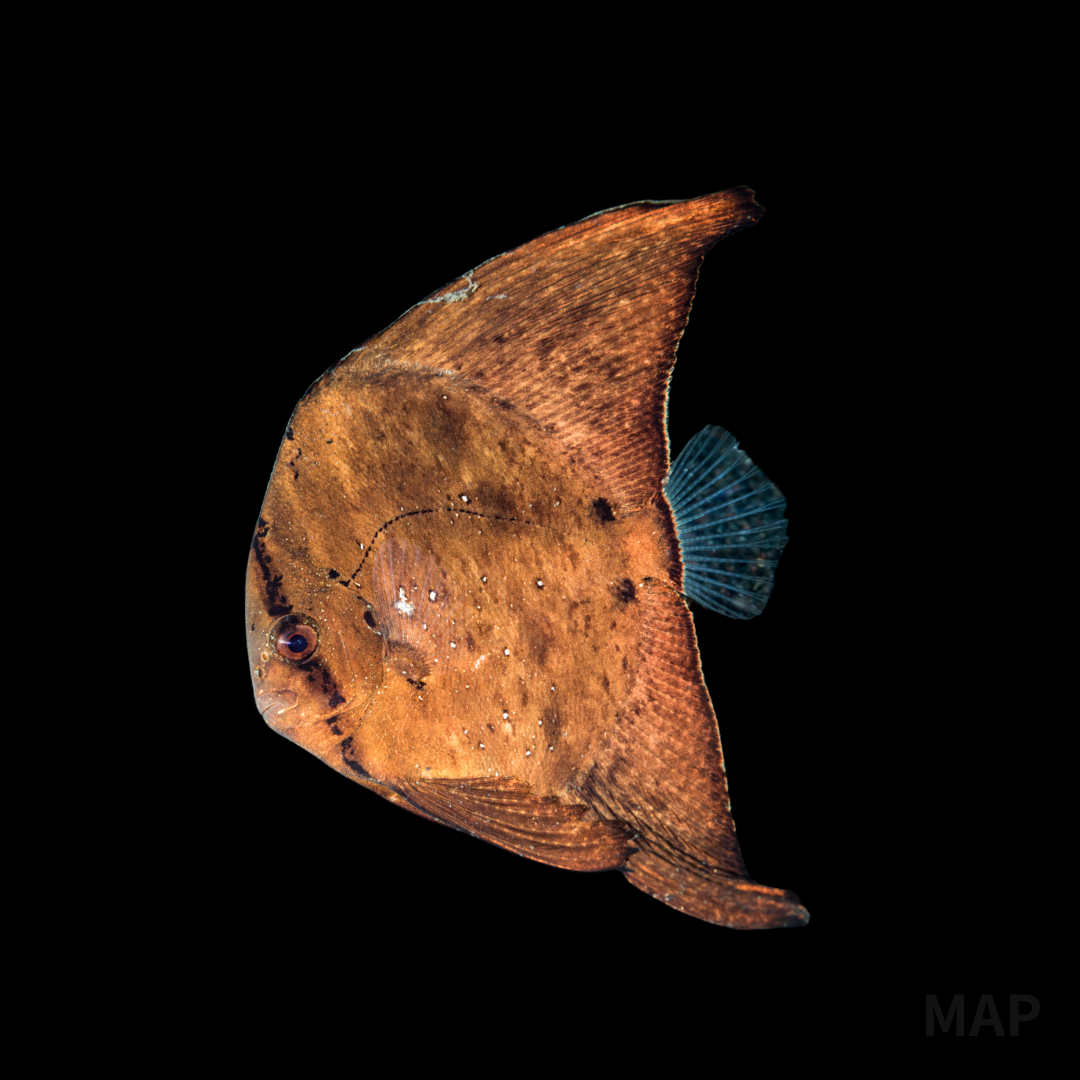
ナンヨウツバメウオは、幼魚と成魚で姿が大きく変わる、マンジュウダイ科の海水魚です。幼魚は赤褐色から茶褐色の平たい体に長い背びれと尻びれを備え、水面近くで枯葉のように漂います。成長すると、ひれの長さが体に対して目立たなくなり、銀灰色から黄褐色の、体高のある円盤形へと変化します。成魚には目を通る暗色帯と頭の後ろの暗色帯が見られ、体側に小さな黒点が現れることもあります。ゆったりとした泳ぎと独特の存在感が魅力ですが、最大で全長約60cmに達します。長期飼育には、成長後の体高に見合う超大型水槽と、多くの餌や排泄物に対応できる濾過設備が必要です。幼魚の姿だけで判断せず、成魚まで育てられる環境を整えてから迎えましょう。 The orbicular batfish is a marine member of the family Ephippidae whose appearance changes markedly as it grows. Juveniles have flattened reddish-brown to brown bodies and elongated dorsal and anal fins, drifting near the surface like fallen leaves. As they mature, their fins become proportionally shorter and their bodies develop into deep, silvery-grey to yellowish discs. Adults show a dark band through the eye and another behind the head, sometimes accompanied by small black spots on the sides. Their unhurried swimming and distinctive presence are appealing, but they can reach approximately 60 cm in total length. Long-term care requires a very large aquarium with sufficient vertical clearance and filtration capable of handling substantial feeding and waste. Prepare for the adult fish before bringing home a juvenile.
基本情報 / Basic Information
| 学名 / Scientific Name | Platax orbicularis (Forsskål, 1775) |
|---|---|
| 通称 / Common Name | ナンヨウツバメウオ。「ツバメウオ」は近縁種の和名でもあるため、購入時は学名も確認すると混同を避けやすくなります。Orbicular batfish, also called round batfish. General trade names such as “batfish” may refer to related species, so checking the scientific name helps avoid confusion. |
| 分類 / Family | マンジュウダイ科(Ephippidae)・ツバメウオ属(Platax)。従来はスズキ目に含められてきましたが、近年の分類体系ではニザダイ目(Acanthuriformes)に置かれることがあります。Family Ephippidae, genus Platax. Traditionally included in Perciformes, the species is placed in Acanthuriformes in some recent classification systems. |
| 英名 / English Name | Orbicular batfish |
| 分布 / Distribution | 紅海、東アフリカ、ペルシャ湾からインド洋を経て、東南アジア、日本南部、オーストラリア、ニューカレドニア、仏領ポリネシアに至るインド太平洋に分布します。日本では琉球列島などの温暖な海域に生息し、本州沿岸でも幼魚が季節的に見られます。幼魚はマングローブ域や波の穏やかな内湾、成魚はラグーンの砂地や水路、サンゴ礁周辺などを利用します。Distributed throughout the Indo-Pacific, from the Red Sea, East Africa and the Persian Gulf through the Indian Ocean to Southeast Asia, southern Japan, Australia, New Caledonia and French Polynesia. In Japan it inhabits warm southern waters, while juveniles also appear seasonally along Honshu. Juveniles use mangrove habitats and sheltered bays; adults occupy sandy lagoons, channels and reef surroundings. |
| 最大体長 / Max Size | 全長約60cm。左右に平たい一方で体高が大きく、ひれを含めた上下の広がりにも十分な空間が必要です。水槽内でも大型化するため、小さな水槽で飼えば小さいままでいられるとは考えないようにしましょう。Approximately 60 cm in total length. Although laterally compressed, the fish has a very deep body and needs generous vertical clearance including its fins. Aquarium specimens can also grow large; a small tank should not be expected to keep the fish small. |
| 寿命 / Lifespan | 飼育下の一般的な寿命については、信頼できる年数の目安が十分に確立されていません。短期間の飼育を前提にせず、長年にわたって管理できる設備と体制を用意しましょう。A reliable typical lifespan in captivity has not been firmly established. Prepare facilities and a maintenance plan suitable for care over many years rather than assuming a short-term commitment. |
飼育環境 / Aquarium Environment
| 水槽サイズ / Tank Size | 90cm規格水槽(90×45×45cm、容積約180L)を小さな幼魚の一時的な育成に使う場合も、成長に合わせた移動が前提になります。成魚の終生飼育には、一般的な120cmワイド水槽(120×60×60cm、容積約430L)でも不足します。大型設備を検討する際の寸法例としては、180cmの特注水槽(180×90×80cm、容積約1,300L)や、240cm級の特注水槽(240×100×90cm、容積約2,160L)が挙げられます。ただし、これらの寸法で飼育できると一律に判断することはできません。個体の体高、ひれの広がり、旋回の余裕、同居魚の数に合わせて、幅・奥行き・高さを検討してください。容積は満水時の概算で、実際の水量は水位や岩などによって少なくなります。If a Japanese standard 90 cm aquarium measuring 90 × 45 × 45 cm, approximately 180 L, is used temporarily for a small juvenile, a move to larger housing must be planned as it grows. Even a Japanese wide 120 cm tank measuring 120 × 60 × 60 cm, approximately 430 L, is inadequate for lifelong housing of a full-sized adult. Examples of custom dimensions to consider when planning a large installation include 180 × 90 × 80 cm, approximately 1,300 L, and 240 × 100 × 90 cm, approximately 2,160 L. These dimensions are not a universal guarantee of suitability. Assess width, depth and height according to the individual’s body depth, fin span, turning space and tank mates. Capacities are approximate full-volume figures; operating water volume is lower. |
|---|---|
| 水温 / Temperature | 22~28℃程度を目安とし、日常管理では24~27℃程度で安定させます。夏はクーラー、冬は水量に合ったヒーターを使用し、急な水温変化を避けましょう。高水温時は酸素不足にも注意が必要です。 A general temperature range is approximately 22–28°C, with stable conditions around 24–27°C as a routine care target. Use appropriately sized heating and cooling equipment to avoid abrupt changes. Pay particular attention to oxygen availability during warm periods. |
| 水質 / Water Quality | 通常の海水環境で管理し、比重1.023~1.025程度、pH8.1~8.4を目安に安定させます。比重の読み値は測定温度や器具に左右されるため、校正した測定器を使いましょう。アンモニアと亜硝酸は検出されない状態を維持し、硝酸塩は10mg/L以下を管理目標とします。ただし、これは飼育管理の目標であり、本種の耐性の限界を示す数値ではありません。餌をよく食べ、排泄量も多いため、十分な生物濾過、プロテインスキマー、酸素供給を組み合わせ、測定結果に応じて換水します。蒸発分は淡水で補い、換水には温度と塩分を合わせた人工海水を使用してください。pH調整剤は必要性を確認してから使い、急激な変化を起こさないようにします。Maintain normal marine conditions, with stable specific gravity around 1.023–1.025 and pH around 8.1–8.4. Specific-gravity readings depend on temperature and equipment, so use a calibrated instrument. Keep ammonia and nitrite undetectable, with nitrate at or below 10 mg/L as a maintenance target rather than a species-specific tolerance limit. Substantial feeding and waste production require adequate biological filtration, protein skimming, oxygenation and water changes guided by testing. Replace evaporation with freshwater and use saltwater matched for temperature and salinity for water changes. Add pH buffers only when needed, avoiding abrupt changes. |
| レイアウト / Layout | 魚を中心とした海水水槽に、十分な遊泳空間を確保します。岩は周辺に安定して配置し、中央には体を傾けたり旋回したりできる広い場所を残しましょう。ひれを傷つける鋭い岩や狭い隙間は避けます。幼魚には水面付近の穏やかな場所と、身を寄せられる遮蔽物を用意します。水流は酸素供給や汚れの回収に必要ですが、強い噴流を魚へ直接当てないようにしてください。Use a fish-focused marine aquarium with ample open swimming space. Arrange stable rockwork around the edges, leaving a broad central area for turning and tilting the body. Avoid sharp rocks and narrow gaps that may damage the fins. Juveniles benefit from calm surface areas and nearby cover. Water circulation supports oxygenation and waste removal, but strong concentrated jets should not strike the fish directly. |
| 注意点 / Precautions | 購入前に、成魚用水槽の設置場所、床の耐荷重、換水量、停電時の酸素供給まで計画します。移動時はひれが網目に絡むおそれがあるため、できるだけ十分に大きな容器で飼育水ごとすくい、体とひれを圧迫しないようにしましょう。導入直後は照明を控えめにし、水温や塩分を急変させず、隔離水槽で状態を確認します。自然界で汽水域を利用することがあっても、淡水魚として飼育できるわけではありません。飼育個体は海や河川へ放さず、飼育の継続が難しい場合は販売店などに受け入れ先を相談してください。Before purchase, plan the adult aquarium’s location, floor loading, water-change requirements and emergency oxygen supply. Nets may entangle the fins, so whenever possible move the fish in a sufficiently large container of aquarium water without compressing its body or fins. Keep lighting subdued after arrival, avoid sudden temperature or salinity changes, and assess the fish in quarantine. Its occurrence in brackish habitats does not make it suitable for freshwater care. Never release captive fish into the sea or rivers; if continued care becomes impossible, consult the retailer or another suitable facility about rehoming. |
餌と給餌 / Feeding
| 餌の種類 / Diet | 藻類、小型の甲殻類などの無脊椎動物、小魚を食べる雑食性です。飼育下では、海水魚用の栄養バランスのよい人工飼料を基本に、冷凍イサザアミ、細かく刻んだエビやアサリなどを組み合わせます。海藻やスピルリナを配合した人工飼料、味付けのない海苔も補助的に利用できます。特定の冷凍餌や魚肉だけに偏らず、口の大きさに合う餌を選びましょう。An omnivore that consumes algae, small invertebrates such as crustaceans, and small fish. In captivity, use a nutritionally balanced marine-fish food as the staple, supplemented with frozen mysid shrimp, finely chopped shrimp or clam. Foods containing marine algae or spirulina, and small amounts of unseasoned nori, can provide additional variety. Avoid relying exclusively on one frozen food or fish flesh, and match food size to the fish’s mouth. |
|---|---|
| 給餌のポイント / Feeding Tips | 1日2~3回を目安に少量ずつ与え、食べ残しを取り除きます。幼魚や導入直後の個体には食べやすい小さな餌を使い、冷凍餌とともに人工飼料を少しずつ与えて慣らしましょう。混泳水槽では、給餌場所に来ていても十分に食べられているとは限りません。一匹ずつ餌を飲み込んでいるか確認し、腹部の痩せや食欲低下を見逃さないようにします。よく食べる個体でも際限なく与えず、体型と水質を見ながら量を調整してください。Offer small portions two or three times daily as a starting point, removing leftovers. Juveniles and newly introduced fish may need small, readily accepted foods; introduce prepared food gradually alongside frozen items. In a community aquarium, approaching the feeding area does not guarantee adequate intake. Check that each individual actually swallows food, and watch for a thinning abdomen or reduced appetite. Even eager feeders should not receive unlimited food: adjust portions according to body condition and water quality. |
性格と混泳 / Temperament and Tank Mates
| 性格 / Temperament | 比較的温和で、他魚を執拗に追い回すことは少ない魚です。ただし、口に入る小魚や小型のエビなどを食べる可能性はあります。野生では単独でも群れでも見られますが、水槽内で必ず複数飼育する必要はありません。体をぶつけずに泳げる広さと、落ち着いて餌を食べられる環境を優先しましょう。Generally peaceful and unlikely to pursue other fish persistently. However, small fish and shrimp that fit into its mouth may be eaten. Wild individuals occur alone or in groups, but keeping several together is not essential in an aquarium. Prioritize ample swimming space and a setting where the fish can feed without disturbance. |
|---|---|
| 混泳の相性 / Compatibility | 混泳相手には、捕食されない大きさがあり、ひれをかじらず、餌を独占しない穏やかな海水魚を選びます。フグ類やカワハギ類など、ひれをつつく習性のある魚との組み合わせは避けましょう。ヤッコ類やチョウチョウウオ類も、種や個体によってひれをつつくため注意が必要です。同種を複数飼う場合は、水量だけでなく遊泳空間と給餌場所にも余裕を持たせます。小型の甲殻類を捕食し、サンゴやイソギンチャクをつつく可能性もあるため、サンゴ中心の水槽には向きません。魚と岩を主体にした環境が無難です。Choose peaceful marine companions large enough to avoid being eaten, and avoid fish that nip fins or monopolize food. Unsuitable puffers, filefish and other fin-nippers should not be combined with this species. Angelfish and butterflyfish also require caution because fin-nipping varies by species and individual. Multiple batfish need additional swimming space and feeding access, not merely more water volume. Small crustaceans may be eaten, and corals or anemones may be disturbed or bitten. A fish-focused aquarium with rockwork is therefore more appropriate than a coral-focused reef tank. |
病気と対策 / Diseases and Prevention
| かかりやすい病気 / Common Diseases | 海水白点病などの寄生虫疾患、リンホシスチス病、外傷に伴う細菌感染に注意します。海水白点病では、細かな白点、体をこする動作、呼吸の速まりなどが見られます。リンホシスチス病は、ひれや体表に白い粒状、またはカリフラワー状の隆起ができるウイルス性疾患です。本種では、テナキバキュラム属細菌による体表の潰瘍や組織の損傷も報告されています。白い病変がすべて同じ病気とは限らず、見た目だけで原因を断定することはできません。Watch for marine white spot disease and other parasitic infections, lymphocystis, and bacterial infections associated with injury. Marine white spot may cause fine white spots, rubbing and increased breathing. Lymphocystis is a viral disease producing white granular or cauliflower-like growths on the fins or skin. Skin ulcers and tissue damage associated with Tenacibaculum bacteria have also been reported in this species. White lesions do not all have the same cause, and appearance alone cannot provide a definitive diagnosis. |
|---|---|
| 対策と予防 / Prevention | 新しい魚は隔離して観察し、網や容器などの器具も本水槽と分けます。安定した水温と塩分、十分な酸素、適切な栄養、外傷を防ぐ混泳管理が予防の基本です。異常が見られたら、まずアンモニアなどの水質と呼吸状態を確認し、必要に応じて隔離して、魚病に詳しい専門家へ相談します。治療薬は病気の原因と製品の使用条件に合わせて選び、サンゴや無脊椎動物のいる本水槽へ安易に入れないようにしましょう。リンホシスチス病には確立した特効薬がなく、良好な環境を保ち、餌を食べられる状態を維持することが重要です。殺菌灯は、装置を通過する水中の病原体を減らす補助になりますが、白点病の完全な予防や、魚体に付着した寄生虫の除去を保証するものではありません。Quarantine and observe new fish, using equipment separate from the main aquarium. Stable temperature and salinity, adequate oxygen, balanced nutrition and protection from injury are the foundations of prevention. If abnormalities appear, first check water quality, including ammonia, and assess breathing; isolate the fish when appropriate and seek advice from a fish-health specialist. Choose medication according to the disease cause and product requirements, and do not casually dose a display containing corals or invertebrates. Lymphocystis has no established specific cure, so maintaining good conditions and continued feeding is important. UV sterilization can help reduce pathogens in water passing through the unit, but does not guarantee prevention of white spot or remove parasites already attached to the fish. |
増やし方(繁殖) / Breeding
| 雌雄の判別 / Sexing | 体色やひれの形など、外見だけで雌雄を確実に見分けるのは困難です。特に幼魚では、家庭での観察だけで判別するのは難しいと考えられます。繁殖用の親魚を選ぶには、雌雄と成熟状態を確認する専門的な評価が必要です。Sex cannot be reliably determined from coloration or fin shape alone. Juveniles are particularly difficult to sex through routine home observation. Selecting broodstock requires specialist assessment of both sex and reproductive maturity. |
|---|---|
| 繁殖形態 / Reproduction | 卵生で、水中へ卵と精子を放出して体外受精します。卵は浮遊性で、孵化した仔魚も初期には水中を漂いながら生活します。親魚が卵や仔魚を守る習性はありません。仏領ポリネシアなどでは、親魚からの採卵と仔魚の育成を組み合わせた養殖が行われています。An egg-laying species that releases eggs and sperm into the water for external fertilization. Eggs are pelagic, and newly hatched larvae initially live in the water column. Adults do not guard the eggs or larvae. Aquaculture in French Polynesia and elsewhere uses broodstock spawning followed by controlled larval rearing. |
| 繁殖のポイント / Breeding Tips | 家庭の観賞水槽で手軽に繁殖させられる魚ではありません。成熟した親魚を飼育する広い水槽に加え、浮遊卵の回収、仔魚専用水槽、微小な生き餌の安定供給が必要です。仔魚育成ではシオミズツボワムシ類からアルテミアへと餌を切り替え、成長に合わせて人工飼料へ慣らす方法が用いられます。仔魚は水流、餌の密度、水質の変化に影響されやすく、親魚が産卵しても、そのまま仔魚を育てられるとは限りません。繁殖に取り組む場合は、海産魚の種苗生産に準じた設備と技術が必要です。This is not a species that can be bred casually in a home display. Mature broodstock require a spacious aquarium, while successful reproduction also calls for pelagic-egg collection, dedicated larval tanks and a dependable supply of microscopic live foods. Larval protocols use marine rotifers followed by Artemia, with prepared feeds introduced as development permits. Larvae are sensitive to circulation, prey density and water quality. Even if adults spawn, the larvae will not necessarily survive without dedicated care. Successful breeding requires equipment and techniques comparable to those used in marine hatcheries. |
雑学と豆知識 / Trivia and Fun Facts
| 1. 枯葉らしさは、姿と動きの組み合わせ / 1. A leaf disguise made of shape and movement | ナンヨウツバメウオの幼魚は、茶色い体をしているだけでなく、体を横に傾けて水面近くを漂うことがあります。長いひれが葉のような輪郭をつくり、尾びれの透明な部分が目立ちにくいことで、魚らしい姿が分かりにくくなります。波に合わせて揺れる動きも重なると、浅い海に浮かぶ一枚の枯葉のように見えるのです。この枯葉擬態は、捕食者に魚として見つけられにくくなる働きを持つと考えられています。ただし、水槽で横になっている姿をすべて擬態と決めつけてはいけません。呼吸が荒い、餌を食べない、姿勢を戻せないといった様子が伴う場合は、不調を疑って確認しましょう。成長すると銀色の体と大きな体高が目立つようになり、生息場所も穏やかな浅場から、より開けた海域へと変わっていきます。Juvenile orbicular batfish do more than wear brown coloration: they may tilt sideways and drift close to the surface. Their elongated fins form a leaf-like outline, while the transparent portion of the tail makes their fish-like shape less obvious. Movement with the waves completes the resemblance to a floating dead leaf. This disguise is thought to make recognition by predators more difficult. However, a sideways posture in an aquarium should not automatically be interpreted as mimicry. Rapid breathing, refusal to feed or inability to regain normal posture may indicate illness. As the fish grows, its silvery coloration and deep body become more prominent, and its habitat shifts from sheltered shallows toward more open waters. |
|---|---|
| 2. 「平たい円形」に込められた学名と記載の歴史 / 2. A name describing a flat, rounded fish | 属名のPlataxは、ギリシャ語で「平たい」を意味する言葉に由来し、種小名のorbicularisはラテン語で「円形の」を意味します。横から見れば丸く、正面から見れば薄いという、成魚の体型をよく表した名前です。本種は1775年にフォルスコールによって、紅海のジッダをタイプ産地、つまり命名の基準となる標本の産地として、Chaetodon orbicularisの名で記載されました。現在の学名で記載者名と年が括弧に入っているのは、最初に分類された属から別の属へ移されたことを示しています。過去にはPlatax albipunctatusやPlatax ehrenbergiiなどの名前でも記載されましたが、現在は同じ種を指す異名として扱われています。幼魚と成魚で姿が大きく異なる本種を知るには、目の前の姿だけでなく、成長に伴う変化にも目を向けることが大切です。The genus name Platax comes from a Greek word meaning “flat,” while orbicularis is Latin for “circular.” Together they describe an adult that looks rounded from the side and thin from the front. Forsskål described the species in 1775 as Chaetodon orbicularis, with Jeddah in the Red Sea as its type locality—the origin of the specimen used as the basis for its name. The parentheses around the author and year in its current scientific name indicate that it has been moved from the original genus. Names such as Platax albipunctatus and Platax ehrenbergii are now treated as synonyms referring to the same species. Understanding its changing appearance is an important part of understanding the fish itself. |
| 3. 似た仲間を見分ける小さな手掛かり / 3. Small clues for identifying related species | ツバメウオ属には、よく似た円盤形の魚がいくつもいます。ツバメウオ(Platax teira)の成魚には胸びれの下方に目立つ黒斑が見られますが、ナンヨウツバメウオにはこの特徴的な黒斑がありません。一方、アカククリ(Platax pinnatus)の幼魚は、黒い体を鮮やかな橙色の線が縁取り、茶褐色のナンヨウツバメウオとは異なる印象を与えます。ただし、体色は成長や状態によって変わるため、一つの模様だけで判断しないことが大切です。ナンヨウツバメウオの背びれには5本の棘と34~39本の軟条、尻びれには3本の棘と25~29本の軟条があります。軟条とは、ひれを支える比較的柔らかい筋状の部分です。専門的な同定では、こうしたひれの構造を体型や模様と組み合わせて調べます。Several Platax species share a similar disc-shaped appearance. Adult teira batfish, Platax teira, have a conspicuous dark blotch below the pectoral fin, a feature absent from orbicular batfish. Juvenile Platax pinnatus have black bodies outlined in vivid orange, giving them a different appearance from brown orbicular juveniles. Nevertheless, coloration changes with growth and condition, so no single marking should determine identification. Orbicular batfish have five dorsal spines and 34–39 dorsal soft rays, with three anal spines and 25–29 anal soft rays. Soft rays are the relatively flexible supports within a fin. Specialist identification combines these fin characters with body shape and markings. |
| 4. 本州の港で出会う、南の海からの訪問者 / 4. Visitors carried north to Honshu | 夏から秋にかけて、本州の港や穏やかな入り江で、枯葉のような幼魚が見つかることがあります。南の暖かい海で生まれた魚が、黒潮などの海流の影響を受けて北へ運ばれてくるためです。こうした魚は「季節来遊魚」と呼ばれ、冬の低水温で生き残れない個体が多いことから、従来は「死滅回遊魚」という呼び方も使われてきました。来遊先の水温や環境は場所によって異なるため、幼魚が見つかっただけで、その場所に定着しているとはいえません。身近な港での小さな出会いにも、遠くの海と沿岸を結ぶ海流の働きが関わっています。From summer into autumn, leaf-like juveniles may appear in sheltered harbours and bays along Honshu. Fish originating in warm southern waters can be carried north under the influence of currents such as the Kuroshio. These are described in Japan as seasonal visitors; an older term refers to the fact that many cannot survive winter cooling. Conditions vary among locations, and finding juveniles alone does not establish that a resident population exists there. An encounter in a local harbour reflects the connection between distant warm seas and coastal waters. |
| 5. タヒチでは、観賞魚とは違う一面も / 5. A different role in Tahiti | 仏領ポリネシアでは、ナンヨウツバメウオは「パラハ・ペウエ」と呼ばれ、食用魚として親しまれています。独特の姿を眺める観賞魚としてだけでなく、食卓に上る魚としても利用され、養殖技術が育まれてきました。親魚から卵を得て、孵化した仔魚にワムシやアルテミアを与え、その後は人工飼料に慣らして育てます。この過程では、仔魚の小さな口や成長段階に合わせて餌を用意する、細かな管理が必要です。観賞魚として迎える幼魚も、やがて大きな成魚になります。食用魚としての一面を知ることも、成長後の姿を具体的に思い描く手掛かりになるでしょう。In French Polynesia, orbicular batfish are known as “paraha peue” and appreciated as food fish. They are valued not only for their unusual aquarium appearance but also for the table, and aquaculture techniques have been developed for them. Eggs are obtained from broodstock, larvae receive rotifers and Artemia, and prepared feeds are introduced as they grow. This requires careful feeding suited to the larvae’s small mouths and developmental stages. A juvenile purchased for an aquarium will also grow into a large adult. Knowing its role as a food fish can help make that future size easier to picture. |
| 6. 薄い体の中に収まる、複雑な消化管 / 6. A complex digestive tract inside a thin body | 正面から見ると薄いナンヨウツバメウオですが、体の中には消化管が折り重なるように収まっています。外から見える円盤形の輪郭の内側には、餌を消化して栄養を吸収するための複雑な構造があるのです。消化管の内側を覆う粘膜は、栄養の吸収だけでなく、病原体から体を守る働きにも関わります。本種では、テナキバキュラム・マリチマムという細菌の感染に伴い、消化管の粘液や組織に変化が見られることが研究されています。これは、病気の影響を考える際には体表だけでなく、体内の組織にも目を向ける必要があることを示しています。ただし、薄い体型そのものが病気に弱い原因だと断定できるわけではありません。飼育では、体型から病気への強さを決めつけず、食欲や泳ぎ方の変化を日々観察することが大切です。Viewed from the front, an orbicular batfish looks remarkably thin, yet its digestive tract is folded within that body. Behind the disc-shaped outline lies a complex structure for digestion and nutrient absorption. The lining of the gut also contributes to defence against pathogens. Research on this species has documented changes in digestive mucus and tissues associated with infection by the bacterium Tenacibaculum maritimum. This shows why the effects of disease need to be considered internally as well as at the body surface. It does not establish that the thin body shape itself causes vulnerability to disease. In everyday care, avoid judging disease resistance from body shape and instead observe appetite and swimming behaviour regularly. |
まとめ / Conclusion
ナンヨウツバメウオは、枯葉のように漂う幼魚から、円盤形の大きな体でゆったり泳ぐ成魚へと変わる海水魚です。その成長を長く見守るには、十分な高さと奥行きのある水槽、安定した水質、栄養の偏らない適量の餌が欠かせません。小さな幼魚を迎えるときから、成長後の居場所まで考えておくことが大切です。 The orbicular batfish grows from a leaf-like drifting juvenile into a large, disc-shaped adult that swims with an unhurried grace. Following that growth over time requires a sufficiently tall and spacious aquarium, stable water quality, and balanced food in appropriate amounts. Planning for the adult’s home begins before the juvenile arrives.
落ち着いて餌を食べ、ひれを傷つけずに泳げる環境の中で、変わっていく輪郭や色合いをじっくり観察できることが、この魚を飼育する楽しみです。成長に合わせて必要な空間と日々の管理を整えることで、その独特の姿と穏やかな存在感を長く見守ることができます。 Much of the pleasure of keeping this fish lies in observing its changing outline and coloration in an environment where it can feed peacefully and swim without damaging its fins. Providing space and daily care suited to its growth allows its distinctive appearance and calm presence to be enjoyed over time.
気になる道具や飼い方を見つけてみませんか?
 アイのアクアグッズ案内そのごはん、泳いでる! 卵から始めるブラインシュリンプの孵化と道具選び道具の特徴や使い方、選ぶときのポイントをアイが紹介します。記事はコチラ →
 アイのアクアグッズ案内水草水槽のCO₂添加|3つの方式の選び方とおすすめ用品道具の特徴や使い方、選ぶときのポイントをアイが紹介します。記事はコチラ →
さまざまな飼育テーマをご紹介。リンク先の記事には広告・商品紹介が含まれます。
案内・紹介記事一覧へ →分布マップ
ナンヨウツバメウオ(Platax orbicularis)は、紅海・東アフリカ・ペルシャ湾から、東南アジア、日本南部、オーストラリア、ニューカレドニア、仏領ポリネシアに至るインド太平洋に分布します。本州沿岸では幼魚が季節的に見られます。
この地図は、分布地域全体を見渡すための概略表示です。表示範囲全体に生息していることや、正確な分布境界を示すものではありません。マーカーは西太平洋の代表地点(緯度0度・東経150度)であり、実際の採集地点や確認記録ではありません。Google Earthのリンクも同じ代表地点を開きます。
参考文献
-
California Academy of Sciences. Eschmeyer’s Catalog of Fishes:Platax orbicularis.
学名、記載者、原記載名、タイプ産地、異名、分布。 -
World Register of Marine Species(WoRMS). Platax orbicularis (Forsskål, 1775).
有効な学名と分類上の位置づけ。 -
Heemstra, P. C.(2001). EPHIPPIDAE — Spadefishes (batfishes). FAO, The Living Marine Resources of the Western Central Pacific, Vol. 6, pp. 3611–3618(本種はp. 3617).
成長段階ごとの形態、近縁種との識別、ひれの棘・軟条数、分布、生息環境、食性、浮遊性の卵。 -
FishBase. Platax orbicularis — Orbicular batfish.
最大全長、分布、生息環境の水温、幼魚と成魚の生息場所、食性。 -
de Queiroz, A. C. ほか(2016). Morphometric comparisons of plant-mimetic juvenile fish associated with plant debris observed in the coastal subtropical waters around Kuchierabu-jima Island, southern Japan. PeerJ, 4, e2268.
幼魚と浮遊する植物片の形態的な類似、枯葉擬態とその行動。 -
Gasset, E. ほか. Premiers résultats de sex-ratio, puberté et dimorphisme sexuel chez le Paraha peue (Platax orbicularis) en élevage. Ifremer・仏領ポリネシア水産局.
養殖個体の性比、性成熟、雌雄差、親魚の管理。 -
Waqalevu, V. ほか(2020). Interplay between hormonal and morphological changes throughout a critical period of larval rearing in the orbicular batfish. Aquaculture Reports, 18, 100521.
仔魚の発育、形態変化、仔魚飼育条件、ワムシ・アルテミアの給餌と人工飼料への移行。 -
Alix, M. ほか(2020). Description of the unusual digestive tract of Platax orbicularis and the potential impact of Tenacibaculum maritimum infection. PeerJ, 8, e9966.
消化管の構造、テナキバキュラム症、感染に伴う消化管の粘液・組織の変化。 -
Yanong, R. P. E. University of Florida, IFAS Extension. Fish Health Management Considerations in Recirculating Aquaculture Systems—Part 3: General Recommendations and Problem-Solving Approaches. FA101.
循環式飼育設備における一般的な水質測定、設備管理、隔離、器具の衛生管理、交差感染の防止。 -
Yanong, R. P. E. University of Florida, IFAS Extension. Cryptocaryon irritans Infections (Marine White Spot Disease) in Fish. FA164.
海水白点病の症状、生活環、隔離と治療、殺菌灯による対策の限界。 -
Yanong, R. P. E. University of Florida, IFAS Extension. Lymphocystis Disease in Fish. FA181.
リンホシスチス病の原因と症状、類似する病変との区別、良好な飼育環境を維持する重要性。



コメント