

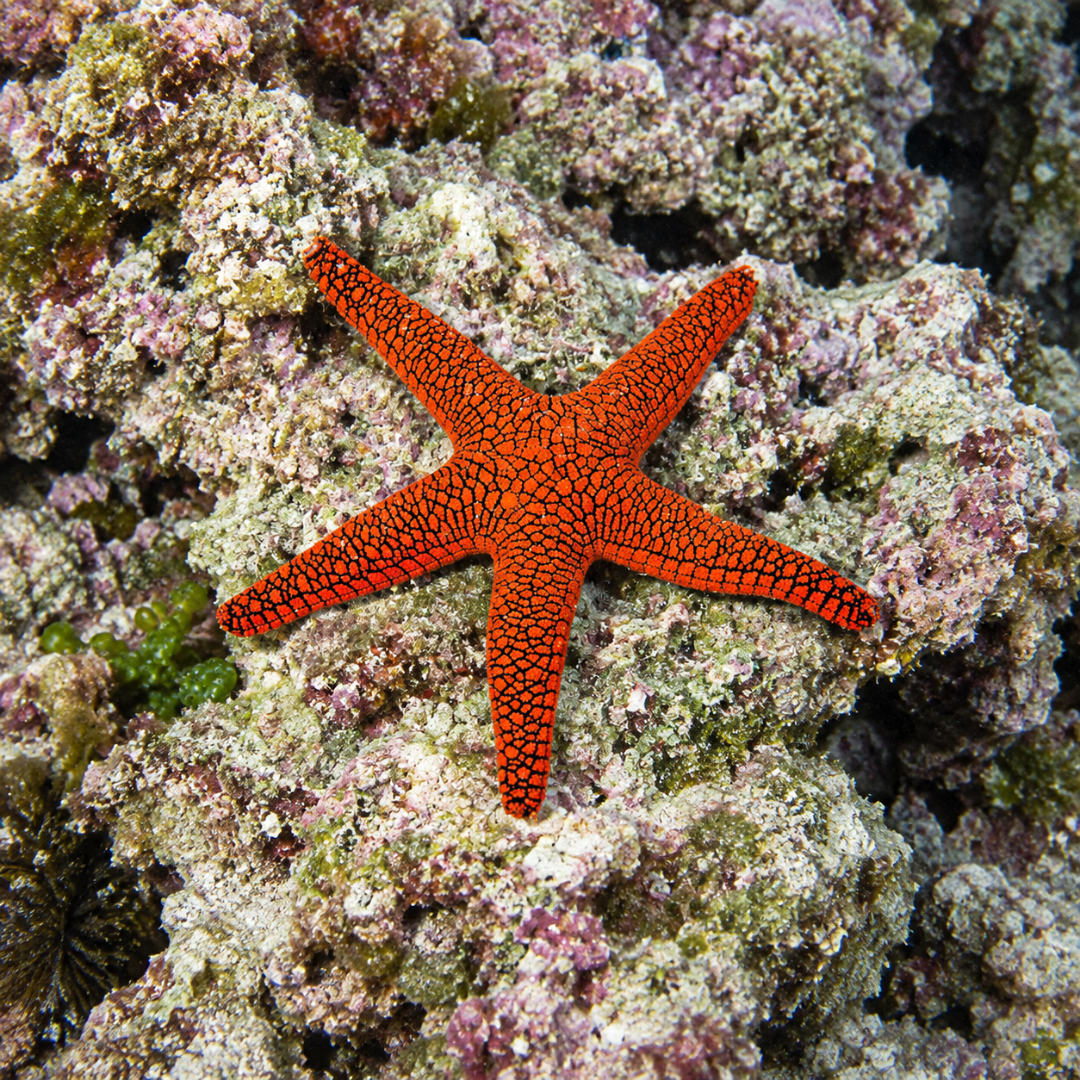
解説 / Description
アミメジュズベリヒトデは、赤色から橙色を基調とする体表に暗色の細い線が網目状に走る、小型の海産ヒトデです。腕の縁には縁板が規則正しく並び、体表の網目模様とともに本種を見分ける手がかりになります。インド洋から西太平洋の熱帯域に広く分布し、日本でも本州沿岸の一部から南西諸島、小笠原諸島まで記録があります。一般にサンゴを積極的に食害する種とはみなされず、リーフアクアリウムでも飼育されますが、水質の急変と長期的な栄養不足には弱いため、よく成熟した安定水槽と慎重な導入管理が重要です。 Fromia indica is a small marine sea star with a red to orange body crossed by a fine network of dark lines. Regular marginal plates along the arms, together with the reticulated pattern, are useful features for recognizing the species. It is widely distributed in the tropical Indian and western Pacific Oceans and has been recorded in Japan from parts of the main islands southward to the Ryukyu and Ogasawara Islands. It is generally regarded as reef-compatible because it is not known to actively prey on corals, but it is sensitive to abrupt changes in water chemistry and to long-term nutritional deficiency. A mature, stable aquarium and careful acclimation are therefore important.
基本情報 / Basic Information
| 学名 / Scientific Name | Fromia indica (Perrier, 1869) |
|---|---|
| 通称 / Common Name | アミメジュズベリヒトデ。国内の生物情報データベースでは「ミナミジュズベリヒトデ」の和名も併記されています。流通上はインディアン・シースターなどの名称で扱われることがあります。Indian Sea Star and Red Starfish are commonly used English names. |
| 分類 / Family | 棘皮動物門・ヒトデ綱・アカヒトデ目・ゴカクヒトデ科・ジュズベリヒトデ属Phylum Echinodermata, Class Asteroidea, Order Valvatida, Family Goniasteridae, Genus Fromia |
| 英名 / English Name | Indian Sea Star |
| 分布 / Distribution | インド洋から西太平洋の熱帯域に広く分布し、スリランカ、アンダマン諸島、東南アジア、オーストラリア、フィジー、日本などから記録されています。日本でも本州沿岸の一部、南西諸島、小笠原諸島などで確認されています。既知の記録は浅いサンゴ礁・岩礁域が中心で、小笠原諸島の標本研究では水深1〜5m、沖縄の博物館標本には30m前後の記録があります。Widely distributed in the tropical Indian and western Pacific Oceans, with records from Sri Lanka, the Andaman Islands, Southeast Asia, Australia, Fiji, and Japan. In Japan it has been recorded from parts of the main islands, the Ryukyu Islands, and the Ogasawara Islands. Known records are centered on shallow coral and rocky reef habitats; an Ogasawara specimen study recorded the species at 1-5 m, while museum material from Okinawa includes records around 30 m. |
| 最大体長 / Max Size | 一般に数cm程度の小型種で、腕を広げた直径は最大級でもおよそ8〜10cm程度が目安です。資料によって数値に差があるため、個体差や測定方法の違いを含めて見る必要があります。A small species, generally only several centimeters across; large individuals are roughly 8-10 cm in diameter. Reported figures vary among references, so individual variation and measurement methods should be kept in mind. |
| 寿命 / Lifespan | 野生下・飼育下ともに、信頼できる標準寿命を示す資料は十分ではありません。飼育下では水質の急変や栄養不足が長期維持の妨げになるため、年数だけで寿命の目安を示すのは適切ではありません。Reliable data defining a standard lifespan in the wild or in aquaria are limited. In captivity, abrupt water-quality changes and nutritional deficiency can prevent long-term survival, so a fixed lifespan in years is not well supported. |
飼育環境 / Aquarium Environment
| 水槽サイズ / Tank Size | 一律に確立された最低水槽サイズはありません。小型水槽ほど水質が変動しやすく、ライブロック上の自然な餌資源も限られるため、十分な水量と表面積を確保できる余裕のある規格水槽を選びます。具体的な「○cm規格」「○L」を本種固有の最低条件として断定できる根拠は乏しく、水槽サイズそのものより、成熟して安定した環境であることを優先してください。There is no well-established species-specific minimum tank size. Small aquaria are more prone to water-quality fluctuations and provide less mature live-rock surface for natural grazing. Choose a system with ample water volume and rock surface, but avoid treating any single tank dimension or liter value as a proven minimum; maturity and stability are more important than a fixed number. |
|---|---|
| 水温 / Temperature | 24〜28℃程度を目安に、急な変動を避けて安定させます。飼育では特定の一点に合わせることより、日内・換水時の温度差を小さく保つことが重要です。 Maintain approximately 24-28°C and avoid abrupt fluctuations. In practice, stability during daily operation and water changes is more important than targeting a single exact temperature. |
| 水質 / Water Quality | 比重1.023〜1.025、pH8.1〜8.4程度が一般的な飼育目安です。特に塩分濃度やpHを急変させないことが重要です。ヒトデ類は体液の浸透圧が周囲の海水に強く影響されるため、急激な比重変化を苦手とします。銅を含む治療薬は使用しません。A specific gravity of about 1.023-1.025 and pH around 8.1-8.4 are commonly recommended. Avoid abrupt changes in salinity and pH. Sea-star body fluids are strongly influenced by the surrounding seawater, making sudden salinity shifts especially stressful. Copper-based medications should not be used. |
| レイアウト / Layout | 十分な量のライブロックを組み、表面にバイオフィルムや微細藻類、微小な底生生物が育つ成熟したリーフレイアウトが適します。岩組みはヒトデが隙間に入り込んでも崩れないよう安定させ、強い吸水口にはガードを装着します。移動時に空気へ長時間さらすことも避けます。Provide abundant, securely arranged live rock with mature biofilm, microalgae, and small benthic organisms. Rockwork should be stable enough that the sea star cannot dislodge it while crawling through gaps, and strong pump intakes should be protected. Avoid prolonged exposure to air during handling. |
| 注意点 / Precautions | 導入時の急な水質変化と長期的な栄養不足が大きな注意点です。点滴法などを用い、販売水と飼育水の比重・pH・温度差を段階的に縮めます。水合わせは「何時間」と固定して考えるのではなく、実際の水質差と個体の状態を確認しながら慎重に進めます。立ち上げ直後の水槽への導入は避け、吸着力の低下、腕先や体表の白濁、組織のただれや崩れが見られた場合は環境をすぐに確認します。The main concerns are abrupt water-quality changes during introduction and long-term nutritional deficiency. Use drip acclimation or another gradual method to reduce differences in salinity, pH, and temperature. Acclimation should not be treated as a fixed number of hours; proceed according to the actual water differences and the condition of the animal. Avoid newly established aquaria, and promptly check environmental conditions if attachment weakens or whitening, lesions, or tissue breakdown appear. |
餌と給餌 / Feeding
| 餌の種類 / Diet | 自然下での詳細な餌組成は十分に解明されていませんが、硬い基質の表面に胃を広げ、付着物を利用して摂食します。飼育情報では、成熟したライブロック上のバイオフィルム、微細藻類、デトリタスなどが重要な餌資源とされます。補助餌としては、細かくしたエビや二枚貝の身、沈下性の海産無脊椎動物用フードなどが用いられます。Its complete natural diet is not well resolved, but it feeds by everting the stomach over hard substrates and digesting material on the surface. Aquarium references commonly emphasize biofilm, microalgae, and detritus on mature live rock as important food resources. Small pieces of shrimp or bivalve flesh and suitable sinking marine-invertebrate foods may be offered as supplements. |
|---|---|
| 給餌のポイント / Feeding Tips | 補助餌はヒトデが接触しやすい位置に少量を置き、実際に取り込んでいるかを確認します。個体によって人工餌への反応には差があるため、補助給餌だけを前提にせず、ライブロック表面の自然な餌資源を維持することが重要です。魚やエビ類に餌を奪われる場合は、給餌中だけ保護する方法もあります。残餌は水質悪化を防ぐため回収します。Offer small amounts of supplemental food where the sea star can contact them and confirm that it actually feeds. Acceptance of prepared foods varies among individuals, so supplemental feeding should not replace the need for natural grazing surfaces on mature live rock. If fish or shrimp repeatedly steal food, temporary protection during feeding can help. Remove leftovers to protect water quality. |
性格と混泳 / Temperament and Tank Mates
| 性格 / Temperament | 非常に温和で、岩やガラス面をゆっくり移動しながら餌を探します。魚を追い回すような攻撃性はなく、基本的には単独で静かに生活します。Very peaceful. It moves slowly over rockwork and glass while searching for food and does not display active aggression toward fish. It generally lives quietly and independently. |
|---|---|
| 混泳の相性 / Compatibility | 温和なリーフ水槽の魚や無脊椎動物とは合わせやすい一方、ヒトデを捕食するモンガラカワハギ類、大型のベラ類、フリソデエビなどとの混泳は避けます。エビ類やヤドカリ類が補助餌を先に持ち去ることもあります。複数飼育では自然餌を取り合う可能性があるため、十分に成熟した広い環境で慎重に判断します。It is generally compatible with peaceful reef fishes and invertebrates, but should not be kept with known sea-star predators such as triggerfishes, large wrasses, or harlequin shrimp. Other shrimp and hermit crabs may also steal supplemental food. Multiple individuals may compete for natural grazing resources, so group keeping should be considered cautiously and only in a sufficiently mature system. |
病気と対策 / Diseases and Prevention
| かかりやすい病気 / Common Diseases | 本種について、特定の「かかりやすい病気」が確立されているわけではありません。飼育下では、水質の急変、輸送時の損傷、栄養不足などで弱った個体に、吸着力の低下、体表の白濁や潰瘍、腕先の壊死、組織の崩壊が見られることがあります。ヒトデ類の消耗症候群と似た外観を示す場合もありますが、症状だけで原因や病原体を特定することはできません。No single disease is established as uniquely or consistently common in this species. In captivity, animals weakened by abrupt water changes, shipping injuries, or nutritional deficiency may show reduced attachment, whitening or ulceration, necrosis of arm tips, and progressive tissue breakdown. These signs can resemble sea-star wasting syndromes, but appearance alone cannot identify a specific cause or pathogen. |
|---|---|
| 対策と予防 / Prevention | 原因が特定できない組織障害では、安易な投薬より予防と環境確認を優先します。水温・比重・pHを安定させ、十分な水流と酸素交換、適切な給餌、外傷を避けた取り扱い、慎重な水合わせを徹底します。組織崩壊が進む個体は他のヒトデ類から隔離して経過を観察します。銅系薬剤は使用しません。When tissue damage has no confirmed cause, prevention and environmental checks are more appropriate than indiscriminate medication. Keep temperature, salinity, and pH stable, provide adequate flow and gas exchange, maintain appropriate feeding, handle gently, and acclimate carefully. An animal with progressive tissue breakdown should be separated from other sea stars for observation. Copper-based medications should not be used. |
増やし方(繁殖) / Breeding
| 雌雄の判別 / Sexing | 外見からの確実な雌雄判別は困難です。家庭水槽で実用的に使える明瞭な二次性徴は知られておらず、生殖腺や放卵・放精の確認なしに性別を特定するのは難しいと考えられます。Reliable external sexing is difficult. No obvious secondary sexual characteristics are known to be practical for hobby aquaria, and sex generally cannot be confirmed without examining the gonads or observing spawning. |
|---|---|
| 繁殖形態 / Reproduction | 雌雄異体で、オスとメスが海中へ放精・放卵し、体外受精を行います。小笠原諸島でも野外で放卵・放精行動が観察されています。ヒトデ類らしく腕の再生能力も高く、腕数が4本または6本の個体が見られることがありますが、これを家庭水槽で安定して利用する繁殖法は確立されていません。The species is dioecious: males and females release sperm and eggs into the water for external fertilization. Spawning by Fromia indica has also been observed in the wild in the Ogasawara Islands. Like other sea stars it can regenerate damaged arms, and individuals with four or six arms are sometimes seen, but this has not been developed into a reliable propagation method for home aquaria. |
| 繁殖のポイント / Breeding Tips | 家庭水槽で繁殖を目的とする場合の確立した手順は情報不足です。腕を意図的に切断して増殖を試みることは、感染や組織崩壊の危険が高いため推奨できません。自然な産卵や再生が起こった場合は、水質を乱さず、強い吸水口から保護し、十分な微小餌資源を維持することが現実的な対応です。There is insufficient information for a standardized home-aquarium breeding protocol. Deliberately cutting an arm to force propagation is not recommended because of the high risk of infection and tissue failure. If natural spawning or regeneration occurs, the practical approach is to keep water conditions stable, protect the animal from strong intakes, and maintain abundant microscopic food resources. |
雑学と豆知識 / Trivia and Fun Facts
| 1. 名前に刻まれた「網目」と「数珠」 / 1. A Name Written in Pattern and Plates | 赤い体表を横切る暗色の細線は互いにつながり、細かな網をかぶせたような模様を作ります。さらに腕の縁には、骨格をつくる縁板が規則正しく並びます。この二つの特徴は、和名に含まれる「アミメ」と「ジュズベリ」を連想させます。名前の由来を断定する資料は限られますが、実物を見ると、和名と形態の対応がとても分かりやすいヒトデです。Fine dark lines connect across the red to orange body to form a net-like pattern, while skeletal marginal plates are arranged regularly along the edges of the arms. These two features strongly echo the Japanese words for “mesh” and “beaded margin” contained in the common name. Although documentary evidence for the formal origin of the name is limited, the connection between the name and the animal’s appearance is easy to appreciate. |
|---|---|
| 2. 長く揺れ動いた分類の歴史 / 2. A Taxonomic History That Kept Shifting | 本種は1869年にScytaster indicusとして記載され、その後Fromia属へ移されました。古い図鑑やデータベースではホウキボシ科として扱われた例も残っていますが、現在のWoRMS、OBIS、BISMaLや近年の分類学的研究ではゴカクヒトデ科に置かれています。またWoRMSではFromia elegans H.L. Clark, 1921をFromia indicaのシノニムとして扱っています。資料によって科名や種名の扱いが違って見えるのは、こうした分類史が背景にあります。The species was described in 1869 as Scytaster indicus and was later transferred to the genus Fromia. Older field guides and databases may still place the genus in Ophidiasteridae, but WoRMS, OBIS, BISMaL, and recent taxonomic treatments place Fromia indica in Goniasteridae. WoRMS also treats Fromia elegans H.L. Clark, 1921 as a synonym of Fromia indica. Apparent disagreements among references therefore often reflect changes in classification rather than differences in the animal itself. |
| 3. 同属の「深場の記録」と本種を混同しない / 3. Separating This Species from Deep-Water Relatives | ジュズベリヒトデ属には深い海から採集される種もいますが、それをそのままアミメジュズベリヒトデの生息深度と考えることはできません。小笠原諸島の標本研究では、本種として同定された個体は水深1〜5mから得られており、同じ調査で水深97〜149mから記録されたのは別種のナメラカジュズベリヒトデ(Fromia eusticha)でした。沖縄の博物館標本には本種の30m前後の記録があり、海外の生物情報でも浅海から数十m程度のサンゴ礁・岩礁域が主な生息環境として示されています。属全体の生態と一種の生態を分けて考えることは、分類を正しく読むうえで大切です。Some species of Fromia occur in deeper water, but those records should not automatically be assigned to Fromia indica. In a specimen study from the Ogasawara Islands, F. indica was collected at 1-5 m, whereas records from 97-149 m in the same work belonged to the different species Fromia eusticha. Museum material from Okinawa includes F. indica around 30 m, and broader biological references place the species mainly in shallow to moderately deep coral and rocky reef habitats. Distinguishing the ecology of a genus from that of a single species is essential when reading distribution records. |
| 4. 胃を体の外へ出して食べるヒトデの方法 / 4. Feeding with the Stomach Outside the Body | ヒトデの摂食で印象的なのは、口から胃を反転させて体外へ出し、餌の表面で消化を始められることです。アミメジュズベリヒトデでもこの体外消化が知られ、基質に胃を広げて表面の餌を利用します。つまり、水槽で岩の上をゆっくり移動している時間の多くは、単なる移動ではなく、広い表面から少しずつ食物を探している時間でもあります。この生態が、成熟したライブロックを重視する飼育につながっています。A striking feature of sea-star feeding is the ability to evert the stomach through the mouth and begin digestion directly on a food surface. Fromia indica uses this type of extra-oral digestion, spreading the stomach over the substrate. Much of the time it spends moving slowly across rock is therefore also time spent searching a broad surface for food. This helps explain why mature live rock is so important in captive care. |
| 5. 腕を失っても再生する力 / 5. Regrowing a Lost Arm | ヒトデ類は失った腕を再生でき、アミメジュズベリヒトデでも4本腕や6本腕の個体が確認されています。腕を失った後の再生過程では、一時的に腕の長さがそろわない姿になることがあります。また、ヒトデ類では切り離された腕から個体全体が再生する例もありますが、それを本種の通常の増殖方法として一般化するのは慎重であるべきです。少なくとも水槽内で意図的に腕を切ることは、感染や組織崩壊の危険を増やすため繁殖法として扱うべきではありません。Sea stars can regenerate lost arms, and four- or six-armed individuals of Fromia indica have been recorded. During recovery, the arms may temporarily be unequal in length. Some sea stars can also regenerate an entire individual from a detached arm, but this should not be generalized as a routine reproductive strategy for F. indica. Deliberately cutting an arm in an aquarium increases the risk of infection and tissue breakdown and should not be treated as a propagation method. |
| 6. ヒトデ消耗病が示した「病原体だけではない」病気の姿 / 6. Wasting Disease and the Role of the Environment | 2010年代に北米太平洋岸で大規模なヒトデの消耗症候群が発生した際、当初は特定のデンソウイルスとの関連が注目されました。しかし、その後の研究では単一の病原体だけでは説明しにくいことが示され、現在も原因は未解決です。有力な仮説の一つでは、有機物の増加によって体表付近の微生物活動が高まり、ヒトデと海水の境界面で酸素が不足することが症状を悪化させる可能性が示されています。ただし、これは複数種のヒトデを対象とした研究であり、アミメジュズベリヒトデの病因を直接示したものではありません。飼育では、外見だけで病名を決めつけず、水質、酸素交換、栄養、外傷を順に確認する姿勢が重要です。Large sea-star wasting events along the Pacific coast of North America drew early attention to a possible densovirus association, but later research showed that a single-pathogen explanation was insufficient and the overall cause remains unresolved. One leading hypothesis proposes that elevated organic matter can stimulate microbial activity near the animal surface, reducing oxygen availability at the sea-star-water interface and worsening tissue damage. These studies involve several sea-star species and do not directly establish the cause of disease in Fromia indica. In aquaria, outward appearance alone should therefore not be used to assign a diagnosis; water quality, gas exchange, nutrition, and injury should be checked systematically. |
| 7. 海の化学防御が創薬研究へつながる可能性 / 7. Chemical Defenses and the Possibility of Drug Discovery | アミメジュズベリヒトデでは、体表由来の代謝物や粗抽出物を調べる基礎研究が行われています。2025年の小規模な試験管内研究では、粗抽出物からサポニンやステロールなど複数の成分群が検出され、抗酸化作用と抗炎症作用を評価する試験で活性が報告されました。ただし、これは成分を分離して薬効を確立した研究でも、人への治療効果を示した研究でもありません。海産無脊椎動物が持つ化学物質の多様性を探る初期研究として捉えるのが適切です。Basic studies have examined surface-associated metabolites and crude extracts from Fromia indica. A small 2025 in-vitro pilot study detected several classes of compounds, including saponins and sterols, and reported activity in antioxidant and anti-inflammatory assays. This does not establish an isolated drug compound or demonstrate therapeutic effectiveness in humans. It is better understood as an early exploration of the chemical diversity found in marine invertebrates. |
まとめ / Conclusion
アミメジュズベリヒトデは、赤色から橙色の体に走る繊細な網目模様と、腕の縁に並ぶ縁板が印象的な小型のヒトデです。岩の表面をゆっくり移動しながら餌を探す穏やかな生き物ですが、飼育下では塩分濃度やpHの急変、輸送時のダメージ、長期的な栄養不足に注意が必要です。 Fromia indica is a small sea star distinguished by a red to orange body, a delicate dark reticulation, and regular marginal plates along the arms. It moves quietly across rock surfaces while feeding, but in captivity it requires particular care with abrupt salinity or pH changes, shipping stress, and long-term nutritional deficiency.
長く付き合うためには、十分に成熟した水槽で水質を安定させ、導入時の水合わせを慎重に行い、ライブロック上の自然な餌資源を保つことが基本になります。補助餌を利用する場合も、与えたことだけで安心せず、実際に受け入れているかを観察することが大切です。急な変化を避けながら日々の状態を見守ることが、このヒトデの美しさと穏やかな行動を維持するうえで最も重要です。 Long-term care depends on a mature aquarium, stable water chemistry, careful acclimation, and preservation of natural grazing resources on live rock. When supplemental foods are offered, confirm that the animal actually accepts them rather than assuming that feeding has occurred. Avoiding abrupt change and observing the animal consistently are the most important habits for maintaining its characteristic appearance and quiet behavior.

気になる道具や飼い方を見つけてみませんか?
 アイのアクアグッズ案内マジックリーフ物語|一枚の葉がアクアリウム用品になるまで道具の特徴や使い方、選ぶときのポイントをアイが紹介します。記事はコチラ →
 アイのアクアグッズ案内アフリカンシクリッドの飼育用品|水槽・ろ過・底砂・岩組み・餌の選び方道具の特徴や使い方、選ぶときのポイントをアイが紹介します。記事はコチラ →
 アイのアクアグッズ案内プレコ飼育に必要なもの|餌・流木・ろ過・隠れ家・掃除用品道具の特徴や使い方、選ぶときのポイントをアイが紹介します。記事はコチラ →
 アイのアクアグッズ案内水槽用ヒーターの選び方|固定式・温度調節式と、水量に合うW数の考え方水槽の魚は冬に寒くない? アイとコタロウが水温計から固定式・温度調節式・分離式ヒーターまで比較。水量と室温に合うW数、設置場所、水換えや交換の注意点を、国内メーカーの商品とともに紹介します。記事はコチラ →
さまざまな飼育テーマをご紹介。リンク先の記事には広告・商品紹介が含まれます。
案内・紹介記事一覧へ →分布マップ
アミメジュズベリヒトデ(Fromia indica)は、インド洋から西太平洋の熱帯域に広く分布し、スリランカ、アンダマン諸島、東南アジア、オーストラリア、フィジー、日本などから記録されています。日本では本州沿岸の一部、南西諸島、小笠原諸島などで確認されています。
※この地図は既知の分布地域全体を把握しやすくするための概略表示です。表示範囲は個々の生息地点や分布限界を厳密に示すものではありません。マーカーは分布域を見渡すために設定した代表地点であり、実際の採集地点や標本記録地点を示すものではありません。
参考文献
-
World Register of Marine Species (WoRMS). Fromia indica (Perrier, 1869). World Asteroidea Database.
WoRMSで確認
分類、受容学名、命名者、シノニムの確認。
-
Mah, C. L. (2018). New genera, species and occurrence records of Goniasteridae (Asteroidea; Echinodermata) from the Indian Ocean. Zootaxa, 4539(1), 1–116. DOI: 10.11646/zootaxa.4539.1.1.
論文情報
ゴカクヒトデ科の分類学、インド洋域におけるジュズベリヒトデ属の分布記録。
-
新井未来仁・田中優平・宮崎貴之・藤田敏彦 (2018). 小笠原諸島のアカヒトデ目(棘皮動物門:ヒトデ綱). 国立科学博物館専報, 52, 191–203.
国立科学博物館PDF
日本・小笠原諸島での分布、標本記録、生息深度、同属の深場種との区別。
-
海洋研究開発機構(JAMSTEC). Biological Information System for Marine Life(BISMaL): Fromia indica (Perrier, 1869).
BISMaLで確認
国内で用いられる和名、分類、日本を含む出現記録と水深情報の確認。
-
SeaLifeBase. Fromia indica (Perrier, 1869), Indian sea star.
SeaLifeBaseで確認
インド・西太平洋の分布、サンゴ礁性の生息環境、既知の水深範囲、硬質基質表面での摂食に関する整理。
-
Diehl, W. J. (1986). Osmoregulation in echinoderms. Comparative Biochemistry and Physiology Part A: Physiology, 84(2), 199–205. DOI: 10.1016/0300-9629(86)90605-5.
DOI
棘皮動物が周囲の海水に体液の浸透圧を近づける性質と、塩分変化を慎重に扱う必要性の生理学的背景。
-
飴田洋祐 (2026). 小笠原諸島の棘皮動物における放精放卵行動の野外観察. 小笠原研究, 52, 195–207.
東京都立大学公開PDF
アミメジュズベリヒトデの野外での放卵・放精行動と有性生殖の確認。
-
Aquino, C. A., Besemer, R. M., DeRito, C. M., et al. (2021). Evidence That Microorganisms at the Animal-Water Interface Drive Sea Star Wasting Disease. Frontiers in Microbiology, 11, 610009. DOI: 10.3389/fmicb.2020.610009.
DOI
ヒトデ消耗症候群と、体表付近の微生物活動・有機物・酸素供給の関係を検討した研究。
-
Oulhen, N., Byrne, M., Duffin, P., et al. (2022). A Review of Asteroid Biology in the Context of Sea Star Wasting: Possible Causes and Consequences. The Biological Bulletin, 243(1), 50–75. DOI: 10.1086/719928.
DOI
ヒトデ消耗症候群の症状、病因に関する複数の仮説、病因が一つに確定していないことの総説。




コメント