
解説 / Description
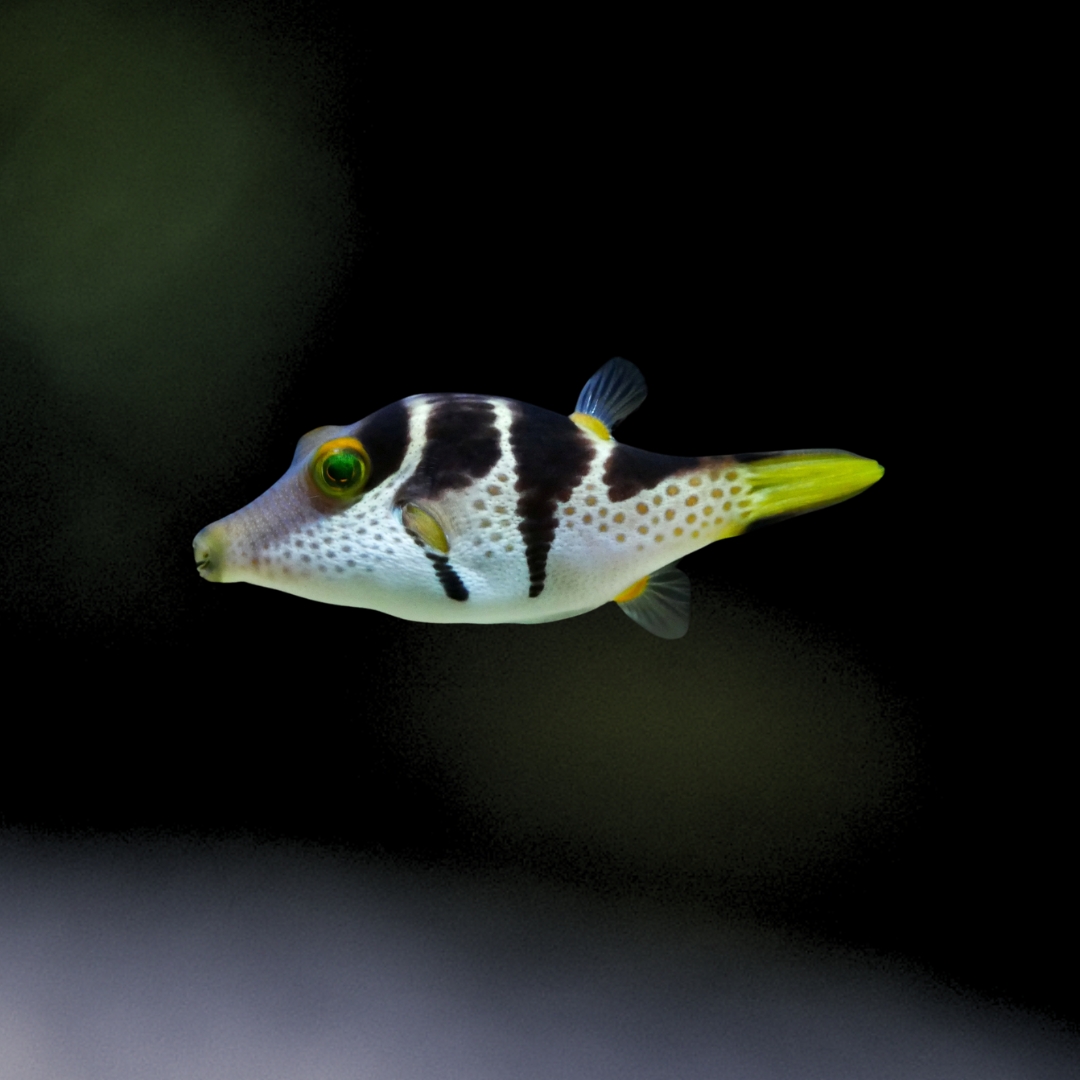
シマキンチャクフグは、白色からクリーム色の体に並ぶ4本の黒褐色の鞍状模様と、鮮やかな黄色の尾部が印象的な小型の海水フグです。目の周囲には青色やオレンジ色の繊細な模様が入り、短く突き出した口先と丸みのある体型が、愛嬌のある表情を生み出しています。胸鰭を細かく動かしながら、サンゴ礁の岩の間を漂うように泳ぐ姿も大きな魅力です。 Valentin’s sharpnose puffer is a small marine pufferfish distinguished by four dark saddle-shaped markings across its white to cream-colored body and a striking yellow tail region. Delicate blue and orange markings surround its eyes, while its short, pointed snout and rounded body give it an appealing appearance. Its gentle, hovering swimming style, achieved through rapid movements of its pectoral fins, adds to its charm.
インド太平洋のサンゴ礁に広く分布し、日本では沖縄をはじめとする南西諸島などで見られます。観賞魚としても比較的よく流通しており、小型で親しみやすい印象を与える魚ですが、飼育には独特の食性や縄張り行動、毒性への理解が欠かせません。特に、成長し続ける歯の管理やサンゴ・小型無脊椎動物への食害には注意が必要です。 Widely distributed throughout Indo-Pacific coral reefs, this species is also found around Okinawa and other southern Japanese islands. Although relatively common in the marine aquarium trade and appealing because of its small size, it requires informed care due to its specialized feeding habits, territorial behavior, and toxicity. Managing its continuously growing dental plates and preventing damage to corals and small invertebrates are particularly important.
さらに、シマキンチャクフグは進化生物学の観点からも興味深い存在です。その毒性と特徴的な模様は、無毒のノコギリハギが姿を似せる「ベイツ型擬態」の代表的な研究例として知られています。愛らしい外見の奥には、厳しいサンゴ礁環境を生き抜くために発達した、巧みな生存戦略が隠されています。 This species is also fascinating from an evolutionary perspective. Its toxicity and distinctive coloration have made it a classic example of Batesian mimicry, in which the harmless blacksaddle filefish resembles a toxic species to gain protection from predators. Beneath its charming appearance lies a remarkable set of adaptations for surviving in coral reef environments.
基本情報 / Basic Information
| 学名 / Scientific Name | Canthigaster valentini (Bleeker, 1853) |
|---|---|
| 通称 / Common Name | シマキンチャクフグ、バレンティニ・パファーValentini Puffer, Blacksaddle Toby, Saddled Pufferfish |
| 分類 / Family | フグ目・フグ科・キタマクラ属Order Tetraodontiformes, Family Tetraodontidae, Genus Canthigaster |
| 英名 / English Name | Valentin’s Sharpnose Puffer |
| 分布 / Distribution | インド太平洋の熱帯・亜熱帯海域。紅海や東アフリカ沿岸から東南アジア、オーストラリア、中央太平洋の島々まで広く分布します。日本では沖縄県、南西諸島、小笠原諸島などに生息し、黒潮の影響を受ける本州太平洋岸でも季節的に観察されます。主な生息場所は水深1~55m程度のサンゴ礁や岩礁域です。Tropical and subtropical Indo-Pacific, from the Red Sea and East African coast through Southeast Asia and Australia to the central Pacific islands. In Japan, it occurs around Okinawa, the Ryukyu Islands, and the Ogasawara Islands, with seasonal appearances along the Pacific coast of Honshu. It inhabits coral and rocky reefs at depths of approximately 1–55 m. |
| 最大体長 / Max Size | 全長約11cm。飼育下では7~10cm程度の個体も多く見られます。Approximately 11 cm in total length. Many aquarium specimens measure around 7–10 cm. |
| 寿命 / Lifespan | 飼育下では5~10年程度が目安として紹介されることがあります。ただし、本種の平均寿命を示す十分なデータはなく、実際の寿命は飼育環境や個体の状態によって異なります。An approximate captive lifespan of 5–10 years is sometimes reported, although reliable species-specific longevity data remain limited. Actual lifespan varies depending on husbandry and individual health. |
飼育環境 / Aquarium Environment
| 水槽サイズ / Tank Size | 長期飼育では90cm規格水槽(約150~160L)程度を推奨します。単独であれば60cm規格水槽(約60~65L)で飼育される例もありますが、水量が少ないほど水質が変化しやすいため、ろ過能力や給餌量に注意した管理が必要です。混泳する場合は、同居魚の大きさや数、縄張りを考慮して、さらに余裕のある水槽を用意しましょう。A standard 90 cm aquarium (approximately 150–160 L) is recommended for long-term care. A single specimen may be kept in a standard 60 cm aquarium (approximately 60–65 L), but the smaller water volume requires particularly careful management of filtration and feeding. Community aquariums should provide additional space according to the size, number, and territorial needs of the tank mates. |
|---|---|
| 水温 / Temperature | 23~26℃を目安に、できるだけ一定に保ちます。通常は24~26℃程度で安定させると管理しやすくなります。夏場は水槽用クーラーなどで高水温を防ぎ、冬場はヒーターを使用して急激な温度変化を避けましょう。 Maintain a stable temperature of approximately 23–26°C, preferably around 24–26°C for consistent aquarium management. Use appropriate cooling equipment during summer and a heater during winter, avoiding sudden temperature fluctuations. |
| 水質 / Water Quality | 一般的な海水魚に適した、安定した水質を維持します。目安はpH8.1~8.4、比重1.020~1.025程度です。なお、比重は水温によって変化するため、測定条件をそろえて管理してください。アンモニアと亜硝酸は検出されない状態を維持し、硝酸塩の蓄積も抑えます。食欲旺盛で排泄量も多いため、十分な生物ろ過能力を確保し、必要に応じてプロテインスキマーを併用するとよいでしょう。1~2週間ごとに10~20%程度の部分換水を行うことを一つの目安とし、実際の水質測定結果に合わせて調整します。Maintain stable marine aquarium conditions, with a target pH of 8.1–8.4 and specific gravity around 1.020–1.025. Because specific gravity changes with temperature, measurements should be made under consistent conditions. Ammonia and nitrite should remain undetectable, while nitrate accumulation should be minimized. This species has a healthy appetite and produces considerable waste, making efficient biological filtration essential. A protein skimmer may also be beneficial. Partial water changes of approximately 10–20% every one to two weeks can serve as a starting point, adjusted according to water test results. |
| レイアウト / Layout | ライブロックや人工岩を組み合わせ、安心して休める岩陰や洞窟状の隠れ家を複数作ります。日中は岩の表面をついばみながら探索するため、変化のある岩組みと適度に開けた遊泳空間を両立させることが理想です。夜間は岩陰で体を傾けて休むこともあるので、落ち着ける場所を確保しましょう。強すぎる一方向の水流は避け、流れの穏やかな場所も設けると過ごしやすくなります。Arrange live rock or artificial rockwork to create several caves and sheltered resting areas. The fish explores and nibbles on rock surfaces during the day, so a combination of varied structures and open swimming space is ideal. It may rest at an unusual angle among rocks at night. Provide sheltered low-flow areas rather than exposing the entire aquarium to strong, continuous currents. |
| 注意点 / Precautions | 本種はテトロドトキシンなどの毒素を持つため、絶対に食用にしないでください。皮膚にも毒素が含まれているため、強い刺激を与えず、丁寧に扱うことが大切です。また、驚いた際に体を膨らませることがありますが、これは外敵から身を守るための防御反応であり、意図的に膨らませてはいけません。水面上で空気を飲み込むと浮力の異常を起こすおそれがあるため、移動時はできるだけ水中で容器に誘導します。輸送袋の水は本水槽に入れず、適切な水合わせの後に生体だけを移してください。サンゴや小型無脊椎動物への食害、歯の伸びすぎにも注意が必要です。This species contains toxins including tetrodotoxin and must never be eaten. Its skin also contains toxins, so gentle handling and avoidance of unnecessary stress are important. It may inflate when frightened, but this is a defensive reaction and should never be deliberately induced. Swallowing air above the water surface can cause dangerous buoyancy problems, so underwater container transfers are preferable. Do not introduce shipping water into the display aquarium; transfer only the fish after appropriate acclimation. Also watch for coral and invertebrate predation and overgrowth of the dental plates. |
餌と給餌 / Feeding
| 餌の種類 / Diet | 雑食性で、自然界では糸状の藻類やホヤ類を主に食べるほか、コケムシ、ゴカイ類、小型の貝類、甲殻類、サンゴのポリプなど、さまざまな付着生物や底生生物も食べています。飼育下では海水魚用の人工飼料、冷凍イサザアミ、冷凍ブラインシュリンプ、細かくしたエビや貝の身などを与えられます。栄養が偏らないよう複数の餌を組み合わせ、歯の摩耗を促すため、小型の殻付き貝類や殻付きのアサリなども適度に取り入れましょう。An omnivore that naturally feeds mainly on filamentous algae and tunicates, along with bryozoans, marine worms, small mollusks, crustaceans, coral polyps, and various other attached or bottom-dwelling organisms. In captivity, it accepts marine pellets, frozen mysis shrimp, frozen brine shrimp, and chopped shrimp or shellfish. Provide a varied diet and periodically offer appropriately sized hard-shelled foods, such as small shellfish, to encourage natural dental wear. |
|---|---|
| 給餌のポイント / Feeding Tips | 成魚には1日1~2回を目安に、食べ残しが出ない適量を与えます。人工飼料にもよく餌付く個体は多いものの、柔らかい餌に偏ると歯板が十分に摩耗せず、伸びすぎた歯によって餌を食べにくくなる場合があります。殻付きの餌は無理なくかじれる大きさで与え、普段から口の開閉や食べ方を観察しましょう。冷凍餌は解凍してから与え、食べ残しは速やかに取り除きます。導入直後や小型の個体には、冷凍イサザアミなど嗜好性の高い餌から慣らす方法も有効です。歯が過度に伸びた場合は、自己判断で切断せず、魚類の診療経験がある獣医師などに相談してください。Feed adults approximately once or twice daily in portions that are consumed without leaving waste. Although many individuals readily accept pellets, an exclusively soft diet may not provide sufficient dental wear, potentially causing overgrown dental plates and difficulty feeding. Offer appropriately sized hard-shelled foods and regularly observe mouth movement and feeding behavior. Thaw frozen foods before feeding and promptly remove leftovers. Newly acquired or small specimens may respond better initially to palatable foods such as frozen mysis shrimp. Never attempt to trim overgrown teeth without appropriate veterinary expertise. |
性格と混泳 / Temperament and Tank Mates
| 性格 / Temperament | 好奇心が強く、周囲を観察しながら岩や底床をついばむように行動します。人に慣れると、飼育者の動きに反応して水槽前面に寄ってくることもあります。一方、愛らしい外見とは異なり縄張り意識が強く、特に成熟したオスは同種や近縁種に対して攻撃的になる場合があります。また、ほかの魚の鰭をかじる行動が見られることもあります。自然界では、オスが複数のメスの縄張りを含む広い範囲を防衛する社会構造を持っています。Curious and observant, this species frequently explores and nibbles at rocks and substrate. Individuals may become accustomed to their keeper and approach the front of the aquarium. Despite their charming appearance, they can be territorial, especially mature males toward conspecifics and related species. Fin-nipping may also occur. In the wild, males defend larger territories containing the individual territories of several females. |
|---|---|
| 混泳の相性 / Compatibility | 極端に攻撃的ではなく、ある程度機敏に泳げる中小型の海水魚と混泳できる場合があります。クマノミ類や比較的温和なヤッコ類などが候補になりますが、個体差が大きいため、導入後も十分な観察が必要です。同種やキタマクラ属の近縁種との混泳は縄張り争いが起きやすく、特に小型水槽では単独飼育が無難です。動きの遅い魚や長い鰭を持つ魚は、鰭をかじられるおそれがあります。また、サンゴ、ケヤリムシ、観賞用エビ、カニ、ヤドカリ、巻貝なども食害を受ける可能性があるため、サンゴや無脊椎動物を中心とした水槽には基本的に向きません。Compatible tank mates may include moderately active, nonaggressive marine fish such as some clownfish and relatively peaceful angelfish, although individual behavior varies and careful observation is essential. Housing multiple Valentini puffers or related Canthigaster species can lead to territorial disputes, making solitary keeping preferable in smaller aquariums. Slow-moving or long-finned fish may be targeted for fin-nipping. Corals, feather duster worms, ornamental shrimp, crabs, hermit crabs, and snails may also be bitten or eaten. Therefore, this species is generally unsuitable for aquariums where coral and invertebrate preservation is a priority. |
病気と対策 / Diseases and Prevention
| かかりやすい病気 / Common Diseases | 海水魚の白点病やウーディニウム病、ハダカムシなどの寄生虫症に注意が必要です。これらは本種だけに特有の病気ではありませんが、輸送時のストレスや水温・水質の急変が体調を崩すきっかけになることがあります。また、栄養の偏りや不適切な餌によって歯が伸びすぎると、摂食障害を起こす場合があります。体表に現れる白い点や粉状の付着物、呼吸の速さ、体を岩にこすりつける行動、食欲の低下などが異常を発見する手がかりになります。Potential health problems include marine ich, marine velvet disease, and parasitic fluke infections. These diseases are not unique to this species, but transport stress and sudden changes in temperature or water quality may contribute to illness. An unsuitable diet can also lead to excessive dental growth and feeding difficulties. Warning signs include white spots or dust-like coatings, rapid breathing, rubbing against rocks, and loss of appetite. |
|---|---|
| 対策と予防 / Prevention | 新しく導入する個体は、可能であれば独立した検疫水槽で健康状態と摂餌を確認してから本水槽へ迎えます。水温と塩分濃度を安定させ、アンモニアや亜硝酸を蓄積させないことが基本です。多様な餌を与え、歯の伸びすぎを予防することも重要です。フグ類への薬剤使用には注意が必要で、銅系治療薬などを自己判断で使用することは避けてください。銅治療が必要な場合は、使用する製剤に応じて濃度を正確に管理できる専用水槽で、専門家の助言を受けて実施します。寄生虫への淡水浴も魚体に負担をかけるため、症状や体力を確認せずに行うことは推奨できません。異常を発見した場合は、原因を見極めたうえで適切な治療方法を選ぶことが大切です。Whenever possible, observe new arrivals in a separate quarantine aquarium before introducing them to the display tank. Maintain stable temperature and salinity, prevent ammonia and nitrite accumulation, and provide a varied diet that supports dental wear. Medication requires particular caution in puffers, including copper-based treatments. Copper therapy, when appropriate, should be performed in a dedicated treatment tank with precise product-specific concentration monitoring and professional guidance. Freshwater dips can also be stressful and should not be attempted without assessing the fish’s condition and the likely cause of infection. Accurate diagnosis is essential before treatment. |
増やし方(繁殖) / Breeding
| 雌雄の判別 / Sexing | 雌雄の外見上の違いは比較的小さく、未成熟個体では判別が難しい種類です。成熟したオスはメスより大型になる傾向があり、目の周囲から後方に伸びる青緑色やオレンジ色の線模様が明瞭になります。また、オスでは肛門の前方付近に青灰色の斑紋が見られることがあります。ただし、模様や体色には個体差があるため、これらの特徴だけで確実に判別できるとは限りません。External sexual differences are relatively subtle, making immature individuals difficult to sex. Mature males tend to grow larger and may display more pronounced blue-green and orange lines extending backward from the eyes. A blue-gray patch anterior to the anus has also been reported in males. However, color patterns vary among individuals, so these characteristics alone do not always provide reliable identification. |
|---|---|
| 繁殖形態 / Reproduction | 卵生で、体外受精を行います。自然界では、1匹の優位なオスが複数のメスの縄張りを含む広い領域を守る「メス防衛型一夫多妻制」と呼ばれる繁殖システムを持ちます。メスは藻類の付着したサンゴ片などに粘着性のある卵を産み付けます。野外研究では、1回の産卵数は15個から800個以上と幅があり、約4~10日間隔で産卵を繰り返すことが報告されています。卵は直径約0.68~0.72mmで、受精後およそ3~5日で孵化します。産卵後、親魚が卵を守る習性はありません。An egg-laying species with external fertilization. In nature, a dominant male defends a large area containing the territories of several females, a reproductive system known as female-defense polygyny. Females deposit adhesive eggs among algae on coral rubble. Field studies have reported clutch sizes ranging from approximately 15 to more than 800 eggs, with spawning intervals of about 4–10 days. Eggs measure approximately 0.68–0.72 mm in diameter and hatch after roughly 3–5 days. Neither parent guards the eggs after spawning. |
| 繁殖のポイント / Breeding Tips | 一般的な家庭用水槽での繁殖は難しく、産卵から稚魚の育成まで安定して成功させるには高度な設備と技術が必要です。繁殖を目指す場合は、十分な広さの水槽に相性のよい雌雄を迎え、それぞれが縄張りを維持できる岩組みや隠れ家を設けます。ただし、相性が悪い個体同士は激しく争うため、単純に複数匹を同居させることは危険です。産卵が確認できた場合は、卵が食べられたり傷つけられたりしないよう、必要に応じて別の設備で管理します。孵化した仔魚は非常に小さく、その後は長期間にわたって海中を漂いながら成長するため、発育段階に適した微小な生き餌の確保や安定した水質、水流の調整が欠かせません。家庭で広く再現できる繁殖手順は、まだ十分に確立されていません。Breeding in home aquariums is difficult, and successfully raising larvae requires specialized facilities and considerable expertise. A breeding setup needs adequate space for compatible adults to establish individual territories, with rockwork and hiding places that reduce aggression. Simply placing several individuals together can lead to serious fighting. If spawning occurs, the eggs may require protection and controlled incubation. Newly hatched larvae are extremely small and remain planktonic for an extended period, requiring appropriately sized live foods, stable seawater conditions, and carefully managed water movement. A consistently reproducible home-breeding protocol is not yet well established. |
雑学と豆知識 / Trivia and Fun Facts
| 1. 学名に刻まれた、300年以上前の博物学の歴史 / 1. A Scientific Name Linked to Centuries of Natural History |
シマキンチャクフグが学術的に記載されたのは1853年のことです。記載したのは、19世紀にインドネシア周辺の魚類を精力的に研究したオランダの博物学者ピーター・ブリーカー(Pieter Bleeker)でした。当初はTetraodon属の一種として記載され、その後の分類学的研究によって現在のCanthigaster属に位置づけられました。
Valentin’s sharpnose puffer was scientifically described in 1853 by Pieter Bleeker, a Dutch naturalist who extensively studied fishes of the Indonesian region during the nineteenth century. Originally described under the genus Tetraodon, it was later placed in Canthigaster through subsequent taxonomic revisions.
属名のCanthigasterは、ギリシャ語で目の端を意味する「kanthos」と、胃や腹部を意味する「gaster」に由来します。一方、種小名のvalentiniは、オランダ東インド会社の時代に東南アジアの自然や文化を記録した牧師・博物学者、フランソワ・ファレンタイン(François Valentijn、1666~1727年)に献じられた名前とされています。 The genus name Canthigaster derives from the Greek words “kanthos,” meaning a corner of the eye, and “gaster,” meaning stomach or abdomen. The species name valentini is understood to honor François Valentijn (1666–1727), a Dutch minister and naturalist who documented the natural history and cultures of Southeast Asia during the era of the Dutch East India Company. ファレンタインは、本種が正式に命名されるより100年以上も前に活動していた人物です。1726年には、現在シマキンチャクフグとして知られる魚についても記述を残していました。つまり、この小さなフグの名前には、近代的な学名が与えられる以前から続いてきた、東南アジアの自然史研究の足跡が残されているのです。 Valentijn lived more than a century before this fish received its formal scientific name. In 1726, he had already recorded an account of the fish now known as Valentin’s sharpnose puffer. The name therefore preserves a connection to the exploration of Southeast Asian natural history long before the species was formally classified under modern scientific nomenclature. |
|---|---|
| 2. そっくりな別の魚がいる? ノコギリハギの巧妙な変装 / 2. The Remarkable Disguise of the Blacksaddle Filefish |
サンゴ礁では、シマキンチャクフグと驚くほどよく似た魚に出会うことがあります。その正体は、フグ科ではなくカワハギ科に属するノコギリハギ(Paraluteres prionurus)です。白っぽい体に並ぶ黒い鞍状の模様、黄色い尾部、さらには体全体の雰囲気まで似ているため、慣れていないと見分けが難しいほどです。
On coral reefs, divers may encounter a fish that looks remarkably similar to Valentin’s sharpnose puffer. This is the blacksaddle filefish, Paraluteres prionurus, which belongs to the filefish family rather than the pufferfish family. Its pale body, dark saddle markings, yellow tail region, and overall appearance closely resemble those of the puffer.
この現象は「ベイツ型擬態」と呼ばれます。毒を持つシマキンチャクフグを捕食者が避けることを利用し、毒を持たないノコギリハギがその姿に似ることで、捕食される危険を減らしていると考えられています。実際に、魚食性の魚に両種の模型を見せた研究では、シマキンチャクフグの模様に似ているほど、捕食者が接近しにくくなる傾向が確認されました。これは、外見を似せることが身を守るうえで有利に働くという考えを裏づける結果です。 This relationship is known as Batesian mimicry. The harmless filefish gains protection by resembling a toxic species that predators tend to avoid. Experiments using artificial models demonstrated that predatory fishes were less likely to approach models whose coloration more closely resembled that of the toxic pufferfish. These findings support the idea that resemblance can provide a survival advantage. 両者を見分ける際に注目したいのは、背鰭と臀鰭の形です。シマキンチャクフグの背鰭と臀鰭は小さく、付け根も短いのに対し、ノコギリハギはそれらの付け根が長くなっています。さらにノコギリハギには、カワハギ類に特有の第一背鰭の棘があります。体色だけでなく鰭の構造まで観察すると、本物のフグと、その姿に似せた魚を見分けられます。 The fins provide useful identification clues. Valentin’s sharpnose puffer has small dorsal and anal fins with short bases. The blacksaddle filefish has longer-based dorsal and anal fins and possesses the characteristic first dorsal-fin spine of filefishes. Looking beyond coloration to fin structure reveals the difference between the toxic model and its harmless mimic. |
| 3. 大型のハタまでフグに似た姿を見せる不思議 / 3. Even a Large Grouper May Resemble a Pufferfish |
シマキンチャクフグに似た姿を持つ魚は、ノコギリハギだけではありません。サンゴ礁に生息する大型の肉食魚、コクハンハタ(Plectropomus laevis)の幼魚にも、シマキンチャクフグを思わせる白い体と黒い帯模様が現れます。
The blacksaddle filefish is not the only species associated with this resemblance. Juveniles of the large predatory grouper Plectropomus laevis also display pale bodies with dark bands that recall the markings of Valentin’s sharpnose puffer.
コクハンハタは成長すると全長1mを超えることもある大型魚ですが、幼魚の時期には、ほかの肉食魚に狙われる立場にあります。この時期に毒を持つ小型フグに似た姿をしていることが、捕食者から身を守るうえで役立つ可能性が指摘されています。ただし、ノコギリハギの場合と比べると、擬態によって得られる効果にはまだ十分に解明されていない部分があります。 Although this grouper may exceed one meter in length as an adult, its juveniles remain vulnerable to larger predators. Resembling a toxic pufferfish during this stage may provide some protection. However, compared with the blacksaddle filefish, the protective benefits of this proposed mimicry remain less thoroughly established. さらに興味深いのは、成長につれてその模様が変化することです。小さなころに見られるフグに似た特徴は、成長とともに失われ、やがて大型のハタらしい姿になっていきます。同じ魚でも、体の大きさや成長段階によって、生き残るために有利な特徴が変わることを示す興味深い例です。 As the grouper grows, its coloration changes substantially. The puffer-like appearance seen in young individuals gradually gives way to the characteristic appearance of a large grouper. This illustrates how traits that may be advantageous for survival can change as a fish develops. |
| 4. フグ毒は一種類ではない? 二つの神経毒を持つ仕組み / 4. More Than One Toxin: A Complex Chemical Defense |
フグの毒といえば「テトロドトキシン(TTX)」が有名ですが、シマキンチャクフグの体内には、それ以外の毒素も含まれています。2020年に発表された研究では、鹿児島県の奄美大島で採集された本種から、テトロドトキシンに加えて、麻痺性貝毒の原因物質として知られる「サキシトキシン(STX)」とその関連成分が検出されました。
Tetrodotoxin (TTX) is the best-known pufferfish toxin, but Valentin’s sharpnose puffer also contains other toxic compounds. A study published in 2020 analyzed specimens collected around Amami-Oshima Island in Japan and detected both tetrodotoxin and saxitoxins (STXs), a group of toxins also associated with paralytic shellfish poisoning.
特に多くの毒素が検出されたのは皮膚と卵巣でした。調査された個体の全身の毒素量を比較すると、STX類が占める割合はオスで約25%、メスで約13%でした。ただし、これらは調査個体から得られた値であり、すべてのシマキンチャクフグが同じ割合の毒素を持つという意味ではありません。また、毒素の種類や割合は、体の部位によっても異なっていました。 The highest toxin concentrations were found particularly in the skin and ovaries. In the specimens examined, saxitoxins accounted for approximately 25% of the total toxin content in males and 13% in females. These percentages describe the studied specimens and should not be interpreted as fixed values for every individual. Toxin composition also varied among different tissues. テトロドトキシンとサキシトキシンはいずれも、神経や筋肉の正常な働きを妨げる強力な毒素です。本種では、食物連鎖などを通じて毒素を取り込み、体内に蓄積していると考えられていますが、その由来や蓄積の仕組みには、まだ解明されていない部分もあります。 Both tetrodotoxin and saxitoxins are potent neurotoxins that interfere with the normal function of nerves and muscles. Their accumulation in this species is thought to involve dietary pathways and ecological interactions, although aspects of their origin and accumulation remain subjects of ongoing research. つまり、シマキンチャクフグは単に「フグ毒を持つ魚」というだけでなく、複数の毒素を体内の異なる部位に蓄積する魚なのです。こうした毒性は捕食者に対する防御にも関係していると考えられています。小さく愛らしい姿の内側に、複雑な化学的防御の仕組みを備えている点は、本種の大きな特徴といえるでしょう。 In other words, Valentin’s sharpnose puffer does not simply possess a single type of pufferfish toxin. It accumulates multiple toxins in different parts of its body. This toxicity is thought to contribute to its defense against predators. Despite its small size and attractive appearance, the species possesses a complex chemical defense system. |
| 5. 捕食者に敬遠される卵と、親が子育てをしない繁殖戦略 / 5. Unpalatable Eggs and a Reproductive Strategy Without Parental Care |
魚の中には、産み付けた卵を親が守ったり、産卵場所を維持したりする種類がいます。しかし、シマキンチャクフグは産卵後の卵を親が保護しません。この特徴には、卵や孵化したばかりの仔魚が、ほかの魚に食べられにくい性質を持っていることが関係していると考えられています。
Some fishes protect their eggs or maintain nesting sites after spawning. Valentin’s sharpnose puffer, however, does not provide parental care after laying its eggs. This unusual behavior may be associated with the fact that its eggs and newly hatched larvae are unpalatable to other fishes.
野外研究では、ほかの魚がシマキンチャクフグの卵や仔魚を口にしても、吐き出す行動が観察されました。これは、卵や仔魚に捕食者が嫌がる性質があることを示しています。ただし、その原因物質がテトロドトキシンであると直接確認されたわけではありません。卵や仔魚が食べられにくいことと、特定の毒素がその原因であることは、分けて考える必要があります。 Field studies have observed other reef fishes taking the eggs or larvae into their mouths and then rejecting them. This indicates that the eggs and larvae possess properties that make them unpalatable to potential predators. However, tetrodotoxin has not been directly confirmed as the substance responsible for this effect. The observed rejection of eggs and larvae should therefore be distinguished from proof of a particular chemical cause. 一方、繁殖期の成魚は複雑な縄張り社会を形成します。1匹のオスの縄張りの中に複数のメスがそれぞれの小さな縄張りを持ち、オスはほかのオスの侵入を防ぎながら繁殖します。メスは産卵前に腹部を膨らませ、尾を曲げる特徴的な姿勢を見せた後、藻類の間に卵を産み付けます。 Adults, meanwhile, maintain a complex territorial society. A dominant male defends an area containing several smaller female territories, excluding competing males while mating with resident females. Before spawning, a female performs a distinctive display involving a swollen abdomen and bent tail, then deposits eggs among algae. 卵を守る必要性が低ければ、親魚はその分の時間やエネルギーを採餌や縄張りの維持、次の繁殖に使える可能性があります。ただし、親が卵を守らない理由を、卵の食べられにくさだけで説明できるわけではありません。生息環境や繁殖行動など、さまざまな条件が関係していると考えられています。親が卵を守らなくても子孫を残せる仕組みを持つことは、サンゴ礁で暮らす魚たちの繁殖戦略の多様さを物語っています。 If eggs face relatively low predation pressure, adults may be able to devote more time and energy to feeding, territorial defense, and future reproduction. However, the absence of parental care cannot be explained by egg unpalatability alone. Habitat conditions and reproductive behavior are also likely to play important roles. This reproductive system illustrates the diversity of strategies used by coral reef fishes to produce surviving offspring. |
| 6. 黒潮に乗って本州へやってくる、小さな南の旅人 / 6. A Small Tropical Traveler Carried North by the Kuroshio Current |
シマキンチャクフグは南の暖かい海に暮らす魚ですが、夏から秋にかけて、和歌山県や伊豆半島などの本州太平洋岸でも姿を見せることがあります。その背景にあるのが、日本列島の南側から太平洋岸を北上する暖流「黒潮」です。
Although Valentin’s sharpnose puffer is primarily a warm-water reef fish, it may also appear along the Pacific coast of Honshu, including areas around Wakayama and the Izu Peninsula, especially from summer to autumn. One important factor is the Kuroshio Current, which carries warm water northward along Japan’s Pacific coast.
本種の卵は岩や藻類などに付着して発生しますが、孵化した仔魚は海中を漂いながら成長します。研究では、この浮遊生活が64~113日間に及ぶことが示されており、その間に海流によって長距離を運ばれる可能性があります。こうして、南方のサンゴ礁から離れた本州沿岸にもたどり着くのです。 The eggs develop while attached to algae or other substrates, but newly hatched larvae drift through the ocean as they grow. Research has indicated a pelagic period of approximately 64–113 days, during which ocean currents may transport them over considerable distances. This helps explain how individuals can reach the coast of Honshu from tropical reef habitats farther south. 本州沿岸に現れた熱帯性の魚は、冬の低水温に耐えられず、多くが越冬できません。そのため、こうした魚は従来「死滅回遊魚」と呼ばれてきましたが、現在では「季節来遊魚」という呼び方も用いられています。シマキンチャクフグも、本来の生息域より北側で季節的に観察される魚の一つです。 Many tropical fishes appearing along Honshu cannot survive the colder winter temperatures. In Japan, such fishes have traditionally been described as “dead-end migrants,” although the more neutral term “seasonal visitors” is also used. Valentin’s sharpnose puffer is among the warm-water species that may appear seasonally north of their usual habitats. 近年は日本近海の海水温の変化に伴い、南方系魚類の分布や越冬状況にも関心が集まっています。特定の地域で見られる魚の種類が変わることは、海の環境変化を知る手がかりになります。ただし、本種の分布変化を詳しく評価するには、継続的な観察と長期的なデータの蓄積が必要です。夏の海で見かける小さなフグの姿にも、黒潮によってつながる広大な海の営みが反映されているのです。 Changes in seawater temperature around Japan have increased interest in the distribution and overwintering success of warm-water fishes. Shifts in the species observed along the coast may provide clues about broader marine environmental changes. However, evaluating long-term distribution changes in this particular species requires sustained monitoring and reliable historical data. Even a small pufferfish appearing along the coast reflects the vast marine connections created by the Kuroshio Current. |
| 7. 小さな口に隠された強力な歯と、風船のように膨らむ体 / 7. Powerful Teeth and an Inflatable Body |
シマキンチャクフグの口は小さく、かわいらしい印象を与えますが、その内側には硬いものをかじるための丈夫な歯板が備わっています。フグの仲間では上下の顎の歯がそれぞれ癒合し、くちばしのような構造を形成しています。この歯板を使って、貝や甲殻類などの硬い獲物をかじったり、岩の表面に付着した生物を削り取ったりすることができます。
The small mouth of Valentin’s sharpnose puffer may look delicate, but it contains strong dental plates adapted for biting hard materials. Like other puffers, its teeth are fused into beak-like structures in the upper and lower jaws. These allow it to bite shellfish and crustaceans and scrape organisms from hard surfaces.
歯板は成長を続けるため、自然界では硬い餌や岩などをかじることで摩耗し、適切な長さが保たれています。しかし、飼育下で柔らかい餌ばかりを与えていると摩耗が不足し、歯が伸びすぎて食べ物を口にできなくなることがあります。小型の魚であっても、自然界での食べ方を意識した給餌が重要になる理由です。 Because the dental plates continue growing, abrasion from hard food and substrates helps maintain their functional length in the wild. In aquariums, a diet consisting only of soft foods may result in insufficient wear and overgrown teeth that interfere with feeding. This is why understanding natural feeding behavior is so important for captive care. もう一つの特徴が、外敵に襲われた際に大量の水を飲み込み、体を丸く膨らませる防御行動です。伸縮性の高い胃を利用して体を大きくすることで、捕食者に飲み込まれにくくなると考えられています。ただし、これは強い危険を感じたときの反応であり、魚体に負担がかかります。特に水面上で空気を飲み込むと、うまく潜れなくなるなどの問題が起きる可能性があるため、観察のためにわざと膨らませたり、不必要に水から取り出したりすることは避けましょう。 Another characteristic is the ability to inflate its body by swallowing water when threatened. Expansion of its highly flexible stomach makes the fish more difficult for predators to swallow. However, inflation is a response to danger and can place considerable stress on the animal. Swallowing air above the water surface may cause buoyancy problems, so the fish should never be deliberately frightened into inflating or unnecessarily removed from the water. |
まとめ / Conclusion
シマキンチャクフグは、鮮やかな縞模様と愛嬌のある表情、そして独特の泳ぎ方が魅力の海水魚です。その小さな体には、硬い餌をかじるための歯板や、体を膨らませる防御能力、毒素を利用した生存戦略など、サンゴ礁で生き抜くためのさまざまな特徴が備わっています。ノコギリハギとの擬態関係や複雑な繁殖行動を知ると、岩の間を泳ぐ何気ない姿にも、より深い興味が湧いてきます。 Valentin’s sharpnose puffer is an appealing marine fish with distinctive saddle markings, an expressive face, and a unique swimming style. Its small body contains remarkable adaptations shaped by life on coral reefs, including powerful dental plates, defensive inflation, and chemical protection. Its relationship with mimic species and its complex reproductive behavior make even ordinary observations more fascinating.
長く健康に飼育するためには、安定した海水環境と十分な隠れ家を用意し、歯の摩耗を考えた多様な餌を与えることが大切です。毒性やサンゴ・無脊椎動物への食害、縄張り意識にも配慮し、無理のない環境で飼育しましょう。人に慣れると水槽前面に近寄ってきたり、岩の間を器用に探検したりする様子も見られます。そうした仕草を日々観察しながら、その習性に合った環境を保つことで、シマキンチャクフグならではの豊かな個性を長く楽しむことができるでしょう。 Long-term care depends on stable seawater conditions, adequate shelter, and a varied diet that encourages natural dental wear. Its toxicity, tendency to bite corals and invertebrates, and territorial nature must also be respected. Individuals accustomed to their keeper may approach the front of the aquarium or explore the rockwork with remarkable precision. By observing these behaviors and maintaining conditions suited to its natural habits, aquarists can enjoy the distinctive character of Valentin’s sharpnose puffer for years to come.
気になる道具や飼い方を見つけてみませんか?
 アイのアクアグッズ案内水槽のコケ掃除|道具の選び方とお掃除生体の得意・不得意道具の特徴や使い方、選ぶときのポイントをアイが紹介します。記事はコチラ →
 アイのアクアグッズ案内水草水槽のCO₂添加|3つの方式の選び方とおすすめ用品道具の特徴や使い方、選ぶときのポイントをアイが紹介します。記事はコチラ →
さまざまな飼育テーマをご紹介。リンク先の記事には広告・商品紹介が含まれます。
案内・紹介記事一覧へ →分布マップ
シマキンチャクフグは、紅海・東アフリカ沿岸から東南アジア、オーストラリア、中央太平洋にかけての熱帯・亜熱帯海域に広く分布しています。日本では沖縄・南西諸島や小笠原諸島などに生息し、黒潮の影響を受ける本州太平洋岸でも季節的に観察されます。主にサンゴ礁や岩礁域に生息しています。
※この地図は分布地域を広域的に確認するための概略表示です。生息範囲の境界や生息密度を示すものではありません。マーカーは表示上の代表地点としてインドネシア周辺海域に配置したもので、実際の採集地点や特定の生息確認地点を示すものではありません。
参考文献
-
FishBase — Canthigaster valentini (Bleeker, 1853)
分類、最大体長、インド太平洋での分布、生息水深、食性、繁殖生態。
-
Bray, D. J. (2018). Blacksaddle Toby, Canthigaster valentini. Fishes of Australia.
形態の識別、サンゴ礁・ラグーンなどの生息環境、自然下の食性、繁殖と卵の特徴。
-
Gladstone, W. (1987). Role of female territoriality in social and mating systems of Canthigaster valentini (Pisces: Tetraodontidae): evidence from field experiments. Marine Biology, 96, 185–191.
オスとメスの縄張り行動、メス防衛型の繁殖システム。
-
Gladstone, W., & Westoby, M. (1988). Growth and reproduction in Canthigaster valentini (Pisces, Tetraodontidae): a comparison of a toxic reef fish with other reef fishes. Environmental Biology of Fishes, 21, 207–221.
成長、雌雄差、産卵頻度、繁殖時期、卵の保護行動の有無。
-
Gladstone, W. (1987). The eggs and larvae of the sharpnose pufferfish Canthigaster valentini (Pisces: Tetraodontidae) are unpalatable to other reef fishes. Copeia, 1987(1), 227–230.
卵と仔魚がほかの魚に敬遠されるという観察結果。
-
Stroud, G. J., Goldman, B., & Gladstone, W. (1989). Larval development, growth and age determination in the sharpnose pufferfish Canthigaster valentini (Teleostei: Tetraodontidae). Japanese Journal of Ichthyology, 36(3), 327–337.
卵径、孵化までの日数、仔魚の発達、浮遊生活の期間。
-
Zhu, H., et al. (2020). Co-Occurrence of Tetrodotoxin and Saxitoxins and Their Intra-Body Distribution in the Pufferfish Canthigaster valentini. Toxins, 12(7), 436.
テトロドトキシンとサキシトキシン類の検出、皮膚・卵巣などでの毒素分布。
-
Caley, M. J., & Schluter, D. (2003). Predators favour mimicry in a tropical reef fish. Proceedings of the Royal Society B, 270(1516), 667–672.
シマキンチャクフグとノコギリハギのベイツ型擬態、捕食者の反応を調べた実験。
-
Merck Veterinary Manual — Management of Aquarium Fish.
観賞魚の一般的な水質・ろ過管理、導入時の健康管理、海水魚への薬剤使用上の注意。
-
Merck Veterinary Manual — Parasitic Diseases of Fish.
海水魚の白点病、ウーディニウム病などの寄生虫症と治療上の注意。
コメント