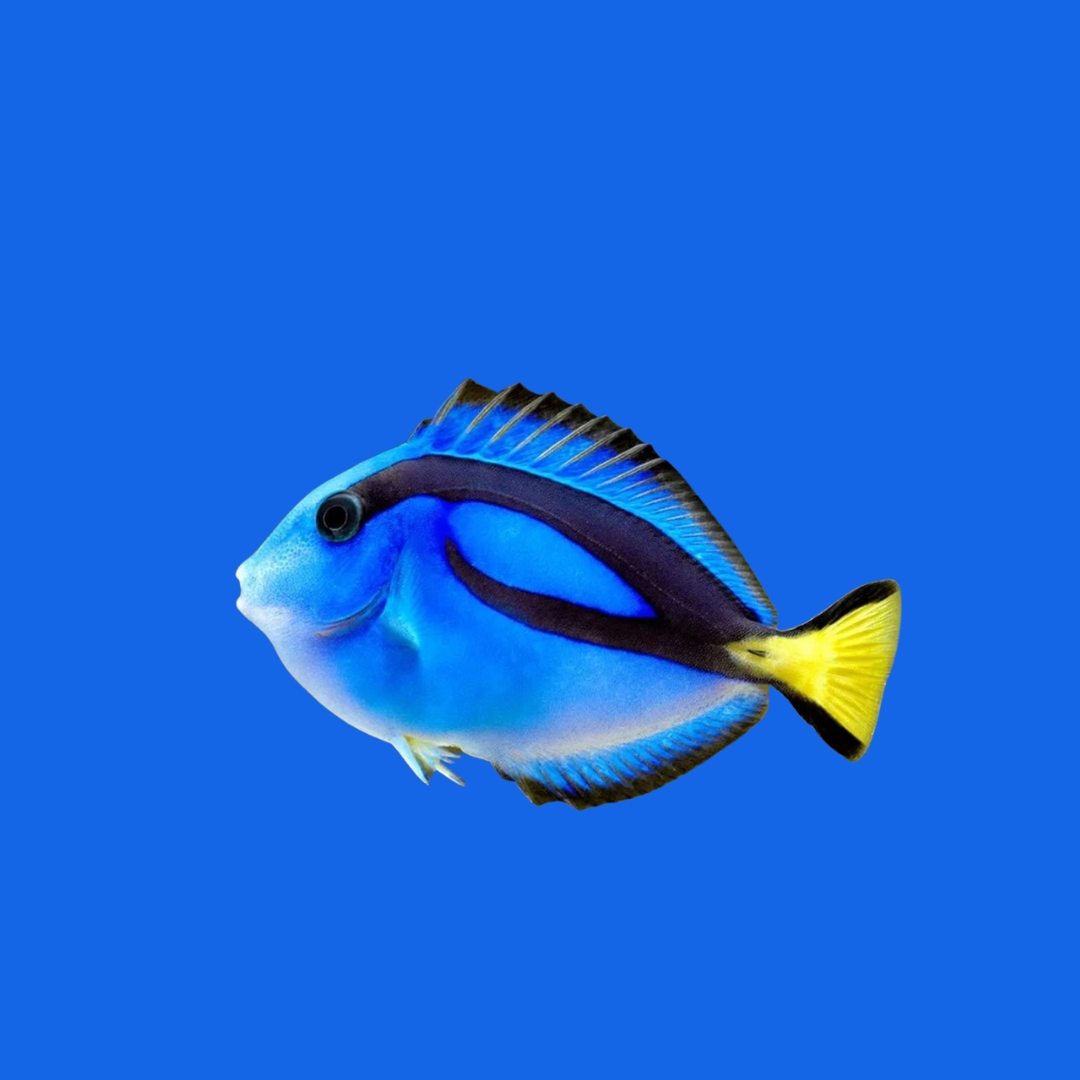
ナンヨウハギは、鮮やかなロイヤルブルーの体色と、体側を大きく走る黒い模様、尾びれ周辺の黄色が印象的な海水魚です。映画のキャラクターとしても有名になったことで、海水魚の中でも特に知名度が高い存在ですが、実際の飼育では広い遊泳スペース、安定した水質、植物質を含むバランスのよい給餌、そして導入時の病気対策が重要になります。見た目の華やかさに反して、体表の粘膜が薄く白点病などにかかりやすいため、初心者が小型水槽で気軽に迎える魚というよりは、海水魚飼育に慣れてきた中級者以上に向いた種類です。The regal blue tang is a striking marine fish known for its vivid royal-blue body, bold black pattern, and bright yellow tail area. It is one of the best-known saltwater aquarium fish thanks to its appearance in popular films, but successful long-term care requires ample swimming space, stable water quality, a balanced diet with plenty of plant matter, and careful disease prevention at introduction. Despite its bright and familiar appearance, it has a relatively delicate slime coat and is prone to marine ich and related problems, making it better suited to intermediate or experienced marine aquarists rather than small beginner tanks.
基本情報 / Basic Information
学名 / Scientific Name
Paracanthurus hepatus
通称 / Common Name
ナンヨウハギ、ブルータン、ドリーRegal blue tang, palette surgeonfish, blue tang, hippo tang
分類 / Family
条鰭綱・ニザダイ目・ニザダイ科・ナンヨウハギ属Class Actinopterygii, order Acanthuriformes, family Acanthuridae, genus Paracanthurus
英名 / English Name
Regal Blue Tang / Palette Surgeonfish / Blue Tang / Hippo Tang
分布 / Distribution
インド太平洋の熱帯・亜熱帯海域に広く分布します。東アフリカ沿岸からインド洋、東南アジア、オーストラリア北東部、サモアやトンガ周辺まで見られますが、紅海には自然分布しません。日本では琉球列島や小笠原諸島、高知県以南などで知られ、近年は黒潮や海況変化の影響により相模湾や房総半島周辺で幼魚が確認される例もあります。Widely distributed across tropical and subtropical Indo-Pacific waters, from the East African coast through the Indian Ocean, Southeast Asia, northeastern Australia, Samoa, and Tonga. It is not naturally found in the Red Sea. In Japan, it is known from the Ryukyu Islands, the Ogasawara Islands, and areas south of Kochi; juveniles have also been reported farther north around Sagami Bay and the Boso Peninsula, likely influenced by the Kuroshio Current and changing marine conditions.
最大体長 / Max Size
最大で約31cm。観賞魚としては20〜25cm前後で扱われることが多いです。Up to about 31 cm, though aquarium individuals are often encountered around 20–25 cm.
寿命 / Lifespan
自然下では20〜30年に達することがあります。飼育下では環境が整えば8〜14年以上、良好な長期管理ではさらに長生きすることもあります。May live 20–30 years in the wild. In aquariums, 8–14 years or longer is possible with well-managed conditions.
飼育環境 / Aquarium Environment
水槽サイズ / Tank Size
最低でも90cm規格水槽が目安ですが、成長後の遊泳力を考えると120cm規格水槽以上、できれば120cmワイド水槽以上が推奨されます。小型個体であっても成長が早く、長期飼育では広い横幅と十分な水量が重要です。A 90 cm standard tank is the bare minimum, but a 120 cm standard tank or larger, preferably a wider 120 cm system, is recommended for adults. Even small juveniles grow and require horizontal swimming space and stable water volume for long-term care.
水温 / Temperature
24〜27℃を目安に安定させます。急な温度変化に弱いため、ヒーターとクーラーを併用し、日内変動をできるだけ小さくしてください。Keep the temperature stable at around 24–27°C. Because this species is sensitive to rapid temperature swings, heaters and chillers should be used as needed to minimize daily fluctuations.
水質 / Water Quality
比重1.020〜1.025、pH8.1〜8.4を目安にします。硝酸塩は50mg/L未満、理想的には5〜10ppm程度まで低く維持したい魚です。オーバーフロー水槽、強力なプロテインスキマー、十分な濾過容量を備えると安定しやすくなります。Aim for a specific gravity of 1.020–1.025 and pH 8.1–8.4. Nitrate should remain below 50 mg/L, ideally closer to 5–10 ppm. A sump-based system, strong protein skimmer, and generous filtration capacity greatly improve stability.
レイアウト / Layout
ライブロックで隠れ家を作りつつ、前面や中央にしっかり泳げる空間を残します。夜は岩や枝状サンゴの隙間に体を横倒しにして入り込むことがあるため、安心して身を寄せられるすき間があると落ち着きます。造波ポンプでランダムな水流を作ると、自然下の外洋に面したサンゴ礁斜面に近い環境を再現しやすくなります。Use live rock to provide secure hiding places while leaving open swimming space at the front and center. At night, the fish may wedge itself sideways into rockwork or branching coral-like spaces, so secure crevices help reduce stress. Random flow from wavemakers helps approximate the current-rich outer reef slopes it prefers in nature.
注意点 / Precautions
体表の粘膜が薄く、輸送や水合わせのストレス後に白点病を発症しやすい魚です。購入直後は本水槽へ直接入れず、可能であれば検疫水槽で4週間以上観察するのが安全です。また、尾柄部には鋭い尾棘があるため、手で追い詰めたり素手で扱ったりしないよう注意してください。Its relatively delicate slime coat makes it prone to marine ich after shipping or acclimation stress. New arrivals should ideally be quarantined and observed for at least four weeks before entering the display tank. It also has a sharp caudal spine, so avoid cornering or handling it with bare hands.
餌と給餌 / Feeding
餌の種類 / Diet
海水魚用の人工飼料を主食に、スピルリナ配合フード、乾燥海苔、海藻フードなど植物質をしっかり与えます。冷凍ブラインシュリンプ、イサザアミ、細かくした甲殻類系フードなども食べますが、動物質だけに偏らせないことが大切です。Base the diet on quality marine pellets or flakes, supplemented with spirulina-rich foods, dried nori, and marine algae sheets. It will also accept frozen brine shrimp, mysid-type foods, and finely chopped crustacean-based foods, but the diet should not be dominated by animal matter alone.
給餌のポイント / Feeding Tips
一度に大量に与えるより、少量を複数回に分けると消化や水質管理の面で安定します。給餌クリップで海苔や海藻フードを固定し、日中に少しずつ齧れるようにすると本来の採餌行動に近づきます。植物質の不足は体色の退色や頭部・側線侵食症の一因になることがあるため、ビタミン添加剤も上手に活用してください。Several small feedings are better than one large feeding for digestion and water quality. Attach nori or algae sheets to a feeding clip so the fish can graze through the day, which better matches its natural behavior. Insufficient plant matter may contribute to color loss and head and lateral line erosion, so vitamin supplements can also be helpful.
性格と混泳 / Temperament and Tank Mates
性格 / Temperament
基本的には温和で、他種の魚には比較的寛容です。ただし、成長すると遊泳力が強くなり、狭い水槽ではストレスから落ち着きがなくなることがあります。同種や近縁のハギ類に対しては縄張り意識を示すことがあるため注意が必要です。Generally peaceful and relatively tolerant of other fish species. However, as it grows, it becomes an active swimmer and may become stressed or restless in cramped tanks. It can show territorial behavior toward its own kind or closely related tangs.
混泳の相性 / Compatibility
カクレクマノミ、ハゼ類、小型〜中型ヤッコ類、ベラ類などとの混泳に向きます。複数のハギ類を入れる場合は、水槽サイズ、導入順、隠れ家、個体差をよく見極める必要があります。サンゴとの相性は概ね良好で、リーフタンクでも飼育されますが、空腹時や弱ったサンゴのポリプをつつく可能性はあります。Suitable tank mates include clownfish, gobies, small to medium angelfish, and wrasses. Keeping multiple tangs requires careful attention to tank size, introduction order, hiding places, and individual temperament. It is generally reef safe, though a hungry individual may occasionally pick at weakened coral polyps.
病気と対策 / Diseases and Prevention
かかりやすい病気 / Common Diseases
代表的な病気は、海水性白点病、ベルベット病、頭部・側線侵食症です。特に白点病は導入直後や水質悪化、温度変化、混泳ストレスのあとに出やすく、青い体色の上では初期の白点を見落とすことがあります。ベルベット病は進行が早く、呼吸が荒い、粉をまぶしたように見える、急に元気がなくなるといった症状に注意します。Common problems include marine ich, marine velvet, and head and lateral line erosion. Marine ich is especially common after introduction, poor water quality, temperature swings, or social stress, and early white spots can be easy to miss on the blue body. Marine velvet progresses quickly, so watch for rapid breathing, a dusty coating, and sudden lethargy.
対策と予防 / Prevention
新規導入魚は検疫水槽で4週間以上観察し、必要に応じて専門的な薬浴を行います。本水槽では安定した水温、清浄な水質、十分な酸素供給、隠れ家の確保が予防の基本です。銅イオンを用いた治療や低比重治療は有効な場合がありますが、サンゴや無脊椎動物がいる本水槽では使えないことが多いため、必ず隔離水槽で行います。活性炭の粉塵、栄養不足、迷走電流などは頭部・側線侵食症の要因とされるため、濾材の扱いと栄養管理にも気を配りましょう。Observe new fish in quarantine for at least four weeks and use appropriate treatments when needed. In the display tank, prevention depends on stable temperature, clean water, strong oxygenation, and secure hiding places. Copper-based treatment and hyposalinity may be useful in some cases, but they should be done in a separate quarantine tank because they are often unsafe for corals and invertebrates. Activated carbon dust, nutritional deficiencies, and stray voltage have been associated with head and lateral line erosion, so filtration media and nutrition should be managed carefully.
増やし方(繁殖) / Breeding
雌雄の判別 / Sexing
明確な雌雄判別は難しい魚です。一般にオスの方がやや大型化するとされますが、外見だけで確実に見分ける方法はありません。Reliable sexing is difficult. Males may become somewhat larger, but there is no simple external feature that allows certain identification.
繁殖形態 / Reproduction
自然下では集団で産卵する浮遊性卵ばらまき型の産卵魚です。夕方に群れで水面方向へ急上昇し、卵と精子を同時に放出します。受精卵は小さく、油滴を持って海流に乗り、仔魚は外洋で浮遊生活を送ります。In nature, this species is a pelagic broadcast spawner. Groups rush upward toward the water column in the late afternoon or evening and release eggs and sperm simultaneously. The tiny buoyant eggs contain an oil droplet, and the larvae drift in the open ocean.
繁殖のポイント / Breeding Tips
家庭水槽での繁殖は極めて難しく、実用的には専門施設レベルの技術が必要です。仔魚が非常に小さく、孵化後すぐに適切なサイズと栄養価を持つ生きた初期餌料を必要とすることが最大の難関です。近年はハワイやフロリダ、台湾などの研究機関や企業で完全養殖に成功し、ブリード個体も少しずつ流通していますが、一般家庭で狙って増やす魚ではありません。Breeding in home aquariums is extremely difficult and generally requires specialized facility-level techniques. The major challenge is the tiny larval stage, which needs live first foods of the correct size and nutritional value shortly after hatching. Complete captive breeding has been achieved by institutions and companies in places such as Hawaii, Florida, and Taiwan, and captive-bred individuals are gradually entering the trade, but this is not a realistic home-breeding species.
雑学と豆知識 / Trivia and Fun Facts
1. 学名に残る、古い標本保存の名残 / 1. A scientific name shaped by old preserved specimens
ナンヨウハギの種小名である「hepatus」は、肝臓を意味する言葉に由来します。生きている姿は鮮やかな青色なので不思議に思えますが、初期の分類記載で参考にされた保存標本では青い色が失われ、体が赤褐色や肝臓のような色合いに見えていたと考えられています。現在の美しい姿だけを見ると少し意外ですが、学名には当時の観察条件や標本保存技術の歴史が静かに刻まれています。The specific name “hepatus” is derived from a word related to the liver. This seems surprising for a living fish with a vivid blue body, but early descriptions likely relied on preserved specimens whose blue coloration had faded, making the body appear reddish-brown or liver-like. The name quietly preserves a piece of taxonomic history and the limitations of early specimen preservation.
2. 「ドリー」で有名になった魚と、持続可能な流通への課題 / 2. The “Dory” effect and the challenge of sustainable supply
ナンヨウハギは映画に登場したことで一気に知名度が高まり、観賞魚市場での人気も大きく伸びました。その一方で、野生採集への依存や、一部地域で問題となる不適切な採集方法が懸念されてきました。こうした背景から、完全養殖技術の確立は大きな意味を持ちます。2016年には人工繁殖個体の育成成功が大きな節目となり、現在はブリード個体の流通も始まっています。購入時には、可能であれば餌付きがよく環境負荷の少ないブリード個体を選ぶことも、アクアリストにできる小さな保全行動の一つです。The regal blue tang became widely recognized after appearing in popular films, which greatly increased its aquarium demand. At the same time, reliance on wild collection and harmful collection practices in some areas became a concern. For this reason, successful captive-breeding technology is especially important. The production of captive-bred juveniles in 2016 marked a major milestone, and captive-bred fish are now gradually available. Choosing a captive-bred individual when possible can be a small but meaningful conservation-minded choice for aquarists.
3. 眠るときは横倒しになることもある / 3. It may sleep lying sideways
夜になると、ナンヨウハギはライブロックや枝状サンゴのすき間に体を差し込み、横倒しに近い姿勢で休むことがあります。初めて見ると病気や衰弱のように見えて驚くかもしれませんが、これは狭い場所に身を固定し、夜間の捕食者から身を守るための自然な行動です。照明が消えたあとに体色が淡く見えることもあり、これも暗い環境で目立ちにくくなるための変化と考えられています。At night, regal blue tangs may wedge themselves into rockwork or branching coral-like crevices and rest in a sideways posture. This can look alarming at first, as if the fish is ill or weak, but it is a natural behavior that helps the fish secure itself and avoid nighttime predators. Its color may also appear paler after the lights go out, which is thought to help it blend into darker surroundings.
4. 尾に隠した「外科医のメス」 / 4. A surgeon’s scalpel hidden at the tail
英名に含まれる「surgeonfish」は、尾柄部にある鋭い棘に由来します。普段は目立ちませんが、危険を感じたときに尾を振って相手を切りつける防御武器になります。ナンヨウハギの黄色い尾周辺の模様は美しさだけでなく、危険な棘の存在を知らせる警告色として働いている可能性があります。水槽掃除の際は、魚を手で追い詰めず、必要な場合は容器やネットを使って落ち着いて扱うことが大切です。The English name “surgeonfish” comes from the sharp spine on the caudal peduncle. Usually inconspicuous, it can be used defensively when the fish swings its tail. The yellow marking around the tail may function not only as decoration but also as a warning signal advertising this weapon. During tank maintenance, avoid cornering the fish by hand; use a container or net calmly when handling is necessary.
5. サンゴ礁の健康を支える一員 / 5. A small participant in reef health
自然下のナンヨウハギは、動物プランクトンだけでなく底生藻類も食べます。サンゴ礁では、藻類が増えすぎるとサンゴの成長を妨げることがあるため、藻類を食べる魚たちは生態系のバランス維持に貢献しています。水槽内でも、植物質の餌をしっかり与えることは、単にお腹を満たすだけでなく、この魚が本来持つ食性に寄り添う飼育につながります。In the wild, regal blue tangs feed not only on zooplankton but also on benthic algae. On coral reefs, excessive algae can interfere with coral growth, so algae-grazing fishes contribute to ecosystem balance. In aquariums, providing enough plant-based food is not just about feeding; it is a way to respect the species’ natural dietary ecology.
まとめ / Conclusion
ナンヨウハギは、海水魚らしい華やかさと知名度を兼ね備えた魅力的な魚です。一方で、成長後の体長と遊泳力、病気への感受性、植物質を必要とする食性を考えると、準備不足の小型水槽で飼うには向きません。広い水槽、安定した濾過、清浄な水質、十分な水流、そして検疫を含めた導入管理を整えてから迎えたい種類です。The regal blue tang is a charismatic marine fish with striking colors and worldwide recognition. However, considering its adult size, active swimming behavior, disease sensitivity, and need for plant-based nutrition, it is not suitable for an underprepared small tank. It should be kept only after providing a spacious aquarium, stable filtration, clean water, sufficient flow, and proper introduction management including quarantine.
近年は人工繁殖個体の流通も始まり、野生採集に頼りすぎない飼育の選択肢が少しずつ広がっています。飼育者が魚の生態を理解し、長期的な健康を第一に考えて設備と管理を整えることで、この美しい魚の魅力をより深く、そして責任を持って楽しむことができます。Captive-bred individuals are becoming more available, gradually expanding options that do not rely solely on wild collection. By understanding the species’ ecology and prioritizing long-term health through appropriate equipment and husbandry, aquarists can enjoy this beautiful fish more deeply and responsibly.
McIlwain, J. et al. 2012. Paracanthurus hepatus. The IUCN Red List of Threatened Species. 保全状況、広域分布、観賞魚採集やサンゴ礁環境への依存に関する記述の根拠として使用。IUCNページへ直接アクセスできない場合は、FishBase掲載のIUCNステータスも照合資料としています。 https://www.iucnredlist.org/
University of Florida IFAS Extension. Overview of Commonly Cultured Marine Ornamental Fish. 海水観賞魚の養殖状況、キイロハギおよびナンヨウハギの人工繁殖、商業量産化までの課題に関する記述の根拠として使用。 https://ask.ifas.ufl.edu/publication/FA224
DiMaggio, M. A., Cassiano, E. J., Barden, K. P., Ramee, S. W., Ohs, C. L. and Watson, C. A. 2017. First record of captive larval culture and metamorphosis of the Pacific blue tang, Paracanthurus hepatus. Journal of the World Aquaculture Society, 48(3):393-401. ナンヨウハギの人工繁殖、仔魚飼育、変態までの飼育成功に関する一次研究として使用。 https://doi.org/10.1111/jwas.12426
University of Florida Digital Collections. Sowaske, G. E. J. 2020. Investigating early larviculture protocols for two marine ornamental fish species: the Pacific blue tang (Paracanthurus hepatus) and the melanurus wrasse (Halichoeres melanurus). 初期仔魚飼育、餌料・光周期など、繁殖技術の課題を補足する大学学位論文として使用。 https://ufdcimages.uflib.ufl.edu/UF/E0/05/69/03/00001/Sowaske_G.pdf
University of Florida IFAS Extension. Cryptocaryon irritans Infections (Marine White Spot Disease) in Fish. 海水性白点病の病原体、生活環、検疫、銅治療など、病気と予防の記述を支える資料として使用。 https://ask.ifas.ufl.edu/publication/FA164
Stamper, M. A., Kittell, M. M. and Patel, E. E. 2011. Effects of full-stream carbon filtration on the development of head and lateral line erosion syndrome in ocean surgeon. North American Journal of Aquaculture, 73(4):489-492. 活性炭使用と頭部・側線侵食症様病変の関連について、ハギ類の飼育上の注意点を補足する査読論文として使用。 https://pubmed.ncbi.nlm.nih.gov/22216709/



 アイのアクアグッズ案内グッピー・プラティ・モーリーを親子で楽しむ飼育用品|水槽・稚魚保護・ろ過・餌・水草道具の特徴や使い方、選ぶときのポイントをアイが紹介します。記事はコチラ →
 アイのアクアグッズ案内エンゼルフィッシュの飼育用品|高さのある水槽・ろ過・水草・餌の選び方道具の特徴や使い方、選ぶときのポイントをアイが紹介します。記事はコチラ →
 アイのアクアグッズ案内水槽用ヒーターの選び方|固定式・温度調節式と、水量に合うW数の考え方水槽の魚は冬に寒くない? アイとコタロウが水温計から固定式・温度調節式・分離式ヒーターまで比較。水量と室温に合うW数、設置場所、水換えや交換の注意点を、国内メーカーの商品とともに紹介します。記事はコチラ →
 アイのアクアグッズ案内コリドラスのもふもふ時間を楽しむ|餌・底砂・お掃除用品の選び方コリドラスのもふもふする食事風景を楽しむために。沈む餌2種類の違い、口元に配慮した底砂、食べ残しを回収する道具を、アクアグッズナビゲーターのアイが紹介します。記事はコチラ →



コメント