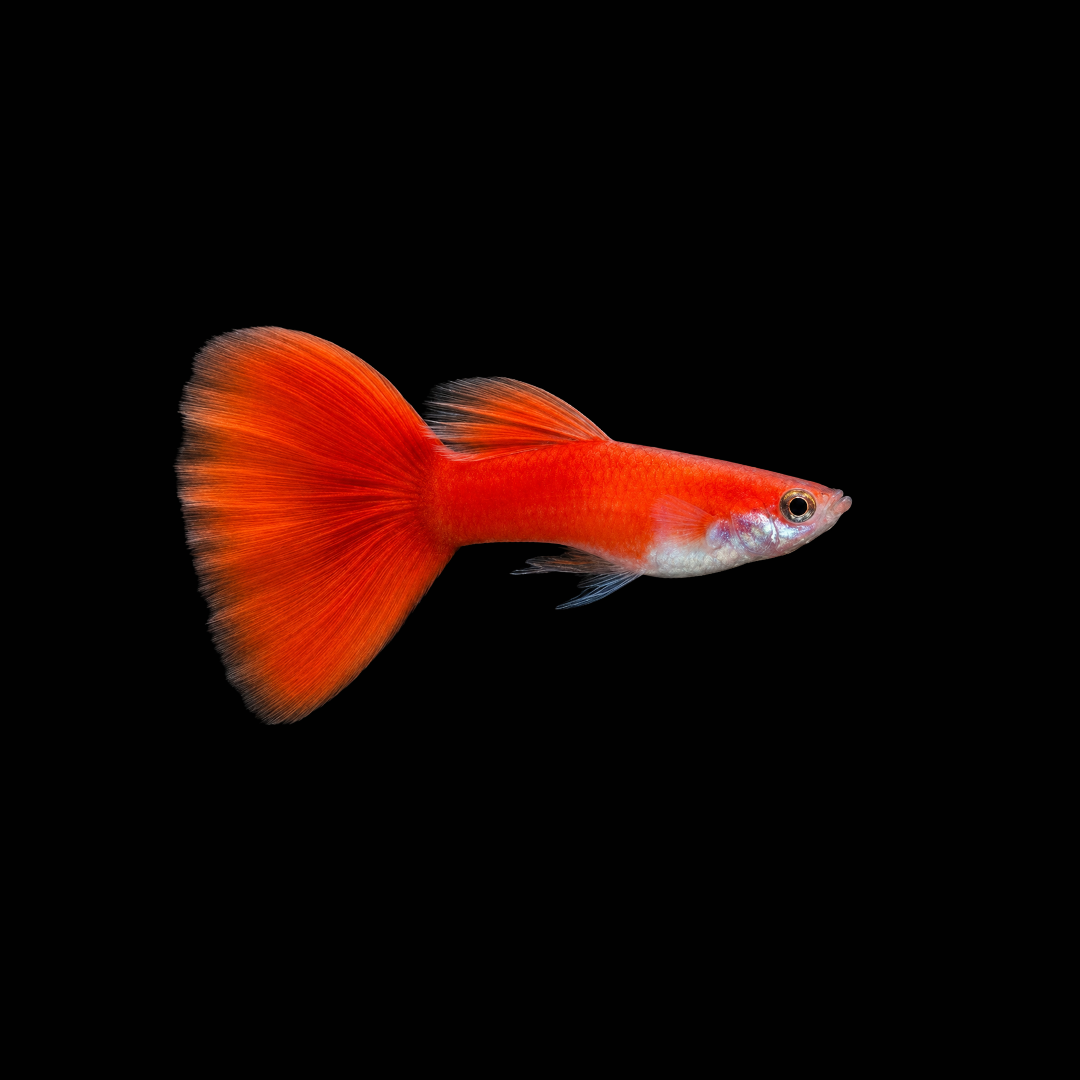
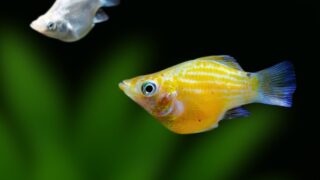
フルレッドグッピーは、吻端から腹部、背ビレ、そして大きく広がる尾ビレまで、全身が均一な赤色に染まるソリッド(単色)系グッピーの代表品種です。日本では「ブルーグラス」「ドイツイエロータキシード」と並ぶ「国産グッピー御三家」のひとつに数えられ、尾ビレだけが赤いレッドテールから発展し、赤を全身へと広げた品種として親しまれてきました。目の黒い通常体色の個体は、体に黒色素(メラニン)を持つぶん赤に落ち着いた深みがあり、視力も良く丈夫で、繁殖させやすいのが持ち味です。このフルレッドを土台に、黒色素を持たないアルビノ化した系統(リアルレッドアイ・フルレッド)や、ヒレの形が変化した系統など、多くのバリエーションが生み出されています。模様のない単色品種だからこそ、色ムラや背ビレ付け根の小さなシミ、尾ビレの形の乱れがそのまま目に付きやすく、高品質な個体を作り上げる難しさは模様のある品種にも劣らないといわれます。飼いやすさと奥深さをあわせ持つ、育てがいのあるグッピーです。The Full Red Guppy is a flagship solid-colored guppy strain whose entire body, from the snout and belly to the dorsal fin and broad caudal fin, is uniformly red. In Japan it is counted among the “Big Three of domestic guppies,” alongside the Blue Grass and the German Yellow Tuxedo, and it is loved as a strain that developed from the Red Tail, in which only the caudal fin is red, by spreading the red over the whole body. Normally pigmented, black-eyed individuals carry black pigment (melanin), which gives their red a calm depth, and they have good eyesight, are hardy, and breed readily. Using this Full Red as a foundation, many variations have been created, such as albino lines lacking black pigment (Real Red Eye Full Red) and lines with altered fin shapes. Because it has no pattern, color unevenness, small dark spots at the base of the dorsal fin, and flaws in caudal fin shape are easy to notice, and producing top-quality fish is said to be as challenging as with patterned strains. It is a rewarding guppy that combines ease of keeping with real depth.
基本情報 / Basic Information
学名 / Scientific Name
Poecilia reticulata (Peters, 1859)
通称 / Common Name
フルレッドグッピー、フルレッド、ノーマルフルレッドFull Red Guppy, Full Red, Normal Full Red
分類 / Family
カダヤシ目カダヤシ科ポエキリア属(改良品種・ソリッド系)Cyprinodontiformes, Poeciliidae, genus Poecilia (ornamental strain, solid group)
英名 / English Name
Full Red Guppy
分布 / Distribution
原種のグッピーは、南米北部(ベネズエラ、ガイアナ、トリニダード・トバゴなど)の淡水域から汽水域に分布します。フルレッドは観賞用に作出された改良品種のため、自然分布はありません。国内では、日本のブリーダーが累代繁殖した個体のほか、台湾・シンガポール・タイなどの養殖場で生産された個体が流通しています。なお、グッピーそのものは、国内の温泉地周辺や琉球列島の水路などで野生化が確認されています。The wild guppy is native to fresh and brackish waters of northern South America, including Venezuela, Guyana, and Trinidad and Tobago. The Full Red is an ornamental strain developed for aquariums and therefore has no natural range. In Japan, fish line-bred by domestic breeders are available alongside fish produced at farms in Taiwan, Singapore, Thailand and elsewhere. Guppies themselves have been confirmed as naturalized around hot springs and in waterways of the Ryukyu Islands in Japan.
最大体長 / Max Size
オスは尾ビレを除いた体長で約3cm、メスは約5cm前後です。コンテストの国際基準では、オスの体長26mm以上がひとつの理想とされています。Males reach about 3 cm in body length excluding the caudal fin, and females around 5 cm. International show standards treat a male body length of 26 mm or more as one of the ideals.
寿命 / Lifespan
約1.5〜3年です。一年中高い水温で飼い続けると代謝が進みすぎ、寿命が縮む傾向があると考えられています。About 1.5 to 3 years. Keeping the water warm year-round is thought to speed up metabolism too much and tends to shorten lifespan.
飼育環境 / Aquarium Environment
水槽サイズ / Tank Size
1ペア〜1トリオを観賞用に飼うなら30cm規格水槽(約12L)から始められますが、水質の安定や繁殖を考えると、45cm規格水槽(約35L)〜60cm規格水槽(約57L)がおすすめです。本格的に系統を維持して選別まで行う場合は、親魚用・稚魚用・雌雄の分離用など複数の水槽が必要になり、海外のブリーダー団体では1系統あたり8〜10本の水槽がひとつの目安とされています。For display keeping of one pair or trio, you can start with a standard 30 cm tank (about 12 L), but for stable water quality and breeding, a standard 45 cm tank (about 35 L) to standard 60 cm tank (about 57 L) is recommended. Serious line maintenance including selection requires several tanks for breeders, fry and separated sexes, and overseas breeder associations suggest 8 to 10 tanks per strain as a guideline.
水温 / Temperature
一年を通して23〜26℃で安定させるのが理想で、繁殖させる場合は25〜27℃程度が目安です。日本の夏は水温が30℃を超えると酸欠や水質悪化の危険が高まるため、冷却ファンや水槽用クーラーを用意しましょう。冬は20℃を下回ると白点病や免疫力の低下を招きやすいため、サーモスタット付きのヒーターが欠かせません。Keeping the temperature stable at 23 to 26°C year-round is ideal, with about 25 to 27°C as a guide for breeding. In Japanese summers, water above 30°C raises the risk of oxygen depletion and poor water quality, so prepare a cooling fan or aquarium chiller. In winter, temperatures below 20°C easily lead to white spot disease and weakened immunity, so a heater with a thermostat is essential.
水質 / Water Quality
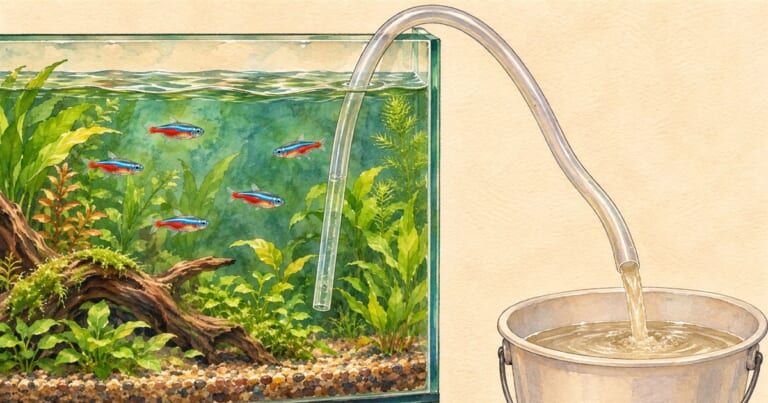
中性〜弱アルカリ性(目安pH 6.8〜7.8、許容範囲6.5〜8.0)で、中硬水〜硬水(目安GH 10〜20、許容範囲8〜25)を好みます。日本の水道水は多くの地域でカルキを抜けばpHは適正範囲に収まりますが、硬度は低い軟水傾向にあります。軟水はpHを一定に保つ力が弱いため、ろ過が進んで水が酸性に傾くとpHが急に下がりやすく、大きな尾ビレを傷める一因にもなるとされます。国産のフルレッドは日本の水道水で累代繁殖されてきたぶん、ある程度は順応していますが、調整剤で数値を無理に理想値へ合わせるより、定期的な換水で水質の変化を小さく保つほうがはるかに大切です。Prefers neutral to slightly alkaline water (target pH 6.8 to 7.8, tolerated 6.5 to 8.0) and moderately hard to hard water (target GH 10 to 20, tolerated 8 to 25). In most parts of Japan, tap water falls within a suitable pH range once dechlorinated, but it tends to be soft. Soft water has little ability to hold pH steady, so pH can drop suddenly as biological filtration gradually acidifies the water, and this is also said to contribute to damage of the large caudal fin. Domestic Full Reds have adapted to some extent because they have been line-bred in Japanese tap water, but keeping changes small through regular water changes is far more important than forcing parameters to ideal values with conditioners.
レイアウト / Layout
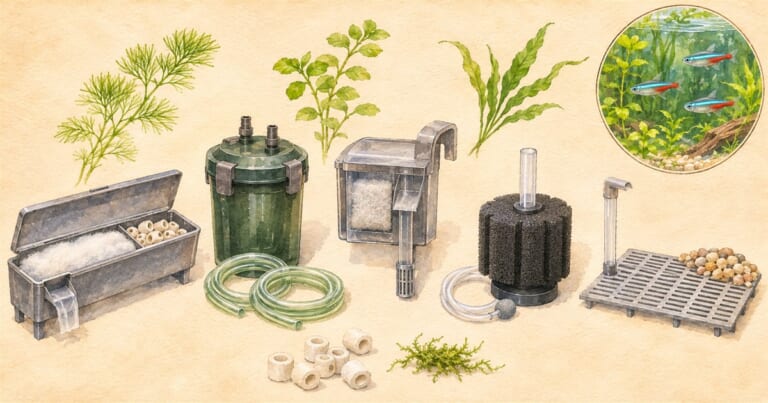
底床は、pHを大きく下げるソイルを避け、大磯砂に少量のサンゴ砂を混ぜてpHの低下を和らげる構成が理にかなっています。マツモやウィローモスなどの水草を入れておくと、メスに追われ続けるのを防ぐ隠れ家や、生まれた稚魚の逃げ場になります。ろ過には、大きな尾ビレを持つオスが水流で疲れにくく、稚魚の吸い込みも防げるスポンジフィルターや、水流の穏やかな投げ込み式フィルターが向いています。For substrate, avoid aqua soils that significantly lower pH; Oiso gravel mixed with a small amount of coral sand to soften pH drops is a sensible choice. Plants such as hornwort or willow moss provide hiding places that spare females from constant pursuit and refuges for newborn fry. For filtration, sponge filters or gentle-flow internal box filters are well suited, as they keep large-finned males from tiring in the current and prevent fry from being sucked in.
注意点 / Precautions
グッピーは国の輸入検疫の対象魚種に含まれていないため、海外から入ってくる個体が病原体を持っていても、水際で止められる仕組みにはなっていません。新しく迎えた個体は1〜2週間ほど別の水槽で様子を見てから合流させ、育った環境の異なる外国産と国産の個体は混泳させないようにしましょう。また、店頭では赤系のグッピーの名前が混同されやすいため、腹部まで赤く染まっているかを確かめて選ぶことが大切です。グッピーは特定外来生物ではないため飼育や販売は合法ですが、環境省の生態系被害防止外来種リストに掲載されています。どのような理由があっても、屋外の川や池に放してはいけません。Guppies are not among the species covered by Japan’s statutory import quarantine, so there is no system to stop pathogens carried by imported fish at the border. Keep newly acquired fish in a separate tank for about 1 to 2 weeks before introducing them, and avoid mixing imported and domestic fish raised in different environments. Also, because names of red guppy strains are easily confused in shops, it is important to check that the belly is red as well when choosing fish. Guppies are not designated Invasive Alien Species, so keeping and selling them is legal, but they are listed on the Ministry of the Environment’s list of alien species that may damage ecosystems. Never release them into outdoor rivers or ponds for any reason.
餌と給餌 / Feeding
餌の種類 / Diet
雑食性で、グッピー用の人工飼料(細かい粒状のものやフレーク)、冷凍赤虫、ミジンコなどをよく食べます。魚は赤い色のもとになるカロテノイドを体内で十分に作れないため、アスタキサンチン、スピルリナ、マリーゴールド由来の色素などを含む色揚げ用の飼料を組み合わせると、赤い発色を保ちやすくなります。稚魚には、孵化させたブラインシュリンプの幼生が最適です。Omnivorous, readily eating guppy foods such as fine granules and flakes, frozen bloodworms and daphnia. Since fish cannot produce enough carotenoids, the source of red coloration, on their own, combining their diet with color-enhancing foods containing astaxanthin, spirulina or marigold-derived pigments helps maintain the red. Freshly hatched brine shrimp nauplii are ideal for fry.
給餌のポイント / Feeding Tips
1日1〜2回、数分で食べきれる量を与えるのが基本です。食べ残しは水質悪化を招き、軟水の水槽ではpHの急な低下にもつながるため注意しましょう。グッピーを使った給餌試験では、飼料1kgあたり50mgのマリーゴールド粉末を加えたグループで、体色がもっとも鮮やかになったと報告されています。ただし、色揚げ用の飼料はその系統が生まれ持った発色の力を最大限に引き出す補助であり、遺伝的な素質そのものを超えるものではありません。The basic approach is to feed once or twice a day, giving an amount they can finish within a few minutes. Leftover food degrades water quality and, in soft-water tanks, can also lead to sudden pH drops, so take care. In a feeding trial on guppies, the group given 50 mg of marigold powder per kilogram of feed was reported to show the most vivid coloration. However, color-enhancing foods only help draw out the full coloring ability a strain is born with; they cannot go beyond its genetic potential.
性格と混泳 / Temperament and Tank Mates
性格 / Temperament
温和で、ほかの魚を攻撃することはほとんどありません。オスはメスに盛んに求愛しますが、大きな尾ビレを持つぶん泳ぎはゆったりとしています。Peaceful and rarely attacks other fish. Males court females actively, but their large caudal fins make them relatively slow, graceful swimmers.
混泳の相性 / Compatibility
ヒレをかじる魚や、動きが素早く餌を独占しがちな魚と一緒にすると、尾ビレを傷つけられたり、餌の取り合いに負けたりします。コリドラスやオトシンクルスのように、水槽の底や苔取りを受け持つ温和な小型魚となら同居できますが、品種単独で飼うのがもっとも安全です。ほかのグッピー品種と混泳させると交雑してしまうため、系統を守るうえでも品種ごとに分けて飼いましょう。When kept with fin-nipping fish or fast-moving fish that tend to monopolize food, their caudal fins may be damaged and they may lose out in competition for food. They can live with peaceful small fish such as Corydoras or Otocinclus that occupy the bottom or graze on algae, but a single-strain tank is the safest option. Keeping them with other guppy strains leads to crossbreeding, so keep each strain separately to protect the bloodline.
病気と対策 / Diseases and Prevention
かかりやすい病気 / Common Diseases
特に注意したいのは、細菌によるカラムナリス病(尾ぐされ病・口ぐされ病)、繊毛虫テトラヒメナによる感染症(いわゆる「グッピーエイズ」の原因のひとつとされる病気)、白点病、針病です。カラムナリス病の原因菌はpH 7.0〜7.5、水温25〜28℃で増えやすいとされ、これはグッピーにとって快適な環境とほぼ重なります。テトラヒメナは皮膚だけでなく筋肉や内臓の奥まで入り込むため、発症すると助けるのが非常に難しく、現時点では市販薬による確実な治療法はないとされています。The diseases to watch most closely are bacterial columnaris disease (fin rot and mouth rot), infections by the ciliate Tetrahymena (considered one cause of the condition known as “guppy AIDS”), white spot disease, and “needle fin” disease. The columnaris bacteria are said to multiply readily at pH 7.0 to 7.5 and 25 to 28°C, which almost exactly matches the conditions guppies find comfortable. Tetrahymena penetrates not only the skin but deep into muscles and internal organs, so once symptoms appear, saving the fish is very difficult, and no reliable treatment with commercially available medications is currently known.
対策と予防 / Prevention
もっとも効果的な予防策は、新しく迎えた個体を1〜2週間ほど別の水槽で観察すること(トリートメント)と、外国産と国産を混ぜずに管理することです。尾ぐされ病などの細菌感染症は、0.5%の塩水浴(水1Lあたり食塩5g)だけでは菌を抑えきれない場合があるとされます。塩水浴は菌を退治するためというより、体内の塩分を保つための魚の負担を軽くし、体力を温存させる補助と考えましょう。治療には、ニトロフラゾンとサルファ剤を含むグリーンFゴールド顆粒、オキソリン酸を含むグリーンFゴールドリキッドや観パラD、ニフルスチレン酸ナトリウムを含むエルバージュエースといった国内の市販魚病薬を、用法・用量を守って隔離水槽で使います。なかでもエルバージュエースは効き目が強いため、ほかの薬が効かないときの切り札とし、水草やろ過槽には使わないでください。薬浴中に同じ薬を混ぜた餌を与えると体内の薬の濃度が高くなりすぎる恐れがあるため避け、症状のない魚に予防目的でむやみに薬を使うことも控えましょう。The most effective prevention is observing new fish in a separate tank for about 1 to 2 weeks (quarantine) and keeping imported and domestic fish apart. For bacterial infections such as fin rot, a 0.5% salt bath (5 g of salt per liter) alone may not be enough to suppress the bacteria. Think of a salt bath not as a way to kill bacteria but as support that eases the fish’s effort to maintain its internal salt balance and helps conserve its strength. For treatment, use Japanese commercial fish medications in a separate hospital tank, following the directions and dosage: Green F Gold Granules (nitrofurazone and sulfonamides), Green F Gold Liquid and Kanpara D (oxolinic acid), and Elbaju Ace (sodium nifurstyrenate). Elbaju Ace in particular is very potent, so reserve it as a last resort when other medications fail, and do not use it with aquatic plants or in filter systems. Avoid giving food mixed with the same medication during a medicated bath, as drug levels in the body may become too high, and refrain from casually medicating symptom-free fish as a precaution.
増やし方(繁殖) / Breeding
雌雄の判別 / Sexing
オスは体が小さく、全身が濃い赤に染まり、大きな尾ビレと背ビレを持ちます。尻ビレが棒状に変化した交接器(ゴノポディウム)があることも、オスを見分ける決め手です。メスはオスより大きくふっくらしており、尾ビレや背ビレに赤が乗るものの、オスほど全身が鮮やかな赤一色には染まらない系統も少なくありません。生後約1か月で雌雄を見分けられるようになります。Males are smaller, deep red over the entire body, and have large caudal and dorsal fins. The gonopodium, a rod-like modified anal fin, is also a decisive way to identify males. Females are larger and plumper than males; although their caudal and dorsal fins show red, many strains do not color the whole body as vividly red as males. The sexes can be told apart from about one month of age.
繁殖形態 / Reproduction
卵胎生で、メスはお腹の中で卵を孵化させてから稚魚を産みます。水温25〜27℃では、およそ21〜30日の妊娠期間を経て出産します。出産が近づくと、メスの肛門付近にある妊娠斑が黒く濃くなるのが目安です。メスは一度の交尾で受け取った精子を体内に蓄えられるため、その後3〜5回ほど続けて出産することができます。A livebearer: the female hatches her eggs inside her body and then gives birth to fry. At 25 to 27°C, gestation lasts roughly 21 to 30 days. As birth approaches, the gravid spot near the female’s vent darkens, which serves as a sign. Because a female can store sperm from a single mating, she can give birth about 3 to 5 times in succession.
繁殖のポイント / Breeding Tips
健康なペアを同じ水槽に入れておけば自然に繁殖しますが、親魚は稚魚を食べてしまうため、出産が近いメスは産卵箱や別の水槽に移すと稚魚を守れます。生まれた稚魚には、お腹がオレンジ色に膨らむまでブラインシュリンプを1日数回与えると、その後の成長と体格に大きな差が出ます。生後約1か月で雌雄を分けて望まない早期の交配を防ぎ、オスの選別は発色と体型がはっきりする生後3か月ごろを目安に行いましょう。赤い色を決める遺伝子はオスとメスの両方の性染色体にあるため、メスも尾ビレや背ビレの赤がはっきりした個体を選ぶことが系統維持の鍵になります。同じ系統どうしの交配を続けると、体が小さくなったり鳩胸が出たりしやすくなるため、別血統のフルレッドとの交配(アウトクロス)で体質を補うことも有効です。リボンやスワローのオスは交接器まで伸びてしまい繁殖できなくなるため、繁殖には必ずヒレが通常のオスを使い、ヒレが伸びない系統と合わせた2系統で維持してください。早産を繰り返すメスは奇形の子が生まれる危険が高いため、親魚から外しましょう。Healthy pairs kept in the same tank will breed naturally, but adults eat their fry, so moving females close to giving birth into a breeding box or separate tank helps protect the young. Feeding fry brine shrimp several times a day until their bellies swell orange makes a major difference in their later growth and build. Separate the sexes at about one month to prevent unwanted early mating, and select males at around three months of age, when coloration and body shape become clear. Since the genes for red coloration lie on both sex chromosomes, choosing females with clearly red caudal and dorsal fins is key to maintaining the line. Continued breeding within the same line tends to cause smaller bodies and “pigeon chest” deformities, so outcrossing with Full Reds of a different bloodline to strengthen the line is also effective. Ribbon and swallow males have elongated gonopodia that make breeding impossible, so always breed with normal-finned males and maintain two lines, including one without elongated fins. Remove females that repeatedly give premature births from breeding, as they carry a high risk of producing deformed fry.
雑学と豆知識 / Trivia and Fun Facts
1. 人の名前に由来する呼び名と、学名が語る網目模様 / 1. A Name from a Person, and the Net Pattern in the Scientific Name
「グッピー」という呼び名は、トリニダード島から本種の標本を送ったレクメア・グッピー氏の名にちなみます。そのGuppyという姓は、イングランド南西部ドーセット州にある小さな集落の地名に由来する、英国生まれの姓とされています。一方、1859年にドイツの博物学者ペータースが記載した学名 Poecilia reticulata の種小名 reticulata は「網目状の」という意味で、野生のグッピーの体に黒い色素が描く網目模様にちなんでいます。地味な網目模様をまとった野生の小魚が、人の手による改良を重ねて、頭から尾ビレの先まで真紅に染まるフルレッドへと姿を変えたと考えると、改良品種の歴史の面白さが感じられます。The name “guppy” honors Lechmere Guppy, who sent specimens of the species from Trinidad. The surname Guppy itself is considered an English surname derived from the name of a small hamlet in Dorset, in southwest England. Meanwhile, the specific epithet reticulata in the scientific name Poecilia reticulata, described by the German naturalist Peters in 1859, means “net-like,” referring to the mesh pattern that black pigment draws on the wild guppy’s body. Picturing how a small wild fish dressed in a plain net pattern was transformed through human breeding into the Full Red, crimson from head to the tip of the tail, conveys the fascination of ornamental breeding history.
2. フラミンゴ・レッドテールとの見分け方 / 2. Telling It Apart from the Flamingo and Red Tail
赤系のグッピーには名前の似た品種が多く、店頭や通販で混同されやすいことで知られています。フラミンゴは金色を帯びた体から尾ビレへ赤が移ろうグラデーションが特徴で、腹部は白っぽく、または金色に抜けます。レッドテールは尾ビレだけが赤一色に染まる品種で、体の色はノーマルやタキシードなどさまざまです。モスコーレッドは前半身に金属光沢を帯びた濃い色が乗る形質と赤色が組み合わさったもので、頭部から胸部の質感が異なります。これに対してフルレッドは、吻端から腹部まで赤く染まることが高品質の条件とされ、腹部が白く抜けた個体はフラミンゴに近い表現とみなされて評価が下がります。購入するときは、お腹まで赤いかどうかを確かめるのが見分けの近道です。Red guppies include many strains with similar names and are known to be easily confused in shops and online. The Flamingo is characterized by a gradient in which red shifts from a golden body into the caudal fin, with a whitish or golden belly. The Red Tail has only a solid red caudal fin, while body color varies, including normal and tuxedo types. The Moscow Red combines red with a trait that places a dark, metallic sheen on the front half of the body, giving the head and chest a different texture. In contrast, for the Full Red, red extending from the snout to the belly is a condition of high quality, and fish with a white belly are regarded as close to the Flamingo and rated lower. When buying, checking whether the belly is red is the quickest way to tell them apart.
3. ひとつではない起源と、日本で磨かれた赤 / 3. Not a Single Origin, and a Red Polished in Japan
フルレッドには単一の起源がない可能性が高いとされ、全身に赤を広げる突然変異の利用や選び抜いての交配は、世界各地で並行して進められてきたと考えられています。実際、ヨーロッパで独自に維持されている「チェコレッド」は、アジアや日本で流通するフルレッドとは別の系統として扱われています。日本での転機は、2002年にドイツから輸入された「ジャーマンフルレッド」の登場だったとされます。導入当初は生まれる子のオスとメスの比率が極端に偏ったり、ペアにしてもなかなか交尾しなかったりと扱いにくい面がありましたが、国内のブリーダーが代を重ねた繁殖と選別でこうした欠点を克服し、レッドテールの発展形として定着させていきました。その後、赤の濃さに優れた台湾系・中国系の血統が取り入れられたことで、以前多かったオレンジ寄りの朱色のタイプは少なくなり、重厚な真紅が主流になりました。近年は、従来とは別の遺伝的要因によると指摘される大きな背ビレを持つ系統も現れ、台湾系の体型と国産系の濃い赤を組み合わせた個体が、高品質な個体の中心になっています。The Full Red likely has no single origin; the use of mutations that spread red across the body and selective breeding are thought to have progressed in parallel in various parts of the world. Indeed, the “Czech Red,” maintained independently in Europe, is treated as a separate line from the Full Reds distributed in Asia and Japan. In Japan, the turning point is said to have been the “German Full Red,” imported from Germany in 2002. At first it was difficult to work with, producing extremely skewed ratios of male to female offspring and pairs that rarely mated, but Japanese breeders overcame these drawbacks through generations of breeding and selection and established it as an advanced form of the Red Tail. Later, the introduction of Taiwanese and Chinese bloodlines with richer red reduced the once-common orange-vermilion type, and a deep crimson became the norm. In recent years, strains with large dorsal fins, said to stem from a different genetic factor than the conventional one, have appeared, and fish combining the Taiwanese body type with the deep red of domestic lines now lead the high-quality market.
4. 赤の色合いを決める色素のバランス / 4. The Pigment Balance Behind Shades of Red
同じフルレッドでも、オレンジがかった赤から紫を帯びた赤まで、色合いには幅があります。グッピーの遺伝に関する著作で知られるフィリップ・シャドックは、この違いが、餌から取り込まれるカロテノイド系の赤い色素(オレンジ寄り)と、体内で作られるプテリジン系の赤い色素(紫寄り)のバランスによって生まれるのではないかという仮説を示しています。さらに近年の研究報告では、パープルボディと呼ばれる遺伝的な変異が加わると、黄色の色素細胞が減り、青紫色に光る細胞が増えることで、オレンジがかった赤がより暗く深い赤へと変わることが示されています。つまり、色揚げ用の飼料は赤を引き立ててくれますが、赤の「質」そのものは、遺伝と細胞の仕組みに大きく左右されているのです。Even among Full Reds, shades range from orange-tinged red to purplish red. Philip Shaddock, known for his writings on guppy genetics, has proposed that this difference may arise from the balance between carotenoid-based red pigments obtained from food (orange-leaning) and pteridine-based red pigments produced in the body (purple-leaning). Furthermore, recent research reports show that when a genetic variant called Purple Body is present, yellow pigment cells decrease and blue-violet reflective cells increase, turning orange-tinged red into a darker, deeper red. In other words, color-enhancing foods help bring out the red, but the very “quality” of the red depends largely on genetics and cellular mechanisms.
5. アルビノ系統を支える「目の黒い」フルレッド / 5. The Black-Eyed Full Red That Supports Albino Lines
フルレッドからは、黒色素を持たないアルビノ化した系統も作り出され、赤い目と鮮烈な赤の体で人気を集めています。アルビノの性質は、両親から同じ遺伝子を受け継いだときにだけ現れる劣性遺伝です。アルビノ系統は同じ血統どうしの交配を重ねると体質が弱りやすく、また視力が弱いためにペアが出会えず繁殖が進まないことがあります。そこで活躍するのが、目の黒い通常体色のフルレッドです。視力の良い通常体色のオスをアルビノのメスと掛け合わせると、子の世代はすべて目の黒い個体になりますが、アルビノの遺伝子を隠し持っています。その子どうしを交配すると、孫の世代でおよそ4匹に1匹の割合でアルビノが再び現れます。丈夫な通常体色のフルレッドは、それ自体の美しさだけでなく、華やかなアルビノ系統の体質を陰で支える存在でもあるのです。Albino lines lacking black pigment have also been developed from the Full Red and are popular for their red eyes and vivid red bodies. Albinism is a recessive trait that appears only when the same gene is inherited from both parents. Albino lines tend to weaken with repeated breeding within the same bloodline, and their poor eyesight can keep pairs from finding each other and stall breeding. This is where the black-eyed, normally pigmented Full Red plays a role. When a sharp-sighted normal male is mated with an albino female, all offspring have black eyes but secretly carry the albino gene. When those offspring are bred together, albinos reappear in the grandchild generation at a rate of roughly one in four. The hardy normal Full Red is not only beautiful in its own right but also quietly supports the health of the showy albino lines.
6. 背曲がりとヒトの特発性側弯症 / 6. Curved Spines and Human Idiopathic Scoliosis
代を重ねて繁殖させるとき、ブリーダーがもっとも警戒する奇形のひとつが「背曲がり」です。実は、背骨が曲がる性質が受け継がれるグッピーの系統(curveback)は、カナダのサイモンフレーザー大学の研究グループによって、ヒトの特発性側弯症の動物モデルとして研究されてきました。特発性側弯症とは、はっきりした原因がわからないまま背骨が左右に曲がっていく病気で、curvebackは遺伝的な背景を持つ特発性側弯症の動物モデルとしては初めてのものとされています。研究では、この系統の背骨の湾曲は生まれつきの骨の形成異常によるものではなく、ほかは健康な個体で成長とともに進むことがわかっており、こうした点がヒトの側弯症とよく似ているといいます。さらに、発症する割合はオスとメスでほぼ同じなのに、重い湾曲になる確率はメスのほうがおよそ5倍高いという性差も確認されています。飼育の現場で「メスの背曲がりが目立つ」と言われる経験則の裏には、こうした性質が関わっているのかもしれません。When breeding over many generations, one of the deformities breeders fear most is the “curved back.” In fact, a guppy line in which spinal curvature is inherited, called curveback, has been studied by a research group at Simon Fraser University in Canada as an animal model of human idiopathic scoliosis. Idiopathic scoliosis is a condition in which the spine curves sideways without a clearly identified cause, and curveback is considered the first animal model of idiopathic-type scoliosis with a genetic basis. Research has shown that the spinal curvature in this line is not caused by congenital malformation of the bones but progresses with growth in otherwise healthy fish, which closely resembles human scoliosis. Moreover, although the rate of onset is about the same in males and females, females are roughly five times more likely to develop severe curvature. This characteristic may lie behind the common observation among hobbyists that curved spines seem more noticeable in females.
7. 単色だからこそ厳しい、尾ビレとコンテストの世界 / 7. Fins and Shows: Tougher Precisely Because It Is Solid
フルレッドは、飼い続けることの難しさは中級程度とされる一方、コンテストで通用する個体を作り上げる難しさは模様のある品種と同じくらい高いといわれます。とくに知られているのが尾ビレの形を保つ難しさです。フルレッドはほかの品種より尾ビレが長く伸びにくく、三角形のデルタテールの鋭い角を追い求めると開きが狭くなりがちです。反対に開きを大きくしようとすると、角が丸まって扇形のファンテールに近づいたり、縁が不揃いになったりしやすくなります。アジアのショーでも「色は良くなったが、背ビレと尾ビレの形が理想に届いていない」という講評が繰り返されてきました。国際的な審査基準では、100点満点のうち67点がヒレ(尾ビレ44点、背ビレ23点)に割り当てられ、尾ビレが70°以上に開くことが理想とされています。日本グッピー協会のコンテストでもフルレッドはソリッド部門で競われ、「しみのない厚い尾鰭」が高く評価されてきました。ただ赤いだけでなく、尾ビレの付け根が太く上下にまっすぐ伸び、骨格がしっかりしていて、尾ビレと背ビレの色が揃った個体を親に選ぶことが、結果的に丈夫で評価の高い系統への近道になるのです。While the Full Red is considered moderately difficult to keep, producing fish that can compete at shows is said to be as hard as with patterned strains. Particularly well known is the difficulty of maintaining tail shape. Full Reds tend to grow shorter caudal fins than other strains, and pursuing the sharp corners of a triangular delta tail tends to narrow the spread. Conversely, trying to widen the spread tends to round the corners into a fan-shaped fantail or make the edge uneven. At Asian shows, judges have repeatedly commented that “the color has improved, but the dorsal and caudal fin shapes fall short of the ideal.” Under international judging standards, 67 of 100 points are allotted to the fins (44 for the caudal and 23 for the dorsal), and a caudal fin spread of 70° or more is considered ideal. At Japan Guppy Association contests, Full Reds compete in the solid division, where a “thick, spotless caudal fin” has been highly valued. Choosing parents that are not just red, but have a thick caudal peduncle with straight upper and lower edges, a solid skeleton, and matching caudal and dorsal fin colors is, in the end, the shortest path to a robust and highly rated line.
8. 温泉地で野生化したグッピー / 8. Guppies Gone Wild at Hot Springs
熱帯魚であるグッピーは、本州などの冬を屋外で越すことはできません。ところが1955年ごろから、温泉の湯が流れ込んで一年中水温の高い場所で野生化した群れが各地で確認されるようになり、さらに一年中温暖な琉球列島では、農業用水路や河川に広く定着しています。こうした背景から、グッピーは環境省の生態系被害防止外来種リストで「その他の総合対策外来種」に位置づけられています。手元の水槽で美しい赤を守り続けることと、決して野外に放さないことは、グッピーと付き合ううえで切り離せないふたつの責任といえるでしょう。As a tropical fish, the guppy cannot survive winters outdoors in places such as mainland Honshu. However, from around 1955, feral groups began to be found in various places where hot spring water keeps temperatures high year-round, and in the Ryukyu Islands, which are warm throughout the year, guppies have become widely established in agricultural channels and rivers. For this reason, the guppy is classified under “other alien species requiring comprehensive countermeasures” on the Ministry of the Environment’s list of alien species that may damage ecosystems. Preserving the beautiful red in your own tank and never releasing fish into the wild are two inseparable responsibilities in keeping guppies.
まとめ / Conclusion
フルレッドグッピーは、模様をすべてそぎ落とした「赤一色」というもっともシンプルな姿の中に、色の濃さと広がり、尾ビレの形を保つ繊細な選別、海外と国内の血統の組み合わせといった、グッピー育種の奥深さが詰まった魚です。丈夫で繁殖させやすい一方、水質を穏やかに保ち、親魚をていねいに選ぶといったひとつひとつの手間が、赤の深さや体つきの良さとなってはっきりと表れます。Within the simplest possible form, a single solid red stripped of all pattern, the Full Red Guppy holds the depth of guppy breeding: the richness and coverage of its color, careful selection to preserve caudal fin shape, and the combining of overseas and domestic bloodlines. It is hardy and breeds readily, yet each effort, from keeping water conditions gentle to choosing parent fish with care, shows clearly in a deeper red and a sturdier build.
入門魚として親しまれながら、系統を守り育てるほど新しい発見がある奥行きを持つのも、この魚の魅力です。迎え入れるときの丁寧な観察と、計画的な選別や交配を積み重ねていけば、世代が替わっても色褪せない真紅の姿が、水槽の中で静かに、そして力強く泳ぎ続けてくれるでしょう。Part of its appeal is that, while loved as a beginner’s fish, it offers ever more discoveries the more you work to preserve and develop a line. With careful observation when fish are introduced and steady, planned selection and breeding, its crimson form will keep swimming in the aquarium, quietly yet powerfully, without fading from one generation to the next.
Chang, Y., Wu, S., Li, J., Bao, H. & Wu, C. (2024). Identification of Candidate Genes for Red-Eyed (Albinism) Domestic Guppies Using Genomic and Transcriptomic Analyses. International Journal of Molecular Sciences, 25(4), 2175. https://doi.org/10.3390/ijms25042175
Bias, A. S. & Squire, R. D. (2017). The Cellular Expression and Genetics of an Established Polymorphism in Poecilia reticulata; “Purple Body, (Pb)” is an Autosomal Dominant Gene. bioRxiv. https://doi.org/10.1101/121277
Bias, A. S. & Squire, R. D. (2017). The Cellular Expression and Genetics of Purple Body (Pb) in Poecilia reticulata, and its Interactions with Asian Blau (Ab) and Blond (bb) under Reflected and Transmitted Light. bioRxiv. https://doi.org/10.1101/121285
Kottler, V. A. ほか (2014). Pigment Pattern Formation in the Guppy, Poecilia reticulata, Involves the Kita and Csf1ra Receptor Tyrosine Kinases. PLoS ONE. https://pmc.ncbi.nlm.nih.gov/articles/PMC3899072
Gorman, K. F., Handrigan, G. R., Jin, G., Wallis, R. & Breden, F. (2010). Structural and micro-anatomical changes in vertebrae associated with idiopathic-type spinal curvature in the curveback guppy model. Scoliosis, 5, 10. https://doi.org/10.1186/1748-7161-5-10
Leibowitz, M. P. ほか (2009). Tetrahymena sp. infection in guppies, Poecilia reticulata Peters: parasite characterization and pathology of infected fish. Journal of Fish Diseases, 32(10), 845–855.
Declercq, A. M., Haesebrouck, F., Van den Broeck, W., Bossier, P. & Decostere, A. (2013). Columnaris disease in fish: a review with emphasis on bacterium-host interactions. Veterinary Research, 44, 27. https://doi.org/10.1186/1297-9716-44-27


コメント