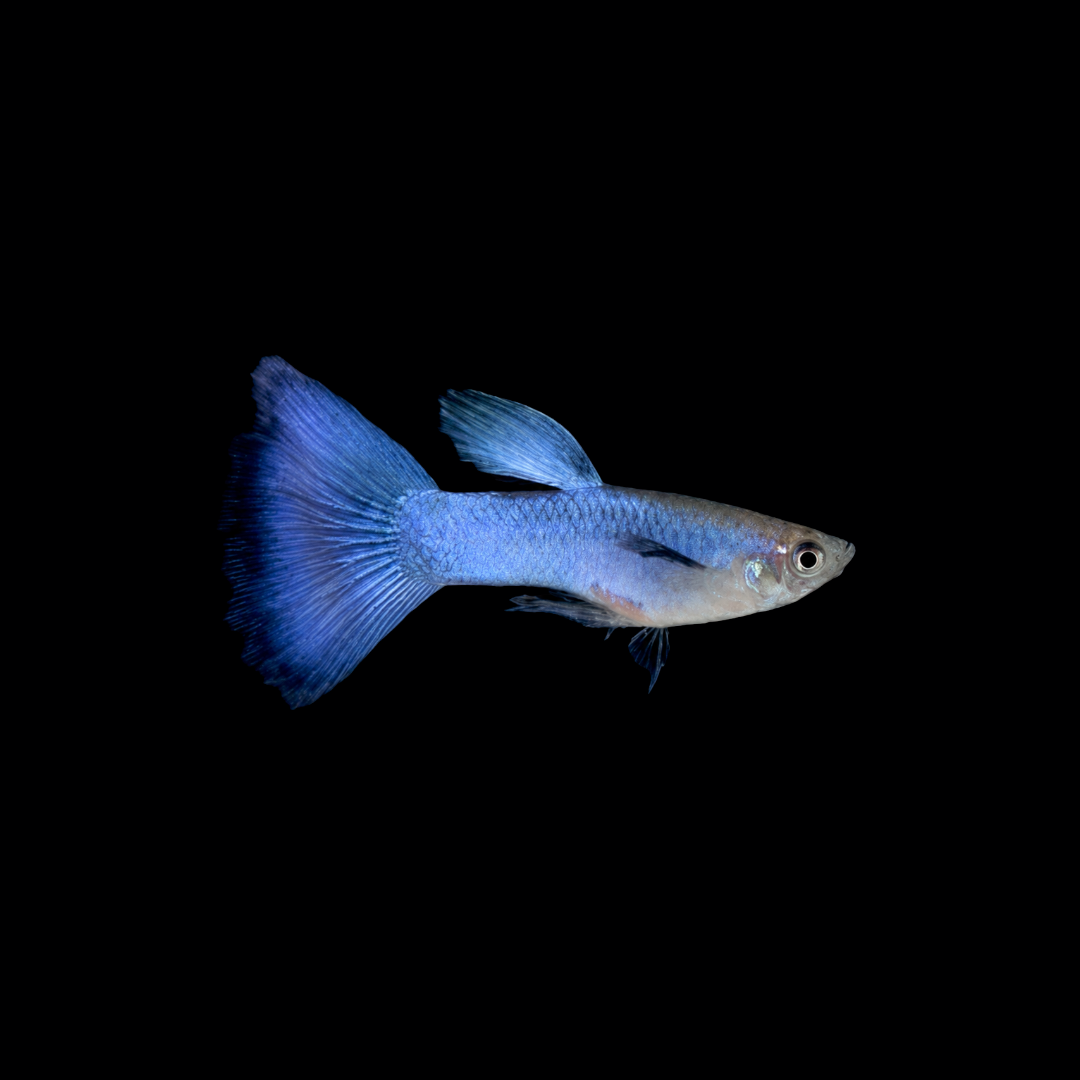
シンガーブルーテールグッピーは、シンガポールの養殖系統から見出された青色の変異をもとに作られた改良グッピーです。国内では「シンガーブルーテール」や「シンガーブルーブルーテール」などの名前で流通しています。この名前は、ボディの青色形質を指す「シンガーブルー」と、尾ビレの色を指す「ブルーテール」を組み合わせたものです。オスは頭部から胴体、尾筒(尾ビレの付け根)にかけて金属光沢のあるライトブルーに染まり、扇形やデルタ形に広がる大きな尾ビレと背ビレも青く色づきます。この青は青い色素によるものではなく、皮膚の中にある虹色素胞が光を反射して生み出す「構造色」です。そのため、光の当たり方や見る角度によって表情を変える、透明感のある輝きを楽しめます。体色を決める主な遺伝子はオスのY染色体に連鎖していると考えられており、国産グッピーの代表的な青系品種であるジャパンブルー(アクアマリン)と同系統の形質として扱われています。性質は温和で丈夫ですが、日本の水道水はグッピーが本来好む水質に比べてかなりの軟水です。底砂などでミネラルを補い、水質を安定させることが、美しい発色と長期飼育の鍵になります。The Singa Blue Tail Guppy is an ornamental guppy developed from a blue mutation found in Singaporean farm stocks. In Japan it is sold under names such as “Singa Blue Tail” and “Singa Blue Blue Tail.” The name combines “Singa Blue,” which refers to the blue body trait, with “Blue Tail,” which describes the fin coloration. Males are covered in a metallic light blue sheen from the head through the body to the caudal peduncle (the base of the tail), and their large fan-shaped or delta-shaped tail and dorsal fin are also tinted blue. This blue is not produced by blue pigment; it is a “structural color” created when iridophores in the skin reflect light. As a result, the fish shows a translucent shimmer that changes with lighting and viewing angle. The main gene responsible for the body color is thought to be linked to the male Y chromosome, and the trait is treated as belonging to the same lineage as the Japan Blue (Aquamarine), one of the classic blue strains in Japanese guppy breeding. The fish is peaceful and hardy, but Japanese tap water is much softer than guppies naturally prefer. Supplementing minerals through the substrate and keeping water parameters stable are the keys to vivid coloration and long-term keeping.
基本情報 / Basic Information
学名 / Scientific Name
Poecilia reticulata
通称 / Common Name
シンガーブルーテール、シンガーブルーブルーテール、シンガーブルー・ブルーデルタSinga Blue Tail, Singa Blue Blue Tail, Singa Blue Delta
分類 / Family
カダヤシ目 カダヤシ科 ポエキリア属(改良品種)Cyprinodontiformes, Poeciliidae, genus Poecilia (ornamental strain)
英名 / English Name
Singa Blue Tail Guppy, Singapore Blue Guppy
分布 / Distribution
原種のグッピーは、南米北東部とその沖合の島々(ベネズエラ、ガイアナ、トリニダード・トバゴなど)に自然分布します。本品種は人の手で作られた改良品種のため野生には存在せず、シンガポールやタイなどの東南アジアと日本国内で養殖・累代されています。The wild guppy is native to northeastern South America and nearby offshore islands (Venezuela, Guyana, Trinidad and Tobago, and others). This strain is a human-developed ornamental variety that does not occur in the wild; it is farmed and line-bred in Southeast Asia, including Singapore and Thailand, and in Japan.
最大体長 / Max Size
オス約3〜4cm(海外の大型系統では4〜5cm)、メス約4〜6cmMales about 3–4 cm (4–5 cm in some large overseas lines), females about 4–6 cm
寿命 / Lifespan
約1.5〜2年。安定した環境では3年近く生きる個体もいます。About 1.5–2 years. Some individuals live close to 3 years in a stable environment.
飼育環境 / Aquarium Environment
水槽サイズ / Tank Size
少数飼育であれば、水量20L以上を確保できる30cmキューブ水槽や36cm水槽から始められます。繁殖や群泳を楽しむ場合は、45cm規格水槽(約35L)〜60cm規格水槽(約57L)がおすすめです。水量が多いほど水温や水質が安定し、病気の予防にもつながります。グッピーは水面近くを泳ぎ、驚くと飛び跳ねることがあるため、隙間の少ないフタを用意しましょう。A small group can be started in a 30 cm cube or 36 cm tank that holds at least 20 L. For breeding or enjoying a school, a 45 cm standard tank (about 35 L) to a 60 cm standard tank (about 57 L) is recommended. A larger water volume keeps temperature and water quality more stable and helps prevent disease. Because guppies swim near the surface and may jump when startled, use a well-fitting lid.
水温 / Temperature
24〜27℃が目安です(適温25〜27℃、許容範囲はおおむね20〜28℃)。冬場の低水温は白点病の引き金になりやすいため、サーモスタット付きヒーターで一定に保ちます。24–27°C is the guideline (ideal 25–27°C, tolerated range roughly 20–28°C). Low winter temperatures easily trigger white spot disease, so keep the temperature constant with a thermostat-controlled heater.
水質 / Water Quality
pH 6.8〜7.8(中性〜弱アルカリ性)、総硬度(GH)8〜15 dH程度が目安です。日本の水道水の硬度は全国平均で50 mg/L前後(ドイツ硬度で約3 dH)とされ、グッピーの好む水質に比べるとかなりの軟水です。国内で累代された個体はpH 6.5〜7.0程度の水にも慣れていることが多いものの、極端な軟水や強い酸性の環境では、粘膜の劣化、ヒレの溶けや閉じ、発色や繁殖力の低下が起こりやすくなります。数値そのものよりも、短時間でpHが大きく変わらないようにすることを最優先にしましょう。Aim for pH 6.8–7.8 (neutral to slightly alkaline) and a general hardness (GH) of about 8–15 dH. Japanese tap water is said to average around 50 mg/L in hardness (about 3 dH), which is considerably softer than guppies prefer. Fish line-bred in Japan are often accustomed to water of about pH 6.5–7.0, but very soft or strongly acidic conditions tend to cause mucus deterioration, fin melting or clamping, and reduced coloration and fertility. Rather than chasing exact values, make avoiding large, sudden pH changes the top priority.
レイアウト / Layout
底砂は未処理の大磯砂(細目〜中目、厚さ3〜5cm)が基本です。軟水地域やpHが下がりやすい水槽では、サンゴ砂を全体の1〜2割ほど混ぜるか、ネットに入れたサンゴ砂や牡蠣殻をフィルター内に入れておくと、溶け出したカルシウムがpHと硬度を安定させてくれます。pHを強く下げるソイルや、流木の多用は避けましょう。大きな尾ビレを持つオスは強い水流で体力を消耗するため、スポンジフィルターなど水流の穏やかなろ過装置が向いています。背景を黒や濃い青のバックスクリーンにすると青の光沢が引き立ちます。照明は6,500〜8,000K前後の白色系LEDを使い、タイマーで1日8〜10時間程度に管理するのがおすすめです。Untreated Oiso gravel (fine to medium grain, 3–5 cm deep) is the basic substrate. In soft-water areas or tanks where pH tends to fall, mix in coral sand at about 10–20% of the total, or place coral sand or oyster shell in a net inside the filter; the dissolved calcium helps stabilize pH and hardness. Avoid soils that strongly lower pH and heavy use of driftwood. Males with large tails tire in strong currents, so a gentle filter such as a sponge filter is suitable. A black or dark blue background makes the blue sheen stand out. For lighting, white LEDs of about 6,500–8,000 K on a timer for around 8–10 hours a day are recommended.
注意点 / Precautions
最も重要なのは、国産グッピーと外国産グッピー、さらには仕入れ先やブリーダーの異なる系統同士を安易に混泳させないことです。外国産の個体は、症状が出ないまま病原体を持っている保菌魚である可能性が指摘されており、抵抗力を持たない国産個体が一気に発症して全滅に至る例が知られています。水槽だけでなく、網やホースなどの器具も分けて管理しましょう。また、グッピーは特定外来生物には指定されていませんが、生態系被害防止外来種リストに掲載されています。河川や水路への放流や遺棄は決して行ってはいけません。Most importantly, do not casually mix Japanese-bred guppies with imported guppies, or even lines from different suppliers or breeders. Imported fish have been suggested to possibly be symptom-free carriers of pathogens, and there are known cases where Japanese-bred fish without resistance fall ill all at once and the whole tank is lost. Keep nets, hoses, and other equipment separate as well as the tanks. In addition, although guppies are not designated as Specified Invasive Alien Species in Japan, they are listed among invasive species of ecological concern. Never release or dump them into rivers or waterways.
餌と給餌 / Feeding
餌の種類 / Diet
雑食性で、グッピー用の微粒ペレットやフレークなどの人工飼料をよく食べます。成長期の若魚や親魚には、孵化したてのブラインシュリンプ、ミジンコ(モイナ、ダフニア)、スピルリナ配合飼料などを組み合わせると、栄養のバランスが整います。Guppies are omnivorous and readily eat prepared foods such as guppy micro-pellets and flakes. For growing juveniles and breeders, combining these with newly hatched brine shrimp, water fleas (Moina, Daphnia), and spirulina-based foods gives a well-balanced diet.
給餌のポイント / Feeding Tips
1日2〜3回、2分程度で食べ切れる量を目安に与えます。食べ残しは水質の悪化やpHの低下につながるため、少量ずつ与えるのが基本です。人工飼料を主食にしながら生き餌を併用すると、体格の厚み、尾ビレの伸び、金属光沢の深みが増すと考えられています。稚魚用のブラインシュリンプには、エアレーションなしで孵化させられる市販品を使うと手軽です。Feed 2–3 times a day, giving only as much as is eaten in about two minutes. Leftover food leads to poorer water quality and lower pH, so feeding small amounts is the basic rule. Using prepared food as the staple while adding live foods is thought to improve body depth, fin growth, and the depth of the metallic sheen. For fry, commercial brine shrimp products that hatch without aeration are convenient.
性格と混泳 / Temperament and Tank Mates
性格 / Temperament
非常に温和で、他の魚を攻撃することはほとんどありません。ただしオスはメスを盛んに追いかける習性があるため、オス1匹に対してメスを2匹以上にすると、メスの負担を減らせます。Very peaceful and rarely attacks other fish. However, males constantly chase females, so keeping two or more females per male reduces stress on the females.
混泳の相性 / Compatibility
中性付近の水質を好む温和な生き物、たとえばコリドラス類、オトシンクルス、ヤマトヌマエビ、石巻貝などとは相性が良好です。一方、スマトラやサーペなどヒレをかじる魚や、大型シクリッドとの混泳は避けてください。ミナミヌマエビやチェリーシュリンプの成体とは同居できますが、生まれたばかりの稚エビは食べられてしまうため、ウィローモスなどで隠れ家を多めに用意しましょう。系統の維持や繁殖を目的とする場合は、稚魚が食べられることや他品種のグッピーと意図せず交雑することを防ぐため、本品種だけを単独の水槽で管理するのが基本です。Compatible with peaceful creatures that prefer near-neutral water, such as Corydoras, Otocinclus, Amano shrimp, and nerite snails. Avoid keeping them with fin-nippers such as tiger barbs or serpae tetras, or with large cichlids. Adult Neocaridina shrimp such as cherry shrimp can share the tank, but newborn shrimplets will be eaten, so provide plenty of cover such as willow moss. If the goal is to maintain the line or breed, keep this strain alone in its own tank to prevent fry from being eaten and to avoid unintended crossing with other guppy strains.
病気と対策 / Diseases and Prevention
かかりやすい病気 / Common Diseases
尾ぐされ病(カラムナリス症)は水質の悪化や急変がきっかけとなり、尾ビレの先端が白く濁ってささくれ、やがて溶けていきます。通称「グッピーエイズ」は、保菌個体の持ち込みによって発生する感染症と考えられており、発症した魚はヒレを閉じてふらつくように泳ぎ、高い確率で死に至るとされています。ハリ病は主に稚魚や若魚に見られ、尾ビレが閉じて針のように尖り、短期間で泳ぐ力を失います。白点病は低水温や水換え時の温度差で発生しやすく、体やヒレに白い粒が現れます。このほか、傷口に綿のようなものが付く水カビ病や、体表の白化、鱗の剥がれ、ただれを起こすテトラヒメナ症にも注意が必要です。Fin rot (columnaris) is triggered by poor or suddenly changing water quality; the tail tips turn cloudy white, fray, and eventually melt away. The condition commonly called “guppy AIDS” is thought to be an infectious disease introduced by carrier fish; affected fish clamp their fins, swim unsteadily, and are said to die at a high rate. “Needle disease” is seen mainly in fry and young fish; the tail closes into a needle-like point and the fish lose the ability to swim within a short time. White spot disease tends to occur with low temperatures or temperature differences during water changes, producing white specks on the body and fins. Also watch for water mold, which leaves cotton-like growth on wounds, and Tetrahymena infection, which causes whitening of the skin, scale loss, and ulceration.
対策と予防 / Prevention
尾ぐされ病には、隔離水槽での0.5%塩水浴(水10Lに食塩50g)と、グリーンFゴールド顆粒やエルバージュエースによる薬浴を組み合わせるのが一般的です。白点病では水温を28〜30℃までゆっくり上げてエアレーションを強め、塩水浴とメチレンブルーを併用します。水カビ病には塩水浴とメチレンブルーを用います。ハリ病は初期のうちに隔離して0.2〜0.5%の塩水浴とメチレンブルーで対処し、根本的な予防として親魚の飼育環境を見直し、過密飼育を避けます。グッピーエイズやテトラヒメナ症は発症後の治療が非常に難しいため、何より予防が大切です。新しい個体はトリートメントを済ませてから導入し、異なる系統を混泳させず、発症した個体はすぐに隔離して器具を熱湯消毒するなど、感染の広がりを防ぎましょう。なお、塩水浴を長く続けるとかえって粘膜を弱らせるため、途中で換水を挟みながら、1週間以内を目安に切り上げます。For fin rot, the common approach is a 0.5% salt bath (50 g of salt per 10 L) in a quarantine tank combined with medication such as Green F Gold granules or Elbazue Ace. For white spot, slowly raise the temperature to 28–30°C, strengthen aeration, and combine a salt bath with methylene blue. Water mold is treated with a salt bath and methylene blue. Treat needle disease early by isolating affected fish in a 0.2–0.5% salt bath with methylene blue; for fundamental prevention, review the breeders’ environment and avoid overcrowding. “Guppy AIDS” and Tetrahymena infection are very difficult to treat once they appear, so prevention matters most: quarantine new fish before introducing them, do not mix different lines, isolate sick fish immediately, and disinfect equipment with boiling water to stop the spread. Prolonged salt baths actually weaken the mucus coat, so include water changes along the way and end the bath within about a week.
増やし方(繁殖) / Breeding
雌雄の判別 / Sexing
オスは体が小さく、頭部から尾筒にかけて鮮やかな青色に染まり、大きな尾ビレを持ちます。尻ビレが細長い棒状の交接器(ゴノポディウム)に変化していることも決め手になります。メスはオスより大きく太めの体つきで、落ち着いた銀灰色をしています。良質な系統のメスでは、尾ビレの青みや体表の細かな光沢も見られます。雌雄の違いは生後1ヶ月前後から現れ始めます。Males are smaller, colored vivid blue from the head to the caudal peduncle, and have a large tail. An anal fin modified into a slender rod-like copulatory organ (gonopodium) is also decisive. Females are larger and stockier with a subdued silver-gray color. In good lines, females may also show a blue tint in the tail and a fine sheen on the body. Differences between the sexes begin to appear at around one month of age.
繁殖形態 / Reproduction
体内受精を行い、メスが卵ではなく稚魚を直接産む卵胎生です。25℃以上の安定した環境では、およそ30日周期で出産を繰り返します。メスは精子を体内に長く蓄えておけるため、一度交尾すれば、オスと離した後も複数回出産を続けることができます。出産が近づくとお腹が大きく張り、尻ビレの付け根にある黒い妊娠マークが目立つようになります。Fertilization is internal, and females give birth to live fry rather than laying eggs (livebearer). In a stable environment above 25°C, they give birth roughly every 30 days. Because females can store sperm for a long time, a single mating allows them to keep producing broods even after being separated from males. As birth approaches, the belly swells noticeably and the dark gravid spot at the base of the anal fin becomes prominent.
繁殖のポイント / Breeding Tips
親魚が稚魚を食べてしまうのを防ぐため、出産間近のメスは産卵ケースや外掛け式の隔離ボックスに移すか、マツモやサルビニアなどの浮草を厚めに浮かべて、稚魚の隠れ場所を作ります。美しい系統を保つには、計画的な選別が欠かせません。生後1ヶ月前後で雌雄を分けて、まだ交尾していないメスを確保します。成長の途中では、黒ずんだ虚弱な個体、極端に小さい個体、背骨の曲がった個体、頭を上げた姿勢で泳ぐ個体などを早めに外し、体型と発色が仕上がる生後4〜6ヶ月の時点で、最も優れた個体を種親に選びます。尾ビレの青にブラオ遺伝子を利用した分離血統では、青い尾ビレ同士を掛け合わせると、理論上、赤い尾(約25%)、青い尾(約50%)、青黒い尾(約25%)の子が生まれます。ブリードを目的に迎える場合は、分離するかどうかを事前に確認しておくと計画が立てやすくなります。また、近親交配を続けると奇形や体格の縮小を招くため、2系統以上に分けて累代し、数世代おきに掛け合わせるとよいでしょう。To prevent the parents from eating the fry, move a female close to giving birth into a breeding box or a hang-on isolation box, or float a thick layer of plants such as hornwort or Salvinia to give the fry places to hide. Planned selection is essential to keep a line beautiful. Separate the sexes at around one month to secure females that have not yet mated. During growth, remove weak darkened fish, extremely small fish, fish with curved spines, and fish that swim in a head-up posture early on, and choose the best individuals as breeders at 4–6 months, when body shape and color are complete. In segregating lines that rely on the Blau gene for the blue tail, crossing two blue-tailed fish theoretically produces offspring with red tails (about 25%), blue tails (about 50%), and bluish-black tails (about 25%). If you are acquiring fish for breeding, checking in advance whether the line segregates makes planning easier. Continued inbreeding also leads to deformities and smaller body size, so it is advisable to keep two or more separate lines and cross them every few generations.
雑学と豆知識 / Trivia and Fun Facts
1. シンガポール生まれの青と、ジャパンブルーとの深い縁 / 1. A Blue Born in Singapore and Its Close Ties to Japan Blue
「シンガー」という名前が示すとおり、この青のルーツは観賞魚養殖の世界的な拠点であるシンガポールにあります。海外の愛好家向けの資料では、シンガーブルーはシンガポールの養殖個体から初めて現れた、ジャパンブルーに関連するY染色体連鎖の変異として紹介されており、標準的なジャパンブルーに比べて反射がわずかに穏やかな点が特徴とされています。日本国内では、シンガポールから輸入されたネオンタキシードの中から現れ、アクアマリン(ジャパンブルー)と同質の遺伝子を持つ系統として紹介され、定着していったと伝えられています。導入当初は、愛好家の間で「アクアマリンとは別の変異なのか、それとも見た目のわずかな違いを呼び分けているだけなのか」という議論も交わされました。初期の個体は下半身を中心に青が乗るものが主流でしたが、その後の選抜育種によって、上半身から頭部付近まで広く青に覆われる表現へと磨かれていったと考えられています。正確な初出年や作出者を示す公的な記録は確認されていませんが、現在ではリボン、グラス、タキシード、さらには赤目のアルビノなど、さまざまな品種に組み込まれる重要な素材として育種の現場で活躍しています。As the name “Singa” suggests, this blue has its roots in Singapore, a global hub of ornamental fish farming. Materials for overseas hobbyists describe Singa Blue as a Y-linked mutation related to Japan Blue that first appeared in Singaporean farm stocks, noting that its reflection is slightly softer than that of standard Japan Blue. In Japan, it is said to have appeared among Neon Tuxedo guppies imported from Singapore and to have been introduced and established as a line carrying the same type of gene as Aquamarine (Japan Blue). When it first arrived, hobbyists debated whether it was a mutation distinct from Aquamarine or simply a name for a slight difference in appearance. Early fish mostly showed blue on the rear half of the body, but later selective breeding is thought to have refined the strain so that blue covers a wide area from the upper body to near the head. No official record of the exact year of origin or the original breeder has been confirmed, yet today the gene is an important building block in breeding, incorporated into many varieties such as Ribbon, Grass, Tuxedo, and even red-eyed albino strains.
2. 青は色素ではなく「光の干渉」で生まれる / 2. The Blue Comes from Light Interference, Not Pigment
意外なことに、シンガーブルーテールの青には、青い色素がほとんど関わっていません。グッピーの皮膚を詳しく調べた研究では、黒色素胞、黄色素胞、赤色素胞、虹色素胞、白色素胞という5種類の色素胞が確認されています。このうち虹色素胞の中には、グアニンでできたごく薄い結晶の板が規則正しく重なっています。そこで反射した光どうしが干渉し合うことで、青い光だけが強められて目に届くのです。シャボン玉の膜が虹色に光るのと同じ原理だと考えると分かりやすいでしょう。さらに、その下にある黒色素胞のメラニンが、反射されずに通り抜けた光を吸収するため、濁りのない金属的な青が浮かび上がります。つまり、光を返す層と光を吸い取る層の二段構えが、あの澄んだ青を作り出しているのです。赤目のアルビノを組み込んだ系統ではメラニンが作られず、この吸収層がなくなるため、通常の個体とはひと味違う、淡く透き通った青になると考えられています。Surprisingly, blue pigment plays almost no part in the Singa Blue Tail’s blue. Research examining guppy skin in detail has identified five types of chromatophores: melanophores, xanthophores, erythrophores, iridophores, and leucophores. Inside the iridophores, extremely thin plates of guanine crystals are stacked in a regular arrangement. As light reflected from these plates interferes with itself, only blue light is reinforced and reaches our eyes. It helps to think of the same principle that makes a soap bubble shimmer. In addition, melanin in the melanophores beneath absorbs the light that passes through without being reflected, so a clean metallic blue emerges. In other words, a two-layer system, one layer that returns light and one that absorbs it, creates that clear blue. In lines carrying the red-eyed albino gene, no melanin is produced and this absorbing layer is lost, which is thought to give a paler, more translucent blue than in normal fish.
3. 父から息子へ受け継がれる「Y染色体の青」 / 3. The “Y-Chromosome Blue” Passed from Father to Son
グッピーの性は人間と同じXY型で決まり、オスはXY、メスはXXの性染色体を持ちます。シンガーブルーの体色を生む遺伝子は原則としてY染色体に乗っているため、父親から息子へまっすぐ受け継がれ、メスには基本的に現れません。そのため、シンガーブルーのオスを他品種のメスと掛け合わせても、生まれたオスの多くにこの青い体色が受け継がれます。狙った色を次の世代に残しやすいという点で、育種家にとって扱いやすい性質といえます。ただし、近縁のジャパンブルーでは、Y染色体とX染色体の間で遺伝子の組み換えが起き、X染色体に青の遺伝子が乗った系統が生まれた例も報告されています。そのため、まれにメスに青みが出たり、代を重ねるうちに青い形質が失われたりする可能性も否定できません。一方、尾ビレの青は体色とは別の仕組みで、性染色体ではない常染色体上のブラオ遺伝子によって生まれることが多いとされます。一匹の魚の美しさの中に、性染色体と常染色体という二つの異なる遺伝の仕組みが重なり合っているのです。Guppy sex is determined by the same XY system as in humans: males carry XY and females XX sex chromosomes. Because the gene producing the Singa Blue body color is, in principle, carried on the Y chromosome, it passes directly from father to son and generally does not appear in females. As a result, even when a Singa Blue male is crossed with a female of another variety, many of the male offspring inherit the blue body color. This makes it easy to carry the desired color into the next generation, a convenient trait for breeders. However, in the closely related Japan Blue, recombination between the Y and X chromosomes has been reported to produce lines in which the blue gene sits on the X chromosome. For this reason, it cannot be ruled out that females occasionally show blue or that the blue trait is lost over generations. The blue of the tail, meanwhile, is said to arise through a different mechanism, often the Blau gene on an autosome rather than a sex chromosome. The beauty of a single fish thus combines two different modes of inheritance, sex-linked and autosomal.
4. 黒い背景で青が深まる理由 / 4. Why the Blue Deepens Against a Dark Background
「お店の暗い水槽では濃く見えたのに、白い砂の水槽に移したら色が薄くなった」という経験は、目の錯覚ではありません。魚には、周囲の明るさに合わせて体色を変える「背景適応」という仕組みが備わっています。暗い底砂や黒いバックスクリーンに囲まれると、神経やホルモンの働きによって黒色素胞の中のメラニンの粒が細胞全体に広がり、虹色素胞の下にある黒い吸収層が厚くなります。その結果、構造色である青い反射光がくっきりと際立つのです。反対に、白い背景や強いストレスの下ではメラニンの粒が細胞の中心に集められ、体色が淡くなります。魚類では、白い環境が長く続くと黒色素胞そのものの数が減り、色が薄いまま戻りにくくなることも報告されています。青系グッピーに黒いバックスクリーンや暗い色の底砂が定番とされるのは、見た目のコントラストだけでなく、魚自身の体の反応にも理由があるからなのです。The experience of a fish looking deeply colored in a shop’s dark tank but turning pale after being moved to a tank with white sand is not an optical illusion. Fish have a mechanism called “background adaptation” that adjusts body color to the brightness of their surroundings. When surrounded by dark substrate or a black background, nerves and hormones cause melanin granules in the melanophores to spread throughout the cells, thickening the dark absorbing layer beneath the iridophores. As a result, the reflected blue of the structural color stands out sharply. Conversely, against a white background or under strong stress, the melanin granules gather at the center of the cells and the color fades. In fish, it has also been reported that if a white environment continues for a long time, the number of melanophores itself decreases and the color tends to stay pale. Black backgrounds and dark substrates are standard for blue guppies not only for visual contrast but also because of the fish’s own bodily response.
5. よく似た青系品種との見分け方 / 5. Telling It Apart from Similar Blue Varieties
青を基調とする改良グッピーは数多く、シンガーブルーテールはしばしば他の品種と混同されます。最も近いのはジャパンブルー(アクアマリン)です。主に尾筒周辺の後半身が強く光る空色をしており、遺伝的にも極めて近い関係にあると考えられています。シンガーブルーは反射がやや柔らかく、青が全身に広がりやすい系統が多い点が違いとされます。モスコーブルーは頭部を含む全身が深い紺色から藍色に染まり、シンガーブルーよりも格段に暗く重厚な色合いです。ラズリーはジャパンブルーの青が頭部まで広がるタイプの品種とされ、ブルーグラスは尾ビレ全体に細かな黒い点模様が入ることで見分けられます。どの品種も「青いグッピー」とひとまとめにされがちですが、青がどこに、どんな濃さで乗っているかに注目すると、それぞれの個性が見えてきます。There are many blue-based ornamental guppies, and the Singa Blue Tail is often confused with other varieties. Its closest relative is the Japan Blue (Aquamarine), which shows a sky blue shining strongly mainly on the rear half of the body around the caudal peduncle and is thought to be genetically very close. Singa Blue is said to differ in having a somewhat softer reflection, with many lines showing blue spreading across the whole body. The Moscow Blue is colored deep navy to indigo over the whole body including the head, a far darker and heavier tone than Singa Blue. The Lazuli is said to be a type in which Japan Blue’s color extends to the head, and the Blue Grass can be identified by fine black dots across the entire tail. All of these tend to be lumped together as “blue guppies,” but paying attention to where the blue appears and how intense it is reveals the individuality of each.
6. 百貨店の高級魚から国民的熱帯魚へ / 6. From Department-Store Luxury to Everyone’s Tropical Fish
「グッピー」という名前は、19世紀にトリニダード島で採集した標本を大英博物館へ送った、ロバート・ジョン・レックミア・グッピーに由来しています。今では誰でも気軽に飼える熱帯魚ですが、日本に初めて渡来したのは大正時代の1920年頃と伝えられています。昭和初期には東京の一等地にある百貨店や高級果物店に並べられ、庶民には手の届かない憧れの存在だったといわれています。戦後になって一般家庭へと広まり、高度経済成長期の1960年代後半には最初のグッピーブームが訪れました。その後、1984年頃に日本で作出されたとされるブルーグラスをきっかけに、バブル経済の追い風も受けて、1980年代後半から1990年代半ばにかけて第2次ブームが起こります。ブーム末期には希少な個体に1ペア100万円もの値が付いたという話も、愛好家の間で語り継がれています。一方で、1990年代初め頃にいわゆるグッピーエイズが国内で問題となったことは、系統を守るための衛生管理の考え方を大きく変える転機になったと考えられています。シンガーブルーテールの澄んだ青も、こうした長い歴史と愛好家たちの工夫の積み重ねの上に輝いているのです。The name “guppy” comes from Robert John Lechmere Guppy, who in the 19th century sent specimens collected on Trinidad to the British Museum. Guppies are now tropical fish anyone can keep, but they are said to have first arrived in Japan around 1920, in the Taisho era. In the early Showa era they were reportedly displayed in department stores and luxury fruit shops in prime Tokyo locations, objects of admiration beyond the reach of ordinary people. After the war they spread to ordinary households, and the first guppy boom came in the late 1960s during Japan’s high-growth period. Later, sparked by the Blue Grass, said to have been developed in Japan around 1984, and helped by the bubble economy, a second boom took place from the late 1980s to the mid-1990s. Hobbyists still tell of a pair of rare fish fetching as much as one million yen near the end of the boom. At the same time, the emergence of so-called “guppy AIDS” in Japan in the early 1990s is thought to have been a turning point that greatly changed attitudes toward hygiene management for protecting lines. The clear blue of the Singa Blue Tail shines on top of this long history and the accumulated efforts of hobbyists.
7. 温泉と沖縄の川に暮らす「野生化グッピー」 / 7. “Feral Guppies” in Hot Springs and Okinawan Rivers
熱帯魚であるグッピーは、本来なら日本の冬の川で越冬することはできません。ところが、放流や逸出によって、冬でも温かい水が流れ込む各地の温泉の排水路などに、野生化した群れが定着してきました。これまでに長野、静岡、大分、鹿児島などの温泉地や小笠原諸島で確認されています。北海道のオンネトー湯の滝では、貴重な自然を守るために長年にわたる駆除が行われ、2019年に根絶が確認されました。とりわけ冬でも水温が保たれる沖縄では、1960年代頃から野外への定着が進んだと考えられており、現在では本島の都市河川などで数多く見られます。環境DNAを使って川にすむ魚の種類を調べた近年の研究では、沖縄のグッピーは原産地の南米に比べて出会う天敵の種類がずっと少ない「生態的解放」の状態にあることが明らかにされ、これが分布の拡大を後押しした可能性が示唆されています。つまり、本来なら天敵に狙われやすい鮮やかな体色も、天敵の少ない場所ではハンデにならないということです。シンガーブルーテールのような美しい改良品種も、ひとたび野外に放たれれば在来の生き物を圧迫する存在になりかねません。この青い輝きは、水槽の中でこそ守り続けていくべきものなのです。As a tropical fish, the guppy normally cannot survive winter in Japanese rivers. Yet through releases and escapes, feral populations have become established in places such as hot-spring drainage channels where warm water flows even in winter. They have been recorded at hot springs in Nagano, Shizuoka, Oita, Kagoshima, and elsewhere, as well as in the Ogasawara Islands. At Onneto Yunotaki in Hokkaido, years of removal work were carried out to protect valuable nature, and eradication was confirmed in 2019. In Okinawa, where water stays warm even in winter, guppies are thought to have begun establishing in the wild around the 1960s, and today they are common in urban rivers on the main island. A recent study that used environmental DNA to survey the fish living in rivers revealed that guppies in Okinawa are in a state of “ecological release,” encountering far fewer kinds of predators than in their native South America, and suggested that this may have helped them spread. In other words, vivid colors that would normally attract predators are no handicap where predators are few. Even a beautiful ornamental strain like the Singa Blue Tail could put pressure on native wildlife once released into the wild. This blue brilliance is something to be protected inside the aquarium.
まとめ / Conclusion
シンガーブルーテールグッピーは、光を受けるたびに表情を変える金属光沢のライトブルーと、水中でゆったりと広がる青い尾ビレを併せ持つ、透明感あふれる改良グッピーです。その青は色素ではなく光が織りなす構造色で、暗い背景と澄んだ照明の下でいっそう深みを増します。丈夫で温和な性格から初めての熱帯魚としても迎えやすく、群れで泳ぐ姿は水槽に涼やかな彩りを添えてくれます。The Singa Blue Tail Guppy is a luminous ornamental guppy that combines a metallic light blue, which changes its expression with every shift of light, and a blue tail that spreads gracefully in the water. Its blue is not pigment but a structural color woven from light, and it gains depth against a dark background under clear lighting. Its hardiness and peaceful nature make it easy to welcome as a first tropical fish, and a group swimming together adds a cool, refreshing color to the tank.
その一方で、日本の軟水に合わせた水質づくりや、系統の異なるグッピーを混ぜない衛生管理、Y染色体に連鎖する青を意識した選別など、少し踏み込んだ工夫にしっかり応えてくれる奥深さもこの魚の魅力です。世代を重ねるごとに変わっていく青の乗り方や尾ビレの形を見守りながら、自分の手で理想の一匹を育て上げていく。そんな楽しみを、長く味わわせてくれる魚です。At the same time, part of this fish’s appeal is the depth with which it rewards a little extra effort: adjusting water chemistry for Japan’s soft water, keeping guppies from different lines apart for hygiene, and selecting with the Y-linked blue in mind. Watching how the blue and the tail shape change from generation to generation while raising your own ideal fish is a pleasure this guppy offers for many years.
Poeser, F. N., Kempkes, M. & Isbrücker, I. J. H. (2005). Description of Poecilia (Acanthophacelus) wingei n. sp. from the Paría Peninsula, Venezuela, including notes on Acanthophacelus Eigenmann, 1907 and other subgenera of Poecilia Bloch and Schneider, 1801 (Teleostei, Cyprinodontiformes, Poeciliidae). Contributions to Zoology, 74(1/2): 97–115.
Schories, S., Meyer, M. K. & Schartl, M. (2009). Description of Poecilia (Acanthophacelus) obscura n. sp. (Teleostei: Poeciliidae), a new guppy species from western Trinidad, with remarks on P. wingei and the status of the “Endler’s guppy”. Zootaxa, 2266: 35–50.
Phang, V. P. E., Fernando, A. A. & Chia, E. W. K. (1990). Inheritance of the color patterns of the Blue Snakeskin and Red Snakeskin varieties of the guppy, Poecilia reticulata. Zoological Science, 7: 419–425.
Phang, V. P. E., Khoo, G. & Ang, S. P. (1999). Interaction between the autosomal recessive bar gene and the Y-linked Snakeskin Body (Ssb) pattern gene in the guppy, Poecilia reticulata. Zoological Science, 16(6): 905–908. https://doi.org/10.2108/zsj.16.905
Hatai, K., Chukanhom, K., Lawhavinit, O., Hanjavanit, C., Kunitsune, M. & Imai, S. (2001). Some biological characteristics of Tetrahymena corlissi isolated from guppy in Thailand. 魚病研究(Fish Pathology), 36(4): 195–199. https://www.jstage.jst.go.jp/article/jsfp1966/36/4/36_4_195/_article
Hoffman, G. L., Landolt, M., Camper, J. E., Coats, D. W., Stookey, J. L. & Burek, J. D. A disease of freshwater fishes caused by Tetrahymena corlissi Thompson, 1955, and a key for identification of holotrich ciliates of freshwater fishes. Journal of Parasitology. https://doi.org/10.2307/3278995



コメント