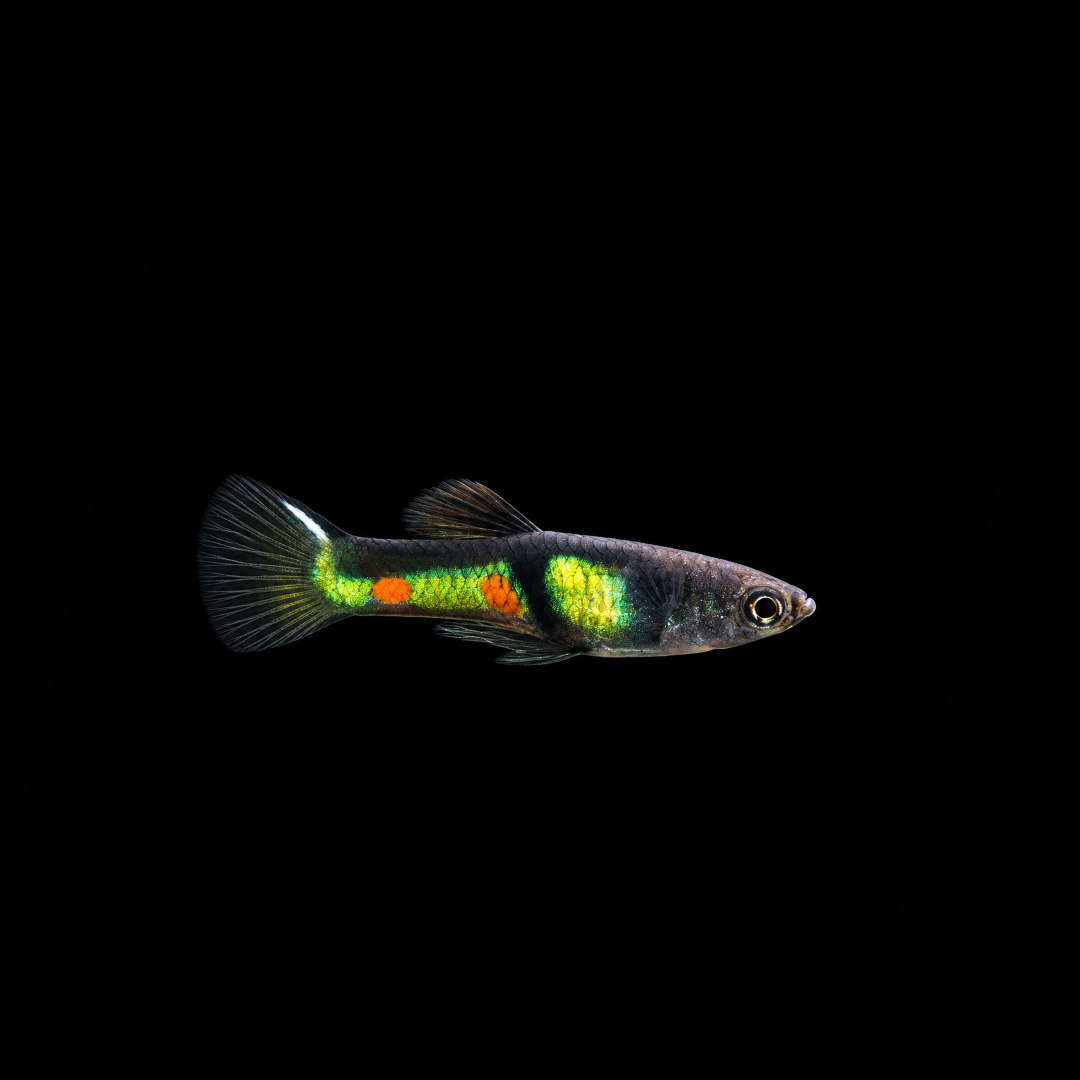
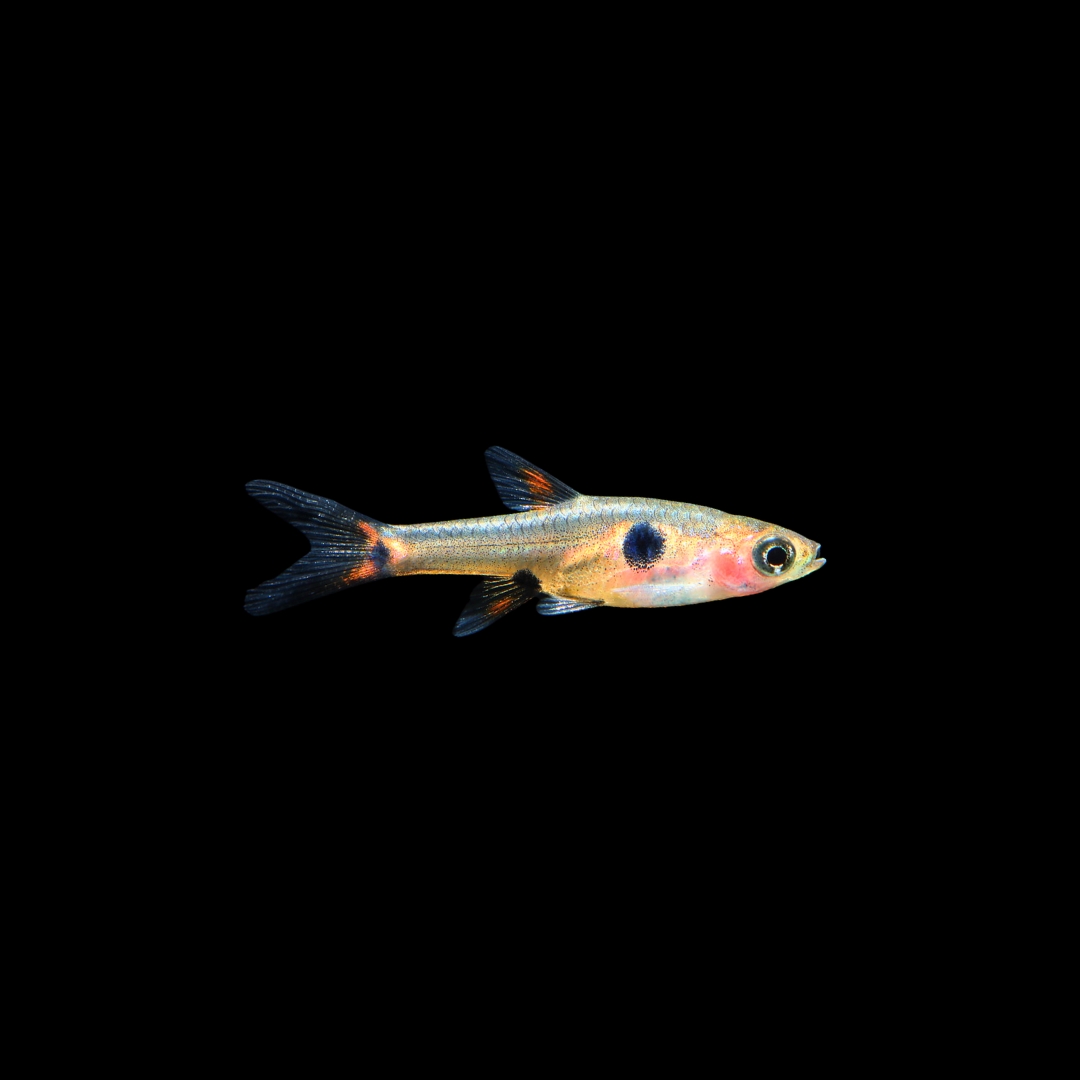
エンドラーズ・エルティグレは、ベネズエラ北東部カンポマ地域を流れる「エルティグレ小川」の個体群に由来する、原種系のエンドラーズ・ライブベアラーです。2011年にフランス人採集家フィリップ・ボワザン氏によって採集され、アクアリウムの世界に紹介されました。オスの体側には濃い黒の斑紋と金属光沢を帯びた緑、そして炎のように横へ走る橙色のスポットが複雑に入り組み、ひれを広げると背びれの黒がひときわ目を引きます。全長2cmほどの小さな体ながら、水槽の中で強い存在感を放つ魚です。採集地の小川はカンポマ湖とは水系がつながっていないため、エルティグレは湖の個体群とは別の、独立した地域個体群と考えられています。一般的なエンドラーズやグッピーに比べて1回に産む稚魚の数が少ないとされ、増やす楽しみに加えて、血統を丁寧に守り継いでいく奥深さも味わえます。種としてのエンドラーズ・ライブベアラーはIUCNレッドリストで絶滅危惧種(EN)に評価されており、水槽で純粋な系統を維持すること自体が、この種の多様性を守る取り組みとしても注目されています。The Endler’s Livebearer “El Tigre” is a wild-type Endler’s livebearer derived from the population of the El Tigre stream, which flows through the Campoma region of northeastern Venezuela. It was collected in 2011 by French collector Philippe Voisin and introduced to the aquarium hobby. The male’s flanks show an intricate mix of deep black markings, metallic green, and orange spots running horizontally like flames, and the black of the dorsal fin stands out strikingly when the fins are spread. Though only about 2 cm long, it has a strong presence in the aquarium. Because the stream is not connected to Laguna Campoma, El Tigre is considered an independent local population distinct from the lagoon fish. It is said to produce fewer fry per brood than typical Endlers or guppies, so in addition to the pleasure of breeding, keepers can enjoy the deeper challenge of carefully preserving the line. Endler’s livebearer as a species is assessed as Endangered (EN) on the IUCN Red List, and maintaining pure lines in the aquarium is increasingly recognized as a way of helping to preserve the species’ diversity.
基本情報 / Basic Information
学名 / Scientific Name
Poecilia wingei “El Tigre”
通称 / Common Name
エンドラーズ・エルティグレ、エルティグレ・エンドラーズEndler’s Livebearer “El Tigre”, El Tigre Endler
分類 / Family
カダヤシ目カダヤシ科ポエキリア属アカントファケルス亜属Cyprinodontiformes, Poeciliidae, genus Poecilia, subgenus Acanthophacelus
英名 / English Name
Endler’s Livebearer “El Tigre”
分布 / Distribution
ベネズエラ北東部スクレ州カンポマ地域のエルティグレ小川。カリアコとカサナイを結ぶ道路沿い、カリアコから約5kmの地点を流れるとされています。種全体としても、クマナ周辺からカンポマ地域にかけての限られた沿岸域にのみ分布します。The El Tigre stream in the Campoma region, Sucre State, northeastern Venezuela, said to flow along the road between Cariaco and Casanay about 5 km from Cariaco. The species as a whole is likewise restricted to a small coastal area from around Cumaná to the Campoma region.
最大体長 / Max Size
オス約2.0〜2.5cm、メス約4cm前後。オスはエンドラーズの中でもとりわけ小柄で華奢な体つきを保つ傾向があり、メスも一般的なエンドラーズのメス(最大4.5〜5cm)よりやや小ぶりです。Males about 2.0 to 2.5 cm, females about 4 cm. Males tend to remain especially small and slender even among Endlers, and females are slightly smaller than typical Endler females, which reach 4.5 to 5 cm.
寿命 / Lifespan
2〜3年程度。やや低めの水温で落ち着いた環境を保つと体への負担が抑えられ、4〜5年ほど生きる例もあるとされています。About 2 to 3 years. A calm environment at somewhat lower temperatures reduces physical strain, and lifespans of 4 to 5 years have been reported.
飼育環境 / Aquarium Environment
水槽サイズ / Tank Size
ペアでの繁殖が目的であれば、30cm規格水槽(約12L)や30cmキューブ水槽(約27L)から飼育できます。欧州では、水量30L以上の横長の水槽がひとつの目安とされています。複数のペアを維持したり、水草レイアウトで群れ泳ぐ姿を楽しんだりする場合は、水質が安定しやすく泳ぐスペースにも余裕がある60cm規格水槽(約57L)以上がおすすめです。For breeding a pair, a standard 30 cm tank (about 12 L) or a 30 cm cube tank (about 27 L) is sufficient. In Europe, a rectangular tank of at least 30 L is a common guideline. For keeping several pairs or enjoying a group in a planted layout, a standard 60 cm tank (about 57 L) or larger is recommended, as it keeps water quality more stable and offers ample swimming space.
水温 / Temperature
22〜26℃。日本では26℃前後に設定されたヒーターがよく使われますが、22〜24℃のやや低めの水温で管理すると、黒・緑・橙の発色がより鮮やかになるという報告があります。17℃を下回らないよう注意し、夏場は冷却ファンやエアコンを使って28℃以下に保ちましょう。22 to 26°C. Heaters preset to around 26°C are common in Japan, but some keepers report that a slightly cooler 22 to 24°C brings out more vivid black, green, and orange. Do not let the water drop below 17°C, and in summer use cooling fans or air conditioning to keep it at 28°C or below.
水質 / Water Quality
pH7.0〜8.0、総硬度(GH)7〜12程度の、中性から弱アルカリ性の中硬水が理想です。水質への適応力は高い魚ですが、日本の水道水は多くの地域で軟水寄りで、ソイルを使うとさらに弱酸性へ傾きます。pH6.0を下回るような環境では体調を崩しやすく、本来の金属光沢や繁殖力も発揮しにくくなります。酸処理されていない大磯砂を底床に使ったり、ろ過槽や底床の一部に少量のサンゴ砂を入れたりすると、硬度とpHを穏やかに高めに保てます。水換えは週1回、全体の3分の1程度を目安に行い、アンモニアと亜硝酸塩は常に検出されない状態を保ち、硝酸塩は20mg/L以下を目標にしましょう。Neutral to slightly alkaline, moderately hard water is ideal, around pH 7.0 to 8.0 and GH 7 to 12. The fish is adaptable, but tap water in most of Japan is on the soft side, and aqua soil pushes it further toward acidity. Below about pH 6.0 the fish is prone to poor health and is less likely to show its full metallic sheen and breeding vigor. Using untreated Oiso gravel as substrate, or adding a small amount of coral sand to the filter or part of the substrate, keeps hardness and pH gently elevated. Change about one third of the water once a week, keep ammonia and nitrite undetectable at all times, and aim for nitrate at 20 mg/L or less.
レイアウト / Layout
上層から中層を活発に泳ぐため、前景側には開けた遊泳スペースを確保しましょう。水草を食べることはほとんどないので、中性から弱アルカリ性の水でも丈夫に育つマツモ、ウィローモス、アヌビアス・ナナ、ベトナムスプライトなどを茂らせるのがおすすめです。茂みはオスの熱心な求愛から逃れたいメスの休み場所になり、稚魚の隠れ家としても生存率を高めてくれます。It swims actively in the upper and middle layers, so leave open swimming space toward the front. Since it rarely eats plants, dense growth of hardy species that thrive in neutral to slightly alkaline water, such as hornwort, Java moss, Anubias nana, and water sprite, is recommended. The thickets give females a place to rest from persistent male courtship and improve fry survival by providing cover.
注意点 / Precautions
グッピーや他の産地のエンドラーズとは簡単に交雑するため、同じ水槽で飼うのは避けてください。また、仕入れ先やブリーダーの異なる個体を同じ水槽に入れたり同じ網を使い回したりすると、病原体が持ち込まれて集団感染が起こることがあります。新しく迎えた個体は、別の水槽でしばらく様子を見てから合流させましょう。近縁のグッピーは日本の温泉地や南西諸島などで野生化しているため、飼いきれなくなった場合でも、決して川や池に放さないでください。It hybridizes readily with guppies and with Endlers from other localities, so do not keep them in the same tank. Placing fish from different suppliers or breeders in the same tank, or sharing a net between tanks, can introduce pathogens and cause outbreaks. Keep newly acquired fish in a separate tank for a while to observe them before introducing them. The closely related guppy has become established in the wild in Japanese hot-spring areas and the southwestern islands, so never release these fish into rivers or ponds, even if you can no longer keep them.
餌と給餌 / Feeding
餌の種類 / Diet
雑食性で、自然下では水生昆虫の幼虫を中心に、藻類や水底に積もった有機物なども食べています。飼育下では、ごく小粒の浮上性の人工飼料や細かく砕いたフレークを主食にし、孵化したてのブラインシュリンプやスピルリナ入りの餌を組み合わせると良いでしょう。It is omnivorous; in the wild it feeds mainly on aquatic insect larvae, along with algae and organic matter that settles on the bottom. In the aquarium, use very fine floating pellets or finely crushed flakes as the staple, combined with newly hatched brine shrimp and spirulina-based foods.
給餌のポイント / Feeding Tips
口がとても小さいので、水面近くで食べやすい細かな餌を選ぶことが大切です。動物性と植物性の餌をバランス良く与えることで、成長が早まり、色彩もより濃く仕上がっていきます。食べ残しは水質悪化の原因になるため、数分で食べきれる量を1日1〜2回与えるのが目安です。Its mouth is very small, so it is important to choose fine foods that are easy to take near the surface. A good balance of animal- and plant-based foods speeds growth and deepens coloration. Leftover food degrades water quality, so as a guide, feed once or twice a day only as much as is eaten within a few minutes.
性格と混泳 / Temperament and Tank Mates
性格 / Temperament
とても温和な魚です。オスはメスに対して熱心に求愛を繰り返し、ひれを広げて体を震わせるディスプレイを見せてくれます。オスの発色は水温や餌だけでなく、その時々の状態や個体同士の力関係によっても大きく変わり、条件が整うと背びれ全体が真っ黒に染まる個体も現れます。A very peaceful fish. Males court females persistently, spreading their fins and quivering their bodies in display. Male coloration changes considerably not only with temperature and diet but also with condition and social rank, and when conditions are right some males develop a completely black dorsal fin.
混泳の相性 / Compatibility
コリドラス類や小型のラスボラ類、ヤマトヌマエビやミナミヌマエビ、石巻貝やラムズホーンなど、温和な小型魚やエビ・貝類とはよく合います。一方、大型魚や、エンゼルフィッシュ、ベタ、繁殖期のラミレジィなど気性が荒くなりやすい魚は、捕食やストレスの原因になるため避けましょう。グッピーや他の産地のエンドラーズとの同居は、交雑につながるため厳禁です。It does well with peaceful small fish, shrimp, and snails, such as Corydoras, small Rasboras, Amano and cherry-type shrimp, nerite snails, and ramshorn snails. Avoid large fish and species that can become aggressive, such as angelfish, bettas, and breeding rams, as they can cause predation and stress. Never house it with guppies or Endlers from other localities, as this leads to hybridization.
病気と対策 / Diseases and Prevention
かかりやすい病気 / Common Diseases
最も警戒したいのは、愛好家の間で「グッピーエイズ」と呼ばれてきた致死率の高い感染症です。名前に反してウイルスによるものではなく、カラムナリス菌などによる細菌感染症と考えられています。輸入された個体の中には、自身は発症しないまま病原体を持っている個体がいるとされ、国内で繁殖された個体と混ぜることで一気に感染が広がることがあります。尾びれを細くすぼめて泳ぐ「針病」と呼ばれる状態や、不自然な泳ぎ方が初期のサインです。The greatest concern is a highly lethal infection that hobbyists have long called “guppy AIDS.” Despite the name, it is not caused by a virus and is thought to be a bacterial infection, such as columnaris. Some imported fish are believed to carry the pathogen without falling ill themselves, and mixing them with domestically bred fish can cause the infection to spread rapidly. Early signs include swimming with the tail fin clamped into a thin needle-like shape and abnormal swimming behavior.
対策と予防 / Prevention
発症した個体は隔離水槽に移し、0.3〜0.5%の塩水浴に加えて、グリーンFゴールド顆粒やエルバージュエースなど細菌性の病気に用いる魚病薬で薬浴を行います。ただし、薬浴をしても病原体を持った状態が完全に解消されるとは限りません。何よりの予防策は、由来の異なる個体を同じ水槽に入れたり、同じ網を使い回したりしないことです。同じブリーダーの同じ管理下にいた個体を追加する場合でもリスクはゼロではないため、導入前の隔離観察を習慣にしましょう。Move affected fish to a quarantine tank and treat them with a 0.3 to 0.5% salt bath together with a medication for bacterial fish diseases. Even so, treatment does not always fully eliminate the carrier state. The most important prevention is never placing fish of different origins in the same tank or sharing nets between them. Even fish added from the same breeder’s system carry some risk, so make quarantine observation before introduction a habit.
増やし方(繁殖) / Breeding
雌雄の判別 / Sexing
オスは小柄で黒・緑・橙の鮮やかな色彩をまとい、尻びれが棒状の交接器(ゴノポディウム)に変化しています。メスはオスよりひと回り以上大きく、全体に落ち着いた体色です。メスの背びれに黒が入るかどうかについては由来によって見解が分かれており、黒い背びれと網目模様を持つメスを特徴とする系統がある一方、メスの背びれが黒くならない系統も維持されています。Males are small, display vivid black, green, and orange, and have an anal fin modified into a rod-shaped copulatory organ called the gonopodium. Females are noticeably larger and more subdued in color overall. Views differ by origin on whether females show black in the dorsal fin: some lines are characterized by females with black dorsal fins and a net-like pattern, while other lines are maintained in which the female dorsal fin does not turn black.
繁殖形態 / Reproduction
卵胎生で、メスはお腹の中で卵をかえし、稚魚の姿で産みます。エンドラーズ全体を対象にした研究では、妊娠期間はおよそ23〜30日、1回の出産数は平均17匹前後、オスは生後5〜6週ほどで成熟するとされています。メスは精子を体内に蓄えておけるため、1回の交尾でほぼ毎月のように出産を繰り返します。ただしエルティグレは、他のエンドラーズやグッピーと比べて1回の出産数が少なく、爆発的には増えにくい系統とされています。It is a livebearer: the eggs hatch inside the female and the young are born as fry. Studies of Endler’s livebearer as a whole report a gestation period of about 23 to 30 days, an average of around 17 fry per brood, and male maturity at about five to six weeks of age. Because females can store sperm, a single mating can lead to births almost every month. El Tigre, however, is said to produce fewer fry per brood than other Endlers or guppies and not to multiply explosively.
繁殖のポイント / Breeding Tips
産まれる稚魚が少ないため、1ペアだけではメスに何かあった時点で系統が途絶えてしまいます。最初から2〜3ペア、あるいはメスを多めにした組み合わせで始めましょう。親が稚魚を食べることは少ないため、水草を多めに入れておけば隔離しなくても稚魚は育ちますが、隠れ家と十分な餌は欠かさないようにします。系統を厳密に管理したい場合は、オスが成熟する前の生後3〜4週で雌雄を分け、4〜6週間ごとに色彩の優れたオスを選んで親魚に残します。同じ血統を2つの水槽に分けて並行して維持し、数世代ごとに両者を交配させると、近親交配による弱体化や、事故による全滅を防ぎやすくなります。別の系統と交配すると純粋なエルティグレではなくなるため、避けてください。Because broods are small, keeping only one pair means the line ends as soon as anything happens to the female. Start with two or three pairs, or with a group that includes extra females. Parents rarely eat their fry, so with plenty of plants the young can grow up without being separated, but always provide cover and ample food. For strict line management, separate the sexes at three to four weeks of age, before males mature, and every four to six weeks keep the males with the best coloration as breeders. Maintaining the same line in two separate tanks and crossing the two every few generations helps prevent weakening from inbreeding and total loss from accidents. Avoid crossing with other lines, as the offspring will no longer be pure El Tigre.
雑学と豆知識 / Trivia and Fun Facts
1. 「虎」の名とゴミ捨て場の小川 / 1. The “Tiger” Name and a Stream by a Dump
エルティグレとは、スペイン語で「虎」を意味する言葉です。この名前は採集地の「エルティグレ小川」に由来するという説が最も広く知られていますが、愛好家の間では、ベネズエラの町エルティグレにちなむという説や、虎のような鮮烈な体色から、「エル・ティグレ」の愛称で知られるコロンビアのサッカー選手ラダメル・ファルカオにちなんだのではないかというユニークな説まで語られています。端正な姿からは想像しにくいのですが、2011年に見つかった小川は建材倉庫の裏手にあり、さまざまな廃棄物が捨てられたゴミ捨て場のような場所だったと伝えられています。網に入ったのも数十匹から100匹余りの小さな群れだったといわれ、汚れた水や酸素の乏しい環境にも耐えてきた、この魚のたくましさがうかがえます。El Tigre means “the tiger” in Spanish. The most widely known explanation is that the name comes from the El Tigre stream where it was collected, but hobbyists also tell other stories: that it refers to the Venezuelan town of El Tigre, or even, because of its striking tiger-like coloration, that it was named after Colombian footballer Radamel Falcao, nicknamed “El Tigre.” Hard as it is to imagine from its elegant appearance, the stream where it was found in 2011 is said to lie behind a building materials warehouse, in a place resembling a dump strewn with all kinds of waste. Only a small group of a few dozen to just over a hundred fish was reportedly netted, which hints at the toughness of a fish that has endured polluted, oxygen-poor water.
2. 5度のベネズエラ遠征が生んだ発見 / 2. A Discovery Born of Five Expeditions
エルティグレを世界に紹介したフィリップ・ボワザン氏は、2008年から2016年にかけて計5回ベネズエラを訪れ、クマナ周辺とカンポマ地域から多くの表現型(見た目の異なるタイプ)を欧州へ持ち帰ったとされています。カンポマ地域で最もよく知られる採集地はカンポマ橋の周辺で、そこで採集された個体群には1番から70番までの番号が付けられています。エルティグレはそのいずれでもなく、湖とつながらない小川に暮らす独立した個体群です。一部の海外フォーラムには特定の番号と関連づける記述も見られますが、採集者自身の記録で明確な対応関係は確認されていません。現在アクアリウムで維持されている純血系のエルティグレは、いずれも2011年に採集された個体に由来すると考えられています。Philippe Voisin, who introduced El Tigre to the world, is said to have visited Venezuela five times between 2008 and 2016, bringing many phenotypes (visually distinct types) from around Cumaná and the Campoma region back to Europe. The best-known collecting site in the Campoma region is around the Campoma bridge, and the populations collected there are numbered from 1 to 70. El Tigre is none of these; it is an independent population living in a stream that is not connected to the lagoon. Some overseas forums link it to a particular number, but no clear correspondence is confirmed in the collector’s own records. Pure El Tigre lines maintained in aquariums today are all thought to descend from fish collected in 2011.
3. 遺伝学者に捧げられた学名と、続く分類論争 / 3. A Name Honoring a Geneticist, and an Ongoing Debate
エンドラーズ・ライブベアラーは、2005年にポーザー、ケンプケス、イスブリュッカーの3名によって新種として記載されました。種小名の wingei は、20世紀前半にグッピーの色彩の遺伝を研究したデンマークの遺伝学者オイヴィンド・ウィンゲへの献名です。グッピーとはごく近い関係にありますが、交接器の形や尾の付け根周りの鱗の数、オスの金属光沢や求愛行動の違いなどを根拠に別種とされました。その後、遺伝子の解析から独立した種であることを支持する研究が発表された一方で、それに反論する研究も出されています。両種は簡単に交雑して子孫を残せることもあり、分類上の位置づけについては現在も意見が完全には一致していません。原産地の成り立ちについては、16世紀の嵐で塩田が水没して湖が生まれ、その後の地震で水系が分断されたことで独自の個体群が育まれた、という話も伝えられています。Endler’s livebearer was described as a new species in 2005 by Poeser, Kempkes, and Isbrücker. The species name wingei honors Danish geneticist Øjvind Winge, who studied the inheritance of guppy coloration in the first half of the twentieth century. Although very closely related to the guppy, it was recognized as a separate species on the basis of differences in gonopodium shape, the number of scales around the base of the tail, and the male’s metallic coloration and courtship behavior. Later, genetic studies were published supporting its status as a distinct species, while other studies disputed this. Because the two species readily interbreed and produce offspring, opinion on its taxonomic position is still not fully settled. As for the origin of its habitat, a story is told that a sixteenth-century storm flooded salt pans to form a lagoon, and that later earthquakes fragmented the waterways, giving rise to distinctive populations.
4. メスの背びれは黒いのか、黒くないのか / 4. Is the Female’s Dorsal Fin Black or Not?
エルティグレを語るうえで欠かせないのが、メスの背びれをめぐる見解の違いです。欧米のブリーダーの多くは、純血のメスは黒い背びれを持ち、次の世代のオスに黒をしっかり出すにはそうしたメスを親魚に使うべきだと考えています。一方、日本に初めて輸入された野生直系の個体を、他の系統と交配させずに長年維持してきた国内のブリーダーは、純粋な直系のメスは背びれが黒くならないと報告しています。このブリーダーの見立てでは、採集直後はオスばかりが流通したため、欧州では別系統のメスを掛け合わせた交雑系統が広まり、それが現在よく知られるエルティグレの姿になったのではないかとされています。採集直後の繁殖でいくつかの系統に枝分かれし、それぞれが別々に広まったと考えれば、どちらの観察も矛盾なく説明できます。背びれの色だけで本物かどうかを決めつけず、どこに由来する系統なのかを確かめることが大切です。No discussion of El Tigre is complete without the differing views on the female’s dorsal fin. Many Western breeders hold that pure females have black dorsal fins and that such females should be used as breeders to bring out strong black in the next generation of males. By contrast, a Japanese breeder who has maintained the first wild-line fish imported to Japan for many years without crossing them with other lines reports that pure wild-line females do not develop black dorsal fins. In this breeder’s view, because mostly males circulated right after collection, a hybrid line crossed with females from another strain spread in Europe and became the El Tigre most people know today. If the line split into several branches during breeding just after collection and each spread separately, both observations can be explained without contradiction. Rather than judging authenticity by dorsal fin color alone, it is important to confirm where a line comes from.
5. よく似た名前の「タイガーエンドラーズ」とは別物 / 5. Not to Be Confused with the “Tiger Endler”
海外のエンドラーズ愛好家の間では、原産地まで血統をたどれる純血の個体を「Class N」、見た目はエンドラーズでも血統の記録がない個体を「Class P」、他の種との交雑種を「Class K」と呼ぶ分類が、共通の物差しとして使われています。日本でよく起こる取り違えが、エルティグレと「タイガーエンドラーズ」です。名前はよく似ていますが、タイガーエンドラーズは改良グッピーとエンドラーズを掛け合わせたClass Kの交雑品種とされ、肩から尾にかけて縦方向の虎縞模様が走り、背びれや尾びれには白っぽさと黒い縁取りが入ります。また、グッピーの血が濃く入った個体は、全体にパステル調の淡い色合いになり、雌雄ともに大きく育ち、一度にたくさんの稚魚を産む傾向があります。姿と増え方の両面が、見分けるための手がかりになります。Among Endler enthusiasts abroad, a classification is used as a common yardstick: “Class N” for pure fish whose lineage can be traced to the wild, “Class P” for fish that look like Endlers but lack lineage records, and “Class K” for hybrids with other species. A frequent mix-up in Japan is between El Tigre and the “Tiger Endler.” Despite the similar names, the Tiger Endler is considered a Class K hybrid of Endlers and fancy guppies; it has vertical tiger stripes from shoulder to tail and whitish dorsal and tail fins with black edges. Fish with strong guppy ancestry also tend to have pale, pastel-like coloring, grow larger in both sexes, and produce many fry at once. Both appearance and breeding output offer clues for telling them apart.
6. 日本とエンドラーズの深い縁 / 6. Japan’s Long Connection with Endlers
日本の愛好家は、エンドラーズが広まり始めた早い時期から大きな役割を果たしてきました。2003年には、国内のあるブリーダーが米国から直接エンドラーズを導入し、約20年にわたって「オレンジボディ」や「ブルーネオン」などの独自の系統を作り出し、海外にも送り出していたとされています。エルティグレについては、国内のブリーダーの記録によると、2014年6月下旬にオス2匹とメス1匹、わずか3匹の野生直系個体が日本に入ったのが最初とされ、雌雄のそろった純粋な直系が輸入されたのはこの一度きりだった可能性が高いと指摘されています。その後、欧州で繁殖された個体やアジアの養殖個体を通じて名前は広く知られるようになりましたが、アジアからの輸入はオスに偏っているため、メスは今も手に入りにくい存在です。Japanese hobbyists have played a major role since the early days of the Endler’s spread. In 2003, a Japanese breeder is said to have imported Endlers directly from the United States and, over about twenty years, developed original lines such as “Orange Body” and “Blue Neon,” some of which were sent abroad. As for El Tigre, according to a Japanese breeder’s records, the first arrival was in late June 2014, when just three wild-line fish, two males and one female, came to Japan, and it is thought likely that this was the only time a pure wild line with both sexes was imported. Since then the name has become widely known through European-bred and Asian farm-raised fish, but imports from Asia are mostly males, so females remain hard to obtain.
7. 父から息子へ受け継がれる色彩 / 7. Colors Passed from Father to Son
エンドラーズは、グッピーと共通の祖先から受け継いだXY型の性決定の仕組みを持っています。つまり、Y染色体を持つ個体がオスになります。遺伝子の研究からは、エンドラーズのY染色体にはグッピーよりも多くの反復配列(同じ塩基配列の繰り返し)が蓄積していることが分かっており、生まれて間もない性染色体がどのように変化していくのかを知る手がかりとして注目されています。飼育者にとって身近なのは、オスの金属光沢や赤・緑・黒の主な模様の多くがこのY染色体に乗って、父から息子へと強く受け継がれる点です。そのため、色彩の優れたオスを親魚に選ぶことが、系統の色を守るいちばんの近道になります。一方で、色やひれの特徴の一部はX染色体や他の染色体にも関わっていることが示されており、メスの選び方もまた系統の姿を左右すると考えられています。Endler’s livebearer has an XY sex-determination system inherited from an ancestor it shares with the guppy, which means individuals carrying a Y chromosome become males. Genetic studies have found that the Endler’s Y chromosome has accumulated more repetitive sequences (repeated stretches of the same DNA) than the guppy’s, making it a focus of interest as a clue to how young sex chromosomes change over time. What matters most to keepers is that many of the male’s metallic sheen and main red, green, and black patterns are carried on this Y chromosome and passed strongly from father to son. Choosing well-colored males as breeders is therefore the surest way to preserve a line’s colors. At the same time, some color and fin traits have been shown to involve the X chromosome and other chromosomes, so the choice of females is also thought to influence how a line looks.
8. 絶滅危惧種として、そして研究のモデルとして / 8. An Endangered Species and a Research Model
原産地のエンドラーズは、5,000平方キロメートルにも満たない限られた沿岸域にしか分布していません。そこへ都市開発や汚水の流入、外来魚ティラピアの侵入、放流されたグッピーとの交雑が重なり、野生の個体群は減少していると考えられています。こうした状況から、IUCNレッドリストでは絶滅危惧種(EN)に評価されています。現地での調査や採集も難しくなっており、ボワザン氏が持ち帰ったカンポマ地域の系統の中には、すでに飼育下でも失われてしまったものが少なくないと伝えられています。そのため、愛好家が純粋な系統を維持することは、魚類保全プログラムCARESなどの取り組みとともに、生息地の外で種の多様性を守る「域外保全」としての意味を持つようになりました。さらに近年は、飼いやすさと色彩の多様さから、性染色体の進化、ホルモンと色模様のでき方の関係、観賞魚の養殖における水質浄化や動物福祉など、さまざまな分野の研究にも用いられています。In the wild, Endler’s livebearer is found only in a small coastal area of less than 5,000 square kilometers. Urban development, sewage inflow, invasive tilapia, and hybridization with released guppies are thought to be causing wild populations to decline. For these reasons, it is assessed as Endangered (EN) on the IUCN Red List. Field surveys and collecting have also become difficult, and it is reported that a considerable number of the Campoma lines Voisin brought back have already been lost even in captivity. Hobbyists maintaining pure lines, alongside fish conservation programs such as CARES, are therefore contributing to ex situ conservation, protecting the species’ diversity outside its natural habitat. In recent years, thanks to its ease of care and color variety, it has also been used in research across many fields, including sex chromosome evolution, the relationship between hormones and color pattern formation, water purification in ornamental fish culture, and animal welfare.
まとめ / Conclusion
エンドラーズ・エルティグレは、ベネズエラの小さな小川で見つかった、黒・緑・橙が鮮やかに交差する原種系のエンドラーズです。中性から弱アルカリ性の水とやや低めの水温、そして変化に富んだ餌を用意してあげれば、小さな体いっぱいに本来の色彩を輝かせてくれます。The Endler’s Livebearer “El Tigre” is a wild-type Endler from a small Venezuelan stream, with vivid black, green, and orange interwoven across its body. Given neutral to slightly alkaline water, a somewhat cool temperature, and a varied diet, it will glow with its true colors across its tiny body.
一度に産まれる稚魚が少ないぶん、一匹一匹の誕生がいっそういとおしく感じられる魚でもあります。他の系統と混ぜることなく世代を重ねていくことは、原産地で数を減らしつつあるこの魚の命を、手元の水槽から未来へとつないでいくことでもあるのです。Because only a few fry are born at a time, each new life feels all the more precious. Raising generation after generation without mixing in other lines is also a way of carrying the life of this fish, whose numbers are dwindling in the wild, from your own aquarium into the future.
Poeser, F. N., Kempkes, M. & Isbrücker, I. J. H. (2005). Description of Poecilia (Acanthophacelus) wingei n. sp. from the Paría Peninsula, Venezuela, including notes on Acanthophacelus Eigenmann, 1907 and other subgenera of Poecilia Bloch and Schneider, 1801 (Teleostei, Cyprinodontiformes, Poeciliidae). Contributions to Zoology, 74(1/2), 97–115.
Schories, S., Meyer, M. K. & Schartl, M. (2009). Description of Poecilia (Acanthophacelus) obscura n. sp., (Teleostei: Poeciliidae), a new guppy species from western Trinidad, with remarks on P. wingei and the status of the “Endler’s guppy”. Zootaxa, 2266, 35–50.
Herdegen, M., Alexander, H. J., Babik, W., Mavárez, J., Breden, F. & Radwan, J. (2014). Population structure of guppies in north-eastern Venezuela, the area of putative incipient speciation. BMC Evolutionary Biology, 14, 28. https://doi.org/10.1186/1471-2148-14-28
Alexander, H. J. & Breden, F. (2004). Sexual isolation and extreme morphological divergence in the Cumaná guppy: a possible case of incipient speciation. Journal of Evolutionary Biology, 17(6), 1238–1254. https://doi.org/10.1111/j.1420-9101.2004.00788.x
Morris, J., Darolti, I., Bloch, N. I., Wright, A. E. & Mank, J. E. (2018). Shared and species-specific patterns of nascent Y chromosome evolution in two guppy species. Genes, 9(5), 238. https://doi.org/10.3390/genes9050238
Winge, Ø. (1922). One-sided masculine and sex-linked inheritance in Lebistes reticulatus. Journal of Genetics, 12, 145–162.
Declercq, A. M., Haesebrouck, F., Van den Broeck, W., Bossier, P. & Decostere, A. (2013). Columnaris disease in fish: a review with emphasis on bacterium-host interactions. Veterinary Research, 44, 27. https://doi.org/10.1186/1297-9716-44-27


コメント