

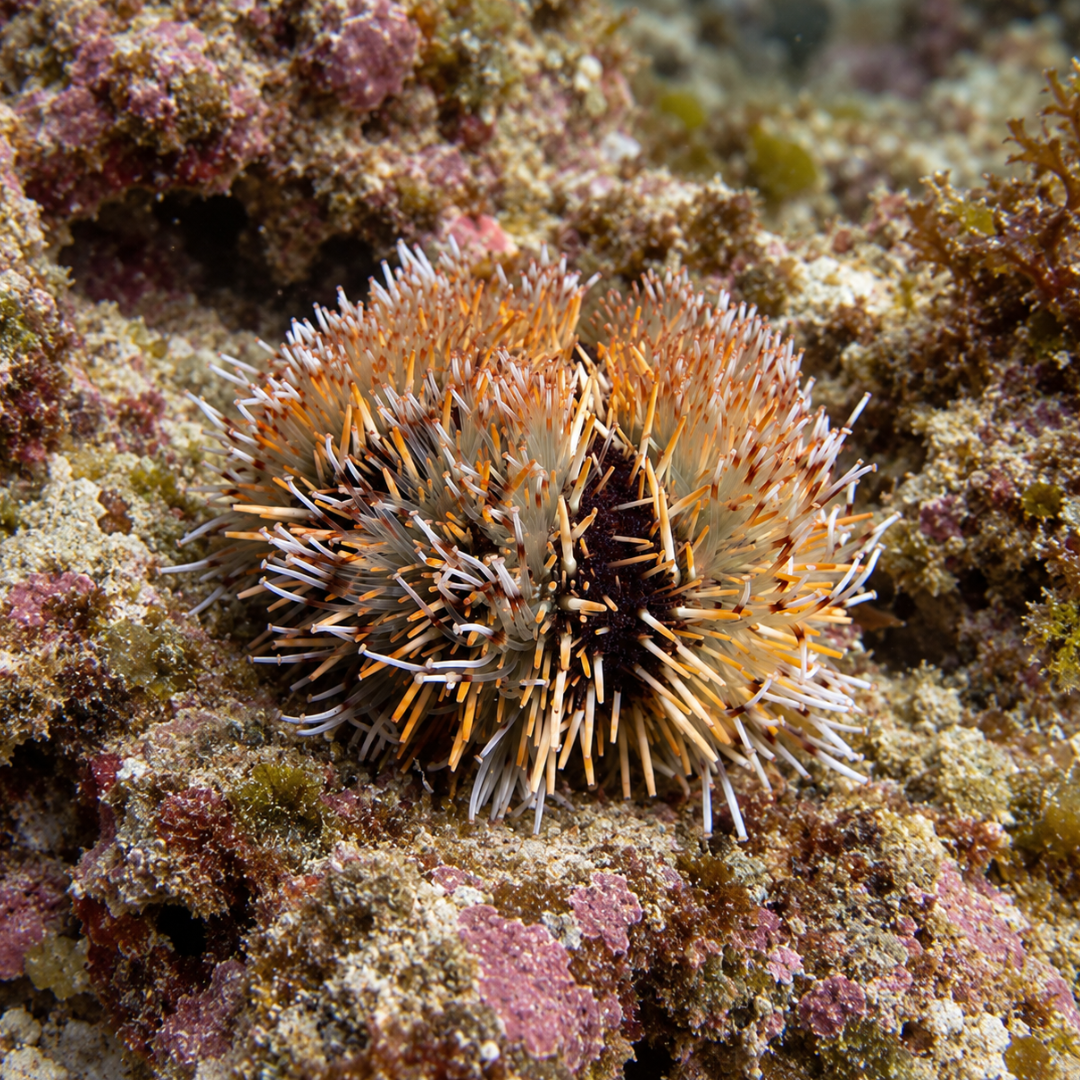
解説 / Description
シラヒゲウニは、インド太平洋の熱帯・亜熱帯域に広く分布する大型のウニで、暗色の殻に白色や橙色などの短い棘が並ぶ姿が印象的です。管足を器用に使い、海藻片や小石、貝殻などを背中側に乗せる「被覆行動」を日常的に行うことから、英名ではCollector urchinと呼ばれます。観賞下では他の生体を積極的に攻撃するタイプではありませんが、海草や藻類を旺盛に食べ、成長も速いため、小型水槽の「お掃除役」として気軽に導入する生体ではありません。十分な容量と安定した海水、豊富な餌、しっかり固定したレイアウトを用意できる環境で、その独特な行動と存在感をじっくり楽しめる種です。 The collector urchin is a large tropical to subtropical sea urchin widely distributed through the Indo-Pacific. Its dark test is set off by short spines that may be white, orange, or intermediate in color. Using its tube feet with remarkable dexterity, it routinely places pieces of algae, shells, rubble, and other objects on its upper surface, a behavior that inspired the English name “collector urchin.” In aquaria it does not usually behave aggressively toward tank mates, but it is a powerful grazer of seagrasses and algae and grows rapidly, so it should not be treated as a casual clean-up animal for a small marine tank. It is best appreciated in a spacious, mature system with stable seawater, abundant food, and securely fixed rockwork.
基本情報 / Basic Information
| 学名 / Scientific Name | Tripneustes gratilla (Linnaeus, 1758) |
|---|---|
| 通称 / Common Name | シラヒゲウニ、コレクターウニCollector urchin |
| 分類 / Family | 棘皮動物門・ウニ綱・ホンウニ目・ラッパウニ科・シラヒゲウニ属Phylum Echinodermata, Class Echinoidea, Order Camarodonta, Family Toxopneustidae, Genus Tripneustes |
| 英名 / English Name | Collector urchin |
| 分布 / Distribution | 紅海・東アフリカ沿岸からインド洋、西部・中部太平洋にかけての熱帯・亜熱帯域に広く分布し、日本では琉球列島や奄美群島をはじめ、暖流の影響を受ける南日本の海域で見られます。浅い海草藻場、サンゴ礁、岩礁、礫底などに生息し、浅場でよく見られる一方、より深い場所からの記録もあります。Widely distributed in tropical and subtropical waters from the Red Sea and East African coast across the Indian Ocean and into the western and central Pacific. In Japan it occurs in warm southern waters, including the Ryukyu and Amami islands and other areas influenced by warm currents. It inhabits seagrass beds, coral reefs, rocky areas, and rubble bottoms. It is often encountered in shallow water, although records also exist from greater depths. |
| 最大体長 / Max Size | 最大級では殻径15cm前後に達します。棘を含めると見た目の直径はさらに大きくなります。Large individuals can reach a test diameter of around 15 cm; the apparent overall diameter is larger when the spines are included. |
| 寿命 / Lifespan | 野外個体群の平均的な寿命は1〜2年と報告される一方、野外で6.85年生存した記録があります。さらに人工飼育下では、12.2年間の長期飼育後にも生存個体が確認されています。野外での短い平均寿命と、生理的に生存できる期間は分けて考える必要があります。Average life expectancy in wild populations has been reported as roughly 1–2 years, while a field record of 6.85 years is known. Under controlled rearing, individuals were still alive after 12.2 years. This distinction suggests that average survival in nature should not be treated as the species’ physiological maximum lifespan. |
飼育環境 / Aquarium Environment
| 水槽サイズ / Tank Size | 最低でも90cm規格水槽(約180L)を目安とし、成体を長期飼育するなら120cm規格水槽(約240L)以上がより安心です。殻径が大きく、行動範囲と摂餌量も大きいため、十分な底面積を確保してください。A 90 cm standard aquarium of around 180 L should be regarded as a practical minimum, while a 120 cm standard aquarium of roughly 240 L or larger is preferable for long-term adult care. Its large test, high grazing demand, and active movement require ample floor space. |
|---|---|
| 水温 / Temperature | 24〜27℃を中心に安定させます。30℃付近の高水温は特に幼生期で大きなストレスになることが知られているため、夏季は水温上昇を避けます。 Maintain a stable temperature centered around 24–27°C. Temperatures near 30°C are known to impose substantial stress, especially during larval development, so overheating should be prevented in summer. |
| 水質 / Water Quality | 一般的なリーフタンク相当の安定した海水を維持します。目安は比重1.023〜1.025、pH 8.1〜8.4。アンモニアと亜硝酸は検出されない状態を保ち、急激な比重・水温変化を避けてください。銅を含む薬剤はウニを含む無脊椎動物に強い毒性を示すため使用しません。Maintain stable reef-aquarium seawater. A useful target is specific gravity 1.023–1.025 and pH 8.1–8.4, with undetectable ammonia and nitrite. Avoid sudden changes in salinity or temperature. Copper-containing medications are highly toxic to sea urchins and other marine invertebrates and should not be used in their system. |
| レイアウト / Layout | 成熟したライブロックと広めの移動スペースを組み合わせ、岩組みは接着剤やパテなどで確実に固定します。シラヒゲウニは管足で物を持ち上げるため、固定の甘いサンゴ片や軽い飾りは動かされることがあります。自然な被覆行動ができるよう、小さな貝殻や安全な海藻片などを利用できる環境も相性が良いでしょう。Combine mature live rock with generous open grazing space, and secure rockwork firmly with suitable reef-safe adhesive or putty. The urchin can lift objects with its tube feet, so loose coral fragments and lightweight decorations may be moved. A setting where it can access harmless shell fragments or pieces of algae also allows natural covering behavior. |
| 注意点 / Precautions | 球形叉棘には毒腺があり、素手で強く触れると刺痛や炎症を生じる可能性があるため、移動は手でつかまず容器ごとすくう方法が安全です。また、非常に旺盛な藻類食性を持つため、観賞用の海藻・海草を育てる水槽には不向きです。ポンプ吸水口にはガードを設け、管足や棘の巻き込みも防いでください。Its globiferous pedicellariae contain venom glands, and forceful bare-handed contact can cause pain and inflammation. When moving the animal, gently guide it into a container rather than gripping it. Its grazing appetite is extremely strong, making it unsuitable for displays intended to maintain ornamental macroalgae or seagrasses. Protect pump intakes to prevent damage to tube feet and spines. |
餌と給餌 / Feeding
| 餌の種類 / Diet | 自然下では海草や大型海藻、付着藻類などを中心に食べ、基質表面を削るように摂食します。生息場所によって利用する餌は変わります。飼育下では水槽内の藻類だけに頼らず、無調味の海苔や海藻シート、アオサ類、海産草食動物向け配合飼料などを補助的に与えます。In nature it feeds mainly on seagrasses, macroalgae, and attached algal growth, scraping food from the substrate; the exact diet varies with habitat and food availability. In aquaria, natural algal growth should be supplemented as needed with unseasoned nori or marine algae sheets, Ulva-type seaweeds, and formulated foods for marine herbivores. |
|---|---|
| 給餌のポイント / Feeding Tips | 「水槽のコケだけで足りる」と考えず、体格と食欲を見ながら追加給餌します。餌不足では急速に痩せ、棘抜けや活動低下につながることがあります。海藻シートはクリップだけでなく岩に輪ゴムで固定するなど、底面で食べやすい形にすると利用しやすくなります。食べ残しは水質悪化を防ぐため回収してください。Do not assume that incidental aquarium algae will always be sufficient. Supplement according to body condition and appetite, because prolonged food shortage can lead to loss of condition, reduced activity, and spine loss. Present algae where the urchin can graze naturally, for example secured close to the rockwork or substrate, and remove uneaten food before it degrades water quality. |
性格と混泳 / Temperament and Tank Mates
| 性格 / Temperament | 他の生体を積極的に追い回すことはなく、基本的には温和です。ただし「おとなしい」というより、周囲を黙々と食べながら動き続ける大型の草食性無脊椎動物と考えるのが適切です。被覆用の物を拾ったり、固定の弱い物を押したりするため、行動そのものがレイアウトへ影響を与えることがあります。It is fundamentally peaceful and does not actively chase tank mates. It is better described, however, as a large grazing invertebrate that continuously moves and feeds rather than simply as a passive animal. Its habit of collecting objects and pushing against loosely placed items can affect the aquarium layout. |
|---|---|
| 混泳の相性 / Compatibility | 多くの温和な海水魚や無脊椎動物と混泳できます。主食は海草や藻類で、サンゴを主な餌とする種ではありませんが、固定されていないフラグを拾ったり倒したりすることがあります。モンガラ類、フグ類、大型ベラ類などウニを捕食・攻撃する魚との混泳は避けます。観賞用の大型海藻とは食害の面で相性がよくありません。It can coexist with many peaceful marine fishes and invertebrates. Its diet centers on seagrasses and algae rather than corals, although unsecured coral frags may still be lifted or knocked over. Avoid known urchin predators such as triggerfishes, puffers, and large wrasses. It is also a poor match for displays where ornamental macroalgae must remain uneaten. |
病気と対策 / Diseases and Prevention
| かかりやすい病気 / Common Diseases | 観賞飼育では特定の病名よりも、急変した水質、飢餓、高水温、物理的損傷などに伴う「棘抜け」や活動低下が問題になりやすい生体です。急速な棘の脱落、管足の反応低下、長時間の転倒、体表のただれなどは状態悪化のサインとして注意します。In aquarium care, environmental stress is usually a greater concern than a single named disease. Rapid spine loss, reduced tube-foot response, prolonged inability to right itself, or deteriorating body surfaces can accompany unstable water quality, starvation, overheating, or physical injury. |
|---|---|
| 対策と予防 / Prevention | 最も重要なのは水温・比重・pHを急変させず、十分な餌と高い溶存酸素を維持することです。棘抜けが始まった場合は、アンモニア・亜硝酸、比重、水温、餌不足、ポンプへの接触などを優先して確認します。銅系薬剤は使用せず、感染が疑われる重い症状では海産無脊椎動物を扱える専門家へ相談するのが安全です。Prevention depends primarily on stable temperature, salinity, and pH, adequate food, and good oxygenation. If spine loss begins, first check ammonia, nitrite, salinity, temperature, food availability, and possible contact with pumps or hard objects. Do not use copper-based treatments; severe cases suggestive of infection are best evaluated by a specialist familiar with marine invertebrates. |
増やし方(繁殖) / Breeding
| 雌雄の判別 / Sexing | 雌雄異体ですが、外見から確実に判別できる明瞭な性的二型はほぼありません。通常は放卵・放精時の配偶子を確認するか、専門的な生殖巣観察などで判別します。The sexes are separate, but there is little reliable external sexual dimorphism. Sex is usually confirmed by observing eggs or sperm during spawning, or by specialized examination of the gonads. |
|---|---|
| 繁殖形態 / Reproduction | 雌雄が卵と精子を海水中へ放出する体外受精型です。受精卵はプルテウス幼生となって浮遊生活を送り、発生が進むと海底の基質を探索して着底・変態し、稚ウニになります。It is a broadcast spawner with external fertilization. Fertilized eggs develop into planktonic pluteus larvae; after further development, competent larvae search for suitable benthic surfaces, settle, metamorphose, and become juvenile urchins. |
| 繁殖のポイント / Breeding Tips | 家庭水槽での計画繁殖は非常に難しく、親個体の産卵だけでなく、微細な浮遊幼生を別系統で管理し、植物プランクトンを安定供給する必要があります。研究・種苗生産では24〜27℃前後で幼生を育成し、約1か月を超える浮遊期を経て着底能力を得る例が知られています。無節サンゴモや成熟したバイオフィルムなどが着底の手掛かりになるため、一般的な魚の繁殖とはまったく異なる専用設備が必要です。Planned breeding in a home aquarium is extremely difficult. Successful culture requires not only spawning adults but also separate rearing of delicate planktonic larvae with a reliable supply of suitable microalgae. Hatchery studies commonly rear larvae around 24–27°C, with competency for settlement developing after a planktonic period of roughly a month or more. Crustose coralline algae and mature biofilms can provide settlement cues, so specialized larval-rearing equipment is required. |
雑学と豆知識 / Trivia and Fun Facts
| 1. 「収集家」の名を生んだ被覆行動 / 1. The covering behavior behind the name “collector” | シラヒゲウニを眺めていると、海藻片や貝殻、小石などがいつの間にか背中に乗っていることがあります。これは偶然ゴミが引っ掛かったのではなく、管足を使って自分で物を持ち上げ、反口側を覆う能動的な行動です。野外と実験室の研究では、明るい環境ほど被覆が増え、透明な素材より紫外線を通しにくい不透明な素材を選ぶ傾向が確認されています。つまり「何かを背負う」という一見ユーモラスな姿には、強い日差しから体を守るという切実な役割が含まれていると考えられます。さらに海藻などを被ることで周囲に紛れ、捕食者から見つかりにくくなる効果も期待できます。A collector urchin may appear to have random algae, shells, or rubble caught on its back, but the process is deliberate. It uses its tube feet to lift objects and place them over the aboral surface. Field and laboratory studies have found more covering under brighter conditions and a preference for opaque materials that block ultraviolet light better than transparent materials. What looks amusing to us is therefore thought to have a serious protective role against intense sunlight, while algae and other natural materials may also help the animal blend into its surroundings. |
|---|---|
| 2. 叉棘は「切り離して使える」防御装置 / 2. Pedicellariae can function as detachable defenses | ウニの棘の間には、ピンセットのような小さな器官である叉棘が並んでいます。シラヒゲウニの球形叉棘には毒腺があり、外敵から強い刺激を受けると、叉棘の頭部を自切して水中へ放出するという珍しい防御行動が知られています。切り離された叉棘も一定時間は機能し、捕食者の口や鰓などに噛みつくことがあります。さらに、この放出に伴って水中へ広がる化学的シグナルを捕食魚が避けることも実験で示されており、シラヒゲウニは接触してきた敵だけでなく、接近を続ける敵そのものを遠ざける仕組みを持つと考えられています。Between the spines are tiny pincer-like organs called pedicellariae. The globiferous pedicellariae of this species contain venom glands, and under strong simulated attack the urchin can shed pedicellaria heads into the water. Detached heads can remain functional and may clamp onto sensitive tissues of a predator. Experiments have also shown that fish avoid a waterborne chemical cue associated with this release, suggesting a defense that can discourage continued pursuit as well as punish direct contact. |
| 3. 海藻を減らす力は、環境破壊にも環境修復にもなる / 3. The same grazing power can damage or restore ecosystems | シラヒゲウニの食欲は、自然界では大きな生態学的力になります。密度が高まり過ぎると海草や大型海藻を食べ尽くし、海底景観を大きく変えてしまうことがあります。一方で、その旺盛な摂食力を逆に利用した例がハワイのカネオヘ湾です。サンゴを覆う侵略的な海藻を抑えるため、人工生産されたシラヒゲウニが放流され、海藻管理の一端を担いました。「食べる」という同じ行動が、場所と個体数によって破壊にも修復にも働くところに、本種の生態的な面白さがあります。The collector urchin’s appetite is an ecological force. Where densities become excessive, heavy grazing can remove seagrasses and macroalgae and dramatically alter the seafloor community. Yet the same feeding ability has been used constructively in Hawai‘i’s Kāneʻohe Bay, where hatchery-produced urchins have been released as part of efforts to suppress invasive algae that overgrow coral habitat. The same act of grazing can therefore contribute to degradation or restoration depending on place, density, and ecological context. |
| 4. 「短命なウニ」という印象を覆した12年以上の飼育記録 / 4. A 12-year rearing record changed the view of its lifespan | シラヒゲウニでは、野外個体群の平均寿命が1〜2年と報告されてきたため、生理的にも短命な種という印象を持たれやすくなっていました。ところが、人工種苗から育てた個体を長期間追跡した研究では、12.2年後にも8個体が生存していました。つまり、自然界で平均寿命が短いことと、体そのものが長く生きられないことは同じではありません。捕食や荒天、餌、環境変動など、野外特有の要因が寿命を大きく左右していると考えられます。Because average life expectancy in wild populations has often been reported as only one or two years, the species can easily be mistaken for an intrinsically short-lived animal. Long-term monitoring of hatchery-produced individuals changed that picture: eight animals were still alive after 12.2 years. In other words, short average survival in nature is not the same as a short physiological lifespan. Predation, storms, food availability, and other ecological pressures are thought to play major roles in limiting survival in the wild. |
| 5. 「アリストテレスの提灯」で岩肌を削る / 5. Aristotle’s lantern turns the seafloor into a feeding surface | 口側を観察すると、ウニ類に共通する複雑な咀嚼装置「アリストテレスの提灯」が働いています。5本の歯を含むこの口器を使い、シラヒゲウニは岩やサンゴ礫の表面を削るようにして付着藻類を食べます。水槽内でライブロックの表面を丹念に歩き続けるのは、単に移動しているだけではなく、広い面を少しずつ「刈り取って」いる時間でもあります。そのため藻類対策として頼もしい反面、餌となる藻類が尽きる速度も速く、飼育者が追加給餌へ切り替える判断が重要になります。Like other regular sea urchins, this species feeds with a complex jaw apparatus known as Aristotle’s lantern, which includes five continuously functioning teeth. It scrapes attached algae from rock and coral rubble surfaces as it moves. A collector urchin methodically crossing live rock is therefore not merely wandering; much of that journey is a grazing operation. This makes it effective at removing algae, but also means a closed aquarium can run out of natural food surprisingly quickly. |
| 6. 幼生は約1か月の漂流生活を経て「海底の合図」を探す / 6. Larvae spend about a month drifting before reading benthic cues | 受精後のシラヒゲウニは、親とまったく似ていない透明なプルテウス幼生として海中を漂います。種苗生産研究では、適した水温と植物プランクトン給餌のもとで発生が進み、およそ1か月を超えるころに着底能力を獲得します。そこで重要になるのが、無節サンゴモや基質上のバイオフィルムなどが示す「ここなら着底できる」という化学的・生物学的な合図です。同種の稚ウニやその糞便の存在によって着底率が高まった実験結果もあり、幼生はただ海底へ沈むのではなく、周囲の環境から手掛かりを受け取って変態へ進むことが分かっています。After fertilization, the animal looks nothing like an adult. It drifts as a transparent pluteus larva and develops while feeding on microscopic algae. Hatchery studies show that, under suitable conditions, settlement competency can develop after roughly a month or more. At that stage the larva responds to benthic cues such as crustose coralline algae and microbial biofilms. Experiments have also found higher settlement in the presence of live juveniles and their feces, showing that metamorphosis is not simply a matter of sinking to the bottom but of responding to environmental cues before settlement. |
| 7. 日本の海で見つけても、持ち帰る前に必ず確認を / 7. Wild collection in Japan requires local legal checks | 日本では沖縄や奄美などの暖かい海で出会えるウニですが、海産生物の採捕は場所によって漁業権や都道府県の規則、保護措置の対象になります。観賞用として欲しい場合でも、現地で見つけた個体をそのまま持ち帰るのではなく、正規に流通した個体を選ぶのが基本です。地域資源として長く利用されてきた生き物だからこそ、水槽の中で楽しむときにも、その土地の資源管理と自然個体群への配慮を切り離さない姿勢が大切です。In Japan, collector urchins occur in warm southern waters such as Okinawa and the Amami region, but collecting marine organisms may be restricted by local fishery rights, prefectural rules, or conservation measures. Aquarium keepers should therefore obtain legally traded specimens rather than assuming that a wild animal can simply be taken home. Because this species has long been part of local coastal resources, responsible aquarium keeping also means respecting the management of natural populations. |
まとめ / Conclusion
シラヒゲウニは、白色や橙色の短い棘と暗色の殻がつくる独特の姿に加え、自分で海藻や貝殻を背負う被覆行動まで観察できる海産無脊椎動物です。ライブロックを丹念に歩きながら表面の餌を削り取る姿には、サンゴ礁や海草藻場で暮らす大型の植食性ウニとしての生態がよく表れています。 The collector urchin is visually striking, with short white to orange spines contrasting against a dark test, but its appeal goes beyond appearance. Watching it deliberately carry algae and shells, cross live rock, and methodically scrape feeding surfaces reveals the natural behavior of a large herbivorous urchin shaped by life on reefs and seagrass habitats.
一方で、大きな体と旺盛な食欲、レイアウトを動かす力、毒腺をもつ叉棘など、小型のコケ取り生体とは異なる配慮が必要です。十分な広さと安定した海水、切らさない給餌、固定された岩組みを整えることで、単なる「掃除役」では終わらない独特の行動を落ち着いて観察でき、水槽の中でも強い存在感を見せてくれるでしょう。 Its size, appetite, strength, and venom-bearing pedicellariae also demand more preparation than a typical small clean-up animal. With adequate space, stable seawater, dependable feeding, and firmly secured rockwork, it can become far more than an algae grazer, offering distinctive behavior and an unmistakable presence in a marine aquarium.

気になる道具や飼い方を見つけてみませんか?
 アイのアクアグッズ案内水槽用ヒーターの選び方|固定式・温度調節式と、水量に合うW数の考え方水槽の魚は冬に寒くない? アイとコタロウが水温計から固定式・温度調節式・分離式ヒーターまで比較。水量と室温に合うW数、設置場所、水換えや交換の注意点を、国内メーカーの商品とともに紹介します。記事はコチラ →
 アイのアクアグッズ案内海水魚の底砂の選び方|サンゴ砂・ライブサンドとおすすめ商品道具の特徴や使い方、選ぶときのポイントをアイが紹介します。記事はコチラ →
 アイのアクアグッズ案内水槽ライトの選び方|魚の見え方・水草・海水で選ぶおすすめ照明道具の特徴や使い方、選ぶときのポイントをアイが紹介します。記事はコチラ →
 アイのアクアグッズ案内水槽のコケ掃除|道具の選び方とお掃除生体の得意・不得意道具の特徴や使い方、選ぶときのポイントをアイが紹介します。記事はコチラ →
さまざまな飼育テーマをご紹介。リンク先の記事には広告・商品紹介が含まれます。
案内・紹介記事一覧へ →分布マップ
シラヒゲウニ(Tripneustes gratilla)は、紅海・東アフリカ沿岸からインド洋、西部・中部太平洋にかけての熱帯・亜熱帯域に広く分布します。日本では琉球列島や奄美群島をはじめ、暖流の影響を受ける南日本の海域で見られます。
この地図はシラヒゲウニの広い分布域を把握するための概略表示です。表示しているマーカーは分布域を示すために設定した代表地点であり、実際の採集地点や特定の生息地点を示すものではありません。
参考文献
- 国立研究開発法人海洋研究開発機構(JAMSTEC)「Biological Information System for Marine Life(BiSMaL):Tripneustes gratilla (Linnaeus, 1758) シラヒゲウニ」Taxon ID: 9005151。分類および日本周辺の出現記録。
- Lawrence, J. M. & Agatsuma, Y. (2020). “Tripneustes.” In Lawrence, J. M. (Ed.), Sea Urchins: Biology and Ecology, 4th ed., Developments in Aquaculture and Fisheries Science, Vol. 43, pp. 681–703. Elsevier. DOI: 10.1016/B978-0-12-819570-3.00037-8.
- Klumpp, D. W., Salita-Espinosa, J. T. & Fortes, M. D. (1993). “Feeding ecology and trophic role of sea urchins in a tropical seagrass community.” Aquatic Botany, 45(2–3), 205–229. DOI: 10.1016/0304-3770(93)90022-O.
- Environment Canada, Method Development and Applications Unit, Science and Technology Branch (2014). Reference Method for Measuring the Toxicity of Contaminated Sediment to Embryos and Larvae of Echinoids (Sea Urchins or Sand Dollars). Reference Method 1/RM/58.
- Rahman, S., Tsuchiya, M. & Uehara, T. (2009). “Effects of temperature on hatching rate, embryonic development and early larval survival of the edible sea urchin, Tripneustes gratilla.” Biologia, 64(4), 768–775. DOI: 10.2478/s11756-009-0135-2.
- Sheppard Brennand, H., Soars, N., Dworjanyn, S. A., Davis, A. R. & Byrne, M. (2010). “Impact of Ocean Warming and Ocean Acidification on Larval Development and Calcification in the Sea Urchin Tripneustes gratilla.” PLOS ONE, 5(6), e11372. DOI: 10.1371/journal.pone.0011372.
- Dworjanyn, S. A. & Pirozzi, I. (2008). “Induction of settlement in the sea urchin Tripneustes gratilla by macroalgae, biofilms and conspecifics: a role for bacteria?” Aquaculture, 274(2–4), 268–274. DOI: 10.1016/j.aquaculture.2007.11.030.
- Sheppard-Brennand, H., Poore, A. G. B. & Dworjanyn, S. A. (2017). “A Waterborne Pursuit-Deterrent Signal Deployed by a Sea Urchin.” The American Naturalist, 189(6), 700–708. DOI: 10.1086/691437.
- Bielmyer, G. K., Brix, K. V., Capo, T. R. & Grosell, M. (2005). “The effects of metals on embryo-larval and adult life stages of the sea urchin, Diadema antillarum.” Aquatic Toxicology, 74(3), 254–263. DOI: 10.1016/j.aquatox.2005.05.016.
- Chiang, Y.-T. et al. (2026). “Integrated molecular and genetic insights into Bald sea urchin disease in Tripneustes gratilla (Linnaeus, 1758).” Aquaculture Reports, 48, 103538. DOI: 10.1016/j.aqrep.2026.103538.




コメント