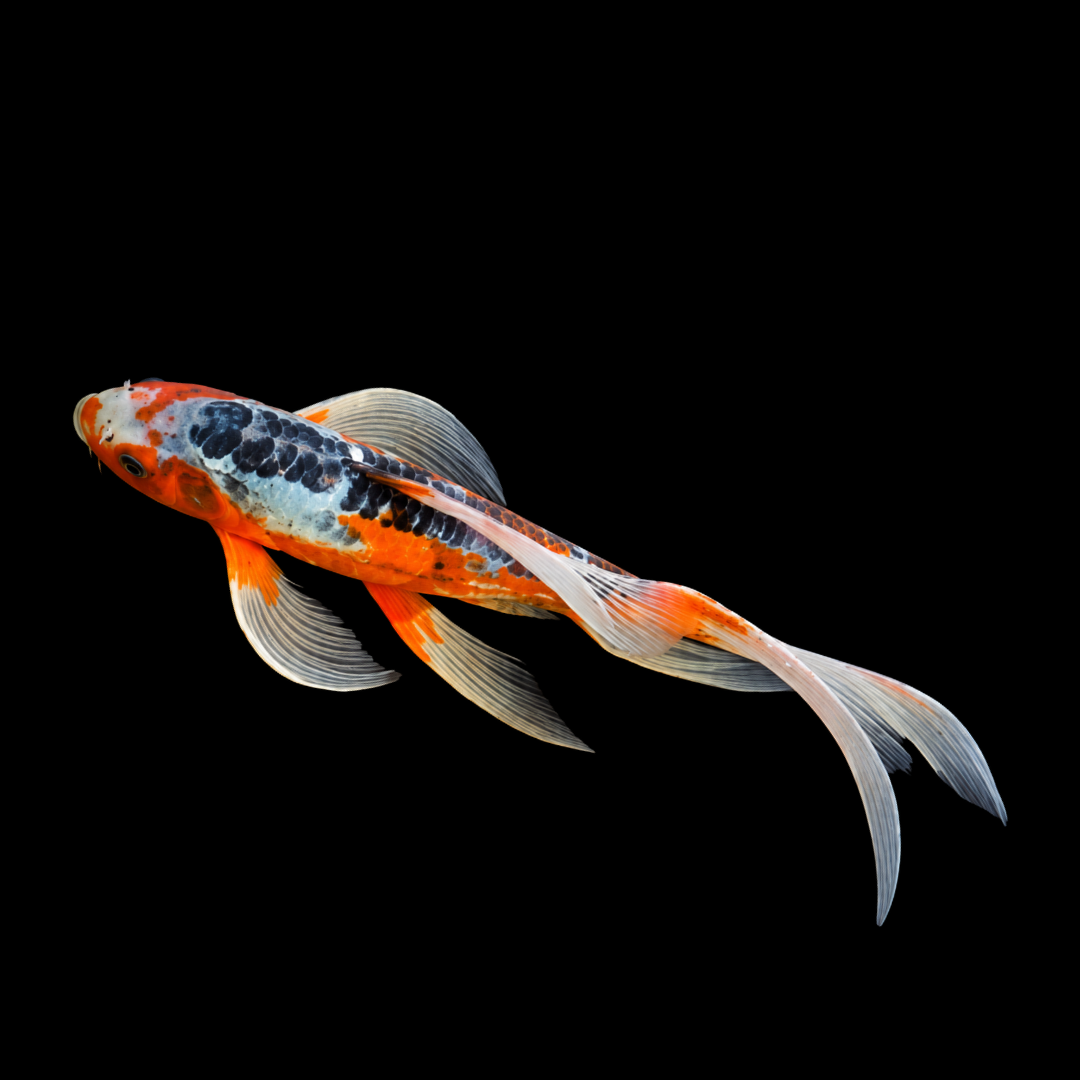
ヒレナガニシキゴイは、ニシキゴイとインドネシア由来の鰭が長いコイを交配し、埼玉県水産試験場で育成された観賞用品種です。胸鰭、腹鰭、背鰭、尾鰭が通常のニシキゴイより長く、泳ぐたびに薄い布のように水中をなびく姿が最大の魅力です。紅白や大正三色、秋水、浅黄、プラチナなど多彩な色柄があり、海外ではバタフライ・コイ、ロングフィン・コイとも呼ばれます。丈夫なコイの仲間ですが、成魚は大型になり、長い鰭を傷めない広い遊泳空間、強力なろ過、十分な酸素供給が欠かせません。小さな水槽に合わせて安全に小型化する魚ではないため、成長後まで見据えた設備を用意することが大切です。Hirenaga Nishikigoi is an ornamental strain developed at the Saitama Prefectural Fisheries Experiment Station by crossing Nishikigoi with long-finned carp introduced from Indonesia. Its pectoral, pelvic, dorsal and caudal fins are much longer than those of standard koi, trailing through the water like fine fabric whenever the fish swims. Many color varieties exist, including Kohaku, Taisho Sanshoku, Shusui, Asagi and Platinum, and the fish is widely known overseas as butterfly koi or longfin koi. Although it shares the hardiness of common carp, an adult becomes a large fish and requires ample swimming room, powerful filtration and generous aeration to protect its delicate fins. It does not remain safely miniature simply because it is kept in a small aquarium, so housing must be planned for its adult size.
コイ目コイ科コイ属。独立した野生種ではなく、コイの観賞用品種です。Order Cypriniformes, family Cyprinidae, genus Cyprinus. It is an ornamental strain of common carp rather than a separate wild species.
英名 / English Name
Butterfly Koi / Longfin Koi
分布 / Distribution
人為的に作出された品種のため自然分布はありません。日本で育成され、現在は世界各地の養鯉場や観賞池で飼育されています。河川や湖沼への放流は、生態系への影響と疾病拡散のおそれがあるため行ってはいけません。As a human-developed strain, it has no natural range. It was developed in Japan and is now maintained by koi breeders and pond keepers worldwide. It must never be released into rivers or lakes because of ecological and disease-transmission risks.
最大体長 / Max Size
成魚では50cmを超える大型魚で、目安は50〜80cmほどです。成長には系統や飼育環境による差があり、条件の整った池ではさらに大きくなることがあります。長い鰭まで含めると、見た目の全長は体長以上に大きく感じられます。Adults are large fish that commonly exceed 50 cm, with roughly 50–80 cm serving as a practical guide. Final size varies with lineage and husbandry, and fish in well-managed ponds may grow larger. The extended fins also make the fish appear longer than its body length alone.
寿命 / Lifespan
ヒレナガニシキゴイに限定した、信頼できる平均寿命の資料は十分ではありません。ただし、コイは長命な魚であるため、短期間で飼い切る魚とは考えず、長期飼育を前提にします。実際の寿命は水質、飼育密度、疾病管理、越冬環境に大きく左右されます。Reliable data defining an average lifespan specifically for Hirenaga Nishikigoi are limited. Common carp are nevertheless long-lived fish, so they should be regarded as a long-term commitment rather than a short-lived aquarium species. Actual longevity depends greatly on water quality, stocking density, disease control and winter conditions.
飼育環境 / Aquarium Environment
水槽サイズ / Tank Size
体長10cm前後の幼魚をゆとりを持って育てる場合も、90cm規格水槽(約180L)以上を一時的な育成環境の目安とします。成長中の単独個体には120cmワイド水槽(120×60×60cm、約430L)以上を検討しますが、これも終生飼育を保証する大きさではありません。成魚は庭池での飼育を基本とし、水槽で管理する場合は200cm級以上の設備を視野に入れます。必要な水量は魚体、頭数、ろ過能力によって変わるため、容量だけで可否を判断しません。For a juvenile around 10 cm, a 90 cm standard aquarium of roughly 180 L is a useful guide for a roomy but temporary grow-out home. A growing single fish calls for consideration of at least a 120 cm wide aquarium measuring 120 × 60 × 60 cm, about 430 L, but even this does not guarantee adequate lifelong space. Adults are fundamentally pond fish; if maintained in an aquarium, a system in the 200 cm class or larger should be anticipated. Required water volume depends on fish size, number and filtration capacity, so suitability cannot be judged by volume alone.
水温 / Temperature
屋内で安定管理する際は15〜25℃を目安にできますが、コイは季節に応じた幅広い水温に適応します。重要なのは急変を避けることで、水換え時も温度差を小さくします。低水温では活動と消化が鈍るため、魚の反応と飼料の表示に合わせて給餌量を減らします。高温時は溶存酸素が低下しやすいので、十分なエアレーションが必要です。For stable indoor management, 15–25°C can be used as a practical guide, although carp adapt to a broad seasonal temperature range. Avoiding abrupt change is more important than holding one exact value, and replacement water should be closely temperature matched. As activity and digestion slow in cool water, reduce feeding according to the fish’s response and the food manufacturer’s directions. Warm water holds less oxygen, so ample aeration is essential.
水質 / Water Quality
淡水、pH6.5〜8.0を目安に、アンモニアと亜硝酸は検出されない状態を維持します。排せつ量が多いため、十分に立ち上がった大型ろ過槽と常時の酸素供給が必要です。硝酸塩と溶存有機物をためないよう、ろ材を一度に洗い切らず、定期的な部分換水と底面清掃を行います。Maintain freshwater at approximately pH 6.5–8.0, with no detectable ammonia or nitrite. Because koi produce a heavy waste load, a mature, oversized biological filter and continuous oxygenation are essential. Control nitrate and dissolved organic waste with regular partial water changes and bottom cleaning, while avoiding the simultaneous over-cleaning of all biological media.
レイアウト / Layout
長い鰭が接触しにくい、広く開けた遊泳空間を優先します。水槽は管理しやすいベアタンク、池は角の丸い素材が安全です。鋭い石や枝状の流木は避け、吸水口には目の細かいストレーナースポンジやガードを付けます。強い一点流は避けつつ、水全体がよどまない循環をつくり、飛び出しを防ぐ頑丈なフタまたはネットを確実に固定します。Prioritize a broad, open swimming area where the long fins will not snag. A bare-bottom aquarium is easiest to maintain, while ponds should use smooth-edged materials. Avoid sharp rocks and branched wood, and cover every intake with a fine pre-filter sponge or guard. Provide complete circulation without a harsh concentrated jet, and secure a strong lid or pond net against jumping.
注意点 / Precautions
購入前に、成魚用の池または大型水槽まで含めた飼育計画を立てます。新しい個体は別容器で一定期間観察し、網やホースなどを共用しないことが感染症予防の基本です。移動時は鰭が絡みにくい無結節網と十分な大きさの容器を使い、網に入れたまま魚体を持ち運びません。小さな水槽で意図的に成長を抑える飼い方は、水質悪化や健全な発育を妨げる原因になるため避けます。Before purchase, make a husbandry plan that already includes an adult-sized pond or large aquarium. Observe every newcomer separately for an appropriate quarantine period and do not share nets, hoses or other equipment between systems. For handling, use a suitably large knotless net and a water-filled transfer container; never carry the fish’s weight in the net. Deliberately restricting growth in a small tank risks poor water quality and impaired healthy development and should be avoided.
餌と給餌 / Feeding
餌の種類 / Diet
雑食性です。主食にはサイズと水温に合う良質なニシキゴイ用浮上性または沈下性配合飼料を用います。胚芽配合の低水温用飼料、成長期用飼料、スピルリナやアスタキサンチンを含む色揚げ飼料は、季節と目的に合わせて使い分けます。補助的にゆでたエンドウ豆や葉物野菜なども食べますが、栄養の偏りと水の汚れを防ぐため少量にします。This is an omnivorous fish. Use a high-quality floating or sinking koi pellet appropriate to the fish’s size and water temperature as the staple. Wheat-germ cool-season diets, growth formulas, and color-enhancing foods containing spirulina or astaxanthin can be selected according to season and purpose. Small amounts of cooked peas or leafy greens may be offered as supplements, but should not unbalance the diet or foul the water.
給餌のポイント / Feeding Tips
活発に摂餌している時期は、数分で食べ切る量を基本とし、体形、水温、ろ過能力、飼料の表示に合わせて回数を調整します。食べ残しはすぐに回収します。低水温では量と回数を減らし、高水温による酸欠時、輸送直後、体調不良時は無理に与えません。色揚げ飼料だけを長期間多給するより、季節に応じた総合栄養と水質維持を優先します。During periods of active feeding, offer only what the fish finish within a few minutes and adjust frequency to body condition, water temperature, filter capacity and the food manufacturer’s directions. Remove leftovers promptly. Reduce both amount and frequency as the water cools, and do not force feeding during heat-related oxygen stress, immediately after transport or when fish are unwell. Balanced seasonal nutrition and clean water matter more than prolonged heavy feeding of color food alone.
性格と混泳 / Temperament and Tank Mates
性格 / Temperament
温和で人に慣れやすく、複数でゆるやかな群れをつくります。飼育に慣れた個体は、給餌時に人影へ寄って水面に集まることがあります。餌を探して底をつつく力は強く、植えたばかりの水草を抜いたり、柔らかな葉を食べたりします。驚くと勢いよく泳ぐため、狭い水槽や障害物の多い環境では鰭や体を傷めやすくなります。Generally peaceful and readily accustomed to people, these koi form loose groups. Fish that are comfortable in their surroundings may approach people and gather at the surface at feeding time. Their vigorous bottom-foraging can uproot newly planted vegetation and consume tender leaves. When startled they accelerate powerfully, making cramped or cluttered enclosures especially hazardous to the fins and body.
混泳の相性 / Compatibility
最も安全なのは、十分な広さの池で同程度の大きさのニシキゴイと飼う方法です。長い鰭をかじる魚、攻撃的な大型魚、吸盤状の口で体表を傷つける可能性がある魚との混泳は避けます。小魚や小型のエビは口に入れば食べられることがあります。金魚との同居は可能な場合もありますが、給餌競争、体格差、病原体の持ち込みを考え、余裕ある水量と検疫が必要です。The safest companions are similarly sized standard koi in a sufficiently large pond. Avoid fin-nipping species, aggressive large fish, and sucker-mouthed fish that may damage the skin. Small fish and shrimp may be eaten if they fit in the mouth. Cohabitation with goldfish can work in some large systems, but feeding competition, size differences and pathogen transfer make ample space and quarantine essential.
病気と対策 / Diseases and Prevention
かかりやすい病気 / Common Diseases
白点病、エラや体表に寄生する吸虫類、カラムナリス症による鰭の白濁・崩れ、エロモナス感染症による充血や潰瘍などが見られます。長い鰭の裂傷は二次感染の入口になります。コイヘルペスウイルス病(KHV病)は、食欲低下、異常遊泳、エラの退色や壊死、まとまった死亡を起こし得る重要疾病で、外見だけでは確定診断できません。Problems include white spot disease, skin or gill flukes, fin clouding and erosion associated with columnaris disease, and reddening or ulcers caused by Aeromonas infections. Tears in the extended fins can become entry points for secondary infection. Koi herpesvirus disease, or KHVD, is a serious condition that may cause appetite loss, abnormal swimming, pale or necrotic gills and group mortality; it cannot be confirmed from appearance alone.
対策と予防 / Prevention
過密を避け、アンモニアと亜硝酸が検出されない状態を保ち、急な水温変化や鰭の擦れ傷を防ぐことが基本です。新しい魚は隔離観察し、網やホースを分けます。異常が出たら、まず水温、pH、アンモニア、亜硝酸、酸素供給を確認し、可能であれば魚病に詳しい獣医師や専門機関の診断を受けます。薬浴は診断と製品表示に従い、薬剤の安易な混用や飼育水槽への一律投薬を避けます。KHV病が疑われる場合は、魚を移動、販売、放流せず、購入店や都道府県の水産試験場などへ相談します。昇温によって見かけ上回復しても保菌魚となる可能性があるため、自己判断で昇温処置をして流通へ戻してはいけません。Prevention begins with avoiding crowding, maintaining undetectable ammonia and nitrite, and preventing sudden temperature changes and fin abrasions. Quarantine new fish and dedicate nets and hoses to each system. At the first abnormal sign, check temperature, pH, ammonia, nitrite and aeration, and seek diagnosis from an aquatic veterinarian or fisheries specialist when possible. Medicate only for a supported diagnosis and according to the product label; avoid casually mixing treatments or dosing the entire display system indiscriminately. If KHVD is suspected, do not move, sell or release the fish, and contact the seller or the relevant prefectural fisheries authority. Heat may produce apparent recovery while leaving a carrier, so suspected fish must not be heat-treated on personal judgment and returned to circulation.
増やし方(繁殖) / Breeding
雌雄の判別 / Sexing
成熟した雌は産卵期に腹部が幅広く柔らかくなり、総排泄孔がやや膨らみます。雄は比較的細身で、産卵期には胸鰭の前縁や鰓蓋に白い追星が現れ、触るとざらつくことがあります。ただし若魚や季節外では外見だけの判別が難しく、体形だけで断定はできません。A mature female develops a broad, softer abdomen and a slightly swollen vent during the spawning season. Males are usually slimmer and may develop rough white breeding tubercles along the leading edge of the pectoral fins and on the gill covers. Juveniles and out-of-season adults can be difficult to sex, and body shape alone is not conclusive.
繁殖形態 / Reproduction
卵生で、体外受精を行うばらまき型です。水温がおおむね17〜22℃へ上がる春から初夏に、雌が水草や産卵ブラシへ粘着性の卵を産み、雄が放精します。親魚は卵を守らず、卵を食べることもあるため、産卵後は親魚を産卵床から離します。適温では卵は数日でふ化し、稚魚は卵黄を吸収した後に微小な餌を食べ始めます。This is an egg-laying, externally fertilizing scatter-spawner. As water rises to roughly 17–22°C in spring or early summer, females place adhesive eggs on aquatic plants or spawning brushes and males release milt. The parents provide no care and may eat the eggs, so they are removed from the spawning substrate afterward. At suitable temperatures the eggs hatch within several days, and fry begin taking minute foods after absorbing the yolk sac.
繁殖のポイント / Breeding Tips
繁殖には成熟した親魚を安全に追尾できる広い池や専用槽、産卵ブラシ、強いエアレーション、稚魚用の複数容器が必要です。1尾の雌から非常に多数の卵が得られ、ふ化後はワムシ類やブラインシュリンプ幼生、稚魚用微粒子飼料へ段階的に移行します。色柄と鰭の長さは親と同じにはならず、良魚を得るには成長に伴う選別と大きな育成面積が欠かせません。安易な近親交配を避け、健康な系統と引き取り先まで計画できる経験者向けです。Breeding requires a large pond or dedicated tank in which mature adults can chase safely, along with spawning brushes, strong aeration and multiple fry-rearing containers. A single female can produce a very large number of eggs. After hatching, fry are moved gradually from rotifers or other microscopic food to newly hatched brine shrimp and fine prepared fry diets. Color pattern and fin length do not reproduce as exact copies of the parents, and selecting quality young requires extensive space as they grow. This is an advanced project that calls for healthy unrelated stock and a responsible plan for every offspring.
雑学と豆知識 / Trivia and Fun Facts
1. 上皇陛下の提言から始まった品種 / 1. A strain inspired by an imperial suggestion
物語の始まりは1977年7月です。当時の皇太子殿下、現在の上皇陛下が埼玉県水産試験場を視察された際、インドネシアにいる鰭の長いコイと日本のニシキゴイを交配してはどうかと提言されました。試験場は1980年にインドネシア国立淡水魚研究所から長い鰭を持つコイを導入し、1982年に交配を始めました。長い鰭と錦鯉の色彩を一つの魚に重ねる試みは、国際交流の中で得られた着想を、日本の選抜育種が形にした例です。The story begins in July 1977. During a visit to the Saitama Prefectural Fisheries Experiment Station, the then Crown Prince, now Emperor Emeritus Akihito, suggested crossing Japan’s colorful koi with long-finned carp from Indonesia. The station imported such carp from Indonesia’s national freshwater research institute in 1980 and began crossing them with Nishikigoi in 1982. It is an example of an idea born through international exchange and realized through Japanese selective breeding.
2. 「クンパイ」と学名の注意点 / 2. Kumpay and a note on scientific names
交配に用いられたインドネシアゴイはクンパイとも呼ばれ、埼玉県の資料では「Cyprinus carpio var. flavipinnis C.V.」と記されています。これは導入した親魚について資料中で使われている表記であり、ヒレナガニシキゴイ自体の学名ではありません。ヒレナガニシキゴイは独立した野生種ではなく、コイの長い鰭と錦鯉の色柄を選抜育種によって組み合わせた観賞用品種です。The Indonesian carp used in the crosses is also called kumpay, and Saitama Prefecture’s account records it as “Cyprinus carpio var. flavipinnis C.V.” This is the notation used in that source for the imported parent stock, not the scientific name of Hirenaga Nishikigoi itself. Hirenaga Nishikigoi is not a separate wild species, but an ornamental strain combining the long fins of that carp with selected Nishikigoi colors and patterns.
3. 長い鰭は「動く輪郭」をつくる / 3. Long fins create a moving silhouette
埼玉県水産研究所は、各鰭が普通のコイの約2倍に長くなると説明しています。この特徴は静止画よりも泳いでいるときに真価を発揮します。上見では尾鰭と胸鰭が水面下に広がり、横見では背鰭や腹鰭まで連続して揺れるため、魚体そのものより大きな「動く輪郭」が現れます。海外でバタフライ・コイと呼ばれるのも、蝶の翅を思わせるこの視覚効果をよく表した名前です。The Saitama Fisheries Research Institute describes the fins as growing to about twice the length of those on ordinary carp. Their full effect appears in motion rather than in a still photograph. From above, the tail and pectoral fins spread below the surface; from the side, the dorsal and pelvic fins join the flowing movement, creating a living outline larger than the body itself. The overseas name “butterfly koi” neatly captures this wing-like visual effect.
4. 美しい一尾が生まれるまでの確率 / 4. The odds behind a show-quality fish
長い鰭だけでなく、錦鯉らしい色と模様を同時に整えることは簡単ではありません。埼玉県が育成過程の値として公表している優良魚の選抜率は、プラチナ41.0%、紅白8.5%、秋水6.2%、浅黄3.2%、大正三色3.1%です。これはすべての交配に共通する出生確率ではなく、その育成・選抜条件のもとで、体色と長い鰭の両方が評価基準を満たした割合を示します。つまり、複雑な色柄と整った長い鰭を併せ持つ個体ほど、選び残すことが難しいという意味です。Combining long fins with refined koi color and pattern is far from simple. Saitama Prefecture reports selection rates from its breeding work of 41.0% for Platinum, 8.5% for Kohaku, 6.2% for Shusui, 3.2% for Asagi and 3.1% for Taisho Sanshoku. These figures are not universal birth probabilities for every cross; they are the proportions that met both color and long-fin criteria under that breeding and selection program. In practical terms, fish combining a complex, well-arranged pattern with balanced long fins are more difficult to select.
5. 皇居の池に泳ぐ、生きた育種史 / 5. Living breeding history in the Imperial Palace
育成されたヒレナガニシキゴイは、1991年に皇居東御苑の二の丸池へ放流され、現在も池で見ることができます。水辺の景観の中で鰭をなびかせる姿は、インドネシアから導入されたコイ、日本の錦鯉文化、公的研究機関の育種技術が結び付いた歴史を今に伝えています。観賞魚としての美しさと、品種が生まれた背景を同時に感じられる存在です。Hirenaga Nishikigoi were released into Ninomaru Pond in the East Gardens of the Imperial Palace in 1991 and can still be seen there today. Moving through the garden pond, they preserve the history that joined carp introduced from Indonesia, Japanese Nishikigoi culture and the breeding work of a public research institution. They reveal both the beauty of an ornamental fish and the background from which the strain emerged.
6. 水槽では優雅さ、池では本来のスケール / 6. Aquarium elegance and true pond scale
10cmほどの幼魚はガラス水槽でも鰭の動きを間近に楽しめますが、やがて大型になるコイであることは変わりません。水槽に合わせて健康なまま小型化するのではなく、狭さや水質の制約によって成長や健康が損なわれるおそれがあります。幼魚を水槽で観賞する場合も、成魚を収容できる池や大型設備を先に計画しておくことが大切です。十分な遊泳空間では、上見と横見で異なる長い鰭の美しさを楽しめます。A juvenile around 10 cm displays every fin movement beautifully in a glass aquarium, but it remains a carp that will grow large. It does not stay healthily miniature to match its tank; restricted space and declining water quality can instead impair growth and health. Even when a juvenile is displayed in an aquarium, an adult-sized pond or large system should be planned in advance. With ample swimming room, its long fins reveal different qualities from above and from the side.
まとめ / Conclusion
ヒレナガニシキゴイは、錦鯉の華やかな色彩と、水中でなびく長い鰭を併せ持つ大型観賞魚です。温和で人に慣れやすい一方、その美しさと健康を保つには、成長後の体格に合う広い池や大型設備、安定したろ過と酸素供給、鰭を傷めない安全な環境が必要です。Hirenaga Nishikigoi is a large ornamental fish combining the brilliant colors of Nishikigoi with long fins that flow through the water. It is peaceful and readily accustomed to people, but maintaining its beauty and health requires an adult-sized pond or large system, stable filtration and oxygenation, and a safe environment that will not damage the fins.
幼魚を迎えるときから長期飼育を見通し、ゆとりある水量と丁寧な健康管理を続けることで、長い鰭を生かした堂々とした泳ぎが育まれます。季節と成長に伴う変化を見守りながら、無理のない環境で長く付き合っていけることが、ヒレナガニシキゴイを飼育する喜びです。Planning for long-term care from the day a juvenile arrives, then maintaining generous water volume and careful health management, allows its long fins and stately swimming style to develop safely. The reward of keeping Hirenaga Nishikigoi lies in watching it change with growth and the seasons while providing an environment in which it can thrive for the long term.






コメント