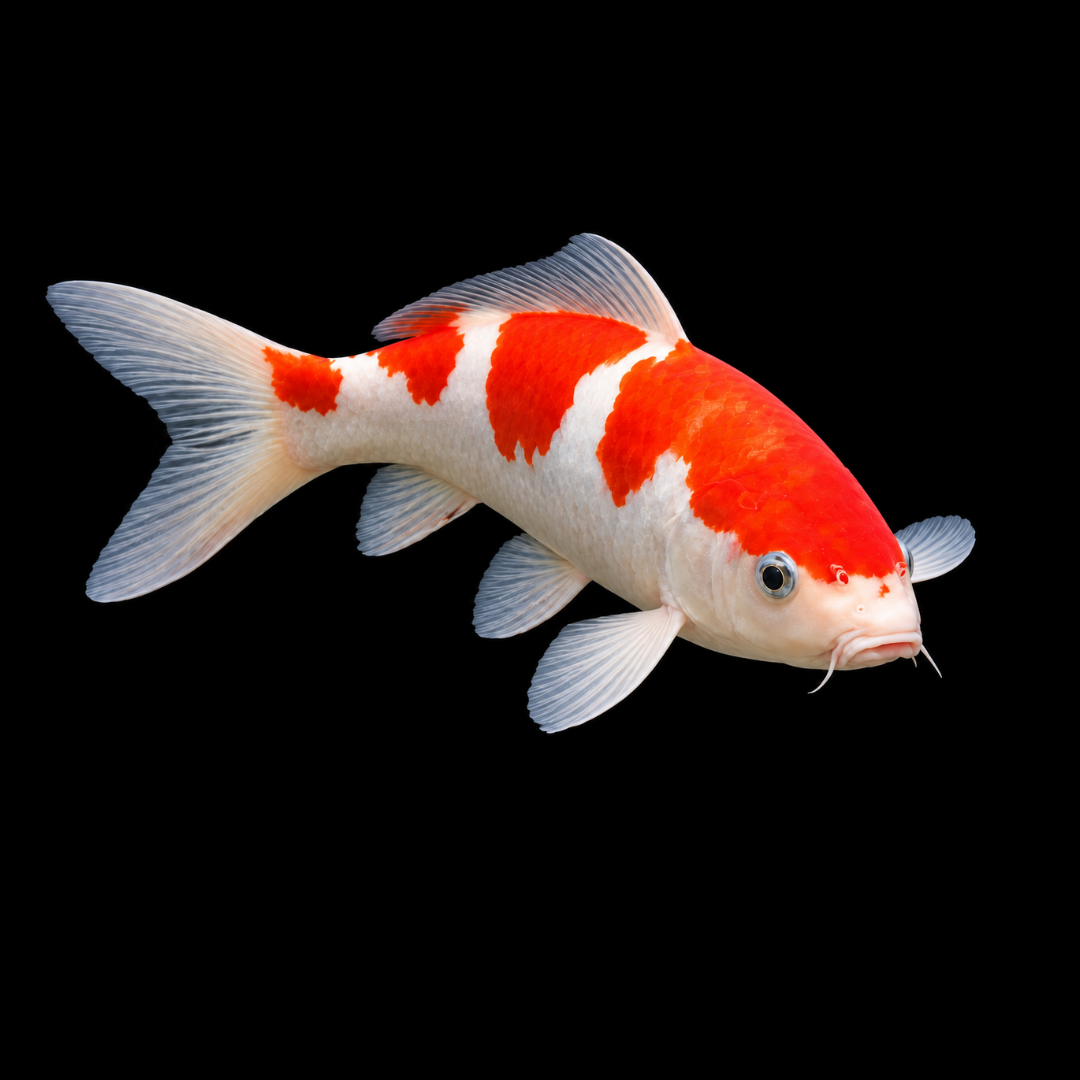
紅白は、澄んだ白地に赤い緋盤だけをまとった錦鯉の代表品種です。色数が少ないからこそ、体形、肌のつや、白地の清らかさ、緋の厚み、模様の流れがありのままに映り、大正三色・昭和三色と並ぶ「御三家」の中心に位置づけられています。小さな幼魚も魅力的ですが、健康に育った成魚は60cmを超えることが珍しくなく、長期飼育には大きな池、強力なろ過、十分な酸素、そして将来の体格を見越した計画が必要です。Kohaku is the classic Nishikigoi variety, displaying only red markings, known as hi, over a clean white ground. Its restrained palette leaves body shape, skin luster, purity of white, depth of red, and the flow of the pattern fully exposed. Together with Taisho Sanshoku and Showa Sanshoku, it forms the Gosanke, the three principal groups of koi. Juveniles can be small, but healthy adults commonly exceed 60 cm, so lifelong care requires a large pond, powerful filtration, abundant oxygen, and planning for their eventual size.
基本情報 / Basic Information
学名 / Scientific Name
Cyprinus carpio(ニシキゴイは独立した種ではなく、観賞用に改良されたコイの品種群です。遺伝研究では複数の母系統が関わった可能性が示されていますが、これは紅白に別の学名が付くという意味ではありません)(Nishikigoi is not a separate species but a group of ornamental carp varieties. Genetic research suggests that more than one maternal lineage contributed to Nishikigoi; this does not mean that Kohaku has a separate scientific name.)
通称 / Common Name
紅白、錦鯉・紅白Kohaku, red-and-white koi
分類 / Family
コイ目・コイ科・コイ属。観賞用に改良されたニシキゴイの一品種Order Cypriniformes, family Cyprinidae, genus Cyprinus; an ornamental Nishikigoi variety
英名 / English Name
Kohaku Koi
分布 / Distribution
観賞品種のため、紅白そのものに自然分布はありません。新潟県中越地方の二十村郷、現在の長岡市・小千谷市・魚沼市の一部にあたる地域で錦鯉の改良が進み、現在は日本各地をはじめ世界各国で養殖・飼育されています。As a cultivated ornamental variety, Kohaku has no natural range of its own. Nishikigoi was developed in Nijumurago in the Chuetsu region of Niigata Prefecture, an area now spanning parts of Nagaoka, Ojiya, and Uonuma, and is currently bred and kept throughout Japan and worldwide.
最大体長 / Max Size
一般的な成魚で60〜80cmほど。良好な血統と広い育成環境では90cmを超え、まれに100cm級へ達する個体もいます。Typically about 60–80 cm as an adult. Fish with strong growth potential in spacious, well-managed conditions may exceed 90 cm, and exceptional individuals can approach or surpass 100 cm.
寿命 / Lifespan
適切な環境では20〜30年以上が目安で、良好な管理下ではさらに長生きすることがあります。Often 20–30 years or more under appropriate care, with some individuals living considerably longer in excellent conditions.
飼育環境 / Aquarium Environment
水槽サイズ / Tank Size
15〜20cmほどの幼魚を一時的に管理する場合でも、120cm規格水槽(約240L)または120cmワイド水槽(300L以上)を目安とします。ただし、いずれも終生飼育用ではありません。成魚の長期飼育は屋外池が基本で、少数飼育でも3,000〜5,000L以上を出発点とし、十分な遊泳距離と水深を確保します。必要な水量は匹数、成魚時の体長、ろ過能力によって大きく変わるため、余裕を持って設計します。Even temporary housing for a juvenile of about 15–20 cm should provide at least a Japanese-standard 120 cm aquarium of roughly 240 L or a 120 cm wide model holding 300 L or more. Neither is suitable for lifelong care. Adults are best kept in an outdoor pond, with 3,000–5,000 L serving only as a starting point for a small number of fish, together with adequate swimming length and depth. The required volume varies greatly with stocking level, adult size, and filtration capacity, so the system should be designed with a generous margin.
水温 / Temperature
安定した15〜25℃を飼育の中心域とし、急変を避けます。25℃を超える時期は水中の酸素が減りやすいためエアレーションを強化します。10℃前後を下回ると消化力が大きく落ちるので、給餌を控えるか休止します。Maintain a stable 15–25°C as the main husbandry range and avoid sudden changes. Above 25°C, dissolved oxygen declines more readily, so increase aeration. As the water approaches or falls below 10°C, digestion slows markedly and feeding should be greatly reduced or stopped.
水質 / Water Quality
弱酸性〜弱アルカリ性のpH6.5〜8.0を目安に、数値そのものより安定を優先します。アンモニアと亜硝酸は検出されない状態を保ち、溶存酸素を十分に確保します。大量に食べて排せつするため、余裕のある物理・生物ろ過と定期的な換水が不可欠です。Aim for stable water from slightly acidic to slightly alkaline, around pH 6.5–8.0, placing stability ahead of a particular number. Ammonia and nitrite should remain undetectable, with ample dissolved oxygen. Koi eat and excrete heavily, making oversized mechanical and biological filtration plus regular partial water changes essential.
レイアウト / Layout
広い遊泳空間を最優先にし、底は清掃しやすいベアタンクまたは滑らかな仕上げとします。鋭い石や狭い隙間は、驚いた際の擦り傷や鱗の損傷につながるため避けます。底面排水、スキマー、強力なろ過、予備を含むエアレーションを組み合わせ、飛び出し防止にも配慮します。水草は掘り返されやすいため、植栽部を仕切る方法が現実的です。Prioritize open swimming space and use a bare, easily cleaned bottom or a smooth finish. Avoid sharp rocks and narrow gaps that can injure startled fish or damage scales. Combine bottom drainage, surface skimming, robust filtration, and redundant aeration, and provide protection against jumping. Koi readily uproot plants, so planted areas are best physically separated.
注意点 / Precautions
小型水槽で生涯飼育できる魚ではありません。導入前に成魚時の池、水量、ろ過能力、停電時の酸素供給、越冬・夏越しの方法まで準備します。新魚は既存魚とすぐに合わせず隔離観察し、袋の水を飼育水へ入れない方法で温度と水質をゆっくり合わせます。飼えなくなっても河川や湖沼へ放流してはいけません。This is not a fish for lifelong care in a small aquarium. Before purchase, plan the adult pond, water volume, filtration capacity, emergency oxygen supply, and seasonal management. Quarantine new arrivals instead of adding them directly, and acclimate temperature and water chemistry gradually without pouring transport water into the pond. Never release unwanted koi into rivers, lakes, or other natural waters.
餌と給餌 / Feeding
餌の種類 / Diet
コイ用の総合栄養食を主食とします。水温が低い時期に給餌する場合は、製品の適温を確認し、消化性に配慮した低水温用飼料を選びます。カロテノイドを含む色揚げ飼料は緋の発色を支える補助になりますが、餌だけで緋質が決まるわけではありません。色揚げを急いで与えすぎると、肥満や水質悪化を招くため注意します。Use a complete koi diet as the staple food. When feeding in cooler water, check the product’s stated temperature range and choose a highly digestible cool-season formula. Color-enhancing diets containing carotenoids can support red pigmentation, but diet alone does not determine pigment quality. Overfeeding in an attempt to intensify color can lead to obesity and deteriorating water quality.
給餌のポイント / Feeding Tips
水温、魚の大きさ、活動量、ろ過能力に合わせ、数分で食べ切れる量を分けて与えます。20〜25℃では少量を複数回に分けられますが、残餌が出る場合は量を減らします。10〜15℃では回数と量を大幅に減らし、使用する飼料の適温表示に従います。10℃前後を下回る環境では消化が鈍るため、原則として給餌を休止します。急な冷え込み、導入直後、体調不良時は無理に食べさせず、水質の確認を優先します。Adjust feeding to temperature, fish size, activity, and filtration, offering only what is consumed within a few minutes. At 20–25°C, the daily ration may be split into several small meals, but reduce the amount if food remains. At 10–15°C, feed much less and less often, following the temperature guidance on the chosen food. As water falls below roughly 10°C, digestion slows and feeding is generally paused. During sudden cooling, immediately after introduction, or when fish are unwell, do not force feeding and check water quality first.
性格と混泳 / Temperament and Tank Mates
性格 / Temperament
基本的に温和で社会性があり、人にも慣れやすい魚です。群れでゆったり泳ぎますが、給餌時は競争が強くなり、小さな個体が餌を取れないことがあります。口に入る小魚や稚魚、エビ類は食べる可能性があります。Generally peaceful and social, koi can become quite accustomed to people. They cruise calmly in groups, but feeding competition can be vigorous and smaller individuals may be outcompeted. Fish fry, shrimp, and other animals small enough to swallow may be eaten.
混泳の相性 / Compatibility
体格の近い錦鯉同士が最も安全です。金魚との混泳は水温面では可能でも、体格差、給餌競争、病原体の持ち込み、必要水量の違いを考えると慎重な管理が必要です。熱帯性の魚、極端に小さい魚、ひれをかじる魚、攻撃的な大型魚との混泳は避けます。新しい同居魚は必ず隔離観察を行います。Koi of similar size are the safest companions. Goldfish can share a broadly compatible temperature range, but size differences, feeding competition, pathogen transfer, and different space requirements demand careful management. Avoid tropical species, very small fish, fin-nippers, and aggressive large fish. Quarantine every new tank or pond mate.
病気と対策 / Diseases and Prevention
かかりやすい病気 / Common Diseases
飼育下で見られる病気には、白点病、コイポックス、エラや皮膚の寄生虫症、細菌性の赤斑・潰瘍、鰭ぐされなどがあります。コイヘルペスウイルス病(KHV)は日常的な病気とは区別して考える必要がありますが、発生すると重大な被害につながるため、特に警戒が必要です。食欲低下、群れから離れる、体をこする、呼吸が速い、エラの異常、充血、ただれは体調悪化のサインです。外見だけで原因を断定することはできません。Conditions seen in captive koi include white spot disease, carp pox, gill or skin parasites, bacterial reddening and ulcers, and fin rot. Koi herpesvirus disease (KHV) should be distinguished from routine health problems, but it demands particular vigilance because an outbreak can cause severe losses. Loss of appetite, isolation, flashing, rapid breathing, abnormal gills, redness, or sores indicate deteriorating health. The cause cannot be identified reliably from appearance alone.
対策と予防 / Prevention
飼育履歴を確認できる販売元から導入し、新魚は別設備で隔離観察します。必要な期間や管理水温は、販売元や魚病に詳しい専門家と相談して決めます。症状の有無は水温などにも左右されるため、一定期間を隔離しただけでKHVに感染していないとは断定できません。網や容器を分け、水温の急変、過密、酸欠、アンモニア・亜硝酸の蓄積を防ぐことが基本です。異常時はまず隔離し、水温、pH、アンモニア、亜硝酸、酸素供給を確認します。診断せずに薬を使ったり、複数の薬を併用したりせず、魚病に詳しい獣医師、購入店、都道府県の水産試験研究機関などへ相談してください。KHVが疑われる大量死では魚を移動・放流せず、管轄機関の指示に従います。Obtain koi from a seller who can provide a health history and observe new arrivals in a separate system. Decide the appropriate quarantine period and water temperature with the seller or a fish-health professional. Because signs of KHV depend partly on temperature and other conditions, quarantine for a set period alone cannot prove that a fish is free of infection. Use dedicated nets and containers, and prevent sudden temperature shifts, crowding, oxygen shortage, and ammonia or nitrite accumulation. At the first sign of trouble, isolate affected fish and check temperature, pH, ammonia, nitrite, and aeration. Do not medicate without a diagnosis or combine treatments without professional guidance; consult an aquatic veterinarian, the seller, or the relevant regional fisheries authority. If mass mortality suggests KHV, do not move or release fish and follow official instructions.
増やし方(繁殖) / Breeding
雌雄の判別 / Sexing
幼魚の確実な判別は困難です。成熟魚では、メスは一般に腹部がふっくらして生殖孔が丸く突出気味になり、オスは比較的細身で胸びれの前縁が厚く感じられます。繁殖期のオスではエラぶたや胸びれに白い追星が現れることがありますが、体形だけで断定せず複数の特徴を見ます。Reliable sexing of juveniles is difficult. In mature fish, females generally develop a fuller abdomen and a rounder, slightly protruding vent, while males tend to remain slimmer with a firmer leading edge to the pectoral fins. Breeding males may show small white tubercles on the gill covers and pectoral fins, but several traits should be considered rather than body shape alone.
繁殖形態 / Reproduction
卵生で、春から初夏、水温の上昇をきっかけに、浅場の水草や産卵床へ多数の粘着卵をばらまきます。オスがメスを追って放卵・放精が行われ、親魚は卵やふ化仔魚を食べることがあります。Koi are egg-layers. From spring into early summer, rising temperature stimulates spawning, and many adhesive eggs are scattered over shallow vegetation or spawning media. Males pursue females during the release of eggs and milt, and adults may eat both eggs and newly hatched fry.
繁殖のポイント / Breeding Tips
成熟した健康な親魚、十分に広い専用池、柔らかな産卵床、強い酸素供給を用意し、産卵後は親魚または産卵床を速やかに分けます。卵は清浄で酸素に富む水中で管理し、ふ化後は口の大きさに合う初期飼料へ段階的に移行します。ただし、紅白らしい白地と緋盤を備えた個体は一腹のごく一部で、過密を避けながら何段階もの選別を行う必要があります。計画のない繁殖は避け、すべての稚魚の飼育先を確保してから取り組みます。Use mature, healthy broodfish, a spacious dedicated spawning pond, soft spawning media, and strong aeration. After spawning, promptly separate the adults or move the egg-bearing media. Keep eggs in clean, oxygen-rich water and introduce progressively larger first foods after hatching. Only a small fraction of a brood will develop the clean white ground and red pattern expected of Kohaku, so repeated selection and careful density control are required. Do not breed without secure homes and adequate facilities for all offspring.
雑学と豆知識 / Trivia and Fun Facts
1. 白と赤だけだからこそ難しい / 1. The challenge of only red and white
紅白を見た第一印象は、驚くほど明快です。白い魚体に赤い模様、それだけに見えます。しかし黒い墨模様や金属光沢に視線を預けられないため、背骨の流れ、左右の肉付き、尾筒の力、肌の照りまでが隠れません。愛好家の間で「紅白に始まって、紅白に終わる」と語られるのは、入門者にも美しさが伝わりやすい一方、見続けるほど奥行きが増す品種だからです。At first glance, Kohaku seems almost disarmingly simple: red markings on a white fish. Yet there is no black pattern or metallic sheen to divert the eye, so the line of the spine, balance of body mass, strength of the tail tube, and luster of the skin remain fully visible. The saying that koi appreciation begins and ends with Kohaku reflects this dual nature: its beauty is immediately accessible, yet its depth grows with experience.
2. 雪国から生まれた「泳ぐ錦」 / 2. Living brocade from snow country
錦鯉発祥の地とされる新潟県中越地方の二十村郷は、棚田と豪雪の土地です。江戸時代後期、食用に飼われていた真鯉に現れた色変わりを人々が残し、交配と選別を重ねた歩みが観賞魚文化へつながりました。明治時代には紅白などの改良が進み、1914年の東京大正博覧会への出品をきっかけに、錦鯉は広く知られるようになります。特定の一尾だけを紅白の唯一の祖とするより、多くの生産者が世代を重ねて形質を整えてきた品種と捉えるほうが、確認されている歴史に沿った理解です。Nijumurago in Niigata’s Chuetsu region, regarded as the birthplace of Nishikigoi, is a land of terraced fields and deep winter snow. In the late Edo period, local people preserved unusual colors that appeared among food carp and gradually developed an ornamental fish culture through repeated breeding and selection. Improvement of Kohaku and other varieties advanced during the Meiji era, and Nishikigoi became widely known after being exhibited at the Tokyo Taisho Exposition in 1914. The documented history is therefore better understood as the work of many breeders over generations than as the achievement of a single ancestral fish.
3. 模様を読む「サシ」と「キワ」 / 3. Reading the pattern through sashi and kiwa
緋盤の縁には時間の物語があります。模様の頭側で、白い鱗の下から赤が透けて淡く見える部分を「サシ」と呼びます。若魚のサシは、成長とともに鱗や色素が整う余地を示す手がかりになります。反対に、模様の後ろ側や横で赤と白が切り替わる線は「キワ」です。鱗の輪郭に沿うウロコギワ、刃物で切ったように見えるカミソリギワという言葉があり、静止画の模様ではなく、成長し続ける皮膚と鱗を読むための語彙になっています。The edge of a red marking carries a story of time. At the leading edge, red showing softly beneath overlapping white scales is called sashi; in a young fish, it offers clues to how scales and pigment may consolidate with growth. The boundary at the rear and sides is called kiwa. Breeders distinguish scale-following uroko-kiwa from the sharply cut appearance of kamisori-kiwa. These terms do more than describe a static pattern: they form a vocabulary for reading living skin and scales as they develop.
4. 段柄、稲妻、丹頂という景色 / 4. Stepping stones, lightning, and the red crown
緋盤が飛び石のように分かれれば二段・三段・四段、背をジグザグに走れば稲妻と呼ばれます。頭部にだけ緋を持つ丹頂では、形の整った丸い斑紋が特に好まれ、広い白地が赤を強く印象づけます。最後の緋盤と尾びれの間に白地が残る状態は尾止めがよいと表現され、模様全体を引き締めます。同じ紅白でも二つとして同じ模様がないことが、個体を見分け、成長を見守る楽しさにつながっています。When red plates are separated like stepping stones, the pattern is described as two-step, three-step, or four-step; a zigzag red band down the back is called inazuma, or lightning. Tancho Kohaku carries red only on the head, where a well-formed circular marking is especially prized and is emphasized by the broad white ground. A clean area of white between the final red plate and the tail is described as good odome, or tail stop, and brings visual balance to the overall pattern. No two Kohaku carry precisely the same design, which makes recognizing an individual and following its growth especially rewarding.
5. 緋色は餌だけでは完成しない / 5. Red pigment is not made by food alone
色揚げ飼料に含まれるカロテノイドは緋の発色を支えますが、餌を増やせば必ず上質な赤になるわけではありません。色素細胞の性質は遺伝的背景に左右され、さらに水質、健康状態、成長、季節、光環境が重なって見え方が変わります。色揚げを急いで過剰に与えれば、肥満や水質悪化によって魚全体の状態を損ないます。紅白の色は、赤だけを濃くする作業ではなく、白との対比を保ちながら魚を健康に育てた結果として現れるものです。Carotenoids in color-enhancing diets support red pigmentation, but simply feeding more cannot guarantee superior red. Pigment-cell characteristics are influenced by genetic background, while water quality, health, growth, season, and light all affect the visible result. Excessive feeding in pursuit of stronger color can cause obesity and deteriorating water quality, harming the condition of the whole fish. Kohaku color is therefore not merely an attempt to deepen red; it emerges from raising a healthy fish while preserving the contrast with white.
6. 学名に残る起源研究の余白 / 6. An origin story still visible in the scientific name
ニシキゴイは観賞用に改良されたコイの品種群であり、水産分野では Cyprinus carpio と表記されています。2023年に公表されたミトコンドリアDNAの研究では、日本産ニシキゴイ8系統15個体を調べた結果、複数の型が見つかりました。中国や台湾のコイに近い型だけでなく、日本の野生型マゴイに近い型も確認されたことから、ニシキゴイの成立には複数の母系統が関わった可能性が示されています。ただし、限られた個体を対象とした研究であり、紅白を別種とする結果ではありません。品種成立の背景が、単一の祖先だけでは説明しきれない可能性を示す知見です。Nishikigoi is a group of ornamental carp varieties and is identified in aquaculture as Cyprinus carpio. A 2023 mitochondrial DNA study of 15 Japanese Nishikigoi from eight strains detected several haplotypes. Some were closely related to carp from China and Taiwan, while others were close to wild-type magoi from Japan, suggesting that more than one maternal lineage may have contributed to Nishikigoi. The study examined a limited number of fish and did not classify Kohaku as a separate species. Its significance is that the variety’s ancestry may not be fully explained by a single ancestral line.
まとめ / Conclusion
紅白の魅力は、白と赤という簡潔な構成のなかに、体形、肌、色、模様、泳ぎの調和がすべて現れることにあります。小さな魚を選ぶ瞬間から、模様の境界が整い、体幅が増し、堂々と池を巡るまで、時間そのものが美しさを育てていきます。Kohaku’s appeal lies in the way body shape, skin, color, pattern, and movement all reveal themselves through a restrained composition of red and white. From the moment a small fish is chosen, time becomes part of its beauty as pattern edges mature, the body gains volume, and the koi grows into a commanding presence in the pond.
その成長を長く楽しむには、幼魚の現在ではなく、数十年を生きる大型魚の未来に合わせて環境を用意することが大切です。広い水量、澄んだ安定水、豊かな酸素、節度ある給餌がそろうと、紅白は人の気配に寄ってくる穏やかな伴侶となり、季節ごとに異なる表情を見せながら池の中心を泳ぎ続けます。To enjoy that development for many years, the environment must be planned not for the juvenile of today, but for the large, long-lived fish it will become. With generous water volume, clean and stable conditions, abundant oxygen, and measured feeding, Kohaku becomes a calm companion that approaches familiar people and continues to command the pond through the changing seasons.






コメント