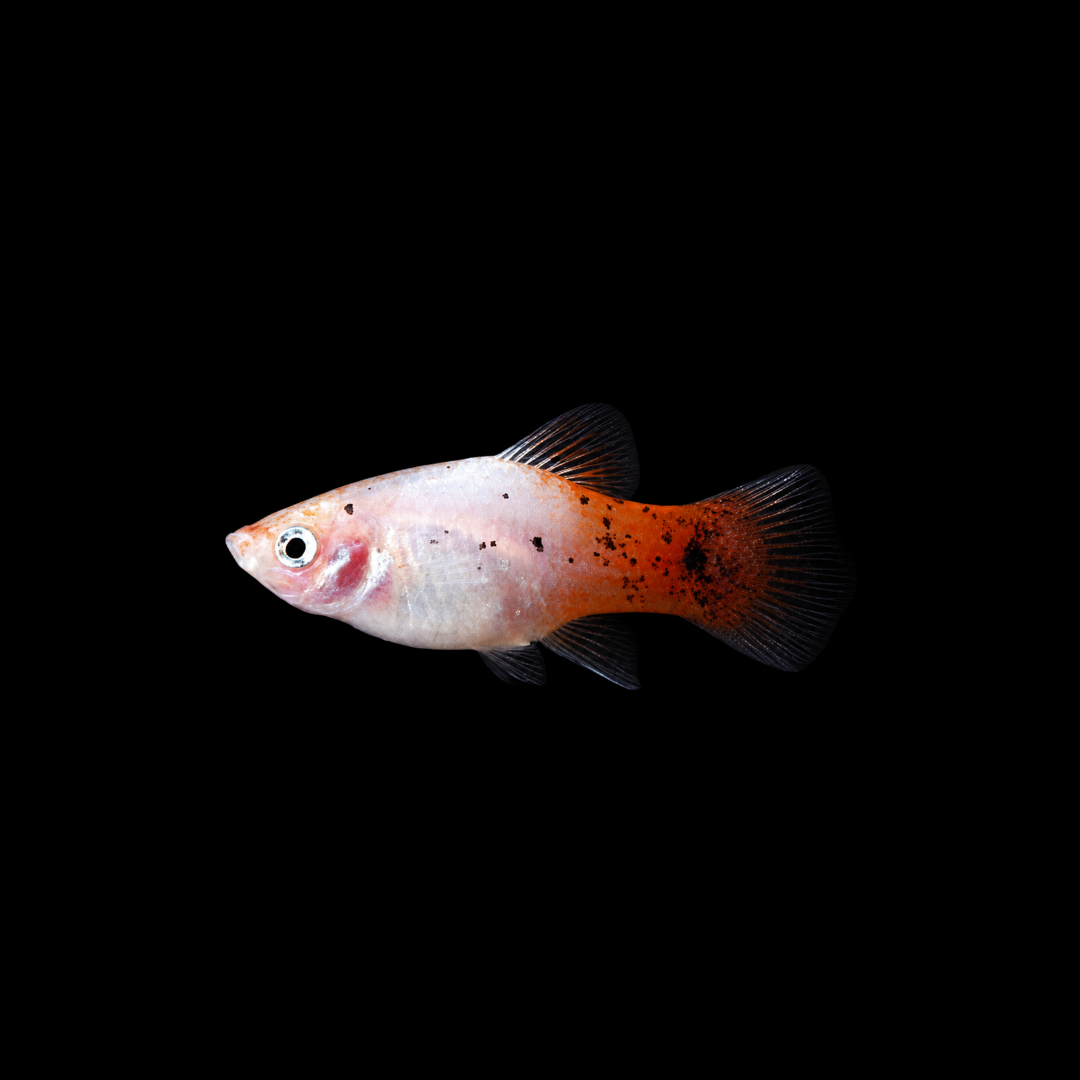
レッドテールホワイトキャリコプラティは、白を基調とした体に不規則な黒い斑点が散り、尾筒から尾鰭にかけて赤色が入る、コントラストの美しいプラティの改良品種です。基幹となるのは中米原産のサザンプラティフィッシュ Xiphophorus maculatus で、長年の選択交配によって観賞価値の高い色彩が固定されてきました。丈夫で人工飼料にも慣れやすく、繁殖も比較的容易なことから、初めて卵胎生魚を飼育する人にも親しまれています。一方で、明るい体色の奥には、色素細胞の遺伝や性決定、さらには腫瘍研究に利用されてきたキフォフォルス属ならではの興味深い生物学が隠されています。The Red Tail White Calico Platy is a selectively bred platy variety with a pale to white base color, irregular black calico spotting, and vivid red coloration extending across the caudal peduncle and tail fin. Its principal ancestral species is the Southern Platyfish, Xiphophorus maculatus, native to Central America, and generations of selective breeding have produced the striking ornamental pattern seen today. Hardy, adaptable to prepared foods, and relatively easy to breed, it is well suited to aquarists who are new to livebearing fishes. Behind its bright appearance, however, lies a fascinating biological story involving pigment-cell genetics, unusual sex-determination systems, and the long history of Xiphophorus fishes as research models in genetics and melanoma biology.
基本情報 / Basic Information
学名 / Scientific Name
Xiphophorus maculatus(本品種の主要な基幹種)
通称 / Common Name
レッドテールホワイトキャリコプラティ、ホワイトキャリコプラティ、キャリコプラティRed Tail White Calico Platy, White Calico Platy, Calico Platy
分類 / Family
条鰭綱・カダヤシ目・カダヤシ科・キフォフォルス属(ソードテール属)Class Actinopterygii, Order Cyprinodontiformes, Family Poeciliidae, Genus Xiphophorus
英名 / English Name
Red Tail White Calico Platy
分布 / Distribution
本品種は飼育下で作出・維持される改良品種です。基幹種である Xiphophorus maculatus の野生分布は、メキシコ東部のベラクルス周辺から北部ベリーズにかけての河川、湧水、運河、湿地などです。観賞魚としては世界各地で養殖・流通しています。This variety is a domesticated ornamental strain maintained in captivity. The wild range of its principal ancestral species, Xiphophorus maculatus, extends from eastern Mexico around Veracruz to northern Belize, where it occurs in rivers, springs, canals, and wetland habitats. Ornamental strains are bred and distributed worldwide.
最大体長 / Max Size
約5〜6cm。一般に雌のほうが雄より大きくなります。About 5–6 cm. Females generally grow larger than males.
寿命 / Lifespan
目安として2〜3年ほど。安定した水質、適切な給餌、過密を避けた環境ではより長く飼育できる個体もいます。Typically around 2–3 years. Some individuals may live longer under stable water conditions, appropriate feeding, and low-stress stocking densities.
飼育環境 / Aquarium Environment
水槽サイズ / Tank Size
少数飼育なら45cm規格水槽から可能ですが、活発に泳ぐことと繁殖による個体数増加を考えると、60cm規格水槽(約57L)以上が扱いやすくおすすめです。複数匹を長期飼育する場合は、実水量40L以上を確保できる構成を目安にすると安定しやすくなります。A small group can be kept in a standard 45 cm aquarium, but a standard 60 cm tank of roughly 57 L or larger is easier to manage because these fish are active and may reproduce quickly. For long-term group maintenance, aiming for at least about 40 L of actual water volume provides greater stability.
水温 / Temperature
20〜28℃程度に対応しますが、日常飼育では24〜26℃前後を安定して保つと管理しやすくなります。急激な温度変化を避け、冬季はヒーターを使用してください。They tolerate roughly 20–28°C, while a stable daily range around 24–26°C is generally convenient for aquarium care. Avoid sudden temperature swings and use a heater during cold seasons when necessary.
水質 / Water Quality
中性〜弱アルカリ性を好み、pH 7.0〜8.0前後が目安です。硬度は中硬水寄りが適しています。日本の水道水は地域によって軟水傾向が強いため、pHやGHが低い場合は、カキガラ、大磯砂、石灰質の素材、市販のミネラル調整剤などを利用して緩やかに補正できます。ただし、数値を急変させるほうが負担になるため、実測しながら少しずつ調整することが大切です。Neutral to mildly alkaline water is preferred, with a practical target around pH 7.0–8.0 and moderate hardness. Tap water in many parts of Japan is relatively soft, so if pH and GH are low, crushed oyster shell, certain mineral-rich substrates or stones, or commercial remineralizing products can be used for gradual adjustment. Sudden changes are more stressful than imperfect numbers, so adjustments should be made slowly while testing the water.
レイアウト / Layout
前面から中央には遊泳空間を確保し、背面や両脇に水草をまとめると、観賞性と安心できる隠れ場所を両立できます。ウィローモス、マツモ、浮き草などの細かい葉や根を持つ植物は、生まれた稚魚の逃げ場所としても役立ちます。底床や石で硬度を上げる場合は、同居させる水草がその水質に適応できるかも確認してください。Keep open swimming space across the front and center, while grouping plants toward the back and sides to provide cover without reducing visibility. Fine-leaved plants and floating plants, such as Java moss or hornwort, also give newborn fry places to hide. If mineral-rich substrates or rocks are used to increase hardness, make sure the chosen aquatic plants can tolerate the resulting water chemistry.
注意点 / Precautions
導入直後は輸送ストレスから体調を崩しやすいため、水温と水質を急変させないよう丁寧に水合わせを行います。繁殖力が高く、雌雄を一緒にすると短期間で個体数が増えることがあります。また、ソードテールやバリアタスなど近縁のキフォフォルス属魚類とは交雑する可能性があるため、品種の色柄を維持したい場合は分けて飼育してください。飼育個体を河川や池など自然環境へ放流してはいけません。New arrivals may be weakened by transport stress, so acclimate them carefully and avoid rapid changes in temperature or water chemistry. They reproduce readily, and mixed-sex groups can increase in number quickly. They can also hybridize with related Xiphophorus fishes such as swordtails and variable platies, so keep strains separate if you wish to preserve a particular color line. Never release aquarium fish into natural waterways or ponds.
餌と給餌 / Feeding
餌の種類 / Diet
雑食性で、フレークフードや小粒の顆粒飼料を主食にできます。植物質を含む飼料、スピルリナ配合フード、冷凍赤虫、ブラインシュリンプなどを組み合わせると栄養の偏りを抑えられます。水槽内の柔らかい藻類や付着物をついばむ行動も見られます。They are omnivorous and readily accept flakes and small pellets as staple foods. A varied diet that includes vegetable-rich or spirulina-based foods, frozen bloodworms, and brine shrimp helps provide balanced nutrition. They also graze on soft algae and biofilm in the aquarium.
給餌のポイント / Feeding Tips
1日1〜2回、数分で食べ切れる量を基本にし、食べ残しを出さないことが水質維持のポイントです。腹部が丸くなりやすい魚なので、常に満腹になるまで与える必要はありません。繁殖中の雌や育成期の若魚には、1回量を少なくして回数を増やす方法が向いています。Feed once or twice daily in portions that are consumed within a few minutes. Avoiding leftovers is important for maintaining water quality. Because platies can appear round-bodied even when adequately fed, there is no need to feed to complete satiation at every meal. Pregnant females and growing juveniles often benefit from smaller, more frequent portions.
性格と混泳 / Temperament and Tank Mates
性格 / Temperament
基本的には温和で活発な魚です。水槽の中層から上層をよく泳ぎ、人の姿にも比較的慣れやすいため、給餌時には前面へ集まってくることがあります。繁殖期の雄は雌を頻繁に追尾するため、雌雄混泳では雄1匹に対して雌2〜3匹程度を目安にすると、特定の雌へ負担が集中しにくくなります。Generally peaceful and active, platies spend much of their time in the middle and upper levels of the aquarium and often become accustomed to people, gathering at the front during feeding. Males may repeatedly pursue females when sexually active, so a ratio of roughly one male to two or three females helps spread that attention among several females.
混泳の相性 / Compatibility
同程度の大きさで温和な魚との混泳に向きます。特に、水温や水質の好みが近い卵胎生魚や小型〜中型の温和な魚が合わせやすい相手です。コリドラス類や一部の小型ナマズ類とも共存できますが、軟水・弱酸性を強く好む魚とは最適水質が一致しない場合があります。大型魚、強い縄張り性を持つ魚、鰭をかじる魚との混泳は避けてください。They are compatible with peaceful fishes of similar size, especially species with comparable temperature and water-chemistry preferences. Corydoras and some other small catfishes can often coexist with them, although species that strongly prefer soft, acidic water may not share the same ideal conditions. Avoid large predators, highly territorial fishes, and persistent fin-nippers.
病気と対策 / Diseases and Prevention
かかりやすい病気 / Common Diseases
白点病、尾ぐされ病、カラムナリス症、体表の細菌感染など、一般的な淡水観賞魚に見られる病気には注意が必要です。特に輸入直後や導入直後、水温・pH・硬度が急変したとき、過密や水質悪化が続いたときは発症しやすくなります。白点病は寄生性疾患で、尾ぐされ病やカラムナリス症などとは原因が異なるため、症状を見分けて対処することが重要です。Watch for common freshwater aquarium diseases such as ich, fin rot, columnaris, and other external bacterial infections. Problems are more likely after transport, during rapid changes in temperature, pH, or hardness, or when overcrowding and poor water quality persist. Ich is a parasitic disease and differs in cause from bacterial conditions such as fin rot and columnaris, so accurate identification is important before treatment.
対策と予防 / Prevention
最も効果的な予防は、急変の少ない安定した水質、適切なろ過、定期的な換水、過密を避けた飼育です。新しい魚は可能であれば隔離して状態を観察してから本水槽へ導入します。卵胎生魚は一定の塩分に耐えるため、状況によっては低濃度の塩分を補助的に用いる方法もありますが、病名や同居する水草・生体によって適否が異なるため、塩分を常用するのではなく目的を明確にして使います。The best prevention is stable water chemistry, adequate filtration, regular water changes, and avoiding overcrowding. Whenever possible, observe new fish in quarantine before adding them to the main aquarium. Livebearers tolerate some salinity, so low-level salt can sometimes be used as supportive care, but its usefulness depends on the condition being treated and on the plants and tank mates present. It should therefore be used for a clear purpose rather than as a universal routine treatment.
増やし方(繁殖) / Breeding
雌雄の判別 / Sexing
成熟した雄は尻鰭が細長い棒状の交接器であるゴノポディウムに変化します。雌の尻鰭は扇形のままで、成熟個体では雄より体格が大きく、腹部がふっくらする傾向があります。明るい体色の品種では妊娠斑が見えにくい個体もいるため、尻鰭の形を見る方法が最も確実です。Mature males have a modified anal fin that forms a narrow, rod-like gonopodium. Females retain a fan-shaped anal fin and are usually larger and fuller-bodied when mature. In pale-colored strains the gravid spot may be difficult to see, so the shape of the anal fin is the most reliable visual method of sexing.
繁殖形態 / Reproduction
卵胎生で、雌は体内で受精卵を発生させ、自由に泳げる稚魚を直接産みます。妊娠期間は水温や個体差によって変わりますが、おおむね4週間前後が目安です。雌は交尾後の精子を体内に保持し、その後も複数回出産することがあるため、雄から隔離した雌でも後になって稚魚を産む場合があります。They are livebearing poeciliids: females retain developing embryos internally and give birth to free-swimming fry. Gestation varies with temperature and individual condition but is often around four weeks. Females can retain viable sperm after mating and may produce several broods afterward, so a female separated from males can still give birth later.
繁殖のポイント / Breeding Tips
親魚は生まれた稚魚を捕食することがあるため、稚魚を多く残したい場合はウィローモス、マツモ、浮き草などを密に植えて隠れ場所を作るか、母魚や稚魚を適切なタイミングで隔離します。狭い産卵箱への長時間の隔離は母魚のストレスになるため、使用する場合は出産が近い兆候を見て短期間にとどめます。稚魚には細かく砕いた人工飼料やブラインシュリンプの幼生など、口に入る大きさの餌を少量ずつ複数回与えると育てやすくなります。Adults may eat newborn fry. To raise a larger number successfully, provide dense cover with Java moss, hornwort, or floating plants, or separate the female or fry at an appropriate time. Long confinement in a small breeding trap can stress the mother, so if one is used, keep the period short and wait until birth appears close. Feed fry small portions several times a day with finely crushed prepared food or newly hatched brine shrimp that fit their mouth size.
雑学と豆知識 / Trivia and Fun Facts
1. 名前に隠れた三つの色 / 1. Three Colors Hidden in the Name
「レッドテールホワイトキャリコ」という長い名前は、実は魚の外見をそのまま順番に説明しています。白い体をキャンバスに、黒い斑点が不規則に散り、最後に尾の赤が強いアクセントを加えます。「キャリコ」は本来、複数色がまだらに入る模様を表す言葉で、観賞魚では金魚やメダカなどにも使われます。プラティでは黒いスポットの出方に個体差が大きく、同じ品種名でも一匹ずつ印象が違うことが、選ぶ楽しさにつながっています。The long name “Red Tail White Calico” is almost a visual description in sequence: a pale body forms the canvas, irregular black spots are scattered across it, and a red tail provides the final accent. “Calico” is a term used for irregular multicolored patterns and also appears in the names of ornamental goldfish and medaka strains. In platies, the amount and placement of black spotting can vary greatly from individual to individual, making each fish visually distinctive even within the same commercial strain.
2. 「剣を持つ者」という属名 / 2. A Genus Name Meaning “Sword Bearer”
キフォフォルス属の学名 Xiphophorus は、ギリシャ語で「剣」を意味する xiphos と、「運ぶ・持つ」を意味する phoros に由来します。名前だけを見るとプラティにも長い剣状の尾があるように思えますが、その特徴が目立つのは近縁のソードテールです。プラティ自身は通常、尾鰭下部が剣のように長く伸びません。それでも同じ属に含まれるのは、外見だけでなく骨格や生殖形態、遺伝的な近縁性を含めた分類によるものです。The genus name Xiphophorus comes from Greek roots meaning “sword” and “bearer.” That may sound puzzling because platies themselves do not normally carry the long lower caudal-fin extension seen in swordtails. The name reflects the broader genus, which also includes the famous swordtails. Their shared classification is based not on one visible feature alone but on a combination of morphology, reproductive biology, and evolutionary relationship.
3. 小さな魚が遺伝学の主役になった理由 / 3. Why a Small Aquarium Fish Became a Genetics Model
20世紀前半、研究者たちはプラティとソードテールを交配すると、体色や斑紋が一定の規則に従って受け継がれることに注目しました。とりわけマイロン・ゴードンやクルト・コスウィッグらによる研究は、キフォフォルス属を遺伝学の重要な実験動物へ押し上げました。現在知られている Xiphophorus maculatus の研究系統には、W・X・Yという三種類の性染色体が関与する系統があり、魚類の性決定が哺乳類の単純なXY型だけでは説明できないことを示す代表例の一つになっています。During the early twentieth century, researchers noticed that crosses between platies and swordtails transmitted color patterns according to repeatable genetic rules. Work by scientists including Myron Gordon and Curt Kosswig helped establish Xiphophorus as an important model for genetics. Some research strains of Xiphophorus maculatus involve three sex chromosomes, W, X, and Y, making the species a classic example of how fish sex determination can be far more diverse than the familiar mammalian XY system.
4. 黒い斑点とメラノーマ研究 / 4. Black Pigment Patterns and Melanoma Research
プラティの黒い斑紋を作る大型の色素細胞は、キフォフォルス属の研究史で特別な意味を持っています。特定の X. maculatus 系統とソードテールを交雑すると、色素細胞の増殖を促す xmrk という遺伝子と、それを抑える調節系の組み合わせが崩れ、黒色腫が発生することがあります。この現象はゴードン、コスウィッグ、アンダースらの研究にちなむ古典的なメラノーマモデルとして発展しました。近年の研究では、長く R/Diff と呼ばれてきた調節座について rab3d が有力な機能候補として示され、研究は現在も更新されています。観賞魚の斑点と医学研究が同じ色素細胞の生物学でつながっている点は、プラティという魚の奥深さを象徴しています。The large pigment cells responsible for dark Xiphophorus markings have a special place in the history of biomedical research. In particular crosses between X. maculatus strains and swordtails, the genetic balance between the xmrk oncogene, which promotes pigment-cell proliferation, and regulatory factors can be disrupted, allowing melanoma to develop. This became the classical Gordon–Kosswig–Anders melanoma model. More recent work has identified rab3d as a strong functional candidate associated with the long-studied R/Diff regulatory locus, although the genetics continue to be refined. The connection between an ornamental pigment pattern and biomedical research is one of the most remarkable stories associated with platies.
5. 一度の交尾が何度もの出産につながる / 5. One Mating Can Lead to Several Broods
プラティの雌は交尾で受け取った精子を体内に保持できるため、雄と離した後でも時間をおいて稚魚を産むことがあります。ショップから雌だけを迎えたのに、しばらくして突然稚魚が現れるのは珍しい出来事ではありません。この能力は自然界では次の繁殖機会を確保するうえで有利ですが、特定の雄との組み合わせを厳密に管理したいブリーダーには難題となります。狙った交配を行う場合、若いうちから雌雄を分けて育てる管理が重要になるのはこのためです。Female platies can retain sperm after mating, which means they may give birth even after being separated from males. It is therefore not unusual for an aquarist to purchase only females and later discover unexpected fry. This ability is advantageous in nature because it preserves future reproductive opportunities, but it creates a challenge for breeders trying to control parentage precisely. For planned strain breeding, separating males and females before sexual maturity becomes especially important.
6. 「昭和プラティ」と日本的な色彩感覚 / 6. “Showa Platy” and a Japanese Color Tradition
日本では赤・白・黒の三色が印象的なプラティに「昭和プラティ」や「三色プラティ」という名前が使われることがあります。「昭和」という呼び方は、錦鯉の代表的な品種である昭和三色を連想させるものです。もちろん魚種としては錦鯉とはまったく異なりますが、日本の観賞魚文化では、色の配置や組み合わせを別の観賞魚になぞらえて表現することがあります。レッドテールホワイトキャリコプラティも、赤・白・黒という日本人に馴染み深い三色を小さな体にまとめた魚として楽しむことができます。In Japan, platies displaying striking combinations of red, white, and black may be sold under names such as “Showa Platy” or “Three-Color Platy.” The word “Showa” evokes Showa Sanshoku, a famous tri-colored variety of ornamental koi. The fishes are unrelated as ornamental forms, but Japanese aquarium culture often borrows familiar color-language from one group of ornamental fish to describe another. The Red Tail White Calico Platy can likewise be appreciated as a compact expression of the classic red, white, and black palette.
7. 丈夫だからこそ放流しない / 7. Hardiness Is Exactly Why Release Is Dangerous
プラティは丈夫で繁殖力が高く、幅広い環境に適応できることが飼育魚としての大きな魅力です。しかし、その長所は自然界に持ち込まれたときには外来種として定着しやすい性質にもなります。世界各地では観賞魚由来と考えられる移入個体群が知られ、日本の温暖な地域でも野外で確認された例があります。水槽で増えすぎたとしても、川、池、用水路などへ放すことはせず、譲渡や飼育計画の見直しによって最後まで管理することが、観賞魚を楽しむうえで欠かせない責任です。Hardiness and high reproductive capacity are major reasons platies are so popular in aquariums, but the same traits can help them establish introduced populations when released outdoors. Aquarium-derived populations have been recorded in many regions of the world, including warm areas of Japan. Even if a home aquarium becomes overcrowded, fish should never be released into rivers, ponds, or drainage channels. Responsible rehoming and population planning are essential parts of keeping ornamental fish.
まとめ / Conclusion
レッドテールホワイトキャリコプラティは、白、黒、赤の鮮やかな対比を楽しめるだけでなく、丈夫さ、餌への順応性、繁殖の観察しやすさを兼ね備えた親しみやすい観賞魚です。中性から弱アルカリ性の安定した水と十分な遊泳空間を用意し、過密や急激な水質変化を避ければ、活発に泳ぎながら水槽に明るい存在感を与えてくれます。The Red Tail White Calico Platy combines a striking red, white, and black color contrast with hardiness, acceptance of prepared foods, and easily observed livebearing reproduction. With stable neutral-to-mildly alkaline water, adequate swimming space, and protection from overcrowding and sudden changes, it becomes an active and colorful presence in the aquarium.
一匹ごとに異なるキャリコ模様を眺める楽しさに加え、その小さな体には、性決定や色素遺伝、メラノーマ研究へとつながるキフォフォルス属ならではの長い科学史があります。気軽に始めやすい入門魚でありながら、飼い込むほど生物学の奥行きにも触れられるところが、このプラティの大きな魅力です。Beyond the pleasure of watching a different calico pattern on every individual, this small fish carries a remarkable scientific history involving sex determination, pigment genetics, and melanoma research in Xiphophorus. It is approachable enough for a beginner, yet rich enough in biology to remain fascinating as an aquarist gains experience.







コメント