

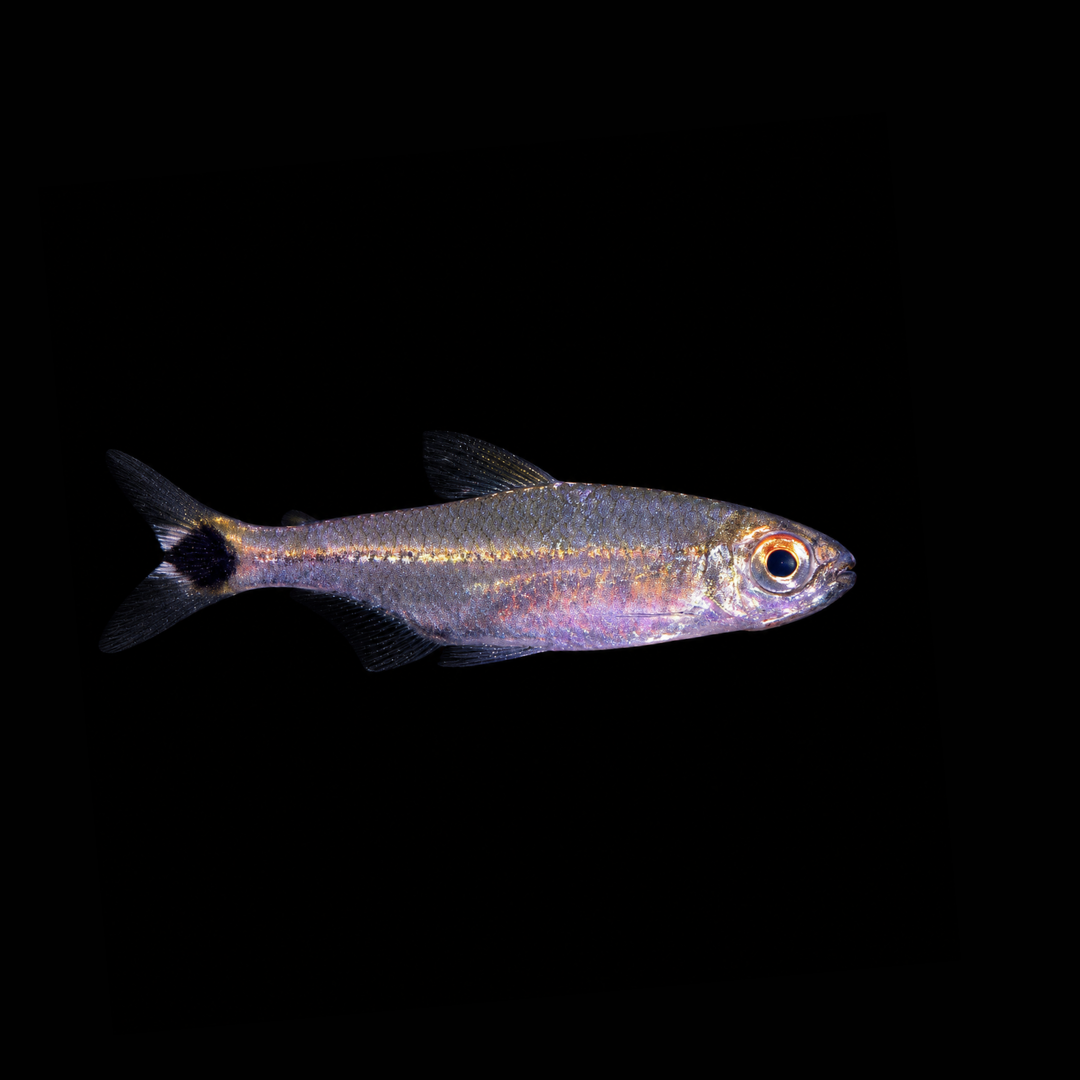
解説 / Description
モンクホーシャ・セロスは、南米アマゾン川流域に分布する小型カラシンです。体は同属に多い体高のあるタイプとは異なり、すっと伸びた流線型で、落ち着いた銀色から黄褐色の体に、状態が上がると赤みを帯びる尾鰭がよく映えます。輸入直後や明るいベアタンクでは地味に見えやすいものの、弱酸性寄りの軟水、流木、落ち葉、薄暗い照明を組み合わせた環境では、本来の上品な色彩と群泳の美しさを見せてくれます。 Moenkhausia ceros is a small characin from the Amazon River basin of South America. Unlike many deeper-bodied members of the genus, it has a slender, streamlined body. Its subdued silvery to yellowish-brown coloration contrasts nicely with a tail fin that can develop a warm reddish tone when the fish is well settled. It may look plain soon after import or in a bright bare holding tank, but in soft, slightly acidic water with driftwood, leaf litter, and dim lighting, it reveals refined coloration and elegant shoaling behavior.
基本情報 / Basic Information
| 学名 / Scientific Name | Moenkhausia ceros Eigenmann, 1908 |
|---|---|
| 通称 / Common Name | モンクホーシャ・セロス、セロステトラCeros tetra, Moenkhausia ceros |
| 分類 / Family | カラシン目、アケストロルハムフス科、スティコノドン亜科。旧来の資料ではカラシン科として扱われることもあります。モンクホーシャ属は分類再編の余地が大きいグループとされるため、今後の研究で位置づけが変わる可能性があります。Order Characiformes, family Acestrorhamphidae, subfamily Stichonodontinae. Older references may still place it in Characidae. The genus Moenkhausia is widely regarded as needing taxonomic revision, so its placement may change with future studies. |
| 英名 / English Name | Ceros Tetra |
| 分布 / Distribution | 南米のアマゾン川流域。タイプ産地はブラジル、アマゾナス州のLake Hyanuaryです。飼育情報ではペルーやブラジル方面のアマゾン流域産として扱われることがありますが、一般的な分布表記は「Amazon River basin」とするのが安全です。Amazon River basin, South America. The type locality is Lake Hyanuary in Amazonas, Brazil. Aquarium references may mention Amazonian localities in Brazil and Peru, but the safest broad distribution wording is “Amazon River basin.” |
| 最大体長 / Max Size | 公的データベースでは最大5.0cm前後の小型カラシンとして扱われます。飼育上も5cm前後を目安にし、個体差を考えてやや余裕のある水槽を用意します。Public database records treat it as a small characin reaching around 5.0 cm. In aquaria, plan for a fish of about 5 cm and provide some extra space for individual variation and active shoaling. |
| 寿命 / Lifespan | 本種単独の確実な寿命データは限られます。近縁の小型カラシンに準じ、飼育下では3〜5年程度をひとつの目安にします。Reliable species-specific lifespan data are limited. As a practical guideline for a small characin, about 3–5 years in captivity is a reasonable expectation. |
飼育環境 / Aquarium Environment
| 水槽サイズ / Tank Size | 群れでの飼育が基本となるため、最低でも60cm規格水槽以上、約60L前後を推奨します。10匹以上の群れや南米産小型魚との混泳を楽しむ場合は、90cm規格水槽以上にすると遊泳空間を確保しやすくなります。Because this species should be kept in a group, a standard 60 cm aquarium of roughly 60 L or more is recommended as a minimum. For a group of ten or more fish, or for a South American community setup, a standard 90 cm tank or larger provides better swimming space. |
|---|---|
| 水温 / Temperature | 24〜28℃を中心に、23℃程度までを下限の目安とします。急な水温変化を避け、ヒーターで安定させます。 A range around 24–28°C is suitable, with about 23°C as a lower practical limit. Keep the temperature stable and avoid sudden drops or rapid fluctuations. |
| 水質 / Water Quality | 弱酸性から中性寄りの軟水を好みます。目安はpH5.5〜7.4、理想はpH6.0〜7.0前後、総硬度5〜15°H程度です。日本の水道水は地域差があるものの軟水寄りのことが多く、サンゴ砂や石灰質の石など硬度を上げる素材を避ければ維持しやすい魚です。It prefers soft water from slightly acidic to near neutral. A useful range is pH 5.5–7.4, ideally around pH 6.0–7.0, with general hardness around 5–15°H. Avoid coral sand, limestone, and other materials that raise hardness. |
| レイアウト / Layout | 細かい砂、流木、枝状の根、落ち葉を使ったブラックウォーター風レイアウトがよく合います。浮き草や陰性水草で光を和らげると落ち着きやすく、尾鰭の赤みや体の黄褐色も引き出しやすくなります。落ち葉は腐敗しきる前に少しずつ交換し、水質悪化を防ぎます。A blackwater-style layout with fine sand, driftwood, branching roots, and leaf litter suits the species well. Floating plants or shade-tolerant plants can soften the light, helping the fish settle and display richer body and tail coloration. Replace leaf litter gradually before it decays excessively. |
| 注意点 / Precautions | 単独や少数飼育、強すぎる照明、隠れ場所の少ないベアタンクでは臆病になりやすいです。導入直後のワイルド個体は特に水質変化や輸送ストレスの影響を受けやすいため、点滴法などで丁寧に水合わせし、落ち着いた環境でトリートメントしてから本水槽へ移すと安心です。Single specimens or very small groups may become shy, especially under intense lighting or in bare tanks with few hiding places. Newly imported wild fish can be sensitive to shipping stress and abrupt water changes, so careful acclimation and a quiet quarantine period are recommended. |
餌と給餌 / Feeding
| 餌の種類 / Diet | 雑食性です。高品質なフレークフードや小粒の顆粒飼料を主食にし、冷凍または生きたブラインシュリンプ、ミジンコ、アカムシなどを副食として与えると、健康維持と発色の向上に役立ちます。自然下では小型の水生生物や落下昆虫、植物質、沈水物表面の微小生物などを幅広く利用していると考えられます。It is omnivorous. Offer high-quality flakes or small granules as a staple, supplemented with frozen or live brine shrimp, daphnia, and bloodworms. In nature it is likely to use a broad range of foods, including small aquatic organisms, fallen insects, plant matter, and tiny organisms growing on submerged surfaces. |
|---|---|
| 給餌のポイント / Feeding Tips | 1日1〜2回、数分で食べ切れる量を与えます。食欲は比較的旺盛ですが、弱酸性寄りの水槽では有機物の蓄積にも注意が必要です。発色を狙う場合や繁殖前のコンディショニングでは、高タンパクな冷凍飼料や活餌を週に数回取り入れます。Feed once or twice daily, offering only what the fish can consume within a few minutes. Although it is usually a ready feeder, avoid excess organic waste in soft, acidic setups. For stronger coloration and breeding conditioning, provide protein-rich frozen or live foods several times per week. |
性格と混泳 / Temperament and Tank Mates
| 性格 / Temperament | 基本的には温和で、群れを作って泳ぐ性質が強い魚です。6匹以上、できれば10匹以上で導入すると落ち着きやすく、同種間の軽い追い合いやフィンスプレッディングも観察しやすくなります。少数では隠れがちになり、本来の魅力が出にくくなります。It is generally peaceful and strongly shoaling. Keep at least six individuals, preferably ten or more, to help them feel secure and display natural interactions such as mild chasing and fin spreading. Very small groups often become withdrawn and less colorful. |
|---|---|
| 混泳の相性 / Compatibility | ヘミグラムス属、ハイフェソブリコン属、ペンシルフィッシュ類などの穏やかな南米産小型魚、コリドラス、小型ロリカリア、オトシンクルス、アピストグラマなどとの相性が良好です。ヒレをかじる魚、気性の荒い魚、捕食できるサイズのシクリッドや大型ナマズ類との混泳は避けます。Good tank mates include peaceful South American fishes such as Hemigrammus, Hyphessobrycon, pencilfish, Corydoras, small loricariids, Otocinclus, and Apistogramma. Avoid fin-nippers, aggressive species, and predatory cichlids or large catfish capable of swallowing it. |
病気と対策 / Diseases and Prevention
| かかりやすい病気 / Common Diseases | 本種だけに特有の病気は知られていませんが、輸入直後や水質が不安定な環境では白点病、尾ぐされ、口ぐされ、外部寄生虫、細菌性の皮膚炎など一般的な熱帯魚の病気に注意が必要です。急なpH変化や水温低下は体調不良の引き金になります。No disease is known to be specific to this species, but newly imported or stressed fish may be susceptible to common aquarium problems such as white spot disease, fin rot, mouth rot, external parasites, and bacterial skin infections. Sudden pH shifts or temperature drops can trigger health issues. |
|---|---|
| 対策と予防 / Prevention | 導入時の検疫、安定した水温、過密を避けた飼育、少量で頻度の高い換水、底床に溜まる有機物の管理が予防の基本です。薬浴を行う場合は、弱ったワイルド個体への負担を考え、規定量を守りながら酸欠と水温変化に注意します。Prevention is based on quarantine, stable temperature, avoiding overcrowding, frequent small water changes, and controlling organic debris in the substrate. When medication is necessary, follow the product directions carefully and watch for oxygen depletion or temperature swings, especially with weakened wild-caught fish. |
増やし方(繁殖) / Breeding
| 雌雄の判別 / Sexing | 成熟したメスは抱卵すると腹部がふっくらと丸みを帯びます。オスは比較的スリムで、状態が上がると尾鰭の赤みや全体の発色がより鮮明になる傾向があります。種小名の由来に関連して、オスの尻鰭条に見られるフック状構造が示唆されていますが、家庭水槽での雌雄判別では体型と発色を総合して見る方が実用的です。Mature females become noticeably fuller-bodied when carrying eggs. Males tend to remain slimmer and may show stronger overall coloration, especially a richer red tone in the caudal fin, when in breeding condition. The species name has been linked to hook-like structures on the male anal fin rays, but for aquarium sexing it is more practical to judge body shape and coloration together. |
|---|---|
| 繁殖形態 / Reproduction | 水草や産卵モップなどに卵をばらまく、ばらまき型の産卵魚です。親魚による保護はなく、卵や稚魚を食べてしまうため、繁殖を狙う場合は専用の産卵水槽を用意します。It is an egg-scattering species that releases eggs among fine plants or spawning mops. There is no parental care, and adults will eat eggs and fry, so a separate breeding tank is recommended. |
| 繁殖のポイント / Breeding Tips | 本種単独の詳細な繁殖記録は多くありませんが、近縁の小型カラシンに準じた方法が参考になります。親魚にはブラインシュリンプやアカムシなど栄養価の高い餌を与えてコンディションを整えます。産卵水槽は45cm程度、約25L前後でも可能で、pH6.0〜7.0、総硬度1〜10°H、水温24〜26℃を目安にします。底にメッシュを敷くと食卵を防ぎやすく、照明は暗めにします。産卵後は親魚をすぐに戻し、卵は暗い環境で管理します。自由遊泳後はインフゾリア、稚魚用液体飼料、成長に応じてマイクロワームや孵化直後のブラインシュリンプへ移行します。Detailed species-specific breeding records are limited, but methods used for related small characins are a useful guide. Condition the adults with nutritious foods such as brine shrimp and bloodworms. A breeding tank of about 45 cm and roughly 25 L can be sufficient, with pH 6.0–7.0, general hardness 1–10°H, and a temperature around 24–26°C. A mesh on the bottom helps protect the eggs from the adults, and lighting should be subdued. Remove the adults immediately after spawning and keep the eggs in dim conditions. Once the fry become free-swimming, start with infusoria or liquid fry food, then move on to microworms and newly hatched brine shrimp as they grow. |
雑学と豆知識 / Trivia and Fun Facts
| 1. セイヤー探検隊がつないだ歴史 / 1. A species linked to the Thayer Expedition | 本種が科学の世界に姿を現した背景には、1865〜1866年に行われたセイヤー探検隊の存在があります。Louis Agassizが率いたブラジル淡水魚調査で採集された標本が、後にハーバード大学比較動物学博物館に収蔵され、1908年にCarl H. Eigenmannによって正式に記載されました。水槽の中で控えめに泳ぐこの魚には、19世紀の自然史探検という物語が静かに重なっています。The scientific story of this species reaches back to the Thayer Expedition of 1865–1866. Specimens collected during Louis Agassiz’s Brazilian freshwater fish survey were later housed at the Museum of Comparative Zoology at Harvard, and the species was formally described by Carl H. Eigenmann in 1908. Behind this modest aquarium fish lies the history of a nineteenth-century natural history expedition. |
|---|---|
| 2. 学名に残る人名と「角」のヒント / 2. A name with a dedication and a hint of “horn” | 属名のMoenkhausiaは、Eigenmannの同僚であったWilliam J. Moenkhaus博士への献名です。一方、種小名cerosはギリシャ語で「角」を意味するkerasに由来し、成熟オスの尻鰭条にある大きな後ろ向きのフック状構造を指す可能性があると説明されています。普段の鑑賞では見落としがちな微細な特徴が、学名の中に残されているのは興味深い点です。The genus name Moenkhausia honors William J. Moenkhaus, a colleague of Eigenmann. The specific name ceros is derived from the Greek keras, meaning horn, and is thought to refer to large retrorse hook-like structures on the anal-fin rays of mature males. It is fascinating that a detail rarely noticed in everyday aquarium viewing may be preserved in the scientific name. |
| 3. 「混じり」から見つかる楽しさ / 3. The charm of discovering it as a “mix-in” fish | 日本の観賞魚流通では、本種のような珍しいカラシンが、ほかの南米産テトラに少数混じって入荷することがあります。いわゆる「混じり」として小売店の水槽に紛れ込んだ個体を探し出す楽しみは、珍カラ好きにとって特別なものです。派手さで目を引く魚ではありませんが、地味に見える魚をじっくり飼い込み、体色の変化や行動の味わいを楽しめるところに、本種らしい魅力があります。In the Japanese aquarium trade, unusual characins like this one sometimes arrive in small numbers mixed with shipments of other South American tetras. Finding such a “mix-in” individual in a shop tank is part of the appeal for enthusiasts of rare characins. It is not a fish that relies on instant visual impact; its appeal lies in patient keeping, the gradual improvement of coloration, and the quiet charm of its behavior. |
| 4. ブラックウォーターだけに縛られない強さ / 4. Adaptability beyond a strict blackwater image | タイプ産地とされるLake Hyanuary周辺は、アマゾン本流域の影響を受ける地域です。本種はブラックウォーター風の水槽で非常によく映えますが、分布表記としてはアマゾン川流域の淡水魚であり、極端に特殊な水だけでしか飼えない魚ではありません。大切なのは、pHや硬度の数字を無理に追い込むことよりも、急変のない安定した水と、安心して群れで泳げる空間を用意することです。The type locality, Lake Hyanuary, lies within the Amazonian freshwater system. The species looks excellent in a blackwater-style aquarium, but it should not be viewed as a fish that can survive only in highly specialized water. More important than forcing exact pH or hardness values is providing stable water without sudden changes, along with a calm space where the group can swim securely. |
| 5. 保全状況 / 5. Conservation status | 本種はIUCN評価で低懸念とされています。広いアマゾン川流域に分布する魚ですが、アマゾン地域では森林伐採、農地開発、ダム建設などによる環境変化が続いています。観賞魚として迎える場合も、現地の水辺に由来する生き物であることを意識し、状態の良い個体を無理のない数で大切に飼育する姿勢が大切です。This species is assessed as Least Concern by the IUCN. It is a fish of the broad Amazon River basin, but the region continues to face environmental pressure from deforestation, agricultural expansion, and dam construction. Keeping it responsibly means remembering that each aquarium specimen is connected to real freshwater habitats and caring for healthy individuals in appropriate numbers. |
まとめ / Conclusion
モンクホーシャ・セロスは、派手な改良品種のように一瞬で目を奪う魚ではありません。けれども、群れで落ち着かせ、流木や落ち葉を配した薄暗い水槽でじっくり飼い込むと、銀色から黄褐色の体と赤みを帯びる尾鰭が静かに際立ち、南米産カラシンらしい自然な美しさを見せてくれます。 Moenkhausia ceros is not a fish that captures attention instantly like a brightly colored domestic strain. Yet when kept in a settled group, in a dim aquarium with driftwood and leaf litter, its silvery to yellowish-brown body and reddish tail begin to stand out quietly, revealing the natural beauty typical of South American characins.
飼育の要点は、十分な群れ、安定した軟水寄りの水質、強すぎない照明、安心できるレイアウトです。控えめな第一印象の奥に、飼育者の環境づくりに応えて深まっていく発色と行動の魅力を秘めており、アマゾンの水辺を水槽の中にそっと映し込んでくれる一種です。 The essentials are a proper group, stable soft-leaning water, subdued lighting, and a secure layout. Beneath its understated first impression lies a fish that responds to careful aquarium design with deeper coloration and more natural behavior, quietly bringing a trace of Amazonian waters into the aquarium.

気になる道具や飼い方を見つけてみませんか?
 アイのアクアグッズ案内カルキ抜き・水質調整剤の選び方|水換えと水槽の種類に合わせて選ぶ道具の特徴や使い方、選ぶときのポイントをアイが紹介します。記事はコチラ →
 アイのアクアグッズ案内ダニオの仲間に合わせる飼育用品|ゼブラダニオから超小型種まで水槽・ろ過・餌を選ぶ道具の特徴や使い方、選ぶときのポイントをアイが紹介します。記事はコチラ →
 アイのアクアグッズ案内海水魚の底砂の選び方|サンゴ砂・ライブサンドとおすすめ商品道具の特徴や使い方、選ぶときのポイントをアイが紹介します。記事はコチラ →
 アイのアクアグッズ案内水槽ライトの選び方|魚の見え方・水草・海水で選ぶおすすめ照明道具の特徴や使い方、選ぶときのポイントをアイが紹介します。記事はコチラ →
さまざまな飼育テーマをご紹介。リンク先の記事には広告・商品紹介が含まれます。
案内・紹介記事一覧へ →分布マップ
モンクホーシャ・セロスは、南米のアマゾン川流域に分布する小型カラシンです。この記事の分布欄では、タイプ産地としてブラジル・アマゾナス州のLake Hyanuaryが挙げられているため、中央アマゾン周辺を概略代表地点として表示しています。
この地図は分布イメージを示すための概略プロットです。実際の採集地点や厳密な生息範囲を示すものではありません。
参考文献
この記事では、店舗・通販サイト、個人ブログ、一般的なまとめサイトを除外し、分類、分布、生息環境、飼育条件、繁殖、病気や導入時の注意点を支える資料として、学術データベース、原記載、査読論文、公的機関または獣医学系の専門資料を中心に選定しました。モンクホーシャ・セロス単独の飼育・繁殖情報は公開された専門資料が限られるため、繁殖と疾病対策については、種固有情報ではなく小型カラシンおよび淡水観賞魚管理の一般原則を補助資料として参照しています。
-
Froese, R. and D. Pauly, Editors. FishBase. “Moenkhausia ceros Eigenmann, 1908.”
https://fishbase.se/summary/Moenkhausia-ceros
主な参照範囲:現行分類、最大体長、淡水・底中層性、アマゾン川流域の分布、IUCN評価、飼育水温・pH・硬度の目安。 -
Fricke, R., Eschmeyer, W. N. and Van der Laan, R. Eschmeyer’s Catalog of Fishes. “Moenkhausia ceros.” California Academy of Sciences.
https://researcharchive.calacademy.org/research/ichthyology/catalog/fishcatget.asp?spid=29184
主な参照範囲:有効学名、記載者と記載年、原記載ページ、タイプ産地、ホロタイプ、科・亜科、淡水生息、広域分布の確認。 -
Eigenmann, C. H. 1908. “Preliminary descriptions of new genera and species of tetragonopterid characins.” Bulletin of the Museum of Comparative Zoology, 52(6): 91–106.
https://www.biodiversitylibrary.org/page/2797381
主な参照範囲:モンクホーシャ・セロスの原記載、学名・記載史、セイヤー探検隊由来の標本群に関する基礎情報。 -
Melo, B. F., Ota, R. P., Benine, R. C., Carvalho, F. R., Lima, F. C. T., Mattox, G. M. T., Souza, C. S., Faria, T. C., Reia, L., Roxo, F. F., Valdez-Moreno, M., Near, T. J. and Oliveira, C. 2024. “Phylogenomics of Characidae, a hyper-diverse Neotropical freshwater fish lineage, with a phylogenetic classification including four families (Teleostei: Characiformes).” Zoological Journal of the Linnean Society, 202(1): zlae101.
https://doi.org/10.1093/zoolinnean/zlae101
主な参照範囲:旧Characidaeを複数科へ再編する近年の系統分類、AcestrorhamphidaeおよびStichonodontinaeを用いる分類表記の背景。 -
Mariguela, T. C., Benine, R. C., Abe, K. T., Avelino, G. S. and Oliveira, C. 2013. “Molecular phylogeny of Moenkhausia (Characidae) inferred from mitochondrial and nuclear DNA evidence.” Journal of Zoological Systematics and Evolutionary Research, 51(4): 327–332.
https://doi.org/10.1111/jzs.12025
主な参照範囲:Moenkhausia属の単系統性に疑問があること、将来的な属の再定義が起こりうるという分類上の注意点。 -
Yanong, R. P. E. 1996. “Reproductive management of freshwater ornamental fish.” Seminars in Avian and Exotic Pet Medicine, 5(4): 222–235.
https://tal.ifas.ufl.edu/people/faculty/roy-yanong/
主な参照範囲:淡水観賞魚の繁殖管理、卵生魚・ばらまき型産卵魚の繁殖管理、稚魚初期飼料と水質管理に関する一般原則。モンクホーシャ・セロス単独の繁殖記録ではなく、近縁小型カラシンの繁殖項目を補助する資料として扱っています。 -
Yanong, R. P. E. “Fish Health Management Considerations in Recirculating Aquaculture Systems—Part 3: General Recommendations and Problem-Solving Approaches.” University of Florida IFAS Extension.
https://ask.ifas.ufl.edu/publication/FA101
主な参照範囲:新規導入魚の検疫、輸送ストレスからの回復、水合わせ、既存水槽への病原体持ち込みを避ける予防管理。 -
Merck Veterinary Manual. “Disorders and Diseases of Fish.”
https://www.merckvetmanual.com/all-other-pets/fish/disorders-and-diseases-of-fish
主な参照範囲:白点病、カラムナリス症、外部寄生虫など淡水観賞魚で一般的に問題となる疾病、診断・治療時の注意、薬剤使用時に専門家の助言が望ましいこと。
閲覧日:2026年6月28日





コメント