

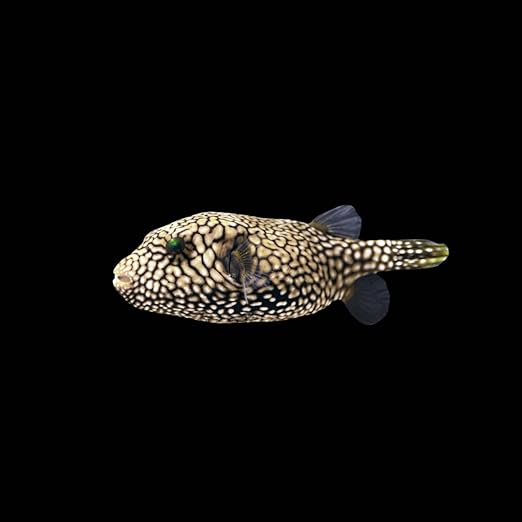
解説 / Description
ケショウフグは、インド洋から西部太平洋のサンゴ礁域に広く分布する大型の海水性フグです。白から灰色がかった地色に、黒や茶色、緑がかった細い線が複雑に入り組む姿は、まるで地図や迷路のようで、英名の「Map puffer」にもその印象が表れています。日本では顔まわりの華やかな模様が化粧のように見えることから、ケショウフグという名で親しまれています。 The Map puffer is a large marine pufferfish distributed widely across coral reef regions of the Indian Ocean and western Pacific. Its pale white to gray body is covered with intricate dark or greenish lines that look like a map or maze, which is reflected in the English name “Map puffer.” In Japan, it is known as “Keshofugu,” a name inspired by the ornate facial markings that resemble makeup.
観賞魚としては、賢く人に慣れやすい魅力的な魚ですが、最大全長は約65cmに達します。そのため、一般的な海水魚水槽では終生飼育が難しく、強い歯を維持するための硬い餌、大量の排泄物を処理する強力なろ過、毒性を持つフグ類としての慎重な取り扱いが求められます。小さな幼魚で見かけても、上級者向けの大型魚として計画する必要があります。 As an aquarium fish, it is intelligent, personable, and highly appealing, but it can reach about 65 cm in total length. Long-term care is therefore difficult in ordinary marine aquariums. It requires hard foods to wear down its powerful teeth, heavy-duty filtration to handle its large bioload, and careful handling as a toxic pufferfish. Even when sold as a small juvenile, it should be planned for as an advanced large marine fish.
基本情報 / Basic Information
| 学名 / Scientific Name | Arothron mappa |
|---|---|
| 通称 / Common Name | ケショウフグ、マップパファー、マップトードフィッシュMap puffer, Scribbled pufferfish, Map toadfish |
| 分類 / Family | フグ目 フグ科 モヨウフグ属Order Tetraodontiformes, family Tetraodontidae, genus Arothron |
| 英名 / English Name | Map puffer, Scribbled pufferfish, Map toadfish |
| 分布 / Distribution | インド洋から西部太平洋の熱帯域。東アフリカからサモア方面、北は琉球列島や日本海西部付近、南はニューカレドニアやオーストラリアのクイーンズランド方面まで記録があります。Tropical Indo-Pacific waters, recorded from East Africa eastward toward Samoa, northward to the Ryukyu Islands and western Sea of Japan region, and southward to New Caledonia and Queensland, Australia. |
| 最大体長 / Max Size | 約65cmAbout 65 cm |
| 寿命 / Lifespan | 本種単独の明確な飼育下寿命データは限られています。大型フグ類として、十分な水量・水質・食性管理が整えば長期飼育が期待されます。Clear, species-specific lifespan data in captivity is limited. As a large pufferfish, it may be maintained long term when water volume, water quality, and diet are properly managed. |
飼育環境 / Aquarium Environment
| 水槽サイズ / Tank Size | 終生飼育では、最低でも約680〜1130L級、余裕を持つなら1500L級の大型システムを目安にします。日本の規格水槽でいえば、一般的な90cm・120cm水槽では不足し、180cm水槽でも奥行きと高さを十分に取ったワイド仕様が望まれます。大型水槽は水槽本体・架台・ろ過槽・水を含めて非常に重くなるため、床強度や設置場所は建築の専門家や施工業者に確認してください。For lifelong care, use a very large system of at least about 680–1130 L, with around 1500 L preferred when possible. In Japanese aquarium terms, standard 90 cm or 120 cm tanks are not sufficient; even a 180 cm tank should ideally be a wide model with generous depth and height. Because the tank, stand, sump, and water become extremely heavy, floor strength and installation safety should be checked with a qualified builder or installer. |
|---|---|
| 水温 / Temperature | 24〜27℃前後を目安に、急変を避けて安定させます。 Keep the water stable at around 24–27°C and avoid sudden changes. |
| 水質 / Water Quality | pH 8.1〜8.4、比重1.020〜1.025を目安に、安定した海水環境を維持します。大型フグは排泄量が多いため、余裕のあるプロテインスキマー、強力な物理ろ過と生物ろ過、十分な水流、定期的な換水が重要です。Maintain stable marine water conditions with pH around 8.1–8.4 and specific gravity around 1.020–1.025. Large puffers produce a heavy bioload, so an oversized protein skimmer, strong mechanical and biological filtration, adequate water movement, and regular water changes are important. |
| レイアウト / Layout | 広い遊泳スペースを確保しつつ、落ち着いて休めるライブロックや大型の隠れ場所を配置します。ただし、サンゴ、甲殻類、貝類などは食べられたり傷つけられたりする可能性が高いため、リーフ水槽ではなくフィッシュオンリー水槽が適しています。驚いて飛び出すことがあるため、頑丈なフタを必ず設置します。Provide open swimming space together with live rock structures or large shelters where the fish can rest. Corals, crustaceans, and mollusks are likely to be eaten or damaged, so this species is best kept in a fish-only system rather than a reef aquarium. A secure, sturdy lid is essential because startled individuals may jump. |
| 注意点 / Precautions | 網で水面上へすくい上げる扱いは避け、水中で大きな容器に誘導して水ごと移動させます。空気を吸い込んで膨らむと、体内の空気を抜きにくくなり衰弱する恐れがあります。また、強いストレスや死亡時には水質悪化や同居魚への悪影響が起きる可能性があるため、異常な呼吸、拒食、横たわり、腹部膨満などを見つけたら早めに隔離・確認します。Avoid lifting the fish out of the water with a net. Instead, guide it underwater into a large container and transfer it together with water. If it inflates with air, it may be unable to expel the air and can become weakened. Severe stress or death may also harm water quality and tank mates, so isolate and check the fish early if you notice abnormal breathing, refusal to feed, lying on the bottom, or abdominal swelling. |
餌と給餌 / Feeding
| 餌の種類 / Diet | 自然下では藻類、海綿、底生無脊椎動物などを食べる雑食性の強い魚です。飼育下では、殻付きアサリ、殻付きエビ、カニ、ヤドカリなど、硬い殻を持つ餌を定期的に与えます。補助的に海水魚用の人工飼料や冷凍餌を使うことはできますが、柔らかい餌だけに偏らせないことが重要です。In the wild, it feeds on algae, sponges, and benthic invertebrates. In captivity, regularly offer hard-shelled foods such as clams on the half shell, shell-on shrimp, crabs, and hermit crabs. Marine pellets and frozen foods can be used as supplements, but the diet should not rely only on soft foods. |
|---|---|
| 給餌のポイント / Feeding Tips | フグ類の歯は伸び続けるため、硬い餌を噛み砕かせて自然に摩耗させることが欠かせません。柔らかい餌だけを続けると歯が伸びすぎ、口が閉じにくくなったり、摂食できなくなったりする恐れがあります。給餌にはピンセットや給餌棒を使い、咬傷事故を避けながら魚の反応を観察します。The teeth of pufferfish continue to grow, so hard foods are essential to keep them naturally worn down. A diet of only soft foods may lead to overgrown teeth, difficulty closing the mouth, or inability to feed. Use feeding tongs or a feeding stick to observe the fish safely while avoiding bite injuries. |
性格と混泳 / Temperament and Tank Mates
| 性格 / Temperament | 基本的には単独行動を好む魚です。幼魚期は比較的おとなしく見えることがありますが、成長すると存在感が強くなり、縄張り意識や捕食性が目立つ場合があります。飼育者を認識して餌をねだるような、知能の高さを感じさせる行動も魅力です。It is generally a solitary fish. Juveniles may appear relatively calm, but as it grows, its strong presence, territorial behavior, and predatory tendencies may become more apparent. One of its charms is its intelligence, including the ability to recognize the keeper and beg for food. |
|---|---|
| 混泳の相性 / Compatibility | サンゴ、エビ、カニ、貝、ウニなどの無脊椎動物とは混泳不可と考えます。小型魚も口に入るサイズであれば捕食される可能性があります。混泳させる場合は、十分に大きく丈夫な大型ヤッコやハタ類などに限られますが、安全性を重視するなら単独飼育が最も無難です。It should be considered incompatible with corals, shrimp, crabs, snails, sea urchins, and other invertebrates. Small fish that fit into its mouth may be eaten. If tank mates are attempted, they should be large, robust species such as large angelfish or groupers, but solitary keeping is the safest option. |
病気と対策 / Diseases and Prevention
| かかりやすい病気 / Common Diseases | 輸入直後は白点病などの外部寄生虫、輸送ストレスによる食欲不振、内部寄生虫を疑う腹部膨満や浮上異常に注意します。野生採集個体では、導入初期の隔離観察が特に重要です。Newly imported individuals should be watched for external parasites such as marine ich, stress-related appetite loss, and abdominal swelling or abnormal floating that may suggest internal parasites. Quarantine and close observation after import are especially important for wild-caught specimens. |
|---|---|
| 対策と予防 / Prevention | 導入前に隔離水槽で十分に観察し、必要に応じて専門店や魚病に詳しい獣医師の判断のもとで駆虫・薬浴を行います。日常管理では、水質悪化を防ぐ強力なろ過、急な比重・水温変化を避ける水合わせ、栄養バランスのよい給餌、ストレスの少ないレイアウトが予防につながります。Observe the fish in a quarantine tank before introduction, and apply deworming or medicated treatment when necessary under the guidance of an experienced shop or a veterinarian familiar with fish diseases. For daily prevention, maintain powerful filtration, avoid sudden salinity or temperature changes, provide a balanced diet, and create a low-stress layout. |
増やし方(繁殖) / Breeding
| 雌雄の判別 / Sexing | 外見だけで雌雄を正確に見分けることは難しく、一般的な観賞魚飼育の範囲では判別情報は限られています。Reliable sexing by external appearance is difficult, and practical information for ordinary aquarium keeping is limited. |
|---|---|
| 繁殖形態 / Reproduction | 卵生です。家庭水槽で狙って繁殖させるための確立した方法は一般的ではなく、仔魚期の管理も非常に難しいと考えられます。It is oviparous. A reliable method for intentional breeding in home aquariums is not generally established, and larval rearing is considered very difficult. |
| 繁殖のポイント / Breeding Tips | 家庭水槽での繁殖は現実的ではありません。なお、海底に精巧なミステリーサークル状の産卵床を作る行動は、本種ではなくアマミホシゾラフグ(Torquigener albomaculosus)に知られる行動です。ケショウフグの繁殖情報として紹介される場合がありますが、種の混同に注意が必要です。Breeding in a home aquarium is not considered practical. The famous behavior of constructing elaborate circular “mystery circle” nests on the seafloor belongs to the White-spotted pufferfish, Torquigener albomaculosus, not this species. It is sometimes mistakenly associated with the Map puffer, so species confusion should be avoided. |
雑学と豆知識 / Trivia and Fun Facts
| 1. 「地図」と「化粧」、同じ模様から生まれた二つの名前 / 1. “Map” and “makeup”: two names born from the same pattern | 英名のMap pufferは、体表の入り組んだ線が地図の道路や等高線のように見えることに由来します。一方、日本名のケショウフグは、顔まわりの派手な線模様を化粧に見立てた名前です。同じ魚の模様でも、海外では地図、日本では化粧として受け止められた点が、この魚の面白い文化的魅力です。The English name “Map puffer” comes from the maze-like lines on the body, which resemble roads or contour lines on a map. The Japanese name “Keshofugu” compares the ornate facial markings to makeup. The same pattern was interpreted as a map overseas and as makeup in Japan, making this species culturally fascinating as well as visually striking. |
|---|---|
| 2. 学名に残る「布」と「地図」の歴史 / 2. The history of “cloth” and “map” hidden in the scientific name | 種小名のmappaは、ラテン語で布やナプキンを意味する語に由来するとされます。この言葉は時代とともに地図を意味する語とも結びつき、複雑な線模様を持つこのフグの名前に用いられました。学名をたどると、魚の模様だけでなく、言葉の歴史まで見えてくるのが面白いところです。The specific name “mappa” is considered to come from a Latin word meaning cloth or napkin. Over time, the word also became connected with maps, and it was applied to this pufferfish with its intricate line pattern. Its scientific name reveals not only the fish’s appearance but also a small piece of linguistic history. |
| 3. 「トードフィッシュ」という名前に注意 / 3. Be careful with the name “toadfish” | 英語のToadfishは、一般にはガマアンコウ科の魚を指すことが多い名前です。しかし、ケショウフグのようにフグ科の一部にも慣用的に使われる場合があります。文献や輸入リストを見るときは、英名だけで判断せず、必ずArothron mappaという学名で確認することが大切です。In English, “toadfish” often refers to fishes in the family Batrachoididae. However, the name is also applied informally to some pufferfish, including the Map puffer. When checking literature or import lists, it is important not to rely only on common names and to confirm the scientific name Arothron mappa. |
| 4. ミステリーサークルを作るフグではありません / 4. It is not the pufferfish that makes mystery circles | 砂地に美しい円形の産卵床を作るフグとして有名なのは、アマミホシゾラフグです。ケショウフグにも同じ行動があるように紹介されることがありますが、これは種の混同による誤情報と考えられます。ケショウフグの魅力は、砂に描く模様ではなく、体そのものに描かれた地図のような模様にあります。The pufferfish famous for creating beautiful circular spawning structures in the sand is the White-spotted pufferfish, Torquigener albomaculosus. This behavior is sometimes incorrectly attributed to the Map puffer because of species confusion. The Map puffer’s charm lies not in patterns drawn in sand, but in the map-like pattern drawn across its own body. |
| 5. 食用ではなく、観賞魚としても毒性に注意 / 5. Not for food, and toxicity matters even as an aquarium fish | ケショウフグは、食べると危険な有毒魚として扱うべきフグです。観賞魚として入手した個体は、いかなる場合も食用にしてはいけません。飼育時も、弱った個体や死亡個体の扱い、同居魚への影響、水質悪化に十分注意します。The Map puffer should be treated as a poisonous fish that is dangerous to eat. Aquarium specimens must never be used as food under any circumstances. In aquarium care, caution is also needed when handling weakened or dead individuals and when considering possible effects on tank mates and water quality. |
まとめ / Conclusion
ケショウフグは、地図のような独特の模様と知的な振る舞いで、海水魚ファンを惹きつける存在感抜群の大型フグです。小さな幼魚で流通することもありますが、成長後のサイズや排泄量、強い歯、毒性を考えると、軽い気持ちで飼い始める魚ではありません。 The Map puffer is a striking large pufferfish that attracts marine aquarists with its map-like pattern and intelligent behavior. Although it may be sold as a small juvenile, its adult size, heavy bioload, powerful teeth, and toxicity mean it should not be purchased casually.
終生飼育を目指すなら、1000Lを超える大型システムを前提に、床強度の確認、硬い餌を使った給餌管理、単独飼育を基本にした混泳計画が必要です。条件を整えられる上級者にとっては、ケショウフグは単なる観賞魚を超え、長く向き合う価値のある個性的なパートナーになります。 For lifelong care, plan on a system exceeding 1000 L, confirm floor strength, manage the diet with hard foods, and design compatibility around solitary keeping. For advanced keepers who can meet these conditions, the Map puffer can become not just an aquarium fish, but a distinctive long-term companion.

気になる道具や飼い方を見つけてみませんか?
 アイのアクアグッズ案内ダニオの仲間に合わせる飼育用品|ゼブラダニオから超小型種まで水槽・ろ過・餌を選ぶ道具の特徴や使い方、選ぶときのポイントをアイが紹介します。記事はコチラ →
 アイのアクアグッズ案内水換え・底砂掃除の道具の選び方|砂利・砂・ソイルに合うクリーナーとポンプ道具の特徴や使い方、選ぶときのポイントをアイが紹介します。記事はコチラ →
さまざまな飼育テーマをご紹介。リンク先の記事には広告・商品紹介が含まれます。
案内・紹介記事一覧へ →参考文献・参照資料
本記事では、ケショウフグ(Arothron mappa)の分類、分布、生息環境、繁殖、毒性、輸入時の注意点、飼育管理上のリスクを確認するため、販売店・通販ページ・個人ブログ・まとめサイトを除外し、魚類データベース、学術論文、公的機関資料を中心に参照しました。
分類・分布・形態・生態
- Froese, R. and D. Pauly, Editors. FishBase: Arothron mappa (Lesson, 1831), Map puffer.
学名、分類、インド太平洋域の分布、水深4〜30m、最大体長65cm、礁域性、単独性、食性、卵生、食毒性など、記事の基礎情報を支える主要資料として参照。
https://www.fishbase.se/summary/Arothron-mappa.html - Fricke, R., Eschmeyer, W. N. and Van der Laan, R. Editors. Eschmeyer’s Catalog of Fishes. California Academy of Sciences.
Arothron mappa の原記載、命名者、シノニム、分類学的位置づけを確認するための分類学的典拠として参照。
https://researcharchive.calacademy.org/research/ichthyology/catalog/fishcatmain.asp - Myers, R. F. 1991. Micronesian Reef Fishes, Second Edition. Coral Graphics.
FishBaseで本種の主要参考文献として挙げられる図鑑資料。サンゴ礁域における外観、生息環境、行動の補助資料として参照。 - Lieske, E. and Myers, R. 1994. Coral Reef Fishes: Indo-Pacific & Caribbean including the Red Sea. HarperCollins.
インド太平洋のサンゴ礁魚類に関する分布・識別の補助資料として参照。
繁殖情報と「ミステリーサークル」誤認の整理
- Kawase, H., Okata, Y. and Ito, K. 2013. Role of Huge Geometric Circular Structures in the Reproduction of a Marine Pufferfish. Scientific Reports 3, 2106.
海底の幾何学的な円形構造を作る繁殖行動が、ケショウフグではなく Torquigener 属の小型フグで確認された行動であることを整理するために参照。
https://www.nature.com/articles/srep02106 - Matsuura, K. 2015. A new pufferfish of the genus Torquigener that builds “mystery circles” on sandy bottoms in the Ryukyu Islands, Japan. Ichthyological Research 62, 207–212.
「ミステリーサークル」を作る種がアマミホシゾラフグ(Torquigener albomaculosus)として記載されたことを確認するために参照。
https://doi.org/10.1007/s10228-014-0428-5
毒性・病気・寄生虫・安全上の注意
- Lago, J., Rodríguez, L. P., Blanco, L., Vieites, J. M. and Cabado, A. G. 2015. Tetrodotoxin, an Extremely Potent Marine Neurotoxin: Distribution, Toxicity, Origin and Therapeutical Uses. Marine Drugs 13(10), 6384–6406.
テトロドトキシンの毒性、ナトリウムチャネル阻害、フグ類を含む海洋生物における分布と由来を説明するために参照。
https://www.mdpi.com/1660-3397/13/10/6384 - Yong, R. Q.-Y., Cutmore, S. C., Jones, M. K., Gauthier, A. R. G. and Cribb, T. H. 2018. A complex of the blood fluke genus Psettarium (Digenea: Aporocotylidae) infecting tetraodontiform fishes of east Queensland waters. Parasitology International 67(3), 285–296.
フグ目魚類に寄生する血吸虫類の情報を補うために参照。記事中の寄生虫リスクは、症状の断定ではなく注意喚起として扱う。 - Moravec, F., Möller, H. and Heeger, T. 1992. Philometra robusta sp. n. (Nematoda: Philometridae) from the abdominal cavity of the scribbled toadfish, Arothron mappa (Lesson), from the Philippines. Folia Parasitologica.
Arothron mappa から記録された線虫類の根拠として参照。輸入個体の腹部膨満や異常遊泳が見られた場合は隔離して観察し、専門家への相談を検討してください。
飼育条件・輸入時の確認
- Spotte, S. 1992. Captive Seawater Fishes: Science and Technology. Wiley-Interscience.
海水魚飼育における水質管理、ろ過、塩分、pH、窒素化合物管理など、一般的な海水魚飼育条件の科学的背景を支える資料として参照。 - 農林水産省 動物検疫所「水産動物の検査について」
日本へ水産動物を輸入する際の輸入防疫制度、対象水産動物、輸入許可申請、書類検査、現物検査などの公的確認先として参照。ケショウフグが個別に対象となるかは、輸入時点で最新の対象水産動物リストと動物検疫所への確認が必要。
https://www.maff.go.jp/aqs/topix/fishinfo.html
注:飼育水槽サイズや混泳可否は、信頼できる種情報と海水魚飼育学の一般原則から安全側に見積もったものです。大型化するフグ類は個体差が大きいため、実際の導入前には十分な水量、強力なろ過、隔離観察、専門店または獣医師への相談を前提にしてください。




コメント