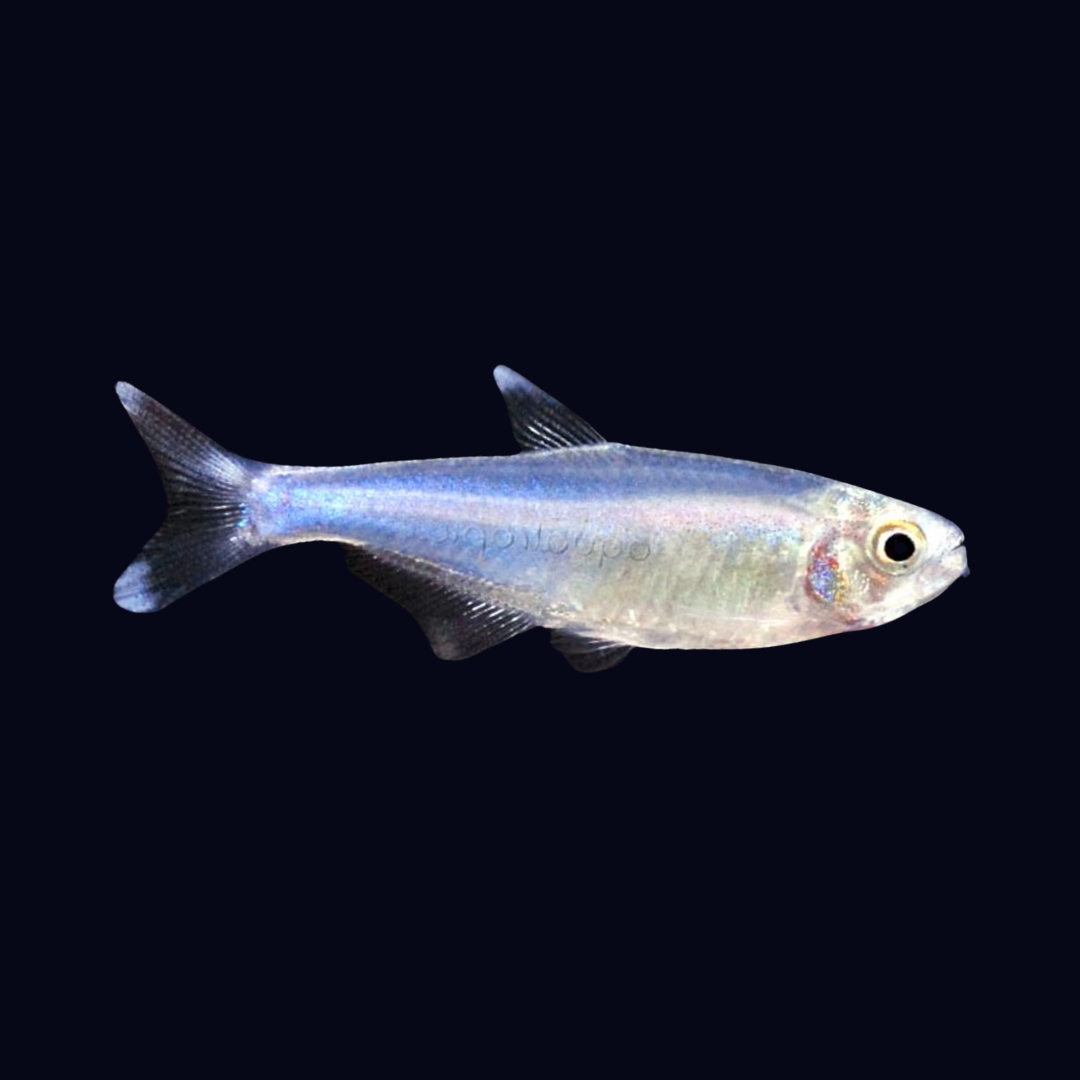
ブルーテトラは、南米ペルーのイキトス周辺に由来するとされる小型カラシンで、体側に走る鮮やかなメタリックブルーの輝きが大きな魅力です。水槽内では非常に活発に泳ぎ、光の角度や個体の状態によって青、藍、淡いラベンダー色を帯びて見えることがあります。その美しさから古くから観賞魚として親しまれてきましたが、性格はやや荒く、ヒレかじりを起こしやすい一面もあるため、混泳には注意が必要です。現在、観賞魚市場で一般にブルーテトラとして流通してきた魚は、長く Boehlkea fredcochui と混同されてきましたが、2008年の記載以降は Knodus borki として扱うのが適切です。The Blue Tetra is a small characin considered to originate from the Iquitos region of Peru, admired for the vivid metallic blue sheen along its flanks. In the aquarium it swims very actively, and depending on the angle of light and the fish’s condition, the body may show blue, indigo, or pale lavender tones. Although it has long been loved as an ornamental fish, it can be assertive and may nip fins, so careful attention is needed when choosing tank mates. The fish commonly traded as the Blue Tetra was long confused with Boehlkea fredcochui, but since its 2008 description it is more appropriately treated as Knodus borki.
基本情報 / Basic Information
学名 / Scientific Name
Knodus borki Zarske, 2008
通称 / Common Name
ブルーテトラ、ペルー・ブルーテトラ、ブルー・ペルー・テトラBlue Tetra, Peruvian Blue Tetra, Blue Peru Tetra
分類 / Family
条鰭綱、カラシン目、Knodus属。科階級は文献によりカラシン科ステバルディア亜科、またはステバルディア科として扱われることがあります。Actinopterygii, Characiformes, genus Knodus. Depending on the reference, the family-level placement may be treated as Characidae: Stevardiinae or as Stevardiidae.
英名 / English Name
Blue Tetra
分布 / Distribution
南米ペルー、イキトス周辺。河川、小川、支流などの淡水域に生息するとされます。古い流通情報ではコロンビアのレティシアが記されることもありますが、これは採集地ではなく、アマゾン地域の観賞魚輸出拠点としての記録である可能性が高いです。South America: the Iquitos region of Peru. It is associated with freshwater habitats such as rivers, streams, and tributaries. Older trade information may mention Leticia, Colombia, but this is more likely related to its role as an ornamental fish export hub in the Amazon region rather than the actual collection locality.
最大体長 / Max Size
約5cm前後。文献や飼育例により4〜5cm台で記されることがあります。Around 5 cm. Depending on the reference and aquarium conditions, it may be listed in the 4 to 5 cm range.
寿命 / Lifespan
飼育下の目安はおおむね3〜5年程度とされます。寿命は水質の安定、十分な遊泳スペース、導入時のストレス管理、群れの状態に左右されます。In aquariums, a practical estimate is roughly 3 to 5 years. Lifespan depends on stable water quality, sufficient swimming space, careful stress management during introduction, and the condition of the group.
飼育環境 / Aquarium Environment
水槽サイズ / Tank Size
小型魚ですが遊泳力と気性の強さを考えると、基本は60cm規格水槽、約60L以上から考えるのが安全です。10匹前後の群れで飼育し、同種間の小競り合いを分散させるなら、90cm規格水槽以上がより理想的です。短期管理を除き、45cm以下の小型水槽や超小型水槽での長期飼育はおすすめできません。Although small, its swimming ability and assertive temperament make a standard 60 cm aquarium of about 60 L or more a safer starting point. For a group of around 10 individuals and better dispersion of intraspecific aggression, a standard 90 cm tank or larger is ideal. Except for short-term holding, long-term care in tanks of 45 cm or smaller, or in nano aquariums, is not recommended.
水温 / Temperature
22〜28℃の範囲で飼育例がありますが、常用では23〜26℃前後が扱いやすいです。高水温では溶存酸素が下がりやすいため、水面をよく動かして酸素を確保します。Aquarium records place it around 22 to 28°C, while 23 to 26°C is a practical everyday range. In warmer water, dissolved oxygen decreases more easily, so good surface agitation is important.
水質 / Water Quality
弱酸性〜中性付近を基本に、pH5.5〜7.5程度、軟水〜中程度の硬度が適しています。急な変化には弱いことがあるため、数値を極端に追い込むよりも、安定した水質を維持することを優先します。ピートモスやマジックリーフを用いた穏やかなブラックウォーター環境も好相性です。Slightly acidic to near-neutral water is suitable, roughly around pH 5.5 to 7.5, with soft to moderately hard conditions. Because it can be sensitive to sudden changes, stable water quality is more important than chasing extreme values. Mild blackwater conditions using peat or Indian almond leaves are also suitable.
レイアウト / Layout
前面には広い遊泳スペースを確保し、後景や側面に水草、流木、枝状の素材を配置して隠れ家と死角を作ります。底床はソイルや暗色系の砂利など、落ち着いた色を選ぶと体色の青が引き立ちます。シダ系水草、アヌビアス類、ミクロソリウム類のような硬めの葉を持つ水草は食害を受けにくく、隠れ家としても使いやすいです。Provide open swimming space in the front, with aquatic plants, driftwood, and branch-like structures along the back and sides to create hiding places and visual breaks. Dark substrates such as aquasoil or dark gravel help enhance the blue coloration. Tough-leaved plants such as ferns, Anubias, and Microsorum are less likely to be damaged and work well as cover.
注意点 / Precautions
飛び出し事故が起こりやすい魚です。ガラス蓋やメッシュ蓋を必ず設置し、フィルターパイプ周辺の隙間もふさいでください。また、攻撃性が強いため、単独や少数飼育では特定個体へのいじめが集中しやすくなります。最低でも8〜10匹以上を目安に、十分な広さで群れとして管理することが重要です。Jumping is a notable risk with this species. Always use a tight-fitting glass or mesh cover, and close gaps around filter pipes. Because it is assertive, keeping only one or a few individuals can concentrate aggression on weaker fish. A group of at least 8 to 10 individuals in a sufficiently spacious tank is important.
餌と給餌 / Feeding
餌の種類 / Diet
雑食性で、人工飼料への餌付きは良好です。小型熱帯魚用の顆粒フード、細かく砕いたフレークフードを主食にし、冷凍アカムシ、ブラインシュリンプ、ミジンコなどの動物性餌を補助的に与えると状態が上がります。栄養バランスを意識する場合は、植物質を含む配合飼料を少量取り入れてもよいでしょう。It is omnivorous and readily accepts prepared foods. Fine granules for small tropical fish and crushed flakes can be used as staples, supplemented with frozen bloodworms, brine shrimp, and daphnia. For nutritional balance, small amounts of prepared foods containing plant matter may also be included.
給餌のポイント / Feeding Tips
運動量が多いため、痩せすぎに注意します。1日1〜2回、数分で食べ切れる量を与えるのが基本です。餌に勢いよく突進して食べるため、混泳魚がいる場合は全体に餌が行き渡るよう、複数箇所に分けて与えるとよいでしょう。食べ残しは水質悪化の原因になるため、与えすぎは避けてください。Because it is very active, avoid letting it become thin. Feed once or twice daily, only as much as can be eaten within a few minutes. It rushes aggressively to food, so in a community tank it is helpful to feed in several spots to ensure other fish also receive food. Avoid overfeeding, as leftovers quickly degrade water quality.
性格と混泳 / Temperament and Tank Mates
性格 / Temperament
非常に活発で、同時に気が強い魚です。同種間では順位争いや追いかけ合いが見られ、他種に対してもヒレかじりを行うことがあります。少数飼育では攻撃対象が固定されやすいため、まとまった数で群泳させ、攻撃を分散させることが飼育成功の鍵になります。It is extremely active and quite assertive. Chasing and dominance behavior are common among its own kind, and it may nip the fins of other species. In small groups, aggression can focus on a single individual, so maintaining a proper group helps disperse aggression and is key to success.
混泳の相性 / Compatibility
グッピー、ベタ、エンゼルフィッシュなど、ヒレが長く動きがゆったりした魚との混泳は避けます。ネオンテトラやカージナルテトラなど小型で穏やかな魚も、体格差や水槽サイズによっては追い回されることがあります。相性がよい候補は、ラスボラ類、ダニオ類、体格のあるカラシン類、コリドラス、プレコなどです。特に底棲魚は生活層が分かれやすく、比較的安心して組み合わせられます。Avoid mixing it with slow fish that have long fins, such as guppies, bettas, and angelfish. Small peaceful tetras such as neon tetras and cardinal tetras may also be chased depending on size difference and tank space. Better candidates include rasboras, danios, more robust characins, Corydoras, and plecos. Bottom-dwelling fish are often suitable because they occupy a different zone of the aquarium.
病気と対策 / Diseases and Prevention
かかりやすい病気 / Common Diseases
基本的には丈夫な魚として扱われますが、導入直後のストレス、水温変化、水質悪化によって白点病が出ることがあります。また、輸送や急な水質変化で体表の粘膜が乱れ、白く濁ったような肌荒れを起こすこともあります。ヒレかじりによる傷から二次感染が起こる場合もあるため、混泳管理も病気予防の一部です。It is generally treated as hardy, but stress after introduction, temperature swings, and poor water quality can trigger ich. Transport stress or sudden water changes may also disturb the body mucus layer, creating a cloudy or rough-looking skin condition. Injuries caused by fin nipping can lead to secondary infections, so social management is also part of disease prevention.
対策と予防 / Prevention
導入時は水温合わせと水合わせを丁寧に行い、可能であれば点滴法で時間をかけて慣らします。週に20〜30%程度の定期換水を行い、硝酸塩の蓄積を抑えます。フィルターの排水で水面を揺らし、溶存酸素を確保することも大切です。マジックリーフなどを用いた穏やかなブラックウォーター化は、ストレス緩和や水質安定に役立つ場合があります。During introduction, match temperature and water parameters carefully, ideally using slow drip acclimation. Perform regular weekly water changes of about 20 to 30% to limit nitrate buildup. Surface agitation from the filter outflow helps maintain dissolved oxygen. Mild blackwater conditions using Indian almond leaves may help reduce stress and stabilize water chemistry.
増やし方(繁殖) / Breeding
雌雄の判別 / Sexing
成熟したメスは抱卵すると腹部が丸くふくらみ、全体にややふくよかな体型になります。オスは比較的スリムで、青の発色が強く出やすいとされます。ただし若魚やコンディションが整っていない個体では判別が難しく、外見だけで確実に見分けるのは簡単ではありません。Mature females become rounder in the abdomen when carrying eggs and appear fuller overall. Males are generally slimmer and are often reported to show stronger blue coloration. However, sexing juveniles or poorly conditioned fish can be difficult, and reliable identification by appearance alone is not always easy.
繁殖形態 / Reproduction
水草や産卵モップなどに卵をばら撒く、卵散布型の繁殖形態です。親魚は卵や稚魚を保護せず、食卵することがあるため、産卵後は親を隔離する必要があります。It is an egg-scattering species that releases eggs among plants or spawning mops. The parents do not guard the eggs or fry and may eat the eggs, so they should be removed after spawning.
繁殖のポイント / Breeding Tips
30cm程度の繁殖用水槽を用意し、ベアタンクにスポンジフィルター、ウィローモス、細葉の水草、産卵モップを入れます。弱酸性の軟水に調整し、親魚には事前にブラインシュリンプや冷凍アカムシなどを与えてコンディションを整えます。孵化時期は水温に左右されますが、およそ2〜3日程度が目安です。自由遊泳後の稚魚は非常に小さいため、最初はゾウリムシなどのインフゾリアを用意しておくと安全です。数日後、成長に合わせてマイクロワームやブラインシュリンプの幼生へ切り替えていきます。Prepare a breeding tank of around 30 cm with no substrate, a sponge filter, Java moss, fine-leaved plants, or spawning mops. Use soft, slightly acidic water and condition the adults beforehand with foods such as brine shrimp and frozen bloodworms. Hatching time depends on temperature, but roughly 2 to 3 days is a useful guide. The free-swimming fry are very small, so preparing infusoria such as paramecia at first is safer. After several days, as they grow, they can gradually be switched to microworms and newly hatched brine shrimp.
雑学と豆知識 / Trivia and Fun Facts
1. 半世紀近く続いた名前の取り違え / 1. A Name Confusion That Lasted for Decades
ブルーテトラの物語で特に興味深いのは、長いあいだ Boehlkea fredcochui という名で親しまれてきたにもかかわらず、現在では Knodus borki として扱われる点です。2008年、アクセル・ザルスケ博士は、観賞魚として流通していた青いテトラが真の Boehlkea fredcochui ではなく、Knodus属の未記載種であることを示し、Dieter Bork氏にちなみ Knodus borki として記載しました。分類の決め手は、上顎骨の歯の数、側線、体色パターンなどで、一般のアクアリストが水槽越しに確認するのは難しい形質です。美しい青い魚として世界中に広がったあとで、分類学がゆっくりとその正体に追いついたような、観賞魚史らしい一幕といえます。One of the most fascinating parts of the Blue Tetra’s story is that it was long known as Boehlkea fredcochui, but is now treated as Knodus borki. In 2008, Dr. Axel Zarske showed that the blue tetra circulating in the aquarium trade was not the true Boehlkea fredcochui, but an undescribed species of Knodus, which he described as Knodus borki in honor of Dieter Bork. Key diagnostic features included the number of teeth on the maxillary bone, the lateral line, and coloration pattern, traits that ordinary aquarists can hardly check through aquarium glass. It is a classic aquarium-history episode in which taxonomy gradually caught up with a beautiful fish that had already spread around the world.
2. 青い色素ではなく、光が作る青 / 2. A Blue Created by Light, Not Blue Pigment
ブルーテトラの青い輝きは、単純な青い絵の具のような色ではなく、皮膚の反射性の細胞や光の当たり方によって強く見え方が変わるタイプの発色です。暗い底床、落ち着いた照明、弱酸性寄りの安定した水質、ストレスの少ない環境が整うほど、本種の青は深く見えます。反対に、明るすぎる底砂や落ち着かない環境では、同じ魚でも驚くほど色が飛んでしまうことがあります。色揚げ用の餌だけでなく、背景、照明、群れの安定まで含めて整えることが、この魚を美しく見せる近道です。The Blue Tetra’s blue sheen is not a simple paint-like blue, but a type of coloration whose appearance changes strongly with reflective cells in the skin and the angle of light. Dark substrate, calm lighting, stable slightly acidic water, and a low-stress environment all help deepen the blue. In contrast, bright substrate or an unsettled environment can make the very same fish look surprisingly washed out. Rather than relying only on color-enhancing food, the best approach is to optimize background, lighting, and group stability together.
3. 美しい小型魚に隠れたブルー・デビルの一面 / 3. The “Blue Devil” Side Behind the Beauty
本種は小さく美しいため、初心者向けの穏やかなテトラと誤解されやすい魚です。しかし実際には、同種間で追いかけ合い、他魚のヒレをかじることもある、かなり気の強いカラシンです。かつてブルー・デビルと呼ばれたという逸話は、そうした性質をよく表しています。とはいえ、この性格は単なる悪癖というより、流れのある淡水域で餌や空間を素早く確保するための行動として理解すると納得しやすくなります。十分な数で群れを作らせ、広い水槽で泳がせることは、この野性味を安全に楽しむための工夫です。Because it is small and beautiful, this species is often mistaken for a gentle beginner tetra. In reality, it is a rather assertive characin that chases its own kind and may nip the fins of other fish. The old nickname “Blue Devil” captures this side of its character well. Still, this behavior is easier to understand if we see it not simply as a bad habit, but as a strategy for securing food and space quickly in flowing freshwater habitats. Keeping a proper group in a spacious tank is a way to enjoy this wild energy safely.
4. 観賞魚輸入史とつながる背景 / 4. A Link to the History of Ornamental Fish Importation
ブルーテトラの旧来の混同名に関わる fredcochui という名は、観賞魚輸入の開拓者として知られるフレッド・コチュー氏に由来します。南米から欧米へ熱帯魚を運ぶことが現在ほど容易ではなかった時代、航空機や現地ネットワークを駆使して未知の魚を世界へ紹介した人々がいました。現在のブルーテトラそのものの正しい学名は Knodus borki ですが、その背景には、アマゾン地域の輸出拠点、商業名、分類学の進展が複雑に重なった歴史があります。今日、日本のショップで見かける小さな青い魚にも、そうした時代の名残がそっと刻まれています。The name fredcochui, associated with the historical misidentification of the Blue Tetra, honors Fred Cochu, a pioneer of ornamental fish importation. In an era when transporting tropical fish from South America to Europe and North America was far more difficult than it is today, explorers and traders used aircraft and local networks to introduce unknown fishes to the wider world. The correct name for the commonly traded Blue Tetra is now Knodus borki, but its background is shaped by Amazonian export hubs, commercial names, and the progress of taxonomy. Even a small blue fish in a Japanese aquarium shop carries a quiet trace of that era.
5. データ不足という保全評価の意味 / 5. What “Data Deficient” Means
本種はIUCNの評価でデータ不足とされており、これは「危険ではない」と断定されたという意味ではありません。十分な分布情報や個体群情報がそろっていないため、絶滅リスクを正確に判断できないという位置づけです。観賞魚として安定して流通していることと、野生での詳しい保全状態が完全に分かっていることは同じではありません。アクアリウムで楽しむ側としては、学名や産地情報を丁寧に扱い、可能な範囲で責任ある流通個体を選ぶ姿勢も大切です。This species is assessed as Data Deficient by the IUCN, which does not mean it has been proven to be safe from risk. Rather, there is not enough distribution or population information to judge its extinction risk accurately. Stable availability in the aquarium trade is not the same as complete knowledge of its wild conservation status. For aquarists, treating scientific names and locality information carefully, and choosing responsibly sourced fish whenever possible, is part of enjoying the species responsibly.
まとめ / Conclusion
ブルーテトラは、メタリックブルーの美しさ、活発な泳ぎ、そして複雑な分類史をあわせ持つ、非常に魅力的な小型カラシンです。丈夫で人工飼料にもよく慣れるため入手しやすい魚ですが、性格は強く、混泳や飼育数を誤るとトラブルが起こりやすい点には注意が必要です。The Blue Tetra is a highly attractive small characin, combining metallic blue beauty, energetic swimming, and a complex taxonomic history. It is hardy and readily accepts prepared foods, making it easy to obtain and maintain, but its assertive temperament means that incorrect group size or tank mate choices can quickly cause problems.
本種を美しく健康に飼うためには、60cm規格水槽以上を基本に、できれば8〜10匹以上の群れで導入し、暗色の底床、十分な遊泳空間、隠れ家、弱酸性寄りの安定した水質を整えることが大切です。青く輝く姿だけでなく、野性味ある行動や観賞魚史に刻まれた背景まで味わえる、知れば知るほど奥深い一種です。To keep this species healthy and beautiful, start with a standard 60 cm aquarium or larger, preferably maintain a group of 8 to 10 or more individuals, and provide dark substrate, open swimming space, hiding places, and stable slightly acidic water. It is a fish whose appeal deepens the more one learns about it, from its blue brilliance to its wild behavior and its place in aquarium history.
Zarske, A. (2008).
Knodus borki sp. n. – ein neuer Salmler aus Peru mit einer ergänzenden Beschreibung von Boehlkea fredcochui Géry, 1966 (Teleostei: Characiformes: Characidae). Vertebrate Zoology, 58(2), 159–171.
https://vertebrate-zoology.arphahub.com/article/30929/学名、記載年、ペルー産であること、Boehlkea fredcochuiとの混同、形態比較の中核根拠。
Thomaz, A. T., Arcila, D., Ortí, G. & Malabarba, L. R. (2015).
Molecular phylogeny of the subfamily Stevardiinae Gill, 1858 (Characiformes: Characidae): classification and the evolution of reproductive traits. BMC Evolutionary Biology, 15, 146.
https://bmcecolevol.biomedcentral.com/articles/10.1186/s12862-015-0403-4ステバルディア亜科周辺の分子系統、Knodusや近縁属の分類上の扱いに関する背景資料。
Soares, I. M., Bertaco, V. A., Ito, P. M. M. & Zuanon, J. (2017).
A new species of Boehlkea (Characiformes: Characidae: Stevardiinae) from the rio Japurá, Amazon basin, Brazil. Neotropical Ichthyology.
https://www.scielo.br/j/ni/a/JZzG8nXHLHtKPyRFRC9Pr7H/?lang=enBoehlkea属、Boehlkea fredcochuiのタイプ産地不確実性、近縁分類群との比較背景に使用。
Scharpf, C.
The ETYFish Project: Family Stevardiidae Gill 1858.
https://etyfish.org/stevardiidae/種小名 borki の献名対象であるDieter Bork氏に関する語源情報の確認に使用。



 アイのアクアグッズ案内海水魚の底砂の選び方|サンゴ砂・ライブサンドとおすすめ商品道具の特徴や使い方、選ぶときのポイントをアイが紹介します。記事はコチラ →
 アイのアクアグッズ案内水槽のコケ掃除|道具の選び方とお掃除生体の得意・不得意道具の特徴や使い方、選ぶときのポイントをアイが紹介します。記事はコチラ →



コメント