

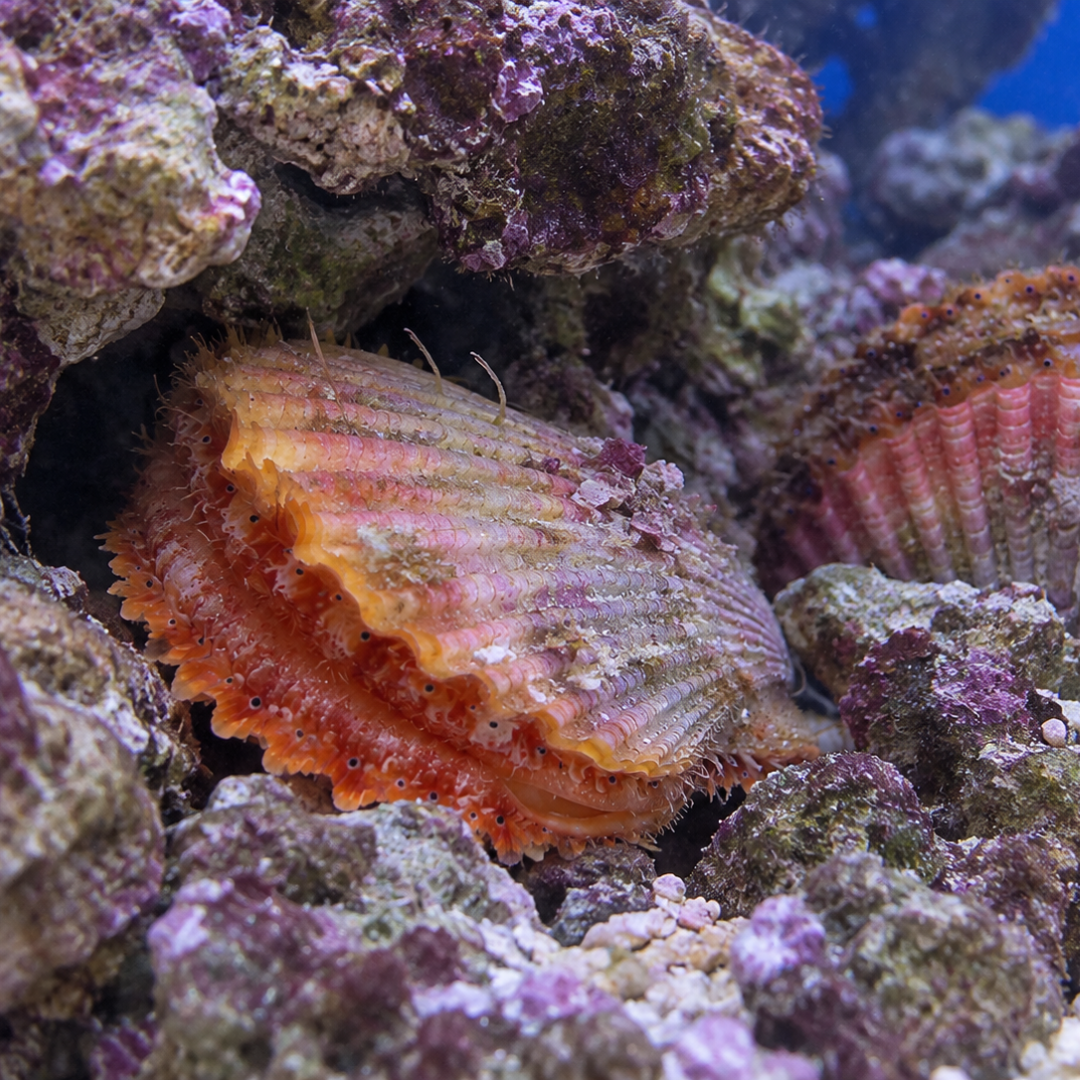
解説 / Description
ヒオウギガイは、赤、橙、黄、紫、褐色など、個体ごとに異なる鮮やかな殻色で知られるイタヤガイ科の海産二枚貝です。日本の暖海域を含む西太平洋に分布し、岩などの硬い基質に足糸を出して付着しながら生活します。外套膜の縁には青い眼が並び、刺激を受けると殻を素早く開閉して移動することもあるなど、一般的な二枚貝の印象とは異なる活発な一面を持っています。日本では愛媛県、三重県、高知県などで食用として利用・養殖され、「アッパ貝」「長太郎貝」「パタパタ貝」などの地方名でも親しまれています。観賞面でも印象的な種類ですが、長期飼育には安定した海水環境に加えて、餌となる植物プランクトンを継続して確保する必要があります。 The noble scallop is a marine bivalve of the family Pectinidae, well known for its naturally variable shell colors, including red, orange, yellow, purple, and brown. It occurs in warm parts of the western Pacific, including Japan, and commonly attaches to hard substrates with byssal threads. Blue eyes line the edge of the mantle, and when disturbed the scallop can rapidly clap its valves and move through the water, giving it a surprisingly active side for a bivalve. In Japan it is cultivated and eaten in areas including Ehime, Mie, and Kochi, where several regional names are also used. Although its colorful appearance makes it attractive for observation, long-term aquarium maintenance requires not only stable seawater conditions but also a continuous source of suitable phytoplankton.
基本情報 / Basic Information
| 学名 / Scientific Name |
Mimachlamys crassicostata (G. B. Sowerby II, 1842) Mimachlamys nobilis (Reeve, 1852)、Chlamys nobilis の名称も日本の図鑑や養殖研究で広く使われてきました。現在のWoRMS/MolluscaBaseでは、M. nobilis は M. crassicostata の異名として扱われています。 Mimachlamys nobilis (Reeve, 1852) and Chlamys nobilis have been widely used in Japanese references and aquaculture research. WoRMS/MolluscaBase currently treats M. nobilis as a synonym of M. crassicostata. |
|---|---|
| 通称 / Common Name | アッパ貝、アッパッパ貝、長太郎貝、パタパタ貝などAppa-gai, Appappa-gai, Chotaro-gai, Patapata-gai and other regional Japanese names |
| 分類 / Family | 軟体動物門・二枚貝綱・イタヤガイ科Phylum Mollusca, Class Bivalvia, Family Pectinidae |
| 英名 / English Name | Noble scallop |
| 分布 / Distribution | 日本では房総半島以南を中心とする暖海域に見られ、中国沿岸、ベトナム、インドネシアなど西太平洋に広く分布します。日本の資料では、潮間帯下部から水深約20mまでの岩礫底などに付着して生息するものとして記録されています。Distributed widely in warm western Pacific waters, including southern and central Japan, coastal China, Vietnam, and Indonesia. Japanese records commonly describe it as occurring attached to rocky or gravelly substrates from the lower intertidal zone to around 20 meters depth. |
| 最大体長 / Max Size | 殻長約12.5cm、殻高約13cmに達する記録があります。養殖・流通個体ではこれより小さいものも多く見られます。Recorded to reach approximately 12.5 cm in shell length and about 13 cm in shell height. Cultured and marketed individuals are often smaller. |
| 寿命 / Lifespan | 標準的な寿命を示す信頼性の高い情報は乏しく、明確ではありません。A well-established standard lifespan is not clearly documented. |
飼育環境 / Aquarium Environment
| 水槽サイズ / Tank Size | 家庭水槽での標準的な推奨サイズは確立されていません。殻の大きさだけでなく、水温、塩分、溶存酸素、餌となる植物プランクトンの状態を安定させられる十分な水量を確保することが重要です。There is no well-established standard tank size for home aquariums. More important than shell size alone is providing enough water volume to maintain stable temperature, salinity, dissolved oxygen, and phytoplankton availability. |
|---|---|
| 水温 / Temperature | 研究では15〜28℃程度で生育でき、20〜25℃前後を適温とする報告があります。29〜31℃では高水温に対する生理的な調節反応が現れるため、長期飼育では高温を避け、20〜25℃前後を目安に安定させるのが無難です。低温側では12℃付近からストレス反応が確認されています。 Studies report survival and growth over roughly 15–28°C, with around 20–25°C described as an optimum range. Physiological responses to heat become evident at 29–31°C, so maintaining a stable temperature around 20–25°C is a cautious target for long-term care. Signs of cold stress have been reported around 12°C. |
| 水質 / Water Quality | 清浄で安定した海水環境が必要です。成長に適した塩分として28〜32ppt程度が報告されており、急激な低塩分化は鰓や生理機能への負担になります。また、酸性化した海水を用いた実験では、幼生の孵化率、生残率、成長率が低下しているため、pHを含む海水条件を安定させることが重要です。Clean and stable seawater is essential. An optimum salinity range of approximately 28–32 ppt has been reported for growth, while sudden reductions in salinity can stress the gills and other physiological functions. Experimental ocean-acidification conditions have also reduced larval hatching, survival, and growth, emphasizing the importance of stable seawater chemistry. |
| レイアウト / Layout | 自然下では岩などに足糸を出して付着するため、安定したライブロックや硬い基質を用意します。濾過摂食を妨げないよう、周囲には淀みを作らない程度の穏やかで安定した水流を確保します。Because the scallop naturally attaches to rocks and other firm surfaces with byssal threads, stable live rock or another hard substrate should be provided. Gentle, consistent water movement should prevent stagnation without physically disturbing the animal or interfering with suspension feeding. |
| 注意点 / Precautions | 高水温、低酸素、急激な低塩分化などを避けることが重要です。養殖研究では、これらの環境ストレスに加えて有害藻類や病原体も大量斃死に関与することが示されています。また、ヒオウギガイは麻痺性貝毒を作る渦鞭毛藻を摂食して毒素を蓄積することがあるため、有毒プランクトンへの曝露にも注意が必要です。Avoid prolonged high temperatures, hypoxia, and rapid drops in salinity. Aquaculture studies indicate that environmental stress, harmful algae, and pathogens can all contribute to mortality events. Noble scallops can also ingest toxin-producing dinoflagellates and accumulate paralytic shellfish toxins, so exposure to harmful plankton is an additional concern. |
餌と給餌 / Feeding
| 餌の種類 / Diet | 植物プランクトンを主体とする濾過摂食性です。人工種苗生産ではイソクリシス類やテトラセルミス類などの微細藻類が餌として利用されています。This species is a suspension feeder that mainly consumes phytoplankton. Microalgae such as Isochrysis and Tetraselmis are used as food in hatchery culture. |
|---|---|
| 給餌のポイント / Feeding Tips | 水中を漂う微細藻類を鰓で濾し取って食べるため、魚のように固形飼料を与えるだけでは維持できません。利用できる大きさの植物プランクトンを継続的に供給しつつ、過剰給餌による水質悪化を防ぐ必要があります。摂食量は餌となる粒子の種類や量、水温などの環境条件にも左右されます。The scallop filters microscopic algae from the water with its gills, so it cannot be maintained simply by offering ordinary solid fish foods. Suitably sized phytoplankton must remain available while excess feeding is controlled to prevent deterioration of water quality. Feeding activity is also influenced by food quality, food concentration, temperature, and other environmental conditions. |
性格と混泳 / Temperament and Tank Mates
| 性格 / Temperament | 他の生物を積極的に攻撃することはありません。普段は岩などに足糸で付着していますが、強い刺激を受けると殻を素早く開閉し、その反動で水中を移動することがあります。It does not actively attack other aquarium animals. Although it normally remains attached to a hard surface by byssal threads, strong disturbance may cause it to clap its valves rapidly and move through the water. |
|---|---|
| 混泳の相性 / Compatibility | 貝類を捕食するヒトデや魚類、殻や外套膜を繰り返しつつく生物との混泳は避けます。ヒオウギガイ自身は濾過摂食性で、魚や他の無脊椎動物を捕食することはありません。Avoid starfish, mollusk-eating fishes, and other animals that repeatedly pick at the shell or mantle. The scallop itself is a filter feeder and does not prey on fish or other aquarium invertebrates. |
病気と対策 / Diseases and Prevention
| かかりやすい病気 / Common Diseases | 養殖で見られる斃死は、ひとつの病気だけで説明できるものではありません。高水温、低酸素、低塩分などによって生理状態が悪化したところへ、有害藻類や細菌などの影響が重なる場合があります。ビブリオ属細菌を用いた感染実験でも免疫応答が確認されており、弱った個体では感染症への注意が必要です。Mortality in cultured noble scallops cannot be attributed to a single disease in every case. Stress from high temperature, hypoxia, or low salinity may occur together with harmful algae or bacterial infection. Experimental challenges with Vibrio bacteria have demonstrated clear immune responses, indicating that weakened animals can also be vulnerable to infection. |
|---|---|
| 対策と予防 / Prevention | 水温と塩分を安定させ、十分な溶存酸素と水流を確保することが基本です。急激な環境変化や過密を避け、摂食できない状態が長く続かないよう管理します。異常な閉殻、外套膜の収縮、反応の低下などが見られた場合は、水温、塩分、酸素、水質、餌の状態をまとめて確認することが重要です。Prevention begins with stable temperature and salinity, adequate dissolved oxygen, and appropriate water movement. Sudden environmental changes and overcrowding should be avoided, and prolonged food deprivation should not be allowed to develop. If abnormal valve closure, mantle contraction, or reduced responsiveness is observed, temperature, salinity, oxygen, water quality, and food availability should all be checked together. |
増やし方(繁殖) / Breeding
| 雌雄の判別 / Sexing | 成熟期には生殖腺の色が判別の手掛かりになります。研究個体では雄の生殖腺は白色から淡い橙色、雌はより濃い橙色を示します。ただし、未成熟個体を外見だけで確実に判別するのは困難です。Gonad color provides a useful clue in mature scallops. In studied animals, males have white to pale-orange gonads, whereas females have more strongly orange gonads. Immature individuals are much more difficult to sex reliably from external appearance alone. |
|---|---|
| 繁殖形態 / Reproduction | 卵と精子を海水中へ放出し、体外受精する繁殖形態です。人工種苗生産では、成熟した親貝にセロトニン(5-HT)を投与して放卵・放精を誘発し、回収した卵と精子を人工授精する方法が研究・利用されています。Eggs and sperm are released into seawater and fertilization occurs externally. In hatchery work, mature broodstock can be induced to spawn with serotonin, or 5-HT, after which eggs and sperm are collected for controlled fertilization. |
| 繁殖のポイント / Breeding Tips | 人工種苗生産の研究例では、水温25℃、塩分32で受精卵を管理すると、約20時間後にD型幼生へ発育しています。その後の幼生にはイソクリシスなどの微細藻類を継続して与えます。幼生期から稚貝期まで水質と餌料密度を細かく管理する必要があるため、一般的な家庭水槽で自然繁殖から稚貝まで育てる難易度は高い種類です。In a published hatchery protocol, fertilized eggs kept at 25°C and a salinity of 32 developed into D-stage larvae after about 20 hours. The larvae were then supplied continuously with microalgae such as Isochrysis. Because water quality and algal food density must be carefully managed throughout the larval and juvenile stages, completing the entire breeding cycle in a typical home aquarium is demanding. |
雑学と豆知識 / Trivia and Fun Facts
| 1. 青い眼の奥には「鏡」を使う仕組みがある / 1. Scallop Eyes Use a Mirror-Based Optical System | ヒオウギガイの外套膜の縁には、小さな青い眼が並んでいます。イタヤガイ類の眼について行われた詳しい研究では、グアニン結晶が何層にも並んだ反射構造が凹面鏡のように働き、光を網膜へ導くことが分かっています。人間の眼のようにレンズだけで像を作る仕組みとは大きく異なります。じっと岩に付着しているように見える二枚貝にも、周囲の光や動きを捉えるための高度な感覚器官が備わっているのです。Small blue eyes line the mantle edge of the noble scallop. Detailed studies of scallop eyes have shown that layers of guanine crystals form a reflective structure that works like a concave mirror and directs light toward the retina. This differs fundamentally from the lens-dominated optical system familiar from the human eye. An animal that appears to sit quietly on a rock therefore possesses surprisingly elaborate sensory organs for detecting its surroundings. |
|---|---|
| 2. 岩に付着するのに、必要なら泳ぐこともできる / 2. It Attaches to Rocks but Can Still Swim | 普段のヒオウギガイは足糸を伸ばし、岩などに付着して暮らします。しかし、刺激を受けると左右の殻を勢いよく開閉し、水を押し出す反動で移動することがあります。南伊勢町でも、殻をバタバタと動かして泳ぐ姿が地域の紹介資料で取り上げられています。静かに固着して暮らす姿と、必要なときに突然動き出す姿の対比は、ヒオウギガイならではの面白さです。Noble scallops usually live attached to rocks by byssal threads. When strongly disturbed, however, they can rapidly clap their valves and move by expelling water. Local descriptions from Minamiise also note this conspicuous swimming behavior. The contrast between an apparently stationary attached animal and its sudden ability to move is one of the species’ most memorable traits. |
| 3. 「檜扇」の名に残る日本の美意識 / 3. A Name Inspired by the Traditional Hiougi Fan | 和名のヒオウギガイは、殻頂から放射状に広がる殻の形が、薄いヒノキ板を重ねて作る伝統的な「檜扇」に似ていることに由来します。殻表には24本前後の放射肋が並び、赤や黄、紫などの色彩を持つ個体もあります。扇形の輪郭と鮮やかな色が重なることで、単に形が似ているだけでなく、装飾性の高い檜扇を思わせる姿になっています。The Japanese name Hiougi-gai refers to the hiougi, a traditional fan made from thin strips of Japanese cypress. The shell bears roughly two dozen radiating ribs and may occur in vivid shades such as red, yellow, and purple. Its fan-shaped outline and colorful surface together explain why it came to be associated with this decorative object from Japanese culture. |
| 4. 産地によって呼び名も変わる / 4. Regional Names Reflect Local Food Culture | ヒオウギガイは地域との結びつきが強く、三重県南伊勢町周辺では「アッパ貝」や「アッパッパ貝」、高知県では「長太郎貝」、愛媛県愛南町では「長太郎貝」や「パタパタ貝」などの呼び名が使われています。ひとつの生物に複数の地方名が残っていることからも、全国一律の商品というより、それぞれの土地の漁業や食文化の中で親しまれてきた貝であることが伝わります。The species is closely tied to regional food culture. Around Minamiise in Mie it is known as Appa-gai or Appappa-gai, while Chotaro-gai is widely used in Kochi, and names such as Chotaro-gai and Patapata-gai are also used around Ainan in Ehime. The survival of these local names reflects a long relationship with regional fishing and cuisine rather than a single uniform national market identity. |
| 5. 黄金色の個体では、カロテノイドを運ぶ仕組みまで研究されている / 5. Golden Scallops Have Revealed How Carotenoids Are Transported | ヒオウギガイの色彩研究では、黄金色の個体が持つ高いカロテノイド蓄積能力が注目されています。StAR-like-3と呼ばれる遺伝子は黄金色個体の腸や血球で強く発現し、その働きをRNA干渉で抑えると血リンパ中の総カロテノイド量が低下しました。さらに、この遺伝子が作るタンパク質にはカロテノイドを結合・輸送する性質があることも研究されています。つまり、鮮やかな表現型の背景には、餌から得た色素を体内へ取り込み、運び、蓄積する仕組みが関係しています。ただし、殻色そのものをひとつの遺伝子だけで説明できるという意味ではありません。Research on noble scallop coloration has focused on the strong carotenoid accumulation seen in golden individuals. A gene called StAR-like-3 is expressed at higher levels in the intestine and hemocytes of golden scallops, and suppressing its expression by RNA interference reduces total carotenoids in the hemolymph. The protein encoded by this gene has also been investigated for its ability to bind and transfer carotenoids. In practical terms, the vivid phenotype is associated with biological mechanisms that absorb, transport, and store dietary pigments, although shell color itself cannot be reduced to the action of a single gene. |
| 6. 殻色による栄養差はあるが、単純な「何色がすべて上」ではない / 6. Nutritional Differences Exist, but No Color Is Higher in Every Nutrient | 同じ集団から得た黄金色、黄色、褐色の個体を比較した研究では、黄金色と黄色の個体は褐色個体より総カロテノイド量と総脂質量が多く、EPAやDHAを含む多価不飽和脂肪酸の割合も高い結果が得られています。一方、アミノ酸については単純ではありません。黄色個体は黄金色個体より必須アミノ酸や呈味に関わるアミノ酸が多い項目がありましたが、褐色個体が高い成分もありました。そのため、殻色と栄養組成には関連が見られるものの、「鮮やかな色ほどあらゆる栄養成分が多い」と考えるのは正確ではありません。A study comparing golden, yellow, and brown scallops from the same breeding population found that golden and yellow individuals had higher total carotenoids, total lipids, and proportions of polyunsaturated fatty acids including EPA and DHA than brown individuals. Amino acids, however, showed a more complex pattern. Yellow scallops exceeded golden scallops in several essential and flavor-related amino acid measurements, while brown scallops were higher in some others. Shell color is therefore associated with nutritional composition, but brighter color does not mean that every nutrient is present at a higher level. |
| 7. 「黄金色の育種」と「低温耐性の選抜」は区別して考える / 7. Golden-Color Breeding and Cold-Tolerance Selection Are Related but Distinct | 中国では、殻や軟体部が黄金色を示す「南澳金貝」が複数世代の選抜によって育成され、2015年に新品種として認定されました。この黄金色系統は褐色個体よりカロテノイドが多く、温度ストレスへの耐性についても研究されています。一方、越冬時の低温耐性を直接高める研究では、2018年から別途、2世代にわたる選抜が行われました。その結果、24時間の低温試験における半数致死温度が13.13℃から12.67℃へ低下し、累積遺伝的獲得量は3.50%と報告されています。以前はこの二つの育種過程が混同されることがありますが、黄金色系統の成立と、その後の低温耐性選抜は分けて理解する必要があります。In China, the Nan’ao Golden Scallop, characterized by golden shells and soft tissues, was developed through multigenerational selective breeding and formally approved as a new variety in 2015. This golden line contains more carotenoids than common brown scallops and has also been studied for temperature-stress tolerance. A separate breeding experiment beginning in 2018 then selected directly for overwintering cold tolerance over two generations. In that study, the 24-hour median lethal temperature declined from 13.13°C to 12.67°C, corresponding to a cumulative genetic gain of 3.50%. The establishment of the golden variety and the later direct selection for cold tolerance are therefore related areas of research but should not be treated as the same breeding process. |
| 8. 食べた後の殻も地域の工芸素材になる / 8. The Empty Shell Is Also Used as a Local Craft Material | ヒオウギガイの天然色は、食用にした後も殻に残ります。愛媛県愛南町では、この色鮮やかな殻を利用したランプシェードなどの工芸品が実際に制作・販売されています。光を内側から当てると、赤や橙、黄、紫の殻がそれぞれ異なる表情を見せます。食材として利用した後の殻が、地域の観光や工芸へつながっている点も、ヒオウギガイならではの文化的な広がりです。The natural colors remain in the shell after the edible tissues have been used. In Ainan, Ehime Prefecture, colorful noble scallop shells are made into and sold as craft items including lampshades. When illuminated from within, red, orange, yellow, and purple shells each produce a distinctive appearance. The transformation of a seafood by-product into a material for local crafts and tourism gives the species a cultural value beyond its role as food. |
まとめ / Conclusion
ヒオウギガイは、天然の鮮やかな殻色に加え、外套膜に並ぶ青い眼、殻を開閉して移動する能力、岩などに足糸で付着する生活様式を持つ、特徴の多い海産二枚貝です。水槽では安定した海水を用意するだけでなく、植物プランクトンを継続して供給し、水温、塩分、溶存酸素を大きく変動させない管理が欠かせません。そのため、外見の華やかさに反して、長期飼育には一般的な海水魚とは異なる知識と設備が求められます。 The noble scallop combines naturally vivid shell colors with blue mantle eyes, the ability to move by clapping its valves, and a lifestyle based on attachment to hard substrates. In an aquarium, stable seawater alone is not enough: suitable phytoplankton must remain available, while temperature, salinity, and dissolved oxygen need to be kept from fluctuating sharply. Its colorful appearance may be immediately approachable, but successful long-term care requires a different set of skills from those used for ordinary marine fishes.
その色彩は地域の食文化や工芸に生かされる一方、カロテノイドの蓄積機構や栄養組成、温度耐性をめぐる育種研究の対象にもなっています。水槽の中では静かに見える時間の長い貝ですが、その背景には、濾過摂食、感覚器官、環境への生理応答、遺伝的な色彩多型といった多様な生物学が隠されています。ヒオウギガイは、美しい殻を眺めるだけでなく、二枚貝という生き物の奥深さそのものを観察できる存在です。 Its coloration supports regional food traditions and crafts while also making the species a subject of research into carotenoid accumulation, nutritional composition, and selective breeding for environmental tolerance. Although it spends much of its time appearing motionless in an aquarium, its biology encompasses suspension feeding, unusual sensory organs, physiological responses to environmental change, and genetically influenced color polymorphism. The noble scallop is therefore not only visually striking but also an especially revealing animal through which to observe the complexity of bivalve life.

気になる道具や飼い方を見つけてみませんか?
 アイのアクアグッズ案内水草トリミングの道具とやり方|ハサミ・ピンセットを水草に合わせて選ぼう伸びすぎた水草は切っていい? 有茎草の差し戻し、前景草の絨毯、流木のモスを整える場面から、水草用ハサミ・ピンセット・ゴミ取りネットの選び方と片付けを紹介します。記事はコチラ →
 アイのアクアグッズ案内小型カラシンの群れを楽しむ|餌と水換えから考える飼育用品ガイド小型カラシンの群れを眺める時間を、もっと楽しく。泳ぐ余白、餌の食べ方、続けやすい水換えを軸に、日本で揃えやすい用品の選び方を紹介します。記事はコチラ →
 アイのアクアグッズ案内ダニオの仲間に合わせる飼育用品|ゼブラダニオから超小型種まで水槽・ろ過・餌を選ぶ道具の特徴や使い方、選ぶときのポイントをアイが紹介します。記事はコチラ →
 アイのアクアグッズ案内バルブの仲間に合わせる飼育用品|チェリーバルブ・スマトラ・中型種の水槽とろ過道具の特徴や使い方、選ぶときのポイントをアイが紹介します。記事はコチラ →
さまざまな飼育テーマをご紹介。リンク先の記事には広告・商品紹介が含まれます。
案内・紹介記事一覧へ →分布マップ
ヒオウギガイは、日本では房総半島以南を中心とする暖海域に見られ、中国沿岸、ベトナム、インドネシアなど西太平洋に広く分布します。
この地図は分布地域を把握するための概略表示です。表示範囲は記事中の分布情報をもとに設定しており、マーカーは分布域を示すための代表地点で、実際の採集地点や生息確認地点を示すものではありません。
参考文献
-
WoRMS Editorial Board. World Register of Marine Species: Mimachlamys nobilis (Reeve, 1852). WoRMS.
分類・学名。Mimachlamys nobilisをMimachlamys crassicostataの異名として扱う現在の分類情報。
https://www.marinespecies.org/aphia.php?p=taxlist&tName=Mimachlamys -
Brand, A. R. (2016). Scallop Ecology: Distributions and Behaviour. In S. E. Shumway & G. J. Parsons (Eds.), Scallops: Biology, Ecology, Aquaculture, and Fisheries, Developments in Aquaculture and Fisheries Science, 40. Elsevier. DOI: 10.1016/B978-0-444-62710-0.00011-0.
分布・生息環境・足糸による付着・遊泳行動。ヒオウギガイの西太平洋での分布と沿岸性の生態を確認する基礎資料。
https://doi.org/10.1016/B978-0-444-62710-0.00011-0 -
Wartenberg, R., Limbu, K., Feng, L., Wu, J. J., Chan, L. L., Telfer, T. C., & Lam, P. K. S. (2018). The Feasibility of Integrating the Noble Scallop Mimachlamys nobilis with Existing Fish Monoculture Farms in the South China Sea: A Bioeconomic Assessment from Hong Kong. Journal of Shellfish Research, 37(3), 635–650. DOI: 10.2983/035.037.0316.
飼育・養殖条件。水温、塩分、溶存酸素、養殖深度と成長・生残の関係を扱う実地養殖研究。
https://doi.org/10.2983/035.037.0316 -
Wang, N., Yang, J., Zhang, H., Soon, T. K., Liu, H., Li, S., Ma, H., & Zheng, H. (2020). Differential responses to low salinity on gene expression, physiological and biochemical indexes between the golden and brown noble scallops Chlamys nobilis. Aquaculture Research, 51, 316–325. DOI: 10.1111/are.14377.
飼育上の注意点。低塩分ストレスに対する生理・生化学応答を扱い、急激な低塩分化を避ける根拠となる資料。
https://doi.org/10.1111/are.14377 -
Lü, W., Li, W., Ke, C., & Wang, H. (2017). Reproductive success under the joint influences of temperature and salinity in noble scallop, Chlamys nobilis (Reeve). Aquaculture Research, 48, 686–696. DOI: 10.1111/are.12915.
繁殖条件。受精率・孵化率に対する水温と塩分の影響を実験的に評価した資料。
https://doi.org/10.1111/are.12915 -
Kanazawa, A., Teshima, S., Sakamoto, M., Matsubara, H., & Abe, T. (1984). An Attempt to Culture the Noble Scallop, Mimachlamys nobilis Reeve, Using a Microparticulate Diet. In C. J. Sindermann (Ed.), Proceedings of the Ninth and Tenth U.S.-Japan Meetings on Aquaculture, NOAA Technical Report NMFS 16, 71–72.
幼生飼育・給餌。D型幼生から付着期までの飼育と、海産クロレラやキートセロスを用いた餌料条件を扱う資料。
https://spo.nmfs.noaa.gov/sites/default/files/legacy-pdfs/tr16.pdf -
Liu, H., Zheng, H., Zhang, H., Deng, L., Liu, W., Wang, S., Meng, F., Wang, Y., Guo, Z., Li, S., & Zhang, G. (2015). A de novo transcriptome of the noble scallop, Chlamys nobilis, focusing on mining transcripts for carotenoid-based coloration. BMC Genomics, 16, 44. DOI: 10.1186/s12864-015-1241-x.
繁殖・雌雄判別。成熟個体の生殖腺色による雌雄差の記載を含む資料。
https://doi.org/10.1186/s12864-015-1241-x -
Yang, J., Luo, J., Zheng, H., Lu, Y., & Zhang, H. (2016). Cloning of a big defensin gene and its response to Vibrio parahaemolyticus challenge in the noble scallop Chlamys nobilis (Bivalve: Pectinidae). Fish & Shellfish Immunology, 56, 445–449. DOI: 10.1016/j.fsi.2016.07.030.
病気・免疫。ビブリオ属細菌への曝露に対する免疫応答を確認した感染実験。
https://doi.org/10.1016/j.fsi.2016.07.030 -
Ye, T., Tan, K., Zhang, H., & Zheng, H. (2021). Potential causative factors of noble scallop Chlamys nobilis mass mortality in Nan’ao Island, Shantou, China in 2017. Science of the Total Environment, 751, 142268. DOI: 10.1016/j.scitotenv.2020.142268.
病気・注意点。有害藻類Karenia mikimotoiへの曝露と大量斃死の関係を、現地調査と実験の両面から検討した資料。
https://doi.org/10.1016/j.scitotenv.2020.142268




コメント