

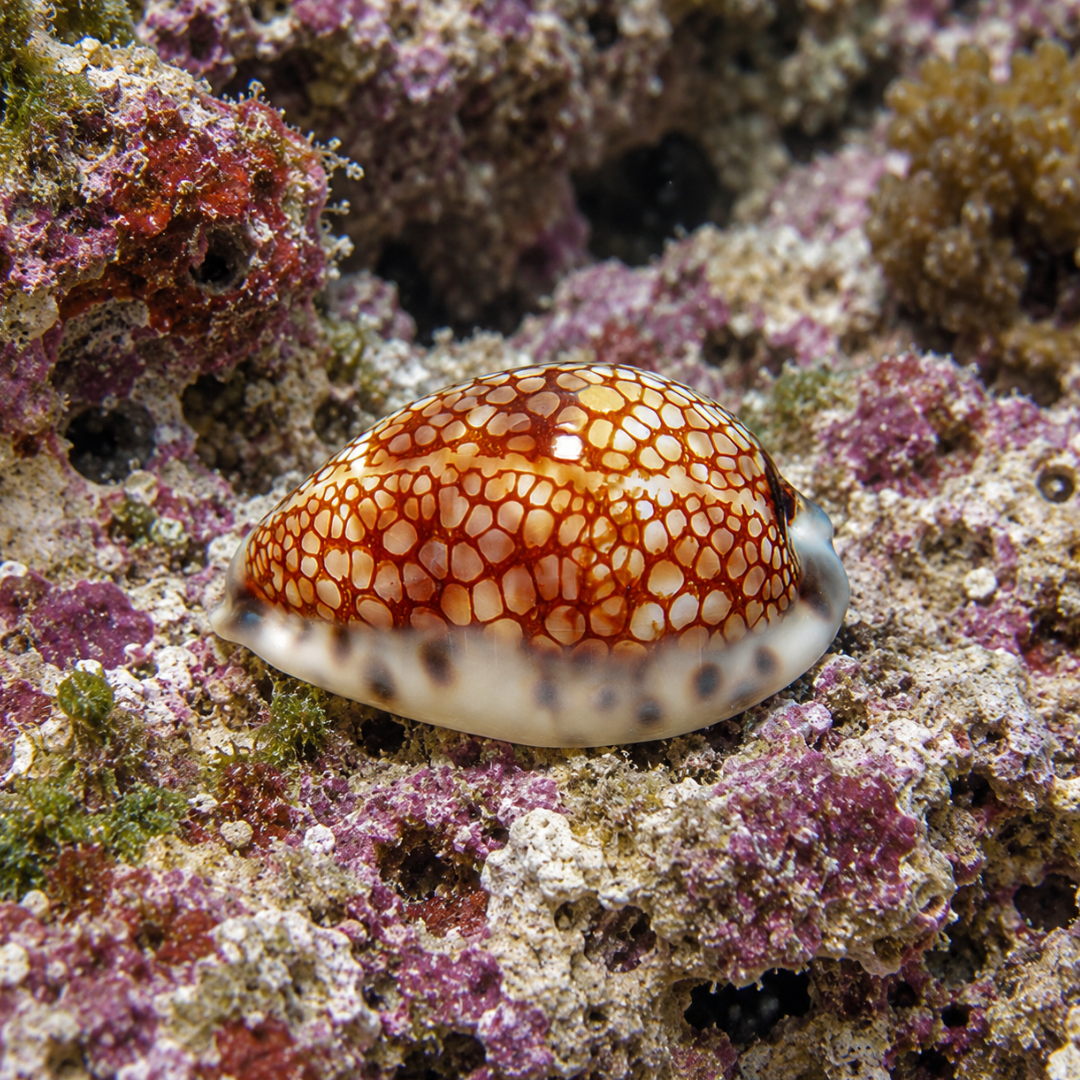
解説 / Description
ニセヤクシマダカラは、淡褐色の地に灰色がかった斑点と複雑な網目模様をもつ、タカラガイ科の海産巻貝です。成貝の殻は丸みがあり、表面は強い光沢を帯び、縁には暗褐色の斑点が現れます。熱帯の浅いサンゴ礁域などに生息し、日中は岩の下や深い隙間に身を潜め、夜間に活動することが知られています。水槽内でもこの夜行性を前提に、落ち着いて隠れられる場所と安定した海水環境を用意することが重要です。食性については藻類を含む付着物を利用する記録がある一方、本種の詳細な食性や飼育下での栄養要求は十分に整理されていません。単純な「コケ取り役」としてではなく、生態を観察しながら餌不足を避けて飼育する生体と考えるのが適切です。 Mauritia histrio is a marine cowry with a pale brown shell marked by greyish spots and an intricate reticulated pattern. The adult shell is rounded, strongly glossy, and bears dark brown markings along the margins. It inhabits shallow tropical reef environments, where it is known to hide beneath rocks or deep in crevices during the day and become active at night. In aquaria, this nocturnal behavior makes secure shelter and stable seawater especially important. Records indicate that it uses algae and other material growing on hard surfaces, but its species-specific diet and nutritional requirements in captivity are not well established. It is therefore better kept as an animal whose feeding must be observed carefully rather than treated simply as an algae-cleaning snail.
基本情報 / Basic Information
| 学名 / Scientific Name | Mauritia histrio (Gmelin, 1791) |
|---|---|
| 通称 / Common Name | ニセヤクシマダカラ、キッコウダカラモドキ、ハーレクイン・カウリーHarlequin cowry, Stage cowry, Minstrel cowry, Histrio cowrie |
| 分類 / Family | 軟体動物門・腹足綱・タマキビ目・タカラガイ科・Mauritia属Phylum Mollusca, Class Gastropoda, Order Littorinimorpha, Family Cypraeidae, Genus Mauritia |
| 英名 / English Name | Harlequin Cowry / Stage Cowry / Minstrel Cowry |
| 分布 / Distribution | インド洋から西太平洋の熱帯域。東アフリカ、マダガスカル、セーシェル、マスカリン諸島、フィリピン、オーストラリア北西部などから記録されています。Tropical waters of the Indian Ocean and western Pacific, with records from areas including East Africa, Madagascar, the Seychelles, the Mascarene region, the Philippines, and northwestern Australia. |
| 最大体長 / Max Size | 殻長は一般に約4〜5.5cm前後。大型個体では約8.8cmに達する記録があります。Shell length is commonly around 4–5.5 cm, with unusually large specimens reported to reach about 8.8 cm. |
| 寿命 / Lifespan | 本種に限定した信頼できる平均寿命の資料は乏しく、明確な年数は不明です。安定した海水環境と十分な餌を維持できれば長期飼育は期待できますが、具体的な寿命は個体や環境条件に大きく左右されます。Reliable species-specific lifespan data are scarce, so a precise average lifespan is not established. Long-term maintenance is possible under stable marine conditions with adequate food, but longevity varies greatly among individuals and environments. |
飼育環境 / Aquarium Environment
| 水槽サイズ / Tank Size | 45cm規格水槽(約30L前後)以上をひとつの目安とし、より水量を確保しやすい60cm規格水槽(約55〜60L)以上の方が水質管理には余裕があります。ただし、本種について検証された「最低水量」が定められているわけではなく、実際には個体の大きさ、ライブロック量、ろ過能力、水質の安定性を優先して判断します。A 45 cm standard aquarium of roughly 30 L or larger can be used as a practical reference, while a 60 cm standard tank of about 55–60 L or larger provides more margin for stable water quality. There is no experimentally established species-specific minimum volume, so tank choice should ultimately reflect the animal’s size, amount of live rock, filtration capacity, and overall stability. |
|---|---|
| 水温 / Temperature | 22〜26℃は飼育上の管理目安として扱えますが、本種だけを対象に最適水温を検証した値ではありません。熱帯性の浅海種であることを踏まえ、一般的な熱帯海水水槽の範囲で急激な温度変化を避け、一定に保つことを優先します。 A range of 22–26°C can be used as a practical husbandry reference, but it should not be interpreted as an experimentally established species-specific optimum. As a tropical shallow-water species, it is more important to maintain a stable temperature within a normal tropical marine aquarium range and avoid rapid changes. |
| 水質 / Water Quality | 一般的な海水無脊椎動物水槽と同様に、比重、pH、カルシウム、アルカリ度を大きく変動させないことが重要です。比重1.023〜1.025、pH8.1〜8.4、カルシウム400〜450mg/L程度はリーフタンクで広く用いられる管理目安ですが、本種固有の必要値として実験的に確立されたものではありません。アンモニアや亜硝酸の蓄積を避け、導入時を含めて急な水質変化を起こさないようにします。As with other marine invertebrates, the priority is to avoid large fluctuations in salinity, pH, calcium, and alkalinity. Specific gravity of 1.023–1.025, pH 8.1–8.4, and calcium around 400–450 mg/L are commonly used reef-aquarium reference values, not experimentally established requirements unique to this species. Avoid ammonia or nitrite accumulation and prevent abrupt water-quality changes, especially during introduction. |
| レイアウト / Layout | 日中に身を隠せるライブロックの隙間やオーバーハングを複数用意し、夜間に安全に移動できる床面も確保します。岩組みは崩れないよう安定させ、固定の甘いサンゴ片やフラグは本種が移動した際に倒されないよう接着しておくと安心です。Provide several shaded crevices and overhangs in live rock for daytime shelter, while leaving safe open surfaces for nighttime movement. Rockwork should be stable, and loosely placed coral fragments or frags should be secured so they are not displaced by the animal’s movements. |
| 注意点 / Precautions | 導入時は急な比重・水温変化を避け、丁寧に水合わせを行います。魚病薬の中には海産無脊椎動物に使用できないものがあるため、薬剤は必ず適用対象を確認してください。また、本種を「完全にサンゴへ無害」と断定できるだけの種別データは十分ではありません。リーフタンクでは、餌量と行動を観察しながら運用するのが安全です。Acclimate carefully and avoid abrupt changes in salinity or temperature. Some fish medications are unsuitable for marine invertebrates, so always confirm the intended use of any treatment before exposure. There is also insufficient species-specific evidence to describe this cowry as universally reef-safe; in reef aquaria, food availability and behavior should be monitored rather than assumed. |
餌と給餌 / Feeding
| 餌の種類 / Diet | 自然下では岩面などを這いながら付着物を摂食し、藻類を利用する記録があります。ただし、本種の食性を藻食性だけに限定できるほど詳細な種別資料はそろっていません。水槽では成熟したライブロックや表面のバイオフィルムを利用できる環境を基本とし、補助餌を試す場合は、実際に摂餌することを確認しながら少量ずつ与えます。In nature it moves over hard surfaces and feeds on attached material, with algal grazing reported for the species. However, the available species-specific information is not detailed enough to define its diet as exclusively herbivorous. In aquaria, mature live rock and naturally developed surface films should form the basis of feeding opportunities; any supplemental food should be offered in small amounts and only continued if actual feeding is observed. |
|---|---|
| 給餌のポイント / Feeding Tips | 夜行性のため、補助給餌を試す場合は消灯後の方が摂餌の有無を確認しやすくなります。付着物をすべて除去するほどの過度な清掃は避けつつ、残餌や汚れは水質を悪化させないよう取り除きます。補助餌の好みや受け入れ方には個体差が考えられるため、食べることを確認できない餌を大量に入れ続けないことが大切です。Because the species is nocturnal, supplemental feeding is easier to evaluate after lights-out. Avoid cleaning so aggressively that all natural surface growth is removed, while still removing uneaten food and waste before they degrade water quality. Feeding responses may vary among individuals, so do not repeatedly add large amounts of food that the animal has not been observed to eat. |
性格と混泳 / Temperament and Tank Mates
| 性格 / Temperament | 他魚を追い回すような攻撃性はなく、基本的には温和です。昼間は隠れていることが多く、暗くなると外套膜を広げながら活発に移動します。体に対して足の力が強いため、移動中に軽い装飾物や固定の甘いサンゴ片を押すことがあります。It is generally peaceful and does not actively attack fish. It usually remains hidden during the day and becomes more active after dark, often extending the mantle over the shell. Its muscular foot is strong enough to push light decorations or loosely secured coral fragments while moving. |
|---|---|
| 混泳の相性 / Compatibility | 温和な小型海水魚や他の非攻撃的な無脊椎動物とは比較的合わせやすいです。一方、フグ類、甲殻類を好んで食べるベラ類、大型のカニ、攻撃的なヤドカリ、タコなど、硬い殻を破壊したり殻口から軟体部を狙ったりする生体との混泳は避けます。サンゴ水槽では個体差と餌量を観察し、異常な食害がないか定期的に確認してください。It is generally compatible with peaceful small marine fishes and non-aggressive invertebrates. Avoid pufferfishes, predatory wrasses, large crabs, aggressive hermit crabs, octopuses, and other animals capable of crushing the shell or attacking the soft body through the aperture. In reef aquaria, monitor individual behavior and food availability for any unwanted grazing. |
病気と対策 / Diseases and Prevention
| かかりやすい病気 / Common Diseases | 本種について、観賞魚のように「かかりやすい病気」として整理できる種固有の情報はほとんどありません。飼育上は病名を決めつけるより、急な比重変化、アンモニアなどの水質悪化、継続的な餌不足、殻の形成に不利な水質条件、無脊椎動物に適さない薬剤への曝露といった環境要因を先に確認する方が実用的です。Reliable husbandry sources do not describe a consistent set of species-specific “common diseases” comparable with those known in aquarium fishes. In practice, it is more useful to first check environmental causes such as abrupt salinity change, ammonia or other water-quality deterioration, prolonged food shortage, conditions unfavorable to shell formation, or exposure to medications not intended for marine invertebrates. |
|---|---|
| 対策と予防 / Prevention | 比重と水温を安定させ、定期換水と適切なろ過で水質の急変を防ぎます。導入時は丁寧に水合わせを行い、付着物がほとんどない立ち上げ直後の水槽は避けた方が無難です。薬剤を使用する場合は、海産無脊椎動物への使用可否を製品ごとに確認し、適用外の薬剤へ曝露させないようにします。Keep salinity and temperature stable, and use regular water changes and appropriate filtration to prevent sudden deterioration. Acclimate new animals carefully and, as a precaution, avoid very newly established aquaria with little natural surface growth. Whenever medication is used, check whether it is approved for marine invertebrates and prevent exposure to products for which they are not intended. |
増やし方(繁殖) / Breeding
| 雌雄の判別 / Sexing | タカラガイ科は一般に雌雄異体ですが、本種では殻の外見だけで使える確実な雌雄判別法は確立されていません。一般的な飼育環境では、生殖器の観察や繁殖行動の確認なしにオス・メスを判別するのは難しいと考えるのが安全です。Cowries are generally gonochoric, with separate sexes, but no reliable shell-based sexing method has been established for this species. In the home aquarium, confident sex determination is therefore difficult without examination of reproductive anatomy or direct observation of reproductive behavior. |
|---|---|
| 繁殖形態 / Reproduction | 本種そのものについて繁殖過程を詳細に追った飼育研究は乏しいものの、タカラガイ科では交尾による体内受精と、メスが卵嚢の塊を足で覆って保護する行動が広く知られています。近縁のMauritia arabicaでは、孵化後に浮遊性のベリジャー幼生となり、その後に着底・変態する過程が飼育下で確認されています。本種についても同様の生活史が想定されますが、種固有の詳細は未確立です。Detailed captive studies of reproduction in Mauritia histrio itself are scarce. Across Cypraeidae, however, internal fertilization and maternal brooding of egg-capsule masses beneath the foot are well documented. In the close relative Mauritia arabica, captive studies have confirmed a free-swimming veliger stage followed by settlement and metamorphosis. A broadly similar life history is expected for M. histrio, but species-specific details remain insufficiently documented. |
| 繁殖のポイント / Breeding Tips | 本種で確立された人工繁殖法はありません。近縁のMauritia arabicaでは、浮遊幼生を70日目に着底させた飼育研究がありますが、長期間にわたる微細餌料の供給と水質管理が必要で、家庭水槽で再現しやすい方法とはいえません。タカラガイ類では抱卵中の個体が刺激によって卵塊を放棄する例も報告されているため、抱卵を確認した場合は不用意に動かさず観察を優先します。No established captive-breeding method exists for this species. In the related Mauritia arabica, a laboratory study achieved the first juvenile settlement at 70 days post-hatch, but this required prolonged larval feeding and careful water-quality management and is not a method readily reproduced in a typical home aquarium. Brooding cowries in other species can abandon egg masses after disturbance, so any brooding individual should be left as undisturbed as possible. |
雑学と豆知識 / Trivia and Fun Facts
| 1. 「役者」を意味する種小名 / 1. A species name meaning “actor” | ニセヤクシマダカラは1791年にグメリンによってCypraea histrioとして記載され、現在はMauritia histrioとして扱われています。種小名histrioはラテン語で「役者」「舞台俳優」を意味する語です。華やかな殻模様と結び付けて説明されることがありますが、命名者自身が模様を舞台衣装になぞらえたと断定できる資料は明確ではありません。古い文献ではCypraea histrioの名が使われているため、学名の変遷そのものがタカラガイ分類の歴史を感じさせます。Gmelin described this cowry in 1791 as Cypraea histrio, whereas it is now treated as Mauritia histrio. The Latin word histrio means an actor or stage performer. The name is sometimes explained in connection with the ornate shell pattern, but clear evidence that Gmelin himself explicitly compared the pattern with theatrical costume is lacking. Older literature often uses Cypraea histrio, so the change in scientific name also reflects the history of cowry classification. |
|---|---|
| 2. 光沢のある殻は「磨かれている」ように見える / 2. A shell that looks continuously polished | 生きたタカラガイを観察すると、殻の上に軟らかな外套膜が大きく広がることがあります。この外套膜は殻表面の形成と維持に深く関わっており、成貝の殻が一般的な巻貝とは違って滑らかで強い光沢を保つ理由のひとつです。夜の水槽で外套膜を広げた個体は、昼間に見える「美しい貝殻」とは印象が大きく変わり、殻そのものが生きた体の一部として絶えず管理されていることを実感させてくれます。Living cowries often extend a soft mantle over much of the shell. This mantle plays an important role in forming and maintaining the shell surface, helping explain why adult cowries retain such an unusually smooth, glossy finish compared with many other gastropods. At night, an individual with its mantle fully extended can look strikingly different from the polished shell seen by day, revealing that the shell is not merely a passive covering but a structure continually maintained by the living animal. |
| 3. 強さを生む交差板構造 / 3. Crossed-lamellar architecture for strength | タカラガイ類を含む海産腹足類の殻では、アラゴナイトの微細な結晶が異なる方向に重なり合う「交差板構造」が研究されています。複数方向に組み合わさった階層構造によって亀裂の進行が妨げられ、炭酸カルシウム主体の殻に強度と靭性を与える仕組みです。ただし、ニセヤクシマダカラそのものを対象にした微細構造の材料学的研究は乏しく、この構造はタカラガイ類で知られる一般的な知見として捉えるのが適切です。タカラガイの美しい殻が、見た目だけでなく精巧な生体材料でもあることを理解する手がかりとして興味深い知見です。Crossed-lamellar architecture has been studied in the shells of marine gastropods, including other cowries. In this structure, fine aragonite crystals are arranged in differently oriented hierarchical layers, helping to deflect cracks and provide toughness to a shell built largely from calcium carbonate. Direct material-science studies of the shell microstructure of Mauritia histrio itself are scarce, so this structure is best treated as broader context established from other cowries. It is therefore best understood as useful family-level context showing that the polished cowry shell is also a highly organized biological material. |
| 4. 21世紀になっても増える亜種名 / 4. New subspecies names still appearing in the 21st century | 広い分布域をもつニセヤクシマダカラでは、地域差をどのように分類へ反映するかという議論が続いています。2026年9月時点のWoRMSでは、基亜種Mauritia histrio histrioのほか、M. h. westralis、2023年に記載されたM. h. jadeni、2025年に記載されたM. h. macromaculataとM. h. vanmuiiが掲載されています。データベースに掲載される分類も将来の研究で再検討される可能性があるため、亜種名は固定された最終結論ではなく、現時点の分類上の扱いとして見るのが適切です。Because Mauritia histrio has a broad geographic range, taxonomists continue to consider how regional variation should be reflected in classification. As of September 2026, WoRMS lists the nominate M. h. histrio together with M. h. westralis, M. h. jadeni described in 2023, and M. h. macromaculata and M. h. vanmuii described in 2025. Such database treatments can be reconsidered as new evidence appears, so subspecies names are best viewed as the current taxonomic treatment rather than an immutable final conclusion. |
| 5. 幼貝は成貝とまるで違う姿から始まる / 5. Juveniles begin with a very different shell form | タカラガイの成貝は、殻口が細長く、その両側に歯が並ぶ独特の形で知られます。しかし幼い時期から最初からこの形をしているわけではありません。成長途中の殻はより一般的な巻貝らしい姿をしており、成熟の最終段階で外唇が内側へ巻き込み、殻が厚くなり、成貝特有の歯と光沢のある表面が仕上がっていきます。完成した成貝だけを見ると想像しにくいこの変化は、タカラガイの成長史の中でも特に興味深い点です。Adult cowries are famous for their long narrow aperture and rows of teeth, yet juveniles do not begin life with this finished shell form. During growth, the shell looks more like that of a conventional coiled gastropod. Near final maturity, the outer lip turns inward, the shell thickens, and the characteristic adult teeth and glossy surface are completed. This dramatic transformation is easy to overlook when only fully grown specimens are seen. |
| 6. 近縁種で知られる化学防御 / 6. Chemical defense known from close relatives | Mauritia属の近縁種では、外套膜に強い酸性物質を蓄える特殊な腺細胞が研究され、捕食者への防御や殻表面への付着生物を抑える働きが議論されています。ただし、ニセヤクシマダカラ自身について同じ仕組みが同じ程度に確認されているとは限りません。分類学的に近い生物の知見は生態を考える大きな手がかりになりますが、「近縁種で確認されたこと」と「本種で直接確認されたこと」を分けて考える姿勢も、生き物を正確に理解するうえで大切です。In close relatives within Mauritia, researchers have described specialized mantle gland cells containing strongly acidic substances, with possible roles in predator deterrence and prevention of fouling on the shell surface. However, the same mechanism has not necessarily been demonstrated to the same extent specifically in Mauritia histrio. Findings from related species are valuable clues, but distinguishing between evidence obtained directly from this species and inferences based on relatives is essential for accurate biological interpretation. |
まとめ / Conclusion
ニセヤクシマダカラは、複雑な網目模様と光沢のある殻だけでなく、昼間は岩陰に潜み、夜になると外套膜を広げて活動する生きた姿にも大きな魅力があります。殻だけを見ていると静かな存在に思えますが、実際には夜のサンゴ礁環境に適応した行動をもつ海産巻貝であり、その生活を観察することでタカラガイらしい特徴がよりはっきり見えてきます。 Mauritia histrio is appealing not only for its intricate pattern and glossy shell, but also for the living animal that hides in reef crevices by day and becomes active at night with its mantle extended. A shell specimen can appear almost static, yet the living cowry is a nocturnal marine gastropod with behavior shaped by shallow reef environments, and observing that behavior reveals much more of what makes cowries distinctive.
飼育では、安定した海水、十分な隠れ場所、成熟した環境を保ち、本種が実際に何を食べているかを観察することが大切です。種固有の飼育データにはまだ不足があるため、決めつけた管理法に当てはめるより、夜間の行動や摂餌の様子を丁寧に見ながら状態を判断する方が、このタカラガイの魅力を長く楽しむことにつながります。 In captivity, stable seawater, adequate shelter, a mature aquarium environment, and careful observation of actual feeding behavior are more important than rigidly following unverified species-specific formulas. Because detailed husbandry data remain limited, watching its nighttime activity and feeding response is the most sensible way to judge how well this cowry is adapting and to maintain it successfully over time.

気になる道具や飼い方を見つけてみませんか?
 アイのアクアグッズ案内ラスボラ・ボララスの群泳を楽しむ飼育用品|水槽・ろ過・ヒーター・餌・水草道具の特徴や使い方、選ぶときのポイントをアイが紹介します。記事はコチラ →
 アイのアクアグッズ案内海水魚の底砂の選び方|サンゴ砂・ライブサンドとおすすめ商品道具の特徴や使い方、選ぶときのポイントをアイが紹介します。記事はコチラ →
 アイのアクアグッズ案内水草水槽のCO₂添加|3つの方式の選び方とおすすめ用品道具の特徴や使い方、選ぶときのポイントをアイが紹介します。記事はコチラ →
 アイのアクアグッズ案内海水魚初心者の必需品|水槽・人工海水・比重計・水質検査道具の特徴や使い方、選ぶときのポイントをアイが紹介します。記事はコチラ →
さまざまな飼育テーマをご紹介。リンク先の記事には広告・商品紹介が含まれます。
案内・紹介記事一覧へ →分布マップ
ニセヤクシマダカラ(Mauritia histrio)は、インド洋から西太平洋の熱帯域に分布し、東アフリカ、マダガスカル、セーシェル、マスカリン諸島、フィリピン、オーストラリア北西部などから記録されています。
この地図は、記事内に記載された分布地域全体を把握しやすくするための概略表示です。表示範囲は実際の分布境界を示すものではありません。また、地図上のマーカーは分布域を見やすくするために設定した代表地点であり、実際の採集地点や生息確認地点を示すものではありません。
参考文献
- MolluscaBase eds. World Register of Marine Species: Mauritia histrio (Gmelin, 1791). AphiaID 216870. 分類、学名、異名、亜種の現行分類を確認する基礎資料。 World Register of Marine Species
- Lorenz, F. (2017). Cowries: A Guide to the Gastropod Family Cypraeidae. Volume 1: Biology and Systematics. ConchBooks, Harxheim, 644 pp. タカラガイ科の分類、生物学、分布、生息環境を扱う専門モノグラフ。 MolluscaBase 文献情報
- Verdcourt, B. (1954). The cowries of the East African Coast (Kenya, Tanganyika, Zanzibar and Pemba). Journal of the East Africa Natural History Society, 22(4): 129–144. 東アフリカ沿岸におけるタカラガイ類の分布記録を支える地域資料。 https://doi.org/10.5962/p.140610
- Tay, T. S., Lee, H. R. S., & Neo, M. L. (2023). Spawning and larval development of two tropical cowries (Gastropoda: Cypraeidae), Cypraea tigris and Mauritia arabica under laboratory conditions. Royal Society Open Science, 10: 221332. タカラガイ類の抱卵、ベリジャー幼生、着底・変態、近縁種Mauritia arabicaの孵化後70日での着底を確認した研究。 https://doi.org/10.1098/rsos.221332
- Caskey, P. University of Florida IFAS Extension. 4-H Marine Aquarium Project Book: Youth Project Guide to Starting and Maintaining a Saltwater Aquarium System. 海水水槽における水温、塩分、アンモニア、亜硝酸、カルシウムなどの一般的な水質管理の参考資料。 University of Florida IFAS Extension
- Brockmann, D., & Janse, M. (2008). Calcium and carbonate in closed marine aquarium systems. In R. J. Leewis & M. Janse (eds.), Advances in Coral Husbandry in Public Aquariums, Public Aquarium Husbandry Series, Vol. 2, pp. 133–142. Burgers’ Zoo. 閉鎖式海水水槽におけるカルシウム、炭酸塩、アルカリ度の管理を扱う公共水族館向け資料。 文献情報
- Merck Veterinary Manual. Management of Aquarium Fish. 海水魚治療で用いられる銅について、無脊椎動物には強い毒性があることを明記しており、薬剤使用時の注意点を支える獣医学資料。 Merck Veterinary Manual




コメント