

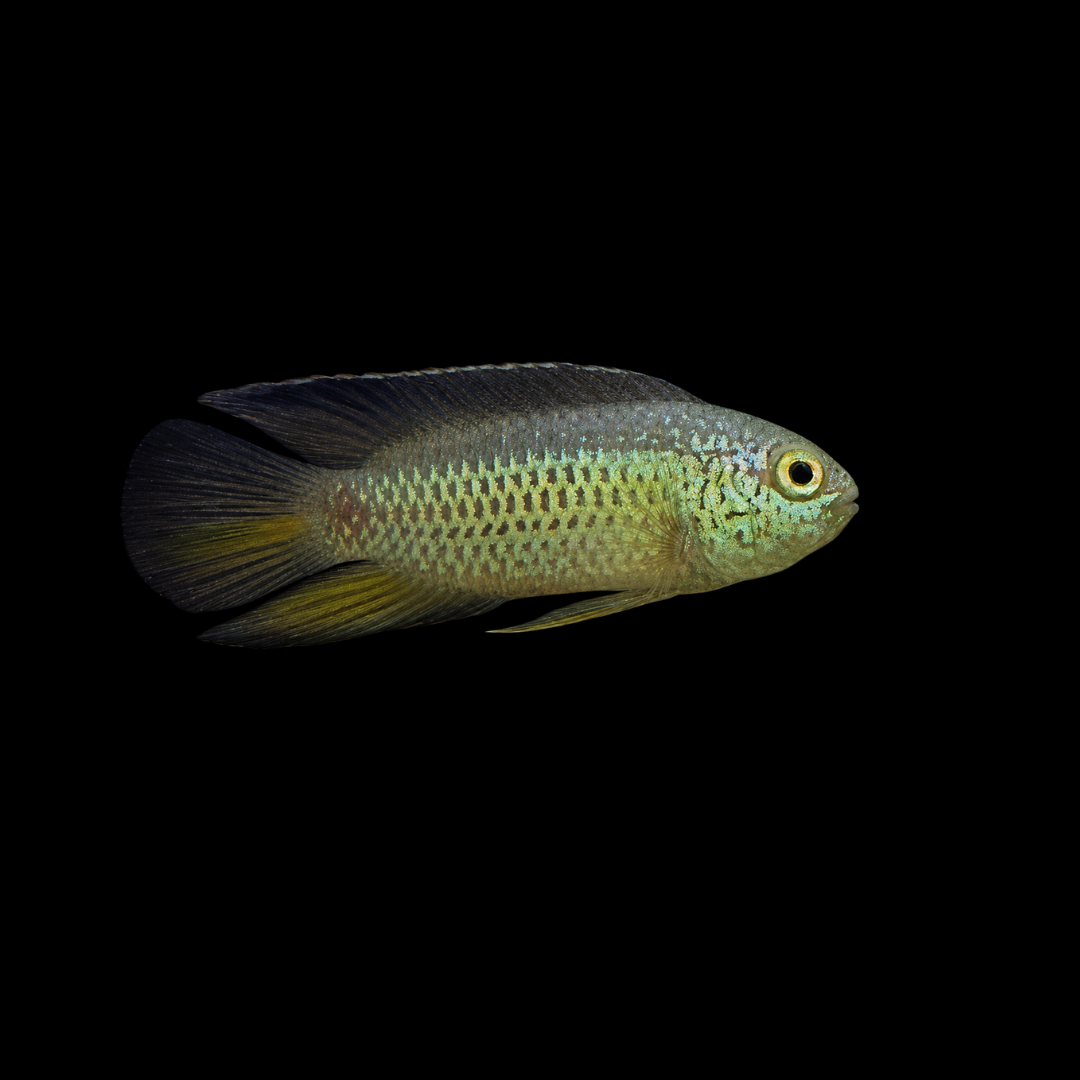
解説 / Description
ナンナカラ・アノマラは、ガイアナ、スリナム、仏領ギアナを含むギアナ地方の淡水域に分布する小型シクリッドです。成熟したオスは青緑色から緑色の金属光沢を帯び、背鰭や臀鰭が伸びる一方、メスは小柄で、繁殖期には黄色い地色に黒い市松模様を浮かべます。美しさだけでなく、オス同士が相手の能力を段階的に見極める闘争行動や、メスが卵と稚魚を守る育児行動でも知られ、観察するほど多くの特徴が見えてくるドワーフシクリッドです。飼育下繁殖個体が広く流通しており、飼育そのものは難しい部類ではありませんが、繁殖期の縄張り意識は強く、落ち着いて飼うには十分な底面積と隠れ場所が欠かせません。 Nannacara anomala is a small cichlid native to freshwater habitats of the Guiana region, including Guyana, Suriname, and French Guiana. Mature males develop an iridescent blue-green to green sheen with elongated dorsal and anal fins, while females remain smaller and can transform into a striking yellow-and-black checkerboard pattern when breeding. Beyond its appearance, the species is notable for staged male contest behavior in which rivals assess one another, and for intensive female care of eggs and fry. Captive-bred fish are widely available and the species is generally manageable in aquaria, but breeding fish can become highly territorial, so adequate floor space and numerous visual barriers are essential.
基本情報 / Basic Information
| 学名 / Scientific Name | Nannacara anomala Regan, 1905 |
|---|---|
| 通称 / Common Name | ナンナカラ・アノマラ、ゴールデンアイ・ドワーフシクリッドGoldeneye cichlid, Golden-eyed dwarf cichlid |
| 分類 / Family | シクリッド科 Cichlidae、シクリナエ亜科 Cichlinae、ナンナカラ属 NannacaraFamily Cichlidae, subfamily Cichlinae, genus Nannacara |
| 英名 / English Name | Goldeneye cichlid |
| 分布 / Distribution | 南米北東部のギアナ地方に分布します。ガイアナ、スリナム、仏領ギアナの河川や低地の湿地に生息し、沿岸部の浸水サバンナや流れの緩い淡水域でも見られます。The species occurs in the Guiana region of northeastern South America, including freshwater systems of Guyana, Suriname, and French Guiana. It is associated with lowland waters and seasonally flooded coastal savannas. |
| 最大体長 / Max Size | 最大標準体長は約5.6cmとされ、メスはオスより小型です。飼育下では鰭を含む全長で7cm前後になる個体も見られます。The documented maximum standard length is about 5.6 cm, with females remaining smaller than males. In aquaria, some individuals may reach around 7 cm in total length when the fins are included. |
| 寿命 / Lifespan | 本種に限った信頼性の高い寿命データは乏しく、明確な年数を示せる資料は確認できません。長期飼育では、水質を安定させ、過密や継続的な闘争を避けることが重要です。Reliable species-specific longevity data are limited, so a precise lifespan cannot be stated with confidence. For long-term care, stable water conditions and avoidance of crowding or persistent aggression are important. |
飼育環境 / Aquarium Environment
| 水槽サイズ / Tank Size | 飼育水槽は少なくとも幅80cm程度を目安とし、日本で一般的な規格では90cm規格水槽(90×45×45cm、約180L)が扱いやすいサイズです。複数のメスを組み合わせる場合や混泳を行う場合も、90cm規格水槽以上を基準にし、底面積と逃げ場を十分に確保してください。Use an aquarium at least about 80 cm in length as a practical guide. In Japan, a standard 90 cm aquarium (90 × 45 × 45 cm, about 180 L nominal volume) is a convenient choice. The same size or larger is preferable for multiple females or a community setup, with particular attention to floor area and escape routes. |
|---|---|
| 水温 / Temperature | 22〜25℃を基本とし、24〜25℃前後は日常管理しやすい範囲です。急激な温度変化を避け、季節を通して安定させてください。 Keep the fish generally at 22–25°C, with about 24–25°C being a convenient everyday range. Avoid rapid temperature changes and keep conditions stable through seasonal changes. |
| 水質 / Water Quality | 弱酸性から中性付近の軟水が扱いやすく、飼育の目安はpH6.0〜7.2程度です。数値を細かく追うより、急激な変化を避けて安定させることを優先してください。繁殖を狙う場合も、軟らかく弱酸性寄りの水を安定して維持することが重要です。Soft, slightly acidic to near-neutral water is suitable, with about pH 6.0–7.2 serving as a practical aquarium range. Stability is more important than chasing an exact value. For breeding, maintain soft, mildly acidic water consistently rather than making abrupt adjustments. |
| レイアウト / Layout | 細かな砂やソイルを底床にし、流木、石、素焼き鉢、ココナッツシェル、水草などを使って、水槽の端から端まで見通せないように配置します。アヌビアス、ミクロソリウム、クリプトコリネなどを組み合わせると、落ち着いた陰影と避難場所を作りやすくなります。落ち葉を利用する場合は、観賞魚用として安全性が確認されたものを少量から使い、水の色やpHの変化を見ながら調整してください。Use fine sand or aquasoil and break long sight lines with driftwood, rocks, small clay pots, coconut shells, and plants. Anubias, Java fern, and Cryptocoryne species work well for creating shaded cover and retreats. If botanical leaf litter is used, choose aquarium-safe material and add it gradually while monitoring water color and pH. |
| 注意点 / Precautions | 最も注意したいのは繁殖期の縄張り争いです。産卵後のメスはオスを含む周囲の魚を激しく追うことがあるため、隔離ケースやセパレーター、予備水槽を用意しておくと安全です。強い水流、過密飼育、隠れ場所の少ない開けたレイアウトは慢性的なストレスにつながります。サンゴ砂など硬度やpHを大きく上げる素材は、本種を弱酸性寄りで管理したい場合には避けた方が無難です。The main concern is territorial aggression during breeding. A guarding female may drive away the male and other fish, so a divider, isolation box, or spare aquarium is useful. Strong current, crowding, and open layouts with too few shelters can create chronic stress. Highly calcareous materials such as coral sand are best avoided when the goal is to maintain softer, slightly acidic water. |
餌と給餌 / Feeding
| 餌の種類 / Diet | 自然界ではワーム類、小型甲殻類、昆虫などの小型動物を食べ、飼育下では小粒の顆粒・ペレットを主食にできます。冷凍赤虫、ブラインシュリンプ、ミジンコなどを補助的に与えると、食欲維持や繁殖前のコンディション作りに役立ちます。稚魚には孵化直後のブラインシュリンプ幼生や微細な稚魚用フードが適しています。In nature this species feeds on worms, small crustaceans, insects, and other small animals. In aquaria, small granules or pellets can form the staple diet, supplemented with frozen bloodworms, brine shrimp, and daphnia. Newly free-swimming fry are well suited to freshly hatched brine shrimp nauplii and fine fry foods. |
|---|---|
| 給餌のポイント / Feeding Tips | 1日1〜2回、短時間で食べ切れる量を基本にし、底に残餌をためないことが大切です。繁殖前は動物性の餌を適度に組み合わせると体力を整えやすい一方、高栄養の餌だけを過剰に与えると肥満や水質悪化につながります。人工飼料と冷凍・生餌を組み合わせ、特定の餌だけに偏らないようにすると管理しやすくなります。Feed once or twice daily in portions that are consumed quickly, and avoid allowing leftovers to accumulate on the bottom. Protein-rich foods can help condition breeding fish, but excessive rich feeding can promote obesity and deteriorating water quality. A varied combination of prepared, frozen, and live foods helps avoid an overly narrow diet. |
性格と混泳 / Temperament and Tank Mates
| 性格 / Temperament | 通常時はドワーフシクリッドとして比較的落ち着いていますが、同種間では順位や縄張りをめぐる駆け引きが見られます。特に繁殖期のメスは攻撃性が高まり、卵や稚魚の周囲を強く防衛します。オス同士も狭い水槽では争いやすいため、複数飼育には十分なスペースが必要です。Outside breeding periods, the species is relatively composed for a dwarf cichlid, although conspecifics may establish rank and territories. Breeding females can become dramatically more defensive around eggs and fry. Males may also fight in confined aquaria, so keeping several adults requires generous space. |
|---|---|
| 混泳の相性 / Compatibility | 温和な小型テトラ類や小型ラスボラなど、中層から上層を泳ぐ魚とは合わせやすい傾向があります。オトシンクルス類も候補になりますが、繁殖中はどの魚でも追われる可能性があります。コリドラス類は必ずしも常時相性が悪いわけではありませんが、底層の行動域が重なり、繁殖時にはメスの防衛対象になりやすいため、稚魚を残したい水槽では分ける方が確実です。小型エビや稚エビは捕食される可能性があります。Peaceful small tetras and rasboras that occupy the middle and upper water layers are often suitable companions. Otocinclus can also be considered, although any tank mate may be chased during breeding. Corydoras are not inherently incompatible, but they share the bottom zone and may repeatedly enter a female’s brood territory, so separating them is safer when fry survival is a priority. Small shrimp and shrimplets may be eaten. |
病気と対策 / Diseases and Prevention
| かかりやすい病気 / Common Diseases | ナンナカラ・アノマラだけに特有の代表的な疾病が知られているわけではありません。一般的な熱帯魚と同様、環境が崩れると白点病や、尾ぐされ病を含む細菌性トラブル、体表の荒れ、食欲不振や消化器系の不調が起こることがあります。闘争による鰭裂けや擦り傷は、二次感染の入口になるため注意が必要です。No single disease is known as uniquely characteristic of Nannacara anomala. As with other tropical aquarium fish, poor conditions can contribute to ich, bacterial fin deterioration, skin damage, appetite loss, and digestive problems. Torn fins and abrasions caused by aggression may provide entry points for secondary infection. |
|---|---|
| 対策と予防 / Prevention | 予防の基本は、急激な水質変化を避け、定期的な換水と適切なろ過で有機物をためないことです。新規導入魚は可能であれば別容器で状態を確認し、食欲・呼吸・糞・体表を観察してから合流させます。傷が増える場合は薬より先に縄張り構造や個体数を見直し、必要なら隔離してください。治療薬を使う際は病状を見極め、製品の用法と対象魚種を確認して使用します。Prevention begins with avoiding abrupt water changes and limiting organic waste through regular maintenance and effective filtration. When possible, observe new fish separately before introduction and check appetite, respiration, feces, and skin condition. If injuries are caused by repeated aggression, first correct the social setup or isolate the fish rather than relying only on medication. Use treatments only after identifying the likely problem and following product directions. |
増やし方(繁殖) / Breeding
| 雌雄の判別 / Sexing | 成熟オスはメスより大きく、青緑色から緑色の金属光沢が強くなり、背鰭・臀鰭の後端が伸びます。メスは小柄で黄褐色系の地色を持ち、繁殖状態に入ると黄色が鮮明になり、体側に黒い市松模様が現れます。幼魚期は雌雄差が分かりにくく、若いオスもメスに似た地味な体色を示すことがあります。Mature males become larger, develop stronger green to blue-green iridescence, and show more elongated dorsal and anal fins. Females remain smaller and more yellow-brown, becoming bright yellow with a dark checkerboard pattern in breeding condition. Sexing juveniles can be difficult because young males may retain subdued, female-like coloration. |
|---|---|
| 繁殖形態 / Reproduction | 基質産卵型です。石、流木、葉、シェルターなどの表面に産卵し、メスが卵と稚魚を直接保護します。文献では一度に最大約300卵が記録され、オスはその外側のより広い縄張りを守ることがあります。メスは繁殖時に鮮明な市松模様へ変化し、孵化後の稚魚を群れとして誘導します。This is a substrate-spawning cichlid. Eggs are deposited on surfaces such as rocks, wood, leaves, or sheltered structures, and the female directly cares for the eggs and fry. Clutches of up to roughly 300 eggs have been reported, while the male may defend a broader outer territory. The female develops a conspicuous checkerboard pattern and leads the fry after hatching. |
| 繁殖のポイント / Breeding Tips | 落ち着いた弱酸性寄りの水、複数の産卵場所、十分な遮蔽物を用意し、人工飼料と冷凍・生餌などを組み合わせて親魚の状態を整えます。産卵後はメスの攻撃性が急上昇するため、オスが執拗に追われる、鰭が傷むといった状況が続く場合は早めに隔離します。卵は水温により数日で孵化し、自由遊泳後は孵化直後のブラインシュリンプ幼生を少量ずつ回数を分けて与えると育てやすくなります。Provide stable, slightly acidic water, several potential spawning sites, and abundant visual barriers. Condition the adults with a varied diet that combines prepared foods with frozen or live foods. Because female aggression can rise sharply after spawning, isolate the male if persistent chasing or fin damage continues. Eggs hatch after several days depending on temperature, and newly free-swimming fry can be raised effectively on freshly hatched brine shrimp nauplii in small frequent feedings. |
雑学と豆知識 / Trivia and Fun Facts
| 1. 1905年に記載されたナンナカラ属のタイプ種 / 1. The type species of Nannacara, described in 1905 | ナンナカラ・アノマラは、イギリスの魚類学者チャールズ・テイト・リーガンによって1905年に記載されました。タイプ産地はガイアナのエセキボ川で、記載に用いられた標本も博物館コレクションに登録されています。ナンナカラ属は本種をもとに設けられたため、本種は属のタイプ種です。現在も Nannacara anomala Regan, 1905 は有効種として扱われています。属名 Nannacara は「小さい」を表す語と「顔」を表す語を組み合わせた名称です。Nannacara anomala was described in 1905 by the British ichthyologist Charles Tate Regan. Its type locality is the Essequibo River in Guyana, and the type specimens are registered in museum collections. Because the genus Nannacara was established with this species alone, N. anomala is the type species of the genus. It continues to be recognized as the valid species Nannacara anomala Regan, 1905. The genus name Nannacara combines words referring to “small” and “face.” |
|---|---|
| 2. ギアナの低地を生きる小さな捕食者 / 2. A small predator of Guianan lowlands | 本種は、ギアナ地方の河川だけでなく、雨季に水没する沿岸サバンナのような浅く穏やかな水域にも姿を見せます。水底には植物片や枝、根が複雑に重なり、その隙間にいる小型の虫状動物、甲殻類、昆虫などを探して食べます。アクアリウムで流木、落ち葉、水草の陰を利用する姿は、身を隠しながら底面を探索する本来の生活様式にもよく合っています。The species inhabits not only rivers but also quiet, shallow environments such as seasonally flooded coastal savannas in the Guianas. Plant debris, roots, and branches create a complex bottom where the fish searches for worms, small crustaceans, and insects. Its use of shaded wood, leaves, and plants in aquaria is consistent with a natural lifestyle built around cover and bottom-oriented foraging. |
| 3. オスの争いは「力比べ」だけではない / 3. Male contests are more than simple fighting | ナンナカラ・アノマラは、動物行動学で闘争時の意思決定を調べるモデルとして使われてきました。オス同士は、最初から激しく噛み合うのではなく、体を横に見せて鰭を広げ、尾鰭で水流を送り合い、必要に応じて噛みつきや顎を組む行動へと段階的に進みます。1980年代から1990年代の研究では、この流れが「逐次評価ゲーム」という考え方に沿って検討されました。簡単にいえば、行動を重ねながら相手との能力差に関する情報を集め、危険な段階へ進むか退くかを判断するという見方です。Nannacara anomala has been used as a behavioral model for studying decision-making during animal contests. Rival males do not immediately begin with intense biting. They first present their sides and erect their fins, then exchange tail-generated water currents, escalating to biting and jaw locking when necessary. Studies from the 1980s and 1990s examined this sequence in relation to the sequential assessment game. In simple terms, contestants gather information about relative fighting ability as the interaction progresses and use it when deciding whether to escalate or withdraw. |
| 4. 捕食者がいると、争い方まで変わる / 4. Predation risk can change the rules of a fight | 本種を使った実験では、捕食者の危険がある条件で、最も激しい行動であるマウス・レスリングに達するまでの時間が平均して長くなり、闘争全体も長引くことが示されています。また、視覚的な誇示や尾振りといった低強度の行動の使われ方にも変化が見られました。これは、捕食リスクが高いから単純に争いをやめるのではなく、危険な段階への進み方そのものが変わることを意味します。つまり、闘争の進み方は相手との能力差だけでなく、周囲の危険にも左右されます。Experiments with this species found that under predation risk, males took longer on average to reach the most escalated behavior, mouth wrestling, and contests also lasted longer overall. The use of lower-intensity behaviors such as visual displays and tail beating changed as well. This does not mean that fish simply stop fighting when danger is present; rather, predation risk changes the way a contest progresses toward its most dangerous stages. Contest behavior therefore depends not only on the opponent but also on risk in the surrounding environment. |
| 5. 稚魚が認識するとされる母親の市松模様 / 5. The mother’s checkerboard pattern is thought to be recognized by fry | 普段のメスは控えめな黄褐色ですが、繁殖状態になると黄色と黒のコントラストが強まり、市松模様のような外観になります。文献では、この繁殖色は稚魚にも認識されるとされ、母魚を識別するための視覚的な手掛かりになると考えられています。観賞上の体色変化であるだけでなく、繁殖行動の一部として意味を持つと考えられている点が興味深い特徴です。A non-breeding female is comparatively subdued, but in breeding condition the contrast between yellow and black intensifies into a checkerboard-like pattern. Published accounts indicate that this breeding coloration is apparently recognized by the young and is thought to function as a visual cue for identifying the female. The change is therefore interesting not only as coloration, but also as a possible part of reproductive communication. |
| 6. 孵化直後は「均等」に大きくならない / 6. Newly hatched larvae do not grow uniformly | 2014年の初期発生研究では、26℃で飼育した仔魚を孵化から18日間追跡し、平均全長は3.74mmから9.60mmへ増加しました。体の各部は同じ割合で成長するのではなく、最初の1週間は頭部と尾部が相対的に速く成長しました。研究では、この成長パターンを、摂餌能力と遊泳能力を早い段階で高めることに関係するものと解釈しています。つまり、アロメトリー成長とは単に体形が変わる現象ではなく、発生段階ごとに必要な機能へ成長の重点が移ることを示しています。A 2014 study followed early development for 18 days after hatching at 26°C, with mean total length increasing from 3.74 mm to 9.60 mm. Different body regions did not grow at the same rate; during the first week, the head and tail grew relatively faster. The authors interpreted this pattern as supporting the early improvement of feeding and swimming abilities. In other words, allometric growth here reflects a shift in developmental emphasis toward the functions most important at each stage. |
| 7. 幼魚期は雌雄判別が難しい / 7. Juveniles can be difficult to sex | 幼魚では雌雄の外見差が小さく、若いオスも成熟オスのような強い金属光沢や伸長した鰭をまだ示さないため、メスに似て見えることがあります。成長に伴ってオスの体格、発色、背鰭や臀鰭の形がはっきりしてくるため、若い段階で無理に判別するより、成熟に伴う変化を確認する方が確実です。Juveniles show relatively little external sexual difference, and young males may still resemble females because they have not yet developed the strong metallic coloration or elongated fins of mature males. As they grow, male size, coloration, and the shape of the dorsal and anal fins become clearer, so sexing is more reliable after these mature traits develop. |
| 8. 日本ではブリード個体を中心に流通 / 8. Japanese trade is centered on captive-bred fish | 日本国内ではブリード個体を中心に流通しており、販売店では東南アジアブリード、EUブリード、国内ブリードなどの表記が見られます。価格は繁殖元、サイズ、雌雄判別の有無、販売形態、入荷状況によって差が大きいため、固定的な相場を示すより、その時点の販売情報を確認する方が確実です。成熟オスの落ち着いた金属光沢と、繁殖に伴って大きく変わるメスの体色や行動を楽しめる点が、長く飼育されてきた本種の魅力です。In Japan, the trade is centered on captive-bred fish, with listings variously identified as Southeast Asian bred, EU bred, or domestically bred. Prices vary substantially with breeding source, size, whether the sex has been determined, sales format, and availability, so current shop listings are more useful than a fixed market price. The species remains appealing for the mature male’s restrained metallic sheen and the female’s dramatic changes in coloration and behavior during breeding. |
まとめ / Conclusion
ナンナカラ・アノマラは、成熟オスの青緑色の光沢と、繁殖期のメスが見せる黄色と黒の市松模様という、まったく異なる二つの表情を楽しめるドワーフシクリッドです。普段は比較的落ち着いていても、繁殖が始まると縄張り意識と育児行動が強く表れます。その変化を安全に観察するには、十分な底面積、視線を遮る流木や水草、そして必要に応じて親魚を分けられる準備が重要です。 Nannacara anomala offers two dramatically different faces: the blue-green metallic sheen of the mature male and the yellow-and-black checkerboard pattern of the breeding female. Although generally manageable outside the breeding season, territoriality and parental defense become much more prominent once spawning begins. Generous floor space, broken sight lines, and a plan for temporary separation allow these behaviors to be observed safely.
弱酸性から中性付近の水を安定させ、良質な餌と落ち着ける環境を整えることが長期飼育の基本です。相手との能力差を見極めながら争うオス、繁殖色へ変化して稚魚を守るメス、発生段階に応じて体の成長配分が変わる仔魚など、本種には観察するほど見えてくる生物学的な特徴があります。十分な空間と隠れ場所を用意して落ち着いて付き合うことで、その行動と色彩の魅力を長く楽しめます。 Stable slightly acidic to near-neutral water, good food, and a secure environment form the basis of long-term care. The species rewards close observation: males assess rivals as contests escalate, females change into breeding coloration while defending their young, and larvae alter their growth priorities as development proceeds. With adequate space and cover, its distinctive behavior and coloration can be enjoyed over the long term.

気になる道具や飼い方を見つけてみませんか?
 アイのアクアグッズ案内海水魚の底砂の選び方|サンゴ砂・ライブサンドとおすすめ商品道具の特徴や使い方、選ぶときのポイントをアイが紹介します。記事はコチラ →
 アイのアクアグッズ案内マジックリーフ物語|一枚の葉がアクアリウム用品になるまで道具の特徴や使い方、選ぶときのポイントをアイが紹介します。記事はコチラ →
 アイのアクアグッズ案内グッピー・プラティ・モーリーを親子で楽しむ飼育用品|水槽・稚魚保護・ろ過・餌・水草道具の特徴や使い方、選ぶときのポイントをアイが紹介します。記事はコチラ →
 アイのアクアグッズ案内ローチの仲間に合わせる飼育用品|クーリー・流水性・ボーシャの水槽と底砂道具の特徴や使い方、選ぶときのポイントをアイが紹介します。記事はコチラ →
さまざまな飼育テーマをご紹介。リンク先の記事には広告・商品紹介が含まれます。
案内・紹介記事一覧へ →分布マップ
ナンナカラ・アノマラ(Nannacara anomala)は、南米北東部のギアナ地方に分布し、ガイアナ、スリナム、仏領ギアナの河川や低地の湿地、沿岸部の浸水サバンナなどの淡水域に生息します。
※この地図は記事に記載された分布地域(ガイアナ、スリナム、仏領ギアナ)をもとにした概略表示です。マーカーは分布域を把握しやすくするために設定した代表地点であり、実際の採集地点や生息確認地点を示すものではありません。
参考文献
- Fricke, R., Eschmeyer, W. N. & Van der Laan, R. (eds.). 2026. Eschmeyer's Catalog of Fishes: Genera, Species, References. California Academy of Sciences. Nannacara anomala Regan, 1905 species record. California Academy of Sciences
- Froese, R. & Pauly, D. (eds.). 2026. FishBase. Nannacara anomala Regan, 1905, Goldeneye cichlid. World Wide Web electronic publication. FishBase species summary
- Kullander, S. O. & Nijssen, H. 1989. The Cichlids of Surinam: Teleostei, Labroidei. E. J. Brill, Leiden. 256 pp. Smithsonian Libraries and Archives
- Kullander, S. O. 2003. Cichlidae (Cichlids). pp. 605–654. In: Reis, R. E., Kullander, S. O. & Ferraris, C. J., Jr. (eds.), Check List of the Freshwater Fishes of South and Central America. EDIPUCRS, Porto Alegre. ISBN 85-7430-361-5. FishBase reference record
- Kupren, K., Prusińska, M., Żarski, D., Krejszeff, S. & Kucharczyk, D. 2014. Early development and allometric growth in Nannacara anomala Regan, 1905 (Perciformes: Cichlidae) under laboratory conditions. Neotropical Ichthyology, 12(3): 659–665. DOI: 10.1590/1982-0224-20130104. SciELO
- Merck Veterinary Manual. Disorders and Diseases of Fish. Merck & Co., Inc. Merck Veterinary Manual
- Merck Veterinary Manual. Management of Aquarium Fish. Merck & Co., Inc. Merck Veterinary Manual
オンライン資料の最終閲覧日:2026年8月18日




コメント