

解説 / Description
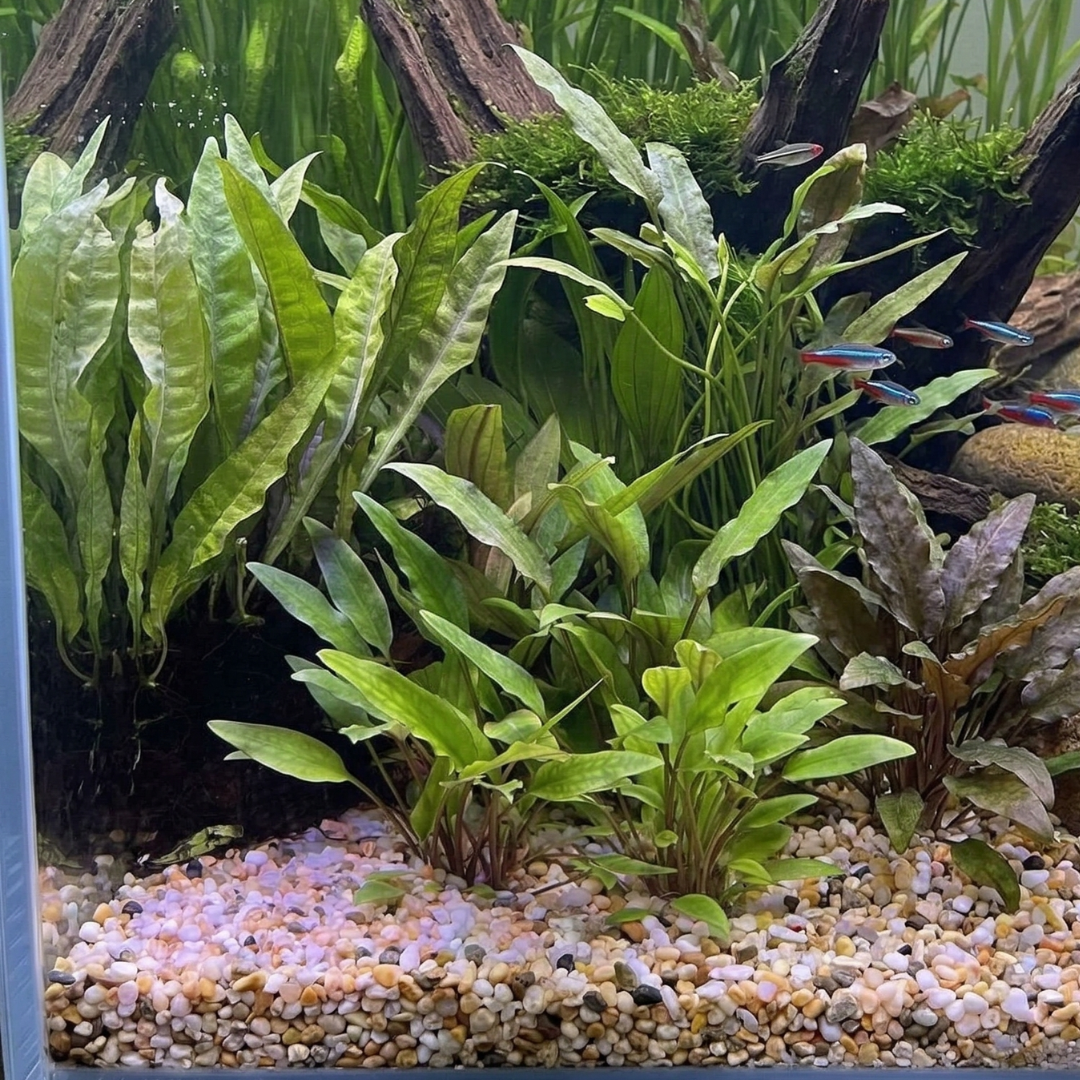
クリプトコリネ・ルテアは、スリランカ原産のクリプトコリネの一種として古くからアクアリウムで親しまれてきたロゼット型の水草です。明るい緑色からややブロンズを帯びた葉を展開し、強い主張をしすぎずに水景へ自然な奥行きを与えてくれます。草丈はおおよそ10〜20cmほどで、60cm規格水槽では前景の後ろから中景、30cmキューブ水槽などでは中景の主役として扱いやすい水草です。 Cryptocoryne lutea is a rosette-forming aquatic plant from Sri Lanka that has long been familiar in the aquarium hobby. It develops leaves ranging from light green to slightly bronze tones, adding a natural sense of depth without overwhelming the aquascape. It usually grows to around 10–20 cm, making it suitable for the rear of the foreground to the midground in a standard 60 cm aquarium, or as a midground focal plant in smaller tanks such as 30 cm cube aquariums.
現在の分類学では、クリプトコリネ・ルテアは広義のクリプトコリネ・ワルケリーに含めて扱われることが多く、学術的には Cryptocoryne walkeri のシノニムとして整理される場合があります。一方で、アクアリウム流通では、明るいライトグリーンの草姿を持つタイプを「ルテア」として区別する慣習が残っています。図鑑記事としては、学術名と流通名のずれを理解したうえで、栽培上は丈夫で環境適応力の高いクリプトコリネとして扱うと分かりやすい水草です。 In current taxonomy, Cryptocoryne lutea is often treated within the broad concept of Cryptocoryne walkeri, and may be regarded academically as a synonym of Cryptocoryne walkeri. In the aquarium trade, however, plants with a bright light-green appearance are still commonly distinguished under the name “lutea.” For aquarium purposes, it is best understood as a hardy, adaptable Cryptocoryne while keeping in mind the difference between its taxonomic treatment and its trade name.
基本情報 / Basic Information
| 学名 / Scientific Name | Cryptocoryne lutea Alston 現在は Cryptocoryne walkeri Schott のシノニムとして扱われることがあります。It is sometimes treated as a synonym of Cryptocoryne walkeri Schott in current taxonomy. |
|---|---|
| 通称 / Common Name | クリプトコリネ・ルテア、ルテア、ウォータートランペットCryptocoryne lutea, Lutea, Water trumpet |
| 分類 / Family | サトイモ科 クリプトコリネ属Family Araceae, genus Cryptocoryne |
| 分布 / Distribution | スリランカ。湿潤地帯の小川、河川沿い、雨季に冠水する森林内の湿地などに分布するとされています。Sri Lanka. It is associated with wet-zone habitats such as small streams, river margins, and seasonally flooded forest wetlands. |
| 育成難易度 / Difficulty | 容易〜普通。丈夫な種類ですが、植え替え直後や水質の急変時にはクリプト溶けを起こすことがあります。根が落ち着くまで動かさず、環境を安定させることが大切です。Easy to moderate. It is a hardy plant, but it may suffer from Crypt melt after replanting or sudden water-parameter changes. Keeping the plant undisturbed until its roots settle is important. |
育成環境 / Cultivation Environment
| 光量 / Light | 低〜中光量で育成可能です。陰性寄りの環境でも維持できますが、中光量以上では葉がややブロンズ色を帯びることがあります。強すぎる光は葉の表面にコケを招きやすいため、成長の早い有茎草との併用や照明時間の管理が重要です。It can be grown under low to moderate light. It remains manageable in shaded setups, while moderate or stronger light may bring out bronze tones in the leaves. Excessive light can encourage algae on the leaves, so pairing it with fast-growing stem plants and managing the photoperiod is important. |
|---|---|
| CO2添加 / CO2 Injection | CO2無添加でも育成は可能です。ただし、CO2を10〜20mg/L程度で安定して添加すると、根張りや新葉の展開がよくなり、葉もやや厚く育ちやすくなります。添加する場合は急なpH変動を避け、毎日同じリズムで管理しておくと安心です。It can be grown without CO2 injection. However, stable CO2 supplementation at around 10–20 mg/L can improve rooting and new leaf growth, often resulting in firmer leaves. If CO2 is used, avoid sudden pH swings and keep the daily routine consistent. |
| 水質 / Water Quality | 水温は20〜28℃、特に22〜26℃前後が扱いやすい範囲です。pHは5.0〜8.0程度まで幅広く順応し、GHは4〜18°dGH程度まで対応するとされています。極端な軟水だけに限定される水草ではなく、適度な硬度のある水でも育ちますが、急激なpH・硬度・水温の変化は避ける必要があります。A temperature range of 20–28°C is suitable, with about 22–26°C being especially manageable. It adapts to a broad pH range of around 5.0–8.0 and is reported to tolerate GH values of about 4–18°dGH. It is not limited to extremely soft water and can grow in moderately hard water, but sudden changes in pH, hardness, or temperature should be avoided. |
| 底床 / Substrate | ソイル、砂利、田砂系の底床で育成できます。根から栄養を吸収する性質が強いため、根元近くに固形肥料を埋め込むと長期維持しやすくなります。鉄やマンガンなどの微量元素が不足すると葉色が薄くなりやすいため、液肥だけに頼らず底床内の栄養を意識することが重要です。It can be grown in aquasoil, gravel, or sand-based substrates. Because it is a strong root feeder, inserting root tabs near the base helps with long-term maintenance. A shortage of trace elements such as iron and manganese may cause pale leaves, so attention should be paid not only to liquid fertilization but also to nutrients in the substrate. |
レイアウト / Layout
| 配置 / Positioning | 標準的なルテアは、60cm規格水槽では前景と中景の境目、中景のつなぎ、流木や石の足元に適しています。30cmキューブ水槽などの小型水槽では中景の主役として使いやすく、葉のまとまりによって自然な茂みを作れます。小型改良品種の「ホビット」は草丈が低く、前景寄りのアクセントとして使いやすい品種です。Standard Cryptocoryne lutea works well between the foreground and midground, as a midground transition plant, or at the base of driftwood and stones in a standard 60 cm aquarium. In smaller aquariums such as 30 cm cubes, it can serve as a midground focal plant, forming a natural-looking cluster. The dwarf cultivar “Hobbit” stays much shorter and is useful as a foreground accent. |
|---|---|
| 注意点 / Precautions | 一度植えた株は、できるだけ動かさないようにします。クリプトコリネは根のダメージや環境変化に敏感で、植え替えを繰り返すと葉が溶ける原因になります。石や流木の近くに植える場合も、後から大きくレイアウトを動かさずに済む位置を最初に決めておくことが大切です。Once planted, it should be disturbed as little as possible. Cryptocorynes are sensitive to root damage and environmental changes, and repeated replanting can trigger melting. When planting near stones or driftwood, decide the position carefully from the beginning so that the hardscape does not need to be moved later. |
増やし方(トリミング) / Propagation & Trimming
| 増やし方 / Propagation | 地下茎やランナーを伸ばし、株元の周囲に子株を作って増えます。子株が十分な葉数と根を持つようになってから切り離すと、植え替え後の失敗が少なくなります。成長は速い水草ではないため、短期間で密生させるよりも、数か月単位でゆっくり群落を作る水草と考えると扱いやすいです。It propagates by extending rhizomes or runners and producing daughter plants around the base. Separating the young plants only after they have developed enough leaves and roots reduces the risk of failure after replanting. It is not a fast-growing plant, so it is best regarded as a plant that forms a colony gradually over several months rather than one that fills in quickly. |
|---|---|
| トリミング / Trimming | 有茎草のように切り戻して形を整える水草ではありません。古くなった葉、溶け始めた葉、コケが強く付いた葉を株元から丁寧に取り除きます。健康な葉をまとめて切ると株が弱りやすいため、不要な葉だけを少しずつ整理することが重要です。It is not trimmed like a stem plant. Remove old leaves, melting leaves, or leaves heavily covered with algae carefully from the base. Cutting many healthy leaves at once can weaken the plant, so it is important to remove only unnecessary leaves gradually. |
病気と対策(コケなど) / Pests & Algae
| かかりやすい病気 / Common Issues | もっとも代表的なトラブルは、植栽直後や水質変化のあとに起こる「クリプト溶け」です。水上葉から水中葉へ切り替わる際や、pH・硬度・水温が急に変わった際に、古い葉が透明になって崩れることがあります。また、成長がゆっくりなため、強い光や栄養過多の環境では葉の表面に茶ゴケ、糸状ゴケ、黒髭状のコケが付着しやすくなります。The most typical problem is “Crypt melt,” which often occurs soon after planting or after changes in water conditions. During the transition from emersed leaves to submerged leaves, or when pH, hardness, or temperature changes abruptly, older leaves may become transparent and collapse. Because the plant grows slowly, diatoms, filamentous algae, or black beard algae may attach to the leaves under excessive light or nutrient-rich conditions. |
|---|---|
| 対策と予防 / Prevention | クリプト溶けが出た場合は、溶けた葉を早めに取り除き、根茎が残っているかを確認します。根茎が硬く残っていれば、新しい水中葉を出す可能性があります。水換えは一度に大量に行わず、総水量の4分の1〜3分の1程度を目安にし、水温を合わせて行うと安心です。コケ対策では、照明時間を長くしすぎないこと、底床から漏れ出た栄養を吸収する有茎草を併用すること、輸入ポット苗では農薬やスネール対策の下処理を丁寧に行うことが大切です。If Crypt melt occurs, remove the melting leaves promptly and check whether the rhizome remains intact. If the rhizome is firm, the plant may produce new submerged leaves. Avoid large water changes; changing about one-quarter to one-third of the total water volume at a time while matching the temperature is safer. For algae prevention, avoid overly long lighting periods, use fast-growing stem plants to absorb excess nutrients leaking from the substrate, and carefully treat imported potted plants to reduce pesticide and snail risks. |
雑学と豆知識 / Trivia and Fun Facts
| 1. 「隠されたこん棒」という属名の由来 / 1. The meaning behind the genus name | クリプトコリネという属名は、ギリシャ語で「隠された」を意味する言葉と「こん棒」を意味する言葉に由来するとされています。これは、サトイモ科植物に見られる肉穂花序が、仏炎苞と呼ばれる筒状の構造の内側に隠れるように収まっていることを表した名前です。葉だけを見ると控えめな水草ですが、花の構造にはサトイモ科らしい独特の進化が隠れている点が、この仲間の大きな魅力です。The genus name Cryptocoryne is said to come from Greek words meaning “hidden” and “club.” It refers to the spadix, a club-like inflorescence typical of the aroid family, being enclosed within a tubular spathe. While the plant may look modest when viewed only by its leaves, its flower structure reveals a distinctive evolutionary feature of the Araceae family. |
|---|---|
| 2. ルテアとワルケリーの関係 / 2. The relationship between lutea and walkeri | クリプトコリネ・ルテアは、アクアリウムでは独立した名前として広く知られていますが、分類学上は広義のクリプトコリネ・ワルケリーに含めて扱われることがあります。クリプトコリネ属は葉の形や色が環境によって変わりやすく、外見だけで種を分けることが難しい仲間です。そのため、分類では仏炎苞の形や染色体数などが重視され、アクアリウムでの流通名と学術的な整理が必ずしも一致しないことがあります。Cryptocoryne lutea is widely known under its own name in the aquarium hobby, but taxonomically it may be included within the broad concept of Cryptocoryne walkeri. The genus Cryptocoryne is highly variable in leaf shape and color depending on the environment, making identification by appearance alone difficult. For this reason, features such as the spathe structure and chromosome number are important in taxonomy, and trade names do not always match academic treatment. |
| 3. クリプト溶けは「失敗」とは限らない / 3. Crypt melt is not always a failure | 植え替え後に葉が溶けると枯れてしまったように見えますが、クリプトコリネでは必ずしも失敗とは限りません。環境が変わったとき、古い葉を維持するよりも、根茎に栄養を戻して新しい環境に合った葉を作り直すほうが合理的な場合があります。根茎が硬く残っているなら、溶けた葉を取り除いて環境を安定させ、しばらく待つことが大切です。When the leaves melt after replanting, the plant may appear to be dying, but this is not always a failure with Cryptocorynes. When the environment changes, it can be more efficient for the plant to withdraw nutrients from old leaves and produce new leaves suited to the new conditions. If the rhizome remains firm, remove the melted leaves, stabilize the environment, and wait patiently. |
| 4. 小型品種「ホビット」の魅力 / 4. The appeal of the dwarf cultivar “Hobbit” | クリプトコリネ・ルテアには、「ホビット」と呼ばれる小型の栽培品種が流通しています。標準的なルテアが10〜20cmほどに育つのに対し、ホビットはより低くまとまりやすく、前景寄りのアクセントとして使いやすい品種です。成長はさらにゆっくりですが、手入れの頻度を抑えながら落ち着いた茂みを作りたい小型水槽では、特に魅力が分かりやすい水草です。A dwarf cultivar known as “Hobbit” is also available in the aquarium trade. While standard Cryptocoryne lutea grows to about 10–20 cm, Hobbit stays lower and more compact, making it useful as a foreground accent. Its growth is even slower, but in small aquariums where a calm, low-maintenance cluster is desired, its appeal becomes especially clear. |
| 5. 輸入ポット苗は下処理が重要 / 5. Imported potted plants require careful preparation | 国内で流通するルテアには、輸入ポット苗、組織培養カップ、国内栽培株などがあります。輸入ポット苗は入手しやすく価格も比較的抑えられますが、残留農薬やスネール混入のリスクを考える必要があります。特にエビ水槽へ入れる場合は、グラスウールを丁寧に取り除き、水草用コンディショナーなどで下処理を行ってから導入すると安心です。In Japan, Cryptocoryne lutea may be sold as imported potted plants, tissue-culture cups, or domestically grown submerged plants. Imported potted plants are easy to obtain and relatively affordable, but residual pesticides and hitchhiking snails must be considered. When introducing them to shrimp aquariums in particular, carefully remove the rock wool and use an aquatic-plant conditioner before planting. |
まとめ / Conclusion
クリプトコリネ・ルテアは、丈夫さ、落ち着いた葉色、自然なロゼット姿を兼ね備えた扱いやすい水草です。低〜中光量でも育ち、CO2無添加の水槽にも適応できますが、根から栄養を吸収する性質が強いため、底床環境を整えることで本来の美しさを長く楽しめます。 Cryptocoryne lutea is an approachable aquatic plant that combines hardiness, calm leaf coloration, and a natural rosette form. It grows under low to moderate light and can adapt to aquariums without CO2 injection, but because it feeds strongly through its roots, preparing a suitable substrate environment helps maintain its beauty over the long term.
育成で意識したい最大のポイントは、急な変化を避けることです。植え替え直後のクリプト溶けを過度に恐れず、溶けた葉を取り除きながら根茎と根の回復を待つと、やがて水槽環境に合った新しい葉を展開していきます。派手さよりも安定感と自然な存在感を求めるレイアウトで、特に頼りになる水草です。 The most important point in cultivation is to avoid sudden changes. Instead of fearing Crypt melt too much after planting, remove melted leaves and allow the rhizome and roots to recover; the plant may then produce new leaves adapted to the aquarium environment. It is especially reliable in layouts where stability and a natural presence are valued over flashiness.

気になる道具や飼い方を見つけてみませんか?
 アイのアクアグッズ案内水槽の底砂の選び方|砂・砂利の違いとおすすめ商品道具の特徴や使い方、選ぶときのポイントをアイが紹介します。記事はコチラ →
 アイのアクアグッズ案内水草トリミングの道具とやり方|ハサミ・ピンセットを水草に合わせて選ぼう伸びすぎた水草は切っていい? 有茎草の差し戻し、前景草の絨毯、流木のモスを整える場面から、水草用ハサミ・ピンセット・ゴミ取りネットの選び方と片付けを紹介します。記事はコチラ →
さまざまな飼育テーマをご紹介。リンク先の記事には広告・商品紹介が含まれます。
案内・紹介記事一覧へ →参考文献・参照資料
本記事では、分類・分布・形態・水槽内での育成条件を確認するため、以下の資料を参照しました。通販ページや店舗の商品ページは参考文献から除外しています。
- Plants of the World Online. “Cryptocoryne walkeri Schott.” Royal Botanic Gardens, Kew. 分類上の受け入れ名、原産地、分布、生育型、Cryptocoryne lutea などのシノニム確認に使用。 参照ページ
- International Plant Names Index. “Cryptocoryne lutea Alston.” Cryptocoryne lutea の原記載情報と、1931年の文献情報を確認するために使用。 参照ページ
- International Plant Names Index. “Cryptocoryne walkeri var. lutea (Alston) Rataj.” C. lutea が C. walkeri の変種として整理された命名上の経緯を確認するために使用。 参照ページ
- Arends, J. C., Bastmeijer, J. D. & Jacobsen, N. 1982. “Chromosome numbers and taxonomy in Cryptocoryne (Araceae). II.” Nordic Journal of Botany 2: 453–463. C. walkeri、C. lutea、C. legroi などの分類関係と染色体数に関する確認に使用。 参照PDF
- Bastmeijer, J. D. “Cryptocoryne walkeri Schott.” The Crypts Pages. ワルケリー広義群の見方、仏炎苞の特徴、スリランカ産クリプトコリネとしての位置づけ、アクアリウムでの扱いを確認するために使用。 参照ページ
- Flowgrow Aquatic Plant Database. “Cryptocoryne walkeri ‘lutea’.” 水槽内での用途、成長速度、光量、温度、pH、硬度、CO2、増殖方法など、育成条件の照合に使用。 参照ページ




コメント