

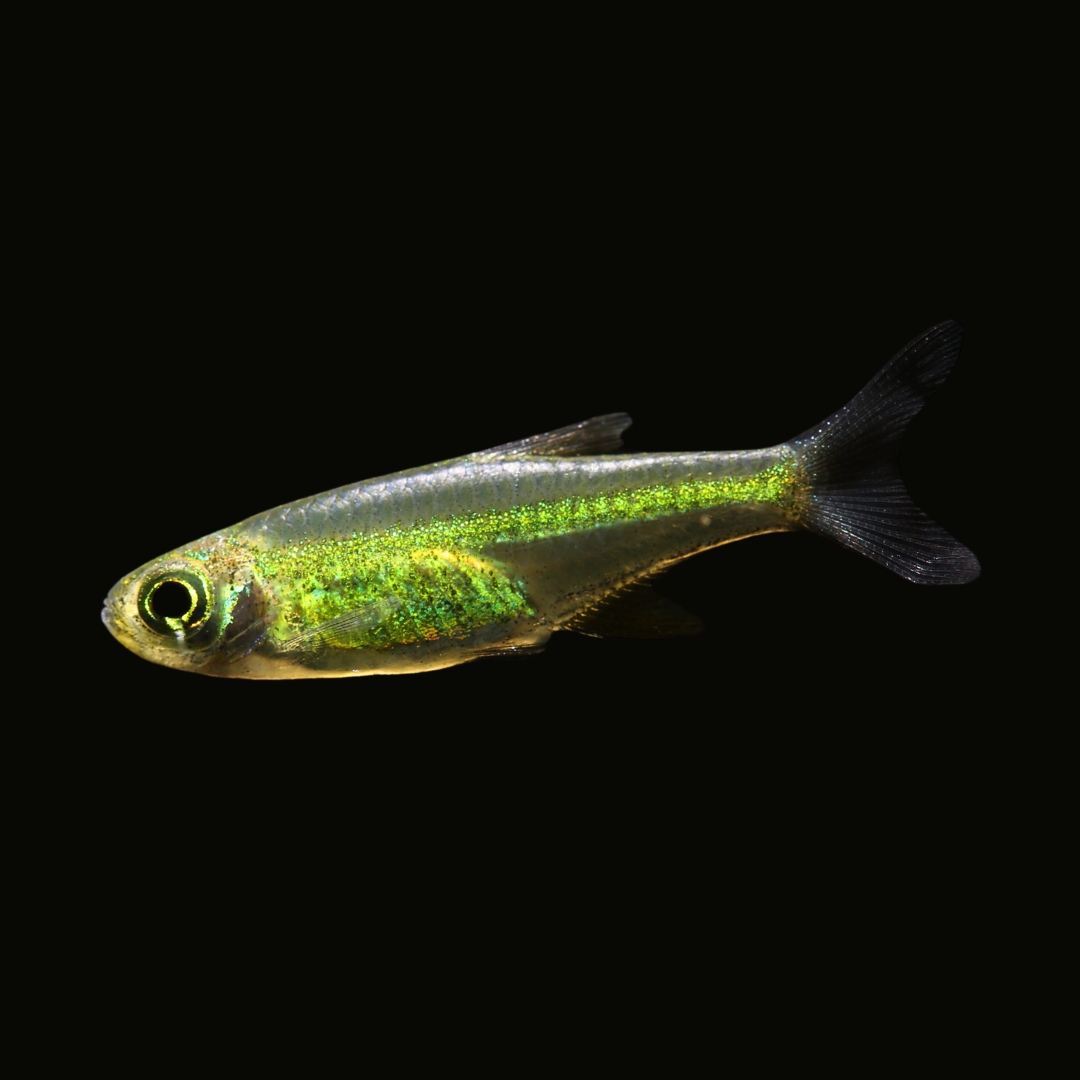
解説 / Description
ミクロラスボラ・ブルーネオンは、現在の学名をミクロデバリオ・クボタイという、東南アジア原産の非常に小さなコイ科系の淡水魚です。水槽内では体側にネオングリーンからライムグリーンの輝きが入り、群れで泳ぐ姿が水草レイアウトによく映えます。体は小さいものの活発に泳ぐため、単に小型水槽へ入れる魚というより、安定した水質と十分な遊泳スペースを用意して魅力を引き出したい魚です。 The Neon Green Rasbora, currently known scientifically as Microdevario kubotai, is a very small freshwater danionin fish from Southeast Asia. In the aquarium, its body shows a neon green to lime green metallic sheen, and its tight shoaling behavior looks especially attractive in planted aquascapes. Although tiny, it is an active swimmer, so it is best appreciated in a stable aquarium with enough horizontal swimming space rather than being treated simply as a fish for the smallest tanks.
基本情報 / Basic Information
| 学名 / Scientific Name | Microdevario kubotai |
|---|---|
| 通称 / Common Name | ミクロラスボラ・ブルーネオン、ミクロラスボラ・クボタイ、グリーンネオンラスボラ、ミクロデバリオ・クボタイNeon Green Rasbora, Green Neon Rasbora, Kubotai Rasbora, Yellow Neon Rasbora |
| 分類 / Family | ダニオ科 Danionidae、ダニオ亜科 Danioninae、ミクロデバリオ属。資料によっては広義のコイ科 Cyprinidae として扱われることもあります。Family Danionidae, subfamily Danioninae, genus Microdevario. Some references still treat the group within a broader Cyprinidae framework. |
| 英名 / English Name | Neon Green Rasbora / Green Neon Rasbora / Kubotai Rasbora |
| 分布 / Distribution | タイ半島部のラノーン県周辺をタイプ産地とし、隣接するパンガー県、ミャンマー側のアタラン川流域などからも知られています。清澄な小河川や支流、植物の多い森林性の水辺に生息するとされます。国内流通では、東南アジアなどで繁殖されたブリード個体も多く見られると考えられます。The type locality is in the Ranong area of Peninsular Thailand, and the species is also known from adjacent Phang Nga Province and the Ataran River basin in Myanmar. It is associated with clear small rivers, tributaries, and plant-rich forest waters. In the Japanese aquarium trade, many specimens are thought to be captive-bred in Southeast Asia or nearby regions. |
| 最大体長 / Max Size | 標準体長で約1.9cm、飼育下では全長2.0〜2.5cm前後が目安です。状態や系統によって見え方に差がありますが、3cmを大きく超える魚ではありません。About 1.9 cm in standard length, with aquarium specimens usually appearing around 2.0–2.5 cm in total length. Size may vary slightly by condition and stock, but it is not a fish that normally grows much beyond 3 cm. |
| 寿命 / Lifespan | 一般的には2〜3年ほどが目安です。水質が安定し、夏場の高水温を避けて管理できれば、より長く楽しめる場合もあります。Typically around 2–3 years. With stable water quality and careful avoidance of excessive summer heat, some individuals may live longer. |
飼育環境 / Aquarium Environment
| 水槽サイズ / Tank Size | 群れで泳がせる魚のため、目安として45cm規格水槽以上、できれば60cm規格水槽での飼育がおすすめです。小型魚ですが遊泳性が高いため、水量だけでなく横方向の泳ぐ余白を確保すると落ち着きやすくなります。A 45 cm standard aquarium or larger is a good minimum, while a 60 cm standard aquarium is preferable for a proper shoal. Although small, this species is active, so horizontal swimming space is just as important as water volume. |
|---|---|
| 水温 / Temperature | 20〜27℃程度で飼育例があり、家庭水槽では22〜26℃前後が扱いやすい範囲です。日本の夏場に30℃近くまで上がる環境では体力を落としやすいため、冷却ファンや水槽用クーラーで高水温を避けることが大切です。 Care records commonly give a range of about 20–27°C, with 22–26°C being a practical aquarium range. In Japanese summers, temperatures approaching 30°C can stress the fish, so cooling fans or an aquarium chiller may be needed. |
| 水質 / Water Quality | 弱酸性〜中性、軟水〜中程度の硬度を好みます。pHは6.0〜7.0前後を目安にし、硬度は低めから中程度に保つと管理しやすいです。アンモニアや亜硝酸が検出されない、よく立ち上がった水槽へ導入してください。急なpH変化や水温差に弱い小型魚のため、導入時は点滴法による丁寧な水合わせが向いています。It prefers slightly acidic to neutral water with soft to moderately hard conditions. A pH around 6.0–7.0 is a useful guide, and low to moderate hardness is generally suitable. The aquarium should be mature with no detectable ammonia or nitrite. Because this small fish can be sensitive to sudden changes in pH and temperature, slow drip acclimation is recommended when introducing new fish. |
| レイアウト / Layout | 暗めの底床、流木、石、ウィローモスや有茎草を組み合わせた水草レイアウトと相性が良い魚です。浮草や背の高い水草で光を少し和らげると安心しやすく、体色も見えやすくなります。強すぎる水流よりも、よく酸素を含んだ穏やかな流れを意識するとよいでしょう。It suits planted aquascapes with darker substrate, driftwood, stones, mosses, and stem plants. Floating plants or tall vegetation can soften the light, helping the fish feel secure and show better coloration. Aim for well-oxygenated but gentle flow rather than strong current. |
| 注意点 / Precautions | 導入直後の水質ショック、過密飼育、夏場の高水温、餌の大きさに注意が必要です。小さな魚なので異変が出てから体力を戻すのが難しく、予防を重視した管理が向いています。立ち上げ直後の不安定な水槽への導入は避けてください。Be careful with acclimation shock, overcrowding, summer heat, and food particle size. Because this is a tiny fish, recovery after visible decline can be difficult, so preventive husbandry is important. Avoid adding it to newly set up or biologically unstable aquariums. |
餌と給餌 / Feeding
| 餌の種類 / Diet | 超小粒の人工飼料、細かく砕いたフレーク、ブラインシュリンプの幼生、ミジンコ、マイクロワーム、細かい冷凍餌などを与えます。自然下では微小な水生昆虫や動物プランクトンを食べる小さな捕食者と考えられるため、細かく動きのある餌も有効です。Offer micro pellets, finely crushed flakes, newly hatched brine shrimp, daphnia, microworms, and finely sized frozen foods. In nature, it is best understood as a small predator of tiny aquatic invertebrates and zooplankton, so small moving foods are especially useful. |
|---|---|
| 給餌のポイント / Feeding Tips | 口が非常に小さいため、餌の粒が大きいと食べきれません。1回で多く与えるより、少量を1日1〜2回、育成や繁殖を狙う場合は水を汚さない範囲で回数を増やす方法が向いています。群泳魚なので、全体に餌が行き渡るように水面の一か所だけでなく、少し広げて与えると弱い個体も食べやすくなります。Its mouth is very small, so oversized food will be ignored or spat out. Rather than one heavy feeding, give small amounts once or twice a day; when conditioning fish for growth or breeding, feeding frequency can be increased as long as water quality is maintained. Since it is a shoaling species, spread the food slightly so weaker individuals can feed as well. |
性格と混泳 / Temperament and Tank Mates
| 性格 / Temperament | 非常に温和で、同程度の小型魚に攻撃的に振る舞うことはほとんどありません。一方で臆病な面があり、少数飼育では隠れがちになることがあります。最低でも6匹以上、できれば10匹以上で群れを作らせると、本来の泳ぎと発色を観察しやすくなります。Very peaceful and rarely aggressive toward similarly small fish. However, it can be shy when kept in small numbers. Keep at least six, preferably ten or more, to encourage natural shoaling, confident swimming, and better color. |
|---|---|
| 混泳の相性 / Compatibility | グリーンネオンテトラ、エンバーテトラ、小型ラスボラ類、ハナビ、ピグミーコリドラス、オトシンクルス、温和な小型エビ類などと相性が良いです。大型魚、気の強いシクリッド、動きが激しく餌を独占する魚、ヒレをかじる魚との混泳は避けてください。稚エビやごく小さな生物は食べられる可能性があります。Good tank mates include green neon tetras, ember tetras, small rasboras, celestial pearl danios, pygmy corydoras, otocinclus, and peaceful dwarf shrimp. Avoid larger fish, aggressive cichlids, boisterous feeders, and fin-nipping species. Very small shrimp fry or tiny organisms may be eaten. |
病気と対策 / Diseases and Prevention
| かかりやすい病気 / Common Diseases | 白点病、コショウ病、尾ぐされ・ヒレぐされ、カラムナリス病を含む細菌性疾患などに注意が必要です。特に輸送後や導入直後のストレス、水温差、水質差、アンモニアや亜硝酸の発生がきっかけになることがあります。小型魚のため、外見に症状が出た時点で体力を消耗している場合があります。Watch for ich, velvet, fin rot, and bacterial diseases including columnaris. Stress after transport, rapid changes in temperature or water chemistry, and the presence of ammonia or nitrite can all trigger problems. Because this is a tiny fish, visible symptoms may already indicate significant stress or weakness. |
|---|---|
| 対策と予防 / Prevention | 最も重要なのは、病気を出さない環境作りです。立ち上がった水槽に導入し、点滴法で水合わせを行い、週1回を目安に適度な換水を続けます。発症時は早めに隔離し、症状に合った魚病薬を慎重に使用します。薬浴を行う場合は、製品ごとの規定量、エアレーション、薬浴期間を確認し、小型魚であることを踏まえて急激な処置にならないよう管理してください。The best prevention is a stable environment. Add the fish only to a mature aquarium, use drip acclimation, and maintain regular partial water changes. If disease appears, isolate affected fish early and use an appropriate medication with care. When medicating, check the product’s dosage, aeration requirements, and treatment duration, and avoid abrupt treatment because this is a very small fish. |
増やし方(繁殖) / Breeding
| 雌雄の判別 / Sexing | 雌雄判別はやや難しい魚です。一般にオスはやや細身で発色が強く、メスは腹部に丸みが出やすいとされます。ただし個体差やコンディションの影響も大きいため、単独の特徴だけで断定しない方が安全です。Sexing is somewhat difficult. Males are usually slimmer and more intensely colored, while females tend to have a rounder belly. However, individual condition and variation can be significant, so it is best not to rely on a single feature. |
|---|---|
| 繁殖形態 / Reproduction | 水草や産卵モップに細かな卵をばらまく散卵性の魚です。親は卵や稚魚を守らず、見つけると食べてしまうことがあるため、繁殖を狙う場合は親魚と卵を分ける工夫が必要です。An egg-scattering species that deposits tiny eggs among plants or spawning mops. The parents do not guard the eggs or fry and may eat them, so separating adults from eggs is important when breeding intentionally. |
| 繁殖のポイント / Breeding Tips | 親魚にはブラインシュリンプの幼生や細かな冷凍餌を与えて状態を上げ、別容器にウィローモスや産卵モップを多めに入れて産卵を促します。産卵が疑われる場合は親を戻し、孵化後の稚魚にはインフゾリアや極微細な稚魚用飼料から始めます。稚魚が非常に小さいため、繁殖自体よりも初期餌を切らさない管理が難所になります。Condition adults with newly hatched brine shrimp and finely sized frozen foods, then use a separate spawning container with plenty of moss or spawning mops to encourage spawning. If spawning is suspected, remove the adults. Newly free-swimming fry are extremely small, so start with infusoria or very fine fry foods. The main challenge is often not spawning itself, but maintaining a constant supply of tiny first foods. |
雑学と豆知識 / Trivia and Fun Facts
| 1. 「ミクロラスボラ」という名前が残る理由 / 1. Why the Name “Microrasbora” Still Remains | 本種は記載当初、ミクロラスボラ属として扱われていたため、日本の流通名にも「ミクロラスボラ・ブルーネオン」という名前が深く定着しました。その後、分子系統解析などにより、現在はミクロデバリオ属へ移されています。つまり店頭で見かける名前は古い学名の名残であり、現在の学術的な位置づけを反映した名前がミクロデバリオ・クボタイです。流通名と学名がずれて見える魚ですが、そのずれ自体がアクアリウム史と分類学の変化を物語っています。This species was originally treated in the genus Microrasbora, which is why the trade name “Microrasbora Blue Neon” became deeply established in Japan. Later, molecular and taxonomic work placed it in Microdevario. The shop name therefore preserves an older scientific name, while Microdevario kubotai reflects its current taxonomic position. The mismatch between trade name and scientific name tells a small story of both aquarium history and changing fish classification. |
|---|---|
| 2. 種小名 kubotai と日本人シッパーの功績 / 2. The Species Name kubotai and a Japanese Shipper’s Contribution | 種小名の kubotai は、東南アジアの観賞魚流通に関わった久保田勝馬氏に献名されたものです。新種の発見や記載は、研究者だけで完結するものではありません。現地の水系を知り、魚を採集し、標本や生体を学術の場へつなぐ人々の存在があって初めて、世界に知られる魚になることがあります。小さな体で水槽を彩るこの魚の名前には、日本のアクアリウム文化とも接点を持つ人物の足跡が刻まれています。The specific name kubotai honors Katsuma Kubota, a Japanese figure involved in the Southeast Asian ornamental fish trade. The discovery and description of new species are not achieved by scientists alone. People who know local waters, collect fish, and connect living specimens or preserved material to academic work often play an essential role. The name of this tiny aquarium fish therefore carries a trace of a person linked to both field collecting and Japanese aquarium culture. |
| 3. 小型化という進化のかたち / 3. Miniaturization as an Evolutionary Path | ミクロデバリオ・クボタイは、成魚になっても2cm前後にとどまる小型魚です。このような極端な小型化は、単に「小さい魚」というだけでなく、体の発達や形態が祖先的な大型種とは異なる方向へ進んだ結果として注目されます。近縁のダニオ類には研究でよく知られるゼブラダニオも含まれるため、小型化したコイ科魚類は、体のサイズや発生の進化を考えるうえでも興味深い存在です。水草の間を光の粒のように泳ぐ姿の裏側には、進化学的にも奥行きのある物語があります。Microdevario kubotai remains around 2 cm even as an adult. Such extreme smallness is not merely a matter of being a “small fish”; it can reflect evolutionary changes in development and body form compared with larger relatives. Because danionins include the well-known zebrafish, miniature cypriniform fishes are also interesting in discussions of body size and developmental evolution. Behind the glittering movement of these fish among aquatic plants lies a surprisingly deep evolutionary story. |
| 4. 緑に光る体色と群れの意味 / 4. The Meaning of the Green Glow and Shoaling Behavior | 本種のネオングリーンの輝きは、単なる派手さだけでなく、光の反射や角度によって見え方が変わる構造色の要素を含むと考えられます。自然界では水草、落ち葉、岩、木の根が複雑に入り組む水辺で、仲間同士の位置を確認するシグナルとして役立っている可能性があります。水槽で群れを作らせると、1匹ずつの美しさだけでなく、光の点がまとまって動くような一体感が生まれます。この魚は、単独で鑑賞するより群れでこそ魅力が伝わるタイプの魚です。The neon green shine of this species is thought to include structural color, changing with light and viewing angle rather than functioning only as simple pigment. In nature, among plants, leaf litter, rocks, and roots, such flashes may help individuals keep track of one another. In an aquarium shoal, the appeal is not only in each fish’s color, but also in the way many points of light move together. This is a fish whose charm is best understood in a group. |
| 5. ブリード流通が支える定番魚としての安定感 / 5. Captive-Bred Supply and Its Role as a Stable Aquarium Species | 現在の国内流通では、東南アジアなどで繁殖されたブリード個体も多く見られると考えられます。ワイルド個体には野性味のある発色や体型の魅力がありますが、ブリード個体は人工飼料に慣れやすく、輸送や導入後の管理もしやすい傾向があります。なお、本種はIUCNでは軽度懸念に評価されていますが、だからといって野生環境への配慮が不要という意味ではありません。繁殖個体が安定して流通することは、愛好家にとっての飼いやすさだけでなく、自然個体群への採集圧を抑える意味でも大切です。In the current Japanese trade, many specimens are thought to be captive-bred in Southeast Asia or nearby regions. Wild fish may have a special appeal in body form and intensity of coloration, but captive-bred fish often adapt more readily to prepared foods and aquarium conditions. Although the species is assessed as Least Concern by the IUCN, this does not mean its natural habitats can be ignored. A stable captive-bred supply benefits hobbyists and can also help reduce pressure on wild populations. |
まとめ / Conclusion
ミクロラスボラ・ブルーネオンは、非常に小さな体に美しいネオングリーンの輝きと群泳の魅力を持つ、水草水槽向きの人気種です。丈夫に見えても導入時の水質変化には敏感なため、よく立ち上がった水槽、丁寧な水合わせ、安定した水温管理を意識することが大切です。 The Neon Green Rasbora is a popular planted-aquarium species that combines a tiny body with beautiful neon green coloration and attractive shoaling behavior. Although it can be hardy once settled, it is sensitive to sudden water changes at introduction, so a mature aquarium, careful acclimation, and stable temperature management are important.
本種の魅力は、1匹だけを眺めるよりも、10匹以上の群れが水草の間をきらめきながら泳ぐ姿にあります。落ち着いた水草レイアウト、細かな餌、清潔な軟水環境を整えれば、小さな魚ながら水槽全体の印象を明るく変えてくれる存在になるでしょう。 Its true appeal is best seen not in a single fish, but in a shoal of ten or more individuals glittering among aquatic plants. With a calm planted layout, finely sized foods, and clean soft water, this tiny fish can brighten the entire impression of an aquarium.

気になる道具や飼い方を見つけてみませんか?
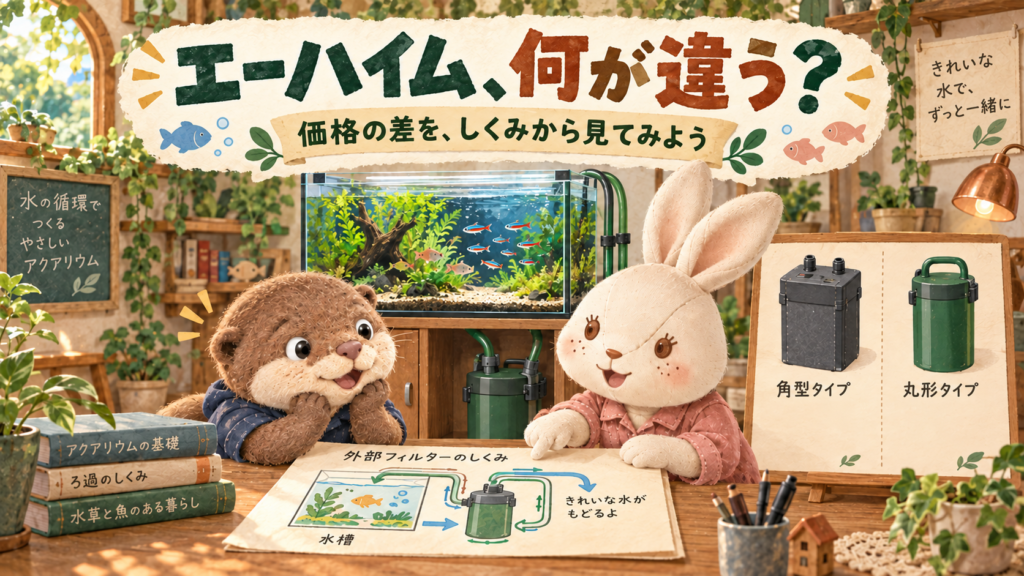 アイのアクアグッズ案内エーハイム、安いのと高いのは何が違う? コタロウと見比べる外部フィルター道具の特徴や使い方、選ぶときのポイントをアイが紹介します。記事はコチラ →
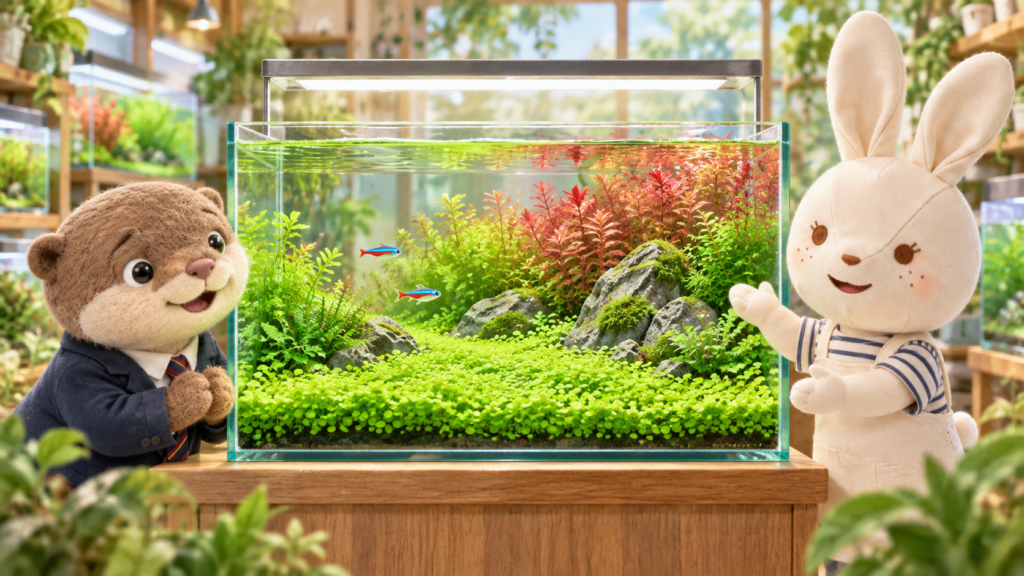 アイのアクアグッズ案内水草用ライトの選び方|緑の絨毯と赤い水草を楽しむ照明・植栽用品道具の特徴や使い方、選ぶときのポイントをアイが紹介します。記事はコチラ →
さまざまな飼育テーマをご紹介。リンク先の記事には広告・商品紹介が含まれます。
案内・紹介記事一覧へ →参考文献・参照資料
本記事では、ミクロラスボラ・ブルーネオン(Microdevario kubotai)の分類、分布、形態、保全状況、飼育環境に関する確認資料として、以下の文献・データベースを参照しました。
-
Froese, R. and Pauly, D. Editors. FishBase. Microdevario kubotai (Kottelat & Witte, 1999). 分類、最大体長、形態的特徴、分布、IUCN評価、学名の語源確認に参照。
https://fishbase.se/summary/58581 - Kottelat, M. and Witte, K. E. 1999. Two new species of Microrasbora from Thailand and Myanmar, with two new generic names for small Southeast Asian cyprinid fishes (Teleostei: Cyprinidae). Journal of South Asian Natural History 4(1):49-56. 原記載、タイプ産地、旧学名、献名、形態的特徴の確認に参照。
-
Fang, F., Norén, M., Liao, T. Y., Källersjö, M. and Kullander, S. O. 2009. Molecular phylogenetic interrelationships of the south Asian cyprinid genera Danio, Devario and Microrasbora (Teleostei, Cyprinidae, Danioninae). Zoologica Scripta 38(3):237-256. ミクロデバリオ属への再分類と分子系統学的背景の確認に参照。
https://doi.org/10.1111/j.1463-6409.2008.00373.x -
GBIF Secretariat. Microdevario kubotai (Kottelat & Witte, 1999). GBIF Backbone Taxonomy. 学名、シノニム、分類データベース間での科レベルの扱いの差異確認に参照。
https://www.gbif.org/species/2363249 -
IUCN Red List. Kottelat, M. 2012. Microdevario kubotai. The IUCN Red List of Threatened Species. 保全状況「Least Concern」の確認に参照。
https://www.iucnredlist.org/species/180778/1661738 -
Thailand Biodiversity Information Facility. Microdevario kubotai. タイ国内での分類、シノニム、淡水性、IUCNおよびタイ国内評価の確認に参照。
https://thbif.onep.go.th/taxons/detail/26005 -
Seriously Fish. Microdevario kubotai (Kottelat & Witte, 1999). 生息環境、飼育水温、水質、レイアウト、混泳、給餌、繁殖に関する実用情報の確認に参照。
https://www.seriouslyfish.com/species/microdevario-kubotai/ -
MSD Veterinary Manual. Bacterial Diseases of Fish / Parasitic Diseases of Fish. カラムナリス病、白点病など、一般的な観賞魚の疾病と予防・隔離の考え方の確認に参照。
https://www.msdvetmanual.com/exotic-and-laboratory-animals/aquarium-fish/bacterial-diseases-of-fish
https://www.msdvetmanual.com/exotic-and-laboratory-animals/aquarium-fish/parasitic-diseases-of-fish
注:店舗・通販サイトは、価格や流通名の確認には有用な場合がありますが、本参考文献ブロックでは学術情報、分類データベース、保全情報、疾病情報、非店舗系の飼育資料を優先し、掲載対象から外しています。




コメント